Under the best of circumstances parenting a young child can be stressful (Brame, Nagin, & Tremblay, Reference Brame, Nagin and Tremblay2001; Crnic & Greenberg, Reference Crnic and Greenberg1990). In families characterized by poverty, single-parent households, and pervasive community violence, parenting resources become further strained and may lead to severe parenting dysfunction that culminates in the occurrence of child maltreatment. Sensitive and protective parenting is sorely lacking in the caregiving environments of maltreated infants, and this absence represents an extreme departure from the nurturance typically expected by infants in the evolutionary context of species typical development (Cicchetti & Lynch, Reference Cicchetti, Lynch, Cicchetti and Cohen1995; Tarullo & Gunnar, Reference Tarullo and Gunnar2006).
Parenting provided in maltreating families can be understood in the context of more global patterns of normative parenting (Rogosch, Cicchetti, Shields, & Toth, Reference Rogosch, Cicchetti, Shields, Toth and Bornstein1995). Maccoby and Martin (Reference Maccoby and Martin1983) drew upon Baumrind's (Reference Baumrind1967, Reference Baumrind1971) typology of parenting styles. They conceptualized parenting along two dimensions: responsiveness and demandingness. The intersection of these dimensions results in four orientations to parenting, including authoritative, indulgent, authoritarian, and neglectful. Of these dimensions, the authoritarian and neglectful patterns are most relevant to understanding parenting in maltreating families. Specifically, authoritarian parenting, which involves low responsiveness and high demandingness, is parent centered, and power assertion is utilized to control children. Conversely, neglectful parenting, which is low on responsiveness and low on demandingness, presents as detached and uninvolved parenting, with a focus on self rather than child interests. Neglectful parenting that reaches the level of maltreatment can be seen as an extreme of the neglectful dimension where responsiveness to child physical and emotional needs is absent.
Of these two types of child maltreatment, neglect continues to be the most commonly reported, accounting for approximately two-thirds of all reported maltreatment cases in the United States (US Department of Health and Human Services, Administration for Children and Families, Administration on Children, Youth and Families, Children's Bureau, 2011). In addition, neglect arguably is associated with the most adverse outcomes for children, including increased risk for behavior problems (Kotch et al., Reference Kotch, Lewis, Hussey, English, Thompson and Litrownik2008), internalizing symptoms (Dubowitz, Papas, Black, & Starr, Reference Dubowitz, Papas, Black and Starr2002), and poorer cognitive functioning (Mills et al., Reference Mills, Alati, O'Callaghan, Najman, Williams and Bor2011). The association between poverty and child maltreatment has been consistently documented (Gil, Reference Gil1970; Jones, Reference Jones1990; Jones & McCurdy, Reference Jones and McCurdy1992; Trickett, Aber, Carlson, & Cicchetti, Reference Trickett, Aber, Carlson and Cicchetti1991), and low-income status has been most strongly associated with the presence of child neglect (Jones & McCurdy, Reference Jones and McCurdy1992; Korbin, Coulton, Chard, Platt-Houston, & Su, Reference Korbin, Coulton, Chard, Platt-Houston and Su1998; Sedlak & Broadhurst, Reference Sedlak and Broadhurst1996). In spite of this, empirical research dedicated toward understanding the causes and consequences of neglect has been disproportionately understudied, leading scholars to refer to this glaring gap in knowledge as the “neglect of neglect” (Garbarino & Collins, Reference Garbarino, Collins and Dubowitz1999; Wolock & Horowitz, Reference Wolock and Horowitz1984).
Because not all impoverished parents neglect their children, it is important to understand other factors that may increase the likelihood of child neglect. Although relatively few studies have examined the relation between parenting characteristics and child neglect, those that have identify inadequate caretaking skills, less knowledge about normative child development, and poorer stress management skills in neglectful than nonneglectful parents (Burke, Chandy, Dannerbeck, & Watt, Reference Burke, Chandy, Dannerbeck and Watt1998). Because parents typically do not intend to neglect their children, factors that impede their ability to provide adequate care need to be identified and addressed (Dubowitz, Reference Dubowitz2013). Therefore, the present study was designed to address this gap through delineating how an intervention provided to mothers in neglectful families might decrease maternal stress, which in turn might result in normalization of physiological stress system functioning.
Integrative Models of Parenting in Maltreating Families
In accord with a multilevel perspective on maltreatment, the determinants of parenting models in maltreating families proposed by Belsky (Reference Belsky1980) and Cicchetti and Rizley (Reference Cicchetti and Rizley1981) share a belief in the importance of examining patterns of interaction and transactions across multiple levels of the social ecology. Drawing upon Bronfenbrenner's (Reference Bronfenbrenner1979) ecological approach to child development, Belsky (Reference Belsky1980) proposed four nested, interactive systems of influence to account for maltreating parenting. These include the ontogenic level (what the parent brings to the parenting situation, including personal history, lack of knowledge, personality characteristics, and psychopathology), the microsystem (the immediate environment of the child, including home environment, characteristics of the child, the spousal relationship, and current stressors), the exosystem (elements of the broader social context such as poverty, community violence, social isolation, and lack of social support), and the macrosystem (overarching cultural beliefs and values, such as attitudes about childrearing, acceptance of corporal punishment, and attitudes toward violence). The etiology of maltreating parenting thus can be seen as involving transactions among multiple levels of these systems.
In the Cicchetti and Rizley (Reference Cicchetti and Rizley1981) model, transactions among risk and protective factors are proffered to account for the mechanisms through which maltreatment is propagated. Risk and protective factors derived from multiple domains of influence, including biological, historical, psychological, familial, sociological, and cultural, can either mitigate against or increase the likelihood of the occurrence of maltreating parenting. Just as Belsky emphasized the interplay among various systemic levels as culminating in maltreatment, Cicchetti and Rizley highlighted the operation of risk and protective factors across multiple domains of influence and their transactions over time as increasing the likelihood of the occurrence of maltreatment.
Preventive Interventions
Given that the majority of maltreated children are abused or neglected by a primary caregiver, preventive interventions that focus on parenting and the relationship between child and caregiver are of utmost importance (Toth & Gravener, Reference Toth and Gravener2012; Toth, Pianta, & Erickson, Reference Toth, Pianta, Erickson, Cicchetti and Roisman2011). In an earlier investigation Cicchetti, Rogosch, and Toth (Reference Cicchetti, Rogosch and Toth2006) compared two active prevention strategies, child–parent psychotherapy (CPP) and psychoeducational parenting intervention (PPI) in a randomized control trial for 1-year-old infants in maltreating families and their mothers. Mothers in maltreating families were randomized to CPP, PPI, or to standard services typically available in the community when maltreatment is identified (CS). A nonmaltreating comparison (NC) group of demographically comparable mother–infant dyads also was recruited. Given heightened associations between poverty and the elevated risk for maltreatment, this randomized control trial specifically focused on impoverished mothers and infants.
CPP is based on the early work of Selma Fraiberg (Fraiberg, Adelson, & Shapiro, Reference Fraiberg, Adelson and Shapiro1975) and has been elaborated on by Alicia Lieberman and her colleagues (Lieberman & Van Horn, Reference Lieberman and Van Horn2005). In this model, difficulties in the parent–child relationship are not considered to be due solely to lack of parenting knowledge and skill. Rather, mothers' own experiences of caregiving during childhood are viewed as contributing to a lack of sensitivity and responsivity. CPP focuses on the relationship between the mother–child dyad and includes the provision of developmental guidance based on maternal concerns. The approach is supportive and nondidactic. By helping mothers to understand the influence of their past on their current parenting, increases in responsiveness, sensitivity, and attunement to the infant foster the development of secure attachment. By providing an empathic environment, CPP not only addresses the mother–child relationship but also helps mothers to develop an overall more supportive relational environment.
In PPI, a didactic approach to parent skills training is utilized. The PPI model does not address the influence of past experiences, but rather focuses on current concerns, parental education, reducing maternal stress, and fostering increased social supports. This model of preventive intervention is derived from the preventive intervention work of David Olds and colleagues (Olds & Kitzman, Reference Olds and Kitzman1990; Olds et al., Reference Olds, Eckenrode, Henderson, Kitzman, Powers and Cole1997, Reference Olds, Henderson, Cole, Eckenrode, Kitzman and Luckey1998), in which nurses provided a home-based education program on infant physical and psychological development and parenting, encouraged mothers to seek further education and employment, and enhanced informal social support. From this home-based model, the PPI intervention was supplemented by a variety of cognitive and behavioral techniques in order to address parenting skill deficits and social–ecological factors, such as limited personal resources, poor social support, and stresses in the home, associated with maltreatment. The PPI model is psychoeducationally based, striving to address current concerns, provide parental education and parenting skill training, reduce maternal stress, foster social support, and increase life satisfaction. The approach is didactic and involves training in parenting techniques, problem solving, and relaxation.
CPP and PPI were both provided by master's level therapists in home-based sessions over a 12-month period. Both therapeutic models were manualized and central components and core principles of each approach were specified. All therapists participated in individual and group supervision on a weekly basis, and videotapes were viewed by an independent party who ensured the maintenance of fidelity. Both models also addressed concrete needs for food, clothing, and adequate housing as necessary. Despite similar attention to these issues, CPP's primary focus was on enhancing the mother–child relationship, while PPI addressed teaching parenting skills.
Several differences were noted between the mothers in the maltreating group compared to the nonmaltreating group, including higher rates of self-reported maltreatment in their own childhoods and maladaptive parenting attitudes in the mothers in the maltreatment group. This group of mothers also reported less family support and evidenced less maternal sensitivity. Postintervention, children who were in the CPP and PPI conditions, as well as those in the NC group, differed significantly from the CS group on attachment classifications. Although disorganized attachment continued to predominate in the children in the CS group, this was no longer the case for children in the CPP and PPI conditions. In addition, less than 2% of the toddlers in the CS group moved from an insecure to a secure attachment from pre- to posttreatment, in contrast to more than half of the toddlers in the CPP and PPI groups, who developed a secure attachment over the course of the intervention. Contrary to expectations, toddlers in the CPP group did not evidence greater attachment security than those whose mothers received PPI. No evidence was found for treatment mediators, despite the sound theoretical choice of each of these interventions and hypothesized pathways through which they are believed to operate.
An important direction in providing and evaluating the efficacy of interventions for maltreating families involves delineating how the treatment may impact multiple members of the family. Although our previous work examining the effectiveness of CPP and PPI was focused on child effects, limited attention has been directed toward understanding how the interventions may impact the mothers in our studies. Taking a multilevel approach, the present investigation examined how the CPP and PPI interventions were predictive of changes in maternal psychological and physiological stress. Although the perpetration of child maltreatment is multiply determined, studies cohere to suggest that maltreating parents experience heightened levels of parenting stress (Haskett, Ahern, Ward, & Allaire, Reference Haskett, Ahern, Ward and Allaire2006). Basic research with caregivers identified as at risk of maltreatment has indicated dysregulation within stress response system functioning (McCanne & Hagstrom, Reference McCanne and Hagstrom1996). Understanding of how the integration of psychological and biological processes may operate as treatment outcomes is gaining more traction in the field, with increasing recognition that experience can impact biology (Cicchetti & Gunnar, Reference Cicchetti and Gunnar2008; Cicchetti & Toth, Reference Cicchetti, Toth and Lamb2015; Ialongo, Rogosch, Cicchetti, Toth, & Neiderhiser, Reference Ialongo, Rogosch, Cicchetti, Toth, Neiderhiser, Cicchetti and Cohen2006). Thus, an evaluation of how changes in maternal psychological stress associated with intervention is predictive of changes in HPA axis functioning postintervention may allow for greater understanding of the impact of psychosocial intervention on biological processes in this population, which represents an important advance in the field (Bruce, Gunnar, Pears, & Fisher, Reference Bruce, Gunnar, Pears and Fisher2013; Cicchetti & Gunnar, Reference Cicchetti and Gunnar2008).
Parenting Stress
Within contextual models of parenting, one factor proposed to systematically and powerfully influence caregiving is the experience of stress associated with the demands of parenting. High levels of stress have been shown to interfere with mothers' ability to respond sensitively to their child's needs (Hibel, Mercado, & Trumbell, Reference Hibel, Mercado and Trumbell2012). Parenting stress has long been identified in the literature and is conceptualized as containing two broad domains associated with parent components and child components (Abidin & Burke, Reference Abidin and Burke1978). Within the parent domain, stressors related to caregiving coalesce around broadband variables such as parental efficacy and competence, parental health, and social isolation and relationships with others. Within the child domain, stressors associated with caregiving range from parents' perceptions of the stress associated with dealing with children's fluctuating mood, low adaptability and high demandingness, difficulty in behavior regulation and lack of reinforcement in the parental role (Abidin, Reference Abidin, Zalaquett and Wood1997).
Parental stress negatively impacts parenting, resulting in an increased risk for child maltreatment (Barton & Baglio, Reference Barton and Baglio1993). Although all parents experience stress, it is the imbalance between stress levels and resources to cope with stress that most likely contribute to child neglect (Éthier, Lacharité, & Couture, Reference Éthier, Lacharité and Couture1995). The results of a recent meta-analysis suggest that parental perceptions of stress in the caregiving role may be a particularly potent risk factor for child neglect (Stith et al., Reference Stith, Liu, Davies, Boykin, Alder and Harris2009). In particular, results revealed large effect sizes for associations between child neglect and parent level of stress and parental perceptions of the child as a problem. These risk factors were more strongly associated with neglect than with the perpetration of abuse, suggesting differentiation in prediction. To our knowledge, work to date has not examined how different treatment modalities may impact these two broad domains of maternal psychological stress around caregiving. To address this, the current study tested whether mothers receiving the CPP and the PPI interventions experienced different reductions in psychological stress within the parenting and child domains. Given its focus on parenting skills, the PPI intervention would be expected to result in decreased stress related to the parenting role. Conversely, given the CPP focus on the relationship and the influence of the maternal past on current perceptions of the child, CPP would be expected to result in more realistic and improved views of child-related characteristics.
Hypothalamus–Pituitary–Adrenal Axis (HPA) Functioning
The role of stress in disrupting psychosocial and psychophysiological functioning is being increasingly examined. Family risk models suggest that physiological responses to family stressors serve as an important explanatory mechanism in links between family adversity and functioning (e.g., Repetti, Taylor, & Seeman, Reference Repetti, Taylor and Seeman2002). As one component of the stress response system, the HPA axis and its end product cortisol mobilize metabolic resources and modulate the processing, encoding, and memory consolidation of emotionally significant and distressing events (Gunnar & Quevedo, Reference Gunnar and Quevedo2007; Munck & Náray-Fejes-Tóth, Reference Munck and Náray-Fejes-Tóth1994). In particular, basal functioning of the HPA axis represents a homeostatic set point for system activation, regulating energy mobilization and environmental engagement (e.g., Booth, Granger, & Shirtcliffe, Reference Booth, Granger and Shirtcliff2008). Dysregulation within the basal activity of the HPA axis has been linked to perturbations in caregiving in previous work. In one of the first studies to examine associations between early life experiences and parenting, higher levels of maternal diurnal cortisol were found to be related to poorer executive functioning, which were associated with lower parental sensitivity (Gonzalez, Jenkins, Steiner, & Fleming, Reference Gonzalez, Jenkins, Steiner and Fleming2012). Specifically, higher levels of diurnal cortisol served as a mediator between maternal reports of adverse early experiences and greater insensitive parenting. A direct path between early life experiences and parenting was not found, highlighting the importance of examining physiological correlates of parenting. Despite the importance of this finding, its impact is limited by reliance on mothers' retrospective reports of early adversity and a low-risk community sample.
In an investigation of the relation between early life adversity and cortisol levels in postpartum women, mothers who reported experiencing early adversity exhibited a tendency toward higher levels of cortisol awakening than women who did not report early adversity (Gonzalez, Jenkins, Steiner, & Fleming, Reference Gonzalez, Jenkins, Steiner and Fleming2009). Although the relation between higher levels of cortisol and parenting was not examined, the authors speculate on implications for mother–infant interactions.
Within the current study, we were interested in examining whether treatment-related changes in maternal psychological stress had further implications for HPA axis functioning. Previous work with normative populations has documented that elevated psychological stress may be associated with physiological functioning. For example, in an examination of parenting stress in combination with work-related stress, mothers who reported higher levels of parenting stress had higher morning cortisol levels on workdays compared with nonworkdays. In addition, a combination of high work stress and parenting stress resulted in elevated cortisol levels and steeper increases in the cortisol awakening response, thereby suggesting a greater impact on psychophysiology as a function of cumulative stress (Hibel et al., Reference Hibel, Mercado and Trumbell2012). Results such as these suggest that intervention-related reductions in mothers' parenting stress may further impact HPA axis activity.
Despite empirical documentation of the potential role of adrenocortical functioning in caregiving models, to our knowledge no studies have done so specifically with respect to the effects of an intervention on parenting in maltreating families. Parents who maltreat their offspring have themselves frequently experienced suboptimal and inadequate care during childhood, resulting in allostatic load processes that initiate the potential for lifelong difficulties in the regulation of physiological stress systems (Juster, McEwen, & Lupien, Reference Juster, McEwen and Lupien2010) and a heightened likelihood of neurobiological, emotional, cognitive, and physical health difficulties throughout the life course (Felitti et al., Reference Felitti, Anda, Nordenberg, Williamson, Spitz and Edwards1998). Support is mounting that identifies linkages between early childhood adversity and stress physiology in adulthood (Engert, Efanov, Dedovic, Dagher, & Pruessner, Reference Engert, Efanov, Dedovic, Dagher and Pruessner2011; Gonzalez et al., Reference Gonzalez, Jenkins, Steiner and Fleming2009; Heim, Shugart, Craighead, & Nemeroff, Reference Heim, Shugart, Craighead and Nemeroff2010). However, investigations to date have not examined the normalization of stress regulatory systems as a function of intervention in maltreating parents.
Evaluations of interventions for maltreated children have begun to demonstrate that disruptions in normative HPA axis functioning can be modified (Cicchetti, Rogosch, Toth, & Sturge-Apple, Reference Cicchetti, Rogosch, Toth and Sturge-Apple2011; Dozier, Peloso, Lewis, Laurenceau, & Levine, Reference Dozier, Peloso, Lewis, Laurenceau and Levine2008; Fisher, Stoolmiller, Gunnar, & Burraston, Reference Fisher, Stoolmiller, Gunnar and Burraston2007). In a review of 19 articles that examined the effectiveness of interventions to promote healthy cortisol regulation in children, 8 of which included a low-risk comparison group, Slopen, McLaughlin, and Shonkoff (Reference Slopen, McLaughlin and Shonkoff2014) concluded that support has been obtained on physiologic plasticity, suggesting that it may be possible to repair regulatory systems after the occurrence of childhood adversity.
Of particular relevance to the current study, infants in maltreating families and their mothers who were randomized to CPP or to PPI previously discussed (Cicchetti et al., Reference Cicchetti, Rogosch and Toth2006) evinced trajectories of morning cortisol levels from 12 to 38 months that were consistent with that seen in the nonmaltreated comparison group, whereas infants in dyads receiving a non-evidence-based community standard (CS) of care had progressively lower levels of morning cortisol over time (Cicchetti et al., Reference Cicchetti, Rogosch, Toth and Sturge-Apple2011).
Other efficacious preventive interventions for children who have been maltreated have focused on children placed in out-of-home care (Dozier, Reference Dozier2003; Dozier et al., Reference Dozier, Peloso, Lewis, Laurenceau and Levine2008; Fisher, Burraston, & Pears, Reference Fisher, Burraston and Pears2005). In addition to positive effects on child functioning and increased permanent placements, these investigations also have found improved regulation and normalizationg of HPA axis functioning (Dozier et al., Reference Dozier, Peloso, Lewis, Laurenceau and Levine2008; Fisher et al., Reference Fisher, Stoolmiller, Gunnar and Burraston2007).
Results such as these underscore the potential of psychosocial interventions to affect biological processes in maltreated children, diverting their developmental course toward a more positive trajectory across multiple levels of functioning. However, to date investigations of psychophysiological changes in maltreating parents as a function of intervention have not been conducted.
Given the ecologically and individually diverse contributors to maltreating parenting, investigations that incorporate a multiple levels of analysis perspective are needed to shed light on this complex societal problem (Cicchetti & Dawson, Reference Cicchetti and Dawson2002; Cicchetti & Toth, Reference Cicchetti, Toth and Cicchettiin press). Moreover, multilevel evaluations of the efficacy of interventions for socioeconomically disadvantaged racially and ethnically diverse women who have experienced trauma and their offspring are particularly important. Thus, the current investigation sought to examine both psychosocial and psychophysiological factors present in mothers in neglectful families that might improve as a function of participation in the interventions.
This investigation was guided by the following hypotheses:
-
Hypothesis 1: Perceptions of parenting stress were expected to decrease posttreatment in mothers in both the CPP and the PPI conditions. Reductions in perceived stress were not expected in mothers in the CS condition. Given the different foci of the CPP and PPI models, it was expected that child-related stress would decrease in mothers receiving CPP and that parent-related stress would decrease in mothers receiving PPI.
-
Hypothesis 2: Specificity in treatment-related changes in psychological stress were hypothesized to be associated with cortisol, such that within CPP, reductions in child-related stress were expected to be associated with adaptive cortisol regulation, and within PPI, reductions in parent-related stress were expected to be associated with adaptive cortisol regulation.
Method
Participants
Mothers and their infants were recruited for a study on the efficacy of two preventive interventions designed to optimize mother–infant relationships and improve parenting in maltreating families (Cicchetti et al., Reference Cicchetti, Rogosch and Toth2006). In the current report, only those mothers identified for neglect were included for the purposes of analyses, and the resulting sample consisted of 105 mothers and their infants (46 boys, 59 girls). A nonmaltreated comparison group of 52 infants (28 boys, 24 girls) and their mothers also were recruited. During the initial assessment, infants were on average 13.30 months of age (SD = 0.80).
In order to recruit mothers, a Department of Human Services (DHS) recruitment liaison was retained. As an employee of DHS, the liaison was able to access DHS Child Protective Service (CPS) and preventive service records in order to identify all biologic infants residing in families that had officially indicated CPS reports of maltreatment. The DHS liaison contacted eligible families and explained the project to mothers. Mothers who were interested in participating signed a release form in order for their names to be given to project staff. During the initial contact by project staff, the mothers provided informed consent and permission for their infants' participation. Mothers also signed a release allowing project staff to have access to DHS records regarding the family's CPS and preventive service involvement.
Maltreatment determinations
All DHS records pertaining to the family were accessed and independently coded by trained research staff. The Maltreatment Classification System (MCS; Barnett, Manly, & Cicchetti, Reference Barnett, Manly, Cicchetti, Cicchetti and Toth1993) was utilized to identify all forms of maltreatment that had occurred. Based on operational criteria, the MCS designates all subtypes of maltreatment (i.e., neglect, emotional maltreatment, physical abuse, and sexual abuse). Coding of the DSS records was conducted by trained research staff, doctoral students, and clinical psychologists. Adequate reliability has been obtained (weighted κ range = 0.86–0.98). Other investigators have demonstrated that the MCS is reliable and valid in classifying maltreatment (Bolger, Patterson, & Kupersmidt, Reference Bolger, Patterson and Kupersmidt1998; Dubowitz et al., Reference Dubowitz, Pitts, Litrownik, Cox, Runyan and Black2005; English et al., Reference English, Upadhyaya, Litrownik, Marshall, Runyan and Graham2005; Manly, Reference Manly2005).
In terms of identifying cases of neglect for inclusion in the present study, physical neglect was coded when the caregiver failed to provide for a child's basic needs for food, clothing, shelter, medical, care, adequate hygiene, or physical safety. Typical neglect incidents include inadequate supervision, maintaining unsanitary living conditions, failing to seek needed medical care, or failing to provide adequate nourishment.
Recruitment of nonmaltreating families
Because of the predominance of poverty in the sample of maltreating families, a demographically comparable sample of mothers and infants in low-income families was recruited to serve as a nonmaltreatment comparison (NC) group. The DHS liaison identified mothers through the rolls of families receiving Temporary Assistance to Needy Families and screened these families for child maltreatment. The DHS liaison then contacted eligible families, explained the study, and for interested mothers, obtained a signed release form in order for the family's name to be given to the research staff. Subsequently, project staff obtained informed consent and signed permission for all DHS records pertaining to the family to be reviewed. DHS and preventive records were thoroughly screened to rule out the existence of documented child maltreatment in these families. Mothers also were interviewed utilizing the Maternal Maltreatment Classification Interview (Cicchetti, Toth, & Manly, Reference Cicchetti, Toth and Manly2003) regarding maltreatment and any DHS involvement to further validate nonmaltreatment status.
Sample characteristics
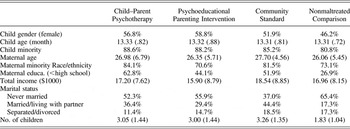
Following completion of preintervention assessments, the mothers and infants recruited for the maltreatment sample were randomly assigned to one of three groups: child–parent psychotherapy (CPP), psychoeducational parenting intervention (PPI), and standard services typically provided in the community when maltreatment was identified (community services [CS]). Some mothers assigned to receive one of the theoretically informed preventive interventions (CPP or PPI) did not complete treatment; however, these mothers (n = 37) and their infants were included in analyses for a more conservative intent to treat analysis approach. The resulting group sizes in the current investigation were CPP (n = 44), PPI (n = 34), and CS (n = 27). The CPP, PPI, CS, and NC (n = 52) groups were comparable on a range of demographic variables, as shown in Table 1. A series of tests were conducted to determine if the intervention and maltreatment control groups differed on demographic characteristics. The results of one-way analyses of variance for tests of mean differences found no difference across the four groups on maternal age, F (3, 157) = 0.27, p = .85, child age, F (3, 157) = 1.15, p = .33, and total income, F (3, 157) = 0.52, p = .67. There was a significant difference on the total number of children, F (3, 157) = 11.01, p < .01, and follow-up planned comparisons using Tukey corrections identified that mothers in the NC group had significantly lower total number of children compared to the other three groups. There were no significant differences among the maltreatment groups on these demographic variables. Chi-square analyses also revealed no differences on child gender, χ2 (3) = 1.71, p = .63, marital status, χ2 (6) = 8.73, p = .19, mother ethnicity, χ2 (3) = 2.80, p = .42, and child ethnicity, χ2 (3) = 1.48, p = .69. There was a significant finding with respect to education, χ2 (3) = 4.08, p = .03; however, this difference was due to a higher likelihood of NC mothers having at least a high school diploma in comparison to the maltreatment sample. The absence of significant comparisons across the maltreatment sample indicates that randomization to treatment condition was successful for demographic characteristics of the sample.
Demographic characteristics of groups

Overall, the families in the sample are characterized by poverty, relatively large family size, and single-parent mothers. In addition, mothers presented with extensive histories of prior trauma exposure, with 63% of the sample experiencing maltreatment as a child. Testifying to the potential intergenerational transmission of trauma (Bernstein & Fink, Reference Bernstein and Fink1998), on the demographics interview mothers in the maltreatment sample reported a higher likelihood, χ2 (1) = 5.73, p < .001, of experiencing maltreatment as a child (72%) compared to the comparison mothers (28%). For the mothers in the maltreatment sample, 74% reported experiencing physical abuse, 66% reported sexual abuse, and 55% reported experiencing neglect as a child. Finally, there was extensive co-occurrence of maltreatment types among these mothers, with 30% reporting experiencing two maltreatment subtypes and 54% reporting experiencing three or more subtypes.
Procedures
Data for the current study was collected at three different time points: preintervention baseline (child M age = 13.30 months), postintervention (child M age = 27.61 months), and 1-year postintervention follow-up (child M age = 39.13 months). At all time points both home- and center-based research sessions were conducted with the mothers and infants. During interviews conducted in the home by trained research assistants, mothers also completed a demographic interview. During center-based laboratory sessions, mothers completed self-report measures and provided saliva samples for cortisol assessment.
Saliva sampling for cortisol assay
To assess basal cortisol levels in mothers postintervention, saliva samples were obtained in the midmorning. Tightly restricting saliva collection to the morning hours in order to obtain basal levels of cortisol has been advocated given research reporting that afternoon and evening assessments are heavily influenced by circadian decreases in cortisol across the day and by situational factors that vary considerably over the course of the day (Susman et al., Reference Susman, Dockray, Schiefelbein, Herwehe, Heaton and Dorn2007). Furthermore, given transportation time and acclimation to the center in the initial interview room, mothers' saliva sampling did not occur during the cortisol awakening period. After the mother had arrived for the center-based session, saliva samples were obtained from mothers before beginning the laboratory assessments. For uniformity of saliva collection times, all center-based sessions were scheduled in the morning as close to 10:00 a.m. as possible. Thus, two samples were obtained at the postintervention assessments (M = 9:58 a.m., range = 8:19 a.m.–11:07 a.m.), and one sample was obtained at the postintervention 1-year follow-up (M = 9:57 a.m., range = 8:24 a.m.–11:05 a.m.).
After mothers acclimated to an interview room upon arrival to the center, saliva sampling procedures were begun. When saliva sampling began, mothers had not had any food or drink in their mouths since the time that they had been picked up for transportation to the center (approximately 45 min). Mothers were instructed to chew on a piece of sugarless gum for 3 min in order to stimulate saliva production. Subsequently, saliva was expressed into two 500-μl collection vials. The samples were immediately frozen and stored at –80 °C. The same procedures were utilized at the 1-year follow-up assessment. Subsequently, the samples were shipped overnight on dry ice for next day delivery to Salimetrics Laboratories (State College, PA) for assay.
Measures
Demographics interview
This measure has been used extensively in research with high-risk, low-income populations. Information obtained includes family composition, gender, race/ethnicity, birth dates, parent's education and occupation, income level, and receipt of public assistance. Experiences of childhood maltreatment also are obtained.
Salivary basal cortisol
Cortisol was assayed in duplicate by Salimetrics, Inc., using an enzyme immunoassay (Salimetrics, State College, PA). This assay has a lower limit of sensitivity of 0.007 μg/dl (range up to 1.8 μg/dl), and average intra- and interassay coefficients of variation less than 5.0% and 10.0%, respectively. Units of cortisol are expressed in micrograms per deciliter (μg/dl).
Cortisol data were checked for possible outliers, and three subjects (2%) evidenced values greater than 3.5 SD away from the mean. These values were removed and their cortisol assessment was estimated in model analyses as missing data. Although cortisol values evidenced some skewness, we used the original scale in model analysis. Primary findings did not change as a function of using log-transformed cortisol values. Given our interest in documenting and interpreting mean change over time in basal cortisol, we felt it important to retain the original scale of the cortisol values.
Maternal parenting stress
The Parenting Stress Index (PSI; Abidin, Reference Abidin, Zalaquett and Wood1997) is a 102-item self-report questionnaire that assesses perceived stress from the mother's point of view. Mothers completed the PSI at baseline and postintervention. The PSI was developed based upon the theory that stress experienced by a parent is a function of two broad domains: stress around salient characteristics of the child and stress related to situations associated with the caregiving role. The PSI has been demonstrated to have excellent reliability and validity (e.g., Abidin, Reference Abidin, Zalaquett and Wood1997). With regard to child-related domains, the PSI utilizes six subscales to identify maternal psychological stress associated with child characteristics (distractibility/hyperactivity, adaptability, reinforces parent, demandingness, mood, and acceptability). In order to operationalize parent-related psychological stress, six subscales from the parent domain were utilized (parenting competence, role restriction, attachment, spouse, depression, and isolation). Reliability across the 12 subscales was acceptable (α range = 0.70–0.83 for the child domain and 0.90–0.93 for the parent domain). To create composite scales for psychological stress within the child and parent domain at each time point, scales within each domain were averaged together.
Results
Data analytic strategy
Structural equation models were estimated using the Amos 18.0 software system (Arbuckle, Reference Arbuckle2006). Missing data analyses for the primary variables indicated that data were missing completely at random based on Little's (Reference Little1988) missing completely at random test (χ2 = 20.31, df = 21, p = .50). Therefore, in order to retain the maximum amount of statistical power, we utilized full-information maximum likelihood available in AMOS and included the full sample in the analyses (Enders, Reference Enders2001).
To parameterize change in outcomes over time within the four groups, we utilized a latent difference score (LDS) approach within a multiple-group framework in order to simultaneously estimate the model within the four groups (e.g., McArdle, Reference McArdle2009). As a relatively new integration of latent growth curve and cross-lagged panel analyses, the versatility of LDS is reflected in its ability to determine whether mothers in the group as a whole: (a) exhibit a significant increase or decrease in treatment outcomes over time, (b) differ significantly from each other in their initial level of outcomes, and (c) exhibit significant individual differences in their change outcomes over time (King, King, McArdle, Shalev, & Doron-LaMarca, Reference King, King, McArdle, Shalev and Doron-LaMarca2009; McArdle, Reference McArdle2009). Furthermore, the LDS approach allows us to examine whether treatment-related change in maternal psychological stress is predictive of later change in maternal stress physiology.
To test for treatment-related differences in model parameters, we utilized pairwise parameter comparisons available in the AMOS Critical Ratio of Differences command. This provides a test of the equivalence of model parameters across groups, or in other words, the moderating effect of treatment. Pairwise parameter comparisons calculate the difference between the two estimates divided by the estimated standard error of the difference. The resulting difference statistic is normally distributed and tested against the z score distribution (CR > 1.96). In our Analysis section below, we report the difference statistic (indicated by ds in the Results section) for pairwise tests.
Although mothers were assessed during the morning on average, cortisol shows a strong diurnal variation whereby the highest levels occur at wake-up time in the morning, followed by a steep decline over the course of the day. Following previous recommendations (e.g., Sturge-Apple, Davies, Cicchetti, & Manning, Reference Sturge-Apple, Davies, Cicchetti and Manning2012), we controlled for the effects of time of day of cortisol collection on cortisol in the latent difference score analysis. We accomplished this by regressing experimenter report of time of day onto their respective manifest cortisol variables. This practice effectively parcels out variance in cortisol level that is due to time of day from the analysis, rendering a more accurate assessment of basal cortisol levels (e.g., Cicchetti et al., Reference Cicchetti, Rogosch, Toth and Sturge-Apple2011).
Unconditional LDS analysis of change over time
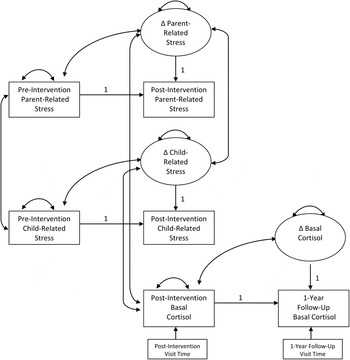
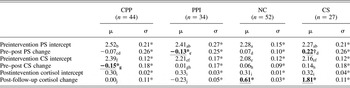
We examined an unconditional LDS model of maternal psychological stress and basal cortisol across the assessment points within each group (e.g., treatment vs. control) using AMOS 7.0 (Arbuckle, Reference Arbuckle2006). Within the unconditional approach, the association between initial status and the latent change score is modeled as a correlational path in order to facilitate examination of the mean change score (see Figure 1). The model was an adequate representation of the data, χ2 (64, N = 157) = 104.86, p = .01, root mean square error of approximation = 0.06, χ2/df ratio = 1.64. The results are presented in Table 2. With respect to preintervention assessments of maternal parent-related psychological stress, pairwise parameter comparisons indicated that mothers in the CPP intervention reported elevated levels of parent-related psychological stress and child-related stress compared to mothers in the NC group (d = 2.07). In addition, CPP mothers reported higher levels of child-related stress when compared to the NC and CS groups (ds = 3.60 and 2.11, respectively). No other parameter comparisons were significant (d range = 0.01–1.90). Given only one difference across the three treatment groups was found out of six possible tests, this suggested that treatment randomization was largely successful with respect to preintervention levels of maternal psychological stress.
Parameterization of the unconditional latent difference score analysis of the intercept and mean change over time in study outcomes. Identical model was analyzed simultaneously within each of the four groups through a multiple group analysis.

Results from unconditional latent difference score analysis of maternal outcomes over time

Note: Significant mean changes are bold and underscored. Common subscripts denote no significant differences in parameters within construct, whereas difference subscripts denote a significant difference. CPP, Child–parent psychotherapy; PPI, psychoeducational parenting intervention; NC, nonmaltreated comparison; CS, child-related stress; PS, parenting-related stress; int, intercept; μ, group mean; σ, group variance.
†p < .10. *p ≤ .05.
We next examined group differences in change over time in maternal psychological stress from preintervention to postintervention. Results revealed some interesting differences across the four groups. For mothers in the PPI intervention group, reports of parent-related stress decreased significantly from preintervention to postintervention. In contrast, mothers in the CS group reported significantly higher levels of parent-related stress over this time period at a trend level. Finally, mothers in both the CPP and the NC groups did not experience any significant changes in parent-related stress. Pairwise parameter comparisons of the latent difference score values revealed that change in parent-related stress was significantly different for the PPI treatment condition when contrasted with both NC and CS mothers (ds = 2.43 and 2.44, respectively), although not statistically different from CPP (d = 1.10).
Focusing next on maternal child-related stress, latent change scores indicated that mothers in the CPP intervention group experienced a significant decrease in child-related stress from preintervention to postintervention. Furthermore, the decline in stress for mothers in this group was significantly different from mothers in the NC and the CS groups (ds = 2.61 and 2.29, respectively); however, it was similar to mothers in the CPP group (d = 1.45). It is interesting to note that while not statistically significant, both the NC and the CS groups experienced increases in child-related psychological stress over the course of the study.
Finally, we also examined the unconditional LDS analysis of change in basal cortisol posttreatment (Table 2). Findings revealed that average levels of basal cortisol increased significantly from postintervention to the 1-year postintervention follow-up for both the NC and the CS groups. In contrast to this, there was no change in basal cortisol over time for mothers in the two intervention groups. We conducted pair-wise comparisons on the change scores across the four groups, and findings revealed that increases in levels of basal cortisol over time in the NC and the CS groups were significantly different from change in basal cortisol in the CPP and the PPI mothers. This suggests the presence of elevated levels of physiological stress in the nonintervention mothers over time. Given these significant differences in change in mothers' stress physiology over time, we proceeded with our next analysis, which examined whether treatment-related changes in maternal psychological stress from baseline to postintervention in the CPP and the PPI conditions were associated with subsequent basal cortisol activity from postintervention to the 1-year postintervention follow-up.
Conditional LDS analysis
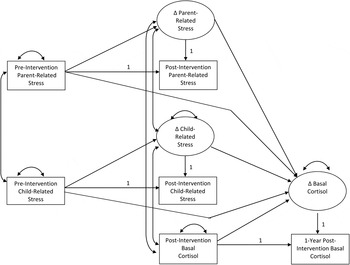
The model for testing predictive associations between intervention-related changes in maternal parenting psychological distress with changes in physiological stress system activity is depicted in Figure 2. To control for the effect of initial status on change over time, the latent change score was regressed onto initial status as depicted in the figure. In addition, we also controlled for preintervention levels of maternal parenting psychological distress variables in our analysis. Taken together, these stringent controls of prior levels of study variables increase confidence in the prediction of change in psychological stress on subsequent change in basal cortisol over time. The model provided a good representation of the data, χ2 (108, N = 188) = 91.746, p < .05, root mean square error of approximation = 0.04, and χ2/df ratio = 1.35. The results revealed that treatment-related change in maternal child-related psychological distress in the CPP intervention group was associated with change in basal cortisol post treatment (B = 0.12, β = 0.19, SE = 0.06, p < .05). Specifically, within the CPP mothers, treatment-related decreases in child-related psychological stress predicted decreases in basal cortisol activity over the 1-year period. Thus, results suggest that the effect of treatment on reducing mother's child-related psychological stress within the CPP treatment condition was also effective in reducing elevations within her physiological stress system activity postintervention. No other findings were significant.
Parameterization of the conditional latent difference score analysis examining treatment-related change in maternal stress in the prediction of change in maternal basal cortisol levels. Identical model was analyzed simultaneously within each of the four groups through a multiple group analysis.

Discussion
The present study demonstrates that both CPP and PPI were effective in decreasing perceived parenting stress in neglectful mothers. However, the models operated differently with respect to the type of stress reduction that occurred. For mothers in the PPI model, perceived stress related to decreases in parent-related stress, whereas for mothers in the CPP model, decreases in perceived stress related to child characteristics. These differential decreases in stress are consistent with what would be expected given the theoretical underpinnings and therapeutic targets of the models. Given that the PPI model specifically addressed parenting skills, the fact that mothers in that condition felt more competent as parents suggests that the intervention was effective in attaining its goal. Conversely, because CPP focuses on how a mother's past may intrude into and distort her perceptions of her children, the fact that mothers' views of their children were modified is consistent with helping mothers to see their children in a more realistic and positive manner without the influence of their own past. Mothers in both the CS and the NC groups who did not receive intervention experienced increased perceived stress over the same period of time. Increases in stress are not surprising from a developmental perspective, because parenting a 2-year-old child can be more challenging than caring for an infant. As children begin to assert their autonomy, caregivers typically are confronted with significant behavioral changes that can be quite taxing. Because all mothers in this sample also had to grapple with stress associated with low socioeconomic status, it is likely that parenting a 2-year-old was even more stressful.
Our results regarding differential decreases in the types of perceived parenting stress across models possess important implications with respect to considering how best to intervene in neglectful families. Although both PPI and CPP were effective in reducing maternal perceived parenting stress and that reduction was consistent with the theoretical underpinnings of each model, a reduction in both child- and parent-related stress would be ideal. There have been increased calls recently to incorporate solid theoretical foundations into the design and evaluation of preventive interventions (Toth, Petrenko, Gravener-Davis, & Handley, Reference Toth, Petrenko, Gravener Davis, Handley and Cicchettiin press). Historically, social learning theory and attachment theory have been two of the most widely utilized theoretical frameworks in interventions. However, even in interventions guided by these perspectives, it has been difficult to identify mechanisms through which change occurs. The results of the current investigation highlight the importance of carefully considering how a theoretical approach might affect treatment outcome. Specifically, in families struggling with multiple and complex stressors, adaptive interventions might be indicated in order to effectively impact relevant domains. Adaptive interventions recognize that people vary in the intensity of intervention needed to prevent a given problem. For example, a randomized control trial (Building Healthy Children; Paradis, Sandler, Manly, & Valentine, Reference Paradis, Sandler, Manly and Valentine2013) to prevent child maltreatment is currently under way at Mt. Hope Family Center in Rochester, New York. The Building Healthy Children program offers an array of evidence-based services to economically disadvantaged mothers who had their first child before age 21. Services are delivered in accord with maternal need. All mothers receive outreach to assist with basic needs, such as adequate food and housing. Mothers also received the Parents as Teachers program (Wagner, Spiker, Hernandez, Song, & Gerlach-Downie, Reference Wagner, Spiker, Hernandez, Song and Gerlach-Deownie2001) to provide parent skills training and developmental guidance. If relationship difficulties or trauma exposure are present, then CPP (Lieberman & Van Horn, Reference Lieberman and Van Horn2005) is provided to foster secure attachment. When mothers are struggling with elevated depressive symptoms, interpersonal psychotherapy for depression (Weissman, Markowitz, & Klerman, Reference Weissman, Markowitz and Klerman2000) is provided. Although appealing from a clinical perspective, adaptive interventions can be particularly challenging to analyze because individuals are receiving different levels or combinations of interventions.
To our knowledge, the current investigation is the first to demonstrate that interventions provided to neglectful mothers are effective in decreasing maternal perceived stress, and that for mothers receiving CPP decreased stress, in turn, relates to stress hormone regulation. Although elevations in physiological stress were seen in mothers in both the NC and the CS conditions from postintervention to 1-year follow-up, basal cortisol levels for mothers in the CPP and the PPI groups did not change. Thus, mothers in neglectful families who did not receive a theoretically informed intervention and mothers in nonmaltreating economically disadvantaged families both evidenced increases in physiological stress over a 12-month period. These results not only highlight the importance of providing theoretically informed and evidence-based models of intervention to parents and infants in neglectful families but also underscore the very high-risk nature of parenting an infant in the context of economic adversity. Approximately 20% of all children in the United States reside in poverty (Jiang, Ekono, & Skinner, Reference Jiang, Ekono and Skinner2014). Our results demonstrate that parents in these families are at heightened risk for both psychological and physiological stress, which may in turn increase the likelihood that they will neglect their children's basic needs. The effects of economic adversity can result in both immediate and lifelong consequences for children in these families. A recent study examined children's cortisol levels over 3 consecutive years in children residing in low-income families (Suor, Sturge-Apple, Davies, & Cicchetti, Reference Suor, Sturge-Apple, Davies and Cicchetti2015). Although children's cortisol levels remained relatively stable over time, exposure to specific forms of family adversity predicted hypo- and hypercortisolism at age 4. Of particular concern, children with both higher and lower cortisol profiles had experienced more family instability, and children with higher cortisol levels had experienced harsher and more insensitive parenting. These cortisol patterns were related to lower levels of cognitive functioning at age 4 (Suor et al., Reference Suor, Sturge-Apple, Davies and Cicchetti2015). In conjunction with our findings, these results cohere to highlight the criticality of providing interventions directed toward decreasing parenting stress and promoting positive parent–child relationships.
In examining the association of intervention effects on psychological and physiological stress, an interesting finding emerged. Although both PPI and CPP interventions resulted in decreases in perceived maternal stress, albeit it with differential effects, only decreases in child-related stress as a function of participation in CPP resulted in more adaptive regulation in maternal basal cortisol. The current investigation cannot account for the mechanisms by which such maternal-perceived parenting stress reductions were related to basal cortisol only for mothers in the CPP group. However, it is interesting that in an earlier investigation of the sustained efficacy of CPP and PPI for dyads that also were utilized for this investigation, attachment security was sustained only for infants in the CPP condition (Stronach, Toth, Rogosch, & Cicchetti, Reference Stronach, Toth, Rogosch and Cicchetti2013). These results suggest that decreases in child-related parenting stress and consequent improved regulation of basal cortisol for mothers in the CPP intervention also may have contributed to sustained improvements in security of attachment over time. Although less likely given these findings, it is not possible to discount that in the PPI group, the failure to detect associations between reductions in maternal basal cortisol and reductions in maternal stress may have been due to fewer numbers of participants in the PPI group, thereby decreasing statistical power to detect differences.
The current investigation adds to the growing body of literature highlighting the potential of psychosocial interventions provided to maltreated children to normalize stress hormone regulatory processes through documenting these effects within caregivers (Dozier et al., Reference Dozier, Peloso, Lewis, Laurenceau and Levine2008; Fisher et al., Reference Fisher, Stoolmiller, Gunnar and Burraston2007). Current findings supplement prior research demonstrating that trajectories of cortisol levels over time among infants in dyads receiving PPI or CPP were comparable to those of infants in a nonmaltreated comparison group (Cicchetti et al., Reference Cicchetti, Rogosch, Toth and Sturge-Apple2011). Specifically, our findings show that parents participating in the CPP intervention also benefitted physiologically and underscore that the ability to promote positive brain and behavioral changes can occur during adulthood (Curley, Jensen, Mashoodh, & Champagne, Reference Curley, Jensen, Mashoodh and Champagne2011). Because alterations in neuroendocrine function possess implications for chronic diseases in adulthood, these findings have significant public health implications and emphasize the criticality of intervening in families not only to prevent the occurrence of maltreatment but also to stop its recurrence. However, despite significant advances in our knowledge base, challenges remain with respect to translating the burgeoning body of neuroscience research into the policy and practice arenas (Boyce & Maholmes, Reference Boyce and Maholmes2013).
Despite important and novel contributions to the literature, a number of limitations must be acknowledged. As with many investigations of interventions with maltreating families, the sample size was not as large as would have been ideal. Thus, some trend-level findings or absence of statistical significance may have been due to limited statistical power. Sample size also precluded our ability to conduct more fine-grained analyses of important variables such as severity of maltreatment. Although the current study represents an important advance in examining intervention outcome in neglectful families given the historical “neglect of neglect,” it also would be important to conduct a similar investigation that included both abusive and neglectful families to ascertain whether the interventions operated differently based on the subtype of maltreatment present. The potential limitation of having only one cortisol assay at follow-up also must be acknowledged. However, exclusive utilization of morning cortisol and careful attention to the time of day of collection somewhat mitigate against this concern.
In summary, the current investigation has demonstrated that psychosocial interventions provided to mothers in neglectful families can positively impact both psychosocial and physiological maternal stress. In conjunction with prior research with these mother–infant dyads (Cicchetti et al., Reference Cicchetti, Rogosch and Toth2006, Reference Cicchetti, Rogosch, Toth and Sturge-Apple2011; Stronach et al., Reference Stronach, Toth, Rogosch and Cicchetti2013), these interventions also have been found to be effective in normalizing infant stress physiology and fostering and sustaining improvements in attachment security. The power of multilevel investigations that incorporate both psychosocial and physiological assessments of intervention outcome is highlighted. Future research utilizing such multilevel approaches to evaluate interventions is imperative if such advances are to be translated into programs and policies that benefit these vulnerable children and parents.