

Brand-name pharmaceutical manufacturers are required by law to submit patents covering their approved small-molecule drugs to the Food and Drug Administration’s (FDA’s) Approved Drug Products with Therapeutic Equivalence Evaluations (the “Orange Book”). Orange Book listing plays a central role in the availability of generic versions of those small-molecule drugs because generic manufacturers must make formal certifications to the FDA about patents listed in the Orange Book before obtaining FDA approval. Patents listed in the Orange Book provide brand-name manufacturers with substantial legal and commercial advantages, including the ability to trigger an automatic 30-month stay of generic approval when litigation over Orange Book-listed patents is initiated, increased leverage during negotiations with generic manufacturers to settle that litigation, and enhanced notice to potential competitors regarding asserted patent rights. These protections can substantially delay generic entry and prolong market exclusivity for brand-name manufacturers, allowing high prices of brand-name drugs to persist, contributing to excess spending by payors and cost-related non-adherence by patients.
Because Orange Book listing carries these important consequences, determining which patents qualify for listing has become an increasingly important policy issue. The FDA generally does not independently evaluate whether patents submitted by manufacturers satisfy the statutory listing requirements and instead relies on sponsor claims regarding eligibility; that is, when a brand-name manufacturer submits a patent to the FDA for listing, the FDA will list the patent without reviewing the details of the patent to determine whether it met the Orange Book listing criteria. 1 Consequently, patents that arguably fall outside the statutory criteria may nevertheless remain listed unless challenged through litigation, voluntarily removed by the manufacturer, or disputed by a third party through FDA administrative procedures. Courts have occasionally ordered patents removed from the Orange Book, 2 manufacturers sometimes voluntarily delist patents following litigation or changes in regulatory guidance, and recent Federal Trade Commission (FTC) enforcement efforts have encouraged additional removals of potentially improper listings.
The issue has received heightened attention in recent years. Beginning in 2023, the FTC raised concern about hundreds of Orange Book patent listings involving inhalers, epinephrine auto-injectors, diabetes therapies, and other drug-device combination products, arguing that certain device patents were improperly listed. 3 At the same time, Congress, the FTC, and the courts have increasingly examined the scope of permissible Orange Book listings, culminating in recent judicial decisions addressing device-related patents. For example, courts have held that device patents that do not claim the approved drug itself may fall outside the statutory criteria for Orange Book listing, requiring manufacturers to delist certain patents covering inhalers and other drug-device combination products. 4 In 2020, Congress passed the Orange Book Transparency Act, which helped clarify which patents should be listed in the Orange Book. But Congress did not create a systematic process for reviewing existing listings and removing patents that do not meet those requirements, leaving enforcement largely to courts and the FTC. These developments suggest that Orange Book patent listings and their removals are an increasingly important component of pharmaceutical competition policy.
Despite the health policy significance of Orange Book patent delistings, little is known about how frequently they occur, which types of patents are removed, or the circumstances surrounding their removal. Prior research has focused on the delisted device patents listed in the Orange BookReference Teng 5 or the relationship between the FTC and delisted patents.Reference Leon 6 Much less attention has been paid to patents that disappear from the Orange Book before expiration, even though such removals may reflect successful litigation, regulatory changes, patent corrections, discontinued products, or evolving interpretations of listing requirements.
To understand the characteristics and patterns of patent delisting, we identified every patent removed from the 1998 to 2024 Orange Book before the patent’s expiration date. We characterized the types of patents removed and examined potential reasons for delisting.
We then reviewed the 1998 to 2024 Orange Books to identify all patents that were removed before their expiration date. For these delisted patents, we recorded the patent expiration dates and all brand-name drugs on which the patent had been listed prior to removal. We excluded all drugs now classified as biologics (e.g., insulin), which were removed from the Orange Book by statute in 2020. 7 We also excluded removals due to typographical errors. We used PatentAdvisor to review the claims of each patent, and classified patents according to the subjects of their claims as active ingredient, method of use, formulation, polymorph/enantiomer, device, or method of manufacturing.
Each delisted patent was reviewed to determine the likely reason for Orange Book removal. Potential reasons for delisting included litigation (assessed using Lex Machina, a commercial patent litigation database), reexamination/reissue (based on PatentAdvisor, a commercial patent database), product discontinuation (from Drugs@FDA), and FTC action (based on FTC warning letters). Litigation does not always lead to patent invalidation, so not all litigated patents are ultimately delisted. Reexamination patents are patents that have been reviewed through an administrative pathway (inter partes review, ex parte reexamination or reissue) and given a new patent number. Accordingly, some patents may be delisted because the administrative pathway generated a new patent number that was subsequently listed on the Orange Book.
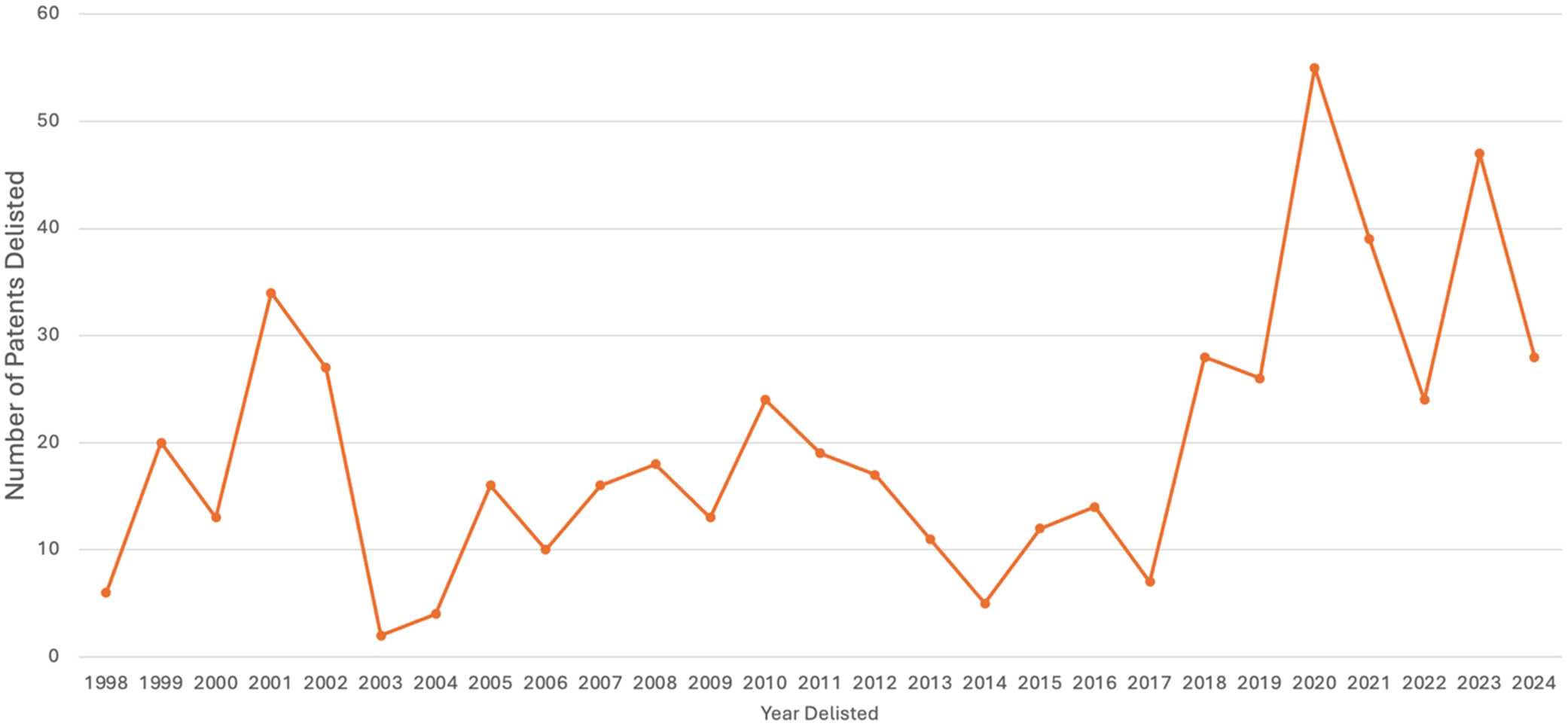
Among the 9,980 patents listed in the Orange Book during that era, manufacturers removed 535 (5%) prior to patent expiration. The number of patent delistings per year ranged from 1 to 55 with a median of 17 (IQR 11.5-26.5) (Figure 1). A minority of delisted patents (71/535, 13%) were directed to the drug’s active ingredients. Most were directed at other features, including methods of use (177/464; 38%), formulations (167/464; 36%), and delivery devices (75/464; 16%). Common reasons to which we attributed the delisting included: litigation (potential invalidation; 226, 42%), product discontinuation (207, 39%), and reissuance/re-examination of the patent (resulting in a new patent number; 60, 11%) (Table 1). Many patents (153, 26%) had multiple potential causes for delisting.
Number of small-molecule drug patent delistings by year.

Figure 1. Long description
The X-axis is labeled Year Delisted and ranges from 1998 to 2024 in one-year increments. The Y-axis is labeled Number of Patents Delisted and ranges from 0 to 60 in increments of 10. An orange line connects data points for each year.
From 1998 to 2002, delistings fluctuate between 6 and 34. A sharp drop occurs in 2003 to the lowest point of 2. Between 2004 and 2017, the trend remains relatively low, oscillating between 4 and 24 delistings.
Starting in 2018, there is a sharp upward trend. Delistings rise from 7 in 2017 to 28 in 2018, reaching an all-time peak of 55 in 2020. Following the peak, the numbers remain high but volatile, dropping to 39 in 2021, 24 in 2022, rising again to 47 in 2023, and ending at 28 in 2024.
Delisted Orange Book Patents, 1998–2024

Table 1. Long description
The table contains 9 rows and 7 columns. The columns are: Patent Category, Total, Litigated, Reexamination or Reissue Patent, Has Discontinued Products, F T C Warning Letter, and Unknown.
* Active Ingredient: 71 total, 9 litigated, 20 reexamination, 29 discontinued, 0 F T C warning, 19 unknown.
* Non-Active Ingredient: 464 total, 217 litigated, 40 reexamination, 178 discontinued, 14 F T C warning, 61 unknown.
* Method of Use: 177 total, 105 litigated, 18 reexamination, 59 discontinued, 0 F T C warning, 30 unknown.
* Formulation: 167 total, 84 litigated, 17 reexamination, 84 discontinued, 0 F T C warning, 24 unknown.
* Device: 75 total, 4 litigated, 3 reexamination, 23 discontinued, 14 F T C warning, 0 unknown.
* Polymorph or Enantiomer: 23 total, 13 litigated, 1 reexamination, 6 discontinued, 0 F T C warning, 7 unknown.
* Manufacturing: 11 total, 3 litigated, 1 reexamination, 5 discontinued, 0 F T C warning, 0 unknown.
* Risk Evaluation and Mitigation Strategy R E M S or Design Patents: 11 total, 8 litigated, 0 reexamination, 1 discontinued, 0 F T C warning, 0 unknown.
* Total (percent): 535 total, 226 (42 percent) litigated, 60 (11 percent) reexamination, 207 (39 percent) discontinued, 14 (3 percent) F T C warning, 80 (15 percent) unknown.
Legend: Excludes patents on products that were previously regulated as small-molecule drugs but are now regulated as biologic products, such as insulin. Biologic products (and their corresponding patents) were removed from the Orange Book in March 2020 due to the Biologics Price Competition and Innovation Act.
* Totals exceed 100% because patents may have multiple potential causes for delisting.
The timing of patent delistings appears consistent with evolving legal and regulatory oversight. Several increases coincided with significant policy events, including early FTC advocacy concerning Orange Book listing practices (2003), implementation of the Orange Book Transparency Act (2020), and, most recently, the FTC’s nationwide campaign challenging potentially improper patent listings (2023). Although this review was not designed to establish causation, these temporal associations suggest that regulatory attention may influence manufacturers’ willingness to reassess existing Orange Book listings.
For example, from 2023 to 2025, the FTC identified 34 products associated with 96 distinct impermissibly listed patents associated with 197 requested patent delistings. 8 After litigation, companies complied with 177 of the 197 (90%) delisting requests. These delisted patents represented 80% of the total number of patents associated with these 34 products. Similarly, recent Federal Circuit decisions addressing device patents may encourage additional voluntary delistings as manufacturers reevaluate the continued propriety of previously listed patents.
These findings provide insight into the changing nature of pharmaceutical patent protection. The overwhelming majority of delisted patents did not claim the active pharmaceutical ingredient itself but instead covered formulations, methods of use, delivery devices, manufacturing processes, or other secondary aspects of marketed drugs. Earlier studies have demonstrated that manufacturers increasingly rely on secondary patents to extend market exclusivity after approval.Reference Kapczynski, Park and Sampat 9 Secondary patents often protect new formulations, dosing regimens, delivery devices, manufacturing methods, or incremental product modifications rather than the underlying active ingredient. Because these patents frequently become the focus of post-approval patenting strategies, it is perhaps unsurprising that they also account for most Orange Book delistings.
Our findings also illustrate that patent delisting is not inherently indicative of improper conduct. Nearly 40% of delisted patents were associated with discontinued products, and many others appeared to reflect patent reexamination or reissue proceedings that simply replaced an existing patent with a corrected patent number. Likewise, litigation may result in patent invalidation, settlement, or strategic business decisions that ultimately lead to removal from the Orange Book. Consequently, patent delisting should not automatically be interpreted as evidence that a manufacturer improperly listed a patent in the first instance.
Nevertheless, over the past two decades, manufacturers removed approximately one in every twenty patents listed in the Orange Book before patent expiration. The increasing number of FTC warning letters and recent judicial clarification of Orange Book listing requirements suggest that patent delisting may become even more common in the near future. If manufacturers proactively remove patents that no longer satisfy statutory listing requirements, generic manufacturers may face fewer unnecessary litigation barriers and patients could benefit from earlier generic competition. Conversely, continued uncertainty regarding listing requirements may perpetuate inconsistent listing practices across therapeutic areas, particularly for increasingly common drug-device combination products.
Our findings also underscore the need for greater administrative clarity. For nearly two decades, stakeholders have requested more explicit FDA guidance regarding which patents should be listed in the Orange Book, particularly for combination products containing both drugs and delivery devices. Although recent litigation has clarified certain aspects of listing eligibility, such as delisting patents that do not include claims to the active ingredient, much uncertainty still remains. More comprehensive FDA guidance, developed in coordination with the US Patent and Trademark Office (USPTO), could improve consistency across manufacturers, reduce unnecessary litigation, and better align Orange Book listings with the statutory criteria established by Congress. The USPTO and FDA could also jointly review Orange Book-listed patents to ensure compliance with statutory listing requirements. Brand-name firms could also face fines or other penalties to disincentivize improper patent listings.Reference Hacohen 10
Notably, our analysis was limited to small-molecule drugs because biologic products are regulated under a different statutory framework and their patents are not comprehensively listed in the Orange Book. In addition, the precise reason for many patent removals could not always be definitively determined because manufacturers rarely disclose why individual patents are delisted. Although we identified several likely explanations using litigation databases, FDA records, FTC warning letters, and patent prosecution histories, multiple factors may have contributed to individual patent removals. Finally, we evaluated only patents that were ultimately removed before expiration; patents that remained listed despite potential eligibility concerns were outside the scope of this analysis.
Patent delistings provide a previously unexplored window into the evolution of pharmaceutical patenting and Orange Book practice. As courts, the FDA, Congress, and the FTC continue to scrutinize the scope of permissible Orange Book listings, the frequency and nature of patent delistings may become an increasingly important indicator of changes in pharmaceutical competition policy. Continued monitoring of these trends will help policymakers evaluate whether current listing practices appropriately balance incentives for pharmaceutical innovation with timely generic competition.
Acknowledgments
Ms. Kirby-Rivera had full access to all the data in the study and takes responsibility for the integrity of the data and the accuracy of the data analysis. The funder had no role in the design or conduct of the study; collection, management, analysis, and interpretation of the data; preparation, review, or approval of the manuscript; and decision to submit the manuscript for publication.
Author contribution
Concept and Design: Tu; Acquisition, analysis or interpretation of data: All authors; Drafting of manuscript: Tu, Feldman, Kesselheim; Administrative, technical or material support: Tu, Kim, Kosmopoulou; Obtained funding: Tu, Kesselheim; Supervision: Tu.
Funding
This work was funded by Arnold Ventures and the Commonwealth Fund.
Disclosures
Dr. Feldman reported serving as a consultant for Alosa Health and as an expert witness in litigation against inhaler manufacturers. Dr. Feldman served on the Editorial Board of the Journal of Law, Medicine, and Ethics. Dr. Kesselheim serves as editor-in-chief of The Journal of Law, Medicine, and Ethics, a consultant for Alosa Health, and as an expert witness on behalf of a payor in a case against Teva regarding marketing of Copaxone and on behalf of a group of state attorneys general and payors in a case against multiple generic manufacturers related to alleged price fixing. Dr. Tu reported receiving consulting fees for purchasers of lenalidomide and abiraterone- containing products outside the submitted work.