


Euphemism is a concept closely related to taboo or embarrassing topics; classic examples include sex, religion and politics. It has been mainly studied to show how, within a given language, alternative expressions replace other unsuitable ones that, accordingly, may cause offence and discomfort to the audience. While this first approximation to the question of euphemism anticipates a key point in the use of these substitute expressions, namely the relationship between speaker-hearer in communication, the present discussion seeks to push this interdependence a bit further, framing it around English words or Anglicisms in the context of Spanish fashion. Some examples include ‘backstage’, ‘fifties’, and ‘street style’. This brings up some interesting questions: why should fashion, a clearly non-taboo topic, resort to the use of euphemistic words? How can English words qualify as good candidates to carry out the euphemistic role?
Fashion, mass media and rhetoric
Fashion permeates our society: every season, we follow its dictates on how to dress and what accessories to wear. It has become a commodity, part of a machinery that moves large sums of money, involves a vast number of professionals, and finds in the consumer the last and vital link to operate, that is to say, its true reason to exist. This necessary relationship with the consumer is mediated through the mass media, in all of its various manifestations: television or radio programs, fashion magazines and, with the advent of the Internet, through digital media (websites, blogs).
Despite the fact that most of the ideas contained in the present discussion could be applied to mass media in general, in order to consider these reflections more accurately, the focus will be placed on print media, and more specifically on women's fashion magazines. Thus this paper rests on the analysis of ten special issues published in March and September 2013 (Elle Fashion Book primavera/ verano 2013; Telva colecciones & accesorios primavera–verano 2013; Vogue colecciones. Primavera/ verano 2013; ¡Hola! “Prêt–à–porter”. Primavera–verano 2013; ¡Hola! fashion N° 8; Elle Fashion Book otoño/ invierno 2013–14; Telva colecciones & accesorios otoño–invierno 2013/ 14; Vogue colecciones. Otoño/ invierno 2013–14; ¡Hola! “Prêt–à–porter”. Otoño–invierno 2013–14; ¡Hola! fashion N° XI). All of these are top quality magazines, which always launch these special numbers on fashion when the changes of seasons are introduced to the readership. Their monographic nature guarantees the homogeneity of the sample used in this work, at the same time granting it a degree of specialisation, setting these publications aside from other women's magazines where fashion shares space with sections on beauty, features or travelling, for example. These editions, with detailed descriptions and full coloured illustrations of the world's leading designers’ collections, are intended for a varied audience, which may range from experts in fashion, to semi-experts, to the general public; this impels fashion journalists to adopt strategies to reach a wide readership. Understanding the nature of these strategies leads us to establish an intimate connection between fashion and rhetoric.
Since its birth in the ancient world, rhetoric has been regarded as the speakers’ or writers’ ability to persuade and motivate their listeners or readers. Needless to say, throughout its long history, rhetoric has suffered the scorn of those who have correlated it with a flowery but empty style, or those others who have seen in it dishonest and manipulative intentions, views that have doubtless damaged its reputation. But in its contemporary revival, rhetoric is approached as the art of constructing effective arguments through word choice (Fahnestock, Reference Fahnestock2011). It is this new dimension that will help to show how stylistic decisions in fashion magazines are carefully made to attract their readers.
Browsing through any Spanish fashion magazine, one is struck by the number of English words they contain (a situation that seems to apply to Italian fashion magazines too (Lopriore & Furiassi, Reference Lopriore, Furiassi, Furiassi and Gottlieb2015)). Such a feature has attracted the attention of recent research on Spanish fashion, either from a lexicological point of view, concerned with the presence of pseudo-Anglicisms (Balteiro & Campos, Reference Balteiro and Campos2012; Balteiro, Reference Balteiro2014), or from a discourse perspective, focusing on neologisms for reasons of specialisation (Diez-Arroyo, Reference Diez-Arroyo2015). Besides, the growing association between fashion and Anglicisms has been noted by FUNDEU (the Foundation of Urgent Spanish, under the expert advice of the Royal Academy of Spanish Language). This institution has warned the mass media against the indiscriminate use of Anglicisms in fashion, encouraging instead the adoption of equivalent Spanish forms (see internet downloadable document on reference list). The question that immediately arises is why the foreign term should be used at all. Searching for an answer will need us to examine the relationship between fashion magazines and borrowings, a necessary step to fully apprehend the role played by English words as euphemisms in the context of fashion.
Borrowing, euphemism and ‘loose use’
In an attempt to persuade and empathise with their readership, Spanish fashion journalists often decide to include English words in their texts. Such a linguistic decision may be conditioned by several factors. First of all, the prestige of English in the world favours the adoption of Anglicisms, which are regarded as a symbol of modernity and professionalism (MacKenzie, Reference MacKenzie, Furiassi, Pulcini and Rodríguez González2012: 31–33). Secondly, although the world of fashion once spoke French, nowadays it is English that has taken the leading role (Lopriore & Furiassi, Reference Lopriore, Furiassi, Furiassi and Gottlieb2015: 202–203). This creates ‘terminological dependency’ (Humbley & García Palacios, Reference Humbley and García Palacios2012: 60, 65). In other words, by inserting English loan words, Spanish fashion magazines emulate the jargon of this specialised domain, manage to project a competent image of themselves, and draw close to experts in the field. Thirdly is what can be labelled the ‘marketing dimension’: the prominent position held by English as a foreign language in present-day Spanish society offers journalists the possibility to capture clients among a particular group of people without a full command of the language but with a superficial understanding of it. In this regard, addressing common readers through terms in a language other than their mother tongue can be considered a kind of flattery, a wink at their skills in English. Spread, even though limited, knowledge of a foreign language thus promotes the use of borrowings and slows down translation into the native language (Álvarez de Miranda, Reference Álvarez de Miranda and de Miguel2009: 143). Summing up, fashion magazines insert English words as a rhetorical strategy to capture the attention of their audience, who, for different reasons, may eventually develop a positive appreciation towards these publications. What this research wants to explore is an additional function of loan words, that is, their value as euphemistic terms for controversial native alternatives.
Euphemism is commonly associated with subject matters that cause offence and social disapproval and, hence, create a need for speakers ‘to find roundabout, indirect and socially acceptable ways to refer to such concepts’ (Hojati, Reference Hojati2012: 553). For instance, in English instead of the straightforward form ‘dismissal’, euphemistic options available in the language would be ‘rebalancing human capital’ or ‘realigning the workforce’. Such indirect expressions are meant to mitigate the rawness of the message. It is this mitigating effect that has led to the connection of euphemism and borrowing.
Among the first to note the euphemistic role of borrowings was Galinsky (Reference Galinsky, Carstensen and Galinsky1967). He observed that the foreign nature of these words grants impunity, a characteristic that would encourage their replacement by more literal equivalents in the recipient language. Nevertheless, it is not clear how fashion can fit in on the traditional list of topics that call for euphemisms because, far from causing discomfort and uneasiness, it is an attractive subject, an activity in the continuous search for glamour, distinction and elegance. This paper wants to argue that it is precisely in this ultimate goal, together with the persuasive function of mass media in which fashion is immersed, where the clue to the alliance with euphemism can be found.
In the domain of fashion, the notion of euphemism is better understood along the lines put forward by Chi Ren (Reference Chi Ren2013) for political speech. For this author, euphemism can be defined as a non-explicit designation that softens or conceals something unpleasant, and not with replacing only a forbidden or offensive concept or reality (Chi Ren, Reference Chi Ren2013: 46). Therefore, under this more flexible approach, euphemistic forms are no longer limited to unmentionable subjects, but rather include expressions that are aimed at maintaining or developing a keen appreciation of a topic. A second interesting aspect of this view on euphemism is the issue of face-saving, concerned not so much with the receiver's feelings, but with projecting a good image of the sender of the message (Chi Ren, Reference Chi Ren2013: 47). Transferring these ideas to the context of fashion implies regarding euphemisms as words whose goal is to keep up with the standards of elegance, quality, modernity, etc., associated with this domain, discarding those expressions that do not match these expectations. This mixes well with the notion of rhetoric as persuading through stylistic choices. Furthermore, the care shown in the discourse of fashion by both professionals and journalists does not have to do so much with saving the image of the anonymous readers, but rather with presenting and enhancing a good public image of themselves and of fashion.
Loan words emerge as ideal elements to play the role of euphemisms as has just been detailed, not only, as Galinsky (Reference Galinsky, Carstensen and Galinsky1967: 47) said, because their foreign nature grants impunity but, more interestingly, because, in choosing them, the sender is seeking to produce some other kind of interpretative effect. In this particular case, the additional effect consists of transmitting all the symbolic power of English words in fashion, namely, sophistication, innovation, professionalism and so on. Consequently, the use of foreign terms is based on a desire to communicate such ideas, which confers on these words an evaluative or emotional dimension. Interpreting a loan word demands that the receiver include all this information, giving way to an occasion-specific concept that is broader in its meaning than the original English concept from which it was derived. It is this ‘loose use’ of language that is responsible in loan words for what Galinsky (Reference Galinsky, Carstensen and Galinsky1967: 46–47) has labelled impunity.
English words vs Spanish alternatives
As has already been noted, the English words that will be analysed in this section are not used in Spanish to fill a lexical gap. On the contrary, all of them have matching equivalents available in the target language (see Table 1 below). The relationship between equivalent terms, however, cannot be equated with identity, and hence the substitute for a native term can be considered its equivalent only to a certain extent; this is ‘not the lexicographers’ fault, nor is it the result of equivalence being fundamentally a misconceived notion – rather, it is a consequence of the complex interactions between language, culture, and the human mind’ (Adamska-Salaciak, Reference Adamska-Salaciak2010: 402). In effect, meaning is largely a contextual construct and does not depend on individual lexical items; the associations of a word are decisive to use it effectively. In this sense, it is not the denotation, but the connotations of uncomfortable vocabulary items that are undesirable (Allan, Reference Allan2007).
Alphabetic list of English euphemisms, their frequency and translation
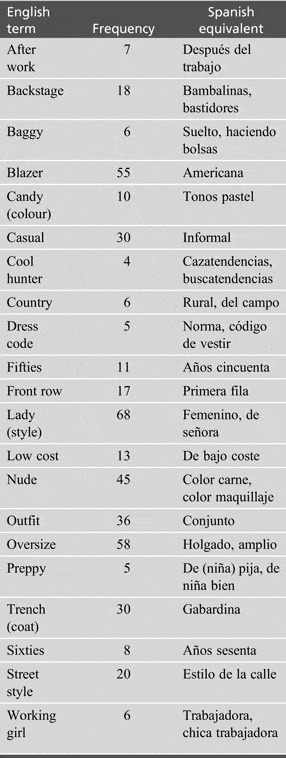
Table 1 lists the English forms that, according to our data, have been identified as euphemisms in the Spanish language of fashion, together with their number of occurrences and their translation into Spanish. Unless otherwise stated, the translations of these terms have been found in the Oxford Dictionary Spanish-English, English Spanish online.
Exemplifying the euphemistic value of these Anglicisms will start with the expressions ‘after work’ and ‘working girl’, which are used to create an atmosphere of fun and elegance:
-
1. El afterwork se vuelve aún más audaz: mini vestidos con cola, cazadoras de piel acharolada, trajes que perfilan el contorno del cuerpo… <Telva, March, 169> [‘The after work style becomes more daring: short dresses with a train, jackets with jet-black skin, suits that cling to your body…’]
-
2. Faldas lápiz, boleros y sastres se suceden en un mix de materiales y hacen las delicias de las working girls. <Elle, September, 48> [‘Pencil skirts, bolero jackets and suits come one after the other in a mixture of materials to the delight of working girls.’]
These English expressions shun the literalness of the Spanish word trabajo ‘work’ in the sequence después del trabajo ‘after work’ and in its derivative form trabajadora, chica trabajadora ‘working girl’. Clothes as those described in (1) and (2) play no part in possible unpleasant connotations accessible through the Spanish expressions, such as the physical effort work may involve, the body odour that may eventually derive from it or the tiredness felt after a working day. These aspects of work, and even certain professions more closely associated with them, are excluded from Spanish women's fashion magazines thanks to the employment of Anglicisms. Furthermore, the English sequence ‘after work’, with the meaning of ‘activities or social events taking place (immediately) after work hours’, can be familiar to a certain set of Spanish readers thanks to TV series or because they themselves take part in such gatherings. By using the English terms, fashion magazines seek to appeal to this sector of the readership which identifies with such atmosphere.
A slightly different situation is found around the English words ‘lady’ and ‘preppy’, used to indicate a classic and neat look. These forms try to avoid the outright rejection that would be aroused by the Spanish equivalents femenino, de señora, or de pija, niña bien, respectively. The literalness of the former forms sends the reader back to past times of classicism, modesty and virtuous demeanour, whilst the latter ones correspond to pejorative terms to denote the style of classic, upper class and conservative people. Therefore the native forms would not be appropriate to describe an attractive look for a modern, liberated woman. However, the English terms, thanks to their symbolic power and their unclear reference for most Spanish readers, function as enticing words and are understood in a broad sense as denoting a classy, attractive and modern style, as illustrated in:
-
3. El estilo lady característico de la mujeres de mediados del siglo pasado se recupera en vestidos estampados (…) y en elegantes trajes de dos piezas en un canto a la feminidad. <Vogue, March, 34> [‘The lady-style, characteristic of last mid-century women, is recaptured in print dresses and in smart two-piece suits in an ode to femininity.’]
-
4. La nueva silueta lady ciñe la cintura y se alarga cinco centímetros bajo la rodilla. <Telva, September, 4> [‘The figure of the new lady shows clasped waists and lets hems down to five centimetres under the knee.’]
-
5. El uso de accesorios desenfadados con toques lady & punk es clave. <Elle, September, 73> [‘The use of carefree accessories with touches of lady & punk style is key (to success).’]
-
6. La cyberwoman se viste de lady y hace de los accesorios en PVC sus mejores aliados. <Elle, March, 40> [‘The cyber woman dresses as a lady and turns accessories made of PVC into her best allies.’]
The modernity attached to the style embodied in the English form ‘lady’ is emphasised in examples (5) and (6), where readers are invited to combine it with its antagonistic punk style or where the highly topical cyber woman, with whom every young woman identifies, embraces this particular fashion trend.
In turn, the euphemism ‘preppy’ for de pija, niña bien, whose meaning is less straightforward for the general readership than that of ‘lady’, is made accessible in (7) thanks to its co-occurrence with popular upper-class seaside resorts such as The Hamptons in New York, or Saint Tropez in France. The elegance and the prestige of these world-famous destinations are transferred to the Anglicism ‘preppy’, which automatically symbolises these characteristics too:
-
7. Rayas. Este verano las hay para todos los gustos: marineras, horizontales, de aires preppy, (…) inspiradas en el estilo de Los Hamptons o Saint Tropez… <Elle, March, 147> [‘Stripes. This summer they will suit all tastes: navy stripes, horizontal, with a preppy air, inspired in the Hamptons or Saint Tropez…’]
Something similar happens in extract (8), where the name of the well-known American designer, Tommy Hilfiger, guarantees the comprehension of the word ‘preppy’ standing for this designer's characteristic style of refinement and quality for young people:
-
8. Tommy Hilfiger. Las chicas preppy del diseñador americano (…) llenan sus maletas de cuadros príncipe de Gales, rombos y pata de gallo. <Elle, September, 46> [‘Tommy Hilfiger. The American designer's preppy girls (…) pack their suitcases with Prince of Wales check clothes, diamond patterns and hound's-tooth prints.’]
Thus, these Anglicisms are able to create an atmosphere of traditional elegance and classicism that is attractive for modern, trendy readers, who could have otherwise rejected these same values should they have been presented with the literalness of the Spanish terms.
‘Casual’, ‘country’ and ‘street style’ made up another group of English words referring to styles of various types and that, for different reasons, can be considered euphemistic forms in Spanish fashion. Starting with the Anglicism ‘casual’, this word exists in the Spanish lexicon with the meaning of ‘chance’, but in fashion magazines it almost always appears either between commas or italicized to indicate that it is a loan word with the sense of ‘suitable for everyday wear rather than formal occasions’ (Oxford English Dictionary, online edition). Its Spanish equivalent, informal, has a pejorative reading in the Diccionario de la lengua española online (the Royal Spanish Academy Dictionary), which is described as inappropriate or incorrect whatever the circumstances. In order to avoid these negative associations, fashion magazines opt for the Anglicism ‘casual’, as shown in the excerpts that appear next:
-
9. Ya sea de fiesta o con un estilo más casual, David Christian tiene un diseño para ti. <Telva, September, 256> [‘Either for special events or with a more casual style, David Christian has a design for you.’]
-
10. (…) la capa-poncho roja y azul mantiene la elegancia omnipresente de Vuitton, pero aporta un toque étnico y casual al look. <¡Hola! fashion, September, 21> [‘The red and blue cape keeps the omnipresent elegance of Vuitton, but gives an ethnic and casual touch to the look.’]
It is worth noting how the reader is guided towards the interpretation of the foreign item ‘casual’. In (9), this is achieved by making the English term co-occur with clothing for special events, as a guarantee that a designer who designs clothes for such special occasions will surely know how to dress you on less formal ones. Extract (10) reaches a similar result by using the Anglicism to characterise a piece of clothing created by the exclusive designer Vuitton. Employing these strategies, the English word is broadened to mean a style that is not formal, but that preserves its elegance and glamour.
The sequence ‘street style’ can easily be assimilated to a context of usage very similar to that of the previous item. In the native equivalent form for this Anglicism, estilo de la calle (translation provided by fashion glossaries on line, such as Fundéu fashion glossary and Wikilengua), the expression la calle ‘the street’ appears attached to strong negative connotations, since it refers to a great body of people without a definite shape. This broad mass of the population is by definition vulgar and unattractive, just like the style it may call to represent. Additionally, in Spanish there are countless examples of colloquial fixed phrases made up with la calle as a synonym of an insignificant, nasty place, for instance, poner a alguien en la calle ‘to throw someone out (on the street)’, vivir en la calle ‘to live in the street = to be homeless’, or hacer la calle ‘to work on the streets’. Needless to say, within this context, the expression el estilo de la calle ‘street style’ can hardly embody distinction and elegance.
The following two examples from the data illustrate how the use of ‘street style’ conveys an atmosphere of up-to-date and sophisticated trends, impossible to attain through the native equivalent:
-
11. Su diseñador, Edgaro Osorio, aúna el street style con un aura lujosa y colorista. <Telva, March, 108> [‘The designer Edgaro Osorio mixes the street style with an aura of luxury and colour.’]
-
12. Estas musas del street style (…) son el mejor manual de estilo del momento. <Telva, September, 144> [‘These street style muses are the best up-to-date style manual.’]
Next for discussion is the Anglicism ‘country’. This term works as a euphemism replacing the less attractive native forms del campo or rural, adjectives that do not lend themselves well to describe fashion. Undeniably, the literalness of the Spanish words directs the reader to the simplicity and unaffectedness of rural life and wild countryside. But these terms are deemed unsuitable to characterise fashion trends, as they would merely refer to the clothing worn by peasants: artless, unrefined and with a rough finish. In contrast, the insertion of the Anglicism ‘country’ omits these negative, uncomfortable aspects, leading to the idea that the cosmopolitan reader enjoys, nevertheless, the natural beauty of simple things, their purity and unpretentious style. This is largely made possible thanks to the foreign origin of the Anglicism, as well as the more than likely familiarisation of the Spanish readership with the English term ‘country’ in the expression música country ‘country music’, with its characteristic ballads. The extract that appears below confirms this charming countrified style:
-
13. Vestidos con print hawaiano, abrigos de verano sobre shorts, chalecos con aire country, hacen de su moda algo fácil, sexy… <Telva, March, 136> [‘Hawaiian print dresses, summer coats over shorts, country waistcoats make of his designs an easy-to-wear and sexy fashion…’]
The next two English words, ‘fifties’ and ‘sixties’ stand for the Spanish equivalents de los años cincuenta and de los años sesenta, respectively, to denote women's characteristic dressing style during the first two decades of the second half of the 20th century. Because of their literalness, these native forms may sound outmoded to the modern woman living in the 21st century. However, the strategy of using the English terms to revive certain fashion trends of this particular period achieves a beneficial effect inasmuch as the style so characterised sounds different, new and glamorous. These expressions can even be associated with relevant people of the time, who have become timeless fashion icons and whose mother tongue was English, such as Grace Kelly, Jackie Kennedy Onassis or Audrey Hepburn. In this way, the Anglicisms are enriched with positive connotations, projecting smartness, stylishness and good taste. The following examples show the use of these forms:
-
14. De rayas, vestido de estilo tipo fifties de Carolina Herrera. <Elle, March, 127> [‘Striped dress inspired by the style of the fifties by CH.’]
-
15. Esta temporada, Karl Lagerfeld a través de Chanel, rinde tributo a este espíritu sixties usando botas altas. <Telva, September, 227> [‘This season, KL for Chanel pays tribute to the spirit of the sixties through high boots.’]
It can also be the case that the English words take over native forms that refer to colour, for instance, ‘candy’ for color/tonos pastel (literally, the colour of cakes) and ‘nude’ for color carne (literally, flesh tone) (translation taken from Wikilengua and RTVE blog, a blog on fashion run by RTVE, Spain's public television). The Spanish literal readings of these two elements lack the necessary appeal to describe fashion of any kind: the former, alluding to the colour of cakes, sounds childish, mawkish and dull. The latter, on the contrary, seems unpleasantly powerful to characterise clothing because it exactly means the colour of human flesh. Curiously enough, its literalness is adequate to describe the colour of a bra that does not show through, but apart from this usage, the average Spaniard will probably refer to this shade with the plausibly euphemistic expression color maquillaje (literally, the colour of makeup). Yet fashion magazines do not echo such an option, since it is hard to see how readers can find it persuasive to describe the colour of clothing using the image of makeup, one of the worst spoilers of clothes.
By replacing these native expressions with English words, the undesirable connotations disappear. The foreign terms ensure, instead, an air of softness, delicacy and sensuality, as can be appreciated in the excerpts below:
-
16. Los tonos candy (…) siguen presentes: azul cielo, vainilla y rosa palo. <Telva, March, 17> [‘Candy shades are still with us: light blue, vanilla and pale pink.’]
-
17. Sensualidad a flor de piel en este delicado vestido de cóctel en gasa nude y azul océano. (¡Hola! “Prêt-à-porter”, March, 123) [‘Lots of sensuality in this delicate cocktail dress in nude and deep blue muslin.’]
‘Low cost’ exemplifies another English euphemism substituting for the native form barato (literally, cheap). Although this Anglicism is gaining ground in present-day Spanish to refer to certain airline companies, outside this circle its practice is not widespread. Fashion magazines, however, often include the foreign word to avoid uncomfortable features easily attached to this Spanish form when it is applied to clothing, above all its low quality and its mass production, both aspects that are not beneficial for the image of the product. The foreign character of the English term manages to avoid these undesirable connotations, adding a touch of modernity and distinction, something unthinkable through the native form. The following example illustrates this link between ‘low cost’, on the one hand, and quality and style, on the other:
-
18. Este año estrenan David Christian Style, una línea low cost que mantiene la calidad y el diseño de la marca. <Telva, March, 243> [‘This year they will launch David Christian Style, a low cost brand that is faithful to the emblematic high quality and design of this firm’]
The following group of English words can be regarded as euphemisms inasmuch as their Spanish equivalents are set into a narrow context of usage that does not serve the persuasive purposes of fashion publications. The items in question are (i) bambalinas or bastidores ‘backstage’, (ii) primera fila ‘front row’ and (iii) gabardina ‘trench (coat)’. Terms (i) and (ii) automatically make the reader think of the theatre, but, despite the fact that nowadays some fashion shows have become dazzling performances, with music and sets included, I believe that behind this choice there is a conscious attempt to give fashion a charismatic and powerful personality. Thus, opting for the English words signals differentiation, symbolises professionalism, and exemplifies the technical vocabulary characteristic of fashion as a specialised field.
An analogous reasoning applies to case (iii). The Spanish form gabardina ‘trench (coat)’ alludes to a traditional clothing option for rainy days, and hence it is inevitably associated to the dullness and gloom of such weather. These determining factors delineate the native term gabardina, which is surrounded by unwanted connotations. In their quest for persuasiveness and positive vocabulary, Spanish fashion magazines usually replace it with the English word ‘trench (coat)’. This decision fits in, in the novel context of use, where this garment can be worn in various cuts, colours, and even in dry weather. Thus the Anglicism is assigned a broadened meaning of newness, innovation and attractiveness, nothing to do with the old style of the equivalent native form:
-
19. ‘He reinterpretado el trench dándole un aire muy estiloso, pero algo descarado y brillante,’ Christopher Bailey. <Elle, March, 260> [‘“I have reinterpreted the trench coat, giving it a stylish air, but also a fresh and glossy touch” says CB.’]
Similarly to the term gabardina ‘trench’ above, the Spanish word americana ‘blazer’, suffers from worn-out and pigeon-holed linguistic use. Its literal meaning indicates a hip-length garment with buttons and lapels, which can be worn by men and women alike. It is thus a traditional piece of clothing. But, once again, in their determination to look for imaginative vocabulary that sounds fresh and professional at the same time, fashion magazines bank on English words. Through these they manage to get rid of the literalness of native terms, to run away from tradition and to give a twist to clothes that are then presented as a sheer novelty.
In the cases that appear next, it is not hard to uncover some problematic aspects surrounding the native forms conjunto ‘outfit’ and norma/código de vestir ‘dress code’. When conjunto, the Spanish translation of ‘outfit’ in the Oxford Dictionary Spanish-English, English-Spanish online is checked in the Royal Spanish Academy Dictionary online (Diccionario de la lengua española), one discovers that none of the ten meanings given for this Spanish entry matches the sense ‘a set of clothes worn together, especially for a particular occasion or purpose’, since, according to this authoritative Spanish source, the lexical unit conjunto refers to a matching cardigan and jumper, that is, the English expression ‘twin set’. ‘Outfit’, however, is recorded in the Oxford Dictionary Spanish-English, English-Spanish as the English translation for the native terms vestimenta and atuendo, but it warns the user that the context in which they tend to appear is either too formal or humorous. It is no wonder then that in fashion magazines preference is given to the English item ‘outfit’ to indicate a type of modern look which follows the latest trends:
-
20. Llega el verano. Shorts, sandalias y un aire desenfadado y cómodo componen el outfit perfecto para los días de playa. <Vogue, March, 25> [‘Summer is here. Shorts, sandals together with a carefree and comfortable air make the perfect outfit for those days on the beach.’]
-
21. (…) cualquiera firmaría por tener en su armario cada uno de los outfits, tan clásicos como estilosos. <Telva, September, 115> [‘Anyone would like to have in her wardrobe each of these classic and stylish outfits.’]
With respect to the Spanish expressions norma/código de vestir ‘dress code’, their literalness connotes a situation of authority, rigidity and control that is unwelcome in the present context of persuasion. But, paradoxically enough, each season brings designers’ new collections, imposing what is in or out. Moreover, some celebrities, bloggers, and ‘it-girls’ are internationally acclaimed as leaders of fashion and arbiters of taste, which offers additional evidence that fashion dictates rules and we obey them. Deciding on the English term, however, relaxes and even dilutes the degree of commitment to the rules because the Anglicism stands, in the readers’ view, for trends, rather than norms. Additionally, the foreignness of the Anglicism signals that such trends come from abroad, from where fashion matters are truly decided, and therefore they appear no longer as rules, but as valuable information worth knowing and putting into practice in order to look stylish.
-
22. El dress code primaveral impone (…) el estilo oriental (…) y el étnico. <Elle, March, 61> [‘The spring dress code confers the Far East style and the ethnic one’]
The interest of the next group of Spanish words, suelto, haciendo bolsas ‘baggy’ and holgado, flojo ‘oversize’, lies in their inadequacy to define a style of clothes with ample, large forms which bears no relationship to overweight or extra large sizes, but that, due to their literalness, ends up establishing it. Unlike other examples of euphemism in this domain, size or weight can really be considered taboo topics, and hence fashion publications feel the need to circumvent them, showing a preference for the euphemistic value of Anglicisms. The first expressions, suelto, haciendo bolsas ‘baggy’, refer to the typical looseness and hanging effect of those garments that are bigger than one's size. Alternatively, they can connote a context of worn out clothes, especially trousers, which, after repeated use, are baggy at the knees. As can be appreciated, both meanings are pejorative. In turn, the Spanish items holgado, flojo ‘oversize’ broadly mean “too wide”, and appear as common words to define the style of clothing for plump people. Consequently, fashion magazines avoid these negatively laden native terms to describe trends based on wide, ample tailoring, but that are not meant for stout people. Choosing the English words, however, thanks to their foreign nature and symbolic power, it is possible to change such undesirable connotations for originality, trendiness and professional skill. The short extract that comes next fosters this atmosphere of innovation and elegance:
-
23. Chic. Siluetas oversize y tejidos tecnológicos. <Telva, March, 22> [‘Chic. Oversize shapes and technological fabrics.’]
The Anglicism ‘cool hunter’ closes this overview on euphemisms. Even though this term is not a lexical entry in the Oxford Dictionary Spanish-English, English-Spanish, fashion glossaries on line (FUNDEU and Wikilengua) translate it as cazatendencias and buscatendencias. These equivalents make the reader activate connotations that are unwelcome in the world of fashion. On the one hand, this is largely the responsibility of the prefixes caza- and busca-, whose meanings, ‘chasing’ or ‘running after’ in a context of interpersonal relationships, indicate the hot pursuit of a person in order to take advantage of them or something they may have. Besides, these relatively uncommon beginnings in the Spanish vocabulary immediately bring to mind other terms that start in the same way, as for instance, cazafortunas ‘fortune hunter’ and buscavidas ‘chancer’. Additionally, the beginning busca- leads the reader to its two derivative forms, namely, buscón and buscona. The first one of these appears in the title of the well-known 17th century picaresque novel La vida del Buscón ‘The life of the Buscón’, the portrait of an uncouth, ruthless and miserable man. The second one, buscona ‘prowler’, is a powerful negative term to denote a woman who runs after men. Given this situation, the (unusual) foreign term ‘cool hunter’ operates as a euphemistic form to neutralise the derogatory meanings of the Spanish expressions. Even though the whole English compound may be unknown to the majority of the readers, they will indeed be familiar with the form ‘cool’, which is enough to introduce a touch of liveliness, innovation and assurance. These ideas will be incorporated to the meaning of ‘cool hunter’, as illustrated in the following example that talks about Juan Vidal, an emerging young Spanish designer:
-
24. Todo cambió cuando (…) los cool hunters del equipo de Dolce & Gabbana (…) se quedaron con su colección. <Telva, March, 111> [‘Everything changed when cool hunters working for Dolce & Gabbana bought his collection.’]
The analysis of the euphemistic value of the various Anglicisms recorded here has been based on their connotative value; as has been noted (Allan, Reference Allan2007: 1048), to identify the connotations of a term is to identify the community attitude towards it. Hence a line of future research may consist of surveying readers’ feelings on the function of these words; equally interesting would be to approach how magazine editors themselves feel about using such foreign terms. Completing the study would also involve examining British magazines in order to know whether they use any other language and what effect is achieved.
Final remarks
This paper has argued that Spanish fashion magazines regard stylistic choices as a persuasive strategy to reach and appeal to their wide readership. Journalists have found in Anglicisms the perfect elements to perform this rhetorical function. In the first place, they have taken advantage of the dominant position held by English in the specialised area of fashion: echoing the jargon used by international experts, their publications also acquire an international and professional dimension. Secondly, they have depended on the symbolic power of English as a guarantee of reliability, modernity and high quality, characteristics that are highly beneficial for fashion. And thirdly, it has been shown how English words are cleverly employed with a euphemistic value. Thanks to their foreign nature and prestige, when they replace some native equivalents they are able to change the unwanted connotations that derive from the literal readings of these forms by an atmosphere of stylishness, innovation and glamour. In so doing, Anglicisms become euphemisms that manage to maintain the required and refined standards of fashion.
 Marisa Diez-Arroyo is a Senior Lecturer in the Department of English Studies at the University of Oviedo, Spain. Her research field has centred on pragmatics and discourse analysis, applied mainly to the language of advertising. She is currently interested in English borrowings. Her latest work has been published in academic journals as Ibérica and Terminology. Email: arroyo@uniovi.es



