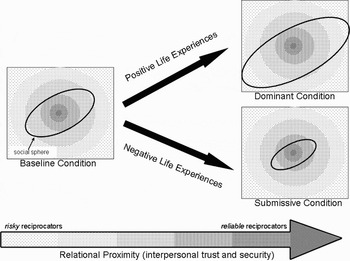
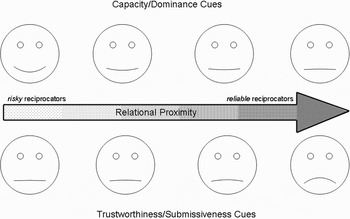
1. Introduction
In The Expression of Emotion in Man and Animals, Charles Darwin (Reference Darwin1872) made multiple observations of similarities and differences in emotional behaviors of humans and other animals, and stylistic differences in emotional expression between men and women that have yet to be fully understood in an evolutionary context. Integrating such between-species and within-species variations in emotional expression into a single framework of expressive behaviors remains a challenge for scientists today.
From a clinical standpoint, pathologies that tend to affect one sex more than the other, such as low mood in adolescent girls and women, and conduct and autistic spectrum disorders among males, require a better understanding of the causes of normal sex differences in emotional development and emotional expression (e.g., Baron-Cohen et al. Reference Baron-Cohen, Knickmeyer and Belmonte2005; Garber Reference Garber, Sameroff, Lewis and Miller2000; Rutter et al. Reference Rutter, Caspi and Moffitt2003). Although males and females may experience these conditions similarly (e.g., felt sadness), they express themselves differently (Bogner & Gallo Reference Bogner and Gallo2004). Boys are often described as producing more externalizing behaviors that act on the external environment (e.g., physical aggression, psychomotor agitation, risk-taking), whereas girls are described as producing more internalizing behaviors that are focused on the individual (e.g., worrying, sadness, self-blame [Crick & Zahn-Waxler Reference Crick and Zahn-Waxler2003; Khan et al. Reference Khan, Gardner, Prescott and Kendler2002; Salokangas et al. Reference Salokangas, Vaahtera, Pacriev, Sohlman and Lehtinen2002]). These patterns beget the questions of whether or not common distress behaviors are associated with adaptive cost-benefit trade-offs, and how and why these trade-offs may differ by sex.
In the first section of the article, I introduce a theoretical framework for understanding phenotypic variation in expressed emotion, which I refer to as a socio-relational framework of expressive behaviors (SRFB). The framework integrates and extends traditional non-evolutionary (e.g., Lazarus Reference Lazarus1991; Leary Reference Leary1957) and evolutionary (e.g., Cosmides & Tooby Reference Cosmides, Tooby, Lewis and Haviland-Jones2000; Nesse Reference Nesse1990) discussions of emotionality by describing the social constraints that were likely essential to the evolution of human social and expressive behavioral systems. I reason that sex-typical emotive behaviors would have coevolved with these constraints in order to regulate interpersonal dynamics to enhance social fitness. The framework also attempts to integrate earlier models of emotionality that highlight subjective dimensions of emotional experiences (e.g., valence and arousal; Barrett Reference Barrett1998) with the natural diversity of expressed emotion.
In the second section, I discuss new work in the evolution and development of sex-typical social dynamics, relationship demands, and social styles, including the perception and expression of masculine versus feminine behaviors. I go on to review common sex differences in the emotional development literature and show how the vast majority of findings can be integrated into the broader socio-relational framework.
In the third and final section, I outline how this framework regularizes our understanding of gender variation, relationship variation, and conditional variation in expressive behaviors across the life span. I describe how the quality and quantity of one's relationships can be related to cost-benefit fitness trade-offs, and how distinctive patterns of expression may be functional for the formation and maintenance of specific types of relationships.
2. The evolution of emotional expressivity
The SRFB rests on the assumptions that the adaptive significance of affective responses (e.g., emotions, dispositions, moods) lies in their expression and that affect behaviors function to systematically motivate other people to respond to the signaler in ways that enhance the signaler's fitness (e.g., Darwin Reference Darwin1872; Dunn Reference Dunn, Davidson, Goldsmith and Scherer2003; McGuire Reference McGuire, Lewis and Haviland1993; Snowdon Reference Snowdon, Davidson, Scherer and Goldsmith2003; see also Panksepp Reference Panksepp, Lewis and Haviland-Jones2000; Reference Panksepp2003; Patterson Reference Patterson2003). Neither physiological arousal, nor feelings occurring within a person can enhance fitness unless there are actions associated with these internal states (James Reference James1884). I thus operationally define emotions as expressive behaviors that are often associated with the conscious awareness of intense, appealing and aversive sensations. Likewise, I define a social expression as any behavior that is both observable and can be exaggerated or attenuated by the individual's audience or other social context.
Several lines of research support this description. Developmental studies, for example, show that human infants produce their very first emotive gestures, such as smiling, subsequent to a social interaction that includes face-to-face contact, and that these behaviors tend to cease immediately following the termination of a mutual gaze (Yale et al. Reference Yale, Messinger, Cobo-Lewis and Delgado2003). Similarly, people become more expressive (e.g., smile) when they know that others are observing them; when observers have similar descriptive characteristics to the participant; when fellow audience members are perceived to be interacting, such as engaging in mutual eye contact; and even when audience members are not physically present, but are only perceived to be, such as when children are told that another child is viewing the same film in another room (Chapman Reference Chapman1973; Reference Chapman1975; Fridlund Reference Fridlund1991; Jakobs et al. Reference Jakobs, Manstead and Fischer1996; Kraut & Johnston Reference Kraut and Johnston1979; LaFrance et al. Reference LaFrance, Hecht and Paluck2003). Fridlund summarized this research by suggesting that emotional expressivity is not only moderated by, but is perhaps mediated by, the imaginary presence of others, and that the expressive components of emotionality should not be assumed to represent felt experiences (see Fridlund et al. Reference Fridlund, Sabini, Hedlund, Schaut, Shenker and Knauer1990). I use these examples not to debate whether the expressive component of emotion is more biologically primary than the cognitive and experiential components (e.g., see Haidt Reference Haidt2001), but simply to justify the relevance of focusing on the types of social properties or socially relevant information that may underlie variation in the expression of emotive gestures.
2.1. Basic dimensions of emotive behaviors
The SRFB subsumes many traditional models of emotive behaviors, especially models that highlight the significance of trust and dominant/submissive patterns of interaction behaviors (e.g., Carson Reference Carson1969; Darwin Reference Darwin1872). For example, Leary (Reference Leary1957) proposed that personality behaviors (e.g., acting nice, weak, aggressive, and confident) can be conceptualized as representing two dimensions: dominance versus submissiveness and love versus hate. He described these behaviors in the context of the reciprocated reactions (e.g., kindness, sympathy, fright, and respect) that they evoke from others. The SRFB extends Leary's and similar models by explicating potential fitness advantages of the motivations to both signal and respond to these traits, as well as by describing how and why these interaction patterns covary with experiential successes versus failures and situational circumstances, such as interpersonal relationship dynamics and audience characteristics.
2.1.1. Approach and withdrawal behaviors
Central to the SRFB is the premise that the most basic dimension of expressed emotion is the universal motivation to respond to external stimuli, and especially to other social agents, with either approach or withdrawal behaviors (Buck Reference Buck1999; Davidson Reference Davidson, Lewis and Haviland1993; Davidson et al. Reference Davidson, Jackson and Kalin2000; see also Cacioppo et al. Reference Cacioppo, Klein, Berntson, Hatfield, Lewis and Haviland1993; Camras et al. Reference Camras, Holland, Patterson, Lewis and Haviland1993; Gray Reference Gray2002). Approach behaviors are actions designed to exploit the environment such as food and mates, whereas withdrawal behaviors are actions designed to avert environmental threats such as toxins and predators. In humans, this system may be especially sensitive to evaluate potential benefits and dangers of interacting with other people and engaging in different types of relationships. Interactions that have the potential to provide reciprocated investment should stimulate affiliative behaviors, whereas interactions that are non-reciprocal in nature, and thus potentially exploitive, should stimulate avoidant behaviors. When considered from an evolutionary perspective, the basic motivation to respond to other social agents through either affiliative or avoidant behaviors should occur reflexively and heuristically and thus be responsive to ecologically relevant stimuli, and develop and manifest as prototypical facial and bodily gestures in the absence of extensive social modeling (Darwin Reference Darwin1859; see also Cosmides & Tooby Reference Cosmides, Tooby, Lewis and Haviland-Jones2000; LeDoux Reference LeDoux1996; Öhman & Wiens Reference Öhman, Wiens, Davidson, Scherer and Goldsmith2003). From this perspective, the types of experiences (e.g., social losses) that elicit a behavioral response (e.g., sadness behaviors) are directly associated with the form and functionality of the behaviors themselves.
Research on facial expression processing shows that the human amygdala is sensitive to process threatening faces (e.g., expressions of anger and fear) more quickly and accurately than other stimuli, and especially when the signaler is a male (e.g., Fox et al. Reference Fox, Lester, Russo, Bowles, Pichler and Dutton2000; Goos & Silverman Reference Goos and Silverman2002; Mogg & Bradley Reference Mogg and Bradley1999). Öhman (Reference Öhman2002) summarized this research by suggesting that hypersensitivity to fearful and angry faces does not reflect an emotion-processing system that is specialized to process the physical characteristics of the human face, per se, but rather an evolved cognitive bias to discriminate threatening from non-threatening individuals. This interpretation is supported by research showing parallel sensitivities for processing nonsocial dangers (e.g., snakes and spiders [Öhman et al. Reference Öhman, Flykt and Esteves2001]).
A related prediction is that attentive and perceptual biases to detect threatening and non-threatening individuals should have coevolved with expressive behaviors designed to promote affiliative and aversive responses from others. In theory, these behaviors should operate by signaling the opportunity to form reciprocal relationships (e.g., displayed kindness) or the ability to protect oneself (e.g., displayed meanness), depending on the likelihood of receiving reciprocal investment from others (see also Hamm et al. Reference Hamm, Schupp, Weike, Davidson, Goldsmith and Scherer2003). In this sense, all expressive gestures, including affect behaviors, should be identifiable along an affiliative/avoidant dimension of behavioral response, depending on whether the behavior typically results in social bonding or in social distancing, across individual relationships. The basic questions that follow are: “What types of social properties should individuals be sensitive to attend to in other people?” and, correspondingly, “What characteristics should individuals express or advertise to others?”
2.1.1.1. Reciprocity potential
The SRFB is based on the thesis that the social properties that influence the motivation to either be attracted to or to avoid other people may be framed in terms of the construct “reciprocity potential” (Vigil Reference Vigil2007). According to this framework, organisms should be sensitive to display or advertise their reciprocity potential, or perceived attractiveness as a social partner (e.g., mate, friend, community member), by displaying the types of characteristics that are preferred among conspecifics. In the broadest sense, reciprocity potential represents the individual's cache of resources that are extractable by others through a single or series of social interactions. More specifically, I have previously hypothesized that this potential is contingent on two essential social properties: perceived capacity and trustworthiness cues. Capacity cues demonstrate the individual's ability to provide some sort of resource (genetic material, food, protection, socio-political opportunities, etc.) or to inflict immediate harm on others. In contrast, trustworthiness cues demonstrate the individual's intentions, desires, or otherwise probability of actually reciprocating altruism and hence investing into a relationship (Vigil Reference Vigil2007; for a similar discussion, see Newcomb Reference Newcomb1990). These two elementary concepts (capacity and trustworthiness) may be the most parsimonious properties of reciprocity potential, because insufficient levels of either of these constructs, such as having a lot to offer but being unwilling to do so, or being willing but having nothing to offer, result in little impact on others.
2.1.2. Capacity and trustworthiness behaviors
2.1.2.1. Capacity cues
Empirical studies show that humans, as do other highly affiliative species, respond to social challenges with either “dominant” or “submissive” behavioral strategies (e.g., happiness vs. sadness, aggression vs. appeasement, disdain vs. shame, confidence vs. worry [Aureli Reference Aureli1997; Bugental & Lewis Reference Bugental, Lewis, Kofta, Weary and Sedek1998; Sapolsky Reference Sapolsky2004; see also Darwin 1872]). These patterns may reflect behavioral advertisements of one's abilities (cues of capacity) and intentions (cues of trustworthiness), respectively. For example, capacity cues may be perceived through personal characteristics, such as physical stature, personal competencies, material resources, and perceived dominance that signal the individual's ability to physically invest in or to otherwise affect the welfare of others, either positively or negatively. Traits that distinguish the individual's personal competencies and healthiness (e.g., physical attractiveness; Scheib et al. Reference Scheib, Gangestad and Thornhill1999) are fundamental components of implicit personality theories (Schneider Reference Schneider1973) and appear to be unrelated to perceptions of integrity and concern for others (Eagly et al. Reference Eagly, Ashmore, Makhijani and Longo1991). Likewise, behavioral studies of humans and other socially embedded species (e.g., monkeys and hyenas) show that individuals implicitly attend to, stare at, and mimic peers whom they perceive to be more powerful, dominant, and higher-status, rather than behaving in this manner towards subordinates (Fiske Reference Fiske1993a; Holekamp Reference Holekamp2006). These studies suggest that cognitive biases to attend to cues of dominance (e.g., larger size, erect posture, threat stares, assertive speech, expressed confidence) may be corollary features of social processing in primates, in general, and almost certainly in humans (Mazur Reference Mazur1985; Mignault & Chaudhuri Reference Mignault and Chaudhuri2003; Moors & De Houwer Reference Moors and De Houwer2005; see also Tiedens & Fragale Reference Tiedens and Fragale2003). The current suggestion is that these perceptual biases may represent a modularized detection system that is primed to evaluate traits and behaviors that signal others' capacity to reciprocate social favors or capacity to inflict physical harm onto the individual.
2.1.2.2. Trustworthiness cues
In contrast to signals of capacity, trustworthiness cues are perceived through interpersonal characteristics such as kindness, sympathy, and integrity in humans, and through submissive behaviors in less social species. The basic reasoning is that explicit demonstrations of prosocial behaviors (e.g., expressed compassion) and displays of vulnerability (e.g., head bow, gaze aversion, slow movement patterns, crying and worrying behaviors, self-degradation) may be adaptive by reducing the perception of threat and thus disarming the threat interpretation by others. Through exaggerated displays of benevolence, individuals may be signaling their motivations and intentions, and hence their trustworthiness or probability of reciprocating altruism. Of course, the phenotypic manifestation of submissive behaviors (e.g., crying) may also reflect the individual's actual vulnerability and inability to reciprocate resources. However, the current reasoning is that these handicaps would not be displayed so explicitly or in such an exaggerated form unless there was a specific fitness advantage to doing so.
Likewise, several studies have identified a specialized neural circuitry (involving the right superior temporal sulcus) that may be responsible for the detection of trustworthiness in other people (Winston et al. Reference Winston, Strange, O'Doherty and Dolan2002; see also Adolphs et al. Reference Adolphs, Tranel and Damasio1998). Todorov and colleagues, for instance, showed that people are particularly sensitive to process cues of competency and trustworthiness in human faces, and that these evaluations are both automatic and integral to social trait impressions (Todorov Reference Todorov2008; Todorov et al. Reference Todorov, Mandisodza, Goren and Hall2005; Willis & Todorov Reference Willis and Todorov2006). More specific analyses show that amygdala activity is positively correlated with perceptions of distrust and with facial expressions (e.g., anger and fear) that signal threat (Engell et al. Reference Engell, Haxby and Todorov2007; Todorov Reference Todorov2008; Zald Reference Zald2003).
Other research shows that people elicit specific endocrine responses, involving the release of oxytocin and vasopressin, when they experience increased trustworthiness and bonding toward others (e.g., Bartels & Zeki Reference Bartels and Zeki2004; Zak et al. Reference Zak, Kurzban and Matzner2004). Behavioral studies have similarly uncovered numerous factors (e.g., repeatedly interacting with others; Ben-Ner et al. Reference Ben-Ner, Putterman, Kong and Magan2004; Buckingham et al. Reference Buckingham, DeBruine, Little, Welling and Conway2006) and interpersonal behaviors that humans may use to induce perceptions of trustworthiness and compliance, including eye contact, self-disclosure, physical touch, smiling, and simple mimicry (Bayliss & Tipper Reference Bayliss and Tipper2006; Collins & Miller Reference Collins and Miller1994; Crusco & Wetzel Reference Crusco and Wetzel1984; Kurzban Reference Kurzban2001; Lakin & Chartrand Reference Lakin and Chartrand2003; van Baaren et al. Reference Van Baaren, Holland, Kawakami and van Knippenberg2004; Webbink Reference Webbink1986; Willis & Hamm Reference Willis and Hamm1980). At least one other study has shown that participants who were administered oxytocin in turn expressed higher levels of eye contact than did controls (Guastella et al. Reference Guastella, Mitchell and Dadds2008). From a socio-relational perspective, these perceptual, neuroendocrine, and expressive biases may have coevolved to process the trustworthiness component of other peoples' reciprocity potential, as well as the motivation to advertise these cues to others selectively (see also Boone & Buck Reference Boone and Buck2003).
2.2. Unique features of capacity and trustworthiness cues
Collectively, these studies suggest that humans are sensitive to categorizing others according to dominance status and traits that signal altruistic tendencies and vulnerability (e.g., babyish features; Fiske Reference Fiske1993b). From a socio-relational perspective, these sensitivities reflect the basic motivation to process the abilities and intentions and hence reciprocity potential of other people. Related research on social preferences suggests that people may evaluate capacity and trustworthiness attributes in others somewhat differently. People tend to evaluate capacity traits (e.g., physical attractiveness, intelligence, material resources) in others relative to self-evaluations (Lazarsfeld & Merton Reference Lazarsfeld, Merton, Berger, Abel and Page1954; see also Kenrick et al. Reference Kenrick, Li and Butner2003) and prefer peers that have similar, yet slightly higher, levels of these traits over peers with significantly lower or significantly higher capacity attributes than themselves (Vigil Reference Vigil2007). In contrast, people tend to appreciate trustworthiness traits (e.g., kindness, responsibility) in others in a more linear fashion such that the highest levels are most preferred, and preferences are independent of self-evaluations (Li et al. Reference Li, Bailey, Kenrick and Linsenmeier2002; Vigil Reference Vigil2007).
These findings are important, because they suggest that perceptions of trustworthiness are obligatory for the formation of most reciprocal relationships, whereas the selective increase or decrease of capacity displays may be needed to strengthen individual relationships between people that differ in social status. The importance of trustworthiness for human sociality may be why people tend to report and presumably believe that they are “kinder than the average person” and why people inflate their self-described kindness more so than other attributes (Vigil Reference Vigil2007). Increased sensitivity to appreciate kindness in others and to exaggerate expressions of, and perhaps (falsely) believe in, the unique virtue of one's own kindness may ultimately result in stabilizing human relationships at the dyadic, group, and perhaps species levels of sociality.
Other research suggests that humans may be motivated to adjust preference for capacity and trustworthiness traits in others in relation to the expected extent of the relationship. For example, research on human mate preferences shows that both men and women place greater emphasis on preference for high capacity traits (e.g., physical attractiveness, material resources) rather than high trustworthiness traits when seeking short-term relationships. In contrast, people place a greater emphasis on high trustworthiness traits (e.g., kindness, responsibility) when seeking long-term, more committed, or more exclusive relationships (Cottrell et al. Reference Cottrell, Neuberg and Li2007; Geary et al. Reference Geary, Vigil and Byrd-Craven2004; Li et al. Reference Li, Bailey, Kenrick and Linsenmeier2002; Vigil et al. Reference Vigil, Geary and Byrd-Craven2006). From a socio-relational perspective, capacity cues may be sought and preferred in short-term relationships, because these types of characteristics do not require repeated interactions to be accurately assessed; they are immediately and more generally observable in other people. In contrast, the veracity of trustworthiness cues may be less discernable through limited exposure, and instead requires repeated interactions to be evaluated accurately.
A complementary hypothesis is that people perceive capacity and trustworthiness cues as signaling the potential to interchange different types of resources with others. Capacity cues may signal one's expedient or immediate resource potential, such as genetic resources in the case of mate preferences. In contrast, trustworthiness cues may signal one's willingness to provide more continuous provisioning, such as extensive and reliable social support. In this sense, the selective advantage in evaluating and potentially interchanging capacity and trustworthiness cues with other people may pivot on the cost-benefit trade-offs that may be associated with investing in different types of relationships (e.g., Vigil & Geary Reference Vigil and Geary2007).
In any case, sensitivity to subtleties in capacity and trustworthiness cues in others, and the tendency to increase preference for higher levels of these cues in short-term and long-term relationships (respectively), suggest that detection and expression of these attributes may be integral to relationship formation. Finally, it is important to note that not all capacity and trustworthiness attributes are intuitively associated with the perception of dominance and submissiveness, respectively. Consider the case of a diseased person who has the capacity to infect others but who is perceived as vulnerable, or a person who is perceived to be trustworthy because of a high-status job. These cases show that dominance and submissiveness trait impressions, while typically associated with high-capacity and high-trustworthiness attributes, are merely examples of cues that humans may use to interchange reciprocity potential.
2.3. Variation in discrete emotive behaviors
From the perspective of the SRFB, discrete emotive gestures (e.g., facial expressions, body-movement patterns, sustained mood behaviors) are examples of social expressions that have evolved to display capacity and trustworthiness cues in order to promote interpersonal affiliation or distancing from other people. In this sense, the following models incorporate both dimensional and discrete aspects of emotionality. According to the SRFB, discrete emotive behaviors (e.g., sadness vs. joy), while specialized in form and function, may also be conceptualized along broad patterns or dimensions of functionality. This is not to say that discrete emotive behaviors are always manifested within an immediate social context, they are always associated with either the motivation to promote affiliation or avoidance, they never overlap, or that they are only targeted at single individuals or types of audiences. On the contrary, just like other forms of communication such as speech, emotions can manifest in the absence of physical audiences. Likewise, many emotive gestures such as sadness and aggressive responses are pleiotropic, emerge in coordination with other emotions (e.g., simultaneous displays of joy and aggression; Hubbard et al. Reference Hubbard, Smithmyer, Ramsden, Parker, Flanagan, Dearing, Relyea and Simons2002), and can be functional for both social consolidation and social distancing (discussed in more detail in section 3, “Implications for variation in expressive behaviors”). The current suggestion is that discrete emotive behaviors, while variable in context, may operate through systematic processes, each in terms of the types of events that precipitate their expression, the expressive characteristics of the gestures themselves, and the social outcomes or responses they elicit from others.
2.3.1. Responses to events
One prediction from the SRFB is that discrete emotive behaviors covary with conditions that affect the opportunity to advertise the capacity and trustworthiness components of reciprocity potential. A conceptual illustration of how salient life conditions and evaluations of other people may affect the expression of so-described “basic” emotions (see Ortony & Turner Reference Ortony and Turner1990) is presented in Figure 1. For convenience, I have separated the emotions into two categories: responses to events (Fig. 1a) and responses to other people (Fig. 1b). Figure 1a shows examples of emotions that people express in response to events and circumstances that affect their own perceived reciprocity potential; I refer to these emotions as intra-appraisal emotions. “High” and “Low” levels of capacity and trustworthiness traits represent the individual's state in relation to the event or circumstance, and in relation to one's immediate peers. The corresponding emotions should then be inferred as behavioral responses to the event that operate in part to selectively promote affiliation or avoidance, and as advertising either capacity or trustworthiness cues to others (Fig. 1a).
(a)Intra-appraisal emotions are responses to the impact of an event or set of circumstances on the individual's own reciprocity potential. Events that decrease the individual's capacity resources (see the y-axis) elicit low-capacity emotions (e.g., sadness and fear), whereas events that retain or enhance these attributes elicit high-capacity emotions (e.g., anger and joy). Depending on the individual's perceived trustworthiness status (see the x-axis), he or she should express emotions that either avert social interactions (e.g., anger and fear) when he or she is not trusted or cannot trust others, or solicit affiliation (e.g., joy and sadness) under more secure social conditions. (b) In contrast, extra-appraisal emotions are responses to the evaluation of other people's reciprocity potential. Individuals should respond to other people who are perceived as “low” in trustworthiness (x-axis) with avoidant emotions (e.g., disgust and fear), and respond to other people who are perceived as “high” in trustworthiness with affiliative emotions (e.g., love and sympathy). Depending on the simultaneous perception of the other person's capacity attributes (y-axis), individuals should produce emotions that advertise their own cues of high-capacity (e.g., love and disgust) or high-trustworthiness (e.g., sympathy and fear) to the person being evaluated.

For example, Figure 1a shows how behavioral expressions of joy and anger may be conceptualized as distinct forms of high-capacity displays that, under certain conditions, are functional for either attracting or averting interactions with other people. Facial expressions of joy and anger are both associated with the perception of dominance from others, though they differ in that joy is associated with the attendant perception of high affiliation, whereas anger is associated with the perception of low affiliation (e.g., Izard Reference Izard, Lewis and Haviland1993; Marsh et al. Reference Marsh, Adams and Kleck2005; Montepare & Dobish Reference Montepare and Dobish2003). According to the SRFB, people are predicted to express these emotions when they either increase or retain high levels of capacity attributes (e.g., health, material resources, physical prowess, social status), but express these emotions differently according to whether the individual also perceives their immediate relationships to be trustworthy or untrustworthy. Thus, expressions of joy and pride may be conceptualized as affiliative responses that signal successful experiences and available resources and hence capacity to reciprocate with others under trustworthy social conditions. Instead, expressions of anger and hostility may be primarily avoidant responses that are used to signal the ability to protect oneself under conditions in which the perception of trust has been breached. People who endure repeated experiences of distrust (e.g., peer rejection, child abuse, adult assault) in their lives show greater sensitivities to recognize and display felt anger and aggression (Hubbard Reference Hubbard2001; Pollak & Sinha Reference Pollak and Sinha2002; Vigil et al., submitted). When individuals experience these feelings, they prefer to avoid other people (Vigil, Reference Vigil2008); when individuals encounter angry peers, they similarly inhibit affiliative gestures (e.g., expressed sympathy; Strayer & Roberts Reference Strayer and Roberts2004).
In contrast, under conditions in which people experience decreased capacity resources, such as financial and social losses (Brown Reference Brown, Lewis and Haviland-Jones2000; Salvador Reference Salvador2005), they may instead exaggerate displays of vulnerability and harmlessness in order to signal their intentions and thus the trustworthiness component of reciprocity potential through emotions such as sadness and fear. However, as shown in Figure 1a, the expression of these emotions may differ according to the level of social support available to the individual. People are predicted to express sadness under conditions in which the individual can rely on the trustworthiness of others, and instead express fear when in untrustworthy, less secure social contexts. Sadness behaviors such as crying and blushing are highly associated with the perception of trust and with expressed sympathy by others (e.g., de Jong Reference de Jong1999; Van Tilburg et al. Reference Van Tilburg, Unterberg and Vingerhoets2002; Williams Reference Williams1982; Zeifman Reference Zeifman2001; see also Boone & Buck Reference Boone and Buck2003). From the current perspective, sadness behaviors have evolved to signal trustworthiness cues to others at times when the ability to display high capacity is diminished and in ways that solicit reciprocal advertisements of trustworthiness displays from others, such as increased attention, expressed sympathy, and behavioral and material investment. In contrast, fear behaviors (e.g., high-pitched whimpering and alarm screams, worrying, incontinence) may be better suited for exaggerating the display of submissiveness and vulnerability in ways that avert interactions with dangerous people. These behaviors may ultimately operate to subjugate the display of capacity, diffuse the threat interpretation of others, stigmatize the status reward of a confrontational victory by others, and ultimately motivate potential assailants to leave the debilitated individual alone.
2.3.2. Responses to other people
Figure 1b shows that the types of emotions that people express in response to the evaluation of others, referred to as extra-appraisal emotions, may also be understood in terms of reciprocity potential and the motivation to affiliate or avert interactions with others. For these emotions, “High” and “Low” trait levels represent perceptions of another person's reciprocity potential relative to self-evaluations. The corresponding emotions should again be inferred as behavioral responses to the evaluations of another person, and as reciprocating displays of capacity or trustworthiness cues in order to promote affiliation or avoidance with the other person. For example, individuals may respond to other people who are perceived as “high” in trustworthiness but having “low” capacity attributes with affiliative responses designed to reciprocate the display of one's own trustworthiness, such as through expressed compassion and sympathy (see also Miller Reference Miller, Tiedens and Leach2004; Rudolph et al. Reference Rudolph, Roesch, Greitemeyer and Weiner2004). Likewise, individuals may respond, when perceiving the other person as both highly trustworthy and highly competent, with behaviors that signal one's own capacity and desire to invest in a reciprocal relationship, through expressions such as admiration and love.
Other people who are perceived as untrustworthy should instead increase one's threat interpretation and should thus stimulate avoidant responses designed to protect the individual. Depending on whether the other person is also perceived as possessing high or low capacity to inflict harm, individuals may express emotions designed to reciprocate the display of vulnerability (e.g., expressed fear) or capacity (e.g., expressed disgust), respectively (see Fig. 1b). Humans and other primates express fear and other submissive displays (e.g., apologizing behaviors, allogrooming, lip smacking) for mitigating conflict with more dominant individuals (Aureli Reference Aureli1997; McCullough et al. Reference McCullough, Rachal, Sandage, Worthington, Brown and Hight1998). In contrast, people may respond to others who are perceived as both untrustworthy and incapable with dominant emotions such as disgust and hatred in order to intimidate, stigmatize, or otherwise avert future interactions with such persons (see also Kurzban & Leary Reference Kurzban and Leary2001; Nesse Reference Nesse2005). Thus, while both fear and disgust responses promote social avoidance, they are predicted to manifest differently depending on the costs and benefits of displaying either lower or higher capacity cues to potential adversaries.
The preceding examples pertain only to a handful of common emotions. However, the overarching thesis – that discrete emotive behaviors are functional for promoting affiliation and avoidance and for selectively advertising capacity and trustworthiness cues to others – may be helpful for understanding more complex emotional experiences. For example, discrete emotions can sometimes occur in the absence of an apparent social context, such as feelings of joy in achieving an insight, anger over a failed hard-drive, fear of incarceration, and sadness over losing a treasured object. These phenomena may be due to the way that the situations simulate experiences that actually influence reciprocity potential, including the loss or gain of capacity resources, and the dependability and threat of relied-upon relationships. Other emotions may similarly be understood in terms of reciprocity potential, such as the relative dissonance between self-perceived and other-perceived reciprocity potential (e.g., guilt, embarrassment, pride, honor), the perceived integrity of other people's reciprocity potential relative to oneself (e.g., disdain, respect), expectations of social affiliations (e.g., feelings of entitlement, remorse, sorrow, jealousy), and lack of control over changes in reciprocity potential (e.g., anxiety). In theory, each of these reactions is systematic in form and function, and is therefore predicted to be associated with the perception of competencies (e.g., dominance) and/or trustworthiness (e.g., submissiveness) and to manifest in ways that either strengthen or diminish relationship formation.
2.4. Summary
The current framework suggests that many, if not all, forms of expressive behaviors, including the momentary and sustained expression of emotion, may be functional for regulating interpersonal relationships. In this sense, even some seemingly problematic behaviors, such as the awareness and self-report of feelings of despair, self-degradation, and somatic disturbances (e.g., loss of appetite and irregular sleep) that constitute depression, may be interpretable from a socio-relational perspective. For example, several theorists have suggested that extreme sadness behaviors may be adaptive in several ways that help offset the fitness costs of reduced social standing and risk of being exploited that are associated with negative life-experiences. Such benefits of depressive behaviors may be lowering risk-taking behaviors and reducing conflict with more dominant individuals, sometimes described as an “involuntary defeat strategy” (Allen & Badcock Reference Allen and Badcock2003; Fournier et al. Reference Fournier, Moskowitz and Zuroff2002; Keller & Nesse Reference Keller and Nesse2005; Sloman & Gilbert Reference Sloman and Gilbert2000). The current suggestion, however, is that that these behaviors operate primarily as expressive mechanisms that function to explicate demonstrations of vulnerability and incapacity in order to reduce the perception of threat to others. By responding to social adversity through submissiveness behaviors (e.g., Vigil et al., in press), individuals may be advertising the single most important criterion for the ability to solicit high levels of reliable social support in times of stress; that is, trustworthiness cues in the form of displayed vulnerability (see also Hagen Reference Hagen and Hammerstein2003).
3. The evolution of sex differences in the expression of emotion
Ironically, even Darwin struggled to understand sex differences in emotionality from the principles of sexual selection – selection forces that act on one sex and not the other – that he first described and which presently underlie our understanding of all sexual dimorphisms in nature (e.g., Geary Reference Geary2009). For instance, in his 1872 monograph on the expression of emotion, Darwin concluded that the prototypical absence of weeping in males “may be accounted for by its being thought weak and unmanly by men, both of civilized and barbarous races, to exhibit bodily pain by any outward sign” (Darwin Reference Darwin1872, p. 153). From a contemporary scientific perspective, this explanation is of course insufficient, because it provides no biological rationale for why emotive behaviors such as weeping are associated with specific social properties (e.g., perceptions of submissiveness), why children implicitly model same-sex behaviors (e.g., Bandura et al. Reference Bandura, Ross and Ross1961), and why the fitness advantage of displaying these behaviors and associated social properties may differ for human males as compared to females.
Despite the universality of observable sex differences in emotion styles (reviewed in detail in section 3.2), some researchers believe that these distinctions are nonexistent or unimportant (e.g., Wester et al. Reference Wester, Vogel, Pressly and Heesacker2002). Such conclusions are usually drawn from research indicating statistically small effect sizes for some elements of emotionality (e.g., sex differences in empathetic behaviors) compared to other elements (e.g., sex differences in self-reported empathy; see Eisenberg & Lennon Reference Eisenberg and Lennon1983). In these studies, researchers find as much intra-group variability as is found between the sexes. However, even behaviors such as depressive symptoms with statistically modest effect sizes (e.g., d=.36) can result in a multifold risk of suffering from clinically profound distress in one sex (e.g., in this case, females) over the other (e.g., Vigil et al., in press). Findings like these suggest that developing a better understanding of sex differences in emotionality is not only worthy of consideration, but that this focus may be essential for understanding the behavior syndromes themselves.
From the perspective of the SRFB, phenotypic variation in the expression of capacity (e.g., externalizing) and trustworthiness (e.g., internalizing) behaviors is predicted to covary with fundamental characteristics of the individual's relationships, such as the perceived trustworthiness and perhaps the expected extent of interpersonal investment (e.g., short-term vs. long-term) across different types of relationships. A large body of research in the social developmental literature describes related distinctions in the prototypical social networks and relational styles of human males and females. These studies show that girls and women spontaneously form and report a preference for fewer, but more intimate, relationships with their same-sex peers. Boys and men evidence the opposite pattern, forming and reporting a preference for larger, but less intimate, social networks, on average (Geary et al. Reference Geary, Byrd-Craven, Hoard, Vigil and Numtee2003; Lever Reference Lever1978; Maccoby Reference Maccoby2002; Rose & Rudolph Reference Rose and Rudolph2006; Vigil Reference Vigil2007). In other words, the corollary distinctions between males' and females' social styles pivot on the quality and quantity of individual relationships that children are sensitive to form and that children and adults engage in their daily lives. In order to ascertain how and why these relationship strategies are manifested psychologically and behaviorally, we must therefore examine the types of social constraints that may have been unique to ancestral males as compared to females (Baumeister & Sommer Reference Baumeister and Sommer1997).
3.1. Male-biased philopatry and male-male coalitional competition
Within the last decade, several theorists have integrated a model that provides a potential evolutionary explanation for sex differences in social styles. Collectively, this model can be framed in terms of a human evolutionary history characterized by male-biased philopatry and male-male coalitional competition. In this type of social system, males remain in closer proximity to their male kin, thus allowing them to form strong, kin-based coalitions, whereas females tend to emigrate into the social networks of their husbands upon marriage (see Geary Reference Geary2002; Reference Geary2009; Geary & Flinn Reference Geary and Flinn2002; Geary et al. Reference Geary, Byrd-Craven, Hoard, Vigil and Numtee2003; Wrangham & Peterson Reference Wrangham and Peterson1996). This system describes the migratory patterns of traditional societies (Murdock Reference Murdock1981; Pasternak et al. Reference Pasternak, Ember and Ember1997) and is consistent with population-genetics studies on extant (Seielstad Reference Seielstad2000; Seielstad et al. Reference Seielstad, Minch and Cavalli-Sforza1998; Wells et al. Reference Wells, Yuldasheva, Ruzibakiev, Underhill, Evseeva, Blue-Smith, Jin, Su, Pitchappan, Shanmugalakshmi, Balakrishnan, Read, Pearson, Zerjal, Webster, Zholoshvili, Jamarjashvili, Gambarov, Nikbin, Dostiev, Aknazarov, Zalloua, Tsoy, Kitaev, Mirrakhimov, Chariev and Bodmer2001; Wilson et al. Reference Wilson, Weiss, Richards, Thomas, Bradman and Goldstein2001) and historical societies (Hammer et al. Reference Hammer, Karafet, Redd, Jarjanazi, Santachiara-Benerecetti, Soodyall and Zequra2001; Semino et al. Reference Semino, Passarino, Oefner, Lin, Arbuzova, Beckman, De Benedictis, Francalacci, Kouvatsi, Limborska, Marcikiae, Mika, Mika, Primorac, Santachiara-Benerecetti, Cavalli-Sforza and Underhill2000), which show that males are more likely to remain in closer proximity to their genetic relatives than are females.
Still, while predominant throughout human societies, the extent of male-biased philopatry does vary according to a number of contextual and ecological factors (see Geary Reference Geary2009). For example, in foraging societies with bride service, the prospective husband is expected to reside with his bride's family to provide service to them before the marriage and often for some time afterwards (Marlowe Reference Marlowe2004). As would be expected, these patterns are related to the nature of inter-group hostilities (Pasternak et al. Reference Pasternak, Ember and Ember1997), with male philopatry being more common during times of, and among societies that engage in, frequent between-group conflict. Nevertheless, these consistent patterns of social migration and cohesion are important, because they would have resulted in unique sub-ecologies in the day-to-day interactions of males and females throughout human evolutionary history.
Within systems of male-biased philopatry, males would have been exposed to and reliant upon more daily interactions with kin, on average. In contrast, females would have been dependent upon more daily interactions with non-kin or distantly related kin (de Waal Reference de Waal, Hechter, Nadel and Michod1993; Geary Reference Geary2002; Geary et al. Reference Geary, Byrd-Craven, Hoard, Vigil and Numtee2003). According to inclusive fitness theory (Hamilton Reference Hamilton1964; Trivers Reference Trivers1971) and based on behavioral research (Daly & Wilson Reference Daly and Wilson1988; de Waal Reference de Waal, Hechter, Nadel and Michod1993; Reference de Waal2000; West et al. Reference West, Pen and Griffin2002), relationships between non-kin require more initial investment and maintenance behaviors and are generally more fragile than relationships among genetic relatives. This is because relationships between kin are maintained by inclusive fitness (the sharing of genes; Hamilton Reference Hamilton1964), whereas relationships between non-kin are maintained by reciprocal altruism (the sharing of investment behaviors; Trivers Reference Trivers1971). In the context of the SRFB, the tendency for women to solicit more committed and secure relationships among non-kin would have created a heavy reliance on behaviors designed to advertise their trustworthiness through higher levels of submissive displays such as crying behaviors, intimate self-disclosure, self-depreciation, and displayed compassion. At the same time, females may have facilitated reciprocal exchanges of trust cues by forming smaller social networks; fewer daily interactions enable greater allocation of intimate, time-consuming investment behaviors in individual relationships (Geary & Flinn Reference Geary and Flinn2001; Reference Geary and Flinn2002; Geary et al. Reference Geary, Byrd-Craven, Hoard, Vigil and Numtee2003; Vigil Reference Vigil2007).
In contrast, as a result of an evolutionary history of male-male, kin-based, coalitional competition, there is predicted to be an overall relaxation of the selection pressures for males to exaggerate the expression of vulnerability (e.g., expressed pain) and intimacy behaviors (e.g., self-disclosure, expressed sympathy). In theory, this would have enabled men to form a greater number of total relationships, and thus larger and more functional coalitions. At the same time, men may have evolved a sensitivity to rely more heavily on the advertisement of externalizing behaviors (e.g., physical aggression), displays of dominance (e.g., inflated self-evaluations), and thus capacity cues in order to attract and maintain more numerous, but less intimate and less exclusive, relationships.
According to this reasoning, intra-sexual selection forces were predominantly responsible for driving the evolution of sex differences in social styles. This general thesis is consistent with studies showing that children are better able to process same-sex, rather than opposite-sex, faces (Goos & Silverman Reference Goos and Silverman2002), and report more comfort observing same-sex speech styles and body language (Underwood et al. Reference Underwood, Schockner and Hurley2001). This thesis is also consistent with stress-response studies showing that men produce greater hypothalamic pituitary adrenal (HPA) activity from between-group competition than from within-group competition (Wagner et al. Reference Wagner, Flinn and England2002), and that these responses are associated with pre-competition preparation and focus. Instead, pre-competition HPA activity in women is less associated with inter-group competition and more associated with interest in bonding and affiliation with fellow team-members (Kivlighan et al. Reference Kivlighan, Granger and Booth2005). Other research suggests that men produce greater stress responses in anticipation of events that compare capacity attributes (e.g., public demonstrations of intelligence), whereas women's stress systems are more sensitive to social exclusion (Stroud et al. Reference Stroud, Salovey and Epel2002; Uhart et al. Reference Uhart, Chong, Oswald, Lin and Wand2006).
Despite this support, some scientists contend that male-biased philopatry is an artifact of modern culture, that these patterns are driven by economic rather than instinctual advantages, and that ancestral males were unlikely to have formed dominance hierarchies and to have engaged in systematic violence (Knauft Reference Knauft1991; Wood & Eagly Reference Wood and Eagly2002). Some of these researchers have, in turn, suggested that sex differences in social behaviors may arise from asexual cognitive processes, such as the motivation to conform and to form norms, and that these behaviors are neither functional nor particularly expressive (e.g., Wood & Eagly Reference Wood and Eagly2002). This position is counterbalanced by cross-cultural and developmental research (described in the following section) that shows consistent sex differences in emotional development, and by research supporting a major thesis of the SRFB – that sex differences in emotionality are specific and functional. In the following sections, I review the literature on sex differences in emotional development, and allow readers to judge for themselves the utility of a socio-relational approach for interpreting this body of work.
3.2. Empirical support from the emotional development literature
3.2.1. Sex differences in nonverbal expressions
3.2.1.1. Facial expressions
The central hypotheses from the SRFB are that males have evolved increased sensitivities to process and exaggerate expressions of capacity cues, relative to females, and that females have evolved increased sensitivities to process and exaggerate expressions of trustworthiness cues, relative to males (Vigil Reference Vigil2007). On average, women are more skilled at decoding the emotional disposition of both sexes (Belle Reference Belle, Barnett, Biener and Baruch1987; Neff & Karney Reference Neff and Karney2005; Rosip & Hall Reference Rosip and Hall2004; see also Hojjat Reference Hojjat2000; Kiecolt-Glaser & Newton Reference Kiecolt-Glaser and Newton2001). Electroencephalographic studies and emotion-discrimination tasks using filtering and merging techniques, for example, show that females are able to process discrete facial expressions (e.g., sadness vs. fear) faster and more accurately than males (Campanella et al. Reference Campanella, Rossignol, Mejias, Joassin, Mauage, Debatisse, Bruyer, Crommelinck and Guérit2004; Cellerino et al. Reference Cellerino, Borghetti and Sartucci2004; Hall & Matsumoto Reference Hall and Matsumoto2004; Larkin et al. Reference Larkin, Martin and McClain2002; see also Hall Reference Hall1984). This effect size is largest during infancy and smaller, but still constant, as children mature (McClure Reference McClure2000). The only type of facial expression that boys and men may be more accurate at detecting is anger, and especially when the poser is another male (Goos & Silverman Reference Goos and Silverman2002).
Other research suggests that males and females may be biased to process facial expressions differently, depending on the sex of the poser. For example, several studies have found that boys and men demonstrate higher accuracy rates and shorter detection times in categorizing neutral or ambiguous facial expressions of male posers as anger and disgust. In contrast, girls and women are more apt to categorize ambiguities in female faces as fear and sadness (Goos & Silverman Reference Goos and Silverman2002; Larkin et al. Reference Larkin, Martin and McClain2002; Mignault & Chaudhuri Reference Mignault and Chaudhuri2003; Widen & Russell Reference Widen and Russell2002). According to the SRFB, because anger/disgust and fear/sadness expressions are associated with the perception of dominance and submissiveness, respectively (e.g., Marsh et al. Reference Marsh, Adams and Kleck2005; Montepare & Dobish Reference Montepare and Dobish2003), these biases may reflect a differential sensitivity in processing the capacity and trustworthiness components of reciprocity potential in males and females.
In general, however, both sexes are better able to process the facial expressions of female posers (Dimitrovsky et al. Reference Dimitrovsky, Spector and Levi-Schiff2000; Ramsey et al. Reference Ramsey, Langlois and Marti2005), probably because females tend to produce more exaggerated facial expressions than males. Regardless of whether expressions were assessed via electromyography, facial-action coding, or cross-context observational techniques, women produced more exaggerated facial expressions, even when both sexes reported similar levels of felt emotion (Eisenberg et al. Reference Eisenberg, Fabes, Karbon, Murphy, Carlo and Wosinski1996; Grossman & Wood Reference Grossman and Wood1993; Kring & Gordon Reference Kring and Gordon1998; LaFrance et al. Reference LaFrance, Hecht and Paluck2003; Thunberg & Dimberg Reference Thunberg and Dimberg2000). Other studies have found greater facial expressivity in female infants (e.g., 28–42 weeks old; Guinsberg et al. Reference Guinsberg, de Araújo Peres, Branco de Almeida, de Cássia Xavier Balda, Cássia Berenguel, Tonelotto and Kopelman2000) and more rapid development and overall motor movement of the mouths of female fetuses, compared to males (Hepper et al. Reference Hepper, Shannon and Dornan1997; Miller et al. Reference Miller, Macedonia and Sonies2006). The prenatal differences were found despite no sex differences in overall physical growth. Collectively, these findings suggest that females may develop affective processing and expressive systems, effectively characterizing “women's intuition,” that are more specialized for moderating intimate relationships than are developed by males.
3.2.1.2. Vocal expressions
Research on emotional prosody (see Scherer et al. Reference Scherer, Johnstone, Klasmeyer, Davidson, Scherer and Goldsmith2003) has yielded similar findings in terms of an overall female advantage in decoding and propensity to express emotion sounds. Women appear to be more accurate at discerning the emotional prosody of others (Besson et al. Reference Besson, Magne and Schön2002; see also Sternglanz & DePaulo Reference Sternglanz and DePaulo2004), although these differences are not always detected (e.g., Morton & Trehub Reference Morton and Trehub2001; Wells et al. Reference Wells, Peppé and Goulandris2004). Other research on preschoolers' conversation styles shows that girls tend to be more talkative and recite more collaborative, informing, and obliging sentences, and interject their partner's speech with more ‘positive’ interruption behaviors by using more sympathetic and encouraging utterances and nodding. In contrast, boys tend to produce more controlling and assertive sentences, and provide more ‘negative’ interruption feedback (e.g., contradictory, analytical) to their partners, especially during unstructured activities with same-sex peers (Anderson & Leaper Reference Anderson and Leaper1998; Dindia Reference Dindia1987; Leaper & Smith Reference Leaper and Smith2004; Leaper et al. Reference Leaper, Tenenbaum and Shaffer1999; Leman et al. Reference Leman, Ahmed and Ozarow2005).
Although these behaviors are sometimes described as “behavioral misconduct,” recent evidence suggests that assertive speech styles may be particularly functional for group-level problem-solving tasks. Boys who used more assertive and controlling, but less obliging, speech styles tended to do better at group-level competitive tasks than did girls and other boys who used more collaborative conversation tactics (Leman et al. Reference Leman, Ahmed and Ozarow2005; see also Wood Reference Wood1987). In contrast, girls are more efficient at sharing tasks, but experience greater conflict than males when they engage in unstructured activities (McElwain & Volling Reference McElwain and Volling2002). These conversation styles suggest that boys are more sensitive to accentuate their confidence and dominance, and engage in more instrumental cooperation to achieve goals that involve an extrinsic task. In contrast, girls appear to be more sensitive to accentuate prosocial intentions and other trustworthiness cues (e.g., using inquisitive sentences) and to engage in more affiliative cooperation related to the strength of the relationship rather than to the outcome of an event.
3.2.1.3. Crying and laughing behaviors
Perhaps the best example of a female propensity to advertise trustworthiness cues is females' greater frequency and intensity of crying behaviors as compared to males' (De Fruyt Reference De Fruyt1997; Lombardo et al. Reference Lombardo, Cretser and Roesch2001; Van Tilburg et al. Reference Van Tilburg, Unterberg and Vingerhoets2002; Vingerhoets & Scheirs Reference Vingerhoets, Scheirs and Fischer2000; Williams Reference Williams1982; Williams & Morris Reference Williams and Morris1996). In a meta-analysis of crying behaviors across thirty countries and six continents, Becht and Vingerhoets (Reference Becht and Vingerhoets2002) found that women reported crying an average of 2½ times more often than men. This ratio is also found when researchers experimentally induce crying behaviors, such as when researchers measure tear production in response to emotional films (Martin Reference Martin1998; Rottenberg et al. Reference Rottenberg, Gross, Wilhelm, Najmi and Gotlib2002).
Other studies suggest that women cry in response to a wider array of experiences compared to men, for instance, following the loss or deterioration of a relationship (e.g., criticism from a coworker or family member), as well as situations involving less conspicuous social relevance (e.g., exhaustion from lack of sleep, personal religious experience; Williams & Morris Reference Williams and Morris1996). Likewise, girls and women report crying and desiring consolation in response to a wider variety of emotions than do males, including experiences of intense anger (Jones et al. Reference Jones, Peacock and Christopher1992) and feelings of frustration, embarrassment, anxiety, fear, and distress. In contrast, men report a greater propensity to respond to these feelings with more aggressive behaviors (e.g., hitting or banging a nearby object) and the desire to avoid peers (Vigil Reference Vigil2008).
Research on laughing behaviors shows women laugh more than men, whereas men are more likely to make other people laugh (Provine Reference Provine1993). Women are more attracted to men who make them laugh (Grammer & Eibl-Eibesfeldt Reference Grammer, Eibl-Eibesfeldt and Koch1990), and some laughing sounds (e.g., involving clearly voiced phonemes such as “ha”) are more attractive than others (e.g., muffled grunts). Overall, however, both sexes rate female-laughter as more “friendly” than male-laughter (Bachorowski & Owren Reference Bachorowski and Owren2001). When people laugh, they raise the pitch of their voice, and some studies have found that higher-pitched and lower-pitched vocal sounds are associated with the perception of submissiveness and dominance, respectively (Puts et al. Reference Puts, Hodges, Cárdenas and Gaulin2007; see also Cosmides Reference Cosmides1983). These findings suggest that laughter and related phenomena, including humor, tickling, and the inhibition of motor activity that occurs during laughter, may be dynamic affiliative gestures (see Provine Reference Provine2004). Specifically, the comedian may be displaying capacity cues by conveying wit and/or projecting interpersonal derogation (Bonanno & Keltner Reference Bonanno and Keltner2004), whereas the person laughing may be displaying trustworthiness cues by demonstrating appeasement, freezing, and allowing access to vulnerable areas of the body for tickling.
3.2.1.4. Body movement, eye gaze, and touch behaviors
Research on body movement shows sex differences present at birth in the form of increased psychomotor activity in male infants compared to females (e.g., Campbell & Eaton Reference Campbell and Eaton1999; Eaton & Enns Reference Eaton and Enns1986). As boys develop, they tend to adopt more open body postures when sitting or standing and produce greater overall body movements than girls. These movements tend to last longer and consist of more complex behaviors, for instance, involving multiple pivots and greater coordination (Bente et al. Reference Bente, Donaghy and Suwelack1998; Cashdan Reference Cashdan1998; Hall Reference Hall1984; see also Costa et al. Reference Costa, Dinsbach, Manstead and Bitti2001). In addition, as early as infancy, males tend to adopt wider interpersonal distance stances (see Hall Reference Hall1984) and use their body language to assert dominance differently than females. Males convey dominance through personal space, open and animated body postures, forward-leaning posture, and rapid rate of approach. In contrast, women convey their dominance through downward head tilts and by using “appropriate” approach patterns such as interjecting eye contact and smiling behaviors in concordance with their partners' responses (Cashdan Reference Cashdan1998; Mast & Hall Reference Mast and Hall2004; Webbink Reference Webbink1986).
Women are also more likely to bow their heads and gaze downward in response to feelings of both sadness and joy, whereas these behaviors are rarely used to convey happiness in men (Mignault & Chaudhuri Reference Mignault and Chaudhuri2003). In terms of absolute gaze rate, infant girls tend to gaze at human figures for longer durations and more frequently than do infant boys, a trend that remains stable throughout childhood and adulthood (see Hall Reference Hall1984). Other research has found that women are more likely to gaze at others' faces for longer durations and to punctuate their glances with submissive behaviors such as downward-gaze patterns. In contrast, men tend to engage in more direct, but less frequent, eye contact; for instance, shifting their gaze to and from a target's face more often and terminating a mutual gaze more quickly than do women (Bente et al. Reference Bente, Donaghy and Suwelack1998).
Similar trends are observed in the absolute rate of non-aggressive touching behaviors, such that young girls (e.g., toddlers) and women tend to engage in more comforting and affiliative touch behaviors than males (e.g., Hall Reference Hall1984; Kneidinger et al. Reference Kneidinger, Maple and Tross2001). Interestingly, similar patterns of earlier onset and more complex patterns of interpersonal touch behaviors have been observed among prenatal female twins (around 100 days post-menstruation), compared to prenatal males and mixed-sex twins (Arabin et al. Reference Arabin, Bos, Rijlaarsdam, Mohnhaupt and van Eyck1996). Because physical proximity, sustained gaze, and gentle touching have been found to induce interpersonal bonding in humans (e.g., Kurzban Reference Kurzban2001; Webbink Reference Webbink1986; Willis & Hamm Reference Willis and Hamm1980), it is reasonable to hypothesize that these are examples of trustworthiness cues that females have evolved a sensitivity to display more frequently and overtly than males. These cues may ultimately function to increase perceptions of trustworthiness in order to consolidate the reliability and security of women's relationships.
3.2.2. Sex differences in verbal expressions
3.2.2.1. Momentary expressions
In addition to nonverbal behaviors, humans express their emotions through self-report; that is, through the momentary use of emotion terms and descriptions of felt experiences (Brody & Hall Reference Brody, Hall, Lewis and Haviland-Jones2000). Studies in both natural and artificial settings show that girls and women use emotion terms to describe themselves and others at rates of nearly three times the frequency of boys and men (Goldshmidt & Weller Reference Goldshmidt and Weller2000; see also Burke et al. Reference Burke, Weir and Harrison1976; Girdle et al. Reference Girdle, Turner, Sherwood and Light1990). At the same time, females report more exaggerated experiences of felt emotion than males, such as when viewing slides of facial expressions (Grossman & Wood Reference Grossman and Wood1993), and especially submissive emotions such as fear, sadness, and embarrassment (Costa et al. Reference Costa, Dinsbach, Manstead and Bitti2001; Lewis & Ramsay Reference Lewis and Ramsay2002; Waters et al. Reference Waters, Lipp and Spence2005).
Greater expression of felt vulnerability is also apparent in the perception and expression of pain. Female infants (e.g., 2–12 months old) have been found to produce more overall and higher-pitched crying in response to acute and established pain, compared to male infants, despite no evidence of sex differences in the actual threshold for pain (Fuller Reference Fuller2002). As they grow older, girls report more frequent and intense experiences of pain and are more likely to attribute ailments to non-physical causes such as interpersonal arguments, weather conditions, family relations, and various felt emotions (e.g., anger; Myers et al. Reference Myers, Riley and Robinson2003; Ramírez-Maestre et al. Reference Ramírez-Maestre, Martinez and Zarazaga2004; Roth-Isigkeit et al. Reference Roth-Isigkeit, Thyen, Stöven, Schwarzenberger and Schmucker2005). Related studies show that adolescent girls and women are more likely than same-age males to report having experienced (e.g., during the previous week) and having anticipated experiences of other types of submissive emotions, including feelings of shyness, surprise, shame, guilt, sadness, and self-hostility (Stapley & Haviland Reference Stapley and Haviland1989; Timmers et al. Reference Timmers, Fischer and Manstead1998). In contrast, boys and men tend to deny experiencing these emotions in favor of more feelings of dominant emotions such as contempt. Other studies show that girls report a greater propensity to experience surprise and sadness in the company of female peers than when alone, whereas boys report a greater likelihood of experiencing these types of emotions when alone than among male peers (Stapley & Haviland Reference Stapley and Haviland1989).
3.2.2.2. Self-presentations
The hypothesis that females are more prone to advertise their trustworthiness via displayed vulnerability is also consistent with the breadth of research demonstrating sex differences in self-reported depressive and anxiety symptoms. Compared to males, girls and women report higher levels of negative life experiences (Davis et al. Reference Davis, Matthews and Twamley1999; Pinquart & Sörensen Reference Pinquart and Sörensen2006), lower self-esteem, and exaggerated symptoms of depression following a traumatic experience (e.g., Kling et al. Reference Kling, Hyde, Showers and Buswell1999; Marttunen et al. Reference Marttunen, Henriksson, Hillevi, Heikkinen, Isometsa and Lonnqvist1995; Parslow et al. Reference Parslow, Jorm and Christensen2006; Solomon et al. Reference Solomon, Gelkopf and Bleich2005; Twenge & Nolen-Hoeksema Reference Twenge and Nolen-Hoeksema2002). Other research suggests that activation of the sympathetic nervous system is associated with increased depressive symptoms in traumatized females and with decreased symptoms (e.g., greater confidence) among traumatized males (Vigil et al., in press). Sex differences in depressive symptoms and self-reported distress become pronounced upon puberty, due to rapid increases in symptoms among adolescent girls compared to the relatively constant rates among adolescent boys. These differences peak in early adulthood and then decline slowly but continue to exist throughout middle and late adulthood (e.g., Davis et al. Reference Davis, Matthews and Twamley1999; Ge et al. Reference Ge, Conger and Elder2001; Reference Ge, Kim, Brody, Conger, Simons, Gibbons and Cutrona2003; Russac et al. Reference Russac, Gatliff and Spottswood2007; see also Twenge & Nolen-Hoeksema Reference Twenge and Nolen-Hoeksema2002).
Although males are far more likely to experience traumatic events in their lifetime, including accidents, physical assault, illness, and witnessing death (the notable exception being sexual assault), females are twice as likely to report symptoms of PTSD following these experiences (Tolin & Foa Reference Tolin and Foa2006). For example, boys who experience physical trauma (e.g., community violence) are no more likely to report these experiences than girls who experience nonphysical trauma (e.g., relational harassment; Ireland Reference Ireland1999; McCart et al. Reference McCart, Davies, Harris, Wincek, Calhoun and Melzer-Lange2005; Nishina & Juvonen Reference Nishina and Juvonen2005; Seals & Young Reference Seals and Young2003; see also Sourander et al. Reference Sourander, Santalahti, Haavisto, Piha, Ikäheimo and Helenius2004). Related research shows that self-reported “machismo” ideology, the desire to appear tough, is associated with acute anxiety over expressing submissive, but not dominant, emotions in males (Gold et al. Reference Gold, Fultz, Burke, Prisco and Willet1992; Jakupcak et al. Reference Jakupcak, Salters, Gratz and Roemer2003; see also Updegraff et al. Reference Updegraff, McHale and Crouter2000).
Women, in contrast, are more likely to exaggerate and perhaps precipitate experienced distress, by using more emotion-focused coping strategies that employ higher rates of self-blame and corumination (rehashing personal problems with peers; Rose Reference Rose2002), and through higher rates of felt guilt and shame (Benetti-McQuoid & Bursik Reference Benetti-McQuoid and Bursik2005). Men, alternatively, use more “problem-focused” and “positive-thinking” coping strategies to deal with misfortune (Vingerhoets & Van Heck Reference Vingerhoets and Van Heck1990). Girls and women are also more likely than males to underrate their self-described capacity attributes such as athleticism, talent, intellectual abilities, and physical attractiveness (Cole et al. Reference Cole, Martin, Peeke, Seroczynski and Fier1999; DuBois et al. Reference DuBois, Felner, Brand, Philips and Lease1996; Patterson et al. Reference Patterson, Foster and Bellmer2001; Stetsenko et al. Reference Stetsenko, Little, Gordeeva, Grasshof and Oettingen2000). Among males, the reverse pattern is often found in the form of exaggerated pride (Tracy & Robins Reference Tracy and Robins2007) and over-rated self-descriptions of capacity characteristics in comparison to ratings by others and in comparison to females (Feingold & Mazzella Reference Feingold and Mazzella1998; see also Cole et al. Reference Cole, Martin, Peeke, Seroczynski and Fier1999; Patterson et al. Reference Patterson, Foster and Bellmer2001).
Finally, males and females present different types of social personas, such that girls and women express higher levels of sympathy for others than do same-age males (Baron-Cohen & Wheelwright Reference Baron-Cohen and Wheelwright2004; Sy et al. Reference Sy, DeMeis and Scheinfield2003; Warden & MacKinnon Reference Warden and MacKinnon2003). Females are also more willing to disclose their personal feelings (Dindia & Allen Reference Dindia and Allen1992) and to invest in and demand greater displays of intimacy across their peer and romantic relationships (Agrawal et al. Reference Agrawal, Jacobson, Prescott and Kendler2002; Benenson & Christakos Reference Benenson and Christakos2003; Hartup Reference Hartup1996; see also Rose & Asher Reference Rose and Asher2004; Shackelford et al. Reference Shackelford, Buss and Bennett2002; Terwogt Reference Terwogt2002). Sex differences in expressed compassion, again, peak around puberty, whereby girls exaggerate their self-ratings more than do boys (Fabes & Eisenberg Reference Fabes, Eisenberg, Eisenberg; and Eisenberg;1998; see also Fabes et al. Reference Fabes, Carlo, Kupanokk and Laible1999). Other studies show that, even as early as toddlerhood, girls engage in more comforting behaviors (Zimmermann & Stansbury Reference Zimmermann and Stansbury2003), and prefer more egalitarian outcomes and attainment status (e.g., homework scores) with their friends (Benenson Reference Benenson1993; Benenson & Schinazi Reference Benenson and Schinazi2004; see also Sprecher Reference Sprecher2001). As they grow older, girls report a greater dissonance, such as feelings of guilt, from exclusionary behaviors as compared to boys (e.g., Horn Reference Horn2003).
Compared to females, males form stricter dominance-hierarchies (Geary et al. Reference Geary, Byrd-Craven, Hoard, Vigil and Numtee2003); are more competitive (Sidanius et al. Reference Sidanius, Pratto and Bobo1994; Reference Sidanius, Levin, Liu and Pratto2000), more violent (Holinger Reference Holinger1980; Wrangham & Peterson Reference Wrangham and Peterson1996), less willing to provide comforting behaviors to friends they perceive to be fearful (Terwogt Reference Terwogt2002); and report a normative preference for more aggressive peers (e.g., Chang Reference Chang2004; Farmer et al. Reference Farmer, Bishop, O'Neal and Cairns2003; Xu & Zhang Reference Xu and Zhang2007). Boys and men are likewise more sensitive to respond to aversive stimuli with automatic and reflexive displays of observable aggression (e.g., Archer Reference Archer2004; Gold et al. Reference Gold, Fultz, Burke, Prisco and Willet1992; Knight et al. Reference Knight, Guthrie, Page and Fabes2002; Vigil Reference Vigil2008). Aggressive behaviors cause other people to distance themselves from the male, which may deny the comforting behaviors of others and demonstrate the capacity to protect oneself in times of stress (Vigil Reference Vigil2008). Other studies suggest that behavioral displays of toughness enhance boys' popularity, whereas submissive behaviors appear to reduce this popularity (Cashdan Reference Cashdan1998, p. 217; see also Lobel et al. Reference Lobel, Gruber, Govrin and Mashraki-Pedhatzur2001). Male popularity is especially enhanced and given “leadership status” when aggressive boys are also perceived as possessing honest or verifiable signals of capacity (e.g., superior athleticism; Farmer et al. Reference Farmer, Bishop, O'Neal and Cairns2003; see also Rodkin et al. Reference Rodkin, Farmer, Pearl and Van Acker2000) and when boys complement their assertiveness with more selective displays of prosocialism (Arsenio et al. Reference Arsenio, Cooperman and Lover2000; Farmer et al. Reference Farmer, Bishop, O'Neal and Cairns2003).
3.3. Summary
From a socio-relational perspective, sex differences in the propensity to express higher levels of capacity displays (e.g., risk-taking, inflated self-evaluations, aggressive behaviors) in males and trustworthiness displays (e.g., expressed compassion, modest self-descriptions, sadness behaviors) in females may reflect asymmetries in the social ecologies and relationship demands in which males and females evolved (Geary & Flinn Reference Geary and Flinn2002; Geary et al. Reference Geary, Byrd-Craven, Hoard, Vigil and Numtee2003; Vigil Reference Vigil2007). If males' evolutionary ecologies consisted of larger social networks among closely related kin, then they may have evolved a sensitivity to relax the display of trustworthiness cues in favor of interchanging more capacity cues for attracting and maintaining a greater number of daily relationships. Likewise, if females' evolutionary ecologies consisted of more frequent interactions with more distantly related kin and non-kin, then they may have evolved a sensitivity to inhibit the display of capacity behaviors in favor of cues that reduce the perception of threat and demonstrate their overall trustworthiness. Formation of smaller social networks among women may have facilitated a feminine social style that promotes the interchange of higher levels of displayed vulnerability and investment behaviors across fewer, more intimate, more secure, yet time-consuming relationships.
From this perspective, higher rates of depressive behaviors in girls and women may stem from an adaptive behavioral strategy that facilitates the advertisement of trustworthiness cues. These behaviors may be particularly functional under conditions when the individual experiences diminished capacity resources, and in ways that ultimately strengthen the intimacy and hence security of one's relationships. The emergence of increased sadness behaviors in females, but not in males, occurs at the time of reproductive debut, when females are hypothesized to have been exposed to, and dependent upon, relationships with distantly related peers for their own and their offspring's well-being. This interpretation is consistent with research showing a significant relation between stress reactivity and quality of intimate relationships of adolescent girls, but not girls in middle childhood or boys of either age (Booth et al. Reference Booth, Granger and Shirtcliff2008). Evolved sensitivities to exaggerate displays of vulnerability (e.g., sadness) and appeasement (e.g., expressed compassion) during this stage of development may have ultimately facilitated the maintenance of more secure and dependable relationships among fewer, more exclusive, and more reliable social affiliates, compared to the social demands faced by women at other stages in their lives, and compared to the relational demands faced by males in general.
4. Theoretical implications for variation in expressive behaviors
At the base of the current framework is the assumption that different types of relationships have varying effects on the individual's fitness (Bronfenbrenner Reference Bronfenbrenner1979). Some types of social interactions are potentially beneficial, for instance, for reciprocating expedient and/or continuous interpersonal investment, whereas other types of social encounters are non-reciprocal and thus potentially harmful. This combination of factors is hypothesized to represent the ecological constraints and opportunities in which ancestral humans evolved, and thus the social contexts in which children currently develop. One possibility is that these ecological conditions would have coevolved with relationship-formation systems that are capable of regulating different types of relationships, simultaneously, in dynamic ways that enhance personal fitness. Again, from the current perspective, such modification may be possible through the selective advertisement of reciprocity potential and adjustment of expressed capacity and trustworthiness cues, as well as through ways described in the following sections.
4.1. Social spheres model
In order to understand how and why humans may be equipped with the ability to modify multiple relationships in systematic, fitness-enhancing ways, it may be best to conceptualize the composite of all the people with whom individuals interact as representing a tangible quotient or ratio of cost-benefit trade-offs. For the sake of illustration I will refer to this quotient as the individual's social sphere. This construct is extremely important because it represents the aggregation of all the possible social interactions, and hence the socio-relational risks and opportunities, to which individuals are exposed at any given point in their lifetime. In more concrete terms, and similar to Newcomb (e.g., Newcomb & Chou Reference Newcomb and Chou1989), I am hypothesizing that the quantity and quality of individuals' relationships qualify these relational possibilities. Specifically, social spheres may be understood in terms of the absolute number of cooperators and competitors with whom individuals may interact, thereby representing the size of the social sphere, as well as the perceived trustworthiness and hence reliability of these relationships, hereafter referred to as the relational proximity between the individual and each sphere-member.
Because individuals' reciprocity potential is finite in terms of time and physical resources, the number of possible relationships that people can maintain at any given time is inversely associated to the relational proximity of their relationships. Again, this is because having a larger social sphere necessarily reduces the amount of investment that individuals can devote to each of their relationships, whereas having a smaller social sphere increases the ability to invest in each relationship (Geary et al. Reference Geary, Byrd-Craven, Hoard, Vigil and Numtee2003; Vigil Reference Vigil2007). Larger and smaller social spheres should therefore be associated with increased and decreased risks of social defection, respectively, and hence with varying safety levels, as well as with unique opportunities to solicit investment from different types of relationships. Research on social interaction patterns shows that the likelihood of receiving social support from family is inversely associated with the amount of support received from peers (Newcomb & Bentler 1986). These constraints are important because they create a series of adaptive cost-benefit trade-offs between having a larger pool of potential reciprocators with a reduced likelihood that each affiliate will actually reciprocate and hence an increased risk of harm, and having a greater likelihood of receiving extensive investment, but from a smaller pool of potential reciprocators (e.g., family members).
According to the model of sex differences in social styles discussed earlier, abbreviated displays of capacity cues are theorized to help maintain larger social spheres (boys' social networks), while advertisements of trustworthiness cues are predicted to be better for maintaining smaller, more intimate social spheres (girls' social networks). In other words, there should be an adaptive benefit to advertising higher levels of capacity and trustworthiness cues across larger and smaller social contexts, respectively. A direct investigation of these relations was conducted by Benenson et al. (Reference Benenson, Maiese, Dolenszky, Dolensky, Sinclair and Simpson2002), in which boys and girls were exposed to stress and placed into either groups or dyads. Both boys and girls who were placed into the larger groups responded with increased externalizing behaviors such as assertiveness, anger, and general meanness to others. In contrast, the children that were placed into smaller groups displayed more internalizing behaviors, including self-depreciation, sadness, and expressed empathy for the feelings of others (Benenson et al. Reference Benenson, Maiese, Dolenszky, Dolensky, Sinclair and Simpson2002; see also LaFrance et al. Reference LaFrance, Hecht and Paluck2003; Leaper & Smith Reference Leaper and Smith2004; Vingerhoets et al. Reference Vingerhoets, Cornelius, Van Heck and Becht2000). Though tentative, these findings suggest that the relative size of the social context in which individuals are embedded may be a proximate factor that stimulates the expression of capacity and trustworthiness displays.
Finally, different types of relationships (e.g., family vs. friends) should present different opportunities for the types of resources that can be interchanged. Relationships characterized by a history of cooperation, such as between family and close friendships, are the most reliable relationships and should therefore be targeted to interchange the trustworthiness component of reciprocity potential. Again, these expressions may be manifested as intimacy behaviors such as the discussion of personal problems and providing compassionate support. In contrast, other types of relationships, such as between acquaintances and strangers, are not based on a history of investment and are therefore more risky relationships. These types of relationships are supported less by the exchange of trustworthiness cues, and perhaps more by the exchange of expedient and/or discontinued capacity resources, such as material gifts and socio-political opportunities. Research on cultural attainment shows that both reliable and risky relationships are crucial for contemporary success (e.g., occupational status; Blau & Duncan Reference Blau and Duncan1967; Breiger Reference Breiger1995), and are therefore presumed to have played a similarly imperative role throughout human evolutionary history.
4.1.1. Conditional variation in expressive behaviors
Collectively, these dynamics lend to the hypothesis that humans may possess the inherent motivation to adjust the relative size and relational proximity of their social spheres in coordination with life experiences and situational circumstances that enhance the ability to advertise reciprocity potential, as well as the associated risks of not being able to do so. Examples of these hypothesized relations are presented in Figure 2. According to Figure 2, when individuals experience conditions that increase their social status or resource accrual, they should be motivated to increase the advertisement of capacity cues such as through displays of joy, pride, and confidence. These displays may be effective for attracting less familiar and hence riskier relationships and, ultimately, increasing the size of the social sphere. By increasing the proportion of risky people to reliable people with whom individuals interact on a daily basis (see Fig. 2), they are able to increase their overall opportunity to solicit reciprocation at the cost of having less secure relationships and hence a lowered probability of actually receiving social support.
Relational proximity represents the probability of receiving reliable social support. The social spheres model predicts that individuals should respond to positive and negative life experiences by either increasing or decreasing the size of their social sphere. These modifications may be facilitated through the selective advertisement of the capacity and trustworthiness components of reciprocity potential, respectively (labeled “Dominant” and “Submissive” conditions). In response to positive life events, individuals increase the ratio of risky to reliable affiliates with whom they may interact in order to enhance the opportunity to reciprocate with more people. In response to negative life events, individuals increase the ratio of reliable to risky affiliates in order to enhance the probability of reciprocating with more reliable affiliates.

This trade-off is optimal under conditions in which the individual can endure the added risk of less reliable social support, again, following positive life events when the individual has experienced increased capacity attributes. Likewise, felt happiness in children and adults is associated with the perception of dominance (Montepare & Dobish Reference Montepare and Dobish2003), broadcast sociability and willingness to help strangers (Eisenberg et al. Reference Eisenberg, Losoya, Spinrad, Davidson, Goldsmith and Scherer2003; Terwogt Reference Terwogt2002), creativity and remote memory retrieval (e.g., in judgment tasks; Bolte et al. Reference Bolte, Goschke and Kuhl2003; Isen Reference Isen, Lewis and Haviland-Jones2000), calculated risk (see Fredrickson & Joiner Reference Fredrickson and Joiner2002), and the motivation to explore novel relationships (Diener & Seligman Reference Diener and Seligman2002; Izard Reference Izard, Lewis and Haviland1993). Felt happiness is also rated among the most preferred characteristics in a potential new friend (e.g., Vigil Reference Vigil2007). Collectively, these findings suggest positive life experiences and corresponding emotive responses may have been selected to facilitate the motivation to form potentially risky relationships, as well as the demonstrated ability to attract these types of social opportunities.
In contrast, the social spheres model predicts that when individuals experience events that decrease their social status, reduce their resource accrual, or otherwise inhibit their capacity, they should instead be motivated to rely more heavily on the behavioral advertisement of trustworthiness cues, such as through sadness, worrying, and sympathetic behaviors. Under these conditions, individuals may be additionally motivated to decrease the size of their social sphere in order to more efficiently advertise these cues and to reduce the likelihood of interacting with (e.g., attracting) less familiar and hence potentially risky affiliates (see Fig. 2). Events that decrease capacity attributes, such as experienced poverty and conditional vulnerability (e.g., during postpartum), are associated with sadness behaviors (e.g., Jackson & Warren Reference Jackson and Warren2000; Sutter et al. Reference Sutter, Leroy, Dallay, Verdoux and Bourgeois1997), as well as with a greater overall threat interpretation of ambiguous stimuli (Chen et al. Reference Chen, Langer, Raphaelson and Mathews2004), perceptions of subdominance, reticence, and reluctance (Montepare & Dobish Reference Montepare and Dobish2003), self-perceived inferiority and feeling less influential (Zuroff et al. Reference Zuroff, Fournier and Moskowitz2007), reduced aggression (Vigil et al., in press), and actual disengagement from less familiar and hence risky relationships (Caldwell et al. Reference Caldwell, Rudolph, Troop-Gordon and Kim2004; Keller & Nesse Reference Keller and Nesse2005).
Sadness behaviors increase the likelihood of receiving extensive social support from intimate affiliates such as family and close friends (e.g., Kaniasty & Norris Reference Kaniasty and Norris1995; Terwogt Reference Terwogt2002). By consolidating their social spheres, individuals may be better able to allocate high levels of intimate investment behaviors into fewer, yet more secure, relationships. Strengthening the intimacy of these relationships may in turn increase the reliability of receiving high levels of investment from others under conditions when dependable social support is needed most (for related discussions, see Aureli Reference Aureli1997; Geary & Flinn Reference Geary and Flinn2002; Hagen Reference Hagen and Hammerstein2003; Izard Reference Izard, Lewis and Haviland1993; Taylor et al. Reference Taylor, Cousino, Lewis, Gruenwald, Gurung and Updegraff2000). Collectively, these affiliative and avoidant response patterns suggest that individuals may be equipped with domain-based algorithms that motivate them to either pursue or avoid specific types of relationships, depending on the costs and benefits of engagement (see also Andersen & Chen Reference Andersen and Chen2002; Bugental Reference Bugental2000; Kenny et al. Reference Kenny, Mohr and Levesque2001; Rudolph et al. Reference Rudolph, Caldwell and Conley2005; see also Nail et al. Reference Nail, MacDonald and Levy2000). From a socio-relational perspective, emotive behaviors evolved to mechanize these motivations, regulate the individual's relationships, and optimize the advertisement of capacity and trustworthiness cues in coordination with stochastic life experiences that affect the ability to advertise these cues.
4.1.2. Situational variation in expressive behaviors
A related prediction is that individuals will adjust the relative expressiveness of capacity and trustworthiness displays in the presence of different sphere members. This hypothesis is illustrated in Figure 3, which shows that individuals should be motivated to increase the expressiveness of capacity displays among larger group settings and less familiar affiliates, and instead produce more neutral capacity displays among smaller social settings and more reliable affiliates. Capacity displays (e.g., bragging, flashy body movements, raised voice volume) may be more observable than displays of trustworthiness (e.g., self-depreciation, modest body movements, lower voice volume), and thus more efficient for maintaining a greater number of expedient and discontinuous relationships (i.e., among acquaintances and strangers). This interpretation may help explain why people feel more compelled to display “positive” affect and to mask their sadness in the presence of strangers than when among close friends or alone, even though they feel greater genuine happiness among close affiliates (Jakobs et al. Reference Jakobs, Manstead and Fischer1996; Lee & Wagner, Reference Lee and Wagner2002; Zaalberg et al. Reference Zaalberg, Manstead and Fischer2004). People also smile more in large than in small group settings, and this pattern is especially pronounced in females (see LaFrance & Hecht Reference LaFrance, Hecht and Fischer2000). In contrast, males tend to increase assertive speech and overall body movements among strangers than among close affiliates, and more so than do females (Bente et al. Reference Bente, Donaghy and Suwelack1998; Leaper & Smith Reference Leaper and Smith2004). Similar studies show that physical aggression and other displays of hegemonic (exaggerated) masculinity are associated with more broadcast, rather than intimate, popularity among males (Cillessen & Mayeux Reference Cillessen and Mayeux2004; Levy Reference Levy2005; Rodkin et al. Reference Rodkin, Farmer, Pearl and Van Acker2000).
Relational proximity represents the probability of receiving reliable social support. The Social Spheres Model predicts that individuals selectively express varying intensities of capacity and trustworthiness cues, depending on the relational proximity of the audience. Individuals should increase the expressiveness of capacity displays in the presence of less reliable and hence riskier affiliates, and instead increase the expressiveness of trustworthiness displays in the presence of more reliable affiliates.

Figure 3 also predicts that people should demonstrate the reverse pattern for trustworthiness displays, such that individuals should increase the expressiveness of these behaviors among smaller groups (e.g., dyads) and more reliable affiliates, and much less so among risky affiliates. Likewise, people report a much greater willingness to express sadness behaviors, such as crying, when alone or in the company of a close friend than when in the presence of a stranger (Lombardo et al. Reference Lombardo, Cretser and Roesch2001; Williams & Morris Reference Williams and Morris1996; Vingerhoets et al. Reference Vingerhoets, Cornelius, Van Heck and Becht2000). In one example, Buss and Kiel (Reference Buss and Kiel2004) found that 2-year-old toddlers were more likely to selectively adjust the display of sadness expressions from other types of emotive behaviors (e.g., fearful and angry facial expressions) when they were engaged in mutual eye contact with their mothers, than when not. Once mutual gaze was broken, the children tended to revert back to their previous expressions (Buss & Kiel Reference Buss and Kiel2004; see also Shipman et al. Reference Shipman, Zeman, Nesin and Fitzgerald2003). Similar research has found that intimate affiliates such as parents and children discuss submissive emotions (e.g., sadness and fear) more extensively than dominant emotions (e.g., happiness; Lagattuta & Wellman Reference Lagattuta and Wellman2002). People also use more affiliative speech in smaller, rather than larger group settings, especially among females (Leaper & Smith Reference Leaper and Smith2004).
In contrast, people are more likely to inhibit and conceal sadness and embarrassment behaviors (e.g., lip biting) in the presence of strangers than when alone (Costa et al. Reference Costa, Dinsbach, Manstead and Bitti2001; Jakobs et al. Reference Jakobs, Manstead and Fischer1996). When people experience submissive emotions, they often try to avoid unfamiliar affiliations such as going out in public, and, when these encounters cannot be avoided, they tend to avert direct eye contact in ways that disallow strangers from detecting states of vulnerability (Webbink Reference Webbink1986). Collectively, these findings suggest that people may increase the expressiveness of submissive behaviors among trusted social partners and the types of interactions (i.e., long-term and committed relationships) that place the highest premium on these displays. At the same time, by maintaining more neutral submissiveness displays among larger group settings and less familiar people, individuals are able to conceal states of vulnerability from risky affiliates (see also the “save face” effect; Sabini et al. Reference Sabini, Siepmenn and Stein2001).
4.1.3. Additional correlates of variation in expressive behaviors
4.1.3.1. Personality correlates
The current framework is based on the thesis that individual differences in observable characteristics are intricately associated with the motivation and opportunity to exchange the capacity and trustworthiness components of reciprocity potential across different types of relationships. Because personality styles are both observable and are usually modified in different social settings to some extent (Matthews & Deary Reference Matthews and Deary1998), these characteristics should, in theory, covary with systematic differences in the types of relationships (e.g., short term vs. long term) that individuals may seek to form and maintain. Early support for this hypothesis may be found in the literature on romantic relationships, which shows that individuals who self-report high ratings of sensation-seeking personality traits, such as disinhibition (Zuckerman et al. Reference Zuckerman, Tushup and Finner1976) and extraversion (Eysenck Reference Eysenck1976), report a greater number of sexual partners (see Simpson & Gangestad Reference Simpson and Gangestad1991). Other research suggests that high self-monitoring, the tendency to regulate one's self-presentation across different social contexts, is also associated with a greater number of lifetime sexual partners and with more serial relationships characterized by discontinued sexual experiences (Snyder et al. Reference Snyder, Simpson and Gangestad1986).
In other words, individuals who rate high on sensation-seeking and self-monitoring personality traits may engage in a greater number of social interactions and thus maintain larger social spheres than do individuals who rate low on these traits. From the present perspective, the ease with which individuals are able to maintain larger social spheres may turn on the ability to advertise capacity cues, for instance, vis-à-vis personas that demonstrate one's willingness to engage in risky relationships (e.g., disinhibition) and ability to exchange resources across various types of relationships (e.g., high self-monitoring). Related predictions are that individuals who rate high on these personality traits should also report a higher number of non-reproductive peer relationships and rate themselves high on other types of capacity cues such as higher mood, self-confidence, assertiveness, and friendliness, among many others (e.g., see recent findings on trait- happiness; Weiss et al. Reference Weiss, Bates and Luciano2008).
4.1.3.2. Peer relations
A similar prediction is that people will adjust self-presentations in conjunction with the relative size and intimacy levels of their social sphere. Specifically, individuals with fewer yet more intimate daily interactions should be more likely to express submissive behaviors, for instance, in the form of lower mood, higher felt pain, worrying behaviors, and expressed sympathy for others. In contrast, individuals with larger and more fluid social networks should be more likely to express dominant behaviors, such as greater joy, confidence, felt strength, and other capacity cues. Although several studies have found a relation between increased sadness and lack of adequate social support and desire for greater support (e.g., Brugha et al. Reference Brugha, Bebbington, MacCarthy, Sturt and Wykes1990; Cramer et al. Reference Cramer, Henderson and Scott1997), no study to my knowledge has examined the relation between frequency and overall number of daily interactions and variation in expressed mood.
4.1.3.3. Developmental variation
In theory, these relationships should exist for both sexes and covary with developmental changes in capacity attributes across the life span. For example, one possibility is that increased fertility (among the most fundamental capacity attributes) upon adolescence may covary with heightened sensitivity to exaggerate the expression of other types of capacity cues during this stage of development. This hypothesis is consistent with patterns of greater risk-taking behaviors, teasing behaviors, felt anger and hostility, and propensity to express physical aggression during adolescence and young adulthood, as compared to other points across the life span (Archer Reference Archer2004; Birditt & Fingerman Reference Birditt and Fingerman2003; Holinger Reference Holinger1980; Keltner et al. Reference Keltner, Capps, Kring, Young and Heerey2001). Adolescents (both boys and girls) show less discriminate activation of the amygdala than other age groups, and hence more similar patterns of threat processing to adult males than to adult females (McClure et al. Reference McClure, Monk, Nelson, Zarahn, Leibenluft, Bilder, Charney, Ernst and Pine2004).
Similarly, decreases in capacity attributes (e.g., fertility and physical abilities) that accompany the later stages of life may help explain why people report dramatic reductions in felt anger and aggression as they progress into older adulthood, with men experiencing sharper declines in these types of feelings than women (Mroczek & Kolarz Reference Mroczek and Kolarz1998). By increasing the display of submissive behaviors in older adulthood, individuals may be optimizing the ability to advertise their reciprocity potential to others. Related predictions are that people should be motivated to form larger social spheres during adolescence and young adulthood, and to form smaller and more intimate social networks during older adulthood. In theory, many correspondences between capacity development and expressive behaviors should exist throughout the human life span.
4.1.3.4. Cultural variation
Another area in which the present framework may be applied is the study of cultural variability in expressive behaviors and the ability to detect expressed emotions. For example, several studies have found that participants from more individualistic cultures (e.g., European-Americans, African-Americans) tend to be more accurate at recognizing emotions, rate more intense reactions to emotions, and express more dominant emotions (e.g., anger and joy), compared to people from more collectivistic cultures (e.g., Asian-Americans [Bond Reference Bond1993; Matsumoto Reference Matsumoto1993; Matsumoto & Ekman Reference Matsumoto and Ekman1989; McLaughlin et al. Reference McLaughlin, Hilt and Nolen-Hoeksema2007; Schimmack Reference Schimmack1996; see also Elfenbein & Ambady Reference Elfenbein and Ambady2003; Marsh et al. Reference Marsh, Elfenbein and Ambady2003]). Other research has found that Latin-Americans, a relatively collectivistic cultural group (Oyserman et al. Reference Oyserman, Coon and Kemmelmeier2002), in contrast report more sadness behaviors than other groups (Twenge & Nolen-Hoeksema Reference Twenge and Nolen-Hoeksema2002).
According to the present framework, these findings may result from variation in basic social dynamics, such as the relative size and relational proximity of the social spheres of people from individualistic versus collectivistic cultures. People from collectivistic cultures report stronger kinship ties and dependency (e.g., for decision making; Kim et al. Reference Kim, Triandis, Kagitcibasi, Choi and Yoon1994), effectively demonstrating relatively smaller and more intimate social spheres than people from other cultures. In theory, these social dynamics should covary with the associated biases to produce and recognize trustworthiness cues (e.g., sadness facial expressions, felt pain, surprise intonations in voice quality, conscientiousness), compared to people from more individualistic cultures. People from individualistic cultures are instead predicted to be more sensitive to producing and recognizing capacity cues (e.g., anger and joy facial expressions, felt pride, assertive intonations in voice quality, impulsivity). This prediction is consistent with findings that people from individualistic cultures report a greater tendency to respond to conflict with higher levels of assertion and confidence, compared to people from more collectivistic cultures (Brew et al. Reference Brew, Hesketh and Taylor2001; Mann et al. Reference Mann, Radford, Burnett, Ford, Bond, Leung, Nakamura, Vaughan and Yang1998; Ohbuchi et al. Reference Ohbuchi, Fukushima and Tedeschi1999). From the present perspective, cultural variation in expressive behaviors (e.g., mood, expressed confidence, body language, vocal intonations) may best approximate structural and relational distinctions in the social dynamics of individuals from different cultural backgrounds.
4.1.3.5. Climatic and geographical variation
From a socio-relational perspective, climatic and geographical variation in expressed mood may also be interpreted from the impact of these factors on the relative size and relational proximity of the individual's social sphere. For example, numerous cross-cultural studies have highlighted an association between living in northern latitudes and colder climates and greater reported sadness and worrying behaviors (Agumadu et al. Reference Agumadu, Yousufi, Malik, Nguyen, Jackson, Soleymani, Thrower, Peterman, Walters, Niemtzoff, Bartko and Postolache2004; de Graaf et al. Reference de Graaf, van Dorsselaer, ten Have, Schoemaker and Vollebergh2005; Kovalenko et al. Reference Kovalenko, Hoven, Wicks, Moore, Mandell and Liu2000; Okawa et al. Reference Okawa, Shirakawa, Uchiyama, Oguri, Kohsaka, Mishima, Sakamoto, Inoue, Kamei and Takahashi1996). Other research suggests that geographic isolation may also be associated with increased prevalence of mood disorders, with large nationally representative samples showing higher prevalence rates of depression among individuals living in rural versus urban neighborhoods (Probst et al. Reference Probst, Laditka, Moore, Harun, Powell and Baxley2006; Wainwright & Surtees Reference Wainwright and Surtees2004). These differences are not always found, however, and may be associated with factors such as population density (Walters et al. Reference Walters, Breeze, Wilkinson, Price, Bulpitt and Fletcher2004; Weich et al. Reference Weich, Holt, Twigg, Jones and Lewis2003). Other research suggests that sex differences in mood and anxiety disorders tend to vary by city size, and are due to higher prevalence rates of depressive symptoms among rural men, compared to urban men (Diala & Muntaner Reference Diala and Muntaner2003).
From the current perspective, rural dwellers and individuals living in colder climates may report higher levels of sadness behaviors because these factors create physical barriers to the ability to interact with multiple people, essentially resulting in smaller social spheres for people living under these conditions. In contrast, warmer climates and higher levels of urbanization provide greater opportunities to interact with more people, which may thereby create a bias to express higher levels of capacity displays. Higher temperature levels are generally related to greater societal aggression (e.g., violent acts; Bushman et al. Reference Bushman, Wang and Anderson2005) and self-reported happiness (de Vliert et al. Reference de Vliert, Huang and Parker2004; Rehdanz & Maddison Reference Rehdanz and Maddison2005). According to the SRFB, contemporary sensitivities to climatic and geographic conditions may have evolved to optimize the ability to exchange capacity and trustworthiness cues with local community members, in association with the physical contingencies and social opportunities that diverse ecological conditions create.
4.1.3.6. Implications for the study of disease
Finally, the current framework may offer new and intriguing directions for our understanding of normative, yet seemingly paradoxical, health processes. One such process is the pattern for humans to respond to traumatic experiences with stress reactions that are broadly associated with significant health consequences and, in certain circumstances, may actually cause illness. Repeated activation of the Hypothalamic-Pituitary-Adrenal (HPA) system and the sympathetic nervous system (SNS) is associated with lower immune functioning, increased susceptibility to viral infection, and onset of disease-causing factors (e.g., pulmonary constriction [Cohen et al. Reference Cohen, Frank, Doyle, Skoner, Rabin and Gwaltney1998; Flinn & England Reference Flinn, England and Wilce2003; Kunz-Ebrecht et al. Reference Kunz-Ebrecht, Mohamed-Ali, Feldman, Kirschbaum and Steptoe2003; Rotton & Dubitsky Reference Rotton and Dubitsky2002; Segerstrom & Miller Reference Segerstrom and Miller2004; Uchino et al. Reference Uchino, Cacioppo and Kiecolt-Glaser1996]). Findings like these have understandably caused many researchers to interpret stress responses from a pleiotropic, disease-centered model. From this perspective, short-term stress responses are believed to be adaptive for sensitizing the organism to prepare for action, whereas repeated stress exposure or allostatic load is thought to result in unintended and hence maladaptive mental and physical health consequences in humans and related species (McEwen & Seeman Reference McEwen and Seeman1999; Sapolsky Reference Sapolsky1994). Longer-termed psychobiological and behavioral symptoms of chronic stress exposure (e.g., blunted HPA activity, low mood, fatigue, stress-related illness) are therefore believed to be the outcome of dysfunctional psychological and/or neuroendocrine regulation (Southwick et al. Reference Southwick, Vythilingam and Charney2005).
An alternative approach to the disease-centered perspective of stress-induced morbidity is provided by models that highlight adaptive trade-offs of phenotypes that affect natural selection and senescence (Williams Reference Williams1957), such as disease behaviors. For example, it is possible, though counterintuitive and certainly speculative at this time, that increased morbidity and susceptibility to illness caused by trauma exposure may be partly functional for regulating fundamental social dynamics, such as the size and relational proximity of the social sphere. If one considers physical health consequences and associated vulnerability in terms of expressive displays, then increased morbidity may reflect a broader behavioral strategy designed to advertise trustworthiness cues in times of adversity. From this perspective, certain illness-related outcomes of behavioral distress (e.g., felt pain suffering) may operate effectively as self-harming mechanisms designed to provide an honest advertisement of disability, reduced threat, and hence trustworthiness to others. In this sense, some physical illnesses may be associated with adaptive cost-benefit trade-offs in and of themselves, for example, manifesting when the social benefits of these conditions may outweigh the physical detriment that they cause.
4.2. Conclusion
Our current understanding of the natural history and present impact of variation in nonverbal behaviors is rapidly evolving. This research has drawn most heavily from the solid scaffolding provided by Charles Darwin's “Sexual Selection Theory” (1882) and, one hundred years later, by Robert Trivers's “Reciprocal Altruism Theory” (1971), as well as more recent contributions from countless researchers and theorists. My goal was to address variation in expressed emotion at the individual, situational, and group levels of analysis. My framework is similar to earlier treatments that suggest that emotions may function to modify the outcomes of social interactions (e.g., Frijda Reference Frijda, Lewis and Haviland1993; Tronick Reference Tronick1989), but extends these earlier models by proposing several overlapping dimensions, as well as essential cost-benefit trade-offs that are predicted to underlie specific patterns of variation.
The phenotypic expression of emotion is predicted to promote affiliative and avoidant reactions from others, in part, by advertisement of cues that signal the individual's abilities and intentions. If so, then theoretically similar emotions such as anger and joy should share a number of trait impressions (e.g., perceptions of dominance vs. submissiveness) and overlapping characteristics, including distinct neurological pathways (for support of this hypothesis, see Murphy et al. Reference Murphy, Nimmo-Smith and Lawrence2003; see also Adolphs & Tranel Reference Adolphs and Tranel2004). These trait impressions should covary with many forms of expressive behaviors, including variation in speech content, declarative versus inquisitive sentence usage, vocal intonations (e.g., low-pitched vs. high-pitched sounds), facial expressions (e.g., teeth-baring vs. closed-mouth expressions), eye-gaze patterns (e.g., narrow threat-stare vs. wide-eyed tear production), body-movement speed and positioning (e.g., basic hand gestures), social dispositions (e.g., independent vs. dependent personas), public policy displays (e.g., pragmatic vs. compassionate political ideologies), displays of rebellion and faith (e.g., religiosity), and so forth.
The second aim of the article was to provide an evolutionary explanation of sex differences in emotionality and to describe the social underpinnings of human masculinity and femininity. From a socio-relational perspective, these sex differences are specializations needed to communicate reciprocity potential with same-sex affiliates, and in specific social ecologies. In addition to the expression of emotion, sex differences have been found in many types of social behaviors, including morality and helping behaviors (see Eagly & Crowley Reference Eagly and Crowley1986; Jaffee & Hyde Reference Jaffee and Hyde2000; Thoma Reference Thoma1986), implicit attitudes and judgments (e.g., Rudman Reference Rudman2004; see also Forgas Reference Forgas, Davidson, Goldsmith and Scherer2003), intra-group biases and prejudice (Ekehammar et al. Reference Ekehammar, Akrami and Araya2003), temperament and personality characteristics (e.g., Cohn Reference Cohn1991; Else-Quest et al. Reference Else-Quest, Hyde, Goldsmith and Van Hulle2006; Feingold Reference Feingold1994), and public policy behaviors (e.g., opinions on judicial philosophy; Gault & Sabini Reference Gault and Sabini2000). Though many of these constructs have not been traditionally viewed in terms of expressive behaviors or advertisements in and of themselves, they can be viewed as simulations of preferred social characteristics. In this sense, a socio-relational perspective may eventually integrate emotional expression with a full range of social communication.
ACKNOWLEDGMENTS
I thank David Geary, Norm Li, Carroll Izard, Shaun Brophy, Adam Carle, Randy Russac, and four anonymous reviewers for comments on an earlier draft. I also thank my wife, Patricia, and my parents, Jake and Annabell Vigil, for their emotional support.