Introduction
The separation of the upper and lower airway caused by total laryngectomy requires patients to adjust to cessation of airflow through the nose, mouth and pharynx. The functions of the intact aerodigestive tract therefore need to be re-learned as a result of altered anatomy. A variety of techniques exist to restore voice and swallowing,Reference Johnson, Casper and Lesswing1 and rehabilitation of the pulmonary tract is also required.Reference Ackerstaff, Hilgers, Aaronson and Balm2 In the UK, an average of 431 total laryngectomies were performed per year over the five years from April 2002 to April 2007.3 Rates of post-laryngectomy olfactory dysfunction vary considerably. Roughly two-thirds of patients will be hyposmic and three-quarters either hyposmic or anosmic, although published incidences of hyposmia and anosmia range from 8 to 100 per cent.Reference Henkin, Hoye, Ketcham and Gould4–Reference Welge-Luessen, Gerd and Wolfensberger11 Despite this, little emphasis is placed on rehabilitation of olfactory function in clinical practice, which is surprising since there are various known interventions shown to improve olfactory performance, both short and long term.
This review considers the theories explaining post-laryngectomy anosmia, the recognised interventions shown to improve laryngectomees' olfactory function, the assessment tools used in such patients, and the results for previously published secondary outcome measures. We hope this review will prove a useful aid to institutions already undertaking olfactory rehabilitation, and to those considering adding it to their rehabilitation programme, as part of patient management for total laryngectomy.
Theories of post-laryngectomy anosmia
Stimulation of the olfactory neuroepithelium can occur orthonasally (i.e. due to odorant molecules entering the nose via the nostrils) or retronasally (i.e. due to delivery of odorant molecules via the nasopharynx and posterior choanaeReference Leon, Catalanotto and Werning7 to the olfactory cleft and the olfactory neuroepithelium). Most taste sensation depends upon retronasal stimulation of olfactory receptors; anosmia and hyposmia are therefore recognised to lead to reduced gustation and appetite.Reference Henkin and Smith12
There are two main theories regarding anosmia and hyposmia in patients who have undergone total laryngectomy.
The first theory states that reduction in nasal airflow leads to reduced olfaction due to the inability of odorant molecules to reach the olfactory mucosa.Reference Van Dam, Hilgers, Emsbroek, Touw, van As and de Jong10, Reference Moore-Gillon13–Reference Schwartz, Mozell and Youngentob16 Reduced nasal airflow is thought to be the cause of histological changes apparent in the olfactory neuroepithelium of laryngectomised patients, compared with normal subjects. Abnormalities include marked heterogeneity, frequent areas of degeneration, an absence of evidence of regenerative features, coverage of neuroepithelium by ‘pseudo-jaline’, replacement of the neuroepithelium by an abnormal alcianophilic material, and absence of neuroepithelium leaving exposed areas of tonaca propria on the nasal mucosa.Reference Minai, Ortolani, Bracale, Petrelli, Staffieri and Marchini8 Scanning electron micrographs of nasal mucosa from laryngectomised patients also consistently show a change from transitional-type epithelium to densely ciliated mucosa with an abundance of mucus.Reference Moore-Gillon13 Mucus production has been shown to reduce during the first 12 post-operative months, and the increased number of epithelial cilia have an increased ciliary beat frequency, although this does not translate into increased mucociliary clearance.Reference Fisher, Lund and Rutman17 However, when considering these findings it should be borne in mind that the majority of laryngectomy patients' olfactory mucosa will have had considerable exposure to tobacco smoke pre-operatively. Therefore, the effect of post-laryngectomy smoking cessation on the histological changes of the olfactory mucosa should not be disregarded.
The second theory of the aetiology of anosmia in laryngectomees was first proposed by Henkin et al. Reference Henkin, Hoye, Ketcham and Gould4 These authors postulated that laryngectomy caused damage to the sensory nerves of the larynx and ‘…significantly alter[ed] olfactory acuity through some complex feedback mechanism, or by interfering with a diffuse anatomical projection system from the pharynx and/or larynx to the olfactory brain’.Reference Ackerstaff, Hilgers, Aaronson and Balm2 Basic science research has leant some support to this theory. Netzer et al. used a canine model to examine the olfactory neuroepithelium from two groups: (1) simulated laryngectomy (i.e. fashioning of an end-tracheostomy and denervation of the larynx); and (2) simple end-tracheostomy with retained laryngeal innervation. The histological changes found in the first group were very similar to those seen in laryngectomised patients.Reference Netzer, Goiz and Goldenberg18
The majority of authors lean towards the reduced nasal airflow theory as the primary cause of hyposmia and anosmia post-laryngectomy, although the argument developed in Henkin's paper, and Netzer's histopathological findings, cannot be ignored.
Interventions to improve olfactory performance
The methods reported to improve olfactory performance in laryngectomees all aim to improve nasal airflow as a means of delivering odorant molecules to the olfactory neuroepithelium. Two main techniques have been described: (1) use of a device to temporarily reconnect the mouth and nose to the lower airway; and (2) use of the oro-facial musculature to develop the means to generate nasal airflow.
Laryngeal bypass devices are well known and have been developed by physiciansReference Mozell, Hornung, Leopold and Youngentob14, Reference Schwartz, Mozell and Youngentob16, Reference Goktas, Lammert and Bert19–Reference Tatchell, Lerman and Watt22 and patientsReference Verma, Verma and Jani23 alike. Such devices use a flexible tube with a flange to create a seal around the stoma, with the other end held between the lips. Natural pulmonary inspiration therefore draws air in through the nose before passing it through the mouth, tubing and trachea. The patient must learn to relax the soft palate so it does not obstruct the nasopharynx. Studies have shown that patients who use this technique have increased olfactory accuracy, which diminishes when they do not.Reference Mozell, Hornung, Leopold and Youngentob14, Reference Schwartz, Mozell and Youngentob16, Reference Goktas, Lammert and Bert19,Reference Tatchell, Lerman and Watt22 However, issues of practicality are frequently raised, and some patients find learning the required technique demanding.Reference Van Dam, Hilgers, Emsbroek, Touw, van As and de Jong10, Reference Goktas, Lammert and Bert19, 20
The technique whereby patients generate nasal airflow by a combination of facial and cervical muscle contractions has been noted as an innate attempt by the laryngectomee to improve olfaction.Reference Van Dam, Hilgers, Emsbroek, Touw, van As and de Jong10, Reference Moore-Gillon13 It has also been noted that patients who develop good oesophageal speech may develop improved olfactory performance, due to the air swallowed into the oesophageal reservoir being inspired through the nasal cavity.Reference Gilchrist24 These observations led to the development of the ‘polite yawning technique’ which ‘…consists of an extended yawning movement with simultaneous lowering of the jaw, floor of mouth, tongue, base of tongue, and soft palate while keeping the lips securely closed’.Reference Hilgers, Van Dam, Keyzers, Koster, van As and Muller5 This technique has been shown to be effective at converting laryngectomy patients considered ‘non-smellers’ into ‘smellers’, both in the short and long term, and can be effective after a single intervention, although further interventions lead to continued improvement in olfactory rehabilitation.Reference Hilgers, Van Dam, Keyzers, Koster, van As and Muller5, Reference Risberg-Berlin, Moller and Finizia9, Reference Risberg-Berlin, Yitalo and Finizia25
A third technique, the use of a Rogers insufflator, was described in 1911 by Jobson Horne.Reference Gilchrist24 It is interesting that the idea of capturing and forcefully blowing air into the nasal cavities has received little further attention in the literature since this publication.
Assessment tools
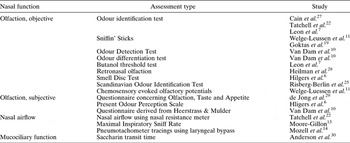
As with many methods of clinical assessment, standardisation of published results occurs rarely, and assessment of post-laryngectomy nasal function is no exception. A review of the different methods available to assess olfactory performance can be found elsewhere.Reference Simmen and Briner26 A variety of methods have been described to assess olfactory performance in laryngectomised patients, including: subjective self-assessment of olfactory function;Reference Leon, Catalanotto and Werning7, Reference Gilchrist24 objective olfactory assessment using a variety of methods (Table I); chemosensory evoked olfactory potentials;Reference Welge-Luessen, Gerd and Wolfensberger11 nasal airflow; mucociliary function; and speech therapist assessment of videos of patients performing the ‘polite yawn’.
Nasal function assessment methods used in laryngectomised patients

For objective assessment of olfaction, the University of Pennsylvania Smell Identification TestReference Doty, Shaman, Kimmelman and Dann31 is considered clinically as the ‘gold standard’, but its use has not been described in the laryngectomee. Most authors describe the use of a form of Odour Detection Test or Olfactory Discrimination Test.Reference Cain, Gent, Goodspeed and Leonard27, Reference Hulshoff Pol, Hijman, Baaré and van Ree32 Odour Detection Tests establish the olfactory threshold by presenting a mixture of an odorant compound (e.g. phenyl-ethyl alcohol, a liquid with a floral odour) at different concentrations diluted in di-propylene glycol, an odourless substance,Reference Van Dam, Hilgers, Emsbroek, Touw, van As and de Jong10 or butanol (a highly alcoholic aroma) in deionised water. Decreasing concentrations of odorant compounds are usually used, which prevents olfactory fatigue and saturation.Reference Hilgers, Van Dam, Keyzers, Koster, van As and Muller5 Olfactory Discrimination Tests determine whether subjects can distinguish between two different smells without having to name them,Reference Van Dam, Hilgers, Emsbroek, Touw, van As and de Jong10 and often use common household items such as peanut butter, soap and chocolate.Reference Leon, Catalanotto and Werning7 Specific tests of retronasal olfaction have also been described.Reference Leon, Catalanotto and Werning7 These tests are time- and labour-intensive (the Olfactory Discrimination Test takes 30 minutes on average to complete). Therefore, it is of interest to note that Hilgers et al. used the Smell Disc Test as well as the Olfactory Discrimination Test combined with the Present Odour Perception Scale (see below) in their follow-up study of the use of the polite yawning technique in laryngectomees.Reference Hilgers, Jansen, Van As, Polak, Muller and van dam Frits6 The Smell Disc Test was found to be much simpler to use than the Olfactory Discrimination Test, and there was reasonable correlation between the Smell Disc Test score and the Olfactory Discrimination Test–Present Odour Perception Scale combination (Cohen's κ = 0.56; p < 0.001). They concluded that ‘[o]dour testing in individuals who have undergone a total laryngectomy is now possible in a relatively simple way using the easily applied [Smell Disc Test]’.Reference Hilgers, Jansen, Van As, Polak, Muller and van dam Frits6
Patients' own perception of their olfactory ability is another useful measure. The ‘Questionnaire concerning Olfaction, Taste and Appetite’ was first described by de Jong et al.,Reference de Jong, Mulder, de Graaf and van Staveren29 and subsequently modified by Hilgers and colleagues.Reference Hilgers, Van Dam, Keyzers, Koster, van As and Muller5, Reference Hilgers, Jansen, Van As, Polak, Muller and van dam Frits6 It comprises 31 multiple-choice questions relating to patients' present situation and their pre-operative experience. The questions are divided into five scales: present odour perception, odour perception now in comparison with the past, gustation, appetite and sensation of hunger. The Present Odour Perception Scale is part of the Questionnaire concerning Olfaction, Taste and Appetite, and has a scoring range of three to 15. Any patient scoring equal to or better than the mean score in the original reference groupReference de Jong, Mulder, de Graaf and van Staveren29 can be considered to have normal olfactory acuity, i.e. a score of 10 or more.Reference Hilgers, Van Dam, Keyzers, Koster, van As and Muller5 The Questionnaire concerning Olfaction, Taste and Appetite appears to be a useful subjective assessment tool, although it has not yet been validated.
Chemosensory evoked olfactory potentials have been studied in laryngectomees by Welge-Luessen et al. Reference Welge-Luessen, Gerd and Wolfensberger11 Of the 11 patients studied, evoked potentials were captured in eight when stimulated by hydrogen sulphide. No conclusions were drawn from this data.
Mucociliary function has been studied using saccharin clearance time, and has been shown to be significantly better in controls than laryngectomised patients (mean time ± standard deviation: 13.4 ± 1.25 minutes versus 18.0 ± 1.47 minutes, respectively (p < 0.01)).Reference Moore-Gillon13 The increased saccharin clearance time seen in laryngectomees may relate to the microscopic structural changes reported, i.e. an increase in the density of mucosal cilia and an increase in mucus production.
Nasal airflow measured with and without a larynx bypass device has also provided comparative data. Using a pneumotachometer, Mozell et al. showed that a laryngectomee with a larynx bypass device could produce nasal airflow tracings (measured at the nares) which were ‘remarkably similar’ to those of a normal subject.Reference Mozell, Hornung, Leopold and Youngentob14 Unsurprisingly, the use of a laryngeal bypass device produces significantly greater nasal airflow than if it is not used (27.4 l/min versus 5.4 l/min, respectively; p < 0.01),Reference Tatchell, Lerman and Watt22 and increasing maximal inspiratory sniff rate is positively correlated with olfactory ability, and significantly so if above 10 l/minute.Reference Moore-Gillon13 Only Henkin and Netzer's work tends not to support the theory that improved nasal airflow improves olfactory performance in the laryngectomee.Reference Henkin, Hoye, Ketcham and Gould4, Reference Netzer, Goiz and Goldenberg18
Secondary outcome measures
It is widely stated that patients with olfactory problems have a relatively worse quality of life (QoL) than those without,Reference Leon, Catalanotto and Werning7, Reference Miwa, Furukawa, Tsukatani, Costanzo, DiNardo and Reiter33, Reference Hummel and Nordin34 although it has not been established that this holds true for the laryngectomee. Two papers from the same group have used the European Organisation for the Research and Treatment of Cancer 30-item questionnaire, and the 35-item questionnaire from the same organisation specifically relating to patients with head and neck cancer, in order to evaluate the effect of loss of olfactory function on laryngectomy patients' QoL.Reference Risberg-Berlin, Moller and Finizia9, Reference Risberg-Berlin, Yitalo and Finizia25 These papers concluded that, when laryngectomised patients were categorised as either ‘smellers’ or ‘non-smellers’ according to the Scandinavian Odour Identification Test (see Table I), there was no significant difference in QoL between the two groups. In addition, these two papers found that interventions shown to improve olfactory performance also improved QoL scores, but not by a clinically significant amount (the improvement was −9.5 score points, whereas changes over time of 10 score points are considered clinically significant). In the latter of these papersReference Risberg-Berlin, Moller and Finizia9, this same group of authors stated that they ‘could not confirm the association between olfaction and quality of life when measured with the [European Organisation for the Research and Treatment of Cancer] questionnaires’.Reference Risberg-Berlin, Moller and Finizia9 They suggested that these findings may possibly be due to small cohort size, use of different assessment tools compared with other authors, and the fact that ‘…quality of life is a complex concept and depends on factors other than olfaction’.
Conclusion
Evidence relating to olfactory rehabilitation of laryngectomised patients has been presented. Not all patients that undergo laryngectomy are rendered anosmic; those that are can improve their olfactory performance with timely and concerted intervention. Various techniques exist, the most promising appears to be the ‘Polite Yawning Technique’ as it can be quickly taught and easily learnt to give useful improvements in health related quality of life outcomes. The standard of care for laryngectomy patients ought to include attention to olfactory rehabilitation, although the relatively small amount of available literature in this area suggests that this may not be the case.