Introduction
Long before the term ‘fortress conservation’ was coined (Brockington Reference Brockington2002), the Belgian colonial authorities erected the first national park in Africa in 1925. Spanning the Belgian colonies of Congo and Rwanda, Albert National Park conserved a significant part of the mountain gorilla’s (Gorilla beringei beringei) home range. Around the globe, this model of fortress conservation displaced communities (West & Brockington Reference West and Brockington2006) and punished people for extracting resources from protected areas (PAs), negatively impacting livelihoods (Pretty & Pimbert Reference Pimbert and Pretty1995, Ferraro Reference Ferraro2002, West & Brockington Reference West and Brockington2006).
Aware of the economic and social costs associated with PAs, conservation organizations and national governments instituted integrated conservation and development projects (ICDPs) to account for the interconnected nature of livelihoods and biodiversity conservation (Wells et al. Reference Wells, Guggenheim, Wardojo and Jepson1999). ICDPs rest on the theory that if PAs can funnel economic and social benefits to local communities, incentives will be created to support conservation activities like national parks (Ahebwa et al. Reference Ahebwa, van der Duim and Sandbrook2012). ICDPs are meant to reduce threats to conservation by improving local perceptions of PAs (Wells et al. Reference Wells, Guggenheim, Wardojo and Jepson1999). Despite criticism that joint benefits for conservation and livelihoods remain elusive (Campbell et al. Reference Campbell, Sayer and Walker2010, Winkler Reference Winkler2011, Davies et al. Reference Davies, Fazey, Cresswell and Pettorelli2013), ICDPs remain the dominant conservation strategy used to improve local perceptions of conservation.
Several studies demonstrate that positive perceptions towards PAs are crucial to achieving conservation goals (Baral & Heinen Reference Baral and Heinen2007, Bennett Reference Bennett2016). In Indonesia, negative perceptions of PAs resulted in more poaching and illegal logging, hindering conservation objectives (Lee et al. Reference Lee, Sodhi and Prawiradilaga2009). Despite the link between conservation effectiveness and perceptions, objective measurements, particularly income, continue to dominate current PA social impact studies (de Lange et al. Reference Lange, Woodhouse and Milner‐Gulland2016, McKinnon et al. Reference McKinnon, Cheng, Dupre, Edmond, Garside, Glew and Holland2016, Jones et al. Reference Jones, McGinlay and Dimitrakopoulos2017). There is a lack of research that evaluates subjective well-being, such as local perceptions of PAs.
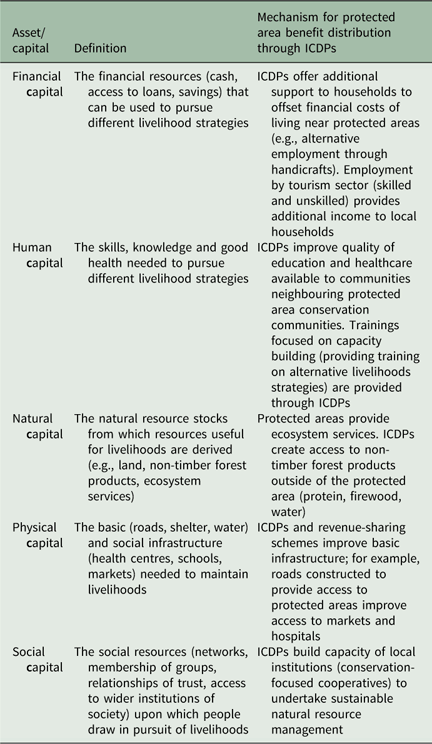
Social impact studies need to go beyond analysing “the impact of a single variable (e.g., gender) on the distribution of benefits from a single source (e.g., employment)” (Sandbrook Reference Sandbrook and Adams2012) and include multiple factors that may influence people’s perceptions of PA-related benefits. The sustainable livelihoods framework (SLF) used to guide the analysis of this study emphasizes that natural, social, human, physical and financial capital, and the ability to access each, all interact to influence livelihoods strategies (Table 1) (Scoones Reference Scoones1998, Bebbington Reference Bebbington1999). The SLF highlights that ICDPs, which aim to improve livelihoods, need to take into consideration that “an uneven distribution of social and human capital within communities is likely to result in an uneven distribution of the benefits from community conservation interventions” (Igoe Reference Igoe2006).
Sustainable livelihood framework capital asset definitions and mechanism for perceived benefit distribution (adapted from Scoones Reference Scoones1998). ICDP=integrated conservation and development project

Age, education, gender and income all interact to mediate access to the social networks that distribute conservation benefits (Gautam Reference Gautam2009). ICDP networks distribute conservation benefits often by trying to improve access to physical capital for communities, such as through the construction of health centres. ICDP beneficiaries are therefore more likely to report higher benefits from living near PAs than non-participants (Infield & Namara Reference Infield and Namara2001). Not every household, however, has the necessary capital to participate in ICDPs. Financial capital is one of the biggest determinants of whether people can access conservation benefits (Holmes Reference Holmes2007, Blomley et al. Reference Blomley, Namara, McNeilage, Franks, Rainer, Donaldson and Malpas2010). Individuals can leverage, or convert, their financial capital to social capital and access networks that distribute benefits (Igoe Reference Igoe2006). Power can mediate access to these networks through ‘elite capture’, influencing who receives conservation benefits (Persha & Andersson Reference Persha and Andersson2014). Women are therefore less likely to report benefits from PAs because their access to financial, natural and social capital, particularly education, has tended customarily to be restricted (Allendorf et al. Reference Allendorf, Swe, Oo, Htut, Aung, Allendorf and Hayek2006, Karki Reference Karki2013). Even though it is unclear whether age impacts conservation benefit perceptions (Allendorf et al. Reference Allendorf, Swe, Oo, Htut, Aung, Allendorf and Hayek2006, Karki Reference Karki2013), we hypothesized that age would have an inverse relationship with reported benefits (Heinen & Shrivastava Reference Heinen and Shrivastava2009, Blomley et al. Reference Blomley, Namara, McNeilage, Franks, Rainer, Donaldson and Malpas2010).
Understanding what factors influence the perceived benefits from PAs in the Virunga-Bwindi Massif is especially pertinent because it is home to the critically endangered mountain gorilla. Though mountain gorilla populations are increasing, poaching remains a major threat across their range, as they can get caught in snares set for other species (Robbins et al. Reference Robbins, Gray, Fawcett, Nutter, Uwingeli, Mburanumwe and Kagoda2011, Gray et al. Reference Gray, Roy, Vigilant, Fawcett, Basabose, Cranfield and Uwingeli2013). Only a few disjointed studies have examined whether people living near the mountain gorilla parks believe they benefit from the PAs (Weber Reference Weber1987, Reference Weber1989, Plumptre et al. Reference Plumptre, Kayitare, Rainer, Gray, Munanura, Barakabuye and Asuma2004, Blomley et al. Reference Blomley, Namara, McNeilage, Franks, Rainer, Donaldson and Malpas2010, Bush et al. Reference Bush, Ikirezi, Daconto, Gray and Fawcett2010). There is limited knowledge of what socioeconomic conditions influence perceived benefits. Despite the differences in the establishment of the four parks and the different political, social and cultural contexts in each country, do similar socioeconomic factors drive positive perceptions of the PAs?
Our study attempts to address this research need for the mountain gorilla PAs in the Virunga-Bwindi Massif. We examine the relationship between household socioeconomic data and the costs and benefits that men and women living near the PAs reported from 752 household surveys conducted between May and August 2014 (Rwanda and Uganda) and June 2016 (Democratic Republic of the Congo [DRC]). Our study analysed whether perceptions of the PA vary based on age, proximity to the park, household wealth, access to resources, education, gender, employment by the tourism industry and membership in a conservation-focused cooperative. We also examined the relationship between reported benefits of living in an area where there had been ICDPs. Finally, we investigated whether there were differences in perceptions of PA benefits between the three countries, though there are similar ICDPs underway in each. By understanding what drives local perceptions of PA benefits, targeted interventions, including policy and management changes, can be made to reach conservation goals (Bennett Reference Bennett2016), ultimately improving mountain gorilla conservation.
Methods
Study Site
Bwindi Impenetrable National Park and Mgahinga Gorilla National Park
Located in Uganda, Bwindi Impenetrable National Park (Bwindi) and Mgahinga Gorilla National Park (Mgahinga) were gazetted as national parks in 1991. They are jointly managed as the Bwindi and Mgahinga Conservation Area. The gazettement of Bwindi and Mgahinga caused high levels of conflict and resistance from surrounding communities (Baker et al. Reference Baker, Milner-Gulland and Leader-Williams2011). To reduce conflicts, conservation and development organizations, along with the Uganda Wildlife Authority (UWA), implemented ICDPs. Capacity building of local conservation associations, like the Nkuringo Community and Development Foundation, is one example of ICDPs around Bwindi. Other projects implemented by non-governmental organizations and/or UWA include agricultural support, multiple-use zones, beekeeping training, infrastructure development, employment in tourism enterprises and tourism revenue sharing (Blomley et al. Reference Blomley, Namara, McNeilage, Franks, Rainer, Donaldson and Malpas2010). The multiple-use programme in Bwindi allows authorized resource users to harvest honey, basketry materials, wild yams and medicinal plants inside the park. In Mgahinga, beekeeping and the collection of bamboo in the park are permitted by authorized users (Blomley et al. Reference Blomley, Namara, McNeilage, Franks, Rainer, Donaldson and Malpas2010). A similar programme does not exist in Virunga or Volcanoes. Revenue sharing directs 20% of park entrance fees to supporting development projects. The Gorilla Levy, instituted in 2006, increased from US$5 to US$10 per permit in 2014. Half of the profits are allocated for communities near the park.
Virunga National Park
Virunga National Park (Virunga), located in eastern DRC, is the world’s oldest national park in Africa. Our study focused on the southern edge of the park, the Mikeno sector where gorillas and gorilla tourism are located. The Mikeno sector is also amongst the hardest hit by conflict in the eastern DRC. Apiculture training, cooperatives for widows of park guards and revenue sharing are the main ICDPs employed to improve relationships between the park and local communities. It is prescribed that 50% of park entrance fees go to the Institut Congolais pour la Conservation de la Nature (ICCN) in Kinshasa, 20% to operational costs of the park and 30% to ICDPs (Molenge Reference Molenge2014).
Volcanoes National Park
Volcanoes National Park (Volcanoes) is located in northwest Rwanda. The area surrounding Volcanoes has the highest population density of the three mountain gorilla countries, with an average of 590 people per km2 (Bush et al. Reference Bush, Ikirezi, Daconto, Gray and Fawcett2010). ICDPs include the installation of community water tanks, improved roads, schools, health centres and the development of apiculture, bamboo and handicraft cooperatives and education initiatives. The government instituted revenue sharing in 2005 and increased the revenue directed towards community conservation projects from 5% to 10% in 2017. Multiple community associations with a conservation focus, including the Sabyinyo Community Livelihoods Association (SACOLA), were organized as part of ICDPs and now implement their own ICDPs with funding from the tourism revenue-sharing scheme.
Data Collection
In order to analyse if ICDPs influence whether people reported benefits from PAs, all administrative units (in Rwanda, the administrative unit is the sector; in Uganda, it is the parish; in DRC, it is the localities) bordering the PAs were classified into targeted or control areas. This allowed us to analyse the counterfactual, or the likelihood that benefits are reported in the absence of ICDP (Ferraro Reference Ferraro2009). Administrative units where there had been long-term investments in ICDPs – of at least 10 years – were classified as targeted areas (Supplementary Table S1, available online). Control areas were administrative units where there had been no ICDPs. We used the random function in Excel to randomly select two targeted and control areas from the administrative units surrounding each of the four PAs. Since only three administrative units border Mgahinga – two targeted and one control – one targeted area was randomly selected and the one control area was chosen by default.
Of the villages, 20% were then randomly selected for each administrative unit. Within villages, respondents were randomly selected from a list of all individuals in the village, stratified by gender, with these data provided by either the local government or wildlife authorities. In Mukono and Mpungu (Bwindi), a list of households was not available, so to ensure random stratified sampling, the surveyors started in the middle of the parish and flipped a coin to pick which path to take, and from there, every fifth household was surveyed. Surveyors were instructed to alternate interviews with men and women in order to ensure equal gender representation. In total, women made up c. 40% of the sample and men accounted for c. 60%. GPS points were taken at each household, except around Virunga, where people did not consent to having their coordinates recorded.
Each person interviewed was asked: (1) Do you personally benefit from the PA? If yes, how? (2) For you personally, do you face any problems because of the PA? (3) Does your community benefit from the PA? If yes, how? (4) For your community, are there any problems because of the PA? If so, what? The individual interviews were combined with household socioeconomic surveys.
To calculate household wealth, we used a modified version of the Basic Necessity Survey (BNS; Davies Reference Davies and Smith1998, Wilkie Reference Wilkie, Wieland and Detoeuf2015), which assesses whether households have access to basic necessities defined as financial assets and social services, with values ranging from 0 (no access to basic necessities) to 1 (access to all basic necessities). We modified the BNS to understand whether the PA increased or decreased access to the basic necessities. In combination with the BNS, we asked respondents if the PA had led to a very negative, moderately negative, slightly negative, slightly positive, moderately positive or very positive change in their access to each necessity, or whether there had been no effect. Each response was assigned a score of –3 to +3, with 0 indicating no change. An access to resource score was calculated by adding the score assigned to each basic necessity.
In total, 222 households were surveyed around Volcanoes (targeted=119, control=103), 210 around Bwindi (targeted=104, control=106) and 94 around Mgahinga (targeted=46, control=48) between June and August 2014. The questionnaire was re-administered to 226 households in Virunga (targeted=118, control=108) in May 2016 because the 2014 datasheets were lost. Relevant stakeholders confirmed that there were no major changes in the study area during 2014–2016, making it possible to compare survey results between the four PAs. In total, 752 households (targeted=387, control=365), across the four PAs were included in this study.
Data Analyses
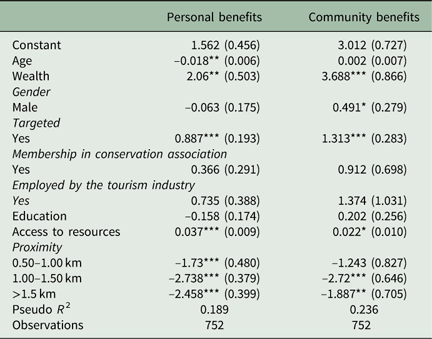
To understand what factors influenced people’s reporting of benefits from the PAs, we used a binary logit regression model (Bragagnolo et al. Reference Bragagnolo, Malhado, Jepson and Ladle2016). We used a dependent binary variable to evaluate the relative influence of the socioeconomic variables on whether respondents’ reported a benefit. If the respondent reported at least one benefit, then we coded the response as a ‘yes’, and if no benefits were reported, the response was coded as a ‘no’. Employment in the tourism industry and membership in a community conservation association were coded as binary variables. Employment in the tourism industry included working as a porter or park guard. We did not include working on infrastructure projects, such as the buffalo wall in Volcanoes, as employment by the tourism industry. The number of years of education that the respondent completed was recorded. Each year of schooling, whether university of technical, was counted as one year. For proximity to PA, we calculated the straight-line distance to the park boundary using Google Earth (Harrison et al. Reference Harrison, Baker, Twinamatsiko and Milner‐Gulland2015). Because of the topography of the region, this method of calculating proximity allows for only general comparisons between household proximity and perception of PA benefits. We used the same method to analyse the variables that influenced whether community benefits were reported. We generated our statistical models based on variables (Table 2) that could influence whether households reported benefits from the PAs (Infield & Namara Reference Infield and Namara2001, Allendorf et al. Reference Allendorf, Swe, Oo, Htut, Aung, Allendorf and Hayek2006, Baral & Heinen Reference Baral and Heinen2007, Spiteri & Nepal Reference Spiteri and Nepal2008, Lee et al. Reference Lee, Sodhi and Prawiradilaga2009). We used the statistical package STATA (version 14.1) to manage the quantitative data.
Results from the logit regression model for personal and community benefits. Standard errors in parentheses. *p<0.05, **p < 0.01, ***p<0.001

Due to the large geographic scope of this study, we did not explore in depth how the different cultures, histories and political contexts in the three countries influenced perceptions, which is another limitation of the study.
Results
Personal and Community Costs
The majority of respondents reported human–wildlife conflict (crop raiding or loss of human life because of wildlife) as the biggest personal (37%) and community cost (57%) incurred as a result of living near the PA. Limited access to resources was cited across all four PAs and ranged from restricted access to gold, water and timber. Around Virunga, the main concern reported was insecurity caused by “thieves living in the park.”
Personal vs. Community Benefits
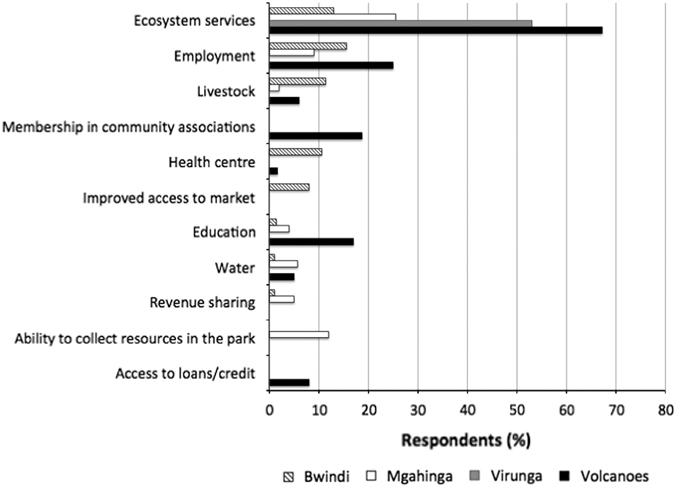
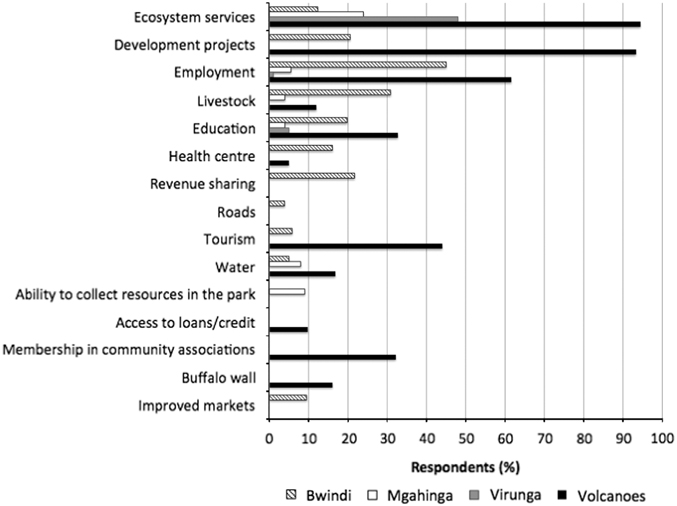
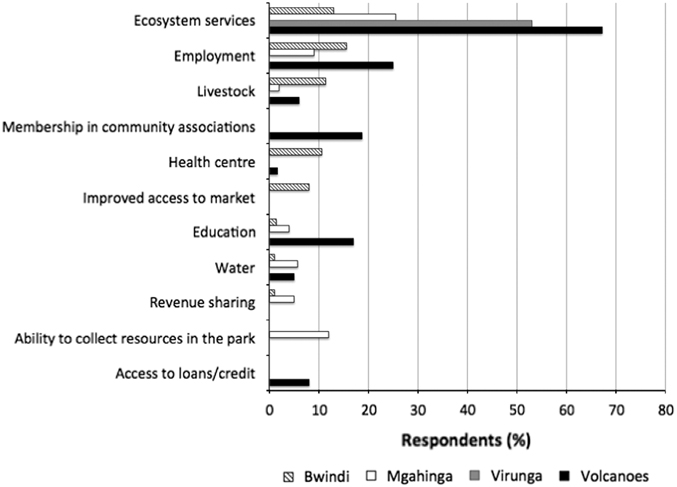
While similar personal and community costs were reported across the four PAs, reported benefits varied (Figs 1 & 2).
Perceived personal benefits from protected areas in the Virunga-Bwindi Massif.
Perceived community benefits from protected areas in the Virunga-Bwindi Massif.
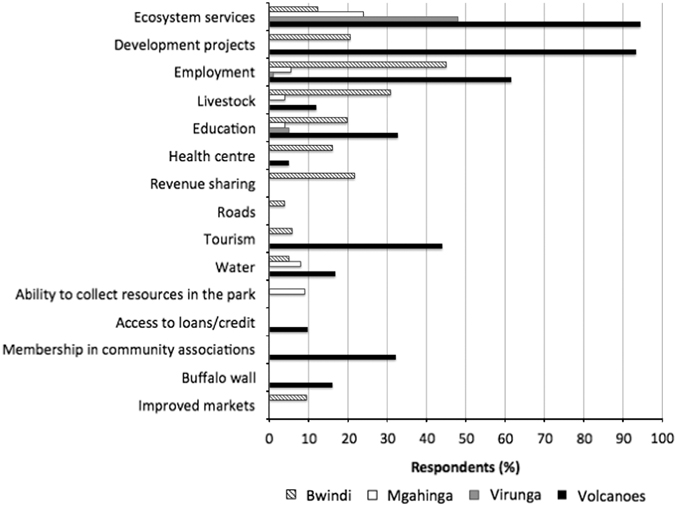
Ecosystem services was the most reported personal and community benefit across the four parks: 53% of people perceived the ecosystems services provided by the PA (clean air and water, healthy environment) as a personal benefit, and 85% reported it as a community benefit. Development and infrastructure projects was the second most reported community benefit (50%). In Bwindi, 33% mentioned revenue sharing, though not always as a benefit. In Virunga and Volcanoes, people did not mention revenue sharing, while 6% of people in Mgahinga listed it as a personal or community benefit. Several people reported an increase in the number of community associations as a result of the park. However, these answers were not always reported as a benefit that people had access to now; rather, respondents often felt that there could be benefits if the park were managed differently. There were multiple complaints that Bwindi, for example, could provide employment, but that “their children were never employed by the park.”
Respondents living near Virunga reported the lowest number of community benefits (72%), whereas those near Volcanoes reported the highest number of community benefits (96%) (Table 3). Across the three countries, no one mentioned either wildlife conservation or mountain gorillas as a perceived benefit from the park.
Percentages of households reporting a personal or community benefit by protected area, disaggregated by whether the household is located in a targeted or control area

Factors Influencing Reported Benefits
Age, targeted vs. control, household wealth, proximity to the PA and access to resources had significant associations with whether benefits were reported at the personal level. Access to resources, gender, household wealth, targeted vs. control and proximity were significant in predicting whether community level benefits were reported. Education, membership in conservation community associations or employment by the tourism industry had no influence on whether a benefit was reported at the personal or community level (Table 2).
Targeted vs. Control
Targeted areas, with the exception of Mgahinga, were significantly more likely to report both personal and community benefits (Table 3). A smaller percentage of people in targeted areas compared with control areas also reported fewer personal costs incurred by PAs (31.2% vs. 49.7%). The types of personal benefits reported varied depending on whether a household was located in a targeted or a control area. A wider diversity of benefits was reported in targeted versus control areas. In Mgahinga, the control area reported more community benefits than the targeted area, and there was not a significant difference in the percentage of personal benefits reported between the control and targeted areas. Unlike the other PAs where a variety of personal benefits were reported, such as employment, education and improved water access, ecosystem services was the only personal benefit reported in Virunga.
Access to Resources
Perceived access to resources, defined as access to both resources and services, varied depending on the country and the administrative area where the household was located. Across the four PAs, people reported that parks influenced their access, both positively and negatively, to firewood, medicinal plants, artisanal plants, bush meat, health centres, water and schools. People near Bwindi and Mgahinga not only reported more restricted access to firewood, medicinal plants, bush meat and artisanal plants, but also less access to services such as health centres and schools as compared to Volcanoes and Virunga. Volcanoes and Bwindi reported the highest increased access to water. People most frequently attributed access to health centres, water and schools to park authorities or community associations.
We found a significant relationship between access to resources and personal benefits. People who reported no personal benefits had an average access to resources score of 0.50. Those reporting benefits had an average score of 6.12. Similarly, people who reported no community benefits had an average access to resources score of –1.64, whereas those reporting community benefits had an average access to resources score of 3.99. Households located in targeted areas had an average access to resources score of 4.56, and those in control areas has an average score of 1.61. Volcanoes had the highest average access to resources score (14.22) and Mgahinga had the lowest average access to resources score (–3.29). There was no clear relationship between proximity and access to resources.
Household Wealth
Household wealth correlated with greater reporting of benefits at the personal and community levels. The 18% of respondents who reported no community benefits had lower household wealth. Wealth also correlated with whether households had access to resources and whether they were members of conservation-focused community associations. Households in the highest income percentile had an average access to resources score of 11.16, whereas those in the lowest percentile had an average score of –1.12. This relationship was true for each PA except Volcanoes, where regardless of whether the household was in the highest or lowest income percentile, average access to resources scores were above 11. Households that reported having three members of their households participating in community associations had a wealth score of 0.8, whereas those with no members participating in community associations had a wealth score of 0.39. People in Rwanda had the highest average wealth score (0.58), while households in DRC had the lowest average wealth score (0.21). Higher education correlated with higher wealth, though whether higher wealth leads to higher levels of education or vice versa is not clear.
Proximity
Virunga had the largest percentage of households surveyed living within less than 0.5 km of the park (27.11%; range: 0.29–1.70 km). The majority of people interviewed in Volcanoes lived between 2.5 and 3.0 km from park boundaries (range: 1.08–6.85 km), whereas in Bwindi, the majority of people surveyed lived between 1.0 and 1.5 km from the park (range: 0.1–6.0 km). There was an inverse relationship between proximity and personal and community benefits reported for all four parks.
Membership in Community Associations
A large portion of people surveyed in Bwindi, Mgahinga and Volcanoes (78%) were members of a community association. A total of 30% were members of community associations in Virunga. Ranging from micro-credit and loan groups to loosely formed self-help associations, people said local associations help families pay for school fees and buy seeds for the next season and provide a platform for communities to help one another in times of need.
Only 10% of people, however, were members of conservation-focused community associations. This includes community associations that are supported by revenue-sharing schemes. More males reported participating in conservation community associations (64% vs. 38%). Households that had no members in conservation community associations had lower mean household wealth scores and less formal education.
Tourism Industry
Only 7% of people reported that members of their households worked in the tourism industry. Gender was the main barrier to working in the tourism industry, as males were more likely to participate than women (63% vs. 33%). Neither income nor education influenced employment.
Age, Education and Gender
As age increased, the percentage of people reporting personal benefits decreased. A total of 53% of people aged 18–30 reported a personal benefit compared to 44% of people aged 31–60 and 35% of people aged 61 and older. The highest percentage of respondents reporting no formal education was in Virunga, where approximately 15% of people reported some primary school education and only 3% reported some secondary school education. Women were less likely to have formal education and to report community benefits than males. However, there was no relationship between age or education and community benefits.
Discussion
The use of similar methods as previous studies in the Virunga-Bwindi Massif makes it possible to compare general changes in perceived benefits over time. Since the last study examining the reported benefits from mountain gorilla PAs in 2004 (Plumptre et al. Reference Plumptre, Kayitare, Rainer, Gray, Munanura, Barakabuye and Asuma2004), Rwanda has launched its revenue-sharing program, Uganda has instituted the Gorilla Levy and the civil war in the DRC has ended. In both Uganda and Rwanda, new community conservation associations were created to lead community development projects financed by revenue-sharing schemes. Each of these events had the potential to change people’s perceptions of the PAs. This study also contributes to the literature that strives to deepen understanding of how access to benefits from PAs is mediated by different livelihood aspects (Igoe Reference Igoe2006, Althor et al. Reference Althor, McKinnon, Cheng, Klein and Watson2016, Bennett Reference Bennett2016, Munanura et al. Reference Munanura, Backman, Hallo and Powell2016).
Over the last three decades, households that felt they personally benefited from Volcanoes have increased from 26% in 1979 (Weber Reference Weber1987) to 49% in 1984 (Weber Reference Weber1989) and up to 88% in 2004 (Plumptre et al. Reference Plumptre, Kayitare, Rainer, Gray, Munanura, Barakabuye and Asuma2004). Plumptre et al. (Reference Plumptre, Kayitare, Rainer, Gray, Munanura, Barakabuye and Asuma2004) also found that 67% of people reported a community benefit from Volcanoes. Our study, however, found that 54% of people around Volcanoes reported personally benefiting from the park, while 96% reported a community benefit. The percentage of people reporting community benefits from Bwindi increased from 79% in 2004 (Plumptre et al. Reference Plumptre, Kayitare, Rainer, Gray, Munanura, Barakabuye and Asuma2004) to 85% in 2014. The perception of community benefits also increased in Virunga from 30% in 2004 to 71% in 2016. Personal benefits, however, decreased in Virunga from 61% to 30%.
Arguably, ICDPs are geared towards community, not personal development, and it follows that more community rather than personal benefits are expected. However, similar ICDPs were underway before Plumptre et al. (Reference Plumptre, Kayitare, Rainer, Gray, Munanura, Barakabuye and Asuma2004) conducted their survey. Plumptre et al. (Reference Plumptre, Kayitare, Rainer, Gray, Munanura, Barakabuye and Asuma2004) reasoned that more people reported personal than community benefits because “Appreciation of community benefits takes a lot of education sensitization that links these benefits to the presence of the PAs […] their impact may take longer to be realized than expected.” Other scholars have contended that ICDP outcomes improve as the number of years committed to the project increase, highlighting the time investment needed to change community perceptions of conservation (Baral & Heinen 2007).
People living in areas with ICDPs reported more personal and community benefits than those living in areas that were not involved in ICDPs. Almost all households in targeted areas around Bwindi and Volcanoes reported a community benefit, supporting other studies in the region that contended that communities involved in ICDPs are “more positive towards the park, held stronger perceptions of its values, and were more willing to see it remain as a park” (Infield & Namara Reference Infield and Namara2001). Although households located closer to the PAs also reported more benefits, since proximity was calculated using straight-line distance, we suggest further research be conducted to better understand this relationship. The relationship between perceived costs, benefits and behaviour is complex. People can benefit from and still resent PAs (Emerton Reference Emerton2001, Tumusiime & Sjaastad Reference Tumusiime and Sjaastad2014). While positive attitudes do not always translate into conservation-friendly behaviour (Waylen et al. Reference Waylen, McGowan and Milner-Gulland2009), research in Bwindi suggests that benefits from ICDPs are an important deterrent to unauthorized resource use (Harrison et al. Reference Harrison, Baker, Twinamatsiko and Milner‐Gulland2015).
Social equity, however, remains a key challenge of distributing benefits from ICDPs and revenue-sharing schemes (Althor et al. Reference Althor, McKinnon, Cheng, Klein and Watson2016). Networks, along with which households have the necessary human, social and financial capital to access them, dictate who receives conservation benefits (Igoe Reference Igoe2006, Sandbrook & Adams Reference Sandbrook and Adams2012, Munanura et al. Reference Munanura, Backman, Hallo and Powell2016). One of the key networks for distributing benefits from PAs is community conservation associations. In Volcanoes, select conservation community associations receive funding for ICDPs through the revenue-sharing scheme. High annual memberships fees to join these conservation community associations, however, exclude poorer households who are unable to pay the dues. While we did not find a significant relationship between education and reported benefits at either a personal or community level, the majority of people involved in community conservation associations had at least a primary school education. This poses an additional hurdle for poorer households, as they tend to have less formal education, although whether higher household wealth leads to higher levels of education or vice versa is not clear. This suggests that limited social, human and financial capital mediate access to conservation benefits.
Social equity is also mediated through individuals and institutions, such as park managers and PAs (Jones et al. Reference Jones, McGinlay and Dimitrakopoulos2017). Our study found that there is growing resentment towards park authorities around Bwindi because of inequitable distribution of revenue-sharing funds. People around Volcanoes share similar sentiments (Munanura et al. Reference Munanura, Backman, Hallo and Powell2016). Feelings of resentment were also reported over whom the UWA decides to hire. One person said, “Park [UWA] never employs poor people, it only considers the rich.” Our study also highlights that the response of park authorities to crop raiding influences how the perceived costs are felt by the households. Several people surveyed around Volcanoes noted that crop raiding was both a personal and community cost, but as one respondent reported, “Not as much as before now that the buffalo wall is there.” In Bwindi, people were frustrated, with respondents stating, for example, that “nothing was done stop it,” or that “there was no compensation.” This highlights the important role park authorities play in resolving conflicts between communities and PAs (Harrison et al. Reference Harrison, Baker, Twinamatsiko and Milner‐Gulland2015).
Overall, we found that the percentage of people reporting community benefits increased with the growth of mountain gorilla populations (Gray et al. Reference Gray, Roy, Vigilant, Fawcett, Basabose, Cranfield and Uwingeli2013). In contrast to recent studies that suggest that strict conservation models fail to deliver benefits to local communities and do not achieve conservation goals (Oldekop et al. Reference Oldekop, Holmes, Harris and Evans2016), we provide evidence that the ICDPs are a conservation tool that can positively influence perceptions of PAs. Our study echoes the calls by other social assessment researchers (Bennett Reference Bennett2016, Jones et al. Reference Jones, McGinlay and Dimitrakopoulos2017) that ICDPs must go beyond using traditional economic measures of livelihoods to understand how socioeconomic factors mediate access to conservation benefits. The frustration voiced about inequitable benefit distribution, around Bwindi in particular, highlights the need for further research to ensure revenue-sharing schemes and ICDPs are managed transparently and equitably (Harrison et al. Reference Harrison, Baker, Twinamatsiko and Milner‐Gulland2015, Munanura et al. Reference Munanura, Backman, Hallo and Powell2016). Conservation practitioners should consider shifting the focus of ICDPs from community infrastructure projects to those that promote social and human capital, improving access to networks that distribute conservation benefits (Igoe Reference Igoe2006, Munanura et al. Reference Munanura, Backman, Hallo and Powell2016). Another important factor that this study did not explore, but that could play an important role in benefit distribution, is the link between governance and perceptions (Oldekop et al. Reference Oldekop, Holmes, Harris and Evans2016). Fewer benefits may be reported if the national government is regarded as corrupt, regardless of park management or revenue-sharing programmes. Though it was beyond the scope of this study, it is also likely that culture, history and political context influence perceived benefits from PAs. While our study demonstrates that ICDPs can be an effective conservation tool to increase perceived benefits from PAs, in order to improve mountain gorilla conservation, more research is needed in the Virunga-Bwindi Massif to investigate the relationship between improved attitudes and conservation-friendly behaviour.
Supplementary Material
For supplementary material accompanying this paper, visit multimediafluids.uam.elogim.com/core/journals/environmental-conservation
Acknowledgements
We are grateful to the Institut Congolais pour la Conservation de la Nature, Rwanda Development Board and the Uganda Wildlife Authority for permission to conduct research at each protected area. B. Weber provided valuable feedback on our draft questionnaire. A. Behm-Masozera advised on the questionnaire and provided feedback on the manuscript. A. Vedder, D. Baker, G. Bush and S. Feyers also provided valuable comments on an earlier manuscript. We thank the three anonymous reviewers for their helpful comments on an earlier draft of this paper.
Financial Support
This research was funded through the Tropical Resources Institute; McMillian Center for African Studies, Lindsay Fellowship for Research in Africa; and the Carpenter–Sperry Research Fund.
Conflict of Interest
None.
Ethical Standards
We adhered to the ethical principles of the Human Research Protection Program governed by the International Review Board at Yale University.