Introduction
Seed dormancy and germination are regulated by developmental and environmental cues (Bewley, Reference Bewley1997; Koornneef et al., Reference Koornneef, Bentsink and Hilhorst2002; Finch-Savage and Leubner-Metzger, Reference Finch-Savage and Leubner-Metzger2006). Dormancy is defined as the inability of an intact viable seed to complete germination under favourable conditions (Hilhorst, Reference Hilhorst, Bradford and Nonogaki2007). Different types of dormancy exist; however, the control of germination is frequently a consequence of the competitive interaction between embryonic growth potential and limiting mechanical force of its surrounding tissues. Several plant hormones are involved in this control (Kucera et al., Reference Kucera, Cohn and Leubner-Metzger2005). Abscisic acid (ABA) is one such hormone that plays a prominent role in dormancy and germination control (Hilhorst, Reference Hilhorst1995; Kermode, Reference Kermode2005). ABA auxotrophs of many plant species exhibit enhanced germination potential and sometimes produce viviparous seeds (McCarty, Reference McCarty1995), whereas mutants and transgenic lines that overaccumulate ABA show enhanced dormancy (Thompson et al., Reference Thompson, Jackson, Symonds, Mulholland, Dadswell, Blake, Burbidge and Taylor2000; Qin and Zeevaart, Reference Qin and Zeevaart2002; Okamoto et al., Reference Okamoto, Kuwahara, Seo, Kushiro, Asami, Hirai, Kamiya, Koshiba and Nambara2006, Reference Okamoto, Tatematsu, Matsui, Morosawa, Ishida, Tanaka, Endo, Mochizuki, Toyoda, Kamiya, Shinozaki, Nambara and Seki2010). These genetic lines have shown that a primary function of ABA during seed development is the inhibition of precocious germination and the induction of primary dormancy. Also, pharmacological analyses using ABA biosynthesis inhibitors indicate that de novo ABA synthesis in imbibed seeds is necessary for the maintenance of seed dormancy (Debeaujon and Koornneef, Reference Debeaujon and Koornneef2000; Grappin et al., Reference Grappin, Bouinot, Sotta, Miginiac and Jullien2000; Ali-Rachedi et al., Reference Ali-Rachedi, Bouinot, Wagner, Bonnet, Sotta, Grappin and Jullien2004). Recent identification of Arabidopsis genes for the ‘core pathway’ of ABA metabolism and signalling will enable evaluation of the role of this hormone in seeds of other plant species for which the genetics are less well understood.
There is likely no single plant hormone that is both necessary and sufficient to control all aspects of dormancy and germination. Indeed, the ABA/gibberellin (GA) balance theory is most commonly used in explaining the regulatory mechanisms for these events (Karssen and Lacka, Reference Karssen, Lacka and Bopp1986). Although not dicussed here, recent molecular analyses largely support this theory, in which GA metabolism (and sensitivity) is oppositely regulated to that of ABA (Yamaguchi, Reference Yamaguchi2008). Furthermore, there is accumulating knowledge on hormone crosstalk (Feurtado and Kermode, Reference Feurtado, Kermode, Bradford and Nonogaki2007). This article stresses our recently acquired understanding of ABA metabolism and sensitivity in seeds, as a step towards elucidating what multiple hormone networks are likely to be present.
ABA metabolism
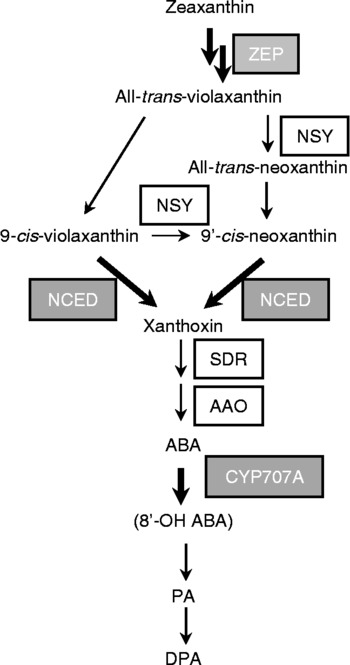
Cellular ABA content is regulated by the balance between its biosynthesis and catabolism (Fig. 1) (Nambara and Marion-Poll, Reference Nambara and Marion-Poll2005). Nine-cis-epoxycarotenoid dioxygenases (NCEDs) catalyse the cleavage of C40 9-cis-epoxycarotenoids, 9′-cis-neoxanthin and 9-cis-violaxanthin, which is a primary regulatory step in ABA biosynthesis (Schwartz et al., Reference Schwartz, Tan, Gage, Zeevaart and McCarty1997). Zeaxanthin epoxidase (ZEP), which is a xanthophyll cycle enzyme, is also postulated to have a regulatory function in this process (Marin et al., Reference Marin, Nussaume, Quesada, Gonneau, Sotta, Hugueney, Frey and Marion-Poll1996). ABA is inactivated by either hydroxylation or conjugation with sugars. Members of the CYP707A family of P450 mono-oxygenases encode ABA 8′-hydroxylase, which is involved in a committed step in the ABA 8′-hydroxylation pathway, and they play a regulatory role in the control of ABA content (Kushiro et al., Reference Kushiro, Okamoto, Nakabayashi, Yamagishi, Kitamura, Asami, Hirai, Koshiba, Kamiya and Nambara2004; Saito et al., Reference Saito, Hirai, Matsumoto, Ohigashi, Ohta, Sakata and Mizutani2004). All plant species examined to date encode NCED and CYP707A as multigene families, and differential combinations of these members contribute to tissue- and environment-specific regulation.
The ABA metabolic pathway. Each box indicates an enzyme. Grey boxes indicate enzymes with a regulatory function in seeds. ZEP, zeaxanthin epoxidase; NSY, neoxanthin synthase; NCED, 9-cis epoxycarotenoid dioxygenase; CYP707A, ABA 8′-hydroxylase. PA, phaseic acid; DPA, dihydrophaseic acid. A more detail description is in Nambara and Marion-Poll (Reference Nambara and Marion-Poll2005).

ABA signalling
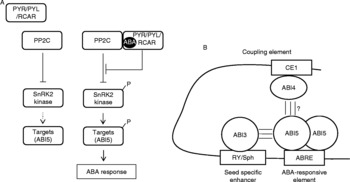
Recent advances in Arabidopsis molecular genetics have revealed the core ABA signalling pathway. Members of the protein phosphatase 2C (PP2C) family of genes, including ABA-INSENSITIVE1 (ABI1) and ABI2, are central regulators (Fig. 2A) and loss-of-function mutations of these genes lead to ABA hypersensitity, suggesting that they are the negative regulators of ABA signalling (Koornneef et al., Reference Koornneef, Reuling and Karssen1984; Gosti et al., Reference Gosti, Beaudoin, Serizet, Webb, Vartanian and Giraudat1999). A comparative analysis of recessive PP2C mutants indicates that AtPP2CA/AHG3 is a major player in imbibed seeds (Yoshida et al., Reference Yoshida, Nishimura, Kitahata, Kuromori, Ito, Asami, Shinozaki and Hirayama2006). A member of SNF1-related protein kinase subfamily 2 (SnRK2) is a key positive regulator of ABA signalling and the snrk2.2 snrk2.3 snrk2.6 triple mutant displays a strong ABA insensitivity during germination, and in vivipary at high humidities (Fujii and Zhu, Reference Fujii and Zhu2009; Nakashima et al., Reference Nakashima, Fujita, Kanamori, Katagiri, Umezawa, Kidokoro, Maruyama, Yoshida, Ishiyama, Kobayashi, Shinozaki and Yamaguchi-Shinozaki2009). SnRK2s activate ABRE-binding bZIP transcription factors, including ABI5 (Nakashima et al., Reference Nakashima, Fujita, Kanamori, Katagiri, Umezawa, Kidokoro, Maruyama, Yoshida, Ishiyama, Kobayashi, Shinozaki and Yamaguchi-Shinozaki2009). The SnRK2s become active when they are de-repressed from their inhibition by PP2Cs (Fujii et al., Reference Fujii, Chinnusamy, Rodrigues, Rubio, Antoni, Park, Cutler, Sheen, Rodriguez and Zhu2009; Umezawa et al., Reference Umezawa, Sugiyama, Mizoguchi, Hayashi, Myouga, Yamaguchi-Shinozaki, Ishihama, Hirayama and Shinozaki2009). Five different types of proteins were reported as ABA receptors (McCourt and Creelman, Reference McCourt and Creelman2008; Ma et al., Reference Ma, Szostkiewicz, Korte, Moes, Yang, Christmann and Grill2009; Pandey et al., Reference Pandey, Nelson and Assmann2009; Park et al., Reference Park, Fung, Nishimura, Jensen, Fujii, Zhao, Lumba, Santiago, Rodrigues, Chow, Alfred, Bonetta, Finkelstein, Provart, Desveaux, Rodriguez, McCourt, Zhu, Schroeder, Volkman and Cutler2009); of these, the PYR1/PYL/RCAR family of START proteins may have a prominent function in seed ABA responsiveness through regulating PP2C activity in an ABA-dependent manner (Ma et al., Reference Ma, Szostkiewicz, Korte, Moes, Yang, Christmann and Grill2009; Park et al., Reference Park, Fung, Nishimura, Jensen, Fujii, Zhao, Lumba, Santiago, Rodrigues, Chow, Alfred, Bonetta, Finkelstein, Provart, Desveaux, Rodriguez, McCourt, Zhu, Schroeder, Volkman and Cutler2009). Fourteen members of the family (PYR1, PYL1–13) are encoded in the Arabidopsis genome, and the pyr1 prl1 prl2 prl4 quadruple mutant shows strong ABA-insensitive germination (Park et al., Reference Park, Fung, Nishimura, Jensen, Fujii, Zhao, Lumba, Santiago, Rodrigues, Chow, Alfred, Bonetta, Finkelstein, Provart, Desveaux, Rodriguez, McCourt, Zhu, Schroeder, Volkman and Cutler2009).
(A) The pathway for ABA signalling mediated by the PYR/PYL/RCAR family of proteins. Left, no ABA: SnRK2 kinase is inactivated by protein phosphatase 2C (PP2C), and thus the downstream targets, including ABI5, are inactive. Right, ABA-binding alters the conformation of PYR/PYL/RCAR and inhibits the activity of PP2C. De-repressed SnRK2 kinase activates the downstream targets. (B) The components of ABA-mediated transcription in seeds. ABI5 is a member of the bZIP transcription factors that bind to the ACGT-core containing the ABA responsive element (ABRE). ABI3 and ABI4 bind to the RY/Sph element and coupling element 1 (CE1), respectively. RY/Sph and CE1 are cis elements that synergistically enhance ABRE-mediated transcription. ABI3 and ABI5 interact with each other, but ABI4 and ABI5 do not.

Transcription is a critical step in ABA responsiveness in seeds (Fig. 2B). Genetic analysis reveals that ABI3 (B3 type), ABI4 (AP2 type) and ABI5 (bZIP type) are key transcription factors that confer seed ABA responsiveness (Finkelstein et al., Reference Finkelstein, Gampala and Rock2002; Holdsworth et al., Reference Holdsworth, Bentsink and Soppe2008). These are conserved in the plant kingdom and corresponding orthologues to those in Arabidopsis are also present in monocots. ABI5/TRAB1 binds specifically to a typical ABA-responsive element (ABRE), which is the cis element triggering ABA-mediated transcription (Hobo et al., Reference Hobo, Kowyama and Hattori1999). The ABI5 protein is regulated by ABA in imbibed Arabidopsis seeds and is an indicator of responsiveness to this hormone (Lopez-Molina et al., Reference Lopez-Molina, Mongrand and Chua2001). ABI3/VP1 binds to the RY/Sph repeat, a seed-specific enhancer (Suzuki et al., Reference Suzuki, Kao and McCarty1997), whereas ABI4/ZmABI4 targets the coupling element 1 (CE1), which functions together with the ABRE to trigger ABA-mediated transcription (Niu et al., Reference Niu, Helentjaris and Bate2002).
Seed development
ABA accumulates in seeds during their development and is high during mid- and late-maturation stages. In Arabidopsis, ABA accumulated during the mid-maturation stage is largely synthesized in maternal tissues, including the testa, and is thus transported from the mother plant (Karssen et al., Reference Karssen, Brinkhorstvanderswan, Breekland and Koornneef1983). This maternally supplied ABA contributes to embryo development in Nicotiana plumbaginifolia and Arabidopsis (Raz et al., Reference Raz, Bergervoet and Koornneef2001; Frey et al., Reference Frey, Godin, Bonnet, Sotta and Marion-Poll2004). Induction of Arabidopsis primary dormancy and seed maturation requires ABA that is synthesized in the zygotic tissues, which is accumulated during late maturation (Karssen et al., Reference Karssen, Brinkhorstvanderswan, Breekland and Koornneef1983; Koornneef et al., Reference Koornneef, Hanhart, Hilhorst and Karssen1989). Among five Arabidopsis NCEDs, NCED6 and NCED9 contribute primarily to ABA accumulation during seed development and the onset of dormancy (Cadman et al., Reference Cadman, Toorop, Hilhorst and Finch-Savage2006; Lefebvre et al., Reference Lefebvre, North, Frey, Sotta, Seo, Okamoto, Nambara and Marion-Poll2006). As for ABA catabolism, CYP707A1 is the major isoform that inactivates ABA during the mid-maturation stage, whereas CYP707A2 becomes predominant during late maturation (Okamoto et al., Reference Okamoto, Kuwahara, Seo, Kushiro, Asami, Hirai, Kamiya, Koshiba and Nambara2006). Catabolic activity is high in immature seeds during mid-maturation to inactivate maternal ABA. The cyp707a1 mutants accumulate more ABA than cyp707a2 mutants, both in immature and mature (dry) seeds, but cyp707a2 mutants show a more prominent dormancy due to slower ABA decline after imbibition (Okamoto et al., Reference Okamoto, Kuwahara, Seo, Kushiro, Asami, Hirai, Kamiya, Koshiba and Nambara2006). In barley, ABA metabolism and responsiveness are environmentally regulated during seed development and after imbibition (Benech-Arnold et al., Reference Benech-Arnold, Giallorenzi, Frank and Rodriguez1999; Chono et al., Reference Chono, Honda, Shinoda, Kushiro, Kamiya, Nambara, Kawakami, Kaneko and Watanabe2006; Millar et al., Reference Millar, Jacobsen, Ross, Helliwell, Poole, Scofield, Reid and Gubler2006).
A profile of abundantly stored mRNAs in Arabidopsis thaliana Col dry seeds shows an enrichment of those with ABREs in their promoters (Nakabayashi et al., Reference Nakabayashi, Okamoto, Koshiba, Kamiya and Nambara2005). In addition, target cis elements for ABI3 and ABI4 are enriched (Suzuki et al., Reference Suzuki, Ketterling, Li and McCarty2003; Nakabayashi et al., Reference Nakabayashi, Okamoto, Koshiba, Kamiya and Nambara2005). This suggests that ABA can influence the composition of those abundant classes of stored mRNAs containing these target elements during late maturation.
Dormancy
Arabidopsis natural variation is useful to study the molecular mechanisms underlying seed dormancy (Koornneef et al., Reference Koornneef, Alonso-Blanco and Vreugdenhil2004). Different mechanisms among accessions reflect a distinct contribution by quantitative trait loci (QTL), designated as DELAY OF GERMINATION (DOG) (Alonso-Blanco et al., Reference Alonso-Blanco, Bentsink, Hanhart, Blankestijn-de Vries and Koornneef2003). DOG1 is a major QTL that is common to many dormant accessions, including the Cape Verde Islands ecotype (Cvi); it encodes a nuclear protein with unknown functions (Bentsink et al., Reference Bentsink, Jowett, Hanhart and Koornneef2006). DOG1 enhances seed responsiveness to ABA and sugars via enhancing expression of the ABI4 gene (Teng et al., Reference Teng, Rognoni, Bentsink and Smeekens2008). Microarray analysis of dormant and germinating Cvi seeds suggests that expression patterns of key metabolism genes for ABA and GA are correlated with these events (Cadman et al., Reference Cadman, Toorop, Hilhorst and Finch-Savage2006).
Finch-Savage et al. (Reference Finch-Savage, Cadman, Toorop, Lynn and Hilhorst2007) examined expression patterns using microarrays for different states of dormancy in imbibed Cvi seeds. Dormancy release of these seeds depends on germination stimulators: afterripening, nitrate, temperature (cold) and light. A combination of multiple germination stimulators permits the release from dormancy, although light is absolutely required for full release under any conditions, i.e. primary dormant seeds do not germinate when only one type of germination stimulator is present. Using these non-germinating Cvi seeds in a one-stimulator condition, microarray expression analysis was performed to compare the different dormancy states. A key conclusion drawn from this comparison was that differences in microarray expression data among different dormant seeds reflects primarily the depth of dormancy rather than the type of treatments they received, suggestive of the existence of a common dormancy mechanism (Finch-Savage et al., Reference Finch-Savage, Cadman, Toorop, Lynn and Hilhorst2007).
After imbibition
Germinating seeds display three phases of water uptake (Bewley, Reference Bewley1997). Phase I is characterized by passive water uptake by the dry seeds, followed by a phase where there is little water uptake (Phase II); further water uptake is related to the completion of germination and subsequent seedling growth (Phase III). Several lines of evidence indicate that seed ABA content just prior to completion of germination (late Phase II) is a determinant of this event, although ABA content during the early stages of germination also plays some role.
In some species the tissues surrounding the embryo (endosperm or perisperm and testa) are the physical barriers to radicle protrusion (Debeaujon et al., Reference Debeaujon, Leon-Kloosterziel and Koornneef2000; Finch-Savage and Leubner-Metzger, Reference Finch-Savage and Leubner-Metzger2006). These tissues also induce hypoxia in barley seeds which inhibits ABA catabolism and enhances ABA sensitivity (Benech-Arnold et al., Reference Benech-Arnold, Gualano, Leymarie, Côme and Corbineau2006). The endosperm of many species, e.g. lettuce, tomato, Arabidopsis, is composed of living cells and its weakening is required for the completion of germination. The involvement of ABA in preventing the synthesis of cell-wall-degrading enzymes may be a critical function of this hormone (Groot and Karssen, Reference Groot and Karssen1992; Müller et al., Reference Müller, Tintelnot and Leubner-Metzger2006), although in tomato an increase in endo-β-mannanase activity in the micropylar endosperm during germination is not inhibited by this hormone (Toorop et al., Reference Toorop, Bewley and Hilhorst1996). Expression of cell-wall-loosening enzymes or accumulation of reactive oxygen species (ROS) that may oxidize wall polysaccharides are reportedly regulated by ABA (Finch-Savage and Leubner-Metzger, Reference Finch-Savage and Leubner-Metzger2006; Müller et al., 2009).
Phase I: imbibition
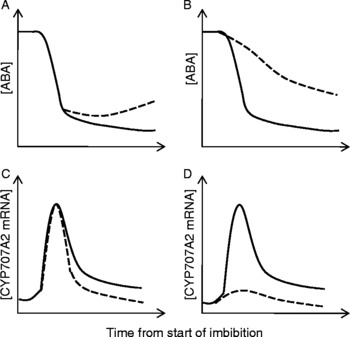
ABA accumulated during development and present in dry seeds declines after imbibition. This reduction occurs both in dormant (Cvi) and non-dormant (Col) Arabidopsis seeds, and depends largely on CYP707A2 activity (Fig. 3) (Ali-Rachedi et al., Reference Ali-Rachedi, Bouinot, Wagner, Bonnet, Sotta, Grappin and Jullien2004; Kushiro et al., Reference Kushiro, Okamoto, Nakabayashi, Yamagishi, Kitamura, Asami, Hirai, Koshiba, Kamiya and Nambara2004; Millar et al., Reference Millar, Jacobsen, Ross, Helliwell, Poole, Scofield, Reid and Gubler2006; Okamoto et al., Reference Okamoto, Kuwahara, Seo, Kushiro, Asami, Hirai, Kamiya, Koshiba and Nambara2006; Liu et al., Reference Liu, Shi, Ye, Liu, Jia and Zhang2009; Preston et al., Reference Preston, Tatematsu, Kanno, Hobo, Kimura, Jikumaru, Yano, Kamiya and Nambara2009). The CYP707A2 gene is induced by 2–3 h following the start of imbibition in both Col and Cvi (Preston et al., Reference Preston, Tatematsu, Kanno, Hobo, Kimura, Jikumaru, Yano, Kamiya and Nambara2009), resulting in a rapid decline in ABA, suggestive of a correlation with de novo synthesized CYP707A2 protein (Liu et al., Reference Liu, Shi, Ye, Liu, Jia and Zhang2009). This early induction is regulated by several factors, such as nitrate (Matakiadis et al., Reference Matakiadis, Alboresi, Jikumaru, Tatematsu, Pichon, Renou, Sotta, Kamiya, Nambara and Troung2009), nitric oxide (NO) (Liu et al., Reference Liu, Shi, Ye, Liu, Jia and Zhang2009) and afterripening (Millar et al., Reference Millar, Jacobsen, Ross, Helliwell, Poole, Scofield, Reid and Gubler2006). While dormant Cvi seeds and thermoinhibited Col seeds exhibit a decline in ABA after imbibition, it increases thereafter (Ali-Rachedi et al., Reference Ali-Rachedi, Bouinot, Wagner, Bonnet, Sotta, Grappin and Jullien2004; Toh et al., Reference Toh, Imamura, Watanabe, Nakabayashi, Okamoto, Jikumaru, Hanada, Aso, Ishiyama, Tamura, Iuchi, Kobayashi, Yamaguchi, Kamiya, Nambara and Kawakami2008). Thus it is the the initial reduction of ABA that may be a prerequisite for germination to be completed later.
Changes in ABA content after seed imbibition. Bold and dotted lines indicate the changes in germinating and non-germinating Arabidopsis seeds respectively, in ABA content (A, B) and transcripts of CYP707A2 (C and D). (A) ABA decline and subsequent accumulation, typical of the change in dormant Cvi seeds (Ali-Rachedi et al., Reference Ali-Rachedi, Bouinot, Wagner, Bonnet, Sotta, Grappin and Jullien2004; Preston et al., Reference Preston, Tatematsu, Kanno, Hobo, Kimura, Jikumaru, Yano, Kamiya and Nambara2009) and thermoinhibited Col seeds (Toh et al., Reference Toh, Imamura, Watanabe, Nakabayashi, Okamoto, Jikumaru, Hanada, Aso, Ishiyama, Tamura, Iuchi, Kobayashi, Yamaguchi, Kamiya, Nambara and Kawakami2008). This ABA accumulation pattern is correlated with CYP707A2 expression, as shown in (C). (B) A gradual decline in ABA caused by mutations or chemical applications to inhibit seed germination. This pattern occurs in the cyp707a2 mutant (Okamoto et al., Reference Okamoto, Kuwahara, Seo, Kushiro, Asami, Hirai, Kamiya, Koshiba and Nambara2006) and in carboxy-2-phenyl-4,4,5,5-tetramethylimidazolin-1-oxyl-3-oxide (cPTIO)-treated seeds (Liu et al., Reference Liu, Shi, Ye, Liu, Jia and Zhang2009). The ABA accumulation pattern associated with CYP707A2 induction in Phase I is shown in (D).

Phase II: decision to complete germination or not
Afterripening
Dormancy in many species is released if the seed undergoes a period of dry storage at room temperature, called afterripening (Finch-Savage and Leubner-Metzger, Reference Finch-Savage and Leubner-Metzger2006). This reduction in dormancy and increase in germination potential is characterized by increasing sensitivity of seeds to germination-stimulating signals, such as GA, light and nitrate, and by a decrease in sensitivity to germination-inhibiting signals (Derkx and Karssen, Reference Derkx and Karssen1993; Bewley, Reference Bewley1997; Ali-Rachedi et al., Reference Ali-Rachedi, Bouinot, Wagner, Bonnet, Sotta, Grappin and Jullien2004; Finch-Savage and Leubner-Metzger, Reference Finch-Savage and Leubner-Metzger2006). The response to afterripening is a change in gene expression patterns of the imbibed seeds (Millar et al., Reference Millar, Jacobsen, Ross, Helliwell, Poole, Scofield, Reid and Gubler2006; Finch-Savage and Leubner-Metzger, Reference Finch-Savage and Leubner-Metzger2006; Carrera et al., Reference Carrera, Holman, Medhurst, Dietrich, Footitt, Theodoulou and Holdsworth2008; Gubler et al., Reference Gubler, Hughes, Waterhouse and Jacobsen2008; Yano et al., Reference Yano, Kanno, Jikumaru, Nakabayashi, Kamiya and Nambara2009) or a reduced responsiveness to exogenous ABA (Yano et al., Reference Yano, Kanno, Jikumaru, Nakabayashi, Kamiya and Nambara2009). The effects of afterripening are observed even in ABA deficient and insensitive mutants, suggesting that its induction is ABA independent (Carrera et al., Reference Carrera, Holman, Medhurst, Dietrich, Footitt, Theodoulou and Holdsworth2008). A characteristic feature of afterripening is that it alters gene expression patterns in imbibed seeds and responsiveness to exogenous ABA following storage, not only of dormant seeds, but also of fully non-dormant seeds (Carrera et al., Reference Carrera, Holman, Medhurst, Dietrich, Footitt, Theodoulou and Holdsworth2008; Yano et al., Reference Yano, Kanno, Jikumaru, Nakabayashi, Kamiya and Nambara2009).
Accumulation of ROS in the cytosol during afterripening is also involved in dormancy breaking (Bailly, Reference Bailly2004). Seeds of sunflower (Helianthus annuus L.) are released from dormancy following dry storage. Variable storage conditions, such as moisture content and duration, result in different contents of ROS in dry seeds, and H2O2 content in the axis correlates with a reduction in dormancy (Oracz et al., Reference Oracz, El-Maarouf Bouteau, Farrant, Cooper, Belghazi, Job, Job, Corbineau and Bailly2007). Proteome analyses of dry seeds of sunflower and Arabidopsis show that accumulated ROS oxidize seed proteins in a selective manner during their storage (Oracz et al., Reference Oracz, El-Maarouf Bouteau, Farrant, Cooper, Belghazi, Job, Job, Corbineau and Bailly2007).
NADPH-oxidase is localized to the plasma membrane and it produces and releases superoxide to the apoplast, using cytosolic NADPH as substrate. Among ten members of the Arabidopsis NADPH-oxidase (AtrbohA–J) family, AtrbohB plays a major role in afterripening and in ABA sensitivity after imbibition (Müller et al., Reference Müller, Carstens, Linkies, Torres and Leubner-Metzger2009). A mutant of its gene (atrbohb) shows defects in afterripening, concomitant with reduced seed protein oxidation during dry storage. Moreover, Müller et al. (Reference Müller, Carstens, Linkies, Torres and Leubner-Metzger2009) report that the AtrbohB mRNA is present as an inactive pre-mRNA in freshly harvested seeds, and is spliced to become an active form during afterripening. This splicing is enhanced by exogenous ABA in imbibed seeds. Also, other members of the Atrboh family seem to be involved in afterripening and germination, in part through ABA signalling (Penfield et al., Reference Penfield, Li, Gilday, Graham and Graham2006; Müller et al., Reference Müller, Carstens, Linkies, Torres and Leubner-Metzger2009).
Several Arabidopsis mutants are also reported to show altered afterripening responses. Circadian clock genes are involved in afterripening, in part through altering the expression patterns of ABA and GA metabolism genes (Penfield and Hall, Reference Penfield and Hall2009). PROTEOLYSIS6 (PRT6) and arginyl-tRNA:protein arginyltransferase (ATE), components of a protein degradation pathway, are involved in afterripening, including the reducing of ABA sensitivity (Holman et al., Reference Holman, Jones, Russell, Medhurst, Ubeda Tomás, Talloji, Marquez, Schmuths, Tung, Taylor, Footitt, Bachmair, Theodoulou and Holdsworth2009). Also, a double AP2 transcription factor CHOTTO1 (CHO1), which functions downstream of ABI4, acts as a negative regulator of afterripening (Yamagishi et al., Reference Yamagishi, Tatematsu, Yano, Preston, Kitamura, Takahashi, McCourt, Kamiya and Nambara2009; Yano et al., Reference Yano, Kanno, Jikumaru, Nakabayashi, Kamiya and Nambara2009).
Light
Light is a critical environmental factor that regulates germination, and the seeds of many plant species, including lettuce (Lactuca sativa ‘Grand Rapids’) and Arabidopsis, require light as a positive stimulator (Bae and Choi, Reference Bae and Choi2008). Dark-imbibed light-sensitive seeds irradiated with a red light pulse (R; wavelength of 600–700 nm) germinate, and this effect of R is cancelled by a subsequent pulse of far-red light (FR; wavelength of 700–750 nm): the typical reversible light response mediated by phytochrome. R induces an increase of the bioactive gibberellin (GA), GA1, in lettuce seeds (Toyomasu et al., Reference Toyomasu, Tsuji, Yamane, Nakayama, Yamaguchi, Murohushi, Takahashi and Inoue1993), and application of GA1 mimics the effect of irradiation. R-absorbing phytochrome induces GA biosynthesis (Toyomasu et al., Reference Toyomasu, Kawaide, Mitsuhashi, Inoue and Kamiya1998; Yamaguchi et al., Reference Yamaguchi, Smith, Brown, Kamiya and Sun1998) and represses GA deactivation (Nakaminami et al., Reference Nakaminami, Sawada, Suzuki, Kenmoku, Kawaide, Mitsuhashi, Sassa, Inoue, Kamiya and Toyomasu2003; Seo et al., Reference Seo, Hanada, Kuwahara, Endo, Okamoto, Yamauchi, North, Marion-Poll, Sun, Koshiba, Kamiya, Yamaguchi and Nambaran2006; Oh et al., Reference Oh, Yamaguchi, Hu, Yusuke, Jung, Paik, Lee, Sun, Kamiya and Choi2007). In barley grains, blue light inhibits germination (Gubler et al., Reference Gubler, Hughes, Waterhouse and Jacobsen2008).
Applied ABA inhibits lettuce seed germination induced by R (Sankhla and Sankhla, Reference Sankhla and Sankhla1968), and endogenous ABA content is decreased, but not in FR-treated seeds (Toyomasu et al., Reference Toyomasu, Yamane, Murohushi and Inoue1994). Expression of lettuce NCED genes for ABA biosynthesis, LsNCED2 and LsNCED4, is down-regulated by R light, and one related to its degradation, the CYP707A gene, LsABA8ox4, is up-regulated; the positive effect of R on expression of these genes is nullified by FR (Sawada et al., Reference Sawada, Aoki, Nakaminami, Mitsuhashi, Tatematsu, Kushiro, Koshiba, Kamiya, Inoue, Nambara and Toyomasu2008). Light-induced changes in the expression of these ABA metabolism genes starts in the early stages of germination, similarly to R-induced LsGA3ox1 expression, a key enzyme in the regulation of GA biosyntheis. Light-regulation of LsNCED2 and LsABA8ox4 expression is GA-independent, whereas at later stages LsNCED4 expression is GA dependent. In Arabidopsis, NCED6 and CYP707A2 are responsible for phytochrome-mediated regulation of seed germination (Seo et al., Reference Seo, Hanada, Kuwahara, Endo, Okamoto, Yamauchi, North, Marion-Poll, Sun, Koshiba, Kamiya, Yamaguchi and Nambaran2006) in a GA-independent manner.
Freshly harvested barley grains complete germination in darkness, but fail to do so in the light (Gubler et al., Reference Gubler, Hughes, Waterhouse and Jacobsen2008), whereas afterripened grains can germinate under both light and dark. Blue light (wavelength 435–455 nm), but neither R nor FR, induces dormancy in fresh grains. Expression of HvNCED1 is induced in both freshly harvested and afterripened grains, while expression of HvABA8′OH-1 is also induced by afterripening (Gubler et al., Reference Gubler, Hughes, Waterhouse and Jacobsen2008). Transgenic barley that harbours an RNAi construct to reduce endogenous HvABA8′OH-1 expression shows a mild alleviation of the afterripening effect (Gubler et al., Reference Gubler, Hughes, Waterhouse and Jacobsen2008).
Temperature
Sensitivity to temperature is correlated with depth of dormancy and is critical for winter and summer annuals to determine when they germinate. Seeds have an intrinsic upper limit temperature for germination, which is determined by environmental and genetic factors (Baskin and Baskin, Reference Baskin and Baskin1998). Some seeds, such as oat (Avena sativa) and barley (Hordeum vulgare) acquire secondary dormancy when thermoinhibited, and fail to germinate even after transfer to an optimal temperature (Corbineau et al., Reference Corbineau, Black and Côme1993; Leymarie et al., Reference Leymarie, Robayo-Romero, Gendreau, Benech-Arnold and Corbineau2008). High ABA content and sensitivity are often associated with both thermoinhibited and secondary-dormant seeds (Yoshioka et al., Reference Yoshioka, Endo and Satoh1998; Tamura et al., Reference Tamura, Yoshida, Tanaka, Sasaki, Bando, Toh, Lepiniec and Kawakami2006; Argyris et al., Reference Argyris, Dahal, Hayashi, Still and Bradford2008; Leymarie et al., Reference Leymarie, Robayo-Romero, Gendreau, Benech-Arnold and Corbineau2008).
Germination of lettuce seeds (cv. Grand Rapids) is fully inhibited at 33°C in darkness (Yoshioka et al., Reference Yoshioka, Endo and Satoh1998); this is associated with a high ABA content, but not with GA content (Gonai et al., Reference Gonai, Kawahara, Tougou, Satoh, Hashiba, Hirai, Kawaide, Kamiya and Yoshioka2004). Imbibed lettuce seeds complete germination in the presence of GA3 at 33°C when treated with fluridone to reduce de novo ABA synthesis. GA3 enhances accumulation of phaseic acid (PA) and dihydrophaseic acid (DPA), suggestive of enhancement of ABA 8′-hydroxylation (Gonai et al., Reference Gonai, Kawahara, Tougou, Satoh, Hashiba, Hirai, Kawaide, Kamiya and Yoshioka2004). A comparative analysis of two lettuce accessions, thermoinhibition-sensitive Lactuca sativa (cv. Salinas) and thermoinhibition-tolerant Lactuca serriola (cv. UC96US23) shows that Htg6.1, the major QTL for thermotolerant germination, is co-localized with the locus conferring lower sensitivity to ABA and that conferring higher sensitivity to GA at high temperatures (Argyris et al., Reference Argyris, Dahal, Hayashi, Still and Bradford2008). Interestingly, Htg6.1 is co-localized with LsNCED4 and its expression is up-regulated by high temperatures only in cv. Salinas. This indicates that regulation of ABA content in imbibed seeds is a key for thermoinhibition of lettuce seeds.
Tamura et al. (Reference Tamura, Yoshida, Tanaka, Sasaki, Bando, Toh, Lepiniec and Kawakami2006) reported that thermoinhibition-resistant mutants of Arabidopsis include those with an abi3 allele. The abi1-1 and abi3 mutants show thermoinhibition-resistant germination, but the abi2-1, abi4 and abi5 mutants are as sensitive to high temperature as wild-type seed (Tamura et al., Reference Tamura, Yoshida, Tanaka, Sasaki, Bando, Toh, Lepiniec and Kawakami2006). This suggests that thermoinhibition requires only some of the ABA signalling factors. Fluridone application partially alleviates thermoinhibition of Arabidopsis seeds (Toh et al., Reference Toh, Imamura, Watanabe, Nakabayashi, Okamoto, Jikumaru, Hanada, Aso, Ishiyama, Tamura, Iuchi, Kobayashi, Yamaguchi, Kamiya, Nambara and Kawakami2008), suggestive of de novo ABA synthesis after imbibition being involved. Seeds decline in ABA within the first 6 h after the onset of imbibition at high temperature (Phase I), but ABA increases thereafter. NCED9, the most abundant NCED member in imbibed seeds, is up-regulated by high temperature. The nced9 mutants, but not other nced single mutants, show thermoinhibition-resistant germination, with nced9nced5nced2 triple mutants showing an even more pronouned positive response (Toh et al., Reference Toh, Imamura, Watanabe, Nakabayashi, Okamoto, Jikumaru, Hanada, Aso, Ishiyama, Tamura, Iuchi, Kobayashi, Yamaguchi, Kamiya, Nambara and Kawakami2008). This indicates that NCED9 is a major NCED in the inhibition of Arabidopsis germination at high temperatures and that NCED5 and NCED2 are also involved, probably at the later stages of germination. NCED9 is the most abundant mRNA in the embryo, whereas NCED5 is highest in the endosperm/testa at high temperature (Toh et al., Reference Toh, Imamura, Watanabe, Nakabayashi, Okamoto, Jikumaru, Hanada, Aso, Ishiyama, Tamura, Iuchi, Kobayashi, Yamaguchi, Kamiya, Nambara and Kawakami2008), suggesting that each NCED member plays a distinct role in different tissues. Furthermore, a role for ABA in Arabidopsis thermoinhibition may also be to inhibit GA biosynthesis.
Nitrate and nitric oxide (NO)
Nitrogenous compounds, nitrate, nitric oxide and cyanides, reduce seed dormancy (Hilhorst and Karssen, Reference Hilhorst and Karssen1988; Bethke et al., Reference Bethke, Gubler, Jacobsen and Jones2004; Alboresi et al., Reference Alboresi, Gestin, Leydecker, Bedu, Meyer and Truong2005; Oracz et al., Reference Oracz, El-Maarouf Bouteau, Bogatek, Corbineau and Bailly2008). Nitrate is able to release dormancy independently of nitrate reductase, and acts as a signal, rather than a nutrient (Hilhorst and Karssen, Reference Hilhorst and Karssen1989). Recently, Ho et al. (Reference Ho, Lin, Hu and Tsay2009) reported that the nitrate transporter CHL1 acts as a sensor in the Arabidopsis nitrate response.
Nitrate application reduces dormancy of Arabidopsis seeds when applied to the mother plant during seed development, or to a germination medium (Alboresi et al., Reference Alboresi, Gestin, Leydecker, Bedu, Meyer and Truong2005). AtNRT2.7 contributes to this response as the primary nitrate transporter (Chopin et al., Reference Chopin, Orsel, Dorbe, Chardon, Truong, Miller, Krapp and Daniel-Vedele2007). Nitrate application to the mother plants reduces ABA contents of mature dry seeds, whereas addition of nitrate to a germination medium leads to a faster decline in ABA in imbibed seeds than a water-imbibed control (Matakiadis et al., Reference Matakiadis, Alboresi, Jikumaru, Tatematsu, Pichon, Renou, Sotta, Kamiya, Nambara and Troung2009). These changes in ABA content are caused primarily by CYP707A2 (Matakiadis et al., Reference Matakiadis, Alboresi, Jikumaru, Tatematsu, Pichon, Renou, Sotta, Kamiya, Nambara and Troung2009), the gene for which is induced by nitrate both in developing and imbibed germinating seeds. Moreover, a cyp707a2 mutant is less responsive to nitrate in developing and imbibed seeds.
NO breaks seed dormancy in many species. Carboxy-2-phenyl-4,4,5,5-tetramethylimidazolin-1-oxyl-3-oxide (cPTIO), a scavenger of NO, is effective in enhancing the depth of dormancy, but does not inhibit germination of non-dormant seeds, suggesting that it plays a specific role in breaking dormancy, and is not a germination inhibitor (Bethke et al., Reference Bethke, Libourel and Jones2006). NO reduces ABA sensitivity of dormant Arabidopsis seeds. Interestingly, the ability of nitrate and cyanide to break dormancy is reduced in cPTIO-treated seeds (Bethke et al., Reference Bethke, Libourel and Jones2006) suggesting that their effectiveness depends on NO, which is probably synthesized from them, as precursors. Liu et al. (Reference Liu, Shi, Ye, Liu, Jia and Zhang2009) reported that induction of CYP707A2 after imbibition is dependent on NO that is produced after imbibition. Thus, it is possible that nitrate-induced CYP707A2 expression is also an NO-dependent process (Liu et al., Reference Liu, Shi, Ye, Liu, Jia and Zhang2009; Matakiadis et al., Reference Matakiadis, Alboresi, Jikumaru, Tatematsu, Pichon, Renou, Sotta, Kamiya, Nambara and Troung2009).
Crosstalk with GA
Plant hormones function mostly in combination. Therefore, hormone balance (at both metabolism and signalling) is critical for short-term and long-term responses.
Antagonistic roles of ABA and GA have been well documented in seeds of many plant species (Seo et al., Reference Seo, Nambara, Choi and Yamaguchi2009), although in order to achieve completion of germination in dark-imbibed seeds of a light-sensitive cv. of lettuce (Grand Rapids), both intact seeds and embryos require the nullification of ABA inhibition by cytokinin before GA can be effective (Khan, Reference Khan1968; Bewley and Fountain, Reference Bewley and Fountain1972). Several factors have been reported to be the node of hormone crosstalk. During Arabidopsis seed development, FUSCA3 (FUS3) B3-type transcription factor functions to balance ABA and GA metabolism (Curaba et al., Reference Curaba, Moritz, Blervaque, Parcy, Raz, Herzog and Vachon2004; Gazzarrini et al., Reference Gazzarrini, Tsuchiya, Lumba, Okamoto and McCourt2004). FUS3 is one of the master genes for seed maturation, and fus3 mutants fail to activate appropriate developmental programmes, resulting in seeds that are desiccation intolerant. This mutant does not accumulate ABA at the mid-maturation stage, but accumulates bioactive GAs (Nambara et al., Reference Nambara, Hayama, Tsuchiya, Nishimura, Kawaide, Kamiya and Naito2000; Curaba et al., Reference Curaba, Moritz, Blervaque, Parcy, Raz, Herzog and Vachon2004). The amount of FUS3 protein is positively regulated by ABA, and negatively regulated by GA (Gazzarrini et al., Reference Gazzarrini, Tsuchiya, Lumba, Okamoto and McCourt2004). The combination of feed-forward and feed-back loops constitutes the metabolic balance. With respect to signalling, VIVIPAROUS1, a maize orthologue of ABI3, has a bifunctional role in seeds, in activating ABA-mediated transcription and in repressing GA-mediated transcription (Hoecker et al., Reference Hoecker, Vasil and McCarty1995).
PHYTOCHROME INTERACTING FACTOR 3-LIKE 5 (PIL5) is an Arabidopsis bHLH transcription factor and plays a key regulatory role during phytochrome-mediated germination (Oh et al., Reference Oh, Kim, Park, Kim, Kang and Choi2004). The pil5 mutant seeds germinate even in darkness and show defects in phytochrome-induced regulatory processes, including ABA and GA metabolism and GA signalling. Phytochrome-regulated expression of AtABA1, NCED6, (NCED9) and CYP707A2 is disturbed in this mutant (Oh et al., Reference Oh, Yamaguchi, Hu, Yusuke, Jung, Paik, Lee, Sun, Kamiya and Choi2007). Further analysis indicates that PIL5 directly activates transcription of the SOMNUS (SOM) gene that encodes a CCH-type zinc-finger protein, which probably functions as an RNA-binding protein to effect phytochrome-regulated ABA and GA metabolism, downstream of PIL5 (Oh et al., Reference Oh, Yamaguchi, Hu, Yusuke, Jung, Paik, Lee, Sun, Kamiya and Choi2007; Kim et al., Reference Kim, Yamaguchi, Lim, Oh, Park, Hanada, Kamiya and Choi2008). Recently, Gabriele et al. (Reference Gabriele, Rizza, Martone, Circelli, Costantino and Vittorioso2010) reported that DAG1, a Dof-type transcription factor, acts downstream of PhyB and binds to the GA3ox1 promoter, possibly to repress GA biosynthesis. Interestingly, the dag1 mutant also down-regulates the ABA biosynthesis genes, AtABA1, NCED6 and NCED9, and up-regulates an ABA catabolism gene, CYP707A2 (Gabriele et al., Reference Gabriele, Rizza, Martone, Circelli, Costantino and Vittorioso2010). It will be of interest to learn if DAG1 is a direct regulator of ABA metabolism genes.
XERICO, a RING-H2-type zinc-finger protein, that affects ABA metabolism, is a direct target of DELLA repressors, nuclear proteins essential for GA signalling (Zentella et al., Reference Zentella, Zhang, Park, Thomas, Endo, Murase, Fleet, Jikumaru, Nambara, Kamiya and Sun2007). The xerico mutant results in a lower ABA content in seeds and its overexpression causes overaccumulation of ABA (Ko et al., Reference Ko, Yang and Han2006; Zentella et al., Reference Zentella, Zhang, Park, Thomas, Endo, Murase, Fleet, Jikumaru, Nambara, Kamiya and Sun2007). Thus transcriptional regulation of XERICO by DELLA proteins is potentially a node for crosstalk between GA signalling and ABA metabolism. Piskurewicz et al. (Reference Piskurewicz, Jikumaru, Kinoshita, Nambara, Kamiya and Lopez-Molina2008) reported that RGL2, one of the DELLA proteins, is required for control of ABA content and ABI5 function. The amounts of both RGL2 and ABI5 proteins are positively regulated by ABA and negatively regulated by GA, with ABI5 acting as a critical checkpoint during germination.
Sites of ABA metabolism and signalling
Germination is a complex process and a variety of cell types likely have distinct functions to ensure the completion of radicle emergence and to initiate seedling establishment. Due to its mobile nature, ABA can potentially alter metabolism of the cells in which it is produced and of others, following its transport thereto.
Immature seeds receive ABA from maternal tissues and can also synthesize their own. During Arabidopsis seed development, NCED6 expression is initiated early in embryogenesis, as early as 1 day after pollination (Lefebvre et al., Reference Lefebvre, North, Frey, Sotta, Seo, Okamoto, Nambara and Marion-Poll2006). Its expression is predominantly in the endosperm and this is maintained until mid-maturation (Lefebvre et al., Reference Lefebvre, North, Frey, Sotta, Seo, Okamoto, Nambara and Marion-Poll2006). NCED9 is expressed in both the endosperm/testa and embryo during the mid-maturation stage. ABA synthesis during late maturation is important for induction and maintenance of dormancy (Koornneef et al., Reference Koornneef, Hanhart, Hilhorst and Karssen1989), although the transcript abundance of NCED genes is low at this stage (Lefebvre et al., Reference Lefebvre, North, Frey, Sotta, Seo, Okamoto, Nambara and Marion-Poll2006). Spatial expression patterns of AtABA2 and AAO3, which encode enzymes catalysing the last two steps in ABA biosynthesis, indicate that these genes are predominantly expressed in provascular tissues in the axis during mid- and late maturation (Seo et al., Reference Seo, Hanada, Kuwahara, Endo, Okamoto, Yamauchi, North, Marion-Poll, Sun, Koshiba, Kamiya, Yamaguchi and Nambaran2006). CYP707A1 is highly expressed in provascular tissues during mid-maturation, and inactivates a large amount of ABA, possibly arriving from maternal tissues (Okamoto et al., Reference Okamoto, Kuwahara, Seo, Kushiro, Asami, Hirai, Kamiya, Koshiba and Nambara2006). Interestingly, in vegetative tissues of Arabidopsis, vascular tissues are also the main site for both ABA biosynthesis and catabolism (Endo et al., Reference Endo, Sawada, Takahashi, Okamoto, Ikegami, Koiwai, Seo, Toyomasu, Mitsuhashi, Shinozaki, Nakazono, Kamiya, Koshiba and Nambara2008; Okamoto et al., Reference Okamoto, Tanaka, Abrams, Kamiya, Seki and Nambara2009). The axis of developing seeds of sunflower (Helianthus annus) may be a primary site of de novo ABA synthesis (Le Page-Degivry and Garello, Reference Le Page-Degivry and Garello1992).
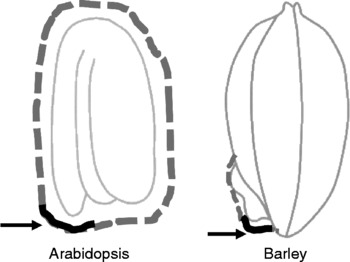
The sites of CYP707A expression in germinating seeds are known in Arabidopsis and barley (Millar et al., Reference Millar, Jacobsen, Ross, Helliwell, Poole, Scofield, Reid and Gubler2006; Okamoto et al., Reference Okamoto, Kuwahara, Seo, Kushiro, Asami, Hirai, Kamiya, Koshiba and Nambara2006), being most intense in endosperm and endodermis (Okamoto et al., Reference Okamoto, Kuwahara, Seo, Kushiro, Asami, Hirai, Kamiya, Koshiba and Nambara2006). Expression in the endosperm of Arabidopsis is localized in the micropylar region, which is immediately exterior to the radicle (Fig. 4). Barley HvABA8′OH-1, an orthologue of CYP707A2, is expressed in the coleorhiza, a tissue also juxtaposed to the embryonic root (Fig. 4) (Millar et al., Reference Millar, Jacobsen, Ross, Helliwell, Poole, Scofield, Reid and Gubler2006). The spatial expression patterns of NCED genes in germinating seeds of Arabidopsis is not known; however, expression of these genes is differentially up-regulated in both embryos and endosperms of thermoinhibited seeds (Toh et al., Reference Toh, Imamura, Watanabe, Nakabayashi, Okamoto, Jikumaru, Hanada, Aso, Ishiyama, Tamura, Iuchi, Kobayashi, Yamaguchi, Kamiya, Nambara and Kawakami2008). In lettuce seeds, there is a greater light-regulated expression of LsNCED genes in the endosperm closest to the axis, rather than to the cotyledons, with concomitant increases in ABA content in the former (Sawada et al., Reference Sawada, Aoki, Nakaminami, Mitsuhashi, Tatematsu, Kushiro, Koshiba, Kamiya, Inoue, Nambara and Toyomasu2008).
ABA catabolism is activated in tissues closely associated with the radicle (arrowed, and highlighted in black) in, left, the Arabidopsis micropylar endosperm and, right, the barley coleorhiza.

The Arabidopsis endosperm is the sensitive and essential site of response to nitric oxide (NO), GA and ABA (Penfield et al., Reference Penfield, Li, Gilday, Graham and Graham2006; Bethke et al., Reference Bethke, Libourel, Aoyama, Chung, Still and Jones2007). Exogenous ABA at concentrations of 1 nM or higher inhibits vacuolation of the endosperm cells of a dormant C24 accession of Arabidopsis (Bethke et al., Reference Bethke, Libourel, Aoyama, Chung, Still and Jones2007). Penfield et al. (Reference Penfield, Li, Gilday, Graham and Graham2006) showed that ABI5 is expressed both in the embryo and micropylar endosperm of Arabidopsis, whereas ABI4 expression is embryo specific. Indeed, abi4 mutant seeds contain ABA-insensitive embryos, but the endosperms are still sensitive to this hormone (Penfield et al., Reference Penfield, Li, Gilday, Graham and Graham2006). This indicates that ABA signalling in embryos and endosperms is partially shared, but also utilizes the different sets of signalling components.
Future perspectives
There are many reasons why viable seeds do not germinate, and a block to the completion of germination is usually a consequence of multiple events. Recent advances in our understanding of ABA metabolism and signalling in Arabidopsis has provided useful molecular tools to test the extent to which ABA contributes to the control of dormancy and germination in seeds of this and other plant species. The next challenge is to integrate this knowledge into the complex and diverse mechanisms underlying seed physiology. Because the actions of plant hormones are mutually interactive (Feurtado and Kermode, Reference Feurtado, Kermode, Bradford and Nonogaki2007), the consequences of a change in content of a single hormone and sensitivity may be quite different from one time to another, depending on the physiological state of the target tissue (Preston et al., Reference Preston, Tatematsu, Kanno, Hobo, Kimura, Jikumaru, Yano, Kamiya and Nambara2009). Understanding seed physiology will require a greater utilization of comprehensive analyses of non-model plants, including the use of comprehensive gene expression (transcriptome) analysis (Baudo et al., Reference Baudo, Lyons, Powers, Pastori, Edwards, Holdsworth and Shewry2006; Busch and Lohmann, Reference Busch and Lohmann2007; Argyris et al., Reference Argyris, Dahal, Hayashi, Still and Bradford2008; Sharma et al., Reference Sharma, Anderson, Kumar, Zhang, Giblin, Abrams, Zaharia, Taylor and Fobert2008; Barrero et al., Reference Barrero, Talbot, White, Jacobsen and Gubler2009). In addition, simultaneous quantification of multiple hormones from the same plant material is a useful methodology to examine the overall picture of hormone balance (Chiwocha et al., Reference Chiwocha, Abrams, Ambrose, Cutler, Loewen, Ross and Kermode2003, Reference Chiwocha, Cutler, Abrams, Ambrose, Yang, Ross and Kermode2005). For example, comprehensive hormone profiling of Arabidopsis seeds indicates that there are common features in hormone content in response to loss of dormancy (Table 1). Now, the metabolic and signalling pathways for each hormone are becoming understood; therefore, the establishment of a metabolic and signalling web to explain many of the aspects of seed physiology is an attractive prospect.
Changes in hormone content in dormant and non-dormant Arabidopsis seeds. Arrows indicate the change (↑, increase; ↓, decrease; or →, no change) in each hormone in non-dormant (i.e. afterripening for 6 or 8 weeks) imbibed seeds relative to the dormant (fresh) seeds. The decline in ABA (abscisic acid) and SA (salicylic acid), and increase in GA (gibberellin) and iP (cytokinin), occur in the non-dormant imbibed seeds using three comparisons. The changes in IAA (auxin) appear to be Cvi-specific. The levels of tZ (cytokinin) do not change between accessions or dormancy states. The cho mutant is hypersensitive to afterripening. Data reported in Preston et al. (Reference Preston, Tatematsu, Kanno, Hobo, Kimura, Jikumaru, Yano, Kamiya and Nambara2009) and Yano et al. (Reference Yano, Kanno, Jikumaru, Nakabayashi, Kamiya and Nambara2009)

Acknowledgements
Authors acknowledge Professor J. Derek Bewley for his critical reading of this manuscript and suggestions. The authors also thank Ms Yuri Kanno and Sachiyo Harada for their excellent technical assistance.