It is widely acknowledged that involvement in delinquent and criminal behavior increases through adolescence, peaking somewhere around age 16 and declining thereafter (Piquero, Reference Piquero and Liberman2008; Piquero et al., Reference Piquero, Blumstein, Brame, Haapanen, Mulvey and Nagin2001). Although a small number of youths persist in antisocial behavior across this developmental period, the vast majority of antisocial adolescents desist from criminal behavior as they enter adulthood (Laub & Sampson, Reference Laub and Sampson2001; Piquero, Reference Piquero and Liberman2008; Sampson & Laub, Reference Sampson and Laub2003). Psychological theory suggests that part of the reason for this age-related desistance from crime is that individuals mature out of antisocial behavior. Specifically, desistance from antisocial behavior is viewed as the product of psychosocial maturation, including increases in the ability to control impulses, consider the implications of one's actions on others, delay gratification in the service of longer term goals, and resist the influences of peers (Cauffman & Steinberg, Reference Cauffman and Steinberg2000; Steinberg & Cauffman, Reference Steinberg and Cauffman1996; Monahan, Steinberg, Cauffman, & Mulvey, Reference Monahan, Steinberg, Cauffman and Mulvey2009). To date, however, little research has examined how psychological maturation is associated with desistance from antisocial behavior, largely because psychological maturation during young adulthood has received relatively little attention from developmental psychologists. Recent research indicating protracted maturation, into the mid-20s, of brain systems responsible for self-regulation, however, has stimulated interest in charting the course of psychosocial maturity beyond adolescence.
The mostly widely cited theory regarding psychological contributors to desistance from antisocial behavior during the transition to adulthood has been advanced by Moffitt (Reference Moffitt1993, Reference Moffitt, Lahey, Moffitt and Caspi2003). She distinguishes between the vast majority (90% or more, depending on the study) of individuals whose antisocial behavior stops in adolescence (“adolescence-limited offenders”) and the small proportion of those whose antisocial behavior persists into adulthood (“life-course persistent offenders”). It is important that Moffitt suggests that different etiological factors explain these groups' involvement in antisocial behavior. Adolescent-limited offenders' involvement in antisocial behavior is hypothesized to be a normative consequence of their desire to feel more mature, and their antisocial activity is often the result of peer pressure or the emulation of higher status age mates. In contrast, when individual antisocial behavior persists into adulthood, it is thought to be rooted in early neurological and cognitive deficits that, combined with environmental risk, lead to early conduct problems and lifelong antisocial behavior.
Longitudinal studies of antisocial behavior have found support for Moffitt's taxonomy of offending, finding youths whose behavior is consistent with life-course persistent and adolescent-limited patterns, as well as youths who abstain from antisocial behavior. However, studies often document more than these three patterns. In a review of over 80 such studies, Piquero (Reference Piquero and Liberman2008) found that, on average, three to five groups are identified in trajectory analyses, with slightly more groups found in studies using self-reports of antisocial behavior than in those using official arrest records. Consistent with Moffitt's theory, studies typically identify those who abstain from antisocial behavior, an adolescent-peak pattern of antisocial behavior (although the specific peak age varies from study to study), and a chronic antisocial behavior trajectory (though individuals in this trajectory tend to decline in their antisocial behavior at some point in adulthood, suggesting that “persistent,” as well as other trajectories such as “adolescence-peak,” are relative, not absolute, terms). In addition to these patterns, studies also identify individuals who consistently engage in moderate levels of antisocial behavior, a late-onset chronic group (individuals who begin antisocial behavior in middle to late adolescence and engage in antisocial acts at a steady rate into adulthood), and a group of individuals who are antisocial as children but not as adolescents or adults. Even in studies of criminal offenders, these general patterns are noted. However, few studies examine these patterns among known offenders (only six studies across three samples). This has limited researchers from much exploration of potential differences in etiology among these variations in trajectory groups. Although the identification of variations in these broad patterns of antisocial behavior has led to refinement of Moffitt's framework (Moffitt, Reference Moffitt, Cicchetti and Cohen2006; Moffitt, Caspi, Harrington, & Milne, Reference Moffitt, Caspi, Harrington and Milne2002), the consensus is that the vast majority of individuals who engage in antisocial behavior during adolescence desist across the transition to adulthood.
Although Moffitt never explicitly outlines the role of normative increases in psychosocial maturity in her framework, it is logical to posit that increases in psychosocial maturity underlie adolescent-limited youths' desistance from antisocial behavior. If the reason that adolescent-limited offenders engage in antisocial behavior is to appear and feel more mature, it is possible that the genuine development of maturity may lessen the need to engage in antisocial behavior to achieve this end and thus contribute to its desistance. There is some evidence to suggest that this is the case. In a previous analysis of earlier waves of data from the study described in this article, youths whose antisocial behavior persisted into their early twenties had significantly lower levels of psychosocial maturity compared to youths who desisted from antisocial behavior (Monahan et al., Reference Monahan, Steinberg, Cauffman and Mulvey2009). The present study extends the follow-up period to age 25.
Our approach to the measurement of psychosocial maturity is based on a model proposed by Steinberg and Cauffman (Reference Steinberg and Cauffman1996), who suggest that during adolescence and early adulthood, three aspects of psychosocial maturity develop: “temperance” (impulse control and suppression of aggression), “perspective” (consideration of others and future orientation), and “responsibility” (the ability to take personal responsibility for one's behavior and resist peer influences). Research suggests that youths with lower temperance, perspective, and responsibility report greater antisocial behavior (Cauffman & Steinberg, Reference Cauffman and Steinberg2000) and that, over time, deficiencies in developing these indices of psychosocial maturity are associated with more chronic patterns of antisocial behavior (Monahan et al., Reference Monahan, Steinberg, Cauffman and Mulvey2009).
It is notable that adolescence is marked by continued changes in brain structure and function, and these developmental changes at the neurological level may underlie the developmental increases in psychosocial maturity that we would expect across adolescence and into early adulthood. Shortly after puberty (typically early adolescence), there is an increase in dopaminergic activity in pathways linking mesolimbic and prefrontal brain regions, producing a heightened sensitivity to and motivation for reward that peaks in midadolescence and declines throughout late adolescence into early adulthood. In contrast, structures of the brain associated with deliberative regulation of behavior that work to inhibit and direct reward motivation toward socially appropriate stimuli (the control network) show linear gains through adolescence and into adulthood (Casey, Getz, & Galvan, Reference Casey, Getz and Galvan2008; Steinberg, Reference Steinberg2008). The development of this control network and circuitry is likely what underlies the development of psychosocial maturity during adolescence and early adulthood. In support of this idea that psychosocial maturity and self-regulation continue to develop well into adulthood, a recent study found that sensation seeking increases between the ages of 10 and 15, but impulsivity decreases linearly from preadolescence through young adulthood (Steinberg et al., Reference Steinberg2008). Similarly, when offered the choice between a smaller immediate reward and a larger delayed one, younger adolescents (16 or younger) evince a relatively stronger preference for the former compared to older adolescents (17 and older; Steinberg, Reference Steinberg, Graham, O'Brien, Woolard, Cauffman and Banich2009). Thus, there is good reason to hypothesize that adolescent involvement in antisocial behavior and risky behavior more generally is the result of increased orientation toward rewards and still-developing self-regulation (Millstein & Halpern-Felsher, Reference Millstein and Halpern-Felsher2002). Thus, as psychosocial maturity continues to develop across adolescence and into early adulthood, we may expect these increases in psychosocial maturity to correspond to decreases in antisocial behavior.
Steinberg and Cauffman's model of psychosocial maturation maps nicely onto one of the most widely cited criminological theories of antisocial behavior: Gottfredson and Hirschi's general theory of crime (Reference Gottfredson and Hirschi1990), which posits that deficits in self-control are the root cause of criminal behavior. Their definition of self-control, like Steinberg and Cauffman's definition of maturity, includes such components as orientation toward the future (rather than immediate gratification), planning ahead (rather than impulsive decision making), physical restraint (rather than the use aggression when frustrated), and concern for others (rather than self-centered or indifferent behavior; Gottfredson & Hirschi, Reference Gottfredson and Hirschi1990, p. 89). However, whereas the general theory of crime is useful in explaining which adolescents are more likely to engage in antisocial behavior (i.e., the ones with poor self-control), it does not explain why most antisocial adolescents desist as they mature into adulthood. From a developmental perspective, it may be individual variability in both level and rate of change in psychosocial maturity across adolescence and early adulthood that distinguishes between those whose antisocial behavior desists and those whose antisocial behavior persists during the transition to adulthood.
In order to investigate whether and to what extent changes in psychosocial maturity across adolescence and young adulthood account for desistance from antisocial behavior, it is necessary to utilize a sample of individuals who are known to be involved in antisocial behavior. The present study investigates the development of psychosocial maturity and desistance from antisocial behavior in a sample of serious adolescent offenders who have been followed intensively from midadolescence into their midtwenties. To our knowledge, no other longitudinal study has examined psychosocial development among serious adolescent offenders across the transition to adulthood, allowing this study to make two key contributions to the literature. First, we are able to examine whether the majority of juvenile offenders do demonstrate significant increases in psychosocial maturity over time, as predicted by psychological theories of desistance. Second, we are able to ask whether individual variability in the development of psychosocial maturity is associated with variability in patterns of desistance. That is, the small proportion of individuals who persist in antisocial behavior into adulthood would be expected to exhibit stunted psychosocial maturation compared to those who desist from offending during the same developmental period. Moreover, we can test if differential timing in desistance (earlier vs. later) is linked to differential development of psychosocial maturity over time (note that within a sample of juvenile offenders, all individuals are desisters or persisters). Because individuals generally cease criminal activity by their midtwenties (Piquero, Reference Piquero and Liberman2008), this extension of our previous analysis through age 25 gives us greater confidence in any conclusions we draw about the impact of psychosocial maturation on desistance from antisocial behavior.
Method
Participants
Participants in the present study were male adolescents enrolled in the Pathways to Desistance study (see Mulvey et al., Reference Mulvey, Steinberg, Fagan, Cauffman, Piquero and Chassin2004), a longitudinal study of serious juvenile offenders in Phoenix, Arizona, and Philadelphia, Pennsylvania (for complete details of study methodology, see Schubert et al., Reference Schubert, Mulvey, Steinberg, Cauffman, Losoya and Hecker2004). Adolescents were eligible for study participation if they were between 14 and 17 years of age and had been charged with a felony or similarly serious nonfelony offense (e.g., misdemeanor weapons offenses or misdemeanor sexual assault). Because a large proportion of offenses committed by adolescents are drug offenses, the proportion of enrolled males whose enrollment offense was a drug offense was capped at 15% of the sample at each study site. All youths whose cases were being considered for trial in the adult system and had been arraigned were eligible for enrollment.
Of eligible youth, 67% of those whom we located and invited to participate in the research agreed to enroll in the study. Compared with youths who declined to participate in the study, enrolled participants had more prior arrests leading to formal charges (2.1 vs. 1.5 for nonparticipants), were somewhat younger at first arrest (13.9 vs. 14.2 years for nonparticipants), were somewhat younger at adjudication (15.9 vs. 16.1 years for nonparticipants), and were more likely to be non-Hispanic Caucasian (25% vs. 20% for nonparticipants). Although these differences are statistically significant, the magnitude of differences is modest. The present analyses are limited to 1,088 males in the sample who had completed at least 70% of the interviews administered during the 7-year study (n = 565 from Phoenix, n = 605 from Philadelphia; full male sample N = 1,170). Comparing the analytic sample to the full sample, there were no differences with respect to race and ethnicity, χ2 (3) = 6.34, p = .10, antisocial behavior prior to the baseline interview, t (1, 169) = 0.86, p = .40, or any dimension of psychosocial maturity at baseline: impulse control, t (1, 165) = 1.52, p = .12; suppression of aggression, t (1, 166) = –1.19, p = .23; consideration of others, t (1, 165) = 0.86, p = .40; future orientation, t (1, 169) = 1.84, p = .7; personal responsibility, t (1, 160) = –0.76, p = .45; and resistance to peer influence, t (1, 160) = 1.18, p = .24. Although the age difference is modest (16.01 vs. 16.53), the analytic sample is significantly younger than the full sample, t (1, 169) = 3.59, p < .01). The sample did not contain a sufficient number of females to control effectively for gender or to conduct the analyses separately for females.
The baseline interview was conducted an average of 36.9 days (SD = 20.6) after participants' adjudication (for those adolescents in the juvenile system), or if participants were eligible for prosecution as an adult, their decertification (i.e., waiver) hearing in Philadelphia or their adult arraignment in Phoenix. At the time of the baseline interview, this group of participants were predominantly of lower socioeconomic status (e.g., <4.5% of the participants' parents held a 4-year college degree, and 40% of the participants' parents had less than a high school education) and were ethnically diverse, with 41% African American, 35% Hispanic American, 20% non-Hispanic Caucasian, and 4% other.
Procedures
The juvenile court in each site provided the names of eligible adolescents based on age and adjudicated offenses. Interviewers attempted to contact each eligible juvenile and his parent or guardian to obtain juvenile assent and parental consent. Once consents had been obtained, interviews were conducted in a facility (if the participant was confined), in the home, or in an agreed-upon location in the community.
The baseline interview was administered over 2 days in two, 2-hr sessions. Interviewers and participants sat side-by-side facing a computer, and questions were read aloud to avoid comprehension or reading difficulties. Participants were informed that we had an affirmative obligation to maintain confidentiality from the federal government, which prohibited our disclosing any information obtained during the study to anyone outside the project staff. Youths were informed that the only exceptions to a promise of confidentiality were (a) if child abuse was suspected or if the participant (b) expressed plans to hurt himself or someone else, (c) had a specific plan to commit a crime in the future, or (d) disclosed that someone was in jail for a crime that the participant had committed. Interviews were conducted out of earshot of other individuals whenever possible. All recruitment and assessment procedures were approved by the institutional review boards of the participating universities. Adolescents were paid $50 for their participation in the baseline interview (when allowed by facility rules).
Each of the follow-up interviews was completed in one 2-hr session. Participants were reinterviewed every 6 months for the 3 years following the baseline interview; after 36 months, participants were interviewed annually for the remaining 4 years of the study. Follow-up interviews were conducted only if completed 6 weeks prior or 8 weeks after a target interview date (i.e., a 6- or 12-month interval depending on the baseline interview date). Participant compensation for the follow-up interviews increased gradually over time to a maximum of $150 in order to minimize attrition. Retention of the sample was excellent. From the baseline interview to the 84-month follow up, 858 individuals (67.8%) included in the present analyses completed all 11 interviews, 221 individuals (17.5%) completed 10 interviews, 94 individuals (7.4%) completed 9 interviews, 59 individuals (4.7%) completed 8 interviews, and 34 individuals (2.7%) completed 7 interviews. To create uniform time measurement for the purposes of the present analyses, we combined data from the 6- to 36-month biannual follow-up interviews into yearlong intervals by averaging psychosocial maturity variables or by counting the variety of endorsed self-reported offenses across the 6- and 12-month assessments, the 18- and 24-month assessments, and the 30- and 36-month assessments, respectively. Individuals had to provide data at both time points to have valid data for any annual period. The present analyses therefore include a total of 8 time points, each spanning 1 year. Because the design of the study is an accelerated cohort design, there was a different number of participants at each age group from 14 to 25 years: 14 years, n = 159; 15 years, n = 405; 16 years, n = 790; 17 years, n = 1,164; 18 years, n = 1,265; 19 years, n = 1,266; 20 years, n = 1,266; 21 years, n = 1,266; 22 years, n = 1,107; 23 years, n = 861; 24 years, n = 476; and 25 years, n = 102.
Measures
Of interest to the present study are measures of psychosocial maturity (separate measures of impulse control, suppression of aggression, consideration of others, future orientation, personal responsibility, and resistance to peer influence), antisocial behavior, and the amount of time a youth spent in the community during each time interval (as opposed to being in an institutional setting), because this affects opportunity to engage in antisocial behavior (see Table 1 for means, standard deviations, and intercorrelations of key variables).
Mean (standard deviations) and bivariate correlations of key variables

Note: All correlations are significant at p < .05.
aRange of correlations found when examining concurrent correlations among constructs. For example, the baseline measure correlated with baseline measure, 6-month measure correlated with 6-month measure, 12-month measure correlated with 12-month measure, and so forth.
Psychosocial maturity
Psychosocial maturity is conceptualized as consisting of three separate components: temperance, perspective, and responsibility, each of which has two elements (Steinberg & Cauffman, 1990). In the present article, we examine growth in each of these six indicators of psychosocial maturity separately. We also create a global index of psychosocial maturity combining all six measures.
Our measures of temperance include impulse control and suppression of aggression; perspective includes consideration of others and future orientation; and responsibility includes personal responsibility and resistance to peer influence. Four measures, described subsequently, were used to create these six indicators of psychosocial maturity: the Weinberger Adjustment Inventory (Weinberger & Schwartz, Reference Weinberger and Schwartz1990), which includes subscales that assess impulse control, suppression of aggression, and consideration of others; the Future Outlook Inventory (Cauffman & Woolard, Reference Cauffman and Woolard1999), which was used to derive a measure of future orientation; the Psychosocial Maturity Inventory (Greenberger, Josselson, Knerr, & Knerr, Reference Greenberger, Josselson, Knerr and Knerr1974), which includes a scale that assesses personal responsibility; and the Resistance to Peer Influence measure (Steinberg & Monahan, Reference Steinberg and Monahan2007).
Three subscales of the Weinberger Adjustment Inventory were used: impulse control (e.g., “I say the first thing that comes into my mind without thinking enough about it”), suppression of aggression (e.g., “People who get me angry better watch out”), and consideration of others (e.g., “Doing things to help other people is more important to me than almost anything else”). The measure asks participants to assess how accurately a series of statements matched their own behavior in the previous months (on a 5-point scale, from false to true). Each subscale was found to have adequate reliability (as indexed by Cronbach α) and good fit to the baseline data (as indicated by confirmatory factor analysis): impulse control (eight items; α = 0.76, normed fit index [NFI] = 0.95, comparative fit index [CFI] = 0.95, root mean square error of approximation [RMSEA] = 0.07), suppression of aggression (seven items; α = 0.78, NFI = 0.96, CFI = 0.97, RMSEA = 0.06); consideration of others (seven items; α = 0.73, NFI = 0.98, CFI = 0.99, RMSEA = 0.04).
The Future Outlook Inventory is an eight-item measure that includes items from the Life Orientation Task (Scheier & Carver, Reference Scheier and Carver1985), the Zimbardo Time Perspective Scale (Zimbardo, Reference Zimbardo1990), and the Consideration of Future Consequences Scale (Strathman, Gleicher, Boninger, & Edwards, Reference Strathman, Gleicher, Boninger and Edwards1994). The inventory asks participants to rank the degree to which each statement reflects how they usually act, on a scale of 1 (never true) to 4 (always true). A future orientation score is calculated based on the mean of items from the scale (e.g., “I will keep working at difficult, boring tasks if I know they will help me get ahead later”). The scale showed good reliability and an excellent fit to the baseline data (α = 0.68, NFI = 0.96, CFI = 0.97, RMSEA = 0.03).
The Psychosocial Maturity Inventory (Greenberger et al., Reference Greenberger, Josselson, Knerr and Knerr1974) includes a 30-item, reverse-scored subscale that assesses personal responsibility (e.g., “If something more interesting comes along, I will usually stop any work I'm doing”). Individuals respond on a 4-point scale, from strongly disagree to strongly agree. An overall personal responsibility score is calculated as the mean across all 30 items. The measure showed excellent reliability and an adequate fit to the baseline data (α = 0.89, NFI = 0.82, CFI = 0.87, RMSEA = 0.04).
Finally, the measure of Resistance to Peer Influence (Steinberg & Monahan, Reference Steinberg and Monahan2007) assesses the degree to which adolescents act autonomously in interactions with their peer group. Participants are presented with two conflicting statements (e.g., “Some people go along with their friends just to keep their friends happy” and “Other people refuse to go along with what their friends want to do, even though they know it will make their friends unhappy”) and are asked to choose the statement that most closely reflects their behavior. Next, participants are asked to rate the degree to which the statement is accurate (i.e., sort of true or really true). Each item is scored on a 4-point scale, ranging from 1 (really true) for the characterization indicating less resistance to influence to 4 (really true) for the characterization indicating more resistance to influence; answers of sort of true are assigned a score of 2 (if associated with the less resistant option) or 3 (if associated with the more resistant option). Ten such items are presented to participants. Each item explores a different dimension of peer influence (e.g., going along with friends or saying things one doesn't really believe), and one resistance to peer influence score is computed for this measure by averaging scores on the 10 items. The measure showed good internal consistency and fit to the baseline data (α = 0.73, NFI = 0.92, CFI = 0.94, RMSEA = 0.04).
In addition to examining each indicator of psychosocial maturity, we also created a global measure of psychosocial maturity. Consistent with the theoretical model of psychosocial maturity, a second-order confirmatory factor analysis with baseline data was confirmed. Specifically, the model with the three first-order factors (i.e., temperance, responsibility, and perspective) and the second-order psychosocial maturity factor had the best fit: χ2 (6) = 26.47, p < .001; CFI = 0.978, RMSEA = 0.055 (0.035, 0.077). Consequently, we created a global psychosocial maturity measure by standardizing each variable across age and then combining the six standardized measures. Standardizing each variable across age, rather than within time point, preserves the developmental patterning of the variable. For example, assuming equal development across ages, the mean or zero point of the standardized variable is set as approximately the middle age across the sample (in the present study approximately 19).
Antisocial behavior
Involvement in antisocial behavior was assessed with a revised version of the Self-Report of Offending (Huizinga, Esbensen, & Weiher, Reference Huizinga, Esbensen and Weihar1991). Participants reported if they had been involved in any of 22 different aggressive or income-generating antisocial acts (e.g., “Taken something from another person by force, using a weapon,” “Carrying a weapon,” “Stolen a car or motorcycle to keep or sell,” or “Used checks or credit cards illegally”). At the baseline and 48- through 84-month annual interviews, these questions were asked with the qualifying phrase, “In the past 12 months have you. . . .” At the 6- through 36- month biannual interviews, these questions were asked with the qualifying phrase, “In the past 6 months, have you. . . .”
Variety scores, a count of the number of different types of antisocial acts that an individual endorsed, were calculated for each annual interval. Variety scores are widely used in criminological research because they are highly correlated with measures of seriousness of antisocial behavior, yet they are less prone to recall errors than are self-reported frequency scores, especially when the antisocial act is committed frequently, such as selling drugs. Some have argued that variety scores and frequency scores represent the same propensity to engage in antisocial behavior, and given the problems associated with frequency scores, variety scores represent a preferred method of measuring antisocial behavior, particularly in a sample with high rates of antisocial behavior (Hindelang, Hirschi & Weis, Reference Hindelang, Hirschi and Weis1981; Thornberry & Krohn, Reference Thornberry, Krohn, Duffee, Crutchfield, Mastrofski, Mazerolle, McDowall and Ostrom2000). In the computation of variety scores, each specific offense (e.g., “Carrying a weapon”) was counted only once in any yearlong recall period, even if an individual endorsed the item in both 6-month intervals. Thus, we created a count of the total number of different antisocial acts that an individual endorsed across a yearlong interval.
Exposure time
Because incarceration can limit opportunity to engage in antisocial acts, failure to account for the time spent in the community, as opposed to in a secure setting, can affect the identification of trajectories of antisocial behavior (Piquero et al., Reference Piquero, Blumstein, Brame, Haapanen, Mulvey and Nagin2001). Youths reported on a calendar the number of days during the recall period that they had been in a detox/drug-treatment program, psychiatric hospital, residential treatment program, or secure institution. The proportion of time that an individual spent in an institutional setting during the year was calculated and used as a covariate in models. Because this information was not available at the baseline interview, all baseline values for this variable were set to 1, a method consistent with other work on antisocial behavior that utilizes exposure time as a covariate (e.g., Monahan et al., Reference Monahan, Steinberg, Cauffman and Mulvey2009; Mulvey et al., Reference Mulvey, Steinberg, Piquero, Besana, Fagan and Schubert2010). The amounts of exposure time reported for each 6-month period was averaged to create annual measures of exposure time.
Plan of analyses
Analyses were conducted in three steps. First, patterns of change (e.g., growth curves) in the six components of psychosocial maturity and in the overall index of psychosocial maturity were estimated by age. Second, semiparametric group-based modeling was used to identify trajectories of antisocial behavior by age. Group-based modeling is a data-driven analytic technique that groups individuals together based on similar patterns of development on a variable over time. The entire pattern of development from adolescence to early adulthood is used to derive the trajectory of antisocial behavior. Third, patterns of change (e.g., growth curves) in the overall measure of psychosocial maturity were compared for individuals who followed different trajectories of antisocial behavior identified in the group-based trajectory models. Thus, membership in different patterns of antisocial behavior across age were used as a predictor of level and rate of change in global psychosocial maturity over the same developmental period.Footnote 1 Specifically, average levels of psychosocial maturity and changes in psychosocial maturity were compared among adolescents who persisted in antisocial behavior versus those who desisted from antisocial behavior. Because this is a sample of adjudicated juvenile offenders, all individuals are desisting from criminal activity. Consequently, we compared all trajectories to the persisting trajectory group. We also compared average levels of psychosocial maturity and changes in psychosocial maturity among individuals who followed a more traditional adolescent-limited pattern: those whose antisocial behavior was quite high during adolescence but desisted from crime relatively earlier or later in development. In summary, we examined average patterns of change in antisocial behavior and psychosocial maturity in our sample and tested if patterns of antisocial behavior are associated with differential development in psychosocial maturity from adolescence to adulthood.
Full information maximum likelihood was used to account for missing data within our analytic sample (e.g., if an individual is missing data at a given time point). The advantage of full information maximum likelihood is that it uses all data, regardless of missing data pattern. Consequently, it protects against bias in analyses and is equivalent to other missing data strategies (i.e., multiple imputation; Graham, Olchowski, & Gilreath, Reference Graham, Olchowski and Gilreath2007).
Results
Patterns of change in psychosocial maturity over time
Growth curve models were estimated for each of the six indicators of psychosocial maturity as well as the global index of psychosocial maturity. Growth models were conducted in SAS (SAS Inc., 2004) from a multilevel perspective by age, with the intercept centered at age 16. Age 16 was selected because it is the youngest age at which greater than 50% of participants provided data. The highest order significant model polynomial was assessed (linear growth, quadratic growth, etc.), and models were tested to determine whether there was significant individual variation in level and rate of change in outcome over time.
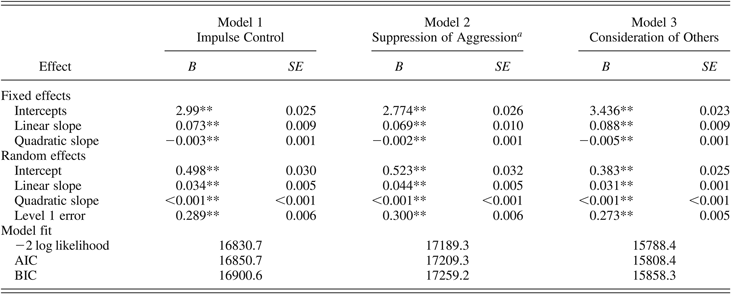
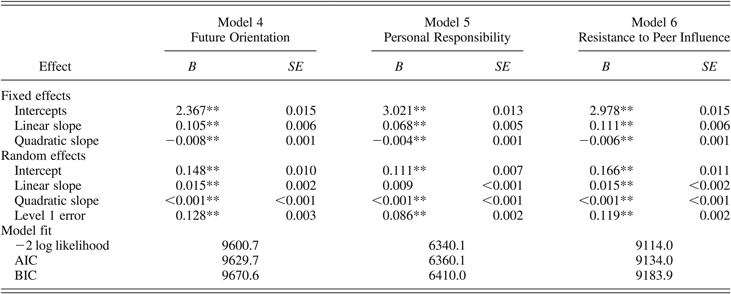
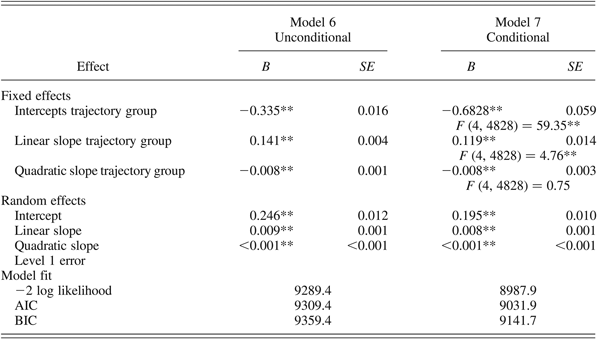
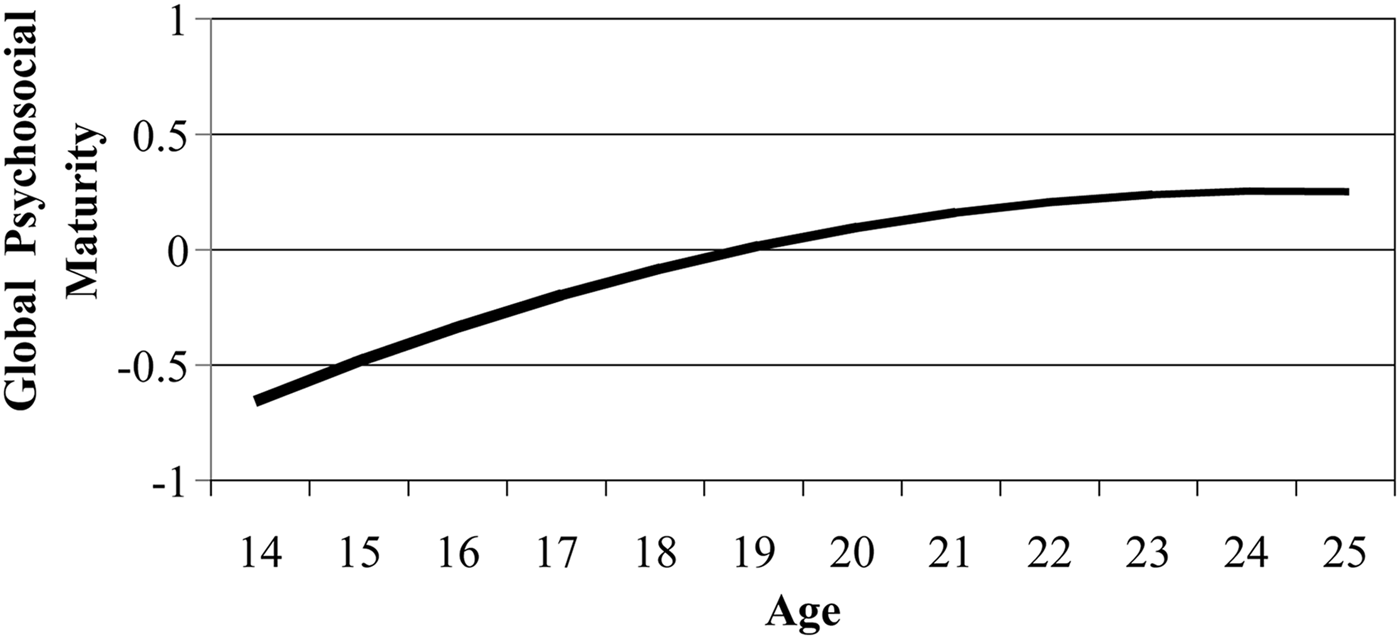
Across each of the six individual indicators of psychosocial maturity (impulse control, suppression of aggression, consideration of others, future orientation, personal responsibility, and resistance to peer influence) and the global index of psychosocial maturity, the pattern of results was identical. Table 2 presents unconditional model statistics for impulse control, suppression of aggression, and consideration of others; Table 3 presents unconditional model statistics for future orientation, personal responsibility, and resistance to peer influence; and Table 4 presents unconditional model statistics for global psychosocial maturity.
Unconditional growth models of impulse control, suppression of aggression, and consideration of others
Note: AIC, Akaike information criterion; BIC, Bayesian information criterion.
aAlthough the quadratic slope is not significantly different from zero, there is significant variance around the quadratic term. Consequently, the term was estimated and allowed to vary.
**p < .01.
Unconditional growth models of consideration of others, personal responsibility, and resistance to peer influence
Note: AIC, Akaike information criterion; BIC, Bayesian information criterion.
**p < .01.
Unconditional and conditional growth models of global psychosocial maturity
Note: AIC, Akaike information criterion; BIC, Bayesian information criterion.
**p < .01.
For each domain of psychosocial maturity and the global indicator of psychosocial maturity, quadratic growth is found, with individuals showing increases in the construct over time but with growth slowing in early adulthood. Moreover, significant individual variation is found in the level of the variable, the linear rate of change in the variable, and the quadratic change in the variable. Stated differently, individuals vary both in their level of psychosocial maturity (each of the six outcomes and global measure) and in the way in which they develop psychosocial maturity across adolescence and early adulthood. Figure 1 shows average patterns of growth in the six indicators of psychosocial maturity; Figure 2 shows the average pattern of growth in global psychosocial maturity. When the original subscales proposed by Steinberg and Cauffman (Reference Steinberg and Cauffman1996) are used (temperance, perspective, and responsibility), we find the identical pattern of findings. For parsimony, we only present the individual subscales and the global psychosocial maturity measure.Footnote 2
The unconditional growth model of six indicators of psychosocial maturity.
The unconditional growth model of global psychosocial maturity.
Based on the parameter estimates of growth derived from these models, we subsequently tested if growth in psychosocial maturity actually had ceased at some point between ages 14 and 25. To do so, we calculated the age at which the quadratic pattern would overcome linear change in the outcome using the parameter estimates from each model. In other words, using the regression formula, we solved for the age at which, given the growth parameters derived from our models, growth in psychosocial maturity would likely stop. We found across each of the six indicators of psychosocial maturity and the global measure of psychosocial maturity that individuals in the sample were still developing at age 25. That is, at age 25, individuals in our sample were still continuing to increase in impulse control, suppression of aggression, consideration of others, future orientation, personal responsibility, resistance to peer influence, and global psychosocial maturity, suggesting that psychosocial maturity continues to develop into the midtwenties.
Trajectories of antisocial behavior
We used group-based trajectory modeling (Nagin, Reference Nagin2005; Nagin & Land, Reference Nagin and Land1993) to identify subgroups of individuals who followed similar patterns of antisocial behavior across age. Because analyses were based on count data (the number of different antisocial acts endorsed), we used zero-inflated Poisson modeling to account for the clustering at zero (Lambert, Reference Lambert1992). We simultaneously derive the probability that each individual belongs to a given group based on his data (i.e., posterior probabilities of group membership) and the maximum-likelihood parameters estimates associated with membership in each of the defined trajectories (i.e., average level and rate of change for a given group). On the basis of posterior probabilities, individuals are assigned membership in their most likely group trajectory. Antisocial behavior was assessed at baseline and seven annual follow-up interviews, and the age range across analyses spanned from 14 to 25 years. Because we were interested in developmental changes in psychosocial maturity that covary with developmental changes in antisocial behavior, we estimate trajectories based on age (Monahan et al., Reference Monahan, Steinberg, Cauffman and Mulvey2009). Alternatively, if one were examining patterns or influences unrelated to developmental differences, one could model the data by time (see Mulvey et al., Reference Mulvey, Steinberg, Piquero, Besana, Fagan and Schubert2010). Proportion of time in institutional placement, as opposed to being in the community, was used as a covariate when deriving trajectories of antisocial behavior.
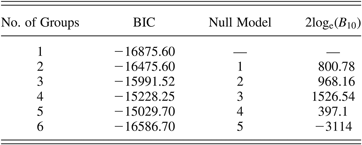
Different group solutions were tested, and the fit of different models was compared using the Bayesian information criterion (BIC; Jones, Nagin, & Roeder, Reference Jones, Nagin and Roeder2001). Solutions with up to six different groups were considered. The best trajectory solution was determined by three criteria: the lowest BIC value across models, a conceptually clear model, and a model in which each group included at least 5% of the sample. The number of latent classes was decided upon and then the form of the polynomial (e.g., linear or quadratic) was determined for each latent class. The highest significant polynomial trend was included in analyses.
BIC values and the BIC log Bayes factor approximation indicated that a five-group solution best fit the data (see Table 5). Moreover, the five-group solution had distinct levels or patterns of each trajectory group over time, and each group consisted of at least 5% of the sample. Thus, the five-group solution was selected because it had a low BIC value, a conceptually clear model, and an adequate percentage of the sample in each trajectory group.
Bayesian information criterion (BIC) and 2loge(B10) of the group based trajectory models considered
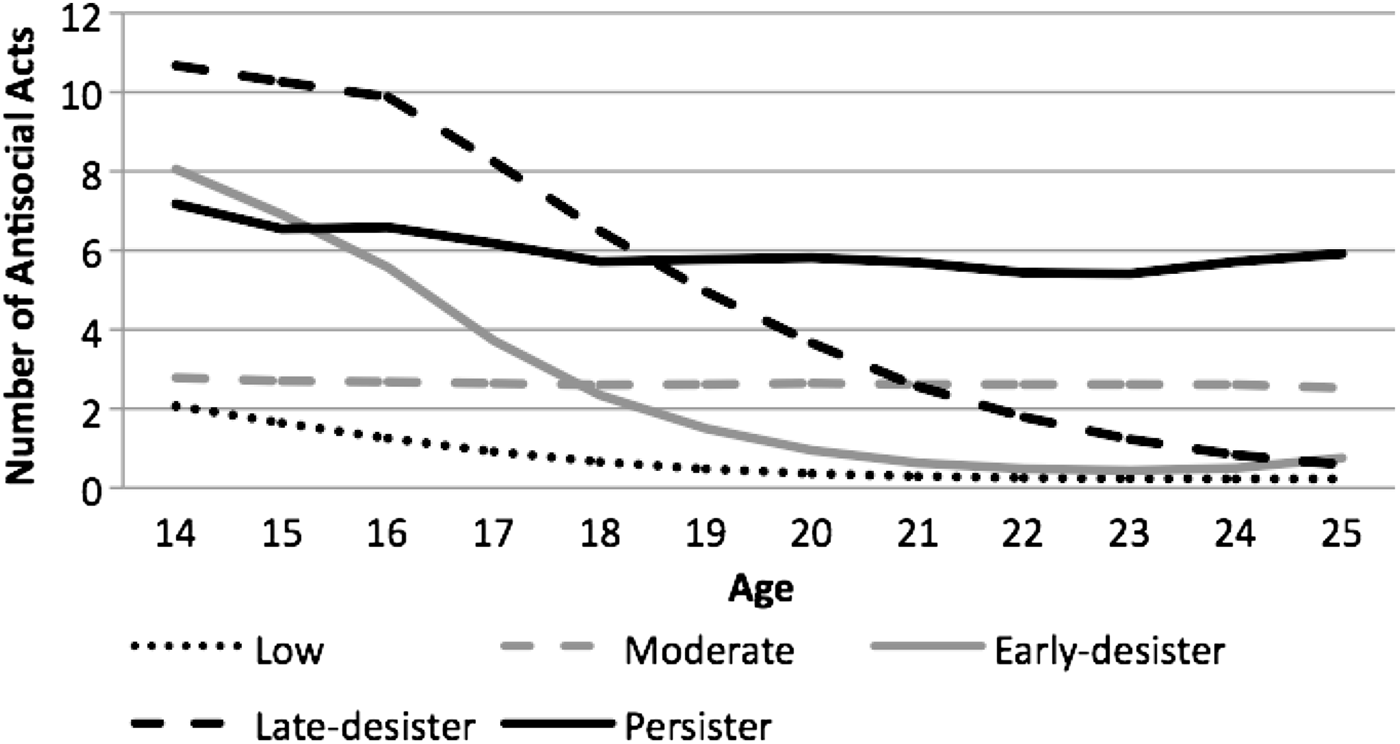
Figure 3 presents the five trajectories over time. The first group (37.2% of the sample) consisted of individuals who reported low levels of offending at every time point (low). The second group (13.5%) showed consistently moderate levels of antisocial behavior from 14 to 25 (moderate). The third group (31.3%) engaged in high levels of antisocial behavior in early adolescence but declined in antisocial behavior steadily and rapidly thereafter (early-desister). The fourth group (10.5%) engaged in high levels of antisocial behavior through midadolescence, peaking around age 15, and then declined in antisocial behavior across the transition to adulthood (late-desister). Finally, the fifth group (7.5%) reported high levels of antisocial behavior consistently from ages 14 to 25 (persisters). Although some individuals follow patterns of antisocial behavior consistent with Moffitt's taxonomy (the persisters, early-desisters, and late-desisters), it is noteworthy that given this is a sample of serious antisocial offenders, all individuals in the sample are either desisters or persisters. Names such as low, moderate, early-desister, or late-desister are simply relative terms to compare these youth.
Trajectories of antisocial behavior.
Posterior probabilities reflect the likelihood that an individual would belong to each of the derived groups. Ideally, each individual should have a very high probability of belonging to one group and very low probabilities of membership in all other groups. In general, posterior probabilities above .70 indicate that individuals are well matched to groups and that an adequate group solution has been achieved (Nagin, Reference Nagin2005). In the present analyses, posterior probabilities indicated that, on average, individuals were well matched to the groups to which they were assigned (average posterior probabilities were as follows: low = .90, moderate = .81, early-desister = .85, late-desister = .85, and persister = .85).
Patterns of change in psychosocial maturity over time as a function of trajectory group membership
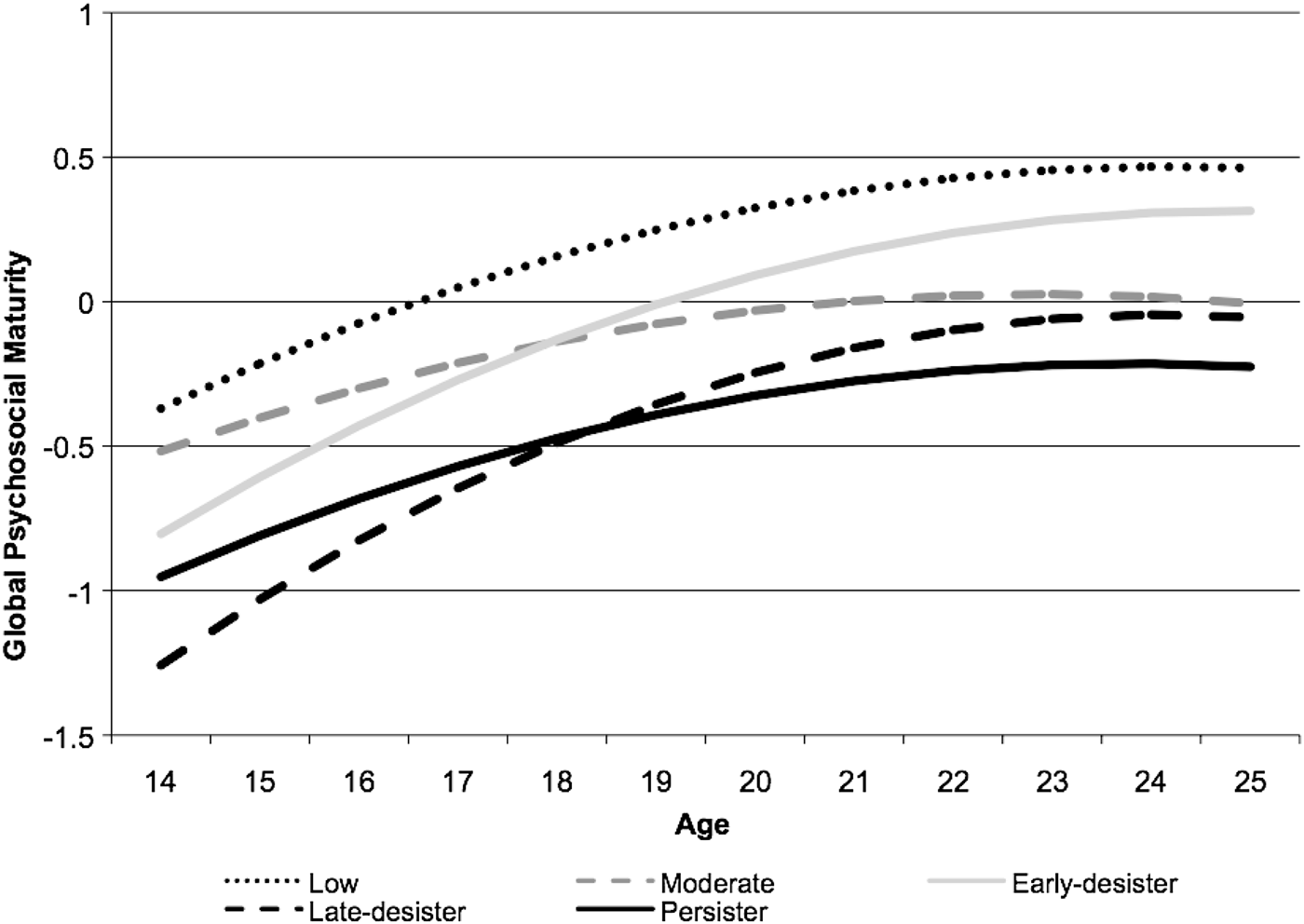
Finally, we tested whether antisocial behavior trajectory membership predicted differences in the intercept, linear slope, and quadratic slope of global psychosocial maturity (Table 4). The pattern of results did not substantively vary when the six indicators of psychosocial maturity were examined separately nor when we used the three subscales of psychosocial maturity proposed by Steinberg and Cauffman's (Reference Thornberry, Krohn, Duffee, Crutchfield, Mastrofski, Mazerolle, McDowall and Ostrom1996) model. Consequently, we only report the analyses for the global psychosocial maturity measure. Antisocial behavior trajectory group membership was related to differences in individuals' level of psychosocial maturity and differences in the extent to which their psychosocial maturity increased over time, but it was unrelated to individual variability in quadratic growth of psychosocial maturity (i.e., the extent to which the rate of growth in psychosocial maturity slowed; Figure 4).
Trajectories of Antisocial Behavior × Global Psychosocial Maturity.
Planned contrasts were used to examine specific differences in the intercept and slope as a function of trajectory group membership. Given the specific hypotheses we advanced, we compared (a) persisters and all other groups (to test the hypothesis that persisters are characterized by greater immaturity and less growth in maturity over time) and (b) early-desisters and late-desisters (to test the hypothesis that youths who desist sooner should have greater maturity than those who desist later).
At age 16, persisters evinced significantly lower levels of psychosocial maturity than did individuals in the low, moderate, and early-desister groups, but they were only marginally different at age 16 from the late-desister youths (p = .07). Moreover, late-desisters evince significantly lower psychosocial maturity at age 16 compared to early-desisters. With respect to linear changes in psychosocial maturity over time, late-desisters show significantly faster increases in psychosocial maturity compared to persister youths, and there was a trend (p = .07) that early-desister youths increased in psychosocial maturity faster compared to persister youth. No other contrasts were significant.
Discussion
Consistent with psychological explanations of desistance from antisocial behavior, the present study finds that normative increases in psychosocial maturity from adolescence to early adulthood distinguish between individuals who desist and those who persist in antisocial behavior. As expected, between ages 14 to 25, youths continue to develop the increasing ability to control impulses, suppress aggression, consider the impact of their behavior on others, consider the future consequences of their behavior, take personal responsibility for their actions, and resist the influence of peers. Although the rate of development of each domain of psychosocial maturity slows as youths age, it is nevertheless the case that even in their midtwenties, individuals are still becoming more mature, consistent with recent findings of protracted maturation in brain systems supporting self-regulation well into the midtwenties.
It is of particular note that in our sample of juvenile offenders, we find that psychosocial maturity has not stopped developing by age 25. The overall developmental pattern of increasing psychosocial maturity as youths age is consistent with cross-sectional work that suggests age differences in the development of resistance to peer influence, impulse control, and future orientation among adolescents, college students, and young adults (Modecki, Reference Modecki2009). Although past research with cross-sectional data suggests that delinquent and nondelinquent adolescents do not differ in the overall level of psychosocial maturity (Modecki, Reference Modecki2008), we do not know the extent to which development of psychosocial maturity varies among high-risk and less risky youths. The present study is one of the first studies to examine between-individual differences in how psychosocial maturity develops across adolescence. Regardless of whether high-risk youths exhibit differential development of psychosocial maturity over time, it is nevertheless the case that these capacities are developing well into their twenties, consistent with evidence from nonoffending samples. Evidence from the present study suggests that these capacities are still developing in their midtwenties, extending prior work on individual differences in the development of psychosocial maturity (Monahan et al., Reference Monahan, Steinberg, Cauffman and Mulvey2009). This provides cogent evidence for juvenile justice policies that mitigate sentencing on the basis of maturity (Steinberg, Cauffman, Woolard, Graham, & Banich, Reference Steinberg, Cauffman, Woolard, Graham and Banich2009; Steinberg & Scott, Reference Steinberg and Scott2003). Further understanding of individual variability in the development of psychological maturity may be important for informing treatment and sentencing of young offenders.
One important contribution of the present paper is that, beyond individual differences in the level of self-regulation (Gottfredson & Hirshi, Reference Gottfredson and Hirschi1990), individual differences in the rate of development of self-regulation are important for understanding individual variability in antisocial behavior (Cauffman & Steinberg, Reference Cauffman and Steinberg2000; Steinberg & Cauffman, Reference Steinberg and Cauffman1996). Within our sample, the desisters who offset antisocial behavior earlier exhibit higher levels of psychosocial maturity in adolescence compared to those who desist later, but notably the groups develop psychosocial maturity at the same rate. In contrast, youths whose antisocial behavior persists into early adulthood exhibited lower levels of psychosocial maturity in adolescence, but this group also demonstrates deficits in the development of psychosocial maturity compared to other antisocial youth. This finding not only supports Moffitt's (Reference Moffitt, Cicchetti and Cohen2006) assertion that life-course persistent offenders show chronic deficits in normative development but also highlights that even among serious adolescent offenders, those whose antisocial behavior is limited to adolescence will develop normally.
Given that individual differences in the development of psychosocial maturity are related to patterns of antisocial behavior, important avenues for future research include risk factors for delayed development of psychosocial maturity across adolescence and into adulthood. Among preadolescents, there is evidence that harsh parenting, low socioeconomic status, and neighborhood risk are related to slower growth in self-control from ages 9 to 12 (King, Lengua, & Monahan, Reference King, Lengua and Monahan2013). How these risk factors are related to growth in self-regulation across adolescence and into early adulthood remains unknown. Understanding the contextual mechanisms that contribute to delayed development of maturity will inform key targets for prevention science.
Our findings provide evidence that, just as psychological immaturity is an important contributor to the emergence of much adolescent misbehavior, development of psychological maturity and cessation from criminal activity are also related. This observation provides an important complement to sociological models of desistance from crime that emphasize that maturity obtained through social roles (such as marriage and employment) leads individuals out of criminal behavior (Laub & Sampson, Reference Laub and Sampson2001; Sampson & Laub, Reference Sampson and Laub2003). The results of the present analyses suggest that the transition into adulthood involves the acquisition of more adultlike psychosocial capabilities, but the extent to which the acquisition of psychosocial maturity and role-related maturity go hand in hand is an important, but understudied question regarding criminal activity (cf., Kandel & Yamaguchi, Reference Kandel, Yamaguchi, Ott, Tarter and Ammerman1999; Yamaguchi & Kandel, Reference Yamaguchi and Kandel1985). Despite continued fascination with the potential implications of the delayed transition into adult roles that characterizes the lives of many contemporary young people, we still do not have a clear picture of whether or in what ways the timing or nature of these role transitions affects psychological development. As developmental psychology turns increasingly to focusing on psychological development across early adulthood, it is key that we investigate the interplay between psychological and sociological maturation.
Although the primary goal of our analyses was to link psychosocial maturity and desistance from antisocial behavior, our findings are also relevant to those interested in describing trajectories of offending over time. Our analyses identified five distinct groups: (a) individuals who engage in consistently low levels of antisocial behavior, (b) individuals who engage in consistently moderate levels of antisocial behavior, (c) individuals who report high levels of antisocial behavior during early adolescence but whose antisocial behavior declines rapidly after that, (d) individuals whose antisocial behavior remains high during early and middle adolescence, and declines thereafter, and (e) individuals whose antisocial behavior is consistently high from adolescence through early adulthood. This pattern of results is largely consistent with other studies on patterns of antisocial behavior over time (Piquero, Reference Piquero and Liberman2008) and provides additional support for Moffitt's taxonomy of offending. It is especially notable that this pattern of findings is documented in a sample of serious juvenile offenders. That is, even in a sample primarily composed of serious juvenile felons, only a very small proportion (9%) of individuals persisted in their antisocial behavior across the transition to adulthood. With the exception of the small proportion of youths who persist in criminal activity, the majority of youths with serious criminal records demonstrate increases in their psychosocial maturity over time. Although we do not have a group of less serious offenders, or adolescents without criminal records, against which to compare the pattern of development seen in our sample of serious offenders, the results are consistent with the view that the vast majority of adolescents who commit serious crimes eventually mature out of antisocial behavior.
Although the present study is strengthened by its focus on a unique sample, longitudinal assessment, and advanced statistical methodology, it is limited in several respects. First, the present study relies on self-report measures of antisocial behavior and psychosocial maturity. Although we are confident that our measure of antisocial behavior is reliable and valid, given its high correlation with official arrest records (Brame, Fagan, Piquero, Schubert, & Steinberg, Reference Brame, Fagan, Piquero, Schubert and Steinberg2004), we have no similar validation for our measure of psychosocial maturity, such as corroboration by knowledgeable informants (e.g., teachers or employers) or performance on standardized tasks that index constructs like impulse control or delay of gratification. We have no reason to expect that these reports are biased in ways that would create the particular patterns of findings observed here (and especially, the fact that different outcomes showed different patterns of change across trajectory groups), but it is certainly possible that measures that reflect the likelihood to engage in aggressive acts (e.g., suppression of aggression) may have more shared variance with measurement of antisocial behavior, which may inflate their apparent association. A second limitation of our study is that we lack information about our participants prior to adolescence. The origins of differential development of psychosocial maturity likely begin earlier than adolescence, and although our study is relatively rare in that it spans the period from midadolescence through the midtwenties, more research is needed that explores these associations from childhood through early adulthood. Third, we do not know if, given our sample, we observed a restricted range of psychosocial maturity or a different rate of change in psychosocial maturity than might have been observed among nonantisocial youth. Moreover, it could be the case that different aspects of psychosocial maturity develop at different times. This remains an important question for future research.
The results of the present study bridge across multiple theoretical perspectives to elucidate the nature and correlates of desistance from antisocial behavior. We find that, over time, increases in psychosocial maturity are related to patterns of desistance. Moreover, at least among juvenile offenders, psychosocial maturity continues to develop well into adulthood, providing support to the notion that developmental immaturity should be a mitigating factor in the adjudication of youths and that even serious offenders have the potential to develop a greater maturity. Understanding how context may accelerate or decelerate this growth remains an important question for future research and for policymakers and practitioners interested in the development of interventions designed to promote young people's desistance from crime.