


Introduction
There are believed to be three main pathways through which children acquire fears: (1) direct traumatic conditioning experiences; (2) observational or vicarious learning; and (3) verbally transmitted information (Rachman, Reference Rachman1977). Vicarious learning and verbal information are seen as indirect pathways. Although there is considerable support for the individual contribution of Rachman's pathways to fear, they do not operate in isolation (Mineka and Zinbarg, Reference Mineka and Zinbarg2006): Rachman and subsequent researchers acknowledge that an anxious individual will most likely endorse several of these routes as having contributed to their fear (Muris, Reference Muris2007; Ollendick and King, Reference Ollendick and King1991). However, much of the research into these pathways has typically (and necessarily) treated them as independent routes through which fears are acquired. For example, children who directly experience an intensely traumatic event report greater subsequent fears relating to the incident (Dollinger, Odonnell and Staley, Reference Dollinger, O'Donnell and Staley1984; Yule, Udwin and Murdoch, Reference Yule, Udwin and Murdoch1990), but within these studies it would be hard to control for what prior or subsequent verbal information a child received about such incidents. In terms of vicarious learning, toddlers show greater avoidance of novel toys towards which they have seen their mothers acting fearfully (Gerull and Rapee, Reference Gerull and Rapee2002) and children's fear cognitions and avoidance of novel animals can be affected by pictures of adults expressing fear (Askew and Field, Reference Askew and Field2007). However, so that vicarious learning is not confounded by other factors, these studies have tried to eliminate the possibility of related direct negative experiences or verbal information. Finally, there has been a wealth of experimental research on the effects of verbal threat information on children's fears. Verbal threat information has been shown to increase children's short (Field, Argyris and Knowles, Reference Field, Argyris and Knowles2001; Field and Lawson, Reference Field and Lawson2003) and long term (Field, Lawson and Banerjee, Reference Field, Lawson and Banerjee2008; Muris, Bodden, Merckelbach, Ollendick and King, Reference Muris, Bodden, Merckelbach, Ollendick and King2003) fear beliefs, avoidance (Field, Reference Field2006a; Field and Lawson, Reference Field and Lawson2003), attention (Field, Reference Field2006a, b) and physiological responses (Field and Schorah, Reference Field and Schorah2007) to novel animals.
There are good theoretical reasons to believe that these pathways will interact in the formation of childhood fears. Davey's (Reference Davey and Davey1997) conditioning model of phobias explains how fears are acquired through direct traumatic experiences; however, this model also describes how one of the indirect pathways (verbal threat information) feeds into these direct conditioning experiences. Davey suggests that threat information has a role in creating expectancies (what he calls expectancy evaluations) about the likely outcome (unconditioned stimulus, US) of an encounter with a conditioned stimulus (CS). Davey suggests that existing beliefs about the likely outcome of interacting with the CS will influence the CS-US association that drives acquired fear responses. Field and Davey (Reference Field, Davey, Silverman and Treffers2001) explicitly suggest that expectancy evaluations could be created through both verbal information and vicarious learning experiences, and research has shown that children's self-reported beliefs about novel animals can be changed through these pathways (e.g. Askew and Field, Reference Field and Storksen-Coulson2007; Field and Lawson, Reference Field and Lawson2003). Other models of fear acquisition broadly concur with this idea that prior expectancies through information will mediate the effect of direct negative conditioning experiences (Mineka and Zinbarg, Reference Mineka and Zinbarg2006; Muris, Reference Muris2007; Muris and Merckelbach, Reference Muris, Merckelbach, Vasey and Dadds2001). Field and Storksen-Coulson (Reference Field, Argyris and Knowles2007) have shown in a laboratory study that verbal information in combination with a mildly aversive apparent interaction with a novel animal creates stronger behavioural avoidance of that animal than the negative interaction or the verbal threat information alone. One crucial finding was that the extent to which the prior information created fear expectancies in the children mediated the subsequent effect of the negative direct experience.
However, this is not the only way that the pathways interact. Davey (Reference Davey and Davey1997) also suggests that verbal information can be a powerful way through which a traumatic event can be revalued or devalued, and that this in turn can affect the strength of conditioned response (CR) elicited by a CS associated with that trauma. He called this “US revaluation processes”. Although vicarious learning was not explicitly discussed by Davey as a means through which a US could be revalued, it is likely that it could. For example, a child who experiences a bad thunderstorm may have associated overcast skies with thunder and lightening and may show some fear to overcast skies. However, if they subsequently observed someone being struck by lightening, this would likely cause them to revalue thunder and lightening as even more threatening and increase their fear responses to overcast skies.
Notwithstanding this theoretical support for the pathways to fear interacting, none of the models have directly speculated about how verbal information and vicarious learning interact. However, some theorists believe that vicarious learning can be conceptualized as conditioning (Field, Reference Field2006c; Mineka and Cook, Reference Mineka and Cook1993). Mineka and Cook (Reference Mineka and Cook1993) hypothesized that a model monkey's fearful reaction (the observer's US) to the CS elicits a fear response in the observer, so that the CS subsequently comes to elicit a conditioned fear response. Field (Reference Field2006c) also points towards recent developments in human associative learning that have shown that CS-US associations can be formed without the US needing to be aversive, or emotionally salient. He suggests that vicarious learning can, therefore, result from an association between a CS and someone's reaction to it, without that reaction needing to be aversive. Askew and Field (Reference Askew and Field2007) have shown that children's fear beliefs to novel stimuli change even when children do not find the reactions they observe (USs) aversive, and their experiments used a standard conditioning methodology that allowed them to conclude that fear belief changes were due to children forming associations between novel animals (CSs) and pictures of scared facial expressions (USs). If vicarious learning is underpinned by basic conditioning mechanisms then it is clear that the arguments made by Davey (Reference Davey and Davey1997) about direct aversive conditioning will extend to vicarious learning. That is, verbal information that creates fear expectancies should enhance the strength of association (and resulting response to the CS) in vicarious learning (Experiment 1); verbal information presented subsequent to vicarious learning should influence the evaluation of USs (in this case facial expressions) and change the resulting responses to the CS (Experiment 3). In addition, because vicarious learning in real life is unlikely to occur in the absence of verbal cues, verbal information occurring concurrently with an observed fear reaction should enhance acquired fear beliefs (Experiment 2).
Experiment 1
Method
Participants
Participants were 58 children (24 males, 34 females) aged 8 years 3 months to 9 years 8 months (M = 8 years 11.59 months, SD = 4.71 months). Evidence suggests that normal developmental fears tend to focus on animals around this age (see Field and Davey, Reference Field, Davey, Silverman and Treffers2001). All children were attending primary schools in East and West Sussex.
The consent and debrief procedures were identical in all experiments. Parents gave informed consent prior to the study and additional in loco parentis consent was given by the head teacher of the school. Before commencing, children confirmed they understood that they could stop the experiment at any time. In all experiments children were fully debriefed using correct information, puzzles and games about the animals.
Design
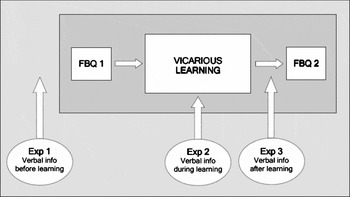
Designs for all three experiments were based on Askew and Field's (Reference Field, Argyris and Knowles2007) vicarious learning procedure and are summarized in Figure 1. Three animals that children were unlikely to have encountered before were used as neutral CSs. Three types of USs were used: scared faces; happy faces; and no faces (control). During vicarious learning each child saw each of the three animals together with one of the three types of faces in animal-face (CS-US) pairings. Each particular animal (CS) was shown together with a different type of face US in three counterbalancing groups: (1) Quoll (happy face), Quokka (no face control), Cuscus (scared face); (2) Quoll (scared face), Quokka (happy face), Cuscus (no face); and (3) Quoll (no face), Quokka (scared control), Cuscus (happy face). A self-report measure of children's fear beliefs is taken before and after vicarious learning by Fear Beliefs Questionnaire (FBQ). Additionally, in Experiment 1 there were also three verbal information conditions: negative, positive, or none.
Summary of procedures used in Experiments 1, 2 and 3: each of the three experiments uses the same basic procedure, but verbal information is presented at three different points in time

To compare changes in fear beliefs over time a 3 (pairing type: scared, happy, none) × 2 (time: before, after) × 3 (verbal information: negative, positive, none) mixed design was used, with repeated measures on the first two variables.
Materials
Animals (CSs). Nine pictures (400 × 400 pixels) of three animals were used as novel stimuli. Three pictures of a quoll, three of a quokka, and three of a cuscus. These Australian marsupials were chosen because UK children were unlikely to have existing knowledge or beliefs about them.
Faces (USs). USs were 20 (10 male, 10 female) portrait photographs (400 pixels wide by 278 to 533 pixels high) used by Askew and Field (Reference Askew and Field2007). Ten were smiling faces created specifically for that study and 10 were pictures of actors displaying fear. Four of the fear faces were taken from Matsumoto and Ekman's (Reference Matsumoto and Ekman1988) Japanese and Caucasian Facial Expressions of Emotion (JACFEE) and the remaining six were taken from films. Previous research has established that children believe the faces depict the intended emotions and do not make them feel scared (Askew and Field, Reference Askew and Field2007).
Fear Beliefs Questionnaire (FBQ). The Fear Beliefs Questionnaire (FBQ; Field and Lawson, Reference Field and Lawson2003) requires children to respond to 21 randomly presented items (seven per animal, of which four are reverse scored) relating to how they would feel in imagined situations involving the animals. Responses are given on a 5-point Likert scale (0 = No, not at all, 1 = No, not really, 2 = Don't know/Neither, 3 = Yes, probably, 4 = Yes, definitely). A final averaged score from 0 to 4 is produced for each animal. Scale reliabilities were consistent with previous research (see Field, Reference Field2006b): before learning Cronbach's α = .85 (Cuscus subscale), .78 (Quokka subscale), and.89 (Quoll subscale) and after learning α = 93 (Cuscus subscale),.90 (Quokka subscale), and.87 (Quoll subscale).
Verbal information. Verbal information consisted of modified versions of sound-clips used by Field and Storksen-Coulson (Reference Field and Storksen-Coulson2007). Previous verbal information studies have produced changes in fear beliefs extending into the lower and uppermost regions of the FBQ scale (e.g. Field and Lawson, Reference Field and Lawson2003), which would be problematic for the present study because of the potential for creating ceiling effects. To lessen the effects of verbal information on fear beliefs, a mixture of positive and negative information was used in a 5:2 ratio: negative trials consisted of five negative statements and two positive statements, and positive trials consisted of five positive statements and two negative statements. For each individual child the positive and negative statements they heard were drawn randomly from pools of nine positive (e.g. “Quokkas come from Australia and are small and cuddly”) and nine negative (e.g. “Quokkas are dirty and smelly and carry lots of germs”) statements.
Procedure
All three experiments were computerized using custom written (by the last author) software in Visual Basic.net with ExacTicks 1.1 (Ryle Design, Reference Design1997) to ensure ms accurate reaction time measurements. It was run on a Pentium 4 Toshiba laptop computer running either Windows 2000 or XP. The procedure was essentially identical to Askew and Field's (Reference Field, Argyris and Knowles2007) baseline procedure except that some children heard predominantly positive or negative information about the animals at the beginning of the experiment.
Pre-learning verbal information. Children were randomly allocated to one of three verbal information groups: “negative”, “positive” or “none”. Children in the negative group heard 5 negative and 2 positive statements about each of the three animals, children in the positive group heard 5 positive and 2 negative statements about the animals, and children in the none group heard no information. Following verbal information the first FBQ was administered.
Vicarious learning. Within each verbal information group children were randomly assigned to one of the three counterbalancing groups. During vicarious learning, children saw each of the three animals in one of the three pairing conditions. Thus, in a within-subjects design, each child saw: one animal presented with the 10 faces expressing fear (scared-paired), one of the animals together with the 10 faces expressing happiness (happy-paired), and one of the animals presented alone on the screen 10 times (unpaired). The type of face a child saw together with each type of animal was determined by the counterbalancing group they were in.
The total length of a single pairing trial was 2s. Each consisted of a randomly chosen animal picture appearing alone on the screen for 1s and then for a further 1s together with a scared face, happy face, or no face. The type of face appearing with each particular animal depended on the counterbalancing group the child was in. The side of the screen animals and faces were presented on was randomly determined in each trial. Unpaired trials were identical to paired trials except that no face appeared and the animal was presented alone for 2s. A total of 30 trials were presented in random order for each child and there was a randomly determined 2s to 4s interval between each trial. On completion of the vicarious learning trials the second FBQ was administered.
Results
α = 0.05 and effect sizes (r) are reported where interpretable.
Verbal information
A preliminary analysis examined pre-vicarious learning fear beliefs scores to determine the effect of verbal information. A two-way 3 (pairing-type: scared, happy, unpaired) × 3 (verbal information: negative, positive, none) mixed ANOVA, with repeated measures on the first variable, found that the main effect of verbal information was significant, F(2, 55) = 8.85. There was no significant (Greenhouse-Geisser adjusted) main effect of pairing-type, F(1.75, 96.08) = 1.63, or pairing-type × verbal information interaction, F<1. Together, the findings indicate that fear beliefs for animals were affected by the type of verbal information children had received, and that this did not differ between specific animals within each verbal information group. Planned contrasts indicated that receiving negative verbal information led to significantly higher fear beliefs, CI 0.95 = 0.14 (lower), 0.94 (upper), but positive verbal information did not lead to significantly lower fear beliefs, CI 0.95 = −0.70 (lower), 0.10 (upper), compared to receiving no verbal information.
Vicarious learning
A three-way 3 (pairing-type: scared, happy, none) × 2 (time: before pairing vs. after pairing) × 3 (verbal information: negative, positive, none) mixed ANOVA, with repeated measures on the first two variables, was performed on the data. There was a significant main effect of verbal information, F(2, 55) = 8.45. The main effects of time, F(1, 55) = 2.54, r = .21, and of pairing-type, F(2, 110) = 2.37, were non-significant, as were the pairing-type × verbal information interaction, F(4, 110) = 1.51, and time × verbal information interaction, F(2, 55) = 1.55. The Greenhouse-Geisser adjusted pairing-type × time interaction was significant, F(1.68, 92.52) = 23.95, indicating that fear beliefs had changed significantly over time. Additional planned contrasts found fear beliefs had significantly increased for scared-paired animals, F(1, 55) = 17.84, r = .49, and significantly decreased for happy-paired animals, F(1, 55) = 13.04, r = .44, compared to unpaired animals. However, the type × time × verbal information interaction was not significant, F(3.36, 92.52) = 1.29, indicating that changes in children's fear beliefs during vicarious learning were not influenced by the verbal information they had previously received.
Given that verbal information had not been successful at creating a group of children with significantly lower fear beliefs, a second analysis examined changes in children's fear beliefs in relation to their actual pre-vicarious learning fear belief scores, rather than merely the verbal information group they had been in. An effective way to do this is to treat the data as hierarchical, viewing children's changes in fear belief scores for each type of pairing as nested within the child. Multilevel modelling can then be used to simultaneously predict the change in fear beliefs for each child from (1) each pairing-type within each child, (2) the child's pre-vicarious learning fear belief scores, and (3) the type of verbal information that the child received (see Wright, Reference Wright1998 for a detailed discussion of multilevel modelling). However, one problem with using the change in fear beliefs as an outcome is that the room on the scale to change will vary as a function of the initial fear beliefs (a child with initial fear beliefs of 3 can only move one point on the scale to the maximum value of 4 whereas a child with an initial fear belief of 2 has twice as much room to change because it would take them two points on the scale to reach the maximum value). Therefore, rather than use change per se, the outcome variable was the change in fear beliefs expressed as a percentage of the available change. For example, a child with an initial fear belief of 2.5 has an available change of 4 – 2.5 = 1.5. If, after vicarious learning, his fear belief is 3.67, then his change is 0.67, expressed as a percentage of available change is 0.67/1.5 × 100 = 44.67%.
An initial analysis indicated that findings were not substantially affected by the inclusion of Information Group as an additional fixed factor: the main effect of information group was not significant, nor any interactions involving this effect and so it is not included in the following analysis. The main effect of pairing-type was not significant, F(2, 83.32) = 1.25, p = .29 indicating that the change in fear beliefs (expressed as a percentage of available change) was not affected by whether CSs were paired with scared, happy or no face. Pre-vicarious learning fear beliefs had a significant general effect on subsequent change in fear beliefs, F (1, 83.04) = 10.09, p <.01. Most important, the pairing-type × pre-vicarious learning fear beliefs interaction was significant, F(2, 83.67) = 6.06, p <.01. These results indicate that the effect of prior fear beliefs on the amount of change in fear beliefs (expressed as a percentage of the available change on the scale) was moderated by the subsequent vicarious learning experience. In particular, this interaction was significant when a scared US was used compared to no US, t(61.57) = 2.03, p <.05, CI.95 = .61 (lower), 71.11 (upper), but not when a positive US was used compared to no US, t(98.34) = −1.65, p = .10, CI.95 = −61.60 (lower) 5.61 (upper).
Discussion
Consistent with Askew and Field (Reference Askew and Field2007), Experiment 1 showed that vicarious learning can create changes in children's self-reported fear beliefs for novel animals. Fear beliefs increased for animals seen with scared faces and decreased for animals seen with happy faces. In addition, prior negative information significantly facilitated the effect of negative vicarious learning on children's fear beliefs. By comparing fear beliefs about animals paired with faces against an animal that was never paired with a facial expression we can be sure the observed vicarious learning is due to the association that a child forms between an animal and the facial expression with which it was presented. Previous studies using identical vicarious learning procedures have indicated that the resulting changes in fear cognitions can also be detected indirectly (using an affective priming task) and are reflected in children's avoidance behaviour for the animals on a behavioural approach task (Askew and Field, Reference Askew and Field2007). However, the manipulation of fear beliefs prior to vicarious learning was by no means ideal in the current experiment. Prior information did not succeed in creating uniform groups with different average prior expectancies. The analysis did show that prior expectancies had some kind of effect on the subsequent change in fear beliefs due to vicarious learning; however, the issue remains as to whether these prior fear beliefs were created by the information we gave (and the group level analysis suggested that the prior fear beliefs had a bigger effect on vicarious learning than the information group to which the child belonged). Nevertheless, this study is the first to show that prior expectancies feed into negative, but not positive, vicarious learning.
Experiment 2
Experiment 1 looked at how verbal information before vicarious learning might impact on acquired fear beliefs. Experiment 2 moves on to look at when verbal information is presented concurrently, as part of the observed reaction to a novel stimulus. Outside of the laboratory, a vicarious learning event is likely to consist of both verbal and visual components and we might expect verbal information to enhance learning. One possibility is that congruently valenced verbal information about animals (CSs) will interact with the vicarious learning event and effectively create a composite US of increased intensity. Mineka and Cook (Reference Mineka and Cook1993) argue that levels of fear learning are related to the aversiveness of the US experienced. Another possibility is that verbal information and vicarious learning do not interact directly, but rather affect fear beliefs independently with a combined overall effect.
Method
Participants
The participants were 42 primary school children (22 females, 20 males) from a Berkshire primary school aged 7–9 years (M = 8 years 2.51 months, SD = 3.15 months).
Design
The basic design of the experiment was the same as Experiment 1 except that instead of children having prior verbal information about the animals, half of the children just received vicarious learning (identical to that described in Experiment 1) and the other half received the same vicarious learning but with a sound file accompanying each face as it appeared on the screen. These sound files were either “gasps” of surprise or “ahhhs” that were played as the face appeared on the screen. The gender of the model in the picture and the person doing the vocalization were matched.
Materials
The CSs, USs and FBQ were identical to those used in Experiment 1.
Vocalizations
Twenty vocalizations (.mp3 files) accompanied USs in the experiment: 10 (5 male, 5 female) were scared vocalizations (gasps) and were presented in conjunction with the scared faces and 10 (5 male, 5 female) were happy vocalizations (ahhhs) that accompanied the happy faces.
Results
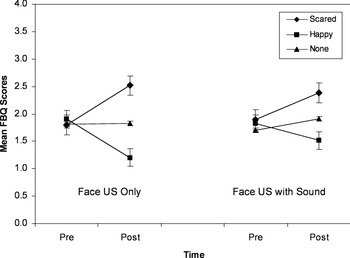
Figure 2 shows the changes in mean FBQ scores to CSs across vicarious learning for face USs alone (left) and face USs accompanied by sound (right) for all types of US (scared face, happy face and no face). It shows a strong vicarious learning in both conditions as the fear belief scores significantly increase for the scared-paired condition, significantly decrease for the happy-paired condition and stay the same in the no face condition.
The change in mean (and SE) FBQ scores pre- and post-vicarious learning for the sound and no sound US groups for CCs paired with scared faces, happy faces and no faces

A 2(sound: yes or no) × 2(time: pre-vicarious learning vs. post-learning) × 3(face type: scared, happy or no face) mixed ANOVA was performed on the average fear beliefs from the FBQ. There was a significant main effect of information type on the children's fear belief questionnaire scores, F(2, 80) = 12.04, p < .001, showing that the children's beliefs about the animals were significantly different depending on the face with which they were paired. There was no significant effect of time on the scores suggesting that the children's scores on the FBQ did not significantly change over time, F (1, 40) = 0.61, ns.
There was no significant interaction between time and sound F(1, 40) = 0.42, ns or face type and sound F(2, 80) = 0.24, ns, showing that the children's FBQ scores were not affected by whether they heard vocalizations or not.
An effect of vicarious learning was demonstrated by a significant time × face type interaction: that is, fear beliefs change over time depending on the face with which it was paired. Sphericity could not be assumed for this effect (W = .818, X 2(2) = 7.84, p < .05), so a Greenhouse-Geisser correction was used, F(1.69, 67.68) = 16.33, p < .001. Contrasts on this interaction revealed significant effects when comparing average FBQ scores over time (pre and post) for animals paired with scared faces compared to those paired with no faces, F(1, 40) = 6.26, p < .05, and to animals paired with happy faces compared to those paired with no faces, F(1, 40) = 16.24, p < .001. The key question for this experiment is whether this interaction was moderated by the sound variable. A non-significant sound × time × face type interaction indicated that it was not, F(1.69, 67.68) = 1.38, ns. This shows that although there was an overall effect of vicarious learning, it was not strengthened by whether or not the US was accompanied by verbal cues.
Discussion
It appears that verbal information presented concurrently with visual information about the threat posed by a novel animal did not enhance vicarious learning. There are always many reasons why a result may be null, such as a lack of power or a failure of the manipulation. It seems likely that the vocalizations used were not particularly powerful (deliberately so because more powerful vocalizations such as screams may have been unethical to use with children). This raises the possibility that (1) the component features of the observed reaction in a vicarious learning episode are themselves not important, but that the overall aversiveness of what is being observed might be (as Mineka and Cook, Reference Mineka and Cook1993 suggest); (2) additional verbal cues during vicarious learning have no additional effect to that of the visual scene; and (3) our verbal cues were simply not strong enough to add value to what is being learned.
Experiment 3
The final experiment looks at the role of verbal information post-vicarious learning. As such, it tests the power of verbal information to revalue the US and hence the vicarious acquired response to a novel animal.
Method
Participants
Participants were 36 children (23 male, 13 female), aged between 8 years 7 months and 9 years 9 months (M = 9 years 1.06 months, SD = 4.00 months), attending an East Sussex primary school.
Materials
Verbal information. Forty sound clips were created: 20 US inflation and 20 US devaluation clips, half male and half female in each case. Each sound file consisted of a different voice stating that they were either more (inflation) or less (devaluation) scared than they appeared in the picture. For example, “I think I look a lot more calm than I actually felt. That was a really frightening experience that I'll never forget” (US inflation) and “I was asked to help with some research. I had to pretend to be scared and they took a picture of me” (US devaluation). Each sound file was linked to a specific US, so that each statement was appropriate to the picture with which it was heard.
Procedure
The basic procedure was the same as in previous experiments except that some children received verbal information about the negative face stimuli (US revaluation) after vicarious learning. Thus the experiment began with administration of the first FBQ, followed by the vicarious learning procedure. Next children were randomly assigned to one of three groups: one third of children heard positive statements (US devaluation) and one third negative statements (US inflation) about the scared USs. The remaining children were a control (no US revaluation) group. Children in the US revaluation groups saw the scared USs again and in each case heard the pictured individual explain that they were either more (inflation) or less (devaluation) scared than they appeared to be. Children in the no US revaluation group did not see the USs again or hear the statements. Following the US revaluation phase children completed the second FBQ and the contingency awareness measure.
Results
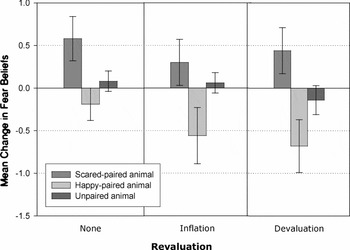
Figure 3 shows the change in fear beliefs for each US revaluation group. A three-way 3 (pairing-type: scared, happy, none) × 2 (time: before pairing vs. after pairing) × 3(US revaluation: none, inflation, devaluation) mixed ANOVA with repeated measures on the first two variables was performed on the data. The Greenhouse-Geisser adjusted type × time interaction indicated significant changes in self-reported fear beliefs due to vicarious learning, F(1.46, 48.10) = 11.05. Planned contrasts confirmed a significant increase in fear beliefs pre- to post- learning for animals seen with scared faces, F(1, 33) = 9.70, r = .48, and a significant decrease for animals seen with happy faces, F(1, 33) = 6.60, r = .41. The Greenhouse-Geisser adjusted type × time × US revaluation interaction was not significant, F(2.91, 48.07) = 0.28, indicating that US revaluation had no additional effect on changes in fear beliefs. There was a significant main effect of pairing-type, F(2, 66) = 8.29, but all other main effects and interactions were non-significant, including the time × revaluation interaction, F(2, 33) = 1.21, the type × revaluation interaction, the main effect of revaluation and the main effect of time (all Fs < 1).
Graph showing mean (and SE) change in fear beliefs for each revaluation condition (Experiment 3)

Discussion
Experiment 3 replicated the findings from Experiments 1 and 2 that vicarious learning leads to changes in children's self-reported fear beliefs for animals seen in both scared and happy pairings. US revaluation was not found to affect changes in children's fear beliefs. There appear to be two likely explanations for this finding: either US revaluation is not a characteristic of the vicarious learning paradigm used; or the manipulation used to revalue the USs was ineffective. Unfortunately, there is no way of determining from the current data which explanation is correct. Establishing this would require collecting evaluative ratings of the USs to clarify whether the US had been successfully re-valued, and then detecting changes in these ratings from pre- to post-revaluation, or by showing differences in post-revaluation US ratings across the three revaluation groups. These US ratings were not collected.
General discussion
Despite good theoretical reasons to assume that verbal information and vicarious learning pathways should interact in the creation of children's fear beliefs, the results of these three experiments seem to partially contradict this view. This leaves us with the unresolved issue of whether it is reasonable to assume that pathways to fear interact.
The first explanation of our failure to find evidence of an interaction between vicarious learning and concurrent and post-learning verbal information is simply that it does not happen, and that the theories on which our initial ideas were based are wrong. This possibility seems unlikely. There is ample evidence from the conditioning literature that the strength of association, and strength of conditioned response are affected by information that influences evaluations of likely outcomes when encountering a CS, and also information that inflates or devalues the US (see Field, Reference Field2006c; Field and Davey, Reference Field, Davey, Silverman and Treffers2001; Davey, Reference Davey and Davey1997 for reviews). In addition, the interaction between verbal information and direct experiences has been verified in children using similar paradigms to those employed here (Field and Storksen-Coulson, Reference Field, Argyris and Knowles2007). Experiment 1 supports this finding too in as much as prior expectancies did influence the subsequent change in fear beliefs caused by vicarious learning. The issue remains that we could not demonstrate unequivocally that these prior beliefs were created by the verbal information we gave. Therefore, although it would be too much to claim that the data support the idea that the verbal information and vicarious learning pathways interact, it does support the general thrust of Davey's (Reference Field and Storksen-Coulson1997) model in as much as expectancy evaluations mediated the effect of vicarious learning. Other research has also shown that when more consistent verbal information is used than was used in Experiment 1, the expectancy evaluations/fear beliefs it creates are reliable, strong and persistent (e.g. Field and Lawson, Reference Field and Lawson2003; Field et al., Reference Field, Lawson and Banerjee2008).
Perhaps then the problem is simply that vicarious learning is not a form of conditioning and, therefore, the hypothesized influence of information is unwarranted. Again, this explanation is unlikely. The use of no US controls is Askew and Field (Reference Askew and Field2007) and all three experiments reported here shows unequivocally that vicarious learning results from associations formed between a CS and USs. One procedural difference to autonomic conditioning experiments is that we used multiple USs that represented the same thing. Field (Reference Field2006c) has argued that the association being formed here is not between a specific CS and a specific US, but between a concept CS (i.e. a quokka) and a concept evoked by the specific picture USs (i.e. threat). However, this should make no difference to the predictions coming from core conditioning research.
If we are prepared to accept that the underlying theoretical premise of these studies holds up, then the second explanation of our lack of evidence is that our manipulations failed. In Experiment 1, the prior verbal information did not uniformly create group differences in prior fear expectancies as we had predicted. This, if nothing else, shows how hard it is to test for interactions between pathways in a tightly-controlled experimental procedure. However, it was possible to abandon our a priori groupings of children to look at how prior expectancies affect fear beliefs acquired vicariously. When this was done, there was evidence for an interaction of prior expectancies and vicarious learning. Similar issues were faced when revaluing the facial USs: the information used apparently had little effect on the fear beliefs created by the vicarious learning procedure. The failure to devalue the negative CSs is consistent with some literature that suggests that there is an asymmetry in the effect that verbal information will have on perceptions of the US. Field and Davey (Reference Field, Davey, Silverman and Treffers2001) note, based on the literature, that it is relatively easy to create fears through revaluing a US but relatively hard to reduce fears through devaluing the US, perhaps because of the potential risk associated with believing something is no longer threatening when in reality it is. However, there is ample evidence that our attempts to inflate the aversiveness of the US should have succeeded. It is impossible to rule out the possibility that children simply did not believe the information and a useful follow-up would be to measure this and to see whether ‘belief’ in the information mediates any effect of information on fear beliefs created by prior vicarious learning.
Experiment 2 also showed no additive effect of combining visual images of fear expressions, with congruent sounds. As with Experiment 3 it is hard to draw conclusions from null results, but it does perhaps suggest that an additive effect can be expected only when the combination of audio and visual material is more aversive to a child than the visual material alone. This would be interesting because it would suggest that vicarious learning was dependent on the aversiveness of the US, which would support Mineka and Cook's data suggesting that the reactions that primates observed were, in themselves, aversive. Future work could valuably assess this by getting children to rate how aversive they find the USs and by varying the intensity of the soundtrack for each picture.
Although verbal information proved most effective presented prior to vicarious learning in Experiment 1, findings from the three experiments should not be compared directly, nor should conclusions about the relative importance of presentation times be made. Distinct processes were under investigation in each experiment and, as well as differences in the time of its presentation, to maximize ecological validity the way verbal information was delivered varied each time. For example, in Experiment 2 the verbal information consisted of “gasps” and “ahhs” because when confronted with an animal that elicits fear an adult would make these sorts of reflexive noises rather than calmly verbalizing a series of facts about the animal (Experiment 1) or reflecting on their own reaction (Experiment 3). Also, the sources of information changed across the experiments. In Experiment 1 verbal information about the CS was given by an unknown source, whereas in Experiment 2 verbal information about the CS was given by the model acting as the US. In Experiment 3, the model again supplied the information but about their response to the CS. Consequently, the three experiments should be seen as distinct investigations of the interaction of verbal information with vicarious learning and not a series of studies investigating whether the timing of the information has an impact on whether it affects vicarious learning. Of course, the importance of when the verbal information happens may well be an interesting question and, in as much as it is, this is a limitation of our studies and something that will have to be tested in subsequent research.
A final issue is that in all three experiments the index of learning was self-reported fear beliefs. Field and Storksen-Coulson (Reference Field, Argyris and Knowles2007) found their effects using a behavioural task that they employed precisely to overcome the problems of using a self-report scale on which there is relatively little room for children's ratings to inflate or devalue. A useful follow-up would be to replicate the current studies but using behavioural measures as an index of fear.
To conclude, these experiments have highlighted the problems in trying to disentangle the way in which Rachman's indirect pathways interact using well-controlled experimental paradigms. Although there is a strong theoretical foundation on which to believe that the pathways will interact, there was only tentative evidence that the pathways have an additive effect. Prior expectancies appeared to affect the change in fear beliefs created by vicarious learning, but these prior beliefs were not conveniently created by verbal information at the group level. Also, there was little evidence for verbal material being able to change fear beliefs by revaluing the US from prior vicarious learning. Adding verbal cues to the USs in vicarious learning also appeared not to increase acquired fear beliefs.
Acknowledgements
Experiments 1 and 3 were supported by an ESRC studentship PTA-030-2002-01619 to Chris Askew. Many thanks go to the pupils and teachers of Buckingham Community Middle School, Shoreham-by-Sea, West Sussex and Telscombe Cliffs Community Primary School, Telscombe Cliffs, East Sussex.



Comments
No Comments have been published for this article.