


INTRODUCTION
The harsh economic crisis in Greece over the last ten years has sparked a thorough examination of the structural weaknesses responsible for this economic failure. During this procedure, researchers have pointed to the many malfunctions in the public sector. Among these, two issues have played a significant role: the extensive evasion of tax paymentFootnote 1 and the size of the shadow (black) economy. This examination has revealed that, among many other factors, freelancers and self-employed persons in Greece enjoy a considerable ability to hide their income. The problem of corruptionFootnote 2 and the shadow economy has been so big, and still is,Footnote 3 that the Greek government was eventually forced to bestow full independence on the Independent Authority for Public Revenue (IAPR).Footnote 4 With this edict, the vast majority of tax-collecting responsibilities passed to the newly formed IAPR.
According to paragraph 2 of the IAPR’s foundation document, among its range of duties is the identification of tax evasion, smuggling, tax fraud, illegal trade, and the shadow economy, with the charge of assessing/recovering undisclosed income implicit in all of these activities. Inside this framework and due to liquidity problems in the Greek economy, the IAPR issued a law to encourage citizens to bring hidden income to light.Footnote 5 According to the Article 57 of this law, “taxpayers who have not submitted a declaration or have submitted an incomplete or inaccurate statement may submit original or modifying debit or zero declarations from the date of publication until 25.11.2017.” The results were disheartening to say the least! Otherwise law-abiding citizens, seemingly beyond reproach, were found to have tremendous amounts of money for which, in most cases, they were unable to provide a satisfactory account of its origin.Footnote 6
This situation planted the seed for this research. More specifically, the following article presents an in-depth examination of over 400 people arrested for crimes related to antiquities smuggling, in order to observe if there is any connection between self-employed persons / freelancers and antiquities smuggling in Greece. The link is revealed by focusing on the number of times the expression “looters/antiquity thieves” appears in the arrest reports.
HYPOTHESIS
Our hypothesis was based on three earlier established facts. First, as we stated, the research into Greece’s economic problem revealed that the hidden income of self-employed persons / freelancers is huge, equaling almost €28.2 billionFootnote 7 or, according to other researchers, an astronomical €50 billion.Footnote 8 Furthermore, the number of self-employed persons / freelancers in Greece is far larger than in other European Union member states, even up to twice the amount.Footnote 9 Hence, our first supposition was that we would find a vast number of self-employed persons / freelancers among the arrested people in Greece.
Moreover, recent research investigating the connections of certain professions in cases that could be characterized as “organized crime with antiquities smuggling” revealed that people with this specific profile—that is, self-employed persons / freelancers—are indeed more heavily involved in antiquities-smuggling activities than others.Footnote 10 Hence, our second premise was that, between the years 1999 and 2015 and in direct relation to large amounts of hidden income that had come to light, these self-employed persons / freelancers would be seen to hold the pole position among all of the professions involved in antiquities smuggling in Greece. Furthermore, a sub-premise would be that we would see that the vast majority of cases that could be characterized as organized crime would have at least one self-employed person / freelancer as a member.
Finally, our third premise consisted of two subordinate parts. First and foremost, organized groups with the existence of at least one self-employed person / freelancer would have managed to collect/loot objects with significant financial value. Furthermore, we also expected that the average financial estimation of the self-employed person / freelancer would surpass the equivalent of the not self-employed person / freelancer.
OFFICIAL PERMISSION AND RELEVANT GREEK LAWS
A necessary precondition at this point is to present how we conducted our research: which national laws we had to be aware of, how we extracted our information from the files, the number and type of the official permission(s) granted to us, the definition of organized crime, and other aspects. Starting from the permission sought and granted, we made use of Protocol no. 2565/15/528492, which was granted by the Hellenic Police, through which we acquired full access to the archive files of the Archaeology and Cultural Heritage Protection Department of the Attica Security Division of Hellenic Police. We included in our research every arrest related to antiquities-smuggling infringements, regardless of the confiscated items or the modus operandi. Thus, we included looting activities in rural areas, illegal metal detector use, extraction of spolia, thefts from archaeological sites, to name but a few. Since the above-mentioned department has national jurisdiction, the files concerned arrests conducted all over Greece.
In so doing, we worked within the dictates of the following national laws: first and foremost, Law 3028/2002.Footnote 11 This is the most significant law for the protection of Greek cultural heritage since it defines specifically the term “cultural heritage” and specifies the measures that the state should take for the protection of the same. Also, we considered Law 3658/2008.Footnote 12 With this law, the Greek Parliament, through the usual law-issuing procedure, had included antiquities smuggling in the crimes that could be related to organized crime’s illegal actions—namely, Article 11. In addition to this, Law 3691 was also relevant to our research due to the fact that this law seeks to “prevent and suppress money laundering and potential financing of terrorism.”Footnote 13 Moreover, due to our extensive access to files that were censored, we were also obliged to conduct our research according to Law 2472/1997Footnote 14 and Law 3471/2006.Footnote 15 These laws set out specific rules and guidelines for data analysis when personal as well as sensitive data information are included.
Finally, our research was heavily dependent on two other laws related to financial issues. The first one was Law 4389/2017, which underpins the authority of the IAPR.Footnote 16 The previous ineffectiveness of the legislation responsible for the tax office’s operations forced the creation of the IAPR in order to ensure that taxes would be collected more effectively and efficiently, that the shadow economy would be dealt with, and that tax evasion in Greece would be reduced. Law 4446/2016 provided us initially with the opportunity to complete our research since it set in motion the procedure for the voluntary declaration of taxable assets in the recent past.Footnote 17 According to Article 57 of this law, “[t]axpayers who have not submitted a declaration or have submitted an incomplete or inaccurate statement may, from the date of this publication, until 25.11.2017, submit initial or amending, debit or zero statements, whether or not there is tax payable.” Moreover, according to Article 59.1, “[i]n all the above cases, fines are not imposed by Articles 58, 58A and 59 of Law 4174/2013 or Article 7 of Law 4337/2015 (A129) or Article 6 of Law 2523/1997 or other provisions. nor any other tax, administrative or criminal penalties or measures for both the taxable material arising from the above declarations and the tax offenses established by those declarations.” Finally, Article 60, paragraph d, specifies that “[t]he provisions of the preceding Articles of this Chapter shall not apply: (d) Where amounts are derived from criminal activities referred to in Article 3 of Law 3691/2008, except for the offense of indent 1(a) in of the same article and law.” Law 4446/2016 was a major acknowledgment, on the part of the state, of the existence of that timeless problem—tax evasion—and its inevitable companion—the shadow economy.
DATA RECORDING
On arrest, the accused will often declare his or her profession, which is then recorded in the police report sheets. Unfortunately, this registration is not a compulsory procedure, and, sometimes, police officers do not record the perpetrator’s profession. This deprives us of a unique opportunity to observe and examine perpetrators’ social profiles, especially in correlation with other information. Luckily, in most of our cases, we had the opportunity to note the profession that a smuggler had taken. The only serious problem that we faced here was that the police archives were not in digital form but, rather, still on paper. This created various difficulties due to the fact that essential official papers were missing in many of the files, such as those that gave the financial estimations, the type of the looted place/museum/collection, and the professions of the accused.
Definition of Self-Employed and Freelancer Status
A brief definition of a self-employed person / freelancer is essential for better understanding these terms. According to Greek legislation, the definition of “self-employed” is a person who in his professional activity contributes as a separate and unattached individual to the execution of a project.Footnote 18 Because of this independence, a self-employed person / freelancer has the possibility of declaring a lower income than he or she actually receives,Footnote 19 unlike a person who is a wage earner and has his salary recorded systematically—for example, someone who is employed by the state or by a private person or company: the list of such professions is long.Footnote 20
Profession Categories
We created three different categories for our study. The first category included all those individuals who fit the definition of self-employed person / freelancer. The second category was for all wage earners. And the third category was a catch-all for other professions that do not fall into either of the first two categories, such as housekeepers, the unemployed, and students, to name but a few. Our final set also included those individuals for whom we possess no data—hence, the category is termed “Unknown.”
Organized Crime
The term “organized crime” included the following features. First and foremost, to be an organized crime, the authorities making the arrest must have recorded the existence of three or more persons who were acting as a group. The team will have had a group hierarchy and an allocation of duties among the members. Also, the team had often been in existence for a long time (often an unspecified length of time), and, of course, they were committing serious criminal offenses for financial gain.
Financial Estimation of the Confiscated Objects
In order to examine the degree of impact that self-employed persons / freelancers have in Greek society and the economy, we tried to assess the financial estimations of the confiscated objects. This examination was conducted both for those organized groups in which at least one self-employed person / freelancer had participated and in cases where only self-employed persons / freelancers were arrested. We obtained the financial estimations of the confiscated objects from the figures provided by a committee, following an official decision issued by the Ministry of Culture. More precisely, it was the General Directorate of Antiquities and Cultural Heritage / the Directorate of Documentation and Protection of Cultural Goods within the Ministry of Culture and Sports who was responsible.
Since recriminatory procedures were initiated only against those who owed money over the amount of €50,000, according to Law 4557/2018,Footnote 21 we also set this amount as our starting point when examining the financial damage caused by self-employed persons / freelancers in cases that could be characterized as organized crime. The period we examined was from 1999 to 2015. We used ACCESS 2010 as a tool for data collection and presentation.
RESULTS
Self-Employed Persons / Freelancers
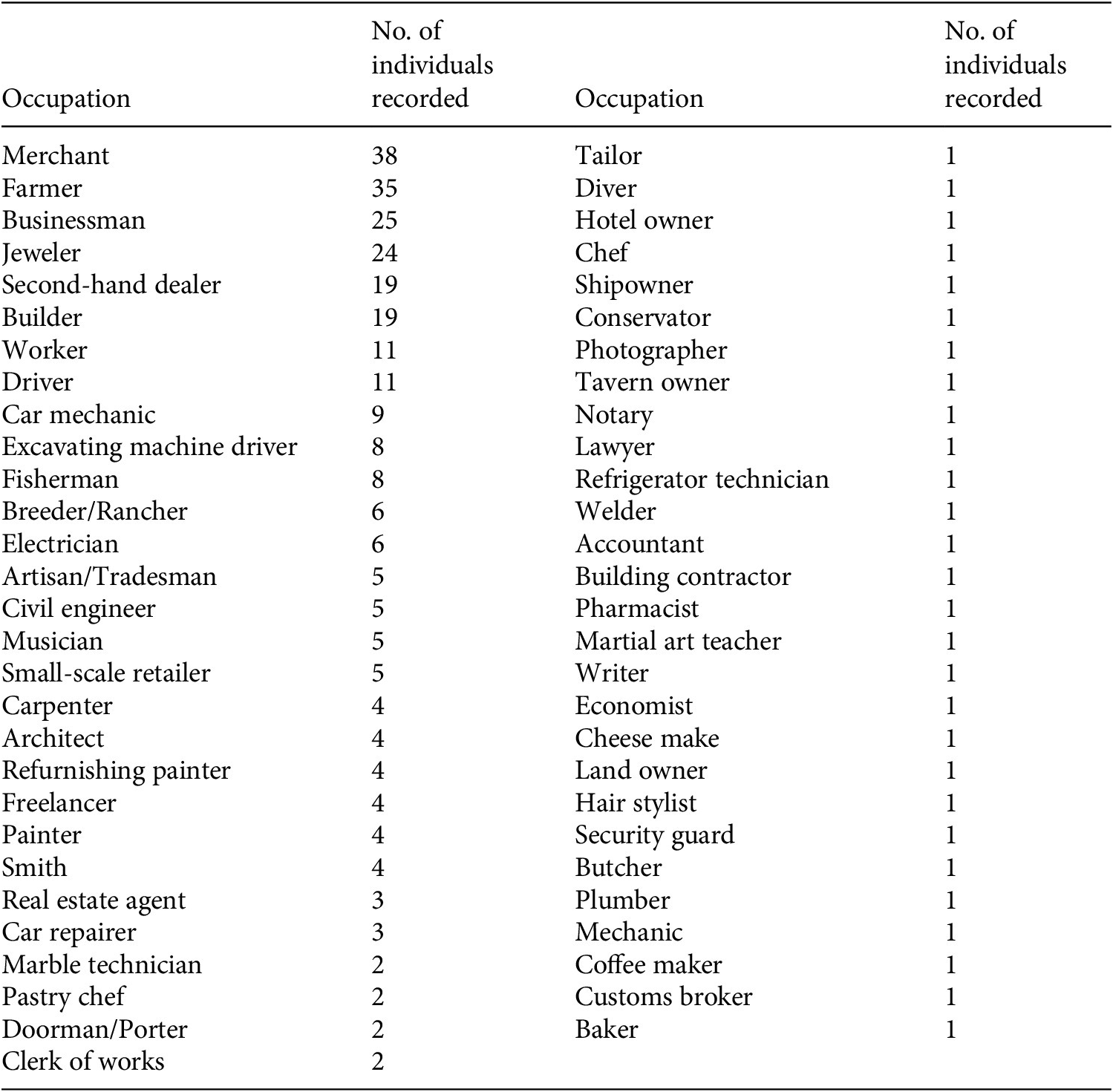
We examined 291 cases (official arrests) that took place between December 1999 and June 2015; we retrieved the professions of 497 individuals. Of these 497 individuals, 305 of them fall into the definition of “self-employed persons / freelancers,” which is an astounding 61.36 percent of the total sample. Furthermore, we were able to break this total down into 57 different self-employed/freelance professions. Table 1 shows the complete list of the professions and the number of recorded individuals in each. Our intention was to be extremely accurate and objective, so we present some of the professions in an awkward way such as cheese maker, coffee maker, and small-scale retailer, amongst others. This was the exact profession that the accused gave to the authorities, and we wished to present it unchanged. In contrast, the “Wage Earners” category contained 113 individuals, which was 22.73 percent of the total sample. The “Other” category revealed only 32 individuals, which was 6.43 percent. Finally, the “Unknown” category contained 47 individuals who had not declared their profession, or, possibly, their profession had not been recorded by the police, which comprised 9.45 percent.
List of the professions of self-employed persons / freelancers arrested on charges of antiquities smuggling

Organized Crime and Self-Employed Status
The extensive involvement of self-employed persons in antiquities-smuggling cases, along with the considerable ability to hide one’s income in Greece, prompted us to consider the research in greater detail. We wished to observe if there was any particular connection between the self-employed/freelance criminal and organized crime. First, we found 94 cases that had all of the characteristics of organized crime. We also investigated the degree to which such details were present—that is, their existence and their numbers in each case. For example, Case 2399 had three perpetrators: an unknown profession, an unknown profession (both not recorded in the arrest report sheet), and a retired person. In this case, none of these individuals could be easily assigned to the self-employed/freelance definition. However, 85 cases out of 94 had at least one self-employed person / freelancer as a participating member, which is 90.42 percent. The correlation of organized crime syndicates and self-employed persons / freelancers is thus clearly considerable. Further, in these 94 cases, we obtained the professions of 278 individuals. Of these professions, 179 fall under the definition of self-employed person / freelancer, which is 64.38 percent.
Financial Estimation and Other Examinations: Organized Crime with at Least One Self-Employed Person /Freelancer
Law 3028/2002 concerning the protection to be afforded for antiquities and, more specifically, Article 53 state that “[u]p to ten (10) years of imprisonment shall be punishable for a theft,Footnote 22 if it was a particularly valuable monument or something removed from an immovable monument, from a site excavated, from a museum, from storage sites or from a collection space for ancient artifacts. If the act was committed by persons united in the commission of theft or robbery or in the commission of the offences set forth in this Act, a sentence shall be imposed.”Footnote 23 With this in mind and considering the vast body of data we extracted from all of the arrest cases, we decided to examine a series of issues related to the involvement of self-employed persons / freelancers in cultural heritage crimes.
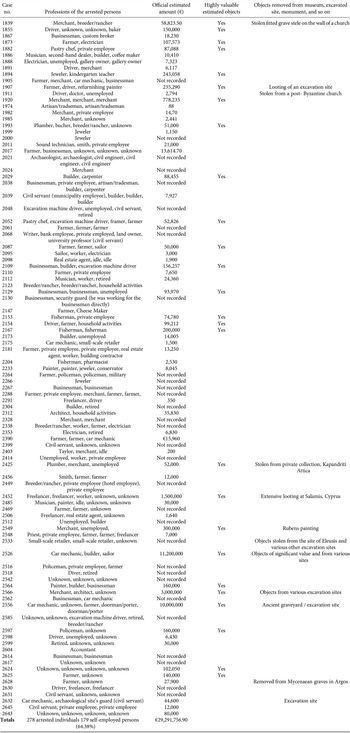
First, we examined the financial estimation of the cases that could be characterized as organized crimes to see how large the amounts of money involved were and which of these cases led to imprisonment under Greek law (Table 2). As we stated above, we set the lower threshold for inclusion at €50,000. All of the cases above this amount fall into the definition of “a particularly valuable monument.” Furthermore, we examined the location from where the objects were extracted (namely museums, excavations, private and public collections) to see the patterns that were revealed.
Breakdown of cases by perpetrators’ professions (as self-employed persons / freelancers), value of theft, and place of theft

Twenty-eight out of these 85 cases that could be characterized as organized crime and that had the participation of at least one self-employed person / freelancer fell within the definition and risk of punishment under Article 53 of Law 3028/2002, which is 32.94 percent. The total amount of the goods involved was €29,291,756.90. The average in these cases worked out to be €505,030.27, which is a tremendous amount of money. In contrast, the total financial estimated amount in these cases that could be characterized as organized crime but had no self-employed person / freelancer involved was a mere €342,050. There were, however, only three cases in this category, with an average amount of €114,016.66. Thus, the first category was almost 4.5 times more profitable to the perpetrators than the second so, clearly, the presence of self-employed persons / freelancers seems to be very worthwhile (Table 2).
Financial Estimation for Individual Self-Employed Persons / Freelancers
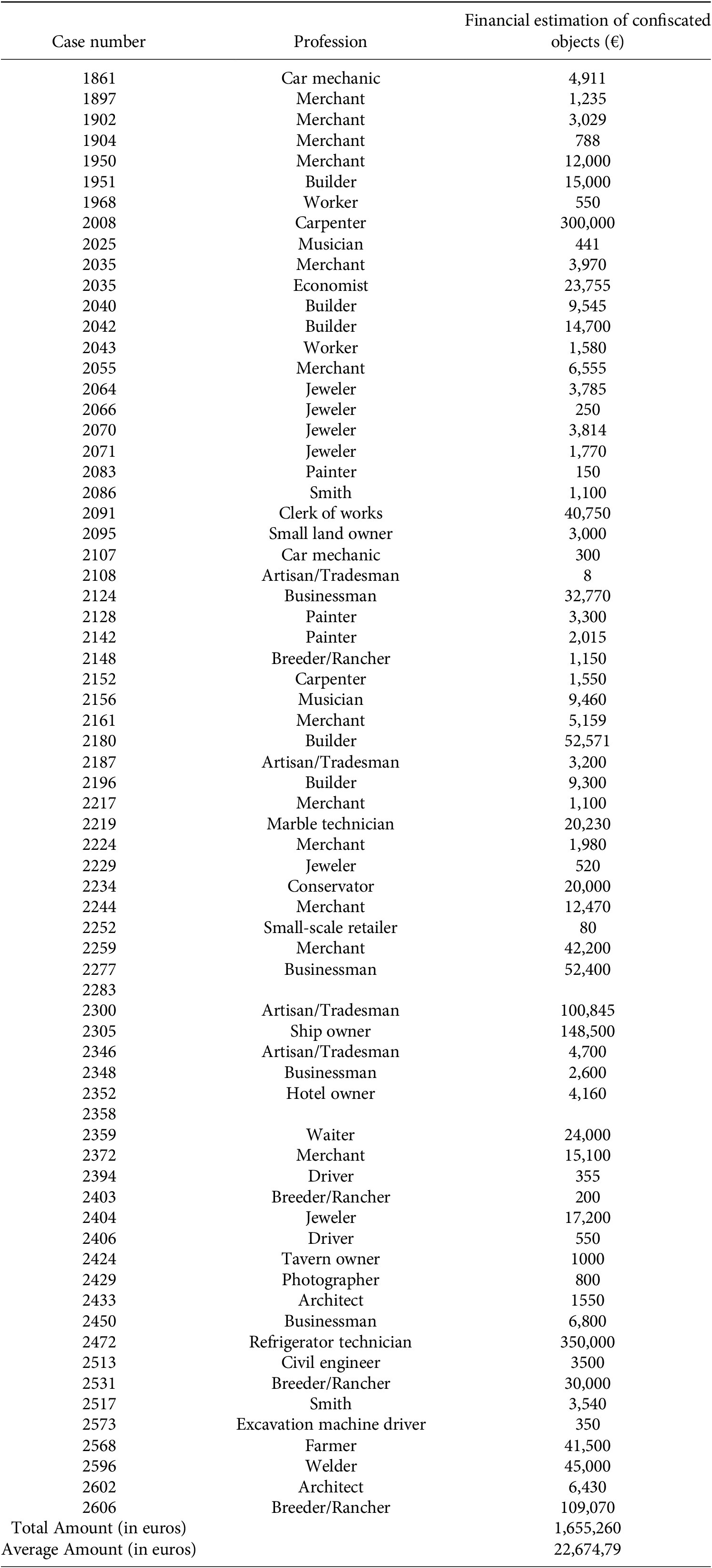
In addition to the fact that the self-employed/freelancer category provided such numbers and advantages as the financial estimations have just revealed, the figures for when individual self-employed persons / freelancers acted alone are also quite alarming. The police files provided us with 74 cases where the self-employed person / freelancer who was arrested was working alone, whether or not these cases could be characterized as organized crime. Here, the total amount of the official financial estimations was €1,655,260, with the average amount being €22.674,79 (Table 3).
Individuals (not organized crime) in the category of self-employed persons / freelancers and the financial estimation of the thefts

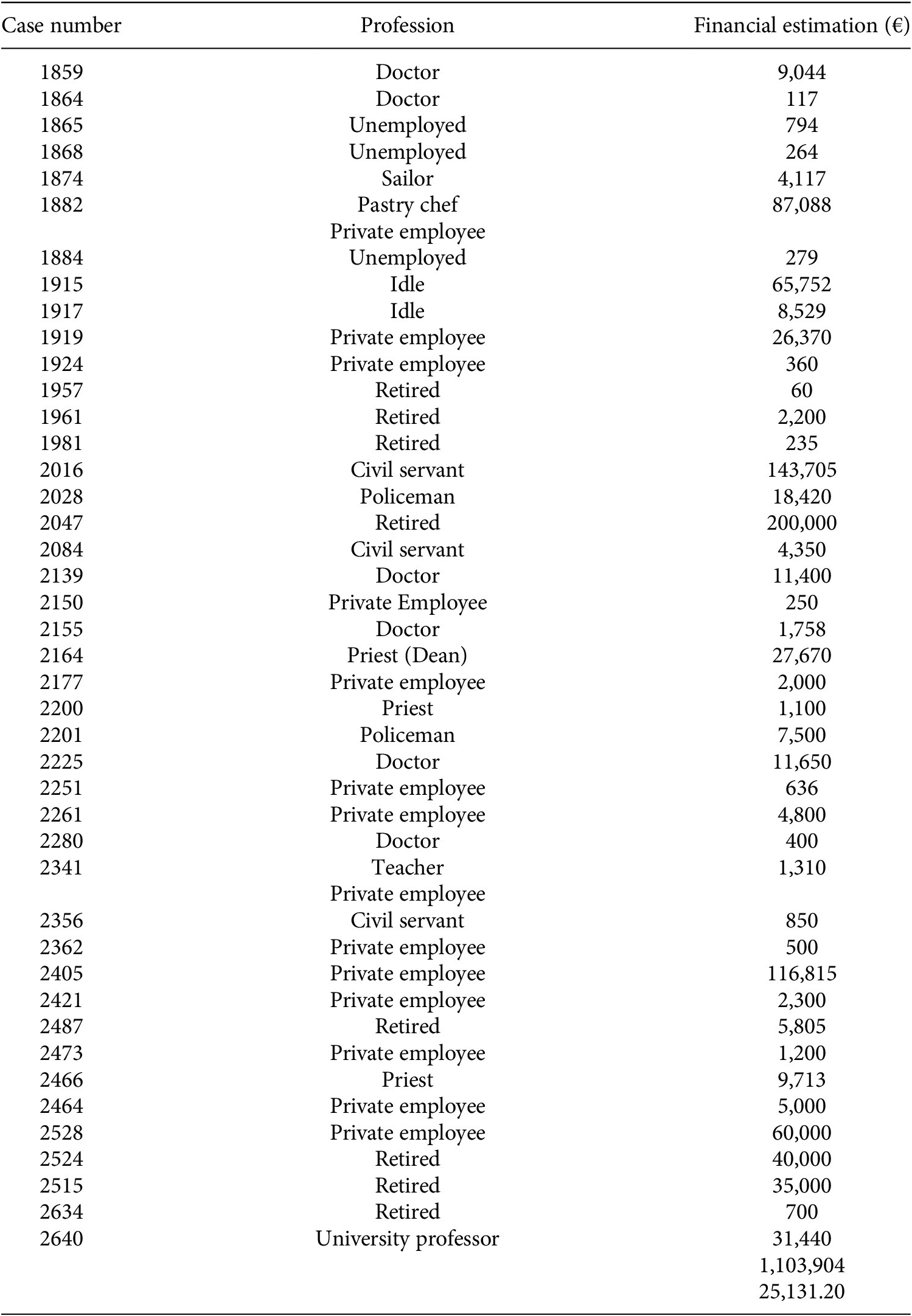
On the other hand, there were 43 cases where the individual concerned was not a self-employed person / freelancer. Two cases, Case 1881 and Case 2331, each had two persons involved, but they did not fall into the definition of organized crime; hence, we split the amount of money involved in their cases between the two of them and divided the total amount of €1,130,904 not between 43 perpetrators but, rather, between 45 of them. In these cases, the total amount estimated was €1,130,904, and the average was €25,131.20. Thus, a self-employed person / freelancer acting alone is pretty much as affective as a non-self-employed person / freelancer working by herself (Table 4).
Financial estimates of thefts carried out by other categories of perpetrators (as individuals)

Results from Self-Employed Persons / Freelancers and Civil Servants
The research also revealed the involvement of civil servants in several of the cases that could be characterized as organized crime. We tried to examine how frequent this pairing of a civil servant and a self-employed person / freelancer was, which potentially involved a total of 14 cases, including Cases 1894, 1911, 2021, 2039, 2048, 2068, 2264, 2399, 2516, 2548, 2597, 2631, 2632, and 2645. Here, the participation of at least one self-employed person / freelancer was clearly determined in 10 cases. Only in Cases 2399, 2597, 2631, and 2645 did the team consist of a civil servant, where the involvement of at least one self-employed person / freelancer could not be fully certified: often the profession of the arrested person(s) was not recorded. Still, 10 out of 14 cases equals a high incidence rate of 71.42 per cent, which is another worrying statistic. The exact profession of these civil servants comprised a policeman (three times), an archaeologist (two times), a site guard (once), and a military personnel, doctor, kindergarten employee, and university professor one time each.
DISCUSSION
Our examination set out to investigate in detail the antiquities-smuggling problem/phenomenon and to look for any correlations between the professions of the arrested persons and whether there were further links to other problems in the state of Greece. The results seem quite enlightening, if depressing. Of the 497 arrested persons, 61.36 percent fall under the definition of self-employed person / freelancer, which is well over half of those arrested. Hence, our first hypothesis was confirmed.
Our second hypothesis was confirmed as well since self-employed persons / freelancers were the group most involved in cases that could be characterized as organized crime. In 85 cases out of the 94 that were judged to be organized crime, we observed the participation of at least one member of the self-employed/freelancer category, which is 90.42 percent. The correlation of organized crime syndicates and self-employed persons / freelancers seems fairly absolute. Moreover, in these 94 cases, we extracted the professions of 278 individuals, and, of these, 179 fell into the definition of self-employed person / freelancer, which is 64.38 percent. Not only is the involvement of self-employed persons / freelancers enormous, but there was also an equally elevated participation of at least one self-employed person / freelancer in cases that could be characterized as organized crime and where a civil servant was involved. Ten out of 14 cases revealed this pairing, which is 71.42 percent.
The average sum estimated for the stolen material both for self-employed persons / freelancers and non-self-employed persons / freelancers is more or less the same, indicating that both categories have the same damaging impact. But when at least one self-employed person /freelancer participates with other persons—be they other self-employed persons / freelancers or not—then the damage skyrockets! Thus, our third hypothesis was also confirmed. In 28 out of the 85 cases judged to be organized crime and with the participation of at least one self-employed person / freelancer, the financial cost to the state was marked. For the 58 cases where we managed to obtain the official financial estimations, the average sum worked out to be €505,030.27, with a total amount of €29,291,756.90.
The economic situation in Greece during the last two decades seems to be one that favors felonious behavior and by a large range of working people. This has come about mainly due to the fact that Greece’s administrative system has faced, and still does, massive problems. One issue is the ineffectiveness of the state in confronting tax fraud and the hiding of income. If the state’s official mechanisms are not capable of spotting the concealment of wealth with respect to everyday things and/or legal matters that have a specific nature and are tangible and visible (for example, the possession of real estate and vehicles, the existence of cash deposits, and so on), they are certainly not going to be able to detect money made on the black market and other nefarious organizations. This failing has probably led those people with a greater ability to hide their income to become involved in some way with antiquities smuggling. Afterwards, if they are successful, they will have no obligation to prove how they earned their sudden fortunes. It is natural that this situation has made antiquities smuggling highly attractive as a practice in which self-employed persons and freelancers can increase their wealth without the risk of getting caught by any of the state’s official mechanisms, such as the tax office. If, for instance, some self-employed person or freelancer is caught by the state’s mechanisms and charged with the acquisition of money that he or she has not declared, they will usually only pay a fine with no questions asked.
On the other hand, wage earners, such as private employees, public servants, and retired people, to name but a few, face restrictions in this area of their lives. Since 2002, Greece has been able to employ the General Inspector of Public Administration to monitor such people. Within its jurisdiction is the examination of the financial holdings of public servants, especially when there is evidence of a great divergence with what the official wage should be.Footnote 24 This scrutiny is enabled by Law 2477/1997, which requires the compulsory deposition of statements on the “origins of money and property” by public servants.Footnote 25 In general, wage earners are subject to a larger range of checks since their known wage can be used as a point of comparison. The fact that a civil servant has in their possession a large sum of money that is not justified by his fixed salary triggers an internal disciplinary procedure and criminal investigation that can lead to his dismissal.Footnote 26 Clearly, this tightest of frameworks for civil servants creates fear, although there have been more than a few times when civil servants have participated in antiquities-trafficking activities. The situation of close inspection seems the most convincing explanation for the involvement of less detectable self-employed persons / freelancers in cases that could be characterized as organized crime, which also involve public servants.
The background against which this criminal behavior in the form of antiquities smuggling is taking place in Greece seems potentially liable to facilitate a massive, even explosive, expansion of crime. Greece is a place with hundreds of archaeological museums and thousands of archaeological sites. New evidence discovered in the Aegean Sea suggests that an unknown amount of archaeological treasure is waiting to be explored or exploited. This means that new potential sites are becoming available to supply those individuals looking for ancient objects. Furthermore, Greece’s borders are distinguished by being porous,Footnote 27 and that too provides an advantage for looters who are trying to get their finds out to other countries. Still further, the shadow economy, which also includes money from illegal activities, is significantly active in Greece, accounting for at least 20 percent of the national gross domestic product (GDP) between 1999 and 2009Footnote 28 and, by 2015, had risen to 22.4 percent of the national GDP.Footnote 29
Finally, there seems to be a national inability to combat money laundering. According to the latest survey, the quality of policies developed in this area, as well as the resources available to audit bodies, are characterized as only being of “medium” quality and are recommended therefore for an immediate upgrading, irrespective of whether there is a legislative capability to deal with the phenomenon or not. It is no coincidence that the legislator included in the law on the prevention and suppression of money laundering the proceeds from various antiquity-smuggling activities. The very situation seems attractive, encouraging people to engage in antiquity smuggling since the probability of being arrested is very small.
CONCLUSION
The thorough examination of the professions of those arrested in Greece on the charge of smuggling antiquities reveals that the vast majority of them fall within the definition of self-employed persons / freelancers. The percentage identified accurately and clearly reveals that there is a strong connection—or correlation, if we can use this term—between antiquities smuggling and these types of professions. Our initial hypothesis to this effect may thus be confirmed. The tremendous capacity for these professions to conceal income, at least during the period we examined, can explain why this is happening. The complete absence of any obligation on anyone to declare how they have acquired their property (real estate, cash in banks, the acquisition of a luxury vehicle, and so on) favors this practice of hiding things away, especially if the money has come from illegal transactions.
The IAPR’s latest reports typify the scale of the problem. Of course, the facts do not automatically mean that each and every self-employed person / freelancer would choose a priori to engage in antiquities-smuggling activities. Nor do they mean that people who are subjected to further examination as to how they have acquired large amounts of money through the IAPR’s checks have necessarily had a relationship with antiquities smuggling. The antiquities-smuggling phenomenon is a multifaceted and complicated form of criminal behavior, and it must be examined in conjunction with all of the other aspects of our country’s economic and public life so that we can fully understand it and develop effective policies to thwart this criminal behavior.
Last but not least, researchers need data in order to examine, evaluate, and design anti-criminal policies. For this reason, the antiquities-smuggling phenomenon must be seen through a law enforcement prism. Access to the full dataset is required to allow this research to be aligned and linked to other problematic areas that society is experiencing. To achieve this goal, new handbooks are being issued, like the forthcoming Manual for the Protection of Cultural Heritage, which is being released by the Organization for Security and Co-operation in Europe, the Transnational Threats Department, and the Border Security Management Unit.Footnote 30 These sources are intended to provide the analyst and researcher with an effective range of tools, which can be immediately applied by law enforcement agencies. The smuggling problem must be confronted through extensive cooperation, the use of new technologies, and the reevaluation of anti-criminal policies based on the core data.