

Introduction
In recent decades, an ever increasing number of cruise ships with mostly elderly tourists on board, is plying the waters of the Arctic and Antarctic seas (Johnston Reference Johnston, Gössling and Hall2006; Snyder and Stonehouse Reference Snyder and Stonehouse2007; Stewart and others Reference Stewart, Howell, Draper, Yackel and Tivy2007). Diseases affecting fishermen, seafarers, and dockers have received a certain amount of attention (Tomaszewski and others Reference Tomaszewski, Dymnicki, Flasinski, Kliz, Skwarlo, Kapiszka, Sokolowski, Goljan and Winnicka1990), as have outbreaks of gastrointestinal diseases on cruise ships (Cramer and others Reference Cramer, Gu and Durbin2003, Reference Cramer, Blanton, Blanton, Vaughan, Bopp and Formey2006; Lawrence Reference Lawrence2004), influenza (Nitsch-Osuch Reference Nitsch-Osuch2008) and Legionnaires’ disease (Castellani and others Reference Castellani, Lo, Goldoni, Mentore, Bakestra, Ciceroni and Visca1999; Regan and others Reference Regan, McCann, Syed, Christie, Joseph, Colligen and McGaffin2003; Goutziana and others Reference Goutziana, Mouchtouri, Karanika, Kavagias, Stathakis, Gourgoulianis, Kremastinou and Hadjikristodoulou2008). However, diseases specifically encountered by passengers and crew members of ships cruising in polar waters are rarely recorded systematically (Shaw and Leggat Reference Shaw and Leggat2008).
Polar cruises are obviously different from cruises into tropical latitudes. Although such cruises are timed to occur during the summer months the sea can be rough and the weather cold. The passenger clientele consists mainly of elderly persons, those in other words, who have the time and money to afford a cruise to the more unusual destinations of the Arctic and Antarctic and who deliberately seek adventure and (real or imagined) danger.
In 1998 Levinson and Ger published a book dedicated to the topic of ‘[m]edical care and safety for the polar tourist’, in which they go into the history of polar medicine and define it as that which ‘embraces all fields of medicine and surgery with emphasis on problems relating to the extreme cold and isolation’ in regions beyond ‘latitude 66°32 ′ north and 66°32′ south of the equator’. In chapter 5 of that book it is concluded that assessments of the current state of medical care available to the polar tourists on board these ships are extremely difficult to make and it is lamented that there was ‘no international maritime regulation required that there be medical personnel aboard cruise ships.’
However, a ‘Medical Information Statement’ and a ‘General Medical Information Form for Antarctic Expedition Cruising’ issued by the International Association of Antarctica Tour Operators (IAATO), founded in 1991, exist and polar cruise operators normally require from their passengers that they fill in a medical information sheet, while members of the crew undergo a physical health check before being hired. What remains still largely unknown (despite the fascinating chapter 11 of the book by Levinson and Ger, in which the reader is introduced to anecdotes and issues raised by a retired general practitioner who had made 37 trips on 7 different ships), are the reasons for which polar cruise passengers (and crew members) seek help from the physician on board. This paper is an attempt to start filling this gap in knowledge. Towards that end we are presenting data, separate for crew and for passengers, on the types of diseases, disorders, and adverse conditions that caused them to seek consultation from the ship's doctor during polar cruises.
Material and methods
Our systematic observations of visits by crew members as well as by passengers to the on board doctor are based on two Antarctic cruises on the same vessel during the periods from early December 1997 to mid March 1998 (lasting 71 days) and early December 1998 to mid January 1999 (lasting 38 days) and one Arctic cruise on a different vessel from mid September to mid October 1998 (lasting 33 days). The first author served as the ship's doctor on these cruises, while the second served as a science lecturer and field instructor during these trips. For reasons of confidentiality we are not permitted to give the precise sailing dates or names of the vessels and the shipping line(s) involved, but can state that the maximum number of passengers per cruise on board was 160 and that the total number of crew members was around 120. Several additional cruises have been made by both authors and certain observations and incidences related to these will also be mentioned when appropriate, but do not form part of the systematic data collections that are the basis for this report.
On the three polar cruises during which all consultations were recorded, 857 patients were seen by the ship's doctor. The overwhelming majority of the patients were German citizens. 360 patients represented members of the crew, while the remainder of 497 were passengers. In our presentation the two groups are being assessed separately, firstly because the age structure was quite different in the two groups (crew members were mostly 20–30 years old; passengers predominantly over 60 years old) and secondly because ‘pre-adaptation’ to a life on board must have differed between regular, professional seamen and -women and passengers. Genders are not entered into our Table 1 as separate entities, but where diseases and complaints exhibited a clear gender bias or were gender exclusive (for example gynaecological problems) this fact could not, of course, be ignored.
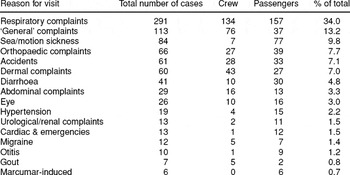
Number of cases in different disease categories having required medical attention during one Arctic and two Antarctic cruises.

Out of a total of 857 persons on board, who were seeking help from the ship's doctor, 360 were crew members and 497 were passengers.
Results
The reasons for seeking help and advice from the ship's doctor are listed in Table 1, and have been assigned to some broadly specific medical categories. In this section, we shall elaborate on the various reasons and will deal with the complaints one by one, starting with the most common and ending with the least common ones. Although the medical categories we have specified are mostly identical to the ones listed in chapter 10 of the book by Levinson and Ger, their sequence, in our case based on the statistical frequency with which they occurred and in their book (Levinson and Ger Reference Levinson and Ger1998: 96) based ‘on a series of anecdotes’, is very different.
The top spot for both crew members and passengers is occupied by respiratory complaints (crew: 134; passengers 291). Fortunately no case of a regular influenza was seen, but cases of bronchitis, sinusitis, common cold, and one lung disease are included under the heading of respiratory complaints.
Closely following in second place are diseases and disorders, which we grouped together as ‘general medical complaints’. Under this category were included consultations for psychological stress, sleep disorders, dental complaints, proctological problems, wound healing, various forms of ‘nerve pain’ (that is common and vegetative neuralgia), cardiovascular disturbances, bleeding caused by rupture of veins, varicoses, mild pain in the joints, warts, inflammation of tendons, and (in the case of females) mild gynaecological complaints and (in rare cases) pregnancy related issues. Members of the crew are over-represented in this category, since they stay and live on board for longer periods than the passengers, who usually stay for one cruise only. Thus, the ship's doctor to members of the crew plays the role of the ‘family doctor’, whom they trust, meet during meal times, and generally speaking- ‘rub shoulders with’ and often regard as a ‘buddy’.
The treatment of sea or motion sickness occupies the third position and saw an overwhelming majority of visitations to the ship's doctor by passengers rather than members of the crew; this despite the fact that it is the custom of the shipping line to make available free anti-motion sickness medication prior to the departure of the vessel. It was observed that passengers suffered less in the Davis Strait off Greenland, the Labrador Sea, areas around the South Shetland Islands or the inshore waters of Antarctica. However, most notorious in the southern hemisphere were the south Scotia Sea, the Drake Passage between the island of Tierra del Fuego and the Antarctic Peninsula, and the region of the South Atlantic Ocean between Tierra del Fuego and the Falkland Islands. In the northern hemisphere the Newfoundland Sea caused the greatest problems with regard to sea or motion sickness.
In fourth place we find various forms of orthopaedic complaints, often with a general rheumatic background, for instance tissue changes leading to pain in tendons and muscles like musculus tibialis anterior, m. rectus femoralis, adductors, gluteal musculature, m. teres major, tractus ileotibialis, lower back pain and hip problems, rupture of muscle fibres, kneecap tendonitis (also known as jumper's knee), different forms of ‘frozen shoulder’ genesis, golf- and tennis arm. So-called connective tissue rheumatism and aches due to tension in the back (so-called ‘TMS-complaints’) were blamed by most of the sufferers on the airconditioning, but more likely had their origin in the often icy wind conditions combined with psychological, perhaps work related stress as well as accompanying infections. Many of the complaints, listed under ‘orthopaedic’, were of a chronic and persistent nature, but some were caused by falling amongst rocks and ice blocks ashore. In one case of ruptured blood vessels, leading to excessive bleeding, an earlier treatment with anti-coagulent medication to decrease the risk of blood clotting, was identified as the cause.
Turning to major accidents, which occupy place five, the crew are at greater risk than the passengers. This is not surprising considering the care under which the passengers are at almost all times and the often hazardous nature of the work that crew members have to carry out under frequently trying conditions and a shortage of time. It is in this context that the case of a groin hernia in a crew member of the age bracket 20–30 has to be seen. On the passenger side the more unusual treatments involved a Paget-von-Schroetter arm syndrome (that is thrombosis of the subclavian vein in the upper arm) and a pressure sore of the leg stump of an amputee. Yet, overall accidents that required treatment occurred in almost equal proportion for both crew and passengers.
The cruise ships on which the authors were working were modern, sophisticated vessels, in which risks of injury for both crew and passengers were kept to a minimum. Due to conditions upon embarkation and disembarkation with zodiacs, a marcumar-induced haemarthros of the knee joints was seen in two cases and treated by setting a new QUICK value of above 30%, that is an INR less than 2.5. Minor head and hand injuries as well as complaints about pain in the back came up for treatment, but fractures on the cruises surveyed in this paper did not occur (X-ray examination with on board equipment could not confirm a suspected vertebral fracture, after a passenger had fallen out of bed in a storm). That this can be different, is shown by the experience gained by the authors on other ships (not part of this survey), in which, for example, under atrocious weather conditions north of Spitsbergen a torn-off thumb had to be re-attached and a tibial as well as a femoral fracture had to be treated in the conventional way with plaster. Various other injuries at that time required stitching. Frostbite of the fingers in a crew member required treatment on one trip to Greenland.
Another relatively important category of complaints in place six of our list are various forms of dermatitis and related skin disorders. Here members of the crew were involved nearly twice as frequently as the passengers. Two severe cases of impetigo (one crew member aged 60 and one passenger aged 75) over large areas of the head and neck had to be treated with antibiotics. Some cases of sun allergy occurred, but no cases of sunburn or sun stroke (in spite of the fact that many passengers seemed to bathe in the sun at any opportunity) were seen. Due to the often irresponsibly reported real or perceived dangers of the ozone hole at higher latitudes (reviewed in Meyer-Rochow (Reference Meyer-Rochow2000)), many passengers sought advice about UV radiation and its effects on human health. One interesting case should be mentioned: when an efflorescence of the mouth in a female patient would not heal despite antimycotic therapy, the specific diagnosis revealed lichen ruber (that is itchy lesions commonly seen on wrists, lower back, and genitalia) of the throat!
A special category, which has received considerable attention in the past (Cramer and others Reference Cramer, Gu and Durbin2003, Reference Cramer, Blanton, Blanton, Vaughan, Bopp and Formey2006; Lawrence Reference Lawrence2004), involves gastrointestinal disorders, especially diarrhoea, which onboard can reach epidemic proportions. In our survey the 41 cases recorded (4.8%) occupy rank seven. With the exception of one Antarctic cruise, in which the origin most likely stemmed from Tierra del Fuego, diarrhoeal cases never formed any threat to the health of crew or passengers. We have separated other abdominal complaints from diarrhoea, when the complaints involved abdominal pain and fever, but in which the faeces were solid and venting occurred at normal frequency. While cases of diarrhoea were more common amongst passengers, non-diarrhoeal complaints were slightly more prevalent amongst members of the crew.
Unspecific gut problems (in place eight) had their causes in nutritional mistakes (heavy eating and alcohol consumption) and one acute abdominal stasis (related to a sodium problem in combination with anorexia) required surgical treatment in the USA. Two cases of appendicitis in crew members and one in a passenger are included. All three cases were controlled through oral or intravenous therapy until the patients could be taken to the nearest hospital ashore for operation. Diagnoses in the area of abdominal pain are not always easy to make for a ship's doctor as the case of an acute abdomen in a young crew member shows, who self-induced an obstruction of the intestine due to paralysis of the intestinal muscles through bulimia-anorexia, or the case of a 13-year old passenger, who, despite showing three criteria for appendicitis, nevertheless suffered merely from an inflammation of the hip joint (arthritis coxae).
Owing to the advanced age of most of the polar cruise passengers, one might have expected a variety of complaints requiring an internist. Some passengers were diabetic, but remained without complaints throughout the trip. However, as the combined cases involving heart, hypertension, renal and urological complaints, gout, and migraine, etc., show, those categories together involved only 11.5% of all consultations. One passenger with terminal kidney insufficiency and existing Brescia-Cimino shunt for repeated haemodialyses (Brescia and others Reference Brescia, Cimino, Appel and Hurwich1966) was amongst the patients seeking help from the ship's doctor.
A full record of anamneses is nowadays regarded as essential and required for the ship's doctor, so that minor disturbances like a highly elevated heart rate or bouts of hypertension can be controlled without much difficulty. However, two cases of emergencies, in which a midbrain syndrome with transient ischaemic attack, disturbances of vision and hearing required successful reanimation should be mentioned. Later and back ashore, however, the two cases ended tragically through exitus caused by a sudden blockage of the main artery of the lung or its branches in a 73 year old female and recurrent apoplexy in a 73 year old male. No infarct or clear angina pectoris, no additional strokes or serious incidents other than those mentioned already above occurred during the cruises surveyed.
Discussion
A doctor, serving on a cruise ship in polar waters, needs to be fully aware of the fact that the majority of his/her potential patients will be elderly folk. Although consultation frequencies and types of illnesses and disorders may vary from cruise to cruise, the overall ranking is not likely to differ from that shown in Table 1 of this paper. Conditions, earlier regarded as life threatening like appendicitis or acute abdomen, can nowadays be treated on board through medication even in polar seas until the nearest shore station with hospital facilities can be reached. Special attention needs to be given to whether the cruise ship still operates wooden rescue boats, as the latter can be the cause of injuries and fractures through falls during rescue rehearsals or true emergencies.
The presence of X-ray and other modern diagnostic equipment (Hb, including leucocytes, blood sugar, and marcumar INR) on board is, naturally, of great help in a variety of situations, but the ship's doctor on such cruises needs to have some experience with emergencies and be able to handle sudden calls to treat lung embolisms, heart arrhythmicities, strokes, intoxications, etc. The cruise ship doctor obviously needs to possess a wide range of experience also in the field of dermal disorders and orthopaedic conditions and it is essential on such cruises that the doctor has available to him/herself on board an ample supply of antibiotics and secretolytica, that is, medicines to facilitate increased production of mucus to bring up sputum.
Skin diseases were treated with antihistaminica, alcohol containing sprays and, in a few special cases, antibiotica like Clindamcin or Cephalosporine (the latter in two cases of immune deficiencies in diabetic passengers with putrid fast growing effluviant eczema). Antihistaminica, incidentally, were also needed in occurrences like those seen with protein overeating or seafood sensitivities. With abdominal disturbances, so-called prokinetic drugs rather than merely soothing medication have helped both younger and older patients and in many that sought help for orthopaedic conditions, help could be provided without having to resort to non-steroid pain killers. Chapter 8 of the book by Levinson and Ger (Reference Levinson and Ger1998) lists the qualifications deemed necessary for a physician on a polar tourist ship and we have little to add to that, except that skills in chiropractic measures and/or acupuncture in the ship's doctor would be an advantage, especially in cases where passengers ask for such manipulations.
In the treatment of wounds and fractures stretch plaster instead of stitching or casts proved to be a very successful option and on a cruise to the Azores Islands, not covered in this report, for which the first author was on board physcian, in which numerous persons received head injuries during a hurricane, not one of the many bleeding scalp wounds had to be stitched.
Older age passengers were the ones most frequently involved in abdominal disturbances due to adipositas-derived fat-liver, gall bladder irregularities and/or diverticles of the colon. Thus, because of the advanced age of the majority of the passenger clientele on board of polar cruise ships one should expect a high percentage of geriatric problems. That this, when compared with the general German population, was not the case suggests that the passengers in our survey represented an overall ‘fitter’ and healthier sub-population of elderly people. Socioeconomic reasons, more regular visits to a physician, more efficient earlier treatments for diseases, or simply a healthier disposition may have accounted for this. The ratio of crew to passengers also needs to be mentioned as we observed, for instance, a greater number of accidents on ships, in which a smaller number of crew members worked than on the cruise ships upon which this paper is based.
An additional reason for the relatively low figure of medical consultations by the elderly passengers compared with crew members could be the kind of mental stimulus and preparation the passengers received on the cruises surveyed from on board lecturers prior to the passengers’ excursions by zodiacs in open water between ice-bergs or their brief disembarkations (lasting maximally 2 hours) onto the Antarctic mainland or Arctic islands. For instance, even though an entire chapter by Sullivan is devoted to hypothermia and cold injuries in a book titled Cruise medicine (Sullivan Reference Sullivan and Harrison1999), none of the passengers seen by us (most likely because of earlier satisfactory information through the on board lectures), had to be treated for these kinds of typical cold climate afflictions. Moreover, from the onset of the cruise, the cruise operator supplied each passenger with correctly fitting boots and a windproof parka with hood.
‘Common cold’-related diseases plus their well known complications (sinusitis. neuralgia, bronchitis, pneumonia, tonsillitis, laryngitis, rheumatism) affected 291 persons, of which 134 were members of the crew. This relatively high number is interpreted by us as a consequence of the character and destination of these polar cruises. A large number of the complaints seen in passengers (for example, running eyes, ear-aches, anticoagulent-induced and other forms of bleedings, aching joints, Paget-von Schroetter's arm syndrome, caused by thrombosis of the upper arm vein, etc.) were, in all likelihood, the consequences of over exertion and special strains during zodiac cruises and hikes over uneven and unfamiliar terrain. Two cases of unstoppable nose bleeding could have been caused by the extraordinarily dry conditions of the Antarctic climate, although an effect of the airconditioning in the passenger cabins cannot be totally ruled out. Cabin location has also been suggested in connection with motion sickness in cruise ship passengers (Gahlinger Reference Gahlinger2000).
Total prostheses of hips and knees (which involved several passengers) stood up surprisingly well to the vagaries of the terrain, although care has to be taken that particular heavy stresses on limb prostheses will not lead to problems. The observed cases of diarrhoea never seemed to have been caused by contaminated seafood ingestion or other nutrition related food poisonings, but most likely had a viral background.
Psychiatric disorders were not brought to the attention of any of us, which does not, however, mean that some passengers might not have suffered from minor psychiatric disorders or used medication to control such disorders. One passenger on an Antarctic cruise displayed some compulsive disorder and got up every morning at 06.00h to clean the windows (from the inside) in one of the passengers’ dining areas. Another apparently physically healthy passenger seemed phlegmatic and not once participated in the zodiac cruises on offer or exploratory trips to the Antarctic mainland. (This passenger, a postman, had won the cruise in a lottery and preferred to solve crossword puzzles on board). On another cruise (not part of those surveyed), one male crew member committed suicide by jumping into the icy sea off the coast of Iceland.
R. Tomaszewski (personal communication, 2004) pointed out that medical records from polar cruises can be particularly useful for international comparisons. In a survey spanning five years, he compared consultation rates between American and German passengers and found that the Germans were nearly four times more frequently seen than the Americans due to cardiovascular diseases and almost 3-times more often because of gastrointestinal disorders. Consultations for seasickness were three times higher in the Germans. Although a variety of explanations could be offered for such findings, it would seem that the difference in the readiness to consult (or seek advice from) the ship's doctor was mainly caused by the different health insurance systems that the two groups were accustomed to in their respective home countries.
This last example shows that quite apart from the academic interest in recording and monitoring reasons for medical consultations on polar cruises, socio-economic questions can also be addressed. Last but not least, to put on record reasons for medical consultations on board helps polar tourism organisers and cruise ship operators take the necessary steps to improve further the safety and care of their human cargo.
Acknowledgments
We wish to thank Prof. Juhani Leppäluoto of the Fysiologian laitos (Oulu University, Oulu, Finland) for informative discussions and the anonymous referees for their helpful suggestions.