Introduction
Generalized social phobia (GSP) and generalized anxiety disorder (GAD) are two highly prevalent anxiety disorders that are characterized by significant chronicity and disability (Stein & Kean, Reference Stein and Kean2000; Heinrichs & Hofmann, Reference Heinrichs and Hofmann2001; Schneier, Reference Schneier2003). They are also significantly co-morbid. GSP involves the fear/avoidance of social situations whereas GAD involves intrusive and largely uncontrollable worry about everyday life circumstances. Although both have considerable social and economic costs, relatively little is known about their neurobiological basis (Mathew et al. Reference Mathew, Coplan and Gorman2001; Stein et al. Reference Stein, Westenberg and Liebowitz2002; Charney, Reference Charney2004). In particular, it remains unclear whether the two disorders are associated with overlapping or distinct neurocognitive impairments. Thus, the high co-morbidity demonstrated in cross-sectional and longitudinal studies indicates a relatively subtle distinction between the two disorders at the descriptive level (Pine et al. Reference Pine, Cohen, Gurley, Brook and Ma1998; Bruce et al. Reference Bruce, Machan, Dyck and Keller2001). Conversely, the relative specificity indicated in family aggregation (Coelho et al. Reference Coelho, Cooper and Murray2007) and pharmacological response (Rickels & Rynn, Reference Rickels and Rynn2002; Blanco et al. Reference Blanco, Schneier, Schmidt, Blanco-Jerez, Marshall, Sanchez-Lacay and Liebowitz2003; Liebowitz et al. Reference Liebowitz, Ninan, Schneier and Blanco2005) in the two disorders suggests dissociation. However, no study has directly compared the response to non-social affective stimuli in GSP and GAD.
There has been some work examining the response to social affective stimuli in the two disorders. This work has linked GSP with an atypical response to social stimuli. At the neural level GSP has been linked with atypical responses in regions including the amygdala to facial expression stimuli (Birbaumer et al. Reference Birbaumer, Grodd, Diedrich, Klose, Erb, Lotze, Schneider, Weiss and Flor1998; Straube et al. Reference Straube, Mentzel, Glauer and Miltner2004; Phan et al. Reference Phan, Fitzgerald, Nathan and Tancer2006; Blair et al. Reference Blair, Shaywitz, Smith, Rhodes, Geraci, Jones, McCaffrey, Vythilingam, Finger, Mondillo, Jacobs, Charney, Blair, Drevets and Pine2008b), public speeches (Lorberbaum et al. Reference Lorberbaum, Kose, Johnson, Arana, Sullivan, Hamner, Ballenger, Lydiard, Brodrick, Bohning and George2004) and self-referential criticism (Blair et al. Reference Blair, Geraci, DeVido, McCaffrey, Chen, Vythilingam, Ng, Hollon, Jones, Blair and Pine2008a). Behaviorally, patients with social phobia display a pattern of hypervigilance to (Mogg et al. Reference Mogg, Philippot and Bradley2004; Coles & Heimberg, Reference Coles and Heimberg2005) and avoidance of (Mogg et al. Reference Mogg, Mathews and Weinman1987; Chen et al. Reference Chen, Ehlers, Clark and Mansell2002) socially threatening stimuli. Relatively little work has examined the response to social stimuli in GAD. However, this work has similarly indicated some circuitry anomalies, implicating in particular prefrontal gyrus (Wu et al. Reference Wu, Buchsbaum, Hershey, Hazlett, Sicotte and Johnson1991; Hoehn-Saric et al. Reference Hoehn-Saric, Schlund and Wong2004; Monk et al. Reference Monk, Nelson, McClure, Mogg, Bradley, Leibenluft, Blair, Chen, Charney, Ernst and Pine2006; Blair et al. Reference Blair, Shaywitz, Smith, Rhodes, Geraci, Jones, McCaffrey, Vythilingam, Finger, Mondillo, Jacobs, Charney, Blair, Drevets and Pine2008b). Importantly, a few neuroimaging and behavioral studies have directly compared the two disorders' response to social affective stimuli (Becker et al. Reference Becker, Rinck, Margraf and Roth2001; Turk et al. Reference Turk, Heimberg, Luterek, Mennin and Fresco2005; Blair et al. Reference Blair, Shaywitz, Smith, Rhodes, Geraci, Jones, McCaffrey, Vythilingam, Finger, Mondillo, Jacobs, Charney, Blair, Drevets and Pine2008b). These studies have all shown differential responses in GSP and GAD, suggesting that the two disorders might be associated with dissociable neurocognitive profiles for social processing.
Little work has examined the response to non-social affective stimuli in the two disorders. In particular, little focus has been given to non-social processing in GSP. However, one study reported impaired aversive conditional discrimination ability in patients with social phobia during an eyelid conditional discrimination learning task (Sachs et al. Reference Sachs, Anderer, Doby, Saletu and Dantendorfer2003). Patients with GAD for their part report chronic, uncontrollable worry even in the absence of specific threats (Craske et al. Reference Craske, Rapee, Jackel and Barlow1989; Borkovec et al. Reference Borkovec, Shadick and Hopkins1991; Brown et al. Reference Brown, DiNardo and Barlow1994) and it is possible that this constant worry can negatively impact upon reward- and punishment-based decision-making abilities. In line with this, there are data suggesting that patients with GAD report lower levels of problem-solving confidence than comparison individuals (although the empirical data on this are mixed; see Roemer et al. Reference Roemer, Orsillo and Barlow2002). Given this, it would be interesting to determine whether patients with GSP and GAD show impairment during stimulus-reinforcement-based decision making. Performance on the paradigm chosen, the Differential Reward/Punishment Learning Task (DRPLT; Blair et al. Reference Blair, Leonard, Morton and Blair2006a,Reference Blair, Marsh, Morton, Vythilingham, Jones, Mondillo, Pine, Drevets and Blairb), is impaired in individuals with psychopathy, shown to be impaired in stimulus-reinforcement learning in the context of aversive conditioning tasks as well as other stimulus-reinforcement-based decision-making tasks such as the passive avoidance learning paradigm (e.g. Newman & Kosson, Reference Newman and Kosson1986). Moreover, functional magnetic resonance imaging (fMRI) work (Blair et al. Reference Blair, Marsh, Morton, Vythilingham, Jones, Mondillo, Pine, Drevets and Blair2006b) has shown that the task recruits ventromedial prefrontal cortex (vmPFC), a region previously implicated in the representation of reinforcement information. In addition, this fMRI work showed that decision conflict (between-object reinforcement distance) is associated with activity in dorsomedial prefrontal cortex, a region implicated in conflict resolution in other paradigms (e.g. Botvinick et al. Reference Botvinick, Cohen and Carter2004). Importantly, these regions of prefrontal cortex may be implicated in the pathophysiology of GAD (Nutt, Reference Nutt2001; Stein et al. Reference Stein, Westenberg and Liebowitz2002; Whalen et al. Reference Whalen, Johnstone, Somerville, Nitschke, Polis, Alexander, Davidson and Kalin2007; Blair et al. Reference Blair, Shaywitz, Smith, Rhodes, Geraci, Jones, McCaffrey, Vythilingam, Finger, Mondillo, Jacobs, Charney, Blair, Drevets and Pine2008b).
Although GSP often presents as an isolated condition, GAD is typically seen with co-morbid anxiety disorders, particularly GSP, complicating attempts to compare the two disorders. Prior studies from our group have combined subjects with GAD who are co-morbid for GSP and subjects with GAD who are not co-morbid for GSP in a single group (Monk et al. Reference Monk, Nelson, McClure, Mogg, Bradley, Leibenluft, Blair, Chen, Charney, Ernst and Pine2006; McClure et al. Reference McClure, Adler, Monk, Cameron, Smith, Nelson, Leibenluft, Ernst and Pine2007; Blair et al. Reference Blair, Shaywitz, Smith, Rhodes, Geraci, Jones, McCaffrey, Vythilingam, Finger, Mondillo, Jacobs, Charney, Blair, Drevets and Pine2008b). These studies have informed our decisions about classification in the current study, where subjects were separated into three groups: (1) patients with GSP but no other current anxiety disorder; (2) patients with GAD including those with or without GSP (referred to here as patients with GAD); and (3) healthy comparison (HC) individuals. This patient-grouping scheme in the current and prior studies reflects our hypothesis that the presentation of GSP in the context of co-occurring GAD reflects a process whereby generalized worry extends to social settings, distinct from the development of isolated or ‘pure’ GSP, in the context of minimal worries in non-social settings.
By comparing the performance of patients with GSP, GAD and HC individuals on the DRPLT (Blair et al. Reference Blair, Leonard, Morton and Blair2006a,Reference Blair, Marsh, Morton, Vythilingham, Jones, Mondillo, Pine, Drevets and Blairb), we tested our primary hypothesis: patients with GAD exhibit distinct, atypical responding from patients with GSP and HC individuals during reward- and punishment-based decision making.
Method
Subjects
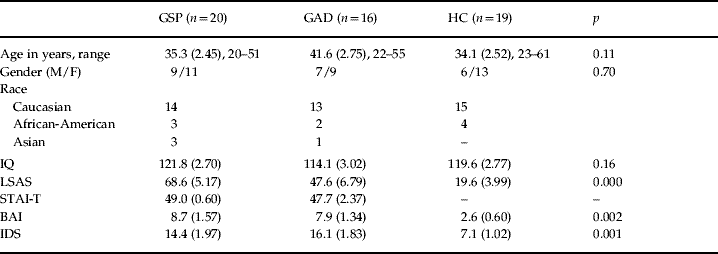
Twenty patients with GSP, 16 patients with GAD and 19 HCs participated in the study. Samples were group-matched on age, gender and IQ as assessed by the matrix reasoning and verbal subtests of the Wechsler Abbreviated Scale of Intelligence (WASI) (see Table 1). Subjects in the GSP patient group met the criteria for generalized social phobia, and the subjects in the GAD group met the criteria for generalized anxiety disorder according to the DSM-IV (1994) criteria based on the Structural Clinical Interview for DSM-IV Axis I disorders (SCID; First et al. Reference First, Spitzer, Gibbon and Williams1997) and an confirmative interview by a board-certified psychiatrist (D.S.P.). All patients with any other co-occurring anxiety disorder were excluded, as were patients with severe major depressive disorder (MDD). Other patients with MDD were included if the evaluating psychiatrist determined the severity of the MDD to be milder than that of the anxiety disorder, such that the anxiety disorder was deemed the primary condition in need of clinical attention. Only one of 36 patients exhibited co-morbid MDD. As in our previous work, the GAD group (n=16) was made up of patients with GAD who were co-morbid for GSP (n=9) as well as ‘pure cases’ who were not (n=7) (Monk et al. Reference Monk, Nelson, McClure, Mogg, Bradley, Leibenluft, Blair, Chen, Charney, Ernst and Pine2006; McClure et al. Reference McClure, Adler, Monk, Cameron, Smith, Nelson, Leibenluft, Ernst and Pine2007; Blair et al. Reference Blair, Shaywitz, Smith, Rhodes, Geraci, Jones, McCaffrey, Vythilingam, Finger, Mondillo, Jacobs, Charney, Blair, Drevets and Pine2008b). Beyond one MDD case, in the GSP group, none of the 35 other patients had any other current Axis 1 diagnosis.
Subjects' characteristics

GSP, Generalized social phobia; GAD, generalized anxiety disorder; HC, healthy comparison; M, male; F, female; LSAS, the Liebowitz Social Anxiety Scale; STAI-T, the Trait subscale on the Spielberger Trait Anxiety Inventory; BAI, the Beck Anxiety Inventory; IDS, the Inventory of Depressive Symptoms.
Values given as mean (standard error).
All subjects were required to be currently medication free (no regular use of psychotropic medication within 2 weeks or fluoxetine/benzodiazepine within 8 weeks of the study). Comparison individuals were excluded if they had current/past history of any psychiatric illness. All subjects were in good physical health, as confirmed by a complete physical examination. Subjects provided written informed consent for participation in the study. The consent forms were approved by the National Institute of Mental Health Institutional Review Board (NIMH IRB). The patients with GSP and GAD reported significantly greater depression, social anxiety and general anxiety than the HC individuals. [One GAD patient's score on the Trait subscale of the Spielberger Trait Anxiety Inventory (STAI-T) and one HC's scores on the Liebowitz Social Anxiety Scale (LSAS), the Inventory of Depressive Symptoms (IDS) and the Beck Anxiety Inventory (BAI) were not available.] However, the patient groups did not differ on these measures (see Table 1).
The DRPLT
The DRPLT consists of 10 images each depicting a different object (house, cup, fork, duck, pineapple, necklace, raccoon, door, torch, or shoe) from the Snodgrass & Vanderwart (Reference Snodgrass and Vanderwart1980) picture set. To prevent systematic task interference from any existing valence attached to the objects (e.g. pineapple might have a pre-existing positive valence), each object was randomly assigned a value automatically by the E-Prime program running the task (−900, −700, −500, −300, −100, 100, 300, 500, 700, or 900) before the subject began (i.e. not every subject received 900 points for choices of the shoe).
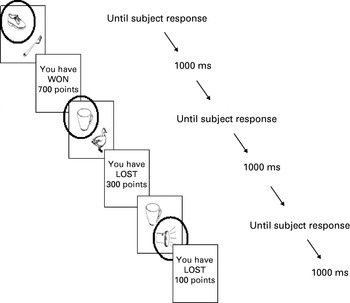
During the task, the objects were presented together in pairs, appearing in two of four different locations positioned around the middle of the screen. At the viewing distance of 60 cm, the visual angle was 10 arcmin horizontally and 12 arcmin vertically. The subject was told that, on each trial, one of the two objects must be chosen, and that some objects would result in losing points and some objects would result in winning points. Following object selection (with the click of a mouse) its assigned value was revealed. Thus, choosing the object assigned the value 100 resulted in the feedback: ‘You have WON 100 points’. Conversely, choosing the object assigned the value −100 resulted in the feedback: ‘You have LOST 100 points’. Feedback stayed on the screen for 1000 ms and was then replaced by the two objects for the subsequent trial (see Fig. 1 for session diagram). There was no time limit for making a response. At the end of the study subjects were told how many points they had accumulated.
Session diagram. In this example, the randomly assigned values for the shoe, cup and torch are 700, −300 and −100 respectively. The objects selected are circled.

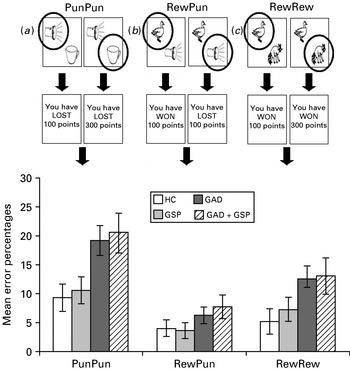
All objects were paired with each other, leading to three task conditions: Reward/Reward (RewRew), Punishment/Punishment (PunPun) and Reward/Punishment (RewPun). In the RewRew condition, both objects were associated with reward. In the PunPun condition, both objects were associated with punishment. Finally, in the RewPun condition, one object was associated with reward and one object was associated with punishment (see Fig. 2).
Breakdown of group performance by decision form: (a) Punishment/Punishment (PunPun), (b) Reward/Punishment (RewPun) and (c) Reward/Reward (RewRew). The patients with generalized anxiety disorder (GAD) committed significantly more errors across decision form than the generalized social phobia (GSP) and healthy comparison (HC) groups. There was no significant group×decision form interaction. The objects selected are circled. Error bars represent standard errors.

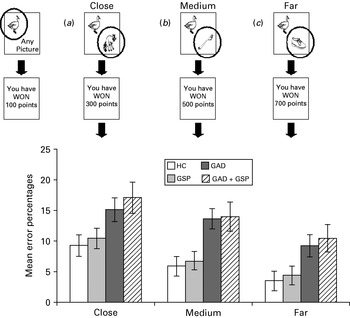
In addition to the three overall task conditions, the task involved different between-object reinforcement distances (e.g. 100 v. 300; 100 v. 900). The point distance was divided into three different between-object reinforcement distances: Close, Medium, Far. So, for example, the ‘close’ between-object reinforcement distance trials involved two objects associated with values that were close together in value [e.g. (−900 v. −700) (900 v. 700) (100 v. −100)]. By contrast, the ‘far’ between-object reinforcement distance trials involved two objects associated with values that were far apart in value [e.g. (−900 v. −100) (900 v. 100) (900 v. −900)]; see Fig. 3. The task therefore involved a 3 (Group: GSP, GAD, HC)×3 (Decision form: RewRew, PunPun, RewPun)×3 (Distance: Close, Medium, Far) design. The task was programmed in VisualBasic and presented on a Dell Inspiron 4150 laptop.
Breakdown of group performance by between-object reinforcement distance: (a) Close, (b) Medium and (c) Far. The patients with generalized anxiety disorder (GAD) committed significantly more errors across distances than the generalized social phobia (GSP) and healthy comparison (HC) groups. There was no significant group×distance interaction. The objects selected are circled. Error bars represent standard errors.

On any trial, choosing the superior object over the more inferior object was scored as ‘correct’. Thus, on RewRew trials, where both objects represented a gain (e.g. 100 and 300), choosing the object representing the greater gain of 300 would be correct. On PunPun trials, where both objects represented a loss (e.g. −100 and −300), choosing the object representing the smaller loss of −100 would be correct. Finally, on RewPun trials, where one object represented a gain and one a loss (e.g. −100 and 100), choosing the object representing a gain of 100 would be correct. The data points pertaining to the first time any object was presented were excluded from the analysis. As there were more RewPun trials than RewRew and PunPun trials, subjects' error scores were converted into error percentages as a function of the number of trials within each of the three decision forms.
Procedure
Each subject was tested individually in a quiet interview room. Each subject was presented with the DRPLT within a larger neurocognitive test battery. The duration of the DRPLT was approximately 22 min for each subject.
Results
A 3 (Group: GSP; GAD; HC)×3 (Decision form: RewRew; PunPun; RewPun)×3 (Distance: Close; Medium; Far) ANOVA was conducted on the data. Importantly, the main effect of group was significant [F(2, 52)=4.70, p<0.025, η2p=0.15]. Patients with GAD committed significantly more errors on this task than the patients with GSP and the HCs (p<0.025 and 0.01 respectively). However, the patients with GSP and HCs did not differ significantly (F<1, n.s.): [mean (GAD)=12.65, s.e.=1.65], [mean (GSP)=7.19, s.e.=1.48], [mean (HC)=6.21, s.e.=1.52] (see Figs 2 and 3).
There was also a significant main effect of decision form [F(2, 104)=19.48, p<0.001, η2p=0.27]. Subjects, as a whole, committed a significantly greater number of errors on PunPun trials relative to RewRew trials and on RewRew trials relative to RewPun trials (p<0.01 and 0.05 respectively): [mean (PunPun)=13.03, s.e.=1.39], [mean (RewRew)=8.36, s.e.=1.26], [mean (RewPun)=4.66, s.e.=0.83]. The main effect of distance was also significant [F(2, 104)=43.00, p<0.001, η2p=0.45], with the linear contrast being significant [F(1, 52)=89.93, p<0.001, η2p=0.63]; the number of errors increased as the between-object reinforcement distance decreased. Subjects made significantly more errors on decisions close relative to medium in distance, and on decisions medium relative to far in distance (p<0.001 for both): [mean (close)=11.61, s.e.=1.02], [mean (medium)=8.74, s.e.=0.94], [mean (far)=5.70, s.e.=0.94]. However, there was no significant decision form×group, distance×group, or decision×distance×group interaction.
Patients with GAD and GSP
Nine of the patients with GAD also presented with GSP. The error rates for these nine patients are also shown in Figs 2 and 3. As can be seen, their data parallel those shown by the patients with GAD rather than those with GSP. To confirm this impression, we conducted a second 2 (Group: GAD with GSP; GSP)×3 (Decision form: RewRew; PunPun; RewPun)×3 (Distance: Close; Medium; Far) ANOVA. The results of this ANOVA were consistent with the results from our main ANOVA. Thus, as before, the main effect of group was significant [F(1, 27)=5.29, p<0.05, η2 p=0.16], with the patients with GAD with GSP committing significantly more errors on this task relative to the patients with GSP only. In addition, as before, there was no significant decision form×group, distance×group, or decision×distance×group interaction (see Figs 2 and 3).
Stratification of performance by group
We performed a preliminary stratification of performance by group to determine whether the patients with GSP as a group were more likely to show notably impaired performance (defined as a total error rate >1 s.d. above the HC mean) and less likely to show superior performance (defined as a total error rate <1 s.d. above the HC mean). This revealed that, in contrast to 11% of the HCs and 15% of the patients with GSP, 31% of the patients with GAD showed notably impaired performance on the task. Moreover, in contrast to 32% of the HCs and 30% of the patients with GSP, only 12.5% of the patients with GAD showed superior performance on this task.
Multiple regression analyses examining potential relationships between individual subject variables and DRPT total score
An initial multiple regression analysis was conducted to evaluate whether there was a relationship between the individual subject variables and total score on the DRPT. The predictor variables were age, gender and IQ and also scores on the BAI, IDS and LSAS, and the criterion variable was total score on the DRPT. This multiple regression revealed a weak trend for a linear relationship between the criterion variable and the entire set of predictor variables [F(6, 54)=1.95, p<0.01]. The sample multiple correlation coefficient was 0.202. Just under 10% of the variance in total score on the DRPT was accounted for by these variables. However, with the exception of IQ, none of these variables had a significant relationship with DRPT total score. However, a second multiple regression analysis examining only IQ and group revealed a significant linear relationship between total score on the DRPT and these two predictor variables [F(6, 54)=7.44, p<0.001]. The sample multiple correlation coefficient was 0.222; 19.3% of the variance in total score on the DRPT was accounted for by these variables. Moreover, both of these variables had a significant relationship with DRPT total score (p<0.02 in both cases).
Correlational analyses examining potential relationships between depressive symptomatology and DRPT scores
Correlational analyses were used to examine the relationship between level of depressive symptomatology as assessed by scores on the IDS and performance on the DRPLT in the GAD group. There was no significant correlation between IDS and total DPRLT score (Pearson's r=0.328, p=0.215). In addition, there was no significant correlation between IDS score and performance on the DRPLT subcomponents RewRew, PunPun and RewPun (Pearson's r range=0.209–0.279, p range=0.294–0.364), indicating that level of depressive symptomatology (at least in this sample) does not modulate performance on the DRPLT.
Discussion
The current study compared stimulus-reinforcement-based decision making in GSP, GAD and HC individuals. The patients with GAD committed significantly more errors on our reward- and punishment-based decision-making task across all trial conditions, relative to patients with GSP and HC individuals. By contrast, there were no significant performance differences between patients with GSP and HC individuals.
Recent studies have indicated that GSP and GAD might be associated with differential responses to social affective stimuli (Becker et al. Reference Becker, Rinck, Margraf and Roth2001; Turk et al. Reference Turk, Heimberg, Luterek, Mennin and Fresco2005; Blair et al. Reference Blair, Shaywitz, Smith, Rhodes, Geraci, Jones, McCaffrey, Vythilingam, Finger, Mondillo, Jacobs, Charney, Blair, Drevets and Pine2008b). By contrast, the response in GSP and GAD to non-social affective stimuli has not been compared directly. However, the observation of significant impairment in the patients with GAD on the current reward- and punishment-based decision-making task is consistent with previous self-reports of poor problem orientation and pathological ‘conceptual planning’ in patients with GAD (see Roemer et al. Reference Roemer, Orsillo and Barlow2002). As can be seen in Figs 2 and 3, the patients with GAD made more errors in the current study relative to patients with GSP and HCs across decision forms and between-object reinforcement distances. Previous work with the current task has suggested that it is reliant on appropriate representation of reinforcement information in vmPFC and the recruitment of dorsal anterior cingulate cortex to resolve response conflicts engendered by different reinforcement values being associated with different objects (Blair et al. Reference Blair, Marsh, Morton, Vythilingham, Jones, Mondillo, Pine, Drevets and Blair2006b). In line with this, neuroimaging work with patients with GAD have implicated frontal pathology (Wu et al. Reference Wu, Buchsbaum, Hershey, Hazlett, Sicotte and Johnson1991; Hoehn-Saric et al. Reference Hoehn-Saric, Schlund and Wong2004; Monk et al. Reference Monk, Nelson, McClure, Mogg, Bradley, Leibenluft, Blair, Chen, Charney, Ernst and Pine2006; Blair et al. Reference Blair, Shaywitz, Smith, Rhodes, Geraci, Jones, McCaffrey, Vythilingam, Finger, Mondillo, Jacobs, Charney, Blair, Drevets and Pine2008b).
These data suggest two possible reasons for the impairment seen in the patients with GAD in the current study. First, regions implicated in GAD may be dysfunctional in the representation of reinforcement information and, as such, lead to impairment on the current task. Second, it is possible that ongoing worry in these patients may have interfered with their task performance. That is, the patients with GAD may have been attending to features of their foci or worry rather than representations necessary for successful task performance. Importantly, these two positions can be distinguished in our ongoing follow-up study. If patients with GAD show impairment in the representation of reinforcement information, we can predict reduced representation of this information relative to patients with GSP and HCs in an fMRI implementation of this paradigm (Blair et al. Reference Blair, Marsh, Morton, Vythilingham, Jones, Mondillo, Pine, Drevets and Blair2006b). Alternatively, if task performance relates to pathological worry, it can be predicted that the patients with GAD will show increased activity in regions previously implicated in worry, that will not be differentially affected by decision type of reinforcement distance. We are currently testing these predictions.
Very little work has investigated whether patients with GSP show impairment in the processing of non-social affective stimuli. One study has reported impaired aversive conditional discrimination ability in patients with GSP relative to HCs during an eyelid conditional discrimination learning task (Sachs et al. Reference Sachs, Anderer, Doby, Saletu and Dantendorfer2003). However, we found no significant impairment in patients with GSP on the DRPLT. There are several possible reasons for the inconsistency between the current results and those of Sachs et al. (Reference Sachs, Anderer, Doby, Saletu and Dantendorfer2003). For example, the Sachs et al. (Reference Sachs, Anderer, Doby, Saletu and Dantendorfer2003) study involved patients with non-GSP whereas the current study involved patients with GSP only; it has been suggested that the impairments seen in non-GSP and GSP may differ (Boone et al. Reference Boone, McNeil, Masia, Turk, Carter, Ries and Lewin1999; Vriends et al. Reference Vriends, Becker, Meyer, Michael and Margraf2007). Moreover, there are clear task differences between the two studies. Thus, although a firm conclusion cannot be made in the absence of additional data, it seems that patients with GSP may be unimpaired in the processing of non-social affective stimuli.
The current data suggest that GSP and GAD might be associated with different neurocognitive impairments. Few studies have previously compared the two disorders directly. However, some behavioral work has revealed significant group differences (Becker et al. Reference Becker, Rinck, Margraf and Roth2001; Turk et al. Reference Turk, Heimberg, Luterek, Mennin and Fresco2005). Moreover, a recent neuroimaging study (Blair et al. Reference Blair, Shaywitz, Smith, Rhodes, Geraci, Jones, McCaffrey, Vythilingam, Finger, Mondillo, Jacobs, Charney, Blair, Drevets and Pine2008b) observed that individuals with GSP showed significantly greater amygdala responses to fearful expressions relative to HCs whereas patients with GAD showed significantly reduced amygdala responses relative to HCs. In addition, and in line with the current results, the neural responses of patients with GAD co-morbid for GSP did not differ from those of patients with ‘pure’ GAD but did significantly differ from those of patients with GSP only.
The use of points as a secondary reinforcer in this study rather than other more salient reinforcers, such as money, could be criticized. However, fMRI work shows that very similar regions, in particular vmPFC (e.g. Blair et al. Reference Blair, Marsh, Morton, Vythilingham, Jones, Mondillo, Pine, Drevets and Blair2006b), are involved in the representation and anticipation of point gain as in financial gain (Knutson & Cooper, Reference Knutson and Cooper2005). Indeed, vmPFC is also implicated in the representation and anticipation of primary reinforcers such as food (O'Doherty et al. Reference O'Doherty, Rolls, Francis, Bowtell and McGlone2001). As such, although money may be a more salient secondary reinforcer than points gained, their computational implications are similar.
The current study did not find any relationship between DRPT total score and severity of symptomatology as indexed by the BAI, LSAS or IDS. This probably reflects that fact that the LSAS and IDS, and even the BAI, do not directly assess GAD symptom expression levels. It is possible that a self-report measure more directly focusing on expression of worry might reveal a relationship with DRPT total score.
It should also be noted that the current study provided an index of successful decision making across conditions. However, it did not provide data on the subjects' learning rates. As yet, it remains unclear whether patients with GAD are slower to learn the reinforcement values associated with the different objects or whether, irrespective of learning rate, they are less able to use the information appropriately across time. Future work will address this issue.
As a relatively small number of patients took part in this study, and it is the first to directly compare stimulus-reinforcement-based decision making in GSP and GAD, our data must be considered preliminary. Nevertheless, consistent with family-based and pharmacological data (Rickels & Rynn, Reference Rickels and Rynn2002; Blanco et al. Reference Blanco, Schneier, Schmidt, Blanco-Jerez, Marshall, Sanchez-Lacay and Liebowitz2003; Liebowitz et al. Reference Liebowitz, Ninan, Schneier and Blanco2005), our results add to the initial evidence that GSP and GAD might be dissociable. Future work is needed to further investigate this issue.
In short, in this study we found that patients with GAD committed significantly more errors relative to patients with GSP or HCs on a decision-making task that is sensitive to overall levels of reward and punishment and also to between-object reinforcement distances. By contrast, the patients with GSP and the HC individuals did not differ on this task. These results link GAD with an anomalous decision-making process that we suggested might relate to an impairment in the representation of reinforcement information, or alternatively that ongoing worry may have interfered with their task performance. We are currently examining these possibilities in a follow-up study. Our results join other recent studies in tentatively suggesting that GSP and GAD may be dissociable disorders and may have implications for future treatment considerations of the two groups.
Acknowledgements
This research was supported by the Intramural Research Program of the National Institutes of Health, National Institute of Mental Health.
Declaration of Interest
None.