I. INTRODUCTION
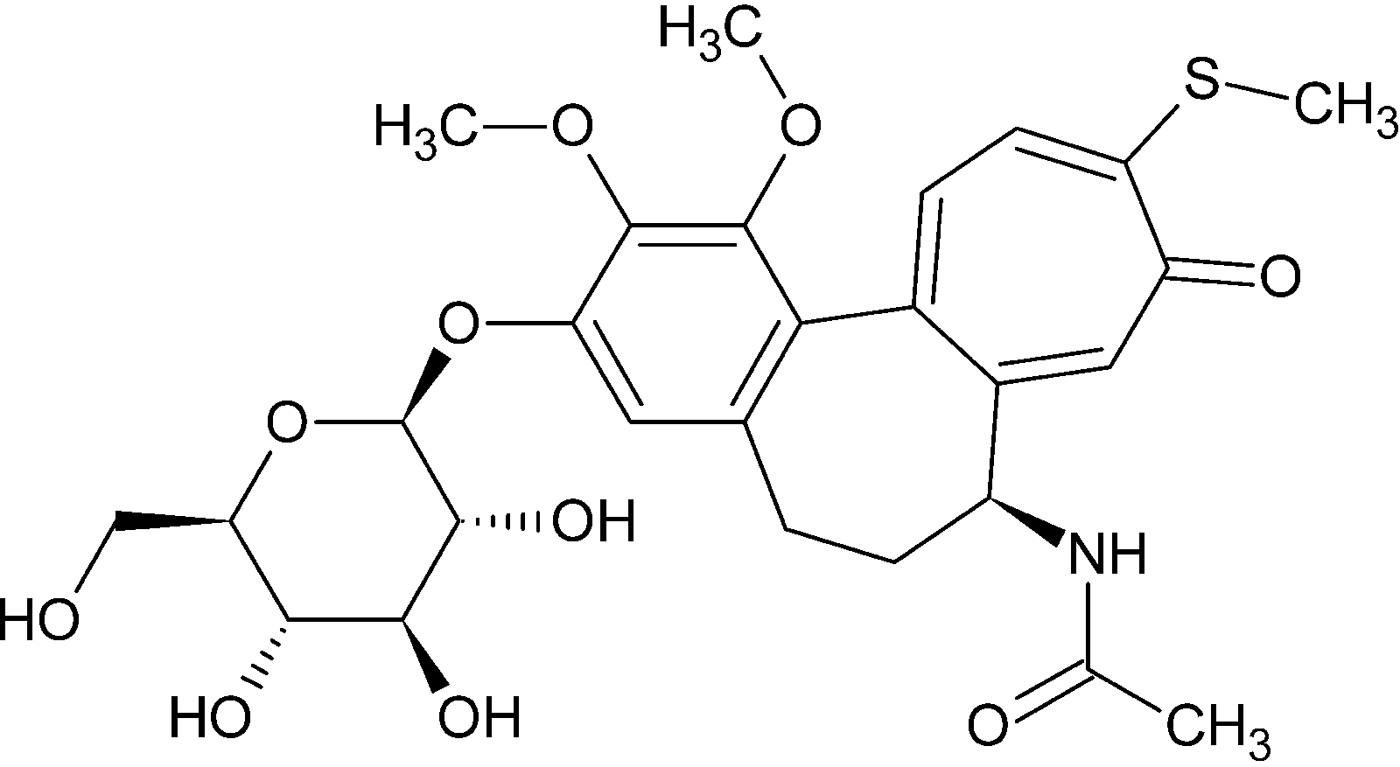
As part of the work being carried out in our laboratory with the purpose of characterizing common active pharmaceutical ingredients (APIs) and to examine the possible formation of polymorphs under different crystallization conditions, a study by X-ray powder diffraction of thiocolchicoside (THC, Figure 1) was carried out. The chemical nature of the materials and their thermal stability were examined using Fourier transform infrared spectroscopy (FTIR) spectroscopy and thermogravimetric (TGA) and differential scanning calorimetry (DSC) analyses.
Chemical structure of THC.

THC is a synthetic sulfur derivative of colchicoside used in the symptomatic treatment of painful muscle spasms. Also, pharmacological evidence has shown that under certain conditions, THC induces convulsant activity in animals and humans (Sweetman, Reference Sweetman2009). A search in the Cambridge Structural Database V 5.34 (Allen, Reference Allen2002) for this material produced only one entry for a THC-related compound. It corresponds to a THC ethanol solvate hydrate (C27H33NO10S·2C2H6O·H2O, refcode: THCLCS). The ICDD PDF-4/Organics database (ICDD, Reference Kabekkodu2012) contains its calculated powder diffraction pattern (entry: PDF 02-073-3591).
For the pharmaceutical industry, it is very important to properly characterize the APIs and the excipients, since their different polymorphs and compositions (solvates, anhydrates, etc.) can influence the stability, solubility, bioavailability, and efficacy of a drug and the manufacturing of the final product (Zhang et al., Reference Zhang, Law, Schmitt and Qiu2004; Cui, Reference Cui2007). Polymorphism continues to be an interesting solid state phenomenon, which increasingly attracts a great deal of attention among organic solid state scientists.
II. EXPERIMENTAL
A. Crystallization of THC
Crystallization of raw THC, provided by Laboratorios CAM, Venezuela, was carried out by slow evaporation of a saturated aqueous solution in an oven at 37 °C over a period of 48 h. The light yellow crystals obtained were later subjected to heating at 105 °C for 3 h. Melting points of the raw and the recrystallized materials were determined using an Electrothermal Engineering LTD, model 9100, digital melting point apparatus.
B. IR spectroscopy and thermal analysis
The FTIR spectra were recorded in KBr pellets, using a Perkin-Elmer PE-1600X spectrophotometer with IRDM software. Thermogravimetric and Derivative Thermogravimetric Analysis (TGA/DTG) and differential scanning calorimetry measurements (DSC) were performed in a thermal analyzer SDT Q600 V3 using 6–7 mg of sample, heating to 600 °C, at a rate of 10 °C min−1, under a dynamic nitrogen atmosphere at 120 ml min−1.
C. X-ray powder diffraction data collection
Powder diffraction patterns were recorded at room temperature on a BRUKER D8 ADVANCE diffractometer working in the Bragg-Brentano geometry using CuKα radiation (λ = 1.541 84 Å), operating at 40 kV and 30 mA. The patterns were recorded in steps of 0.0156° (2θ), from 5° to 60° at 4 s step−1. The diffractometer was equipped with the primary and secondary Soller slits of 2.5°, divergence slit of 0.2 mm, Ni filter of 0.02 mm, and a LynxEye detector. The profile fit of each pattern was carried out with the FULLPROF software (Rodriguez-Carvajal, Reference Rodriguez-Carvajal1990). The indexing of each pattern was performed with the program DICVOL06 (Boultif and Louer, Reference Boultif and Louer2004) and analyzed with the NBS*AIDS83 program (Mighell et al., Reference Mighell, Hubbard and Stalick1981).
III. RESULTS
The crystallization experiments carried out on raw THC led to two new phases: a dihydrated phase and an anhydrous phase obtained after heating the dihydrate. For the sake of clarity, the results of the characterization of each of these materials are presented separately in the following paragraphs.
A. Raw THC
The FTIR spectrum of raw THC clearly shows the chemical nature of the compound under study. The bands corresponding to the –OH stretching appear at 3421 cm−1 and the N–H stretching of the secondary amide appears at 3300 cm−1. In general, the spectrum shows broad absorption bands possibly because of the large number of hydrogen bonds present.
This phase exhibits an endothermic transition at 51.86 °C and melts and immediately decomposes at 204–206 °C, according to the DSC analysis. The TGA curve shows that this material undergoes a weight loss of 5.524% at 51.86 °C, consistent with the endotherm observed in DSC analysis. The low peak temperature of this process seems to indicate the presence of moisture in the sample and the percentage suggests a degree of hydration greater than one but less than two water molecules. A weight loss of 53%, attributed to the decomposition of the material, occurs above 210 °C.
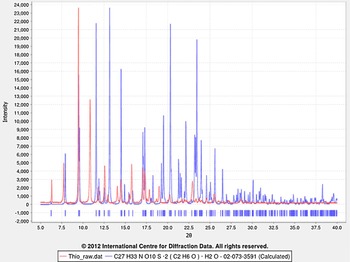
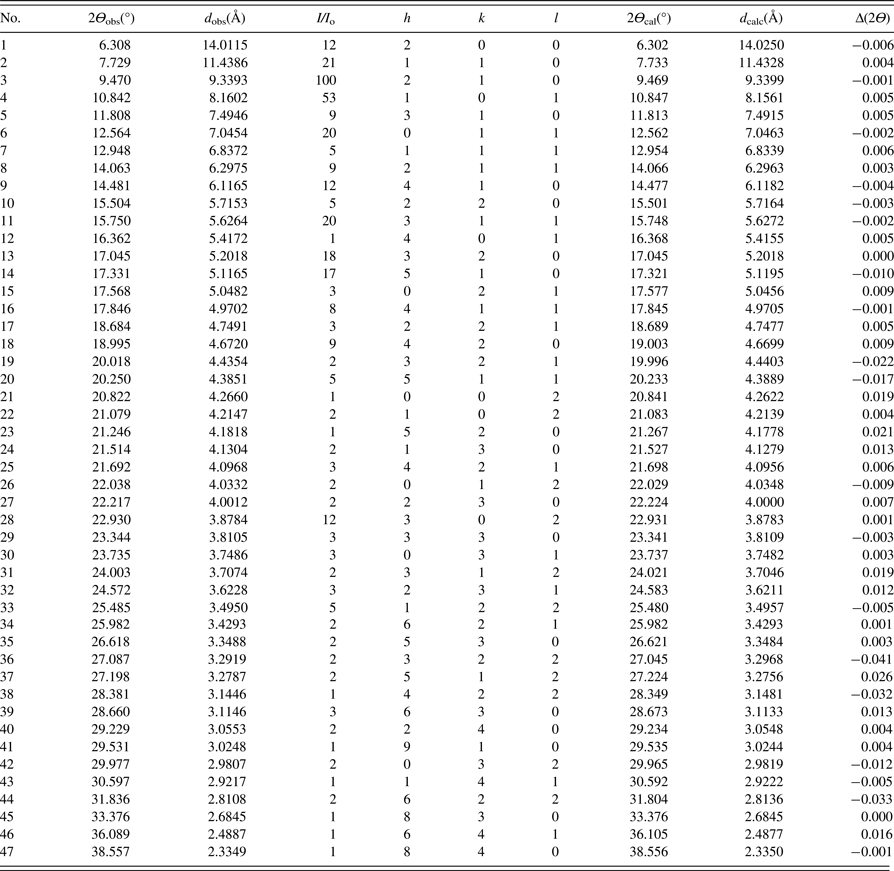
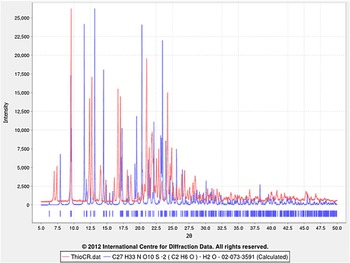
The powder diffraction pattern recorded for the raw material (THC) does not match the pattern for THCLCS contained in the PDF-4/Organics database (Figure 2). The indexing of this pattern carried out with DICVOL06 and the analysis of 47 diffraction maxima recorded, performed with NSB*AIDS83, led to an orthorhombic unit cell with a = 28.018(7) Å, b = 12.519(2) Å, c = 8.519(1) Å, and V = 2988.01 Å3. The Miller indices of the reflections suggest P212121 as possible space group. The de Wolf (de Wolf, Reference de Wolff1968) and Smith–Snyder (Smith and Snyder, Reference Smith and Snyder1979) figures of merit obtained were M 20 = 56.5 and F 20 = 137.6 (0.0035, 42), respectively. Table I contains the corresponding powder diffraction data. The fitting of the whole pattern with the Le Bail algorithm implemented in FULLPROF (Rodriguez-Carvajal, Reference Rodriguez-Carvajal1990), in space group P212121, accounts for all the diffraction maxima recorded. The X-ray powder diffraction data along with the FTIR and thermal analysis results indicate that this material is a previously unreported THC phase.
(Color online) Comparison of the powder diffraction pattern of raw THC (red) with PDF 02-073-3591 THCLCS (blue).

X-ray powder diffraction data of raw THC.

B. THC recrystallized in water
The bands observed in the FTIR spectrum of this phase are better defined than those of the raw sample. Two –OH stretches appear at 3548 and 3434 cm−1. The first band at 3548 cm−1 corresponds to a water molecule, whereas the 3434 cm−1 band corresponds to the –OH groups of the glucoside residue. The N–H stretching appears at 3250 cm−1.
The TGA curve shows that, at about 50 °C, this material begins to lose weight (6.125%, corresponding to the loss of two water molecules) with a peak temperature (T p) of 79.89 °C. This endothermic process is observed in the DSC at a peak temperature of 79.24 °C. DSC also shows that this phase melts at 269 °C, and undergoes decomposition between ~280 and 600 °C (weight loss of 54.25% and T p = 307.32 °C). It is worth noting that this behavior is different from the thermal behavior of raw THC.
The crystals obtained were irregularly shaped blocks of size and quality appropriate for single crystal X-ray diffraction analysis. The crystal structure of this dihydrated phase was determined and will be reported elsewhere.
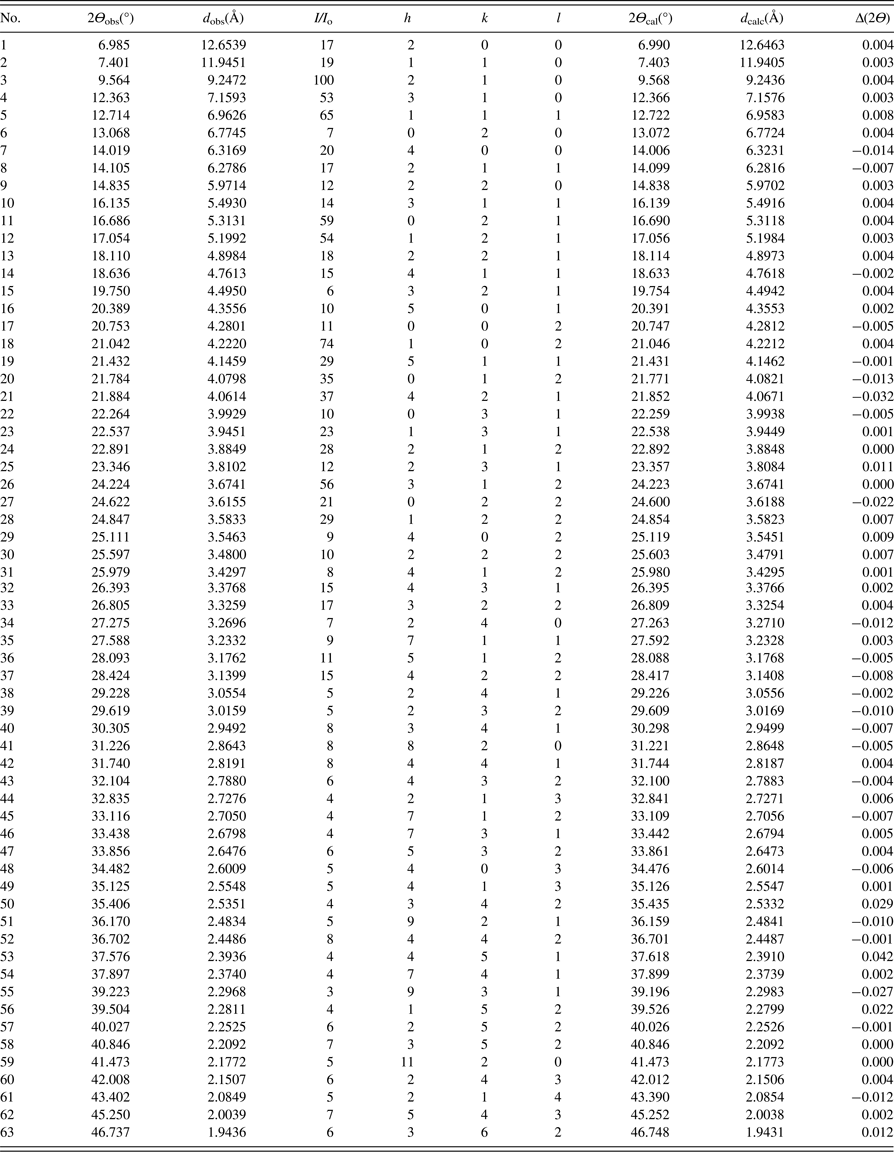
The powder diffraction pattern recorded for this phase is different from the one recorded for the raw material (Figure 3) and from the one reported for THCLCS in PDF-4/Organics (Figure 4). The indexing of the pattern carried out using DICVOL06 produced an orthorhombic unit cell. The analysis of the entire pattern (63 diffraction maxima) with NBS*AIDS83 resulted in a unit cell with parameters: a = 25.264(4) Å, b = 13.537(3) Å, c = 8.553(1) Å, and V = 2925.12 Å3. The set of reflections observed are consistent with space group P212121 obtained in the single-crystal analysis. The de Wolf (de Wolf, Reference de Wolff1968) and Smith–Snyder (Smith and Snyder, Reference Smith and Snyder1979) figures of merit obtained were M 20 = 47.3 and F 20 = 131.2 (0.0040, 38), respectively. The powder diffraction data are presented in Table II.
(Color online) Comparison of the powder diffraction pattern of the recrystallized material (red) with the pattern recorded for raw THC (blue).

(Color online) Comparison of the powder diffraction pattern of recrystallized THC (red) with PDF 02-073-3591 THCLCS (blue).

X-ray powder diffraction data of THC recrystallized in water.

C. Dehydrated THC obtained from the recrystallized phase
The dihydrate THC phase obtained by recrystallization in water was heated at 105 °C for 3 h. A change in the morphology of the crystals upon heating, from blocks to an opaque yellow powder, was observed.
The FTIR spectrum recorded for this material differs slightly from those previously obtained. The absorption bands observed are generally broad. The –OH stretching vibration appears at 3435 cm−1, whereas the N–H stretch appears at 3324.54 cm−1. DSC curves show an endothermic transition at 264.31 °C corresponding to melting, followed by decomposition at T p = 338.65 °C.
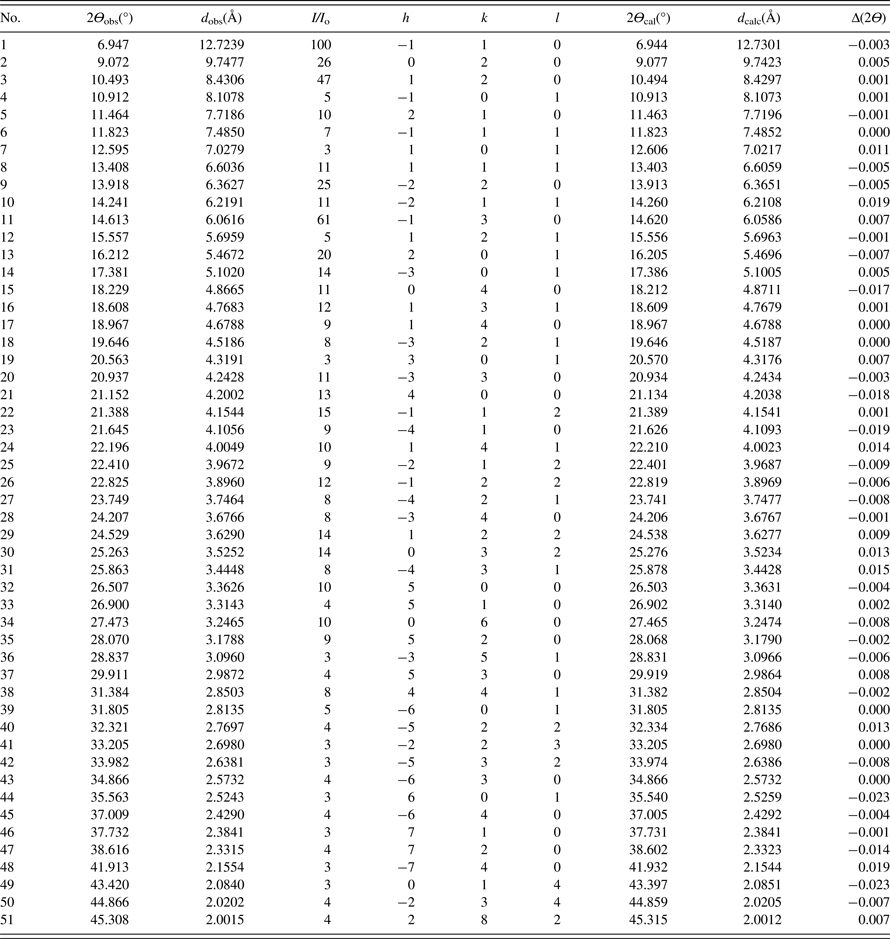
The entire powder diffraction pattern registered is consistent with the monoclinic unit cell found by DICVOL06 for the first 20 peaks used in the indexing process. The unit cell parameters obtained with NBS*AIDS83, after the analysis of the 51 diffraction maxima recorded, are: a = 17.090(5) Å, b = 19.485(5) Å, c = 8.526(3) Å, β = 100.30(2)°, and V = 2793.34 Å3. The indices of the reflections observed are consistent with P21 as possible space group. The de Wolf (de Wolf, Reference de Wolff1968) and Smith–Snyder (Smith and Snyder, Reference Smith and Snyder1979) figures of merit obtained were M 20 = 36.6 and F 30 = 56.3 (0.0067, 79), respectively (see Table III).
X-ray powder diffraction data of the recrystallized THC after heating.

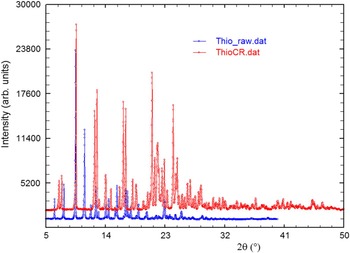
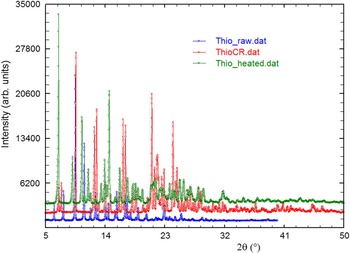
A comparison of the powder diffraction pattern of raw THC, the pattern of the material recrystallized in water and the pattern of the dehydrated phase, obtained from the recrystallized material after heating (shown in Figure 5), clearly indicates that THC exhibits several solvates and polymorphic modifications that, to our knowledge, have not been previously reported.
(Color online) Comparison of the powder diffraction pattern of raw THC (blue) with the pattern of the recrystallized material (red) and the pattern of the heated recrystallized THC (green).

Given the interesting behavior observed for THC, additional experiments are being carried out in order to examine the possible interconversions among its crystalline phases.
ACKNOWLEDGMENTS
This work was made possible thanks to the grant LAB-97000821 from FONACIT-Venezuela for Laboratorio de Cristalografía-LNDRX and a grant for Laboratorio de Difracción de Rayos-X, PTG, Universidad Industrial de Santander, Bucaramanga, Colombia. The authors thank Marlin Villarroel for technical assistance with the TGA/DSC analysis.