Mass strandings on beaches have been described for a wide range of marine organisms. The majority of strandings are related to adverse weather or tidal conditions and generally involve sedentary benthic organisms which occupy the intertidal and subtidal zones of the shore (O'Brien et al., Reference O'Brien, Ritz and Kirkwood1986). Of greater interest for researchers and the general public are occasions when apparently healthy animals such as whales and dolphins (Podesta et al., Reference Podesta, D'Aamico, Pavan, Drougas, Komnenou and Portunato2006; García-Godos & Cardich, Reference García-Godos and Cardich2010; Amaha et al., Reference Amaha, Tonay and Dede2011), squid (Nolan et al., Reference Nolan, Strange, Alesworth and Agnew1998; Mazzillo et al., Reference Mazzillo, Staaf, Field, Carter and Ohman2011), sea turtles (Chaloupka et al., Reference Chaloupka, Work, Balazs, Murakawa and Morris2008), lobster and fish (Scotto di Carlo et al., Reference Scotto di Carlo, Costanzo, Fresil, Guglielmo and Ianoral1982; Beckley et al., Reference Beckley, Cliff, Smale and Compagno1997; Gárate-Lizárraga et al., Reference Gárate-Lizárraga, Band-Schmidt, Verdugo-Díaz, Muñetón-Gómez, Félix-Pico, Funes-Rodríguez, Gómez-Gutiérrez and Palomares-García2007a, Reference Gárate-Lizárraga, Band-Schmidt, Bustillos-Guzmán and López-Cortés2007b; Halford & Perret, 2009; Speed et al., Reference Speed, Meekan, Russell and Bradshaw2009) are washed ashore.
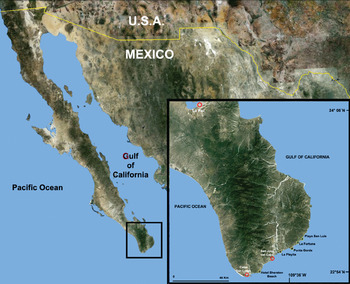
We describe a massive stranding of several species of teleostean fish in the southern part of the Baja California Peninsula, in addition to an initial report of the incident (Gárate-Lizárraga et al., Reference Gárate-Lizárraga, González-Armas, Tiburcio-Pintos, Sánchez-García, Olvera-Guevara and Montero Becerril2011). The stranding occurred between 16 June and 21 June 2011. This area, the Cape Region of the Gulf of California, is one of the most important tourist destinations and sport fishing areas of Mexico (Figure 1).
Locations of fish strandings in the Cape Region in the State of Baja California Sur, Mexico, 16–21 June 2011 (‘stars' symbols). Map produced from an image of Google Earth© 6.0.

On the cape coast, the shoreline is usually steep and the sea-surface temperatures range from 20°C–30°C and the tidal range is less than 2 m. The offshore area has practically no continental shelf located at the edge of the continental slope at the 100 m isobaths (Pedrín & Padilla, Reference Pedrín and Padilla1999). The zone is characterized by a rich reef fauna and the only extensive growths of coral in the Gulf of California (Cabo Pulmo National Marine Park).
The reef fish fauna of the lower gulf is the richest in the Gulf of California and perhaps the entire eastern Pacific (Thomson et al., Reference Thomson, Findley and Kerstitch2000), which includes fish species of temperate and tropical origin and an endemism of nearly 10% or 82 species (Hastings et al., Reference Hastings, Findley, Van der Heiden and Brusca2010). Several circumtropical and trans-Pacific species from the Indian and western Pacific Oceans have become established in the gulf, including parrot fish, surgeon fish, wrasses, morays and puffers.
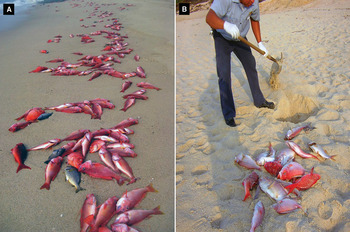
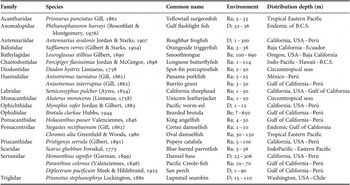
The fish stranding was first reported by the ‘Campamento Tortuguero Don Manuel Orantes' at El Zacatito on 16 June 2011, extending northward to Playa San Luis (23°10′41.78″N–109°28′39.49″W). Strandings occurred southward to the Hotel Sheraton resort, 9 km north of the Cabo San Lucas harbour (22°54′54.06″N–109°50′07.45″W). The largest concentration of fish was at La Fortuna (23°09′00.54″N–109°29′39.54″W). Lately, reports from federal and state agencies mentioned that die-offs were observed from La Playita (23°3′38.98″N–109°40′7.47″W), later at Punta Gorda (23°05′00.46″N–109°34′33.70″W) to La Fortuna. In total during this period, massive numbers of dead fish were washed ashore along 43.5 km of beach from the Sheraton to Playa San Luis (Figure 1). We identified 22 fish species belonging to 17 families (Table 1) and the municipal authorities estimated the loss at 50 t. The species Hemanthias signifier (Garman, 1899) and Pristigenys serrula (Gilbert, 1891) were those that provided the greatest amount of abundance and biomass. It is likely that additional species were stranded, but the municipal authorities removed and buried the many tons of fish before the authors could survey all locations (Figure 2).
(A) Typical beach at Los Cabos, Baja California Sur, Mexico with stranded fish along 43.5 km of the coast (June 2011); (B) staff of the municipality of Los Cabos removing and burying the dead fish.

Fish species stranded in the Cape Region of Baja California Sur (B.S.C.), Mexico (family: nomenclature, common name, environment, depth-range, and distribution according to Froese & Pauly (Reference Froese and Pauly2012)). Ra, reef associated; D, demersal; Ba, bathypelagic; Be, benthopelagic.

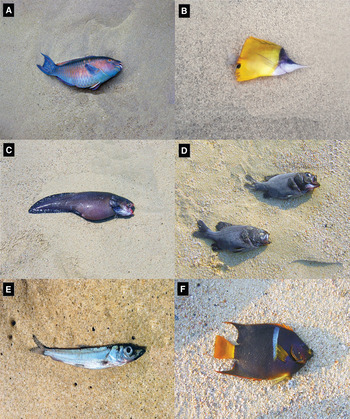
The dead fish include reef-associated, demersal, benthopelagic and bathypelagic species that inhabit depths ranging from 1 m to 650 m (Froese & Pauly, Reference Froese and Pauly2012). Here we note rare sightings of trans-Pacific species: the blue-barred parrotfish Scarus ghobban Forsskal, 1775 (Figure 3A) and the long-nose butterfly fish Forcipiger flavissimus Jordan & McGregor, 1898 (Figure 3B). Deep-water species include Pacific bearded brotula Brotula clarkae Hubbs, 1944 (Figure 3C), California smooth-tongue Leuroglossus stilbius Gilbert, 1890 (Figure 3E), and the Baja California endemic, the flashlight fish Phthanophaneron harveyi (Rosenblatt & Montgomery, 1976) (Figure 3D). The latter is known only from the holotype and two specimens captured along the east-central Gulf of California and one off the outer coast of the Baja California Peninsula.
Selected fish species stranded on the south-eastern beaches of Cabo San Lucas, Baja California Sur, between 16 and 21 June 2011. (A) Scarus ghobban; (B) Forcipiger flavissimus; (C) Brotula clarkae; (D) Phthanophaneron harveyi; (E) Leuroglossus stilbius; (F) Holacanthus passer.

The local health authority (Comisión Estatal para la Protección contra Riesgos Sanitarios, COEPRIS-B.C.S.) gathered information from fish necropsies. They concluded that the massive die-off was caused by a bloom of the photosynthetic ciliate Myrionecta rubra (Lohmann, 1908) Jankowski, 1976. Blooms of this species are common along the coast of the Gulf of California (Gárate-Lizárraga et al., Reference Gárate-Lizárraga, Hernández-Orozco, Band-Schmidt and Serrano-Casillas2001, Reference Gárate-Lizárraga, Band-Schmidt, Cervantes-Duarte and Escobedo-Urías2002). However the information derived from necropsies was not available to the authors; therefore we cannot exclude other causes.
Although there is a vast literature on stranding of marine mammals, there are few published accounts of mass strandings of marine fish. Some of these studies suggest that beach strandings are caused by: large coral spawning event resulting in the asphyxia of organisms (Simpson et al., Reference Simpson, Cary and Masini1993); sudden changes in water temperature that reduce metabolic rate (Bohnsack, Reference Bohnsack1983); direct effects on fish assemblages through intense storms (Lassig, Reference Lassig1983); a combination of heavy wave action and a steeply sloping continental shelf that push organisms ashore; and fish are caught in surface eddies formed by opposing tidal currents and pushed ashore by onshore winds (e.g. Scotto di Carlo et al., Reference Scotto di Carlo, Costanzo, Fresil, Guglielmo and Ianoral1982; Beckley et al., Reference Beckley, Cliff, Smale and Compagno1997). During this massive die-off, persistent cold winds from the south generated cooler currents, dropping water temperatures from 24.5 to 22°C through much of the southern Baja coast. On the other hand, algal blooms are common on the southern coast of the Gulf of California (Gárate-Lizárraga et al., Reference Gárate-Lizárraga, Hernández-Orozco, Band-Schmidt and Serrano-Casillas2001, Reference Gárate-Lizárraga, Band-Schmidt, Cervantes-Duarte and Escobedo-Urías2002, Reference Gárate-Lizárraga, Band-Schmidt, Bustillos-Guzmán and López-Cortés2007b; López-Cortés et al., Reference López-Cortés, Gárate-Lizárraga, Bustillos-Guzmán and Hernández-Sandoval2008). Nevertheless, to our knowledge, there is only one report of a fish and jellyfish die-off due to M. rubra at red tide in the southern part of the gulf (Gárate-Lizárraga et al., Reference Gárate-Lizárraga, Band-Schmidt, Cervantes-Duarte and Escobedo-Urías2002).
Harmful algae blooms have affected wild and cultured fauna in the Gulf of California (Gárate-Lizárraga et al., Reference Gárate-Lizárraga, López-Cortés, Bustillos-Guzmán and Hernández-Sandoval2004; Nuñez-Vázquez et al., Reference Nuñez-Vázquez, Gárate-Lizárraga, Band Schmidt, Cordero Tapia, López-Cortés, Hernández-Sandoval, Heredia-Tapia and Bustillos-Guzmán2011) and fish dies-off have been reported in Bahía de La Paz, Baja California Sur due to the proliferation of the diatoms Pseudo-nitzschia fraudulenta (Cleve) Hasle, 1993 and Thalassiosira sp., and could result from depletion of dissolved oxygen. Depletion of oxygen was also suspected to have resulted due to the coral spawning in the study by Halford & Perret (Reference Halford and Perret2009), which caused a mass coral reef fish stranding in north-western Australia. With the information we gathered (no necropsy information was available), we conclude as did Scotto di Carlo et al. (Reference Scotto di Carlo, Costanzo, Fresil, Guglielmo and Ianoral1982), that there is no unequivocal explanation to account for this event, since each species reacts differently to an environmental stress.
ACKNOWLEDGEMENTS
We thank Gary Graham, Eric Brictson, Phil Sanders, Jose Luis Escalante, Ernesto Acevedo, Pedro Márquez, Carlos Torres, and Paolo Ibaa for providing images and Ira Fogel, English editor at CIBNOR, for improving the English. The organization ‘Red para la Protección de la Tortuga Marina' (http://www.cabotortugas.org/) and Mario García Isais (COEPRIS) provided important data collection. Thanks to Dr A.R. Halford for the information provided. Special thanks to Hotel Hilton Los Cabos Hilton Beach & Golf Resort and Villas Del Mar-Palmilla for their courtesies. Funding for this report was provided by Instituto Politécnico Nacional (SIP-IPN). I.G.L. and J.D.A. are COFAA and EDI fellows. J.D.A. appreciates the support of the Sistema Nacionalde Investigadores (SNI-CONACyT).