Significant outcomes
-
1. No statistically significant difference was found in the genotype or allele frequencies of the NOTCH4 gene variant rs3131296 between schizophrenia (SZ) patients and healthy controls in the Chinese Zhuang population.
-
2. No statistically significant difference was found in the genotype or allele frequencies of the NOTCH4 gene variant rs3131296 between SZ patients and healthy controls in the Chinese Han population.
-
3. The results of the meta-analysis also demonstrated that no statistically significant difference was found in the genotype or allele frequencies of the NOTCH4 gene variant rs3131296 in combined samples including Zhuang and Han individuals.
Limitations
-
1. The sample sizes were relatively small; therefore, in subsequent research, larger sample sizes are required.
-
2. Control subjects were not screened by the psychiatrists according to the standard psychiatric assessment, and patients with a history of suicide attempts were excluded; therefore, potential selection bias was inevitable.
-
3. Our study only explored one GWAS-supported single nucleotide polymorphism; in subsequent studies, the effects of potential gene–gene interactions should be taken into consideration when evaluating the schizophrenia (SZ) predisposition.
Introduction
Schizophrenia (SZ) is a common severe psychiatric disorder and is considered to have a lifetime prevalence of 1%. Characterised by early onset, poor response to medication, frequent recurrence and chronic condition, SZ increases the burden of the patients, families and society. Studies on the field of epidemiology, pharmacology and neurobiology have made much progress in our understanding of SZ (Reference McGrath1). However, the aetiology and pathogenesis of SZ have not yet been fully interpreted. It has been demonstrated that both environmental and genetic factors contribute to the development of this complex disease. Heredity was also proven to play an important role in the development of SZ by evidence from family, twin and adoption studies (Reference Cardno and Gottesman2,Reference Sullivan, Kendler and Neale3). Genetic factors were found to confer the largest risk for SZ with a heritability approaching 80% of all of the already known risk factors of SZ. At present, it is generally recognised that SZ is not inherited in a classic Mendelian pattern. SZ is believed to be a complex polygenic inherited disease; however, the accurate mode of inheritance remains unknown. Therefore, the challenge of clarifying the aetiology and mechanism of SZ remains.
The NOTCH4 gene, which is not only a positional but also a functional candidate gene for SZ, has attracted extensive attention. The cloning of NOTCH4 cDNA was conducted by Uyttendaele et al. (Reference Uyttendaele, Marazzi, Wu, Yan, Sassoon and Kitajewski4) in 1996, and NOTCH4 was reported to be located in the class II–class III fringe region of the major histocompatibility complex on chromosome 6p21.3. A meta-analysis by Lewis et al. (Reference Lewis, Levinson and Wise5) revealed that regions on chromosome 6pter-6p21.1 possibly contain loci that could increase the susceptibility of SZ. It was reported that the Notch signalling pathway plays an important role in regulating the decisions of one cell to those of its neighbours and influences the development of the nervous system in many different aspects (Reference Louvi and Artavanis-Tsakonas6). As a significant gene associated with the development of the nervous system, NOTCH4 was considered a candidate gene for SZ, the development of which is believed to be related to nervous system development (Reference Lewis and Levitt7). Many previous association studies have focused on the SNP1 (rs387071), SNP2 (rs367398), (TAA)n, (CTG)n and (TTAT)n polymorphisms of the NOTCH4 gene (Reference Allen, Bagade and McQueen8,Reference Glatt, Wang, Yeh, Tsuang and Faraone9). However, the results were inconsistent. A significant association with SZ has also been found in some other loci in the NOTCH4 gene, such as rs520692 (Reference Wang, Wei and Zhang10), rs2071282 (Reference Shibata, Ohnuma and Higashi11) and rs204993 (Reference Liu, Liu and Fann12). However, other independent research has failed to reproduce these results (Reference Betcheva, Mushiroda and Takahashi13–Reference Tochigi, Zhang and Ohashi15).
Inspiringly, it was reported by Stefansson et al. (Reference Stefansson, Ophoff and Steinberg16) that the association of the rs3131296 polymorphism in an intron of the NOTCH4 gene with the susceptibility of SZ had achieved the level of genome-wide significance [G vs. A: OR = 1.19 (1.13−1.25), p = 2.3 × 10⁻¹⁰]. Moreover, a significant association between the rs3131296 polymorphism and SZ in Chinese Han population was replicated in a study by Li et al. in Shanghai [A vs. G: OR = 0.68 (0.58, 0.79), p = 1.29 × 10⁻⁶] (Reference Li, Li and Chen17). China is a multinational country with a large population of 56 ethnic groups. People of different ethnicities are likely to have different genetic backgrounds (Reference Lou, Li and Yang18). The Zhuang nationality has the second largest population in China, ranking second only to the Han nationality. In China, over 90% of the Zhuang populations live in the Guangxi Zhuang Autonomous Region, which is located in the south of China bordering on Vietnam. The Zhuang nationality accounts for 30% of the population in Guangxi. Most of the association studies concerning a predisposition gene of SZ in China were conducted in the Han population. Few studies on other Chinese nationalities and rare research on the Zhuang nationality have been reported. Because of the different genetic backgrounds, environments and cultures of these ethnicities, the pathology of SZ might be influenced by different cultures and ethnicities (Reference Peng, Lu, Luo, Xiang-Yu and Zhang19). This study was conducted on the Chinese Zhuang population and Han population to evaluate the association of the NOTCH4 gene rs3131296 polymorphism with the risk of SZ and to explore whether a significant association could be replicated in the two different ethnic populations in China.
Methods
Subjects
SZ patients comprised Zhuang samples and Han samples. All of the patients were confirmatively diagnosed with SZ based on the International Classification of Disease tenth revision. Clinical descriptions and diagnostic guidelines were performed by at least two experienced psychiatrists. Kappa statistic was used to assess the concordance of the included subjects. Both Zhuang and Han cases reported themselves (or were reported by their linear family members) to be of Zhuang or Han descent within three generations in Guangxi. Patients with the following diseases were excluded: (1) mental disorders because of various causes, such as cerebral disease, physical diseases, medication or other treatments; (2) nervous system diseases or other severe physical diseases; (3) severe head trauma; (4) mental retardation; (5) alcohol or drug abuse; and (6) uncontrollable excitement, severe suicide or autolesion attempts. We recruited all cases (94 Zhuang and 188 Han) from the inpatients of SZ in Guangxi Brain Hospital from April to June in 2010.
The control group also consisted of two populations of Zhuang samples and Han samples. They were healthy normal subjects and also reported themselves to be of the same descent within three generations in Guangxi (or reported by their linear family members). Subjects with personal or family histories of mental disorder and nervous system diseases, inherited diseases, severe physical illness, head trauma or birth injuries were excluded from our study. A total of 188 Han and 30 Zhuang healthy controls undergoing health checkup in the first affiliated hospital of Guangxi University of Chinese Medicine were recruited; another 64 Zhuang voluntary healthy subjects from Liujiang County in Guangxi were also included in the control group. Liujiang is inhabited by the Zhuang population, accounting for more than 70% of the population in this county of Guangxi. All subjects were interviewed by the investigators who had been simultaneously trained using the self-designed questionnaire and were included as healthy controls on the basis of their self-report, inclusion and exclusion criteria.
The 564 subjects studied, including 282 cases and 282 controls, were all unrelated. The objective and process of our study had been made clear, and we obtained written informed consent from all participants.
Genotyping
Peripheral venous blood samples of 5 ml were collected from all patients and healthy controls. Each sample was stored in a vacuum tube with EDTA anticoagulant in a −4°C freezer and genomic DNA was extracted within 3 days. The TIANamp Blood DNA Kit (Catalog Number: DP318DNA) was used for DNA extraction. After extraction from blood plasma, the genomic DNA was equally divided into three tubes and stored at −80°C. Genotyping of rs3131296 within the NOTCH4 gene was conducted using the quantitative real-time PCR TaqMan MGB experimental method and TaqMan SNP genotyping assay (Applied Biosystems Inc., CA, USA). The amplification was carried out using 10 μl reaction mixtures of 2 × TaqMan Universal PCR Mix (5.00 μl), Assay-on-Demand SNP Genotyping Assay Mix 40 × (0.25 μl), Nuclease-free H2O (3.75 μl) and genomic DNA (1.00 μl). The conditions for PCR consisted of an initial denaturation at 95°C for 10 min, then a 15 s denaturation at 92°C of 43 cycles and a final 1 min of annealing at 60°C. The experimental operators were blinded to the condition of DNA samples of the cases and controls. A positive control of two blank controls and three random replicate samples were used for the PCR reaction plate with a 96-well format used each time. Five per cent of the samples were randomly selected for a replicate blinded trial and the concordance rate was 100%.
Statistical analysis
The STATA software version 11.1 and SPSS version 16.0 for Windows were used for statistical analysis. Enumeration data were compared between different groups using χ 2-test. With regard to the measurement data, comparison was made by t-test or variance analysis. Hardy–Weinberg equilibrium (HWE) for the distribution of genomic frequency was assessed by the goodness-of-fit χ 2-test. Furthermore, we performed a meta-analysis to combine the data of the two ethnic samples (Zhuang and Han). The genotype frequency of A/A was equal to zero in both control groups of Zhuang and Han; therefore, the allelic model (A vs. G), dominant model (AA + AG vs. GG) and codominant 2 model (AG vs. GG) were adopted to evaluate the association of the NOTCH4 gene rs3131296 polymorphism with SZ risk. The Q-statistic test was used for heterogeneity assessment, and a random effects model or fixed effects model was selected for the meta-analysis according to the significance of heterogeneity. All the statistical analyses were two-sided. Conclusions of statistical significance could be made if the p-value was <0.05.
Results
Demographic characteristics
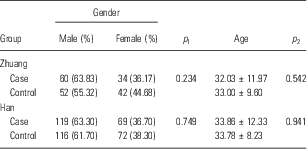
It is shown in Table 1 that no statistically significant difference was observed in the distribution of gender and age between SZ patients and healthy controls in the Zhuang samples and Han samples, respectively (p > 0.05; Table 1).
Comparison of gender and age distribution between the cases and controls

HWE tests
The genotype frequencies of the NOTCH4 gene variant rs3131296 were in HWE in both the Zhuang healthy controls (χ 2 = 0.044, p = 0.833) and Han healthy controls (χ 2 = 0.068, p = 0.795).
Association analysis
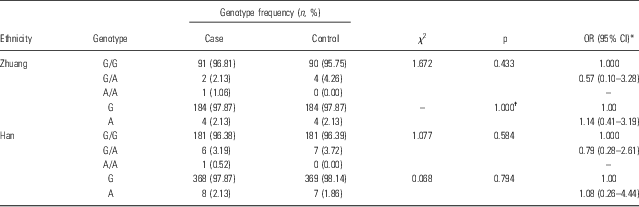
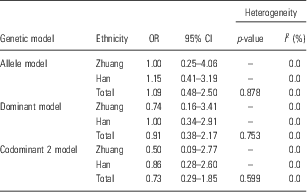
The results of the χ 2-test showed that no statistically significant difference was found in the genotype or allele frequencies of the NOTCH4 gene variant rs3131296 between SZ patients and healthy controls, neither in the Zhuang nor Han samples (p > 0.05; Table 2). The results of the meta-analysis showed that there was no significant difference in the allelic model, dominant model or co-dominant 2 model in the combined samples including Zhuang samples and Han samples (Table 3).
The genotype and allele frequency of NOTCH4 gene variant rs3131296 between schizophrenia patients and healthy controls

*Multivariable non-conditional logistic regression model: odds ratio (OR) adjusted for age and sex.
†Fisher's exact test.
Odd ratios (ORs) and confidence intervals (CI) of the three genetic models tested in the meta-analysis of rs3131296 and the risk for schizophrenia

Discussion
This study failed to replicate the association identified by the genome-wide association study (GWAS) among Europeans. The results of our study showed that there was also no significant association of the NOTCH4 gene polymorphism rs3131296 with risk of SZ in Chinese Zhuang or Han populations. Results of the meta-analysis showed that no statistically significant difference was found in the combined samples including Chinese Zhuang and Chinese Han samples in the allelic model, dominant model or co-dominant 2 model. To the best of our knowledge, this is only the second association study on the NOTCH4 gene rs3131296 polymorphism with risk for SZ in the Chinese Han population, and the first association study of this polymorphism with SZ in the Chinese Zhuang population.
The GWAS of Stefansson et al. (Reference Stefansson, Ophoff and Steinberg16) reported that the association of the variant rs3131296 in the intron of the NOTCH4 gene with susceptibility to SZ in Caucasians had achieved the level of genome-wide significance. A subsequent replication study by Halley et al. (Reference Halley, Doherty, Megson, McNamara, Gadja and Wei20) also indicated that rs3131296 was significantly associated with SZ among the British population. However, our study failed to replicate this significant association of the rs3131296 polymorphism with SZ risk both in the Chinese Zhuang and Chinese Han populations. A possible explanation is that different continental populations might have genetic heterogeneity. Data from the International HapMap project showed that the MAF of the NOTCH4 gene rs3131296 polymorphism in residents of northern and western European ancestry (CEU), Han Chinese in Beijing (CHB) and Japanese from Tokyo (JPT) were 0.100, 0.056 and 0.012, respectively. The rs1344706 polymorphism in ZNF804A has been proven to be an SZ risk variation in Europeans (Reference Li, Luo and Xiao21); however, it was not associated with Chinese populations, as demonstrated by the recent meta-analysis (Reference Li, Zhang and Luo22).
In 2010, the significant association of rs3131296 with SZ was reproduced by the study of Li et al. (Reference Li, Li and Chen17) among the Han population in Shanghai. However, our study did not show any association in the Chinese Han samples in Guangxi. There were two main reasons accounting for these controversial results. On the one hand, the sample size in our study was smaller than that of the study by Li et al., meaning that the power for detecting a significant association was not sufficient. Therefore, we could not easily eliminate the potentially significant association between the NOTCH4 gene rs3131296 polymorphism and the risk of SZ. On the other hand, although both studies were conducted on the Chinese Han population, there might also be different genetic heterogeneities for SZ risk variants among different regional Han Chinese populations. The MAF in our Guangxi Han control group was 0.019, whereas the MAF in the Shanghai Han control group reported by Li et al. (Reference Li, Li and Chen17) was 0.047. It was reported that genetic substructure differences were observed among different regional Han Chinese populations (Reference Tian, Kosoy and Lee23). Besides, subjects in the study of Li et al. (Reference Li, Li and Chen17) were recruited from the inhabitants in Shanghai, whereas subjects in our study were from the Zhuang and Han populations in Guangxi, which is located in the south of China, bordering Vietnam. There is approximately a distance of 2000 km between Shanghai and Guangxi, indicating that they are quite different from each other in their geographic environment, economic level and cultural background. Therefore, the inconsistency of our study with the significant association reported by Li et al. (Reference Li, Li and Chen17) could possibly be explained by the different genetic background of the populations in Guangxi and Shanghai. Similarly, inconsistent results of the GWAS-supported SNP rs1344706 in ZNF804A with the risk of SZ were reported in different regional Han Chinese populations (Reference Li, Zhang and Luo22), which were also possibly considered to be related to the genetic heterogeneity in different regional Han Chinese populations.
There are several limitations to interpreting the results of our study. First, we calculated the post-hoc power using the Quanto software (http://hydra.usc.edu/gxe). The following parameters were included in the power calculation for the NOTCH4 gene rs3131296 polymorphism: minor-allele frequency was 0.02, sample size was 94 for Zhang, 188 for Han and 282 for total, the odds ratio was 1.5, dominant model and the disease prevalence of SZ was 0.01. Assuming these parameters, we have 9.1%, 13.4% and 17.7% power to detect an association in Zhang, Han and the total population, respectively. Therefore, the possibility of results being false negative was more than 82%. Second, the sample sizes were relatively small because the sample collection of SZ patients was difficult, especially for the pure Zhuang population. In addition, the lower prevalence of SZ (1.00%) compared with other complex diseases, such as hypertension, also contributed to the difficulty of sample collection. In any of the following research, larger sample sizes will be required to explore this polymorphism with SZ. Third, control subjects were not screened by psychiatrists according to the standard psychiatric assessment, and we excluded patients with suicidal attempts; therefore, potential selection bias was also inevitable. In future studies, standard psychiatric screening for healthy control subjects should be taken into consideration, to avoid the inclusion of subjects that could interfere with results. Finally, our study only explored one GWAS-supported SNP. It is widely acknowledged that SZ is a polygenetic disease, which includes both common and rare variants (Reference Owen, Craddock and O'Donovan24); thus, the effects of potential gene–gene interactions should be taken into consideration when evaluating SZ predisposition.
Inconsistent results of other GWAS-supported SZ risk genes between Europeans and Asians have been reported previously, such as rs1344706 in ZNF804A, rs7341475 in RELN and rs12807809 in NRGN, all of which were identified to be associated with SZ risk, and failed to be replicated in the Chinese population. Therefore, more independent replication studies of the NOTCH4 gene rs3131296 polymorphism with SZ in Asians are necessary. Although our study failed to replicate the association, it could provide fundamental data for future meta-analyses and lay a foundation for further identifying the essential association of the rs3131296 polymorphism with the risk of SZ in Chinese populations.
Acknowledgement
This study was supported by grants from the Guangxi Medical University Science Foundation for Youths (Grant No. GXMUYSF15), Guangxi National Natural Science Foundation (Grant No.2012GXNSFAA053089), National Natural Science Foundation of China (Grant No. 81060244) and Guangxi Natural Science Foundation (Guikezi 0991110).