I. INTRODUCTION
Direct formic acid fuel cell (DFAFC) is considered to be a promising candidate for portable power sourceReference Rees and Compton1,Reference Yu and Pickup2 because of its high theoretical open circuit voltage, superior performance and small fuel crossover relative to direct methanol fuel cells.Reference Rice, Ha, Masel, Waszczuk, Wieckowski and Barnard3,Reference Li, Shen, Yang, Tang and Lu4 However, the commercial application of DFAFC is still hindered by several issues including its insufficient activity and high cost of anode catalysts. To solve these problems, tremendous efforts have been made to find catalysts with high activity, stability and low cost. Recently, palladium (Pd) is the most active catalyst for the formic acid electro-oxidation (FAEO).Reference Ha, Larssen, Zhu and Masel5–Reference Ha, Larsen and Masel7 It is well known that the catalytic efficiency of Pd highly depends on both the sizeReference Zhang, Arikawa, Murakami, Yahikozawa and Takasu8,Reference Zhou, Lewera, Larsen, Masel, Bagus and Wieckowski9 and the dispersion of Pd nanoparticles (NPs). However, the Pd-NPs are difficult to be synthesized.Reference Zhang, Lu, Bao, Tang and Li10,Reference Zhu, Kang, Zou, Zhou, Zheng, Xia and Yang11 Because the Pd2+ ion is readily reduced to metallic Pd, which would result in the formation of Pd-NPs with a larger particle size. To the best of our knowledge, the average sizes of Pd-NPs from the reported literature almost are larger than 3.0 nm, while that of Pt-NPs could be about 1.0 nm. A great deal of effort has been made to the synthesis of Pd-NPs with small size and uniform dispersion.Reference Daoush and Imae12 Pd-NPs supported on carbon materials have been synthesized mainly by the polyol reduction method and by the sodium borohydride (NaBH4) reduction method. In the case of the polyol [most commonly ethylene glycol (EG)] reduction method, EG is usually used as reducing and stabilizing agent. Wang et al.Reference Chen, Wang, Zhou and Chu13 synthesized Pd/C catalyst by modified polyol process using a mixture of isopropanol and EG as solvent and reducing agent, respectively. Then, theyReference Wang, Yuan, Zhou, Chu and Chen14 optimized the technical parameters and obtained Pd/C catalyst with the high catalytic activity for FAEO. In the case of NaBH4 reduction method, the particle size of Pd-NPs synthesized by the general NaBH4 reduction method is difficult to be controlled. Therefore, Pd-NPs are generally prepared by improved NaBH4 reduction method. Chen et al.Reference Chen, Tang, Gao and Lu15 prepared the Pd/C catalyst with the improved liquid phase reduction method using Na2CO3 to adjust the value of the solution to 8–9 before adding the reducing agent. It was found that the PdCl2 and Na2CO3 could form a complex, leading to a decrease in the aggregation trend of the Pd particles. Thus, the electrocatalytic activity of the Pd/C catalyst for formic acid oxidation was improved. It was also observed that the highly dispersed Pd-NPs with small size could be synthesized in the presence of some ligand molecules, such as NH3,Reference Tang, Zhang, Zhong and Ma16–Reference Li, Sun, Jiang, Zhu, Sun and Xin18 EDTA,Reference Zhu, Kang, Zou, Zhou, Zheng, Xia and Yang11 NaH2PO2,Reference Zhang, Tang, Bao, Lu and Li19 NH4F + H3BO3,Reference Zhang, Lu, Bao, Tang and Li10 EDTMP,Reference Liang, Zhou, Ma, Zhao, Chen, Tang and Lu20 and BDPA,Reference Liang, Zhu, Ma, Tang, Chen and Lu21 followed by NaBH4 reduction. However, these synthesis processes are complicated and are greatly affected by the pH value.
We have synthesized the Pt/C catalyst with small particle size and good dispersion using an EG-assisted NaBH4 reduction method and demonstrated that it has high catalytic activity for methanol oxidation.Reference Chen, Jiang, Yang, Feng, Gallogly and Wang22 In this synthesis process, EG firstly reacts with NaBH4 to form a complex, and then the complex serves as a moderate reductant for the metal precursor which can balance the rate of nucleation and growth. Moreover, EG can serve as a stabilizer for the dispersion of metal NPs. So, we first proposed to use this method for preparing highly dispersed and active Pd/C catalyst for FAEO. And the above-mentioned modified polyol reduction methodReference Chen, Wang, Zhou and Chu13 and improved liquid phase reduction methodReference Chen, Tang, Gao and Lu15 were used as a comparison. The performance of the obtained Pd/C catalysts for FAEO was evaluated.
II. EXPERIMENTAL
A. Synthesis of Pd/C catalysts
Certain amount of Vulcan XC-72R carbon black from Cabot Company (Boston, MA) was pretreated with 8 mol/L H2SO4 and 8 mol/L HNO3 mixture under refluxing conditions at 90 °C for 4 h to import oxygen-containing functional groups onto carbon black. Palladium chloride (PdCl2) was purchased from Shenyang Research Institute of Nonferrous Metals (Shenyang, China). All other reagents were of analytical grade and used as received without further treatment. The Pd/C (20 wt% Pd on carbon black) catalysts were synthesized by the following three procedures.
In the EG-assisted NaBH4 reduction method, the 40 mg of acid-treated carbon black and 1.66 mL of 0.034 mol/L PdCl2 aqueous solution were dispersed in 20 mL EG with sonication for 30 min, and then stirred for 2 h. A freshly prepared NaBH4 solution (360 mg in 15 mL EG) was added dropwise into the above solution at 35 °C, and the resulting suspension was stirred for 3 h. The mixture was filtered, washed, and dried in a vacuum oven at 75 °C for 10 h. The obtained catalyst was denoted as a Pd/C-EG-NaBH4 catalyst. In the modified polyol reduction method,Reference Chen, Wang, Zhou and Chu13,Reference Wang, Yuan, Zhou, Chu and Chen14 the 40 mg acid-treated carbon black and an appropriate amount of PdCl2 were dispersed in the mixture of 25 mL EG and 5 mL isopropanol with sonication for 30 min, and then stirred for 2 h. Its pH value was adjusted to 12 by 2.5 mol/L NaOH solution of EG and then raised its temperature to 120 °C along with refluxing and stirring for 3 h. Final treatment of the product was the same as described in the EG-assisted NaBH4 reduction method. The obtained catalyst was denoted as Pd/C-EG catalyst. In the improved liquid phase reduction method,Reference Chen, Tang, Gao and Lu15 appropriate amounts of acid-treated carbon black and PdCl2 were dispersed in 20 mL DI water with sonication for 30 min, then the pH was adjusted to 9.0 using 0.2 mol/L Na2CO3 solution. After that, a freshly prepared NaBH4 solution (160 mg in 20 mL DI water) was added to the above solution at 35 °C, and the resulting suspension was stirred for 3 h. Final treatment of the product and drying process were the same as other methods. The obtained catalyst was denoted as Pd/C-NaBH4 catalyst.
B. Characterization of the catalysts
The x-ray diffraction (XRD) analyses were carried out on a DX-2000 x-ray diffractometer (DX-2000, Dandong Fangyuan Ltd., Dandong, Liaoning, China). Transmission electron microscopy (TEM) images were obtained using a FEI, TECNAI G2 microscope (Hillsboro, OR).
All electrochemical measurements were carried out in a conventional three-electrode electrochemical cell at 25 °C using cyclic voltammetry (CV) on a CHI 760B. A glassy-carbon working electrode (φ3, surface area 7.0 mm2) was used as the substrate. A 5.0 mg sample of the Pd/C catalyst was dispersed in a solution containing 1.0 mL of deionized water, 1.0 mL of isopropanol, and 50 μL of a 5 wt% Nafion solution using 30 min of ultrasonification to form a uniform suspension. A 5 μL sample of the dispersed catalyst suspension was pipetted onto the glassy-carbon substrate. The calculated loading of Pd was 35 μg/cm. The counter electrode was a graphite electrode and the reference electrode was a saturated calomel electrode (SCE). All potentials reported in this paper were referenced to the SCE. The CV was carried out in 0.5 mol/L HCOOH + 0.5 mol/L H2SO4 solution deaerated by ultra-pure argon for 20 min before measurements.
III. RESULTS AND DISCUSSION
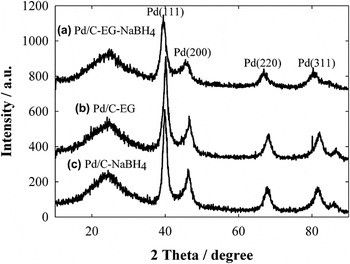
The crystalline structure of the Pd/C catalysts are confirmed by the XRD technique, and the results are shown in Fig. 1. In each XRD pattern, the diffraction peaks at approximately 40, 46, 68, and 82° are corresponding to the 2θ values of Pd (111), (200), (220), and (311) planes,Reference Cheng, Lv, Wang, Mu, Pan and Marken17 respectively, illustrating that the Pd particles possess the face-centered cubic (fcc) crystal structure. The crystallite size of the Pd NPs can be calculated from the half peak widths of the Pd (220) peak according to Scherrer equation.Reference Radmilovic, Gasteiger and Ross23,Reference Antolini and Cardellini24 The sizes of the Pd NPs in the Pd/C-EG-NaBH4, Pd/C-EG, and Pd/C-NaBH4 catalysts are calculated to be 3.5, 4.8, and 5.0 nm, respectively.
XRD patterns of the synthesized Pd/C catalysts.

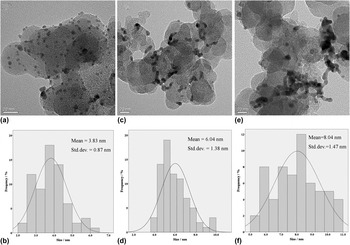
Although the mean size of Pd NPs can be estimated according to XRD data, TEM characterization is more intuitive and reliable for this parameter. And the dispersion of Pd NPs can also be observed directly from TEM images. Figure 2 shows TEM images of the Pd/C catalysts and their corresponding particle size distribution histograms. It is observed that the spherical Pd NPs of the Pd/C-EG-NaBH4 catalyst [Fig. 2(a)] are highly dispersed on the carbon support, while there are large-scale aggregations in the Pd/C-EG and Pd/C-NaBH4 catalysts [Figs. 2(c) and 2(e)]. As to distribution histogram of catalysts, the analysis using “Statistical Product and Service Solution (SPSS)” proved that the particle size distribution is a Gaussian distribution. The average size and the standard deviation of the Pd/C-EG-NaBH4 catalyst [Fig. 2(b)] are 3.83 and 0.87 nm, respectively. More than 70% of the Pd particles have a particle size between 2.5 and 4.5 nm, indicating that the obtained Pd particles have a relatively narrow size distribution. However, Pd/C-EG and Pd/C-NaBH4 [Figs. 2(d) and 2(f)] NPs exhibit a large mean size of 6.0 and 8.0 nm, respectively, with broad size distribution. Obviously, the Pd/C catalyst with high quality can be synthesized by using the EG-assisted NaBH4 reduction method. This is due to the fact that EG first reacts with NaBH4 to form a complex of Na+B−(OCH2CH2OH)4,Reference Chen, Jiang, Yang, Feng, Gallogly and Wang22 and then the complex serves as a moderate reductant for the metal precursor and as a stabilizer for the dispersion of metal NPs, so PdCl2 could be completely reduced at lower temperature with stabilization to generate uniform and small size Pd NPs.
TEM images and the corresponding histogram of size distribution of the Pd nanoparticles of Pd/C-EG-NaBH4 (a)-(b), Pd/C-EG (c)-(d) and Pd/C-NaBH4 (e)-(f) catalysts.

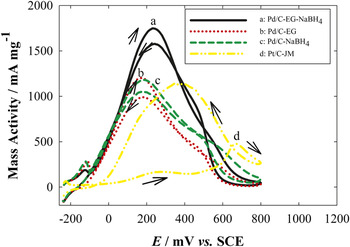
The catalytic activities of the prepared Pd/C catalysts and the Johnson Matthey Pt/C catalyst toward FAEO were evaluated in deaerated 0.5 mol/L HCOOH + 0.5 mol/L H2SO4 by CV with a scan rate of 50 mV/s at 25 °C, as shown in Fig. 3. It can be seen that both Pd/C samples represent much lower initial anodic oxidation potential for formic acid than the commercial Pt/C catalyst. This may indicate different reaction pathways of FAEO on Pd and Pt catalysts. On a Pt/C catalyst, formic acid is likely to be oxidized to CO2 with the poisoned CO as the reactive intermediate.
Cyclic votammograms of (a) Pd/C-EG-NaBH4, (b) Pd/C-EG, (c) Pd/C-NaBH4 and (d) Pt/C-Johonson Matthey catalysts in 0.5 mol/L HCOOH + 0.5 mol/L H2SO4 solution at the scan rate of 50 mV/s.

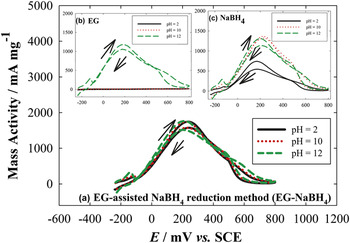
The electrocatalytic activities of the Pd/C catalysts prepared by different methods at different pH values for formic acid electro-oxidation. Test condition: 0.5 mol/L HCOOH + 0.5 mol/L H2SO4 solution, scan rate: 50 mV/s.

Figure 3(d) curve shows the typical CV curve of FAEO on Pt/C catalyst in which the reaction commences in the hydrogen region and proceeds slowly during the positive scan direction to reach a plateau at 0.3 V. This corresponds to formic acid oxidation through the dehydrogenation path, but the coverage by COads simultaneously continues to grow and then causes only relatively small currents. At potentials more positive than 0.55 V, the reaction is significantly accelerated and an anodic peak emerges at 0.67 V with a current density of 476 mA/mgPt. This anodic peak can be attributed to the oxidative removal of COads.
It can be observed from Figs. 3(a)–3(c) that in the positive scan direction, the onset potential of FAEO on Pd/C catalysts is the same (−0.1 V), and the two oxidation peaks are similar, around 0.2 and 0.53 V. It is generally recognized that the electro-oxidation of formic acid on Pd/C catalyst can proceed through two parallel pathways, direct pathway and CO pathway. In the direct pathway, formic acid is directly oxidized to CO2 and no COads formed [Eq. (1)].
 $${\rm{HCOOH}}_{{\rm{ads(Pd)}}} \to \,\,{\rm{Pd - COOH}}^ - + {\rm{H}}^{\rm{ + }} \to \,\,{\rm{Pd}} + {\rm{CO}}_{\rm{2}} + {\rm{2H}}^{\rm{ + }} + {\rm{2e}}^ - \quad.$$
In the CO pathway, formic acid is first oxidized to intermediate CO [Eq. (2)], and then COads is oxidized to CO2 [Eq. (4)].
 $${\rm{HCOOH }}_{{\rm{ads(Pd)}}} \to {\rm{CO}}_{{\rm{ads(Pd)}}} + {\rm{H}}_{\rm{2}} {\rm{O\quad,}}$$
 $${\rm{H}}_{\rm{2}} {\rm{O}}_{{\rm{ads(Pd)}}} \to {\rm{OH}}_{{\rm{ads(Pd)}}} + {\rm{H}}^{\rm{ + }} + {\rm{e}}^ - \quad,$$
 $${\rm{CO}}_{{\rm{ads(Pd)}}} + {\rm{OH}}_{{\rm{ads(Pd)}}} \to {\rm{CO}}_{\rm{2}} + {\rm{2H}}^{\rm{ + }} + {\rm{2e}}^ - \quad.$$
The oxidation of COads needs the oxygen-containing species like OHads, which can be generated by the activation of H2O [Eq. (3)]. However, the activation of H2O on the Pd surface is difficult, and relatively high positive potentials are needed. So, the two oxidation peaks at around 0.2 and 0.53 V are corresponding to the direct pathway and the CO pathway of FAEO, respectively. The current of the first anodic peak is much larger than the second one, which indicates that most of formic acid is directly oxidized to CO2 on a Pd/C catalyst. As to the catalytic activity, it can be observed from Fig. 3(b) curve that the peak current density of the Pd/C-EG catalyst is 84.07 mA/cm2, and the corresponding mass activity is 1201 mA/mgPd, which is slightly higher than that of the one described in the literatureReference Wang, Yuan, Zhou, Chu and Chen14 (1172 mA/mgPd) using the same method. And the Fig. 3(c) curve shows that the mass activity of the Pd/C-NaBH4 catalyst is 1180 mA/mgPd, which is higher than that of the one described in the literatureReference Chen, Tang, Gao and Lu15 (671 mA/mgPd) using the same method. We refer to the Pd/C catalysts performance in the literature to prove that our repetition is credible, including preparation and electrochemical measurement process. However, the Pd/C-EG-NaBH4 catalyst prepared using our proposed method exhibits the highest mass activity. The peak current density is 1742 mA/mgPd. The higher electrocatalytic performance of Pd/C-EG-NaBH4 catalyst is mainly due to its smaller NP size and better dispersion.
It is well known that some technical parameters in the synthesis process, especially the pH value, can affect the performance of the Pd/C catalyst. In this work, the influences of the pH value of the reaction solution are studied. The Pd/C catalysts were prepared by three reduction methods at different pH values and their electrocatalytic activities for formic acid oxidation were shown in Fig. 4. It can be observed from Fig. 4(a) that in the EG-assisted NaBH4 reduction method, the peak potentials and peak current densities of FAEO on the two Pd/C catalysts prepared at different pH values (2, 10, and 12) are almost the same. This indicates that the EG-assisted NaBH4 reduction method is independent of the pH value for Pd/C synthesis. However, we can see from Figs. 4(b)–4(c) that the modified polyol reduction methodReference Chen, Wang, Zhou and Chu13,Reference Wang, Yuan, Zhou, Chu and Chen14 and the improved liquid phase reduction methodReference Chen, Tang, Gao and Lu15 are strongly affected by the pH value.
In the modified polyol reduction method, the Pd/C catalysts prepared at pH = 2, 10 have almost no activity for formic acid oxidation, then the Pd/C catalyst prepared at pH = 12 shows high activity. It can be explained that in this reaction pathway, the –OH groups of EG interact with metal ion sites, resulting in the oxidation of the alcohol groups to aldehydes. These aldehydes are not very stable and are easily oxidized to glycolic acid which is a poor stabilizer. However, glycolate is an excellent stabilizer. The oxidation product of EG mainly exists as glycolate, while the pH value of the reaction solution is raised. At pH values below 2, glycolate essentially does not exist.Reference Bock, Paquet, Couillard, Botton and MacDougall25 This may cause the decline of Pd utilization, which in turn decreases the catalytic activity of Pd/C catalyst for FAEO. In the improved liquid phase reduction method, the Pd/C catalyst prepared in alkaline reaction solution presents much better electrocatalytic performance than the one prepared in acidic reaction solution. This is very different from the EG-assisted NaBH4 reduction method. It is well known that only the NaBH4 solution in alkaline condition can act as a strong reducing agent. So, if the Pd/C catalysts are prepared in acidic solution, Pd could not be completely reduced, resulting in lower catalytic activity. While in the EG-assisted NaBH4 reduction method, EG first reacts with NaBH4 to form a complex, and then the complex serves as a moderate reductant for the metal precursor and as a stabilizer for the dispersion of metal NPs. So, it is independent of the pH value. In summary, the EG-assisted NaBH4 reduction method is a facile procedure for preparing highly dispersed and active Pd/C catalysts for FAEO.
IV. CONCLUSIONS
An EG-assisted NaBH4 reduction method was successfully carried out to prepare Pd/C catalysts for FAEO. By this method, the Pd/C catalyst with small crystallite size and narrow size distribution was obtained. From the CV curves, the anodic peak current densities of the Pd/C-EG-NaBH4, Pd/C-EG, and Pd/C-NaBH4 catalysts are 1742, 1201, and 1180 mA/mgPd, respectively. Moreover, compared with other two reduction methods, this facile method is independent of the pH value. The EG-assisted NaBH4 reduction method is simple and can be used in mass-production of highly active Pd/C catalysts for DFAFC.
ACKNOWLEDGMENTS
This work was supported by Specialized Research Fund for the Doctoral Program of Higher Education (Grant No. 20110181110003) and Chengdu Natural Science Foundation (Grant Nos. 10GGYB380GX-023 and 10GGYB828GX-023), Collaborative innovation fund by China Academy of Engineering Physics and Sichuan University (Grant No XTCX2011001).