1. Introduction
The Ireviken Event (IE) records a little-studied, but important, Silurian extinction at the Llandovery/Wenlock (L/W) Series boundary (Telychian/Sheinwoodian Stage boundary) (e.g. Calner, Reference Calner and Elewa2008). Extinction losses began at the base of the Lower Pseudooneotodus bicornis conodont Zone and culminated during the Lower Kockelella ranuliformis Zone (e.g. Lehnert et al. Reference Lehnert, Männik, Joachimski, Calner and Frýda2010). The observed carbon and oxygen isotopic excursions began considerably later, but might share their origins with extinctions, through feedbacks in the carbon and oxygen system. Munnecke, Samtleben & Bickert (Reference Munnecke, Samtleben and Bickert2003) suggested that the anoxia responsible for the extinction losses originated in the deep oceans, before invading the shallower shelf seas. The IE scarcely affected shallow-water reefs, while pelagic and hemipelagic organisms such as the graptolites, conodonts and trilobites suffered preferential losses (Calner, Reference Calner and Elewa2008).
Until now, the reconstruction of palaeoenvironments during the IE has been based on stable carbon and oxygen isotope studies (Munnecke, Samtleben & Bickert, Reference Munnecke, Samtleben and Bickert2003; Cramer & Saltzman, Reference Cramer and Saltzman2005, Reference Cramer and Saltzman2007; Noble et al. Reference Noble, Zimmerman, Holmden and Lenz2005; Loydell & Frýda, Reference Loydell and Frýda2007; Lehnert et al. Reference Lehnert, Männik, Joachimski, Calner and Frýda2010; Vandenbroucke et al. Reference Vandenbroucke, Munnecke, Leng, Bickert, Hints, Gelsthorpe, Maier and Servais2013), but interpretations have not always been consistent with other sedimentological and geochemical observations (e.g. Page et al. Reference Page, Zalasiewicz, Williams, Popov, Williams, Haywood, Gregory and Schmidt2007). Some palaeoceanographic models infer permanent anoxia in the pycnocline (Wilde, Barry & Quinby-Hunt, Reference Wilde, Barry and Quinby-Hunt1991; Bickert et al. Reference Bickert, Pätzold, Samtleben and Munnecke1997), while other authors propose cold, oxic bottom-water regimes during deposition of Silurian sediments (Jeppsson, Reference Jeppsson1990). Major discrepancies exist in proposed sea-level histories (see compilations in Munnecke et al. Reference Munnecke, Calner, Harper and Servais2010; Melchin, Sadler & Cramer, Reference Melchin, Sadler, Cramer, Gradstein, Ogg, Schmitz and Ogg2012) and in the origins of redox changes (Jeppsson, Reference Jeppsson1990; Bickert et al. Reference Bickert, Pätzold, Samtleben and Munnecke1997; Page et al. Reference Page, Zalasiewicz, Williams, Popov, Williams, Haywood, Gregory and Schmidt2007).
Most knowledge of the IE derives from much better exposed shallow-shelf settings (e.g. Munnecke, Samtleben & Bickert, Reference Munnecke, Samtleben and Bickert2003; Lehnert et al. Reference Lehnert, Männik, Joachimski, Calner and Frýda2010; Racki et al. Reference Racki, Baliński, Wrona, Małkowski, Drygant and Szaniawski2012). Here we investigate palaeoredox conditions from a scarcely studied deep-shelf setting using geochemical, petrographical and sedimentological methods. Our palaeoenvironmental proxies have never before (pyrite framboids) or only rarely (inorganic indicators) been applied to the Ireviken extinction event (Emsbo et al. Reference Emsbo, McLaughlin, Munnecke, Breit, Koenig, Jeppsson and Verplanck2010; Racki et al. Reference Racki, Baliński, Wrona, Małkowski, Drygant and Szaniawski2012).
2. Geological setting
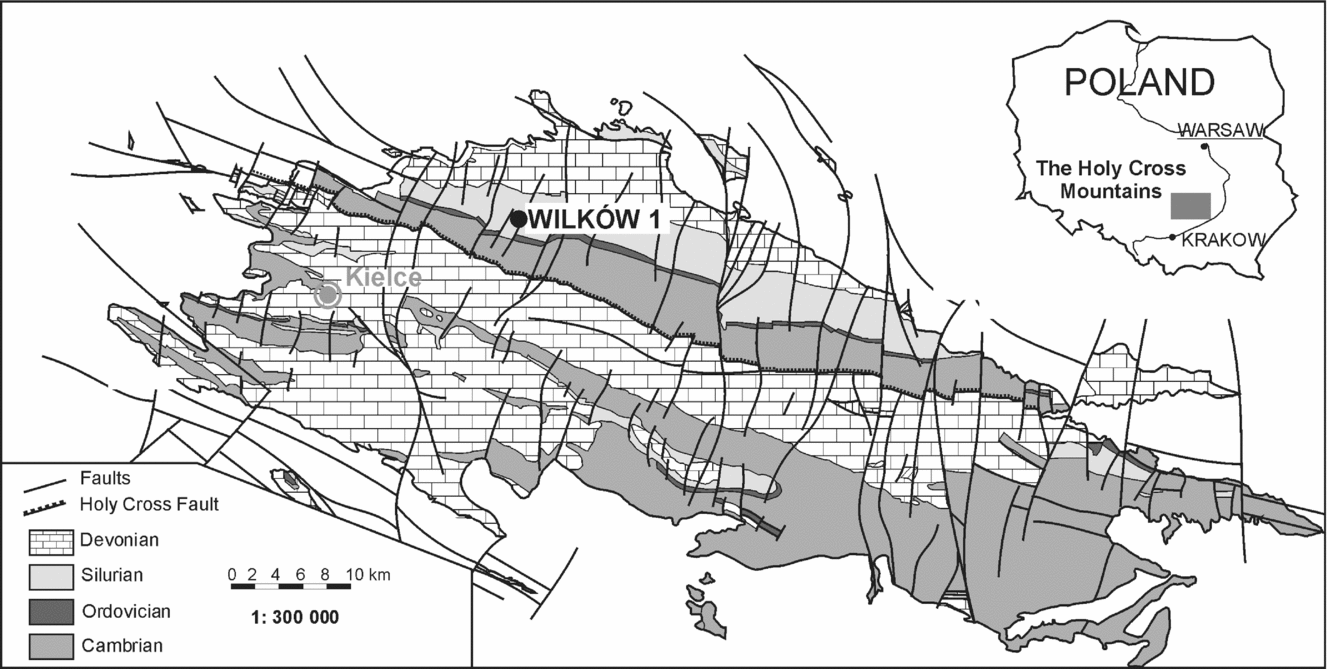
The Holy Cross Mountains (HCM) region of central Poland is traditionally subdivided into the Małopolska Massif (MM) in the south and the Łysogóry Unit (LU) in the north, separated by the Holy Cross Fault (Fig. 1). The MM is considered to be a proximal terrane that separated from Baltica but became reattached some time before late Cambrian/Ordovician times. The LU is treated as a part of the passive margin of this palaeocontinent (Dadlez, Kowalczewski & Znosko, Reference Dadlez, Kowalczewski and Znosko1994). During Silurian time these units are believed to have occupied a position close to the present SW margin of Baltica, which, according to the reconstruction of Torsvik & Rehnström (Reference Torsvik and Rehnström2001), Hartz & Torsvik (Reference Hartz and Torsvik2002) and Cocks & Torsvik (Reference Cocks and Torsvik2005), was located close to 30 °S (Cocks, Reference Cocks, Winchester, Pharaoh and Verniers2002; Nawrocki et al. Reference Nawrocki, Dunlap, Pecskay, Krzemiński, Żylińska, Fanning, Kozłowski, Salwa, Szczepanik and Trela2007).
Schematic geological map of the Holy Cross Mountains showing the location of the Wilków 1 borehole (50° 54′ 44.5″ N, 20° 50′ 59.4″ E).

The Silurian system in the HCM consists of up to 300 m of Llandovery – lower Ludlow (Rhuddanian to Gorstian stages) shale and mudstone deposits, which are overlain by a ~2000 m thick succession of the upper Ludlow and Pridoli greywacke sandstones, mudstones and carbonates (Kozłowski, Reference Kozłowski2008). These sediments filled a foredeep basin that extended from the HCM to the present SW margin of Baltica (Poprawa et al. Reference Poprawa, Šljaupa, Stephenson and Lazauskiene1999; Narkiewicz, Reference Narkiewicz2002) (Fig. 1). The Rhuddanian part of the Silurian shale and mudstone succession is made up of black shales and cherts that accumulated under upwelling conditions (Kremer, Reference Kremer2005) generated by the SE trade winds (Trela & Salwa, Reference Trela and Salwa2007). They belong to the Bardo Formation (op. cit.) and contain a graptolite fauna indicative of the ascensus/acuminatus, vesiculosus and cyphus zones (Tomczyka & Tomczykowa, Reference Tomczyk, Tomczykowa and Basset1976; Podhalańska & Trela, Reference Podhalańska and Trela2007). The overlying Aeronian to Gorstian sediments are represented by grey/green shales and mudstones interrupted by conspicuous black shale intervals of various thicknesses. In the regional lithostratigraphic subdivision these shales and mudstones are given various informal names (Modliński & Szymański, Reference Modliński and Szymański2001). The graptolite data indicate that black shale horizons reported in the HCM are coeval with prominent sea-level and palaeoceanographic changes documented by Page et al. (Reference Page, Zalasiewicz, Williams, Popov, Williams, Haywood, Gregory and Schmidt2007). A relatively thick black shale interval (up to 9 m thick) occurs at the L/W Series boundary and straddles the lower Sheinwoodian murchisoni–riccartonensis–flexilis graptolite zones. This stratigraphic interval is correlated with the worldwide IE.
3. Materials and methods
The Wilków 1 borehole spans almost all of the Lower Silurian (excluding the Rhuddanian and most of the Aeronian) and it records deep-shelf facies. Fifty-three samples were collected from the Llandovery and lower Wenlock strata of the Wilków 1 borehole (Fig. 1), which comprises claystones and black shales (see Deczkowski & Tomczyk, Reference Deczkowski and Tomczyk1969). Owing to the relatively high thermal maturation of the sediments (within the ‘gas window’; conodont alteration index: CAI > 2, Narkiewicz, Reference Narkiewicz2002; vitrinite-like maceral values calculated to vitrinite reflectance VRequ = ~1.7%, Smolarek et al. Reference Smolarek, Marynowski, Spunda and Trela2014), our research has focused on redox proxies that are not susceptible to alteration by heat, such as pyrite framboid petrography and trace metal concentrations. Sedimentological observations of colour, lithology, sedimentary structures and ichnofabric are supported by thin-section petrography of microfacies.
3.a. Geochemical signature
3.a.1. Total organic carbon (TOC) and total sulphur (TS)
Total carbon (TC), total inorganic carbon (TIC) and total sulphur (TS) contents were measured in 53 samples using an Eltra CS-500 IR-analyser with a TIC module. TC was determined using an infrared cell detector on CO2 gas, which was evolved by combustion under an oxygen atmosphere. TIC content was derived from reaction with 15% hydrochloric acid and CO2 was determined by infrared detector. Total organic carbon (TOC) was calculated as the difference between TC and TIC. Calibration was made by means of the Eltra standards. Analytical precision and accuracy were better than ± 2% for TC and ± 3% for TIC.
3.a.2. Trace metals analysis
Thirty-four rock samples from the Wilków 1 borehole were analysed at AcmeLabs, Vancouver, Canada. Samples were chosen based on their position in the section. Major oxides and several minor elements (Ba, Ni, Sr, Zr, Y, Nb, Sc) were measured using inductively coupled plasma atomic emission spectrometry following a lithium borate fusion and dilute acid digestion of a 0.2 g sample pulp. Two separate inductively coupled plasma mass spectrometry analyses of trace elements were performed to optimize determination of a 31-element suite (Ba, Be, Co, Cs, Ga, Hf, Nb, Rb, Sn, Sr, Ta, Th, U, V, W, Zr, Y, La, Ce, Pr, Nd, Sm, Eu, Gd, Tb, Dy, Ho, Er, Tm, Yb, Lu). The reliability of analytical results was monitored by the analysis of international standard reference materials and duplicate analyses of a few samples. Precision and accuracy of the results were better than ± 0.05% (mostly ± 0.01%) for the major elements and generally better than ± 1 ppm for the trace elements.
3.a.3. Pyrite framboid analysis
Pyrite framboid analysis has become a widely used petrographic palaeoredox proxy (e.g. Wignall & Newton, Reference Wignall and Newton1998; Bond & Wignall, Reference Bond and Wignall2010; Wignall et al. Reference Wignall, Bond, Kuwahara, Kakuwa, Newton and Poulton2010). It is especially valuable for evaluating thermally altered or weathered outcrop samples because, while the framboids are sometimes pseudomorphed by iron (oxyhydr)oxides, their distinctive size distributions are retained (Lüning et al. Reference Lüning, Kolonic, Loydell and Craig2003). Twenty-eight samples in the form of small chips were polished and examined for pyrite framboid populations using a Philips Environmental Scanning Electron Microscope (ESEM) in back-scattered electron (BSE) mode at the University of Silesia (Sosnowiec, Poland). Framboid diameters (in µm) were measured using the ESEM internal measuring device. Where possible, at least 100 framboids were measured per sample. In samples W 582.3 and W 583.8, fewer than 100 framboids were measured (33 and 36 counts, respectively) owing to their scarcity. The minimum, maximum and mean diameters of framboids in each sample, and their standard deviations, were calculated. Framboid size-frequency distributions are depicted in the form of box and whisker plots (see e.g. Wignall & Newton, Reference Wignall and Newton1998), and we have generated histograms to better show the size-frequency distribution within a given framboid population.
4. Results
4.a. Stratigraphy
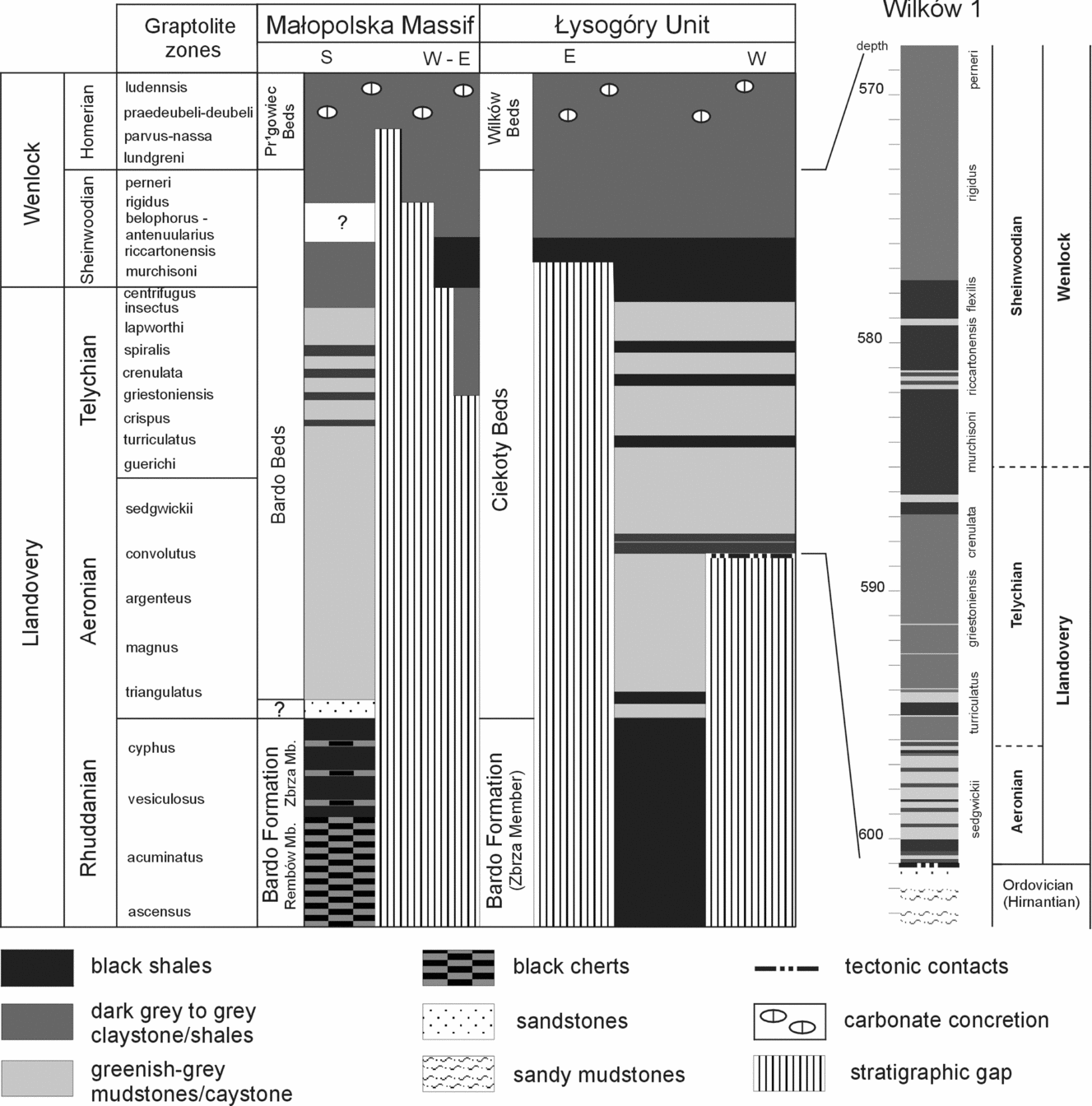
The Silurian of the Wilków 1 borehole includes upper Llandovery to lower Ludlow mudstones and shales (601.0–417.0 m) overlain by upper Ludlow fine-grained greywackes, mudstones and shales (Deczkowski & Tomczyk, Reference Deczkowski and Tomczyk1969). The older part of the succession consists largely of grey to dark grey and subordinate black shales that belong to an informal lithostratigraphic unit, called the Ciekoty Beds (Fig. 2).
Schematic cross-section showing stratigraphy and facies pattern of the Llandovery and Wenlock in the Holy Cross Mountains (after Malec, Reference Malec, Skompski and Żylińska2006, modified) and correlation with the Wilków 1 borehole.

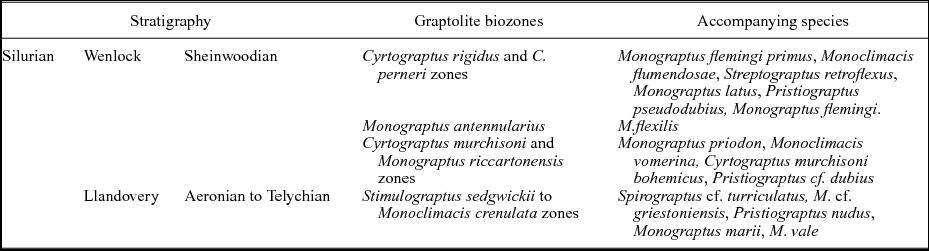
Deczkowski & Tomczyk (Reference Deczkowski and Tomczyk1969) reported tectonic contact between the Hirnantian sandy mudstones of the Zalesie Formation (sensu Trela, Reference Trela2006) and Silurian (uppermost Aeronian Stage) shales of the sedgwickii Zone (Table 1; Fig. 2), suggesting a hiatus of at least 6 million years in the borehole. Deczkowski & Tomczyk (Reference Deczkowski and Tomczyk1969) postulated tectonic zones within the Silurian succession, which may have been responsible for the stratigraphic incompleteness of the Wilków section. Nevertheless, the borehole exposes a prominent 9 m thick black shale that spans the lower Wenlock murchisoni and riccartonensis graptolite zones and extends up to the flexilis Zone (Table 1; Fig. 2). The black shales are bound at their base by grey shales of the lower Telychian turriculatus to crenulata zones (Deczkowski & Tomczyk, Reference Deczkowski and Tomczyk1969), suggesting that the upper Telychian is missing. It cannot be excluded that the 2 m thick black shale / greenish-grey mudstones below the first appearance of Cyrtograptus murchisoni (at a depth of 585.0 m) are upper Telychian (Fig. 2). The Wenlock (lower Sheinwoodian murchisoni–riccartonensis–flexilis graptolite zones) black shales grade upwards into grey shales extending up to the leintwardinensis Zone of the lower Ludfordian Stage (Deczkowski & Tomczyk, Reference Deczkowski and Tomczyk1969) (Table 1; Fig. 2).
Graptolite biozones recognized by Deczkowski & Tomczyk (Reference Deczkowski and Tomczyk1969) in grey and black shales

4.b. Sedimentary facies: distribution and description
Detailed sedimentological study reveals that the apparently monotonous lower Wenlock black shale interval in the Wilków 1 borehole consists of two distinctive facies, each recording its own depositional conditions. The dominant facies is dark grey to black shales, while the second facies comprises light grey to greenish-grey clayey mudstones. The black shales form four horizons interrupted by thin greenish-grey mudstones that sometimes alternate with thin dark shales (Fig. 2). Graptolite faunas place the lower black shale horizons within the murchisoni Zone and the upper black shales within the riccartonensis–flexilis zones (Table 1; Fig. 2). The sandwiched greenish-grey mudstone intervals appear to correlate with the uppermost Telychian (or Llandovery/Wenlock boundary), lower riccartonensis and lower flexilis zones (Table 1; Fig. 2).
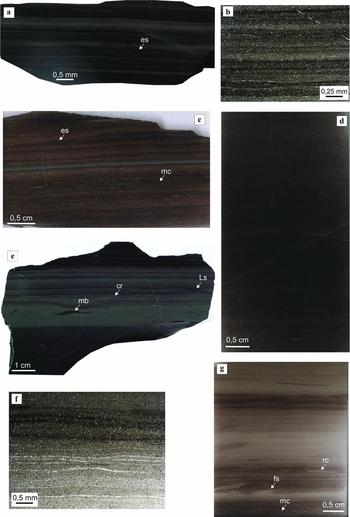
The dark grey to black shales reveal conspicuous lamination on a submillimetre to millimetre scale, enhanced by light grey mudstone laminae (Fig. 3a–d). Black laminae are enriched in fine short fibres of organic matter, which in some cases are wrinkled and usually located parallel to the lamina surface (Fig. 3b). The detrital material (silt-size quartz and mica flakes), pyrite framboids and carbonate crystals are trapped between fibres. The mudstone laminae consist of fine silt-sized quartz and are apparently homogeneous; however, some of them show subtle normal grading and discrete mottling as a result of bioturbation (Fig. 3b). Their contact with the black shale laminae is seen to be variously gradational and sharp. This facies exhibits subordinate erosional surfaces (Fig. 3c) and common, tiny mudstone clasts of submillimetre size that appear as light and rounded spots in the darker matrix (Fig. 3c).
Sedimentological features of the lower Sheinwoodian rocks from the Wilków 1 borehole. (a) Distinct light laminae with subtle normal grading interrupting dark shales. Note discrete mottling bioturbation within light laminae and erosional surface (es) at its base cutting the underlying dark shale. (b) Photomicrograph showing details of (a) (plane polarized light); black laminae enriched in short fibres of organic matter and pyrite framboids intercalated with mudstone laminae. Note scattered silt-sized quartz grains forming discrete laminae. (c) Laminated dark shales with light mudstone laminae, erosional surface (es) cutting laminated sediment. Note numerous tiny sub-rounded mudstone clasts (mc) in dark sedimentary background. (d) Wispy and discontinuous mudstone laminae interrupting organic-rich background. (e) Grey/green clayey mudstone interbeds with alternating black shale layers showing mottling bioturbation (mb) in the lower part and parallel lamination in its upper portion, discrete normal grading within the light laminae, current ripples (cr) and load-cast structures (Ls). (f) Photomicrograph showing discontinuous laminae consisting of silt-sized quartz grains within mudstone beds (plane polarized light). Note dark organic and pyrite-rich laminae in the upper part of photomicrograph. (g) Mudstone with flame structure (fs), rip-up clasts (rc) and tiny mudstone clasts (mc) occurring as light and sub-rounded spots in dark sedimentary background.

The grey and greenish-grey mudstones are present both as thin beds and as intervals of several dozen centimeteres (Fig. 3e). They are largely homogeneous with subordinate subtle bioturbation, although some beds reveal flame structures, rip-up clasts, tiny load-casts, inclined microlamination, current ripples and discrete laminae consisting of silt-sized quartz grains (Fig. 3e, f, g). In some cases, mudstone beds are interrupted by dark laminae consisting of submillimetre-size mudstone clasts (Fig. 3g).
4.c. Bulk geochemical data (TOC, TS, CC)
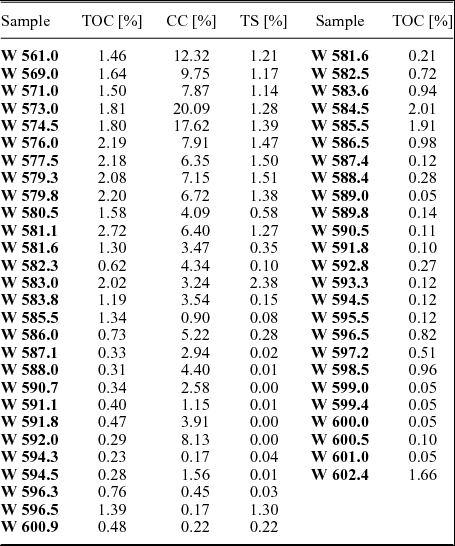
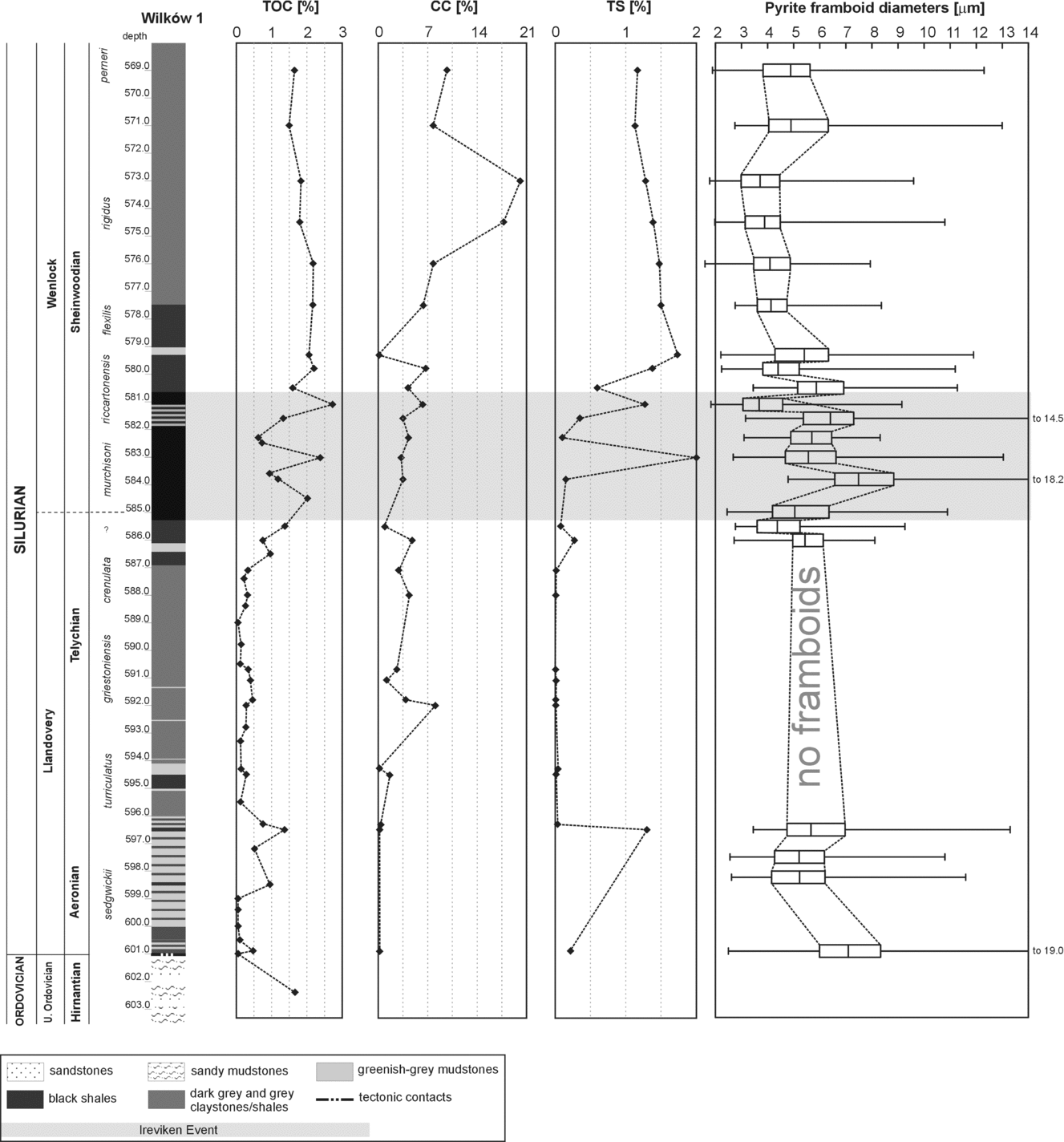
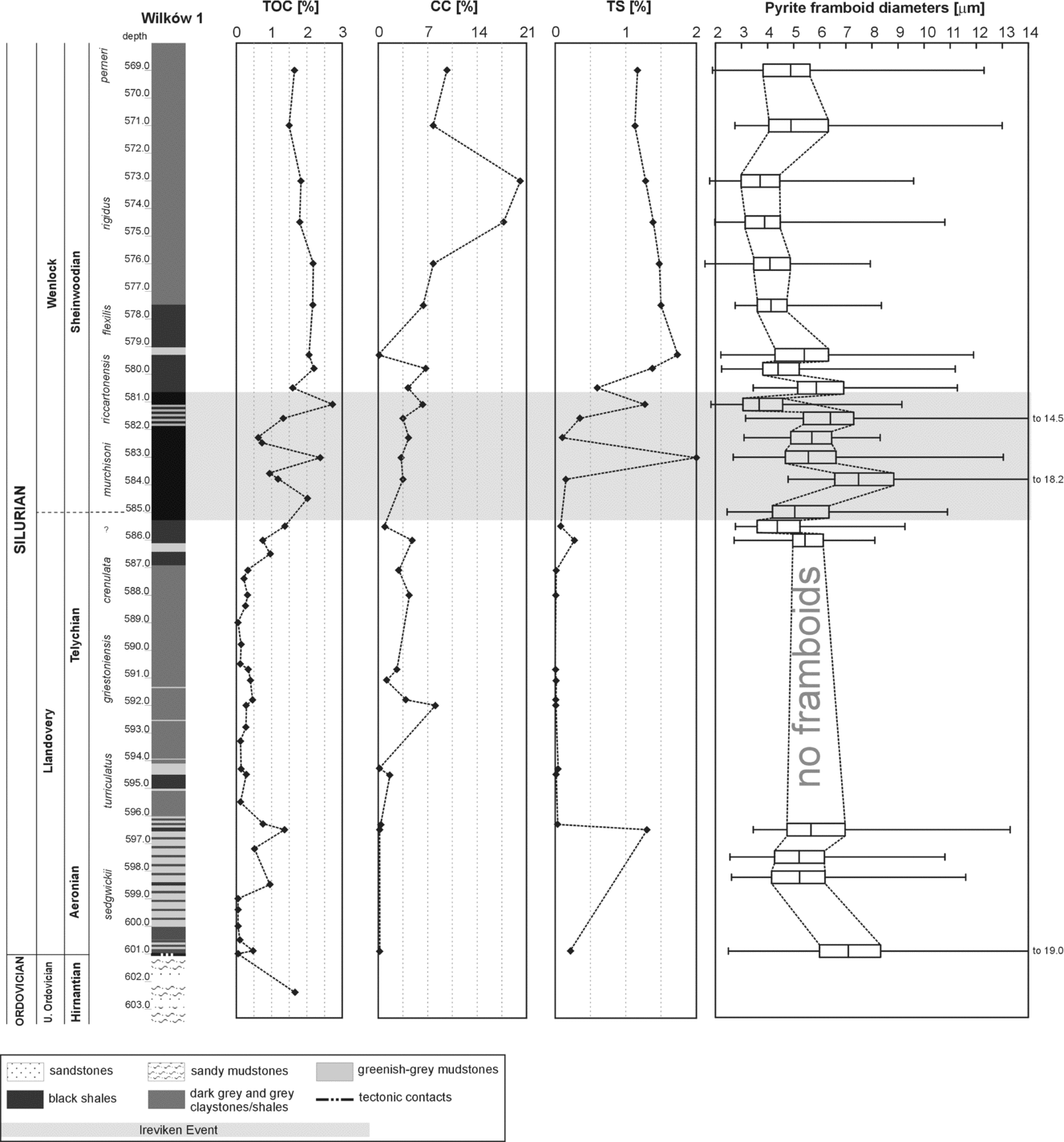
Despite being lithologically rather similar, the tested samples are characterized by major variations in TOC, ranging from c. 0.2% to 2.7% (Table 2; Fig. 4). TOC values in the Aeronian and Telychian samples do not usually exceed 0.5%. TOC content increases just before the Telychian/Sheinwoodian (Llandovery/Wenlock) boundary, and during the Ireviken black shale sedimentation TOC values fluctuate between 0.6% and 2.7% (Fig. 4). Younger Sheinwoodian samples are characterized by relatively stable and generally higher TOC values in the range of 1.5% to 2.2%. The TS record follows a similar pattern to that of TOC concentration, excluding a single sample (W 583.0) that is very rich in TS but poor in TOC (possibly owing to hydrothermal mineralization by sulphides: see e.g. Rubinowski, Reference Rubinowski1969). Thus, a good correlation between TOC and TS (R2 = 0.7) is observed, suggesting normal marine deposition (Sageman & Lyons, Reference Sageman, Lyons and MacKenzie2004). Carbonate content (CC) does not exceed 20% by weight, and in most of the samples ranges between 3% and 10%.
Percentage content of total organic carbon (TOC (%)), carbonate content (CC (%)) and total sulphur (TS (%)) in samples from the Wilków 1 borehole

Composite plot of the Wilków 1 borehole showing total organic carbon content (TOC (%)), carbonate content (CC (%)), total sulphur (TS (%)) and pyrite framboid diameters (µm) (see Table 2).
4.d. Trace metal palaeoredox proxies
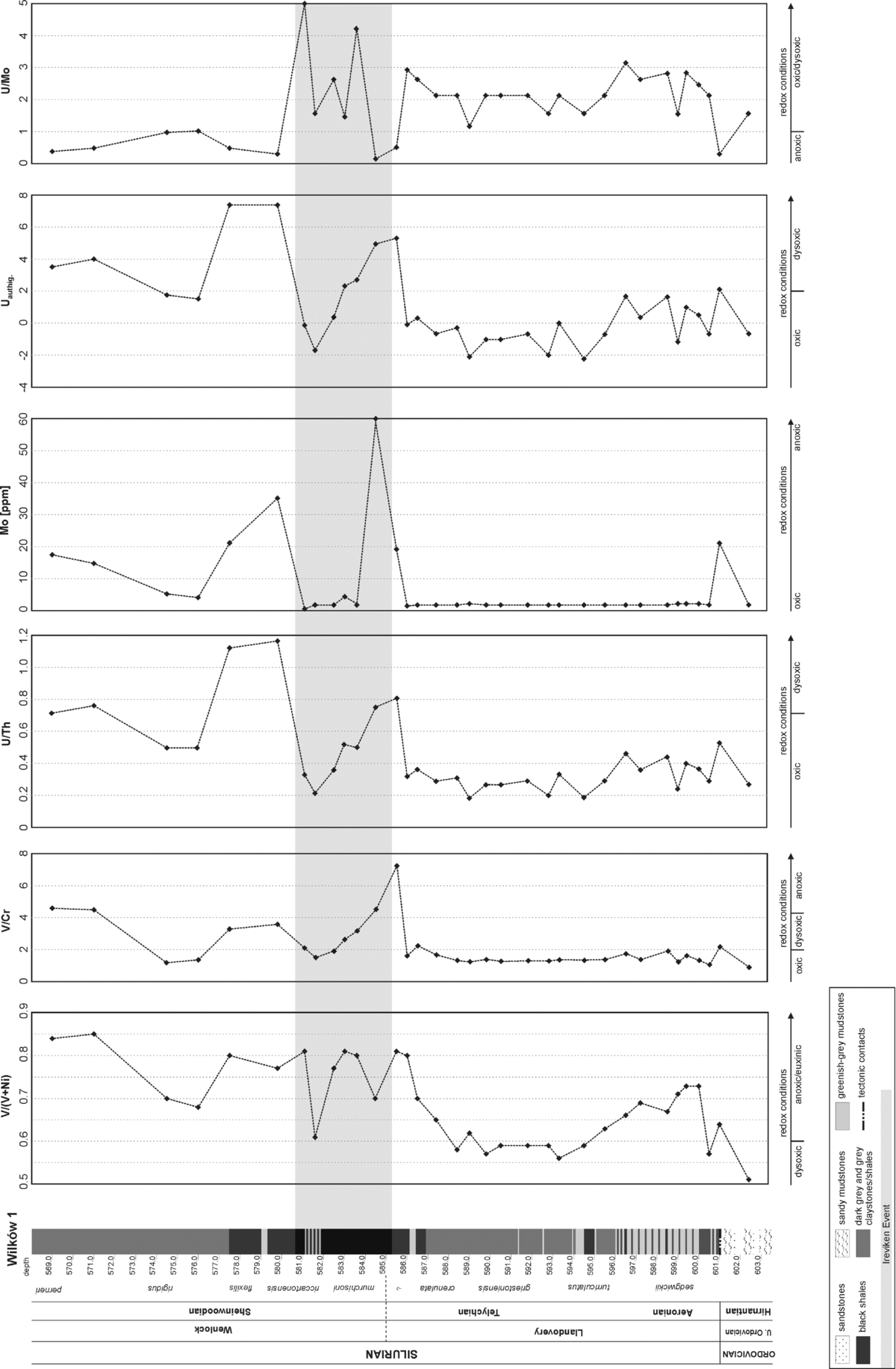
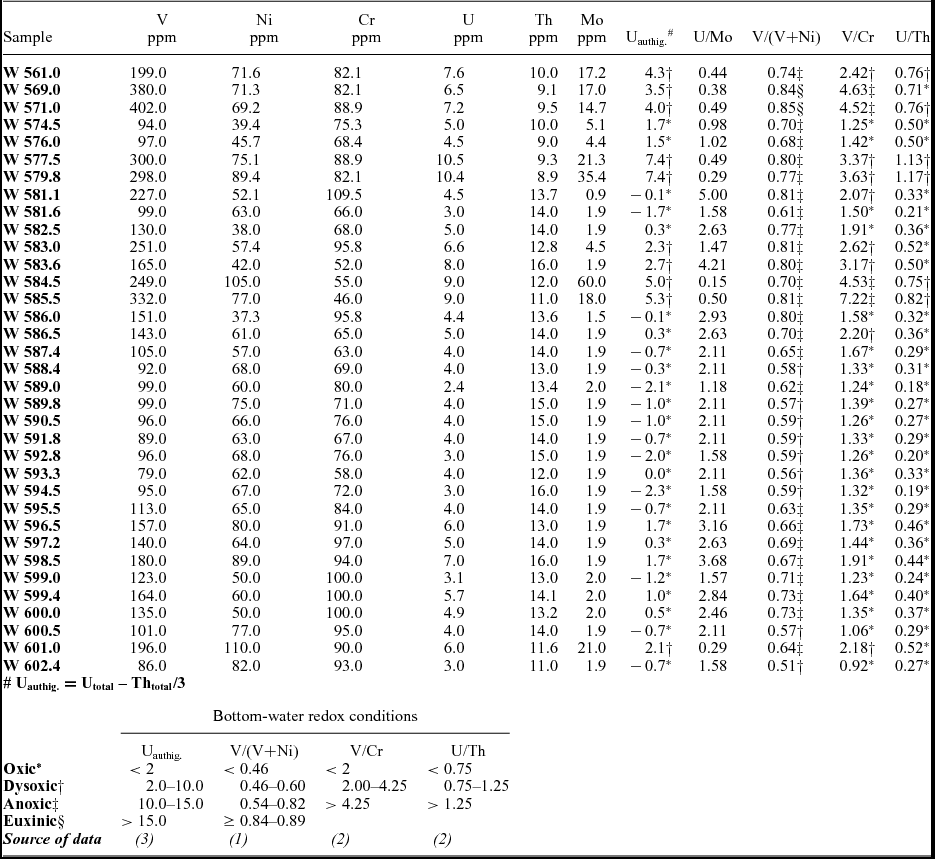
Generally, all of our inorganic redox proxies are in accordance with, and are indicative of, a variety of bottom-water redox conditions (Fig. 5). Only the Ni/Co ratio values are out of step with other data (this is not unusual, see Racka et al. Reference Racka, Marynowski, Filipiak, Sobstel, Pisarzowska and Bond2010), and we have not included Ni/Co in Figure 5. The lack of correlation between the Ni/Co ratio and other trace metal proxies might be attributed to upwelling activity (resulting in Co depletion; Brumsack, Reference Brumsack2006), especially in the upper part of the section, and/or very unstable redox conditions at the L/W boundary that led to partial pyrite oxidation and release of Co and Ni (see Tribovillard et al. Reference Tribovillard, Algeo, Lyons and Riboulleau2006; Swanner et al. Reference Swanner, Planavsky, Lalonde, Robbins, Bekker, Rouxel, Saito, Kappler, Mojzsis and Konhauser2014). The V/(V + Ni), V/Cr and U/Th ratios, and Mo and U concentrations are low through almost the entire Aeronian and Telychian (excluding some elevated values at the beginning of the Aeronian noted for e.g. sample W 601.0). The V/(V + Ni) ratio does not exceed 0.7, U/Th ranges from 0.2 to 0.4, V/Cr ranges from 1 to 2, authigenic uranium (Uauthig) is below 1 and Mo is about 2 ppm. U/Mo fluctuates between 1.5 and 3.7 (Table 3).
Stratigraphic distribution of the trace metal redox indicators across the Wilków 1 borehole (see Table 3).

Evolving palaeoredox conditions interpreted for the Wilków 1 borehole as indicated by different trace metals ratios

Threshold values: (1) Hatch & Leventhal (Reference Hatch and Leventhal1992); (2) Jones & Manning (Reference Jones and Manning1994); (3) Wignall (Reference Wignall1994).
The uppermost Telychian and the IE in the basal Sheinwoodian record an increase in all inorganic redox proxy ratios, as well as Mo concentrations and Uauthig content (and also a decrease in U/Mo, which subsequently becomes rather unstable). This is consistent with the development of reducing conditions across the Telychian/Sheinwoodian boundary (Fig. 5; Table 3). Following a short phase during which these proxy values decreased, they once again increased and stabilized for the duration of the Sheinwoodian, with values characteristic of anoxic/euxinic conditions (V/(V + Ni) and U/Mo) or of dysoxic (and sporadically oxic) environments (U/Th, Uauthig and V/Cr) (Table 3). A similar discrepancy whereby V/(V + Ni) exhibits a similar pattern to the other inorganic proxies, but is suggestive of more oxygen-restricted regimes, has been recognized in other basins (Rimmer, Reference Rimmer2004; Racka et al. Reference Racka, Marynowski, Filipiak, Sobstel, Pisarzowska and Bond2010).
4.e. Pyrite framboids
Pyrite framboids are common in almost all the Llandovery and Wenlock shales, excluding Telychian samples between 594.3 and 587.1 m depth, where framboids were absent but euhedral pyrite and other sulphides (e.g. sphalerite) are recorded.
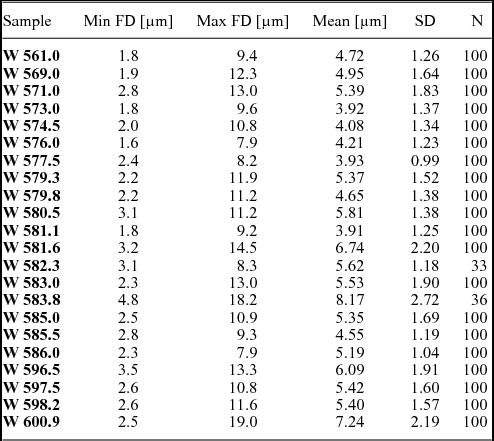
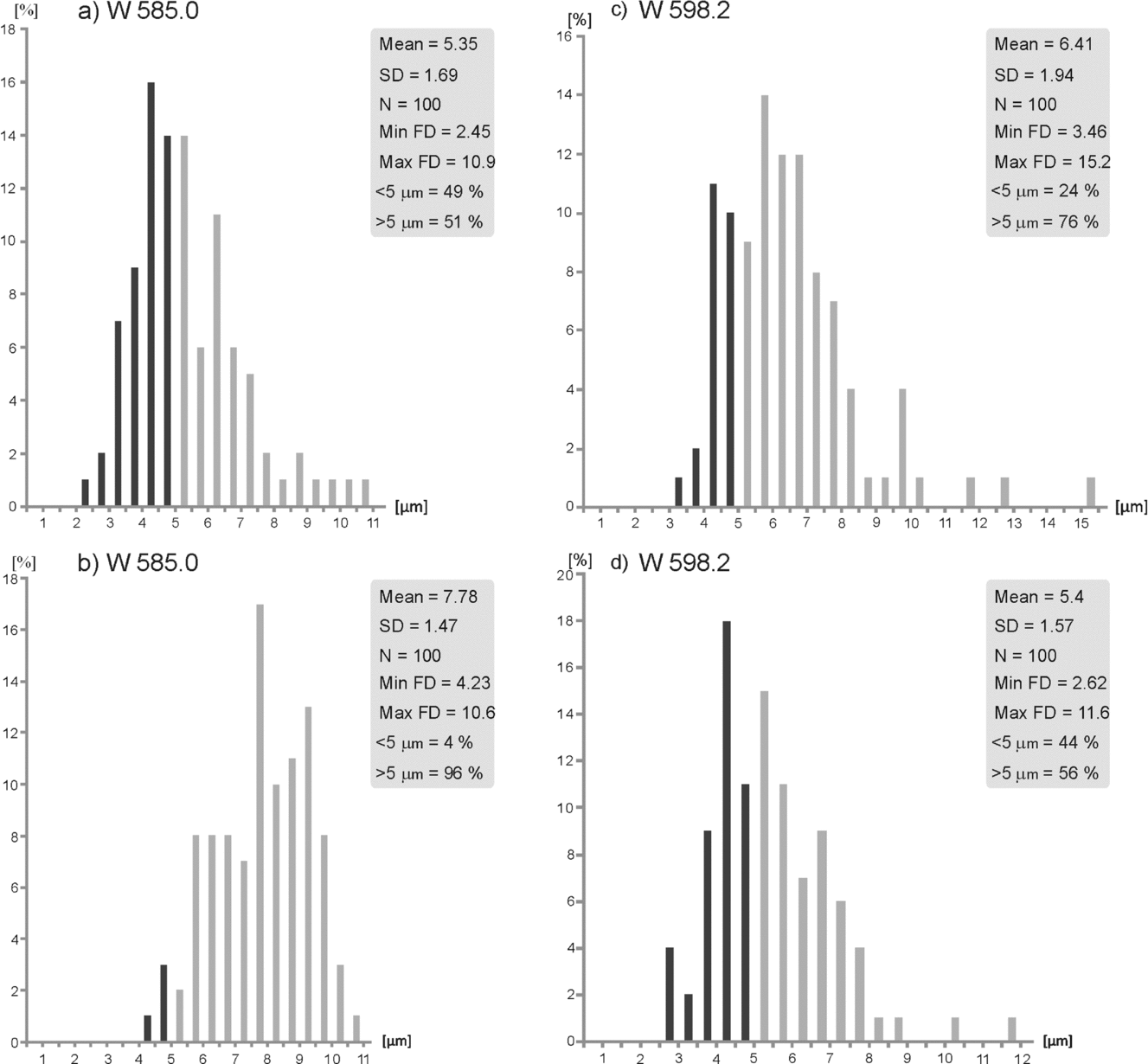
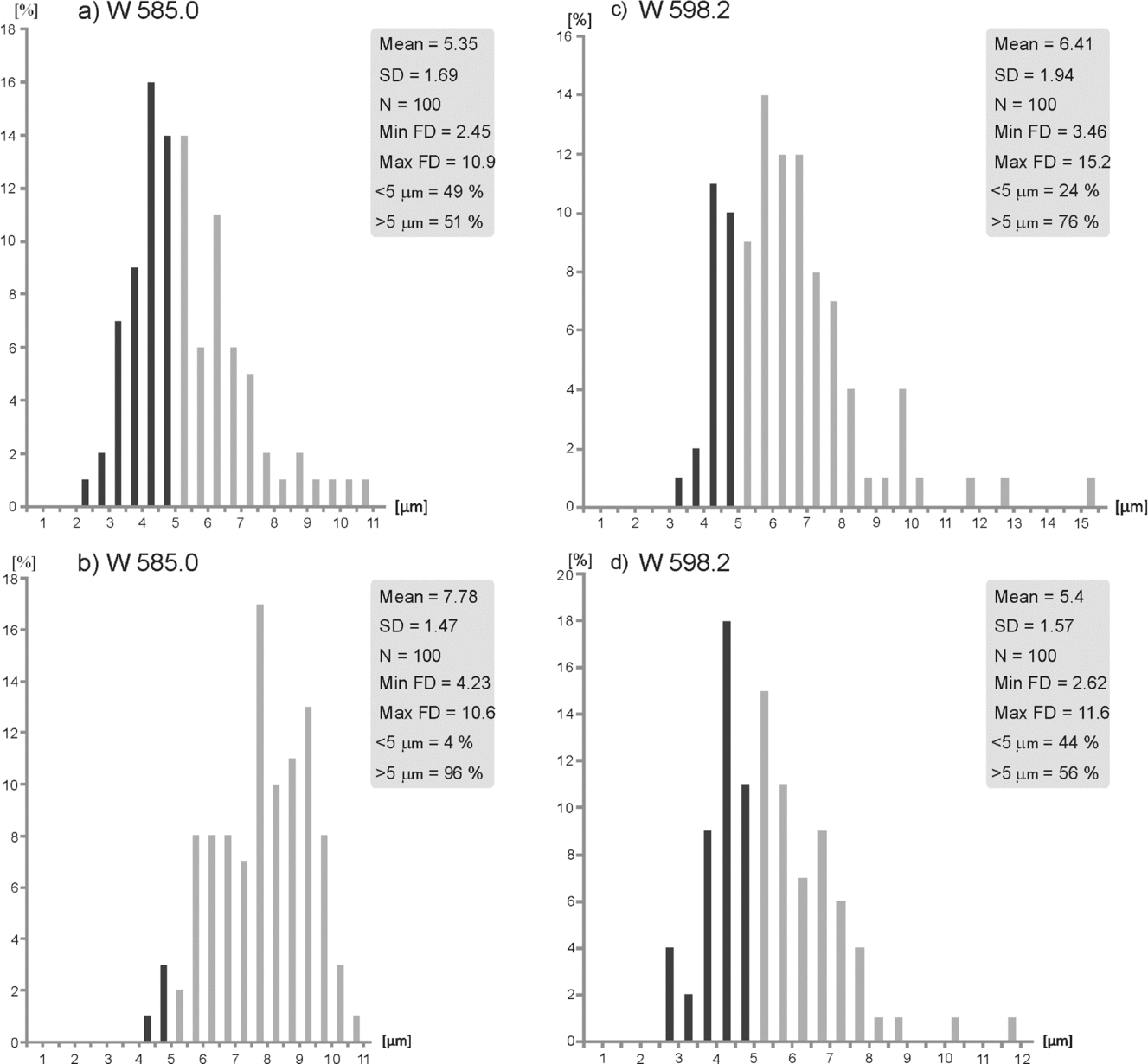
The Rhuddanian and Aeronian samples contain abundant small framboids (mean diameters around 5 μm), with low standard deviations (Table 4). The beginning of the Telychian is marked by the disappearance of framboids, which remained absent through most of the stage. Small framboids reappear at the end of the Telychian, at a depth of 586.0 m in the borehole. The samples from the IE interval are characterized by very rapid fluctuations in pyrite framboid size distributions and in their standard deviations (Table 4; Fig. 4). For example, in the laminated shale at depth 585.0 m, pyrite framboids occur along individual laminae. Analyses of framboids from individual laminae (negating time-averaging effects, see Wignall et al. Reference Wignall, Bond, Kuwahara, Kakuwa, Newton and Poulton2010) yield different framboid size frequencies, suggesting rapidly changing conditions (in this case from anoxic/euxinic to upper dysoxic) (Fig. 6a, b). In sample W 598.2 the contact between lighter and darker sediments separates very different framboid populations (in the lighter layer framboids suggest dysoxic conditions, while the darker layer contains a framboid population characteristic of anoxia/euxinia) (Fig. 6c, d). Above the Telychian/Sheinwoodian boundary framboid diameters have a very narrow range (mean c. 4.0 μm, SD c. 1.0), typical of restricted, oxygen-free conditions.
Pyrite framboid data from Wilków 1 borehole

N – number in sample; SD – standard deviation; FD – framboid diameter.
Histograms showing the distribution of pyrite framboids within two adjacent layers in sample W 585.0 (a, b) and two layers in sample W 598.2 (c, light coloured layer; and d, dark coloured layer). Black bars – framboid diameters below 5 µm; grey bars – framboid diameters above 5 µm; mean – mean diameter; SD – standard deviation; N – number of measurements; FD – framboid diameter.
5. Discussion
5.a. Facies evolution on the basis of the sedimentological record
The lower Wenlock (Sheinwoodian) benthic oxygenation history and associated sea-level changes recorded in the Wilków 1 borehole were likely driven by major early Sheinwoodian climatic changes (compare Page et al. Reference Page, Zalasiewicz, Williams, Popov, Williams, Haywood, Gregory and Schmidt2007). Thus, sedimentological and stratigraphic data from South America indicate that Llandovery and early Wenlock times saw the expansion of glaciation on Gondwana (Díaz-Martínez & Grahn, Reference Díaz-Martínez and Grahn2007) driving third-order eustatic sea-level changes and consequently impacting on palaeoceanographic conditions (Loydell, Reference Loydell2007; Lehnert et al. Reference Lehnert, Männik, Joachimski, Calner and Frýda2010). In sequence stratigraphic terms, black shales record either the basal part of the transgressive systems tract or the maximum flooding surface (Wignall, Reference Wignall1991; Wignall & Maynard, Reference Wignall and Maynard1993). In the lower Sheinwoodian shale and mudstone succession of the LU, the black shales derived from sediment starvation and oxygen-deficient conditions during deglacial transgressive periods that favoured the development of benthic microbial mats and biofilms that are preserved as organic matter fibres. However, the fine silt material in the lighter coloured laminae indicate periodic deposition from diluted low-density bottom currents, or dust clouds of aeolian origin interrupting accumulation of hemipelagic organic-rich clays (see O'Brien, Reference O'Brien and Kemp1996). Tiny mudstone micro-clasts within the dark laminae probably originated from the intermittent erosion of a partially consolidated mudstone substrate and subsequent transport by bottom currents (see Schieber, Southard & Schimmelmann, Reference Schieber, Southard and Schimmelmann2010). A similar fabric has been interpreted elsewhere as the result of accumulation of faecal pellets or burrow fills modified by compaction (op. cit.). The activity of bottom currents contributed to short-lived oxygenation events in the LU sedimentary basin and to periodic water-column mixing (compare with Schieber, Reference Schieber1994).
The Sheinwoodian greenish-grey mudstones record periods of benthic oxygenation that promoted bioturbation and subsequent homogenization of the muddy sediment. The occurrence of discrete erosional (rip-up clasts, cut and fill, and flame structures) and sedimentary structures within this facies suggest that bottom currents influenced sedimentary conditions. According to Page et al. (Reference Page, Zalasiewicz, Williams, Popov, Williams, Haywood, Gregory and Schmidt2007) this type of shale and mudstone facies can result from water-column ventilation in response to increased thermohaline circulation during the glacial maxima and regressions.
Graptolite faunas clearly correlate the lower Wenlock black shale horizons in the LU with the murchisoni and late riccartonensis Zone sea-level highs postulated by Loydell (Reference Loydell1998) and Loydell & Frýda (Reference Loydell and Frýda2007). The black shales are interrupted by a relatively short interval of increased greenish-grey mudstone intercalations, which may reflect sea-level fall from the late murchisoni to early riccartonensis graptolite zones (op. cit.). Thin green mudstones above the upper riccartonensis black shales appear to be coeval with Loydell's (Reference Loydell1998) short-term regressive–transgressive event during the flexilis Zone (Table 1). As is the case in the eastern Baltic area (Loydell, Reference Loydell1998; Kaljo & Martma, Reference Kaljo and Martma2006), there is a stratigraphic gap in the Wilków section that spans the upper Telychian and appears to be related to sea-level fall during this time interval. The base of the considered black shale interval may be of uppermost Telychian age, but a lack of precise biostratigraphic data hampers any sequence stratigraphic correlations and sea-level reconstructions.
5.b. Reconstruction of depositional environments based on integrated geochemical proxies
There is general correspondence between TOC and our inorganic redox proxies, which reveal repeated changes in benthic oxygenation. Two peaks in TOC occur near the Aeronian/Telychian boundary and during the lower Telychian. The later phase of enhanced TOC continued across the Telychian/Sheinwoodian boundary and (with some fluctuations) well into the Sheinwoodian (Figs 4, 5). The TOC increase associated with the Aeronian/Telychian boundary is probably the local manifestation of the so called ‘Sandvika event’ (Calner, Reference Calner and Elewa2008), but there is lack of comparable data from other worldwide sections. Similar TOC values from the Sheinwoodian (basal Wenlock) were reported by Loydell & Frýda, (Reference Loydell and Frýda2007) from the Banwy River section, Wales, and by Racki et al. (Reference Racki, Baliński, Wrona, Małkowski, Drygant and Szaniawski2012) from Podolia, Ukraine, and patterns are similar to those presented here. In both cases authors reported a noticeable increase in TOC concentration in the lower Wenlock deposits, but in those relatively shallow facies absolute values are two to three times lower than those observed in the HCM. Vandenbroucke et al. (Reference Vandenbroucke, Munnecke, Leng, Bickert, Hints, Gelsthorpe, Maier and Servais2013) inferred that primary productivity increased just before the IE on the basis of sections in Gotland. Further afield, Noble et al. (Reference Noble, Zimmerman, Holmden and Lenz2005) noted a sharp increase in TOC to 3% precisely at the Telychian/Sheinwoodian boundary in the deep-water Cape Phillips Formation, Arctic Canada, followed by a similarly sharp decrease to < 1% during the centrifugus–insectus Zone (Table 1). The above data suggest that in deeper shelf settings TOC enrichment began prior to the L/W boundary while in shallow-water sections this did not begin until after L/W boundary. This implies that oxygen-depleted waters expanded from the deeper parts of the basin (compare to the model of Hammarlund et al. Reference Hammarlund, Dahl, Harper, Bond, Nielsen, Bjerrum, Schovsbo, Schönlaub, Zalasiewicz and Canfield2012 proposed for the Ordovician/Silurian boundary) and reached the deep shelf during early Wenlock time.
Such a scenario is confirmed by our inorganic proxies. U/Th ratios suggest that during the IE, bottom-water conditions changed from being initially oxic at the end of Telychian time to suboxic/anoxic, before returning to oxic for a short time at the end of the event (Fig. 5). A similar history can be inferred from V/Cr values, Uauthig and Mo concentrations (Table 3). The values of V/(V + Ni) are suggestive of more oxygen-restricted conditions, from dysoxic/anoxic (0.5–0.8, see Table 3) in the basal and middle parts of the section to euxinic (> 0.84) by the upper Sheinwoodian (Fig. 5). We observe general similarities between patterns in the abovementioned redox proxies with the U/Mo ratio, defined recently by Zhou et al. (Reference Zhou, Wignall, Su, Feng, Xie, Zhao and Huang2012) as a depositional environment indicator that distinguishes anoxic/euxinic from dysoxic conditions (Table 3). The U/Mo proxy (Zhou et al. Reference Zhou, Wignall, Su, Feng, Xie, Zhao and Huang2012) as applied to the Wilków 1 section reveals U/Mo > 1 in the Aeronian and Telychian, suggesting oxygenated conditions. Fluctuating values during the IE include those of < 1 in the Sheinwoodian that are characteristic of an anoxic/euxinic redox environment (Zhou et al. Reference Zhou, Wignall, Su, Feng, Xie, Zhao and Huang2012).
Elevated TOC near the Aeronian/Telychian boundary, together with increased U/Th and V/(V + Ni) ratios (Fig. 5) and the occurrence of small pyrite framboids (see Section 5.c below), suggests that more oxygen-restricted conditions prevailed during the lesser known Sandvika event. However, other inorganic proxies show no significant changes.
Based on these results, Aeronian sedimentation records dysoxic to anoxic/euxinic conditions, and almost the entire Telychian was oxic. The L/W boundary interval was distinguished by rapidly changing conditions from dysoxic to anoxic/euxinic, even down to the millimetre scale within the studied sediments (Fig. 6). The youngest investigated sediments of the Sheinwoodian Stage yield relatively stable values for all inorganic proxies, indicative of dysoxic to anoxic sedimentary conditions.
5.c. Correlation of pyrite framboid and inorganic redox proxies
Pyrite framboid analysis is routinely used as a palaeoredox proxy and has been applied to marine basins dating back to Ediacaran time (e.g. Wignall & Newton, Reference Wignall and Newton1998; Zhou & Jiang, Reference Zhou and Jiang2009; Bond & Wignall, Reference Bond and Wignall2010; Wignall et al. Reference Wignall, Bond, Kuwahara, Kakuwa, Newton and Poulton2010; Algeo et al. Reference Algeo, Kuwahara, Sano, Bates, Lyons, Elswick, Hinnov, Ellwood, Moser and Maynard2011; Hammarlund et al. Reference Hammarlund, Dahl, Harper, Bond, Nielsen, Bjerrum, Schovsbo, Schönlaub, Zalasiewicz and Canfield2012; Marynowski et al. Reference Marynowski, Zatoń, Rakociński, Filipiak, Kurkiewicz and Pearce2012; Wang, Shi & Jiang, Reference Wang, Shi and Jiang2012). Framboids form in waters that are supersaturated with respect to both Fe monosulphides and pyrite in which reaction kinetics favour the formation of the framboidal varieties of the former (Wilkin, Barnes & Brantley, Reference Wilkin, Barnes and Brantley1996). In euxinic basins the locus of framboid and euhedral pyrite formation is separated by the thickness of the sulphidic water column and often Fe limitation within the sediments ensures that sediments have very high proportions of syngenetic framboids (e.g. Ross & Degens, Reference Ross, Degens, Degens and Ross1974; Wilkin & Arthur, Reference Wilkin and Arthur2001). Syngenetic framboids, such as those in the modern Black Sea, rarely reach 6–7 μm diameter before the dense particles sink to the sea bed and accumulate as small-sized populations with a narrow size distribution (Wilkin, Barnes & Brantley, Reference Wilkin, Barnes and Brantley1996). This resulting size-frequency distribution is useful for identifying ancient euxinia because it contrasts with framboid populations from more oxygenated settings (Wilkin, Barnes & Brantley, Reference Wilkin, Barnes and Brantley1996; Wilkin & Arthur, Reference Wilkin and Arthur2001). Thus, in dysoxic settings (bottom-water oxygen levels between 0.2 and 2.0 ml O2/l H2O), framboids form within the sediment as populations with a broader size distribution and consequently have a larger standard deviation (Wilkin, Barnes & Brantley, Reference Wilkin, Barnes and Brantley1996). In dysoxic sediments formed in the oxygen-minimum zones offshore of Oman and Angola, framboid populations range up to 20 μm diameter (Schallreuter, Reference Schallreuter, Hay, Sibuet, Barron, Brassell, Dean, Huc, Keating, McNulty, Meyers, Nohara, Schallreuter, Steinmetz, Stow and Stradner1984; Lallier-Verges, Bertrand & Desprairies, Reference Lallier-Verges, Bertrand and Desprairies1993). Shallower-water dysoxic sediments, such as those encountered in Baltic lagoons have similar-sized populations (Neumann et al. Reference Neumann, Rausch, Leipe, Dellwig, Berner and Bottcher2005) as do those of the Mississippi shelf where framboids average 9–13 μm diameter, with a total size range of 4–20 μm diameter (Brunner et al. Reference Brunner, Beal, Bentley and Furukawa2006).
Pyrite populations of euxinic and dysoxic settings are clearly distinguishable; however, the distinction between euxinic and suboxic sediments (forming in bottom waters of 0.0–0.2 ml O2/l H2O) is less clear cut. Recent suboxic sediments from the Santa Barbara Basin have very small framboid populations at some levels that are typical of those encountered in euxinic basins (Schieber & Schimmelmann, Reference Schieber and Schimmelmann2006, Reference Schieber and Schimmelmann2007). It may be that the smaller framboid populations settled from the water column during transient euxinia – brief phases that would be impossible to distinguish in the geological record, owing to the time-averaging effect of analysing a rock chip typically of 1–2 cm thickness. This effect is particularly notable in environments subject to high-amplitude redox changes. The Salton Sea, a hypereutrophic lake in southern California, experiences summer euxinia and winter oxia. Its sediments contain abundant framboids showing a narrow size-frequency distribution around 5 μm that record the euxinic phases (De Koff, Anderson & Amrhein, Reference De Koff, Anderson and Amrhein2008) but not the oxic phases. However, redox fluctuations in the HCM are likely to have been less dynamic at the yearly-to-decadal scale owing to the large water masses involved.
Comparing TOC and inorganic palaeoredox indicators with pyrite framboid size distributions in the Wilków 1 borehole (Figs 4, 5) yields a good correlation between all (in particular there is strong agreement in redox inferred from pyrite framboids and the V/(V + Ni) ratio). Pyrite framboids are absent from almost all of the Llandovery section (10 m thick), which also records very low TOC and low inorganic proxy values. During the Telychian/Sheinwoodian boundary interval, all proxies display sharp fluctuations (on the centimetre scale) that indicate a full range of conditions from oxic/dysoxic to euxinic. Above the 6 m thick Telychian/Sheinwoodian boundary interval, most of our redox proxies stabilized. Thus, Wenlock sedimentary rocks contain exclusively small pyrite framboid diameters and relatively high concentrations of redox-sensitive trace metals, typical of anoxic/euxinic conditions.
5.d. Causes and consequences of sea-level changes
Three major episodes of L/W boundary sedimentation can be reconstructed, based on new data:
(i) Pre-IE times (Telychian Stage) record a sea-level lowstand, intensive water circulation and low productivity. Such conditions might have resulted from sea-level fall (Ross & Ross, Reference Ross, Ross, Witzke, Ludvigson and Day1996; Brett et al. Reference Brett, Ferretti, Histon and Schönlaub2009 but see also Loydell, Reference Loydell1998; Johnson, Reference Johnson2006, Reference Johnson2010; Spengler & Read, Reference Spengler and Read2010; review in: Munnecke et al. Reference Munnecke, Calner, Harper and Servais2010; Melchin, Sadler & Cramer, Reference Melchin, Sadler, Cramer, Gradstein, Ogg, Schmitz and Ogg2012) that may be connected with icehouse pulses (Page et al. Reference Page, Zalasiewicz, Williams, Popov, Williams, Haywood, Gregory and Schmidt2007).
(ii) During the IE the basin saw intensive chemocline fluctuations during a marine transgression and moderate productivity. The late Telychian sea-level rise and transgression was probably associated with deglaciation, during which sedimentary conditions on the deep shelf became oxygen restricted. Very intense anoxic/euxinic zone oscillations are recorded by both inorganic proxies and pyrite framboids (Figs 4, 5). Typically, rapid chemocline fluctuations result in time-averaged geochemical and petrographic redox proxies that might be interpreted as a signal of dysoxia, but might actually derive from short-lived, repeated oxic to anoxic–euxinic transitions. Rapid fluctuations of the chemocline in the water column, reported also by McLaughlin, Emsbo & Brett (Reference McLaughlin, Emsbo and Brett2012) represent a potent kill mechanism in the Ireviken mass extinction scenario. Redox changes in the deeper water masses would likely preferentially affect pelagic and hemipelagic organisms (e.g. Jeppsson, Reference Jeppsson1990; Munnecke, Samtleben & Bickert, Reference Munnecke, Samtleben and Bickert2003). These observations are compatible with reconstructions of depositional conditions based on sedimentological data and stable isotope records through the Ireviken black shale deposition by Page et al. (Reference Page, Zalasiewicz, Williams, Popov, Williams, Haywood, Gregory and Schmidt2007) and McLaughlin, Emsbo & Brett (Reference McLaughlin, Emsbo and Brett2012). The one discrepancy in each of those studies is the interpretation of the transgression/regression pulse, which stems from the use of different sea-level curves (Ross & Ross, Reference Ross, Ross, Witzke, Ludvigson and Day1996; Johnson, Reference Johnson2010) that record local conditions (see e.g. Brett et al. Reference Brett, Ferretti, Histon and Schönlaub2009).
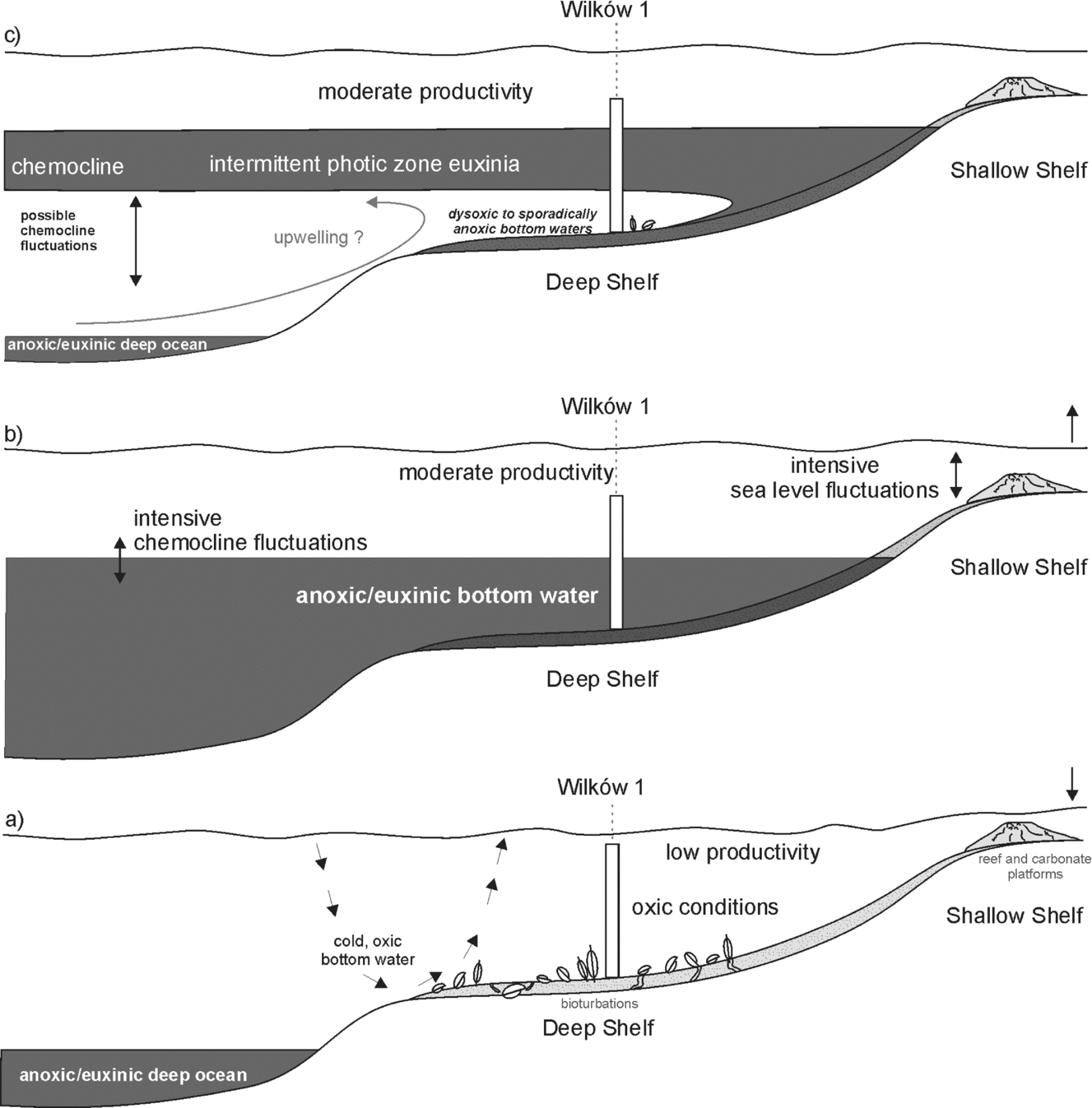
Two phases of deposition in our environmental model (Fig. 7a, b) generally correspond to humid (H) and arid (A) periods described by Bickert et al. (Reference Bickert, Pätzold, Samtleben and Munnecke1997). During A conditions at low latitudes, better ventilated episodes frequently occurred owing to evaporation and downwelling of warm, saline and well-oxygenated surface water. During H periods anoxic deep waters invade deep-shelf areas owing to estuarine water circulation, leading to deposition of black shales. However, Page et al. (Reference Page, Zalasiewicz, Williams, Popov, Williams, Haywood, Gregory and Schmidt2007) presented a different interpretation of Silurian sea-level fluctuations closely connected with glacial events, which correlate well with our geochemical results. A third model (Fig. 7c) is proposed for intervals during which inorganic proxies suggest oxic to dysoxic bottom-water conditions, but the predominance of tiny pyrite framboids is typical for the occurrence of a euxinic water column (e.g. Bond & Wignall, Reference Bond and Wignall2008). Our data confirm the occurrence of euxinia in the Silurian ocean (see Munnecke, Samtleben & Bickert, Reference Munnecke, Samtleben and Bickert2003), but the application of multiple proxies adds to the possible water-column structure before and during the IE.
Three conceptual models showing sedimentary conditions detected before, during and after the Ireviken Event: (a) before: oxic to sporadically dysoxic sedimentary conditions during a lowstand, with intensive water circulation and low productivity; (b) during: very intensive chemocline fluctuations caused by transgressive seas with moderate productivity; (c) after: relatively stable conditions with a euxinic zone in the water column and dysoxic to sporadically anoxic bottom waters and moderate productivity.

(iii) Following the IE, stable conditions developed with a euxinic zone in the water column and dysoxic to sporadically anoxic bottom water and moderate productivity (Fig. 7).
Following the Ireviken black shale sedimentation, redox conditions became more stable for a time, reflected in all of our redox proxies (Figs 4, 5). An anoxic/euxinic zone occurred in the water column (very small pyrite framboids) while the seafloor experienced oxygen-deficient conditions interspersed with episodes of anoxia/euxinia (inorganic redox proxies; Tables 3, 4; Fig. 7).
5.e. Comparison of the model with other Palaeozoic events
A very similar redox history to that presented here for the IE has been described by Hammarlund et al. (Reference Hammarlund, Dahl, Harper, Bond, Nielsen, Bjerrum, Schovsbo, Schönlaub, Zalasiewicz and Canfield2012) and Harper, Hammarlund & Rasmussen (Reference Harper, Hammarlund and Rasmussen2014) for the end-Ordovician mass extinction event (see also Armstrong & Harper, Reference Armstrong and Harper2014). Similarities between the end-Ordovician and IE have been postulated by Noble et al. (Reference Noble, Zimmerman, Holmden and Lenz2005 and references therein) because of the coincidence of a positive δ13C excursion, biotic extinction, widespread eustatic low stands and sedimentary hiatuses in shallow waters, sediments that are poor in organic carbon, and the short duration of events. Our data support the assertion that the sedimentary redox record for the Ireviken black shale is analogous to that described from the end-Ordovician event.
In parallel scenarios, fluctuating photic zone euxinia in the water column has been proposed for the much better-known Permian–Triassic Panthalassic Ocean successions (Algeo et al. Reference Algeo, Kuwahara, Sano, Bates, Lyons, Elswick, Hinnov, Ellwood, Moser and Maynard2011) and Famennian (Upper Devonian) black shales (Marynowski et al. Reference Marynowski, Rakociński, Borcuch, Kremer, Schubert and Jahren2011, Reference Marynowski, Zatoń, Rakociński, Filipiak, Kurkiewicz and Pearce2012). In both scenarios bottom-water conditions were at least periodically oxic/dysoxic during black shale deposition despite evidence for euxinia in the water column. In the case of Devonian black shales, the existence of a euxinic water column was confirmed by pyrite framboids and biomarkers from green sulphur bacteria (Marynowski et al. Reference Marynowski, Rakociński, Borcuch, Kremer, Schubert and Jahren2011, Reference Marynowski, Zatoń, Rakociński, Filipiak, Kurkiewicz and Pearce2012; Racka et al. Reference Racka, Marynowski, Filipiak, Sobstel, Pisarzowska and Bond2010). Such palaeoenvironmental scenarios took place with some frequency during Phanerozoic time.
6. Conclusions
(1) Inorganic trace metal redox proxies suggest that during the Ireviken bio-crisis, bottom-water conditions ranged from oxic (Telychian) to mostly suboxic/anoxic (the first phase of the IE) and back to oxic again (the last phase of the IE). Oxygen-depleted waters expanded from the deeper parts of the basin and reached the deep shelf during the first phase of Ireviken black shale deposition. Post-IE conditions stabilized and became anoxic/suboxic on the seafloor with a euxinic zone in the water column.
(2) General similarities are observed in the patterns of all our redox proxies and in the U/Mo ratio. Large variations in these values during Ireviken black shale sedimentation are suggestive of rapid redox fluctuations. Such fluctuations can be connected with deglaciation, in a similar scenario as has been proposed for the Ordovician/Silurian extinction event.
(3) Rapid fluctuations of the chemocline in the water column during the IE were likely a major trigger of the Ireviken mass extinction, which affected mainly pelagic and hemipelagic organisms. Shallow-water dwellers, such as reef ecosystems, were relatively unaffected during the IE.
Acknowledgements
This work was supported by the National Science Center of Poland, grants: 2012/07/B/ST10/04211 (to WT) and 2014/13/N/ST10/03006 (to JS). DB acknowledges his support from the Natural Environment Research Council (Grant NE/J01799X/1). The research was also supported by Wroclaw Research Centre EIT+ within the project ‘The Application of Nanotechnology in Advanced Materials’ – NanoMat (POIG.01.01.02-02-002/08) financed by the European Regional Development Fund (Innovative Economy Operational Programme, 1.1.2).