


Background
Depression is the most common mental health disorder, affecting around one in 10 persons in the Western world at least once in their lifetime (Lépine and Briley Reference Lépine and Briley2011). It accounts for 4.3% of the global burden of disease and is among the largest single causes of disability worldwide (WHO 2013).Footnote 1 In this letter, we explore the participatory consequences of depressive symptoms and argue that this global and growing malaise has ramifications for the democratic engagement of citizens around the world. We hypothesize that depression matters because it reduces the political motivation and physical resources required for participation. Our results show strong and robustly negative effects of depressive symptoms on voter turnout, political motivation, and physically demanding participatory acts. Revealing that the negative effects of depressive symptoms on turnout are a global phenomenon, we implore scholars to take depressive symptoms seriously in the study of abstention and nonparticipation. That depressive symptoms make citizens less interested in politics, less efficacious about their ability to engage politically, and generally less participatory, especially at a time when depressive symptoms are on the rise, is a cause for concern.
Hypotheses
In recent years, scholars of political behavior have come to widely accept that poor health dampens turnout (Blais and Daoust Reference Blais and Daoust2020), although studies have tended to focus on physical health. In contrast to a now robust literature on physical health (e.g. Burden et al. Reference Burden, Fletcher, Herd, Jones and Moynihan2017; Gollust and Rahn Reference Gollust and Rahn2015; Mattila et al. Reference Mattila, Rapeli, Wass and Söderlund2017) is a fledgling literature on how mental health shapes participation. Ojeda (Reference Ojeda2015) provided the first evidence for the negative effect of depression on turnout and political participation, finding that episodes of depression during youth have lasting negative effects on participation in later years. Since then, studies have examined how depression slows the development of a voting habit (Ojeda and Pacheco Reference Ojeda and Pacheco2017), analyzed how self-reported mental health dampens or spurs participation at different levels of government (Couture and Breux Reference Couture and Breux2017), and assessed racial and gendered differences in how depression reduces turnout (Ojeda and Slaughter Reference Ojeda and Slaughter2019). Given the small number of studies, the typical focus on turnout among young adults in the United States, and the emphasis on establishing a correlation between depression and turnout (rather than identifying and testing mechanisms), a number of questions remain. Is the negative effect of depression generalizable across countries, over the life course, and to other forms of political participation? And, if so, what are the mechanisms that connect depression to participation? We argue in this letter that depressive symptoms profoundly and negatively shape the political activity of citizens across the world’s democracies—more so than general physical health—and that two sets of factors—reduced political motivation and physical energy—explain the lower participation among those experiencing symptoms of depression.
The first set of factors pertain to political motivation: depression is defined by an inability to feel or even imagine pleasure or happiness (American Psychiatric Association 2013), meaning that sufferers will find it difficult to see how changes in their environment, political or otherwise, could positively affect their feelings and welfare. Even in subclinical cases, depressive symptoms shift focus to more immediate everyday problems of private life (Smith and Greenberg Reference Smith and Greenberg1981), resulting in a loss of interest in the more abstract and remote issues of politics. Perhaps most importantly, depressive symptoms are associated with pessimism and feelings of low self-efficacy: sufferers may feel less competent to evaluate and understand the implications of political alternatives and to expect their actions to alter the future. Where a general sense of efficacy is dampened, internal political efficacy must be reduced as well. Given that political efficacy is a strong determinant of participation (Finkel Reference Finkel1985; Vecchione and Caprara Reference Vecchione and Caprara2009), we see a strong direct connection between depressive symptoms, political motivation, and participation.
A second set of factors concern the physical resources required for political participation. As a standard model of political participation, the civic voluntarism model (Verba, Schlozman, and Brady Reference Verba, Schlozman and Brady1996), suggests that a lack of resources—time, money, civic skills, and social networks—creates obstacles to participation. However, not all forms of participation require the same kind of resources, and some obstacles may loom larger for those who suffer from depressive symptoms. In particular, many forms of participation require a physicality that is diminished by symptoms of fatigue and exhaustion. Where coping with daily hassles is already a challenge, the opportunity costs incurred for registering to vote, making the way to a polling station, and queuing to cast a ballot can become forbiddingly high. Working for a political party or attending a demonstration requires even more physical energy. Physical energy is thus a resource for participation that has so far been neglected in theories of participation, but whose absence likely constitutes a relevant obstacle for participation.
We thus arrive at the following three hypotheses:
-
1. The generalizability hypothesis: The negative effect of depressive symptoms generalizes to turnout in other Western democracies and to citizens of all ages.
-
2. Political motivation hypothesis: Depressive symptoms have a negative effect on political participation by reducing political motivation.
-
3. Physical resources hypothesis: Depressive symptoms have a stronger negative effect on acts that require physical resources.
Notably, the two mechanisms identified here—political motivation and physical resources—are not mutually exclusive, but exist in parallel and may even be mutually reinforcing. Our hypotheses are thus not competing, but complementary.
Although not tested in this paper, the effect of depressive symptoms on turnout is likely moderated by political institutions that shape the motivation and opportunity costs of participation and nonparticipation. To us, the assumed existence of such moderating effects is reason to control for country-level factors and to estimate models with country-level fixed effects when possible; however, we would encourage future research to explore the theoretical and empirical role of political institutions in moderating the consequences of depressive symptoms.
While there are thus highly plausible mechanisms leading from depressive symptoms to political nonparticipation, one might argue that the political relevance of depression is limited by the fact that even if its prevalence is increasing, only a small proportion of citizens suffer from clinical depression at any given point in time. However, we hold that the threshold for clinical depression is ultimately an arbitrary one set on a continuum ranging from a complete absence of symptoms to full-blown depression. We assume that depressive symptoms below the clinical threshold shape political participation and that the effects are gradual rather than categorical. We thus see a strong case for comprehensively assessing the link between depressive symptoms, however mild or severe, and political participation.
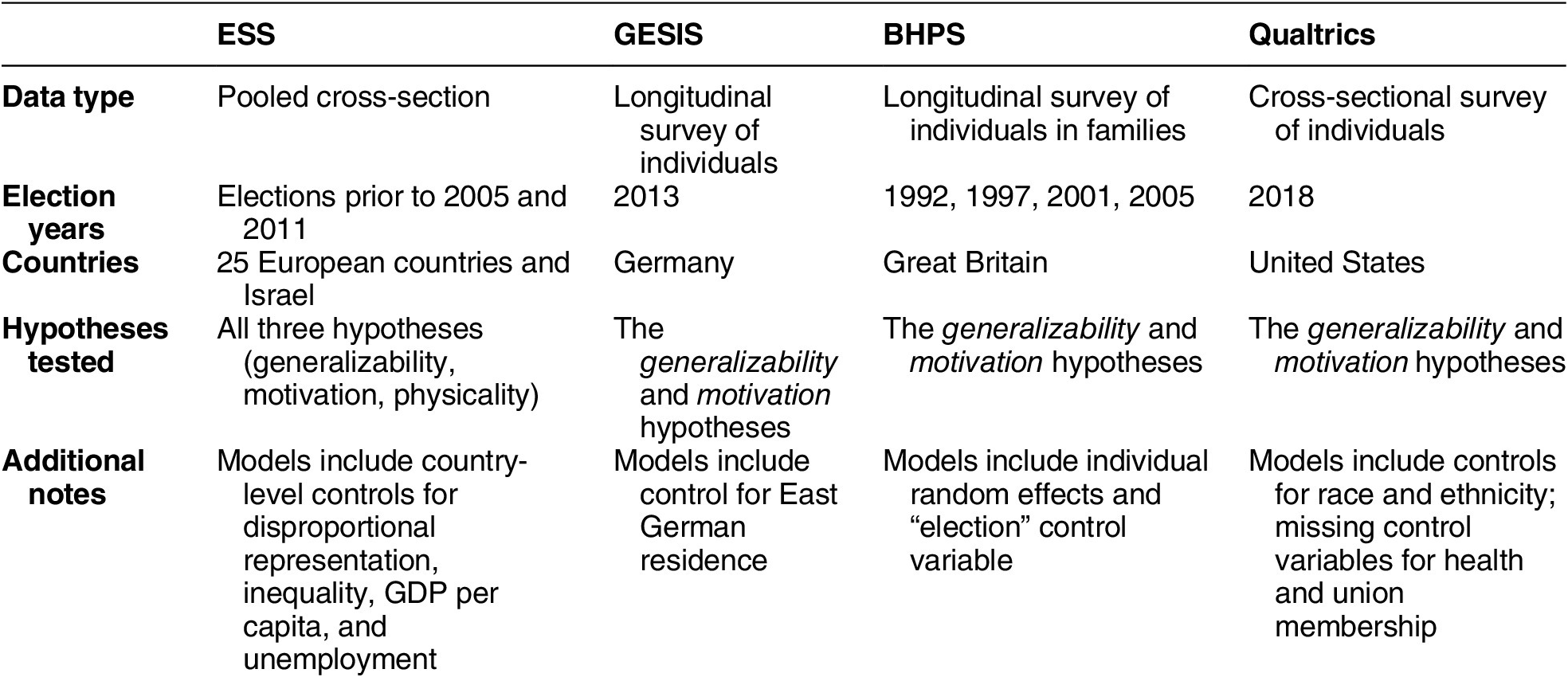
Methodology
We use data from the European Social Survey, the German GESIS Panel, the British Household Panel Study, and an original Qualtrics survey to test our hypotheses. Table 1 lists the key features of each study. The European Social Survey (ESS) is a biennial cross-sectional and nationally representative survey of Europe and Israel (Jowell et al. Reference Jowell, Roberts, Fitzgerald and Eva2007). The ESS is the primary data source because it includes nonvoting participation and covers the most countries. We pool 97,673 individuals from 2006 and 2012 because these waves include measures of depressive symptoms. The German GESIS Panel (GESIS) is a longitudinal study of adult residents in Germany (Bosnjak et al. Reference Bosnjak, Dannwolf, Enderle, Schaurer, Struminskaya, Tanner and Weyandt2018). Starting in 2013, a total of 7,599 respondents have been surveyed using online and mail questionnaires. The British Household Panel Survey (BHPS) is a nationally representative survey of British families from September 1991 to April 2009 (University of Essex 2018). The first wave included over 10,300 individuals in 5,500 households. Finally, we conducted a nationally representative online Qualtrics survey of 1,014 American citizens in August 2019.
Features of the Data Used in the Analyses

Appendix A (“Question Wording”) reports the measurement details for all variables; a summary of these measures is reported here. Voter turnout is self-reported and coded 1 for voted and 0 for abstained, with mean voter turnout being 0.77 in the ESS, 0.86 in the GESIS, 0.73 in the BHPS, and 0.68 in Qualtrics. We create a political motivation index by rescaling responses to standard questions about internal efficacy and political interest so they range from 0 (no motivation) to 1 (full motivation) and then taking the mean of the three items. The ESS index has a mean of 0.45, a standard deviation of 0.27, and a Cronbach’s alpha of 0.65. The corresponding statistics in the GESIS are 0.54, 0.21, and 0.58, and in Qualtrics they are 0.54, 0.24, and 0.57. The BHPS does not ask about internal efficacy, so the scale is comprised of only the political interest question. The BHPS mean is 0.42 and standard deviation is 0.30.
The ESS asks about nonvoting forms of political participation: contacting a politician or government official (12.8%), working for a political party or action group (3.8%), working for another political organization (13.6%), displaying campaign gear (7.4%), signing a petition (20.2%), and demonstrating in public (6.3%). Working for a political group or another organization, demonstrating, and voting typically require physical action. The remaining activities—contacting a politician, displaying campaign gear, and signing a petition—can be undertaken from home and thus impose minimal physical demands. We construct physical and nonphysical participation indices by taking the mean of each set of activities. The indices range from 0 (no participation) to 1 (full participation). The physical index has a mean of 0.23 and a standard deviation of 0.19; the nonphysical index has a mean of 0.14 and a standard deviation of 0.23. Appendix B (The Physicality of Participation) further discusses this categorization.
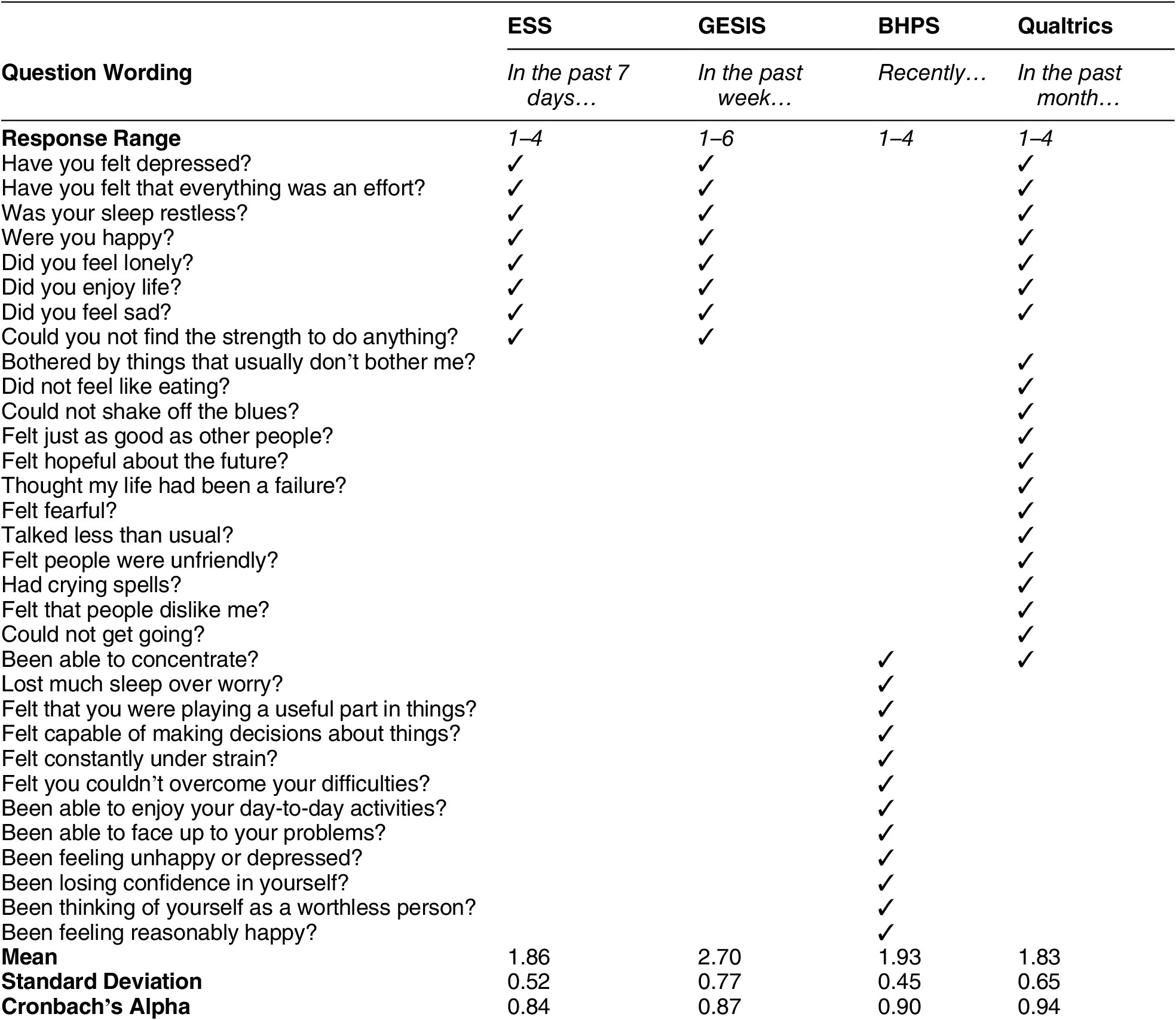
Questions about depressive symptoms are adapted from the Center for Epidemiological Studies Depression scale (Radloff Reference Radloff1977). Table 2 reports the question wording, response range, descriptive statistics, and reliability score for each study. We calculate depressive symptoms by taking the mean across the items for each respondent. Appendix C (The Measurement of Depression) discusses the trade-offs between self-reported and diagnostic measures of depression and includes an analysis of diagnoses using the General Social Survey.
Question Wording and Descriptive Statistics of Depressive Symptoms
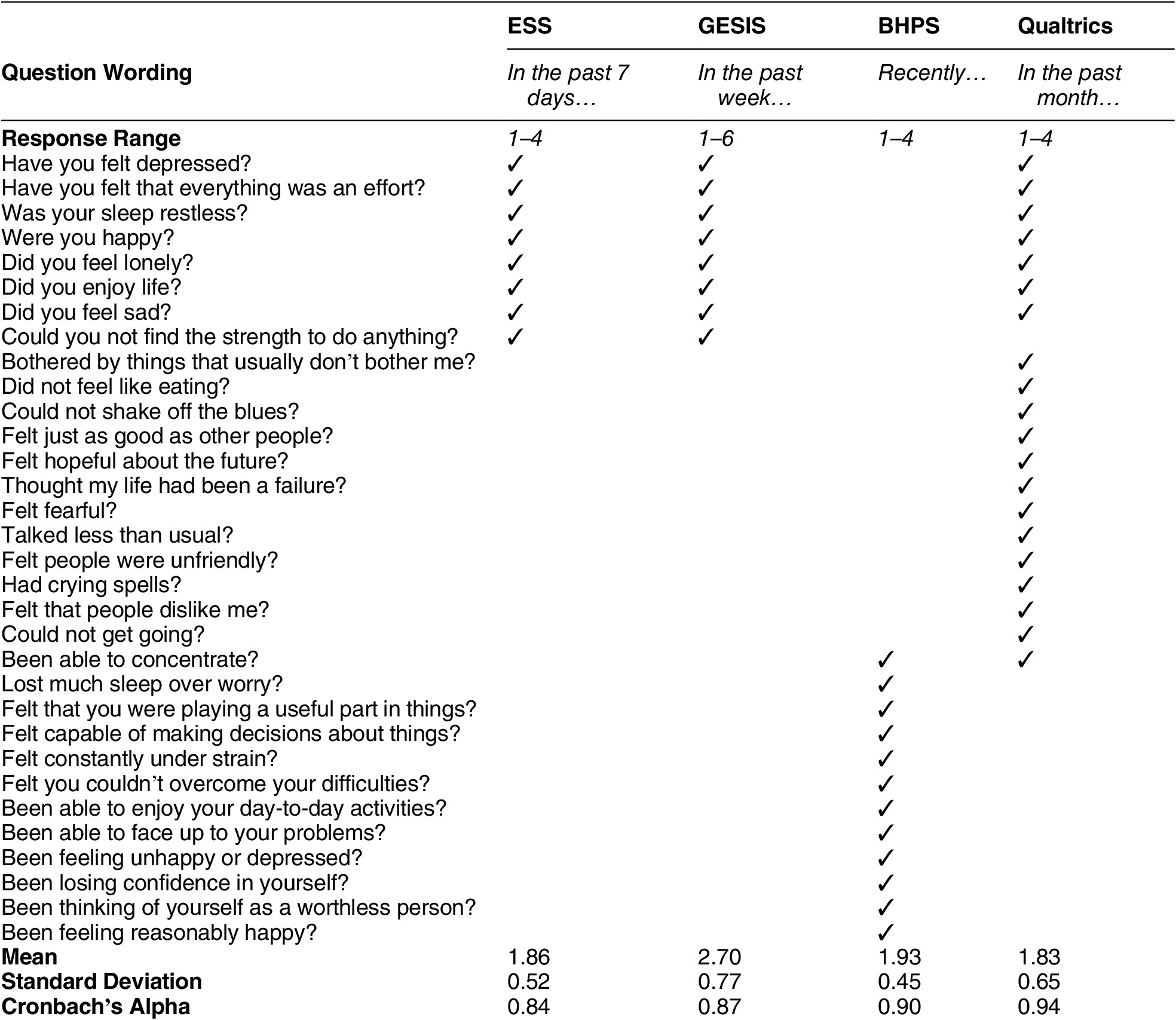
We test the generalizability hypothesis by estimating a logistic regression of voting in each study. The political motivation hypothesis is tested by estimating ordinary least squares regressions for the ESS, GESIS, and Qualtrics, and an ordinal logistic regression for the BHPS. Finally, we test the physical resources hypothesis by estimating fractional logistic regressions using the ESS. A negative and statistically significant coefficient for depressive symptoms would indicate that they reduce turnout, motivation, and participation. The model estimation strategy varies across studies according to the data structure; these differences are summarized in Table 1.
Regarding the voter turnout models, we use data from the 2014 GESIS because only this wave included a question about voting. In the BHPS, we use data from years in which a general election occurred (1992, 1997, 2001, 2005) or the following year, because these years best align with the time frame for which depressive symptoms are reported. In the Qualtrics survey, we analyze turnout in the 2018 midterm election because it has the closest temporal alignment with the measurement of depressive symptoms. For the political motivation model, we use ESS data from 2006 because it was the only wave to include both internal efficacy and depressive symptoms. For the GESIS and BHPS, we report models using data from election years or the subsequent year because we are particularly interested in the motivation to vote. Whether depressive symptoms affect motivation around elections—a time of heightened attention to politics—is germane to assessing the mechanisms by which depressive symptoms reduce turnout.
Across all models, we control for other important predictors: gender, age, education, income, marital status, religious attendance, union membership, and employment status. Each of these variables represents an important demographic characteristic or has been found to consistently predict political participation by capturing the effects of resources, mobilization, or socialization (Prior Reference Prior2010). The ESS models also control for the country’s economic health (GDP per capita, unemployment rate), level of income inequality (Gini coefficient), and political institutions (level of disproportionality in representation). The GESIS models control for whether a respondent lives in East or West Germany in order to account for the historical impact of communist rule. The BHPS model of political motivation excludes religious attendance, since it was not included in most of the waves that measured political interest. The Qualtrics survey did not ask about health or union membership, but we add controls for race (Black) and ethnicity (Hispanic). Appendix D (Descriptive Statistics) reports the mean, standard deviation, minimum, and maximum for all variables.
In the results, we only present the estimated coefficient and standard error for depressive symptoms from each model. Appendix E (Full Output of Regression Models) reports the results for the remaining variables. Appendix F (Fixed Effects in the British Household Panel Study) shows that individual-level fixed effects in the BHPS do not substantively change the results. Appendix G (Posttreatment Bias and Alternative Model Specifications) shows that the results are unaffected by the inclusion or exclusion of control variables for income, health, and unemployment. Appendix H (Reanalysis of Political Motivation Index) shows that using the full GESIS and BHPS data does not change the results. Appendix I (Vote Validation and the 2019 American National Election Pilot Study) provides evidence that depressive symptoms do not lead to overreporting of turnout. Finally, Appendix J (Predictions from the European Social Survey Models) reports the predicted levels of turnout, motivation, and participation for all statistically significant individual-level predictors in the ESS models.
Results
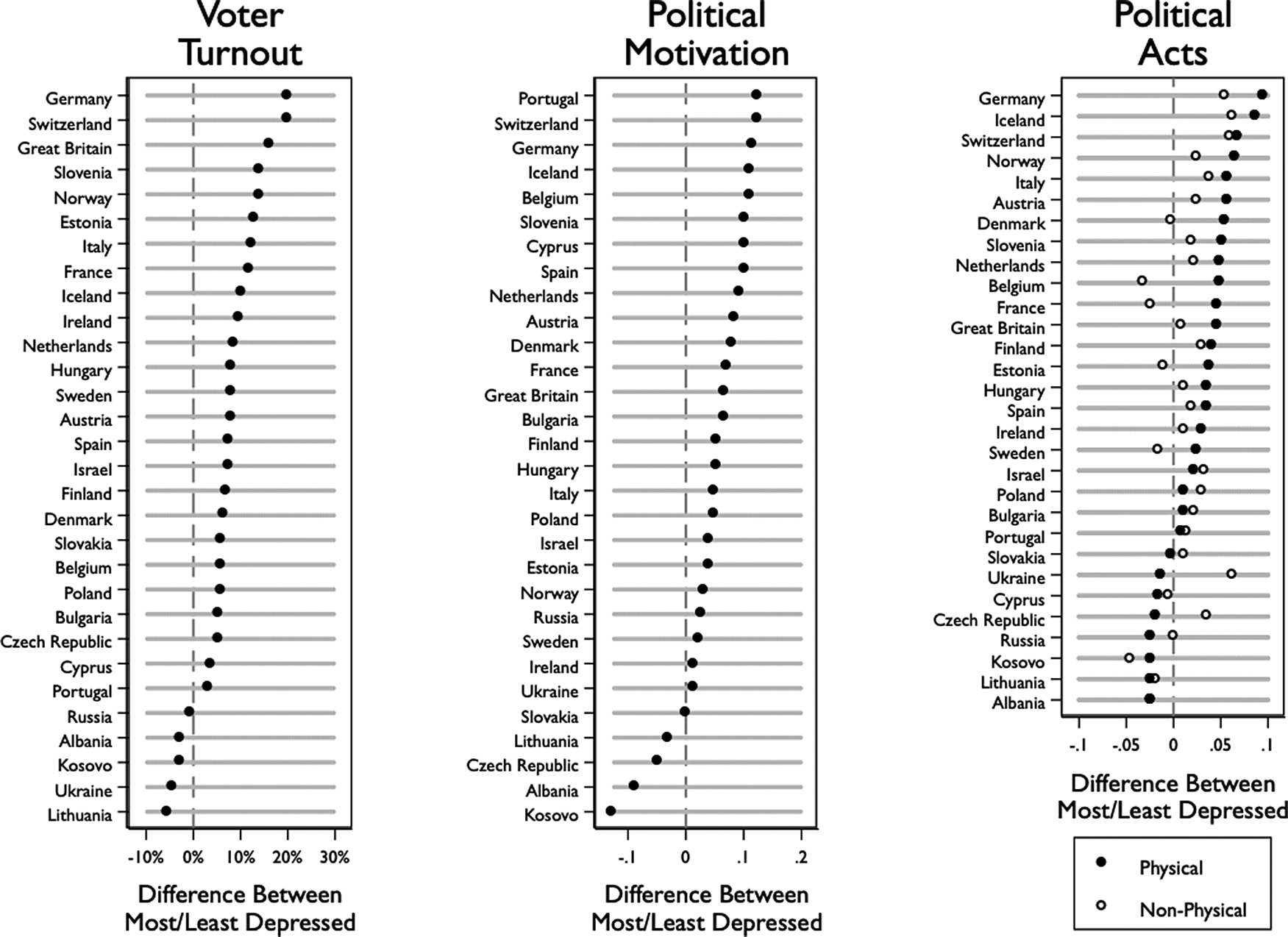
We begin by looking at the bivariate association between depressive symptoms and the political outcomes. Figure 1 shows the average weighted difference in turnout, motivation, and participation between the top and bottom quintiles of depressive symptoms for each country in the ESS. Turnout and motivation consistently decline as depressive symptoms increase. The turnout gap is positive in 25 of the 30 countries and larger than 5 percentage points in 23 of the 30 countries. A turnout gap is observed in other studies, too: 13.5% in the GESIS, 2.1% in the BHPS, and 35.2% in the Qualtrics survey. The gap in political motivation is also positive in 26 of the 30 countries and exceeds 5 points (0.05 on a scale from 0 to 1) in 17 countries. For the other studies, the motivation gap is 8.0 points in the GESIS, 1.5 points in the BHPS, and 14.4 points in the Qualtrics survey. For political acts, respondents without depressive symptoms generally report more physical and nonphysical participation. However, the gap is typically larger for physical acts than for nonphysical acts, suggesting an important role for physical resources. These descriptive statistics provide initial support for all three hypotheses.
Difference in Political Behavior between Depressed Quintiles in ESS

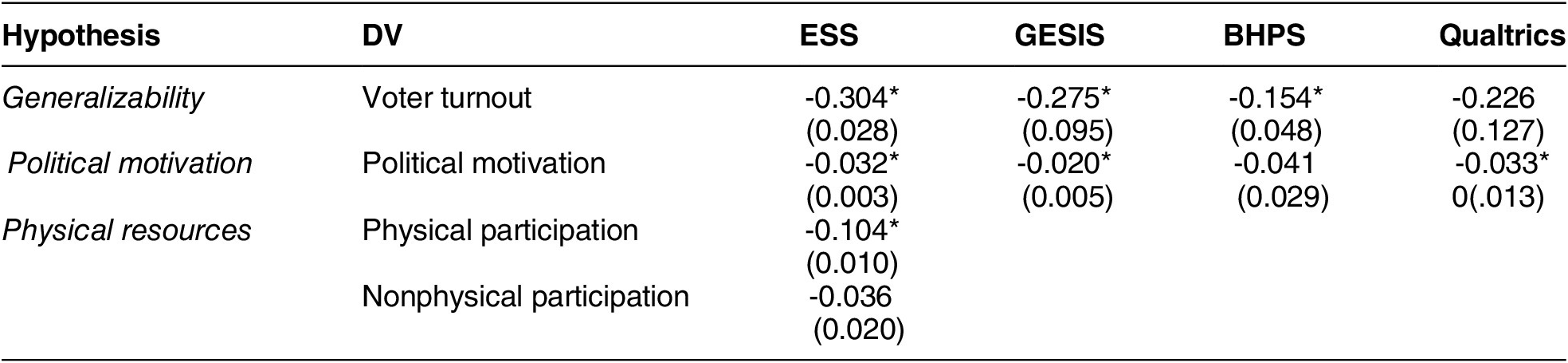
Table 3 reports the estimated coefficient and standard error for depressive symptoms in the multivariate models of voter turnout, political motivation, physical participation, and nonphysical participation across all studies. We discuss each set of models—turnout, motivation, and participation—in turn.
Estimated Coefficient and Standard Error for Depressive Symptoms

Note: * p < 0.05
Depressive symptoms have a negative and statistically significant effect on voting in the ESS, GESIS, and BHPS after controlling for other predictors. The coefficient in the Qualtrics model does not reach a conventional level of statistical significance; however, we would note that it is significant at the level of p < 0.10. Along with age, education, and marital status, depressive symptoms have the most consistent effect (in 3 of 4 models); other variables, including general health, are inconsistent in their direction and/or statistical significance.
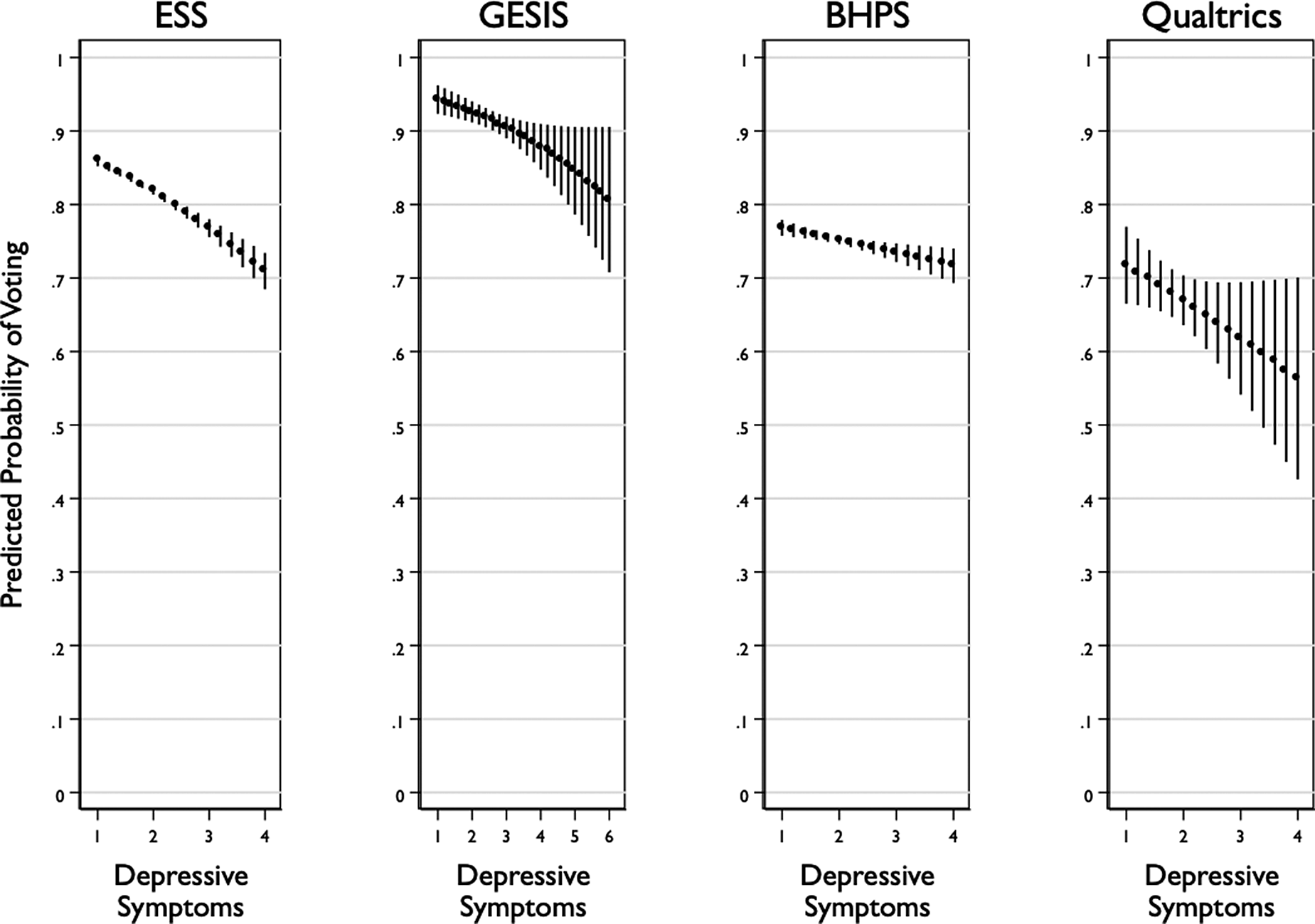
Figure 2 reports the predicted probability of voting across depressive symptoms (with other variables at their mean). Going from no to full depressive symptoms leads to a 5-point decline in the predicted probability of voting in the BHPS, a 14-point decline in the GESIS, a 15-point decline in the ESS, and a 25-point decline in the Qualtrics survey. In the ESS, the corresponding shifts in voting are 36 points for education; 32 points for age; 11 points for income; 6 points for marital status; 4 points for health and union membership; and 3 points for religious attendance and unemployment. The effect of depressive symptoms is thus substantially greater than that of many common predictors of turnout, although still well below age and education. Overall, the results show that depressive symptoms reduce voter turnout in democracies around the world and across the life course and thus provide strong support for the generalizability hypothesis.
Predicted Probability of Voting Across Depressive Symptoms

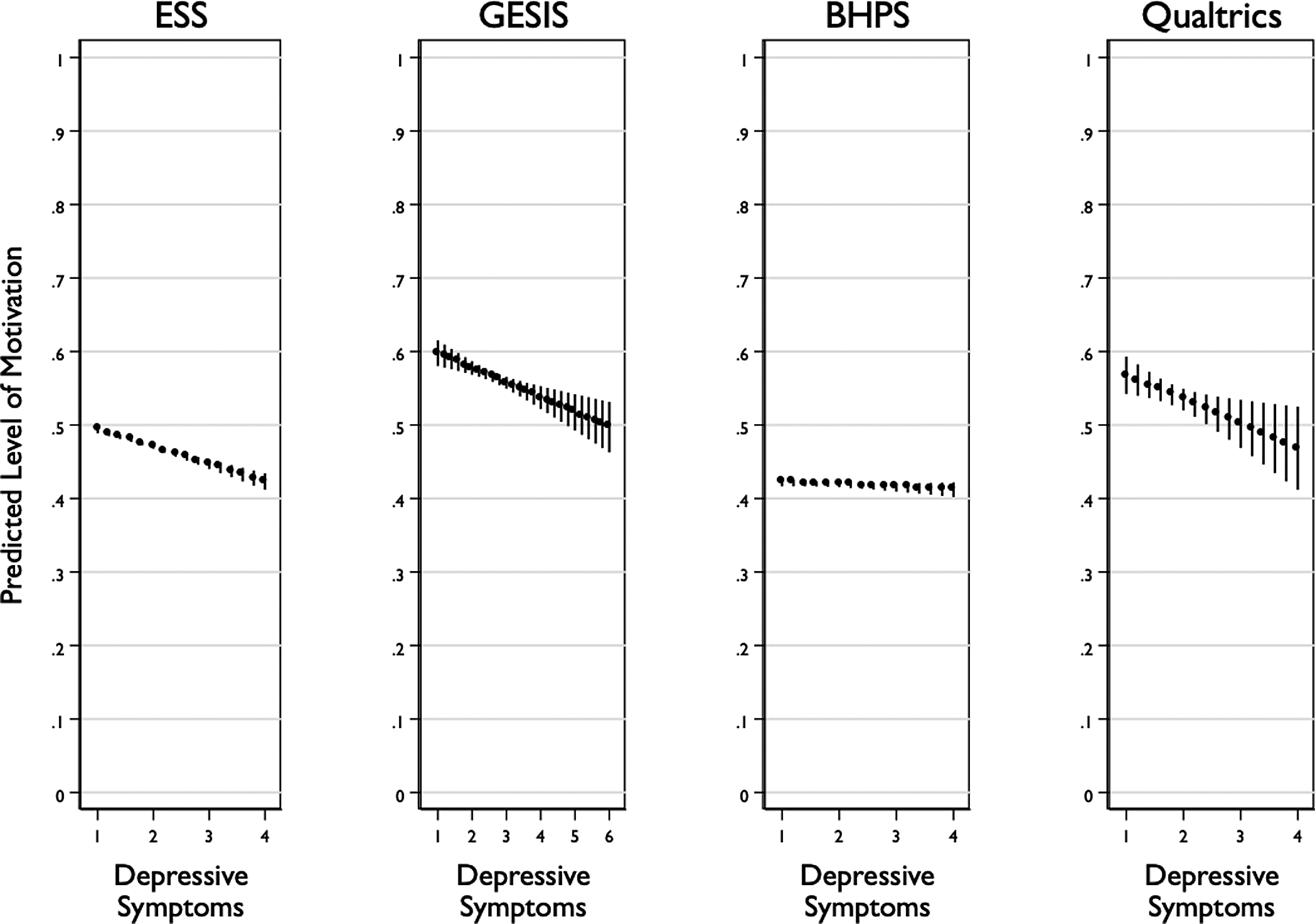
The political motivation models also reveal a negative and statistically significant effect of depressive symptoms in the ESS, GESIS, and Qualtrics studies. The estimated coefficient in the BHPS, while in the expected direction, does not reach a conventional level of significance. Figure 3 displays the predicted level of political motivation across depressive symptoms while other variables are held at their mean. In the ESS, a change from the minimum to the maximum of depressive symptoms is associated with a 0.095-point decline in motivation. The results from the GSS and the Qualtrics models are remarkably similar, with respective changes of 0.120 and 0.099 in political motivation across the range of depressive symptoms. The shifts in political motivation for the other predictors in the ESS are 41 points for education, 16 points for age, 9 points for income, 8 points for gender, 3 points for general health, and 2 points for union membership. Depressive symptoms therefore have one of the largest effects after education and age. Altogether, these results provide support for the political motivation hypotheses.
Predicted Level of Political Motivation across Depressive Symptoms

Finally, the results of the political participation models show that the coefficients for depressive symptoms are negative and statistically significant for physical acts and negative but not statistically significant for nonphysical acts. Moving from no to full depressive symptoms reduces the predicted probability of physical action from 0.261 to 0.206 (on a 0 to 1 scale), while a similar shift in depressive symptoms reduces nonphysical action from 0.138 to 0.126 (a difference that is not statistically distinguishable from zero). Notably, this shift in depressive symptoms has a greater effect on the predicted level of physical participation than do corresponding shifts in all other variables except age and education. For nonphysical participation, the strongest predictors are education, age, income, and union membership. Overall, these results highlight the importance of psychosomatic symptoms and physical resources.
Conclusions
Our findings provide compelling evidence for the negative effect of depressive symptoms on political participation. Apart from education and age, depressive symptoms in fact constitute the only other variable that has a consistent and significant effect on both electoral turnout and political motivation across the studies. In particular, they turn out to be a better predictor for nonparticipation than many of the factors identified in Verba, Scholzman, and Brady’s civic voluntarism model, such as income and opportunities to practice civic skills (religious attendance, union membership). Confirming that the negative effect of depressive symptoms on electoral turnout indicated by earlier research generalizes across Western democracies and age groups (generalizability hypothesis), we also expand earlier research by exploring two mechanisms that lead from depressive symptoms to nonparticipation. First, depressive symptoms negatively affect political interest and internal political efficacy (political motivation hypothesis). Secondly, we show that the loss of physical energy associated with depressive symptoms can constitute an obstacle to participation, which is reflected in the fact that the negative effect of depression on participation is stronger for acts that require physicality (physical resources hypothesis).
Importantly, we not only find strong evidence for the reported effects; we have reason to believe that our estimations are very conservative and that we might in fact only be seeing the tip of the iceberg where the political consequences of depression are concerned. If those with the most severe depressive symptoms are also the least likely to participate in our surveys, then we may very well underestimate the strength of the relationship between democracy and depression. In sum, we thus have reason to urge other researchers to seriously consider depressive symptoms as an important predictor of turnout and political participation.
Moreover, our findings constitute a reason to reflect on the long-term political implications of the apparently rising prevalence of depression. Depressive symptoms disproportionately affect individuals with lower socioeconomic status and their negative influence on political participation might further enhance problems of political inequality: depressive symptoms constitute an obstacle for groups that already have difficulty in making their voices heard. In this context, we should expect the long-term social and political ramifications of the 2020 coronavirus crisis to depend to a significant degree on its effects on mental health in the population. A further rise in depressive symptoms could critically affect the functioning of institutions that depend on political participation. However, psychologists have also observed phenomena of individual growth in the face of crises and adverse life events (see Tedeschi and Calhoun Reference Tedeschi and Calhoun2004). There may thus be a justified hope for an activation of citizens and a revitalization of civil society in the wake of the coronavirus crisis, despite the toll the pandemic has taken on the mental health of ordinary citizens.
Supplementary Materials
To view supplementary material for this article, please visit http://dx.doi.org/10.1017/S0003055420000830.
Replication materials can be found on Dataverse at: https://doi.org/10.7910/DVN/ZABHCA.




Comments
No Comments have been published for this article.