INTRODUCTION
Neurocognitive dysfunction is arguably the most central characteristic of moderate–severe traumatic brain injury (TBI), with significant deficits in the acute stage that may persist many years after injury (Draper & Ponsford, Reference Draper and Ponsford2008; Himanen et al., Reference Himanen, Portin, Isoniemi, Helenius, Kurki and Tenovuo2006; Millis et al., Reference Millis, Rosenthal, Novack, Sherer, Nick, Kreutzer and Ricker2001). Long-standing cognitive impairments can influence all areas of the individual’s life and make participation in work and society challenging (Gautschi et al., Reference Gautschi, Huser, Smoll, Maedler, Bednarz, von Hessling and Seule2013; Grauwmeijer et al., Reference Grauwmeijer, Heijenbrok-Kal, Peppel, Hartjes, Haitsma, de Koning and Ribbers2018; Ponsford, Draper, & Schonberger, Reference Ponsford, Draper and Schonberger2008). These impairments occur after diffuse axonal injury and contusions, particularly in the frontal and temporal lobes, which are brain regions important in Memory and Executive function (Haberg et al., Reference Haberg, Olsen, Moen, Schirmer-Mikalsen, Visser, Finnanger and Eikenes2015; Wood & Worthington, Reference Wood and Worthington2017). In terms of neurocognitive recovery after TBI, early spontaneous improvement is typically observed in the initial weeks and months after injury and maintained throughout the first year (Christensen et al., Reference Christensen, Colella, Inness, Hebert, Monette, Bayley and Green2008; Finnanger et al., Reference Finnanger, Skandsen, Andersson, Lydersen, Vik and Indredavik2013).
Stability in cognitive recovery is often reached approximately 1–2 years after injury (Rabinowitz, Hart, Whyte, & Kim, Reference Rabinowitz, Hart, Whyte and Kim2018; Ruttan, Martin, Liu, Colella, & Green, Reference Ruttan, Martin, Liu, Colella and Green2008). However, a complete recovery is unlikely, and individuals with moderate–severe TBI continue to exhibit cognitive difficulties 5 and 10 years after injury (Hetherington, Stuss, & Finlayson, Reference Hetherington, Stuss and Finlayson1996; Marsh, Ludbrook, & Gaffaney, Reference Marsh, Ludbrook and Gaffaney2016), with larger impairments in the domains of attention, Executive functions, and Memory (Chu et al., Reference Chu, Millis, Arango-Lasprilla, Hanks, Novack and Hart2007; Dikmen et al., Reference Dikmen, Corrigan, Levin, Machamer, Stiers and Weisskopf2009; Haberg et al., Reference Haberg, Olsen, Moen, Schirmer-Mikalsen, Visser, Finnanger and Eikenes2015; Rabinowitz et al., Reference Rabinowitz, Hart, Whyte and Kim2018; Ruttan et al., Reference Ruttan, Martin, Liu, Colella and Green2008; Vasquez, Tomaszczyk, Sharma, Colella, & Green, Reference Vasquez, Tomaszczyk, Sharma, Colella and Green2018). Various publications have demonstrated that moderate–severe TBI can lead to progressive degenerative processes affecting neurocognitive functioning (Corrigan & Hammond, Reference Corrigan and Hammond2013) as well as the development of late medical effects such as posttraumatic epilepsy (Lowenstein, Reference Lowenstein2009; Masel & DeWitt, Reference Masel and DeWitt2010); thus, some individuals do not achieve stability in the chronic stages of injury. Unfortunately, individuals with moderate–severe TBI are more at risk for developing neurological disorders later in life, such as Alzheimer’s disease, particularly for those with the APOE ε4 genotype (Edlow et al., Reference Edlow, Keene, Perl, Iacono, Folkerth, Stewart and Dams-O’Connor2018; Isoniemi, Tenovuo, Portin, Himanen, & Kairisto, Reference Isoniemi, Tenovuo, Portin, Himanen and Kairisto2006). However, the effect of APOE ε4 on cognitive functioning was not observed during the early period of recovery (Padgett, Summers, Vickers, McCormack, & Skilbeck, Reference Padgett, Summers, Vickers, McCormack and Skilbeck2016).
Studies have reported that individuals with moderate–severe TBI can decline in cognitive functioning between the first months and 5 years after injury (Green et al., Reference Green, Colella, Maller, Bayley, Glazer and Mikulis2014; Millis et al., Reference Millis, Rosenthal, Novack, Sherer, Nick, Kreutzer and Ricker2001; Till, Colella, Verwegen, & Green, Reference Till, Colella, Verwegen and Green2008), at least in some areas of cognitive functioning such as Memory functions (Till et al., Reference Till, Colella, Verwegen and Green2008) and Executive function (Vasquez et al., Reference Vasquez, Tomaszczyk, Sharma, Colella and Green2018). Indeed, the degree of variability in cognitive recovery following moderate–severe TBI is exemplified by Millis et al. (Reference Millis, Rosenthal, Novack, Sherer, Nick, Kreutzer and Ricker2001), where 22.2% of patients improved, 15.2% declined, and 62.6% were unchanged in neuropsychological measures 1–5 years after injury. However, long-term changes or declines were not observed in intellectual functioning from 1 year up to 16 years after injury (Wood & Rutterford, Reference Wood and Rutterford2006).
Identifying factors associated with neurocognitive outcomes in chronic TBI when viewed over longer periods is of importance in order to understand its progression. Differences in injury severity (Dikmen, Machamer, Powell, & Temkin, Reference Dikmen, Machamer, Powell and Temkin2003; Draper & Ponsford, Reference Draper and Ponsford2008) including duration of posttraumatic amnesia (PTA) (Konigs, de Kieviet, & Oosterlaan, Reference Konigs, de Kieviet and Oosterlaan2012; Sigurdardottir et al., Reference Sigurdardottir, Andelic, Wehling, Roe, Anke, Skandsen and Schanke2015) have been shown to influence the recovery of cognitive deficits. Patient characteristics such as cognitive reserve or premorbid IQ (Christensen et al., Reference Christensen, Colella, Inness, Hebert, Monette, Bayley and Green2008; Leary et al., Reference Leary, Kim, Bradley, Hussain, Sacco, Bernad and Chan2018), education (Sumowski, Chiaravalloti, Krch, Paxton, & Deluca, Reference Sumowski, Chiaravalloti, Krch, Paxton and Deluca2013), and age (Kaup et al., Reference Kaup, Peltz, Kenney, Kramer, Diaz-Arrastia and Yaffe2017; Marquez de la Plata et al., Reference Marquez de la Plata, Hart, Hammond, Frol, Hudak, Harper, O'Neil-Pirozzi, Whyte, Carlile and Diaz-Arrastia2008; Senathi-Raja, Ponsford, & Schonberger, Reference Senathi-Raja, Ponsford and Schonberger2010; Wood, Reference Wood2017) have been recognized as predictors that were significantly associated with the cognitive outcomes after TBI. For example, a high age at injury and male gender were significant risk factors of cognitive deficits and decline decades after TBI (Himanen et al., Reference Himanen, Portin, Isoniemi, Helenius, Kurki and Tenovuo2006; Senathi-Raja et al., Reference Senathi-Raja, Ponsford and Schonberger2010).
Depression and anxiety are the most common psychiatric problems experienced by patients following TBI (Bombardier, Hoekstra, Dikmen, & Fann, Reference Bombardier, Hoekstra, Dikmen and Fann2016; Gould, Ponsford, Johnston, & Schonberger, Reference Gould, Ponsford, Johnston and Schonberger2011). Correspondingly, there have been several longitudinal studies of neuropsychiatric issues (anxious/depressed mood) and cognitive outcomes over 10 years after moderate–severe TBI (Dahm & Ponsford, Reference Dahm and Ponsford2015; Grauwmeijer et al., Reference Grauwmeijer, Heijenbrok-Kal, Peppel, Hartjes, Haitsma, de Koning and Ribbers2018). Grauwmeijer et al. (Reference Edlow, Keene, Perl, Iacono, Folkerth, Stewart and Dams-O’Connor2018) showed no strong evidence for associations between depression and neurocognitive functioning spanning 10 years post-TBI. Other studies reported that elevated scores on emotional symptom rating scales (Symptom Checklist-90-R, Hospital Anxiety and Depression Scale) were related to worse neurocognitive outcomes up to 10 years after TBI (Dahm & Ponsford, Reference Dahm and Ponsford2015; Ponsford et al., Reference Ponsford, Draper and Schonberger2008).
There is still limited research on the long-term cognitive trajectories following TBI. Inconsistent findings, partly due to the heterogeneity of TBI and different assessment methods used in the studies, challenge our understanding of the chronicity of cognitive difficulties after moderate–severe TBI. Thus, well-designed, longitudinal studies with large samples are still needed. The current study contributes to the literature by expanding our previous research of the 1 year follow-up after TBI (Sigurdardottir, Andelic, Roe, & Schanke, Reference Sigurdardottir, Andelic, Roe and Schanke2009) and exploring the changes in scores in neurocognitive domains (Memory, Executive functions, and Reasoning) across 10 years postinjury in individuals with moderate–severe TBI. A central aim is to investigate whether these changes are related to injury severity, demographics, functional outcome at 3 months postinjury, and emotional distress at 1 year postinjury. Memory and Executive function were included because these domains are most likely to be affected following TBI (Kersel, Marsh, Havill, & Sleigh, Reference Kersel, Marsh, Havill and Sleigh2001). Other TBI studies using IQ assessments have found that general intelligence was significantly lower in individuals with TBI compared to healthy controls (Donders, Tulsky, & Zhu, Reference Donders, Tulsky and Zhu2001; Konigs et al., Reference Konigs, de Kieviet and Oosterlaan2012; Rassovsky et al., Reference Rassovsky, Levi, Agranov, Sela-Kaufman, Sverdlik and Vakil2015). In order to investigate the influence of injury severity characteristics on trajectory of intellectual abilities, the Reasoning domain was included in this longitudinal study. In addition, this study aims to investigate whether neuropsychological performance remained stable or changed in the chronic phase from 1 year to later follow-ups (5 or 10 years). Based on the current literature, it was hypothesized that neurocognitive functioning would be significantly improved over time. It was expected that education and injury severity would significantly predict long-term neurocognitive functioning. In order to identify individuals manifesting cognitive decline by using a Reliable Change Index (RCI), it was hypothesized that decline might appear within Memory and Executive function but not in Reasoning in the long-term perspective.
METHODS
Design
This study was a longitudinal prospective study of individuals with acute TBI admitted from 2005 to 2007 to the Trauma Referral Centre at Oslo University Hospital, Oslo, Norway. Participants had four follow-ups over 10 years with neuropsychological assessments at 3 months, 1, 5, and 10 years postinjury.
Study population
The criteria for inclusion were (a) persons 16–55 years of age; (b) residing in East region of Norway; (c) admitted with the following ICD-10 diagnoses within 24 h of injury: contusions/diffuse brain lesions (S06.1–S06.3, S06.7–S06.9, S07.0, S07.1, S09.7, T04.0, and T06.0), traumatic intracranial hemorrhages (S06.4–S06.6), cranial fractures (S02.0, S02.1, and S02.7–S02.9), and concussions (S06.0) (see Andelic, Sigurdardottir, Brunborg, & Roe, Reference Andelic, Sigurdardottir, Brunborg and Roe2008); and (d) computed tomography (CT) brain scan performed within 24 h postinjury. Patients with a diagnosis expected to interfere with TBI-related outcome were excluded: (a) previous neurological disorders; (b) associated spinal cord injuries; and (c) severe psychiatric or substance use disorders. The initial severity of TBI was measured by the Glasgow Coma Scale (GCS) (Teasdale & Jennett, Reference Teasdale and Jennett1974), with scores of 3–8 (severe TBI) and 9–12 (moderate TBI) given on admission to the emergency department at the hospital or preintubation values assigned at the accident site. Eligibility criteria for the neuropsychological study included patients who had a Galveston Orientation and Amnesia Test (GOAT) (Levin, O’Donnell, & Grossman, Reference Levin, O’Donnell and Grossman1979) score of more than 75 and speaking the Norwegian language.
Eligible participants between 16 and 55 years old received a letter containing information about the study 4–6 weeks after injury. A total of 147 persons with moderate–severe TBI were eligible during the inclusion period of 2005–2007. Twenty-four persons died in acute and postacute care and four died between 1 and 10 year follow-ups. Eleven persons who had ongoing PTA or were in a vegetative state during the first year were excluded. Twenty-nine persons declined to participate. The final sample included 79 patients (61 males and 18 females) for a 10 year analysis in this study (see Figure 1).
Patient eligibility flowchart and follow-ups.

Evaluations were conducted at the outpatient TBI department of the Oslo University Hospital, Oslo, Norway, or during the rehabilitation stay at the Sunnaas Rehabilitation Hospital, Nesodden, Norway, between August 2005 and February 2017. Participants completed a neuropsychological examination before they completed a set of questionnaires. The examination duration was approximately 3 hr. Written consent was obtained from all participants. No control group was used in this study. The Regional Committee for Medical Research Ethics, East-Norway, and the Norwegian Data Inspectorate approved the study according to the Helsinki Declaration.
Measures
Assessment of clinical and trauma status
Demographic variables (age, gender, education, employment, and marital status) were collected at 3-month follow-up. Employment preinjury was dichotomized into employed and unemployed, where individuals in the employed group consisted of individuals working full/part time or studying (high school, college, or university), while those in the unemployed group were jobseekers, on sick leave, or receiving disability pension. Marital status was dichotomized into married/partnered and single.
Trauma scores of the Abbreviated Injury Scale (AIS) (Association for the Advancement of Automotive Medicine, 1990) and Injury Severity Score (ISS) (Baker, O’Neill, Haddon, & Long, Reference Baker, O’Neill, Haddon and Long1974) were extracted from the Trauma Registry at the Oslo University Hospital, Ulleval. AIShead scores ranged from one (minor) to six (fatal). An ISS score greater than 15 (ranging from 1 to 75) was accepted as the definition of a major trauma patient.
Duration of PTA was chosen as a measure of injury severity because it is most often used by rehabilitation physicians when making prognostic evaluations (Ponsford, Spitz, & McKenzie, Reference Ponsford, Spitz and McKenzie2016). A GOAT score above 75 indicated emergence from PTA. PTA was evaluated on a daily basis during rehabilitation in 89% of cases with severe TBI and 45% of those with moderate TBI. Four patients with severe TBI had PTA lasting longer than 3 months and were therefore assessed with neuropsychological measures at 5 months postinjury. For 20 patients (25%), duration of PTA was obtained from medical records.
Assessment of emotional distress
The Symptom Checklist 90-Revised (SCL-90-R) (Derogatis, Reference Derogatis1983) measured 90 symptoms during the previous 7 days on a 5-point scale from 0 (not at all) to 4 (extremely). The 90 scores were transferred to a profile sheet of nine symptom dimensions (Somatization, Obsessive-Compulsive, Interpersonal Sensitivity, Depression, Anxiety, Hostility, Phobic Anxiety, Paranoid Ideation, and Psychoticism) and provided a Global Severity Index (GSI) that represents overall psychological distress. The SCL-90-R was collected at 3-month and 1-year follow-ups. Because of the lack of awareness in the early stage after brain injury (Geytenbeek, Fleming, Doig, & Ownsworth, Reference Geytenbeek, Fleming, Doig and Ownsworth2017) we chose to include the GSI score at 1 year to predict trajectories of long-term cognitive outcomes. The demographically corrected T-score was used (Derogatis, Reference Derogatis1983), and a higher score was indicative of greater emotional distress. The effects of depression, comorbid psychiatric disorders, medication, and substance abuse on neurocognitive outcomes were not examined in the current study because of insufficient statistical power for multiple predictor analysis. Further details about psychiatric disorders, including depression, anxiety, and substance abuse, have been published elsewhere (Sigurdardottir, Andelic, Roe, & Schanke, Reference Sigurdardottir, Andelic, Roe and Schanke2013).
Assessment of functional status
The Glasgow Outcome Scale-Extended (GOSE) is a structured interview for assessing areas of independence, work, leisure activities, and participation in social life (Wilson, Pettigrew, & Teasdale, Reference Wilson, Pettigrew and Teasdale1998). The GOSE scores represent the following: 1 = dead, 2 = vegetative state, 3 and 4 = lower/upper severe disability, 5 and 6 = lower/upper moderate disability, 7 and 8 = lower/upper good recovery. A GOSE score ≥ 6 indicates that people are able to participate in a working environment or studying (Wilson et al., Reference Wilson, Pettigrew and Teasdale1998). GOSE measured at 3 months was chosen because this time point has been shown to predict long-term neuropsychological deficits better than GOSE measured at early hospital discharge (Gautschi et al., Reference Gautschi, Huser, Smoll, Maedler, Bednarz, von Hessling and Seule2013).
Assessment of neurocognitive domains
Neuropsychological evaluations were performed at 3-month, and at 1-, 5-, and 10-year follow-ups. Neuropsychological raw scores were transformed to standardized scores according to age- and gender-corrected normative data. Normative data were not stratified by education. The tests included in each domain were based on data in the literature and were among the tests most commonly used by clinical neuropsychologists regarding TBI (Rabin, Barr, & Burton, Reference Rabin, Barr and Burton2005).
Memory domain
The California Verbal Learning Test-II (CVLT-II; List A trials 1–5) (Delis, Kaplan, Kramer, & Ober, Reference Delis, Kaplan, Kramer and Ober2000) was administered to assess learning and memory using the sum of correctly recalled words (List A trials 1–5). The Rey–Osterrieth Complex Figure Test (ROCF) (Meyers & Meyers, Reference Meyers and Meyers1995) measured visual–spatial constructional ability and visual memory, wherein the participant copies a complex figure and draws the same figure from memory. Only the short delay task (ca. 3 min) was used in this study. Results from both the CVLT-II (List A) (Delis et al., Reference Delis, Kaplan, Kramer and Ober2000) and ROCF (Meyers & Meyers, Reference Meyers and Meyers1995) were given by a T-score (M = 50, SD = 10).
Executive function domain
The subtests of the Letter Fluency Task and Color-Word Interference Test (CWIT, condition 3) from the Delis–Kaplan Executive Function System (D-KEFS; Delis, Kaplan, & Kramer, Reference Delis, Kaplan and Kramer2001) were administered to assess phonemic word fluency, inhibition, and mental flexibility. The Letter-Number Sequencing from the Wechsler Adult Intelligence Scale Third Edition (WAIS-III; Wechsler, Reference Wechsler1997) was included to assess verbal working memory and divided attention. The Trail Making Test, Part B (Reitan & Wolfson, Reference Reitan and Wolfson1985) was administered as a measure of mental flexibility.
Reasoning (intellectual) domain
The intelligence/reasoning level was assessed by administering the subtests Similarities and Matrices of the WAIS-III (Wechsler, Reference Wechsler1997).
Statistical analysis
Statistical analyses were performed using IBM SPSS, version 23 (SPSS Inc., Chicago, IL, USA). Descriptive analyses of demographic, clinical, and neuropsychological tests were performed. The subtask scores of the D-KEFS and WAIS-III were scaled scores (M = 10, SD = 3), which were converted into T-scores before a composite score was calculated within each domain (Memory, Executive function, and Reasoning). The Shapiro–Wilk test showed that the neuropsychological T-scores accorded with normal distribution (all p > .05). Sample size and statistical power were calculated by the program G*power (Faul, Erdfelder, Lang, & Buchner Reference Faul, Erdfelder, Lang and Buchner2007). The sample size of 77 would give a statistical power of 0.8 at α level of .05, with large effect size (F 2 = 0.26) and six predictors. The RCI values were calculated for neurocognitive composite scores based on the RCI described by Jacobson and Truax (Jacobson & Truax, Reference Jacobson and Truax1991). Change was defined by RCI values ±1.645 (a 2-tailed α of 0.10, with a 90% confidence interval) as recommended by Duff (Reference Duff2012). For each neurocognitive domain, the number of participants with improved (positive values) or declined (negative values) performance over the years was counted, that is, between 1 and 5 years and between 1 and 10 years.
A hierarchical linear modeling (HLM) analysis was used to examine predictors for the three separate models of Memory, Executive function, and Reasoning. Neurocognitive composite scores were used as dependent variables with four time points coded as 0.25 (3 months), 1 (1 year), 5 (5 years), and 10 (10 years). First, models were run without covariates to establish the best-fitting model. When the most accurate curvature model was determined, the covariates were then included in the models: age, education, duration of PTA, AIShead, general functioning (GOSE) at 3 months, and self-reports of emotional distress (SCL-90-R: GSI) at 1 year. Since the correlation between ISS and AIShead was high (r = .71), the AIShead was preferred as a measure of brain injury severity. The Pearson correlation coefficient between PTA and AIShead was r = .36. Covariate data were entered simultaneously as fixed effects. A random intercept was included for the patient neuropsychological performance, and the interactions between follow-up time and significant predictors in each model were then modeled. Continuous predictor variables were centralized with the total sample mean values before being entered into the HLM. The model handled missing data at the follow-ups through maximum likelihood estimation, thus retaining all 79 patients. Statistically significant fixed effects on the Memory, Executive function, and Reasoning composite scores were then graphed across each of the time points. The main effects would indicate that the composite scores over time vary as a function of the predictor variable. Cohen’s d effect sizes were calculated for the neuropsychological tests between the first and last assessment follow-ups, interpreted as small = 0.10, medium = 0.30, and large = 0.50 (Cohen, Reference Cohen1992). The statistical significance was set at p < .05.
RESULTS
Patients’ characteristics
Table 1 presents the general characteristics and injury-related data of the 79 participants. The majority of participants were male (77%) and single (75%) and were working or studying at the time of injury (85%). The mean age was 30.2 years (range 16–52), and the mean years of education was 12.6 years (range 8–18). Education is presented as a continuous variable in Table 1 but was categorized as 9–12 years or ≥13 years of education, based on the mean values before being entered into the HLM analyses.
Demographics, patient characteristics, and symptom scores of the follow-up sample (N = 79)

GCS = Glasgow Coma Scale; PTA = posttraumatic amnesia; GOSE = Glasgow Outcome Scale-Extended; SCL-90-R: Symptom Checklist 90-Revised.
Note: Values are mean (SD) or n (%).
According to the GCS, 46 participants sustained a severe TBI (GCS 3–8). For the total sample, PTA ranged from 0 to 128 days. The AIS scores ranged from 2 to 5 and the ISS scores ranged from 5 to 59. A traffic accident was the cause of injury in more than half of the injuries. As reflected by the GOSE mean scores at both the 3-month (range 3–7) and 10-year follow-ups (range 5–8), the functional levels were consistent with lower and upper moderate disability, respectively. Participants did not report severe symptoms according to the mean scores of the SCL-90-R at the 3-month (range 39–131) and 1-year (range 40–113) follow-ups.
Results of sensitivity analyses comparing the participants followed up at 10 years (n = 53) and those who dropped out in the study (n = 26) did not show significant differences with respect to age t = −0.492, p = .624, education t = 0.869, p = .387, PTA t = 0.709, p = .481, AISheadt = 1.492, p = .140, or GOSE at 3 months t = −0.937, p = .352. These characteristics were similar for the participants and dropouts. Of note, the SCL-90-R GSI at 3 months was statistically significant between the groups t = −2.029, p = .046, and the SCL-90-R GSI at 1 year approached marginal significance t = −1.714, p = .091. Those in the dropout group were more likely to report emotional distress than the participants.
Neurocognitive performance over time
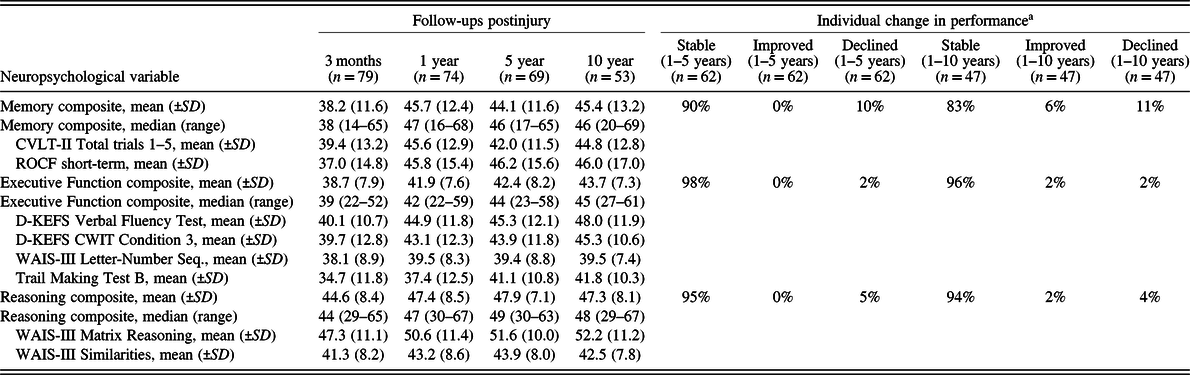
Descriptive statistics for neuropsychological scores at each follow-up (i.e., 3 months, 1, 5, and 10 years) are presented in Table 2. At 3 months, the TBI sample showed 1 SD below average in composite scores of Memory and Executive function and 0.5 SD below average in the composite score of Reasoning. As seen in Table 2, the mean Memory composite scores increased from 38.2 (SD 11.6) at 3 months to 45.4 (SD 13.2) at 10 years; the mean Executive function composite scores increased from 38.7 (SD 7.9) to 43.7 (SD 7.3) between the same follow-ups; and the mean Reasoning composite scores increased from 44.6 (SD 8.4) to 47.3 (SD 8.1). The effect sizes between the first (3 months) and last (10-year) follow-up assessments were large for the Memory domain (Cohen’s d range: 0.44–0.57), followed by small to large effect sizes for the Executive domain (Cohen’s d range: 0.17–0.70), and small to moderate effect sizes for the Reasoning domain (Cohen’s d range: 0.15–0.44), across age and gender groups.
The three neurocognitive composite scores and neuropsychological tests from 3 months to 10-year follow-up (N = 79)

CVLT-II = California Verbal Learning Test-II; ROCF = Rey–Osterrieth Complex Figure Test; D-KEFS = Delis–Kaplan Executive Function System; CWIT = Color-Word Interference Test; WAIS-III = Wechsler Adult Intelligence Scale-Third Edition.
Note: Values are T-scores.
a Based on the Reliable Change Index for neurocognitive composite T-scores between 1 year and later follow-ups (i.e., participants who attended either the 5-year or 10-year follow-ups).
Pearson correlation coefficients between three neurocognitive trajectories were as follows: Memory and Executive function r = .66; Memory and Reasoning r = .51; and Executive function and Reasoning r = .57.
Between the 1 and 10 year follow-ups, the neuropsychological composite scores were fairly stable at the mean group level. Using the RCI, as in other TBI studies (Bercaw, Hanks, Millis, & Gola, Reference Bercaw, Hanks, Millis and Gola2011; Till et al., Reference Till, Colella, Verwegen and Green2008), approximately 83–96% of individuals remained cognitively stable between 1 and 10 years (see Table 2). The RCI was calculated between the 1 year and later follow-ups, that is, participants who attended either the 5 year (n = 62) or 10 year follow-ups (n = 47). A significant increase was observed in 2–6% of participants (n = 47) from 1 to 10 year follow-ups across the three neurocognitive domains, and a significant decrease was observed in 2–11%. Decreased performance was most frequently observed (11%) within the Memory domain.
Predictors of neurocognitive trajectories
Unconditional Models (i.e., no covariates)
The first analyses examined if there was a large enough score variance within subjects to proceed with the HLM. The Memory model showed a significant estimated subject variance of 109.00 (Wald Z = 3.98, p < .001) and a significant estimated residual variance of 41.13 (Wald Z = 9.72, p < .001); the Executive function model showed a significant estimated subject variance of 47.31 (Wald Z = 5.70, p < .001) and a significant estimated residual variance of 15.10 (Wald Z = 9.70, p < .001); and the Reasoning model showed a significant estimated subject variance of 48.26 (Wald Z = 5.66, p < .001) and a significant estimated residual variance of 16.71 (Wald Z = 9.68, p < .001). The results indicate a wide change in neurocognitive scores over time. A spaghetti plot of 79 participants demonstrated an inter-individual variability in Memory scores (see Supplementary Figure).
Model fit
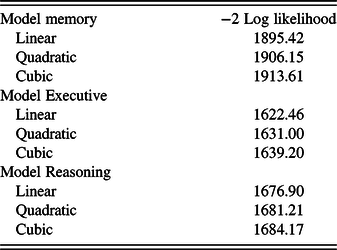
Unconditional linear, quadratic, and cubic models were then analyzed without the covariates for each neurocognitive domain scores over time, but including the quadratic and cubic effects did not improve model-fit based on -2 log likelihood (-2LL), Akaike information criterion, and Bayesian information criterion (see Table 3). A linear shape trajectory emerged as the best fitting to the data in the neurocognitive analyses over time.
Model fit for neurocognitive trajectories over time

Note: The Chi-square value for significant difference (p = .05) is ≥ 3.84 drop from the previous model. Lower −2 log likelihood is better.
Full models
Demographic, injury severity, functional outcome, and self-reported symptom covariates in the models of domain-specific neurocognitive trajectories (Memory, Executive function, and Reasoning) are presented in Table 4, which shows their standardized coefficients (β) and statistically significant and nonsignificant fixed effects from the HLM, as well as 95% confidence intervals. Details of the distribution of changes in the neurocognitive T-scores by predictors are presented in the Supplementary Table.
Predictors of each neurocognitive trajectory across 3 months, 1-, 5-, and 10-year follow-ups

PTA = posttraumatic amnesia; AIShead = Abbreviated Injury Scalehead GOSE = Glasgow Outcome Scale-Extended; SCL-90-R = Symptom Checklist 90-Revised.
Note: Predictor variables are centered at mean. Lower scores on the Abbreviated Injury Scale indicate less severity. Lower scores on the SCL-90-R indicate less distress. Higher scores on the GOSE indicate better functional outcome.
* p < .05.
a Set to zero because of redundant.
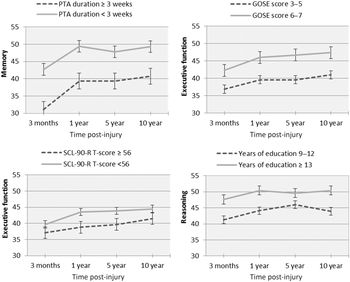
As seen in Table 4, a significant improvement in performance over time was found between 3 months and 1 year (all three neurocognitive trajectories p < .01). A higher level of education was significantly associated with a better performance on the neurocognitive trajectories, with the strongest association with Reasoning (p < .001). Those with fewer symptoms of emotional distress (SCL-90-R) also performed better on the neurocognitive trajectories (ps < .05). Participants with a shorter duration of PTA (p = .009) showed a better performance on Memory. Individuals with better functional outcome (p = .040) showed better performances on Memory and Executive function. To illustrate the effects of the demographics and clinical predictors, Figure 2 displays the neurocognitive trajectories that were estimated based on a mean-split procedure (above and below the mean) for the PTA, GOSE, SCL-90-R, and education. For example, the GOSE mean score was 5.4 at 3 months and was dichotomized into GOSE scores ≤ 5 and scores ≥ 6 to be plotted across the four time points. There were no statistically significant interactions of any predictors with the neurocognitive trajectories over time (see Table 4). This suggests that the slopes of the subjects’ neurocognitive trajectories did not differ over time as a function of education, injury severity, emotional distress, and functional outcome.
Neuropsychological trajectories by significant predictors for the three cognitive domains. Cognitive composite score are presented by T-scores (mean, standard error). PTA = posttraumatic amnesia; GOSE = Glasgow Outcome Scale-Extended; SCL-90-R = Symptom Checklist 90-Revised.

DISCUSSION
This study examined the trajectory of neurocognitive performance over the course of 10 years in patients with moderate–severe TBI. Follow-up assessments were conducted at 3 months, 1, 5, and 10 years postinjury. The findings demonstrate that significant changes were observed in all neurocognitive domains (Memory, Executive function, and Reasoning), with the greatest improvement occurring during the first year postinjury, in line with previous TBI studies (Christensen et al., Reference Christensen, Colella, Inness, Hebert, Monette, Bayley and Green2008; Rabinowitz et al., Reference Rabinowitz, Hart, Whyte and Kim2018; Sigurdardottir et al., Reference Sigurdardottir, Andelic, Roe and Schanke2009; Spitz, Ponsford, Rudzki, & Maller, Reference Spitz, Ponsford, Rudzki and Maller2012). After the first year, cognitive stability up to 10 years after injury was observed among the majority of patients who retained in this study. However, one-third of the participants dropped out and this may limit the study generalizability. Other longitudinal studies (Millis et al., Reference Millis, Rosenthal, Novack, Sherer, Nick, Kreutzer and Ricker2001; Ruttan et al., Reference Ruttan, Martin, Liu, Colella and Green2008; Till et al., Reference Till, Colella, Verwegen and Green2008) and a recent review (Mollayeva, Mollayeva, Pacheco, D’Souza, & Colantonio, Reference Mollayeva, Mollayeva, Pacheco, D’Souza and Colantonio2019) examining neurocognitive functioning in mixed TBI populations indicated trends in functioning stability after the first year after trauma, which may give reason for optimism. However, a small subset of patients (11%) in this study showed a significant decline, especially in memory performance. Perhaps this decline was not apparent until sufficient time had passed, that is, up to 5–10 years after trauma. Previous findings by Ruff et al. (Reference Ruff, Young, Gautille, Marshall, Barth, Jane, Kreutzer, Marmarou, Levin, Eisenberg and Foulkes1991) reported that 33% of those with severe TBI declined in verbal memory from 6 to 12 months postinjury (Ruff et al., Reference Ruff, Young, Gautille, Marshall, Barth, Jane, Kreutzer, Marmarou, Levin, Eisenberg and Foulkes1991). A systematic review on moderate–severe TBI recommended that regular assessments should be made every 3–5 years to detect long-term cognitive changes (Schultz & Tate, Reference Schultz and Tate2013). Such follow-ups may also assist in the aid of differential diagnoses for the TBI population. Other longitudinal studies following moderate–severe TBI have reported neurocognitive decline at various time points after injury from 2 years up to 5 years (Hammond, Hart, Bushnik, Corrigan, & Sasser, Reference Hammond, Hart, Bushnik, Corrigan and Sasser2004; Till et al., Reference Till, Colella, Verwegen and Green2008) and as long as 30 years (Himanen et al., Reference Himanen, Portin, Isoniemi, Helenius, Kurki and Tenovuo2006). A prior study found that 14%, 26%, and 61% of 292 patients with TBI demonstrated declines, improvements, or no change, respectively, between 1 and 5 years after injury (Hammond et al., Reference Hammond, Hart, Bushnik, Corrigan and Sasser2004). Importantly, hours of rehabilitation in early phases were shown to have the greatest effect on later cognitive decline (Till et al., Reference Till, Colella, Verwegen and Green2008). These findings may have clinical value for a specific subgroup of patients, indicating the need for continual neurocognitive assessments and for seeking age-related changes including psychological (e.g., depression and anxiety) and medical (e.g., seizures, biomarkers, and neurodegenerative) mechanisms that may contribute to cognitive decline in chronic TBI. However, as the time since TBI progresses, the environmental, behavioral, structural, morphological, and physiological influences may become a scientific challenge in understanding the prognostic factors of cognitive outcomes (for review, see Mollayeva et al., Reference Mollayeva, Mollayeva, Pacheco, D’Souza and Colantonio2019). The current findings suggest that premorbid relationship of education was a consistently significant predictor of the three neurocognitive trajectories, where individuals with a lower education (12 years or less) showed a trend in Reasoning decline after 5 years of brain trauma (e.g., see Figure 2). However, the interaction effects between time and education in predicting neurocognitive trajectories were nonsignificant. Sumowski et al. (Reference Sumowski, Chiaravalloti, Krch, Paxton and Deluca2013) presented that a higher education level may have neuroprotective effects when facing TBI, while Miller, Colella, Mikulis, Maller and Green (Reference Miller, Colella, Mikulis, Maller and Green2013) found that preinjury education was not associated with hippocampal neurodegeneration in the chronic stages of moderate–severe TBI.
Another study offered support for the cognitive reserve (i.e., preinjury intellectual functioning) in predicting cognitive, occupational, emotional, and social outcomes (Rassovsky et al., Reference Rassovsky, Levi, Agranov, Sela-Kaufman, Sverdlik and Vakil2015). Furthermore, one study found that persons with a college education (i.e., a better cognitive reserve) were seven times more likely than those who did not finish high school to be disability-free 1 year after a TBI (Schneider et al., Reference Schneider, Sur, Raymont, Duckworth, Kowalski, Efron and Stevens2014). In the present study, significant improvement was evident in the Reasoning trajectory (WAIS-III: Similarities, Matrices) occurring between 3 months and 1 year, with scores returning to the average range at 1 year, suggesting that Reasoning abilities are relatively robust after moderate–severe TBI.
This study is one of few TBI studies that investigated neurocognitive trajectories across 10 years in adults. We identified differential contributions of injury severity and clinical variables in the association of neurocognitive domains. Of all included predictors, the most notable association with the Memory trajectory was the duration of PTA, that is, a duration longer than 3 weeks was negatively associated with a worse memory performance. A recent study of patients with moderate–severe TBI did not find age, education, or injury severity (GCS score) as predictors of visual memory change from 3 to 12 months follow-up (Zaninotto et al., Reference Zaninotto, Vicentini, Solla, Silva, Guirado, Feltrin and Paiva2017). The length of PTA as a measure of injury severity is known to affect cognitive and intellectual functioning both in the acute and postacute phases of TBI (Konigs et al., Reference Konigs, de Kieviet and Oosterlaan2012; Ponsford et al., Reference Ponsford, Spitz and McKenzie2016; Rassovsky et al., Reference Rassovsky, Levi, Agranov, Sela-Kaufman, Sverdlik and Vakil2015). Studies of severe TBI have suggested a PTA duration of 4 weeks as a threshold for predicting cognitive outcomes (Brown et al., Reference Brown, Malec, Mandrekar, Diehl, Dikmen, Sherer and Novack2010; Sigurdardottir et al., Reference Sigurdardottir, Andelic, Wehling, Roe, Anke, Skandsen and Schanke2015).
The current study indicates that greater deficits in Executive function were related to early emotional distress and functional impairment; however, the nature of these relationships is unclear. Executive function difficulties may have led to emotional or behavioral problems, further affecting school or work outcomes (general functioning). In the present study, emotional distress symptoms measured at 1 year postinjury predicted all neurocognitive trajectories. Prior research reported that patients with diagnosed anxiety disorders post moderate–severe TBI had a significantly slower information processing speed, a worse working Memory, and worse Executive functions compared to those without postinjury anxiety (Gould, Ponsford, & Spitz, Reference Gould, Ponsford and Spitz2014). These same authors gave support to the theory that cognitive difficulties could give rise to elevated anxiety after TBI (Schonberger, Ponsford, Gould, & Johnston, Reference Schonberger, Ponsford, Gould and Johnston2011). Other publications have demonstrated that emotional variables may be accurate in predicting cognitive outcomes (Grauwmeijer et al., Reference Grauwmeijer, Heijenbrok-Kal, Peppel, Hartjes, Haitsma, de Koning and Ribbers2018; Shields, Moons, Tewell, & Yonelinas, Reference Shields, Moons, Tewell and Yonelinas2016). Another study compared cognitive functioning and emotional distress in patients with mild–severe TBI at 10 years and found that the group with a worse functional outcome (GOSE) performed more poorly on cognitive measures (information processing speed, attention, Memory, and Executive function) and showed higher levels of anxiety (Ponsford et al., Reference Ponsford, Draper and Schonberger2008). In our results, the functional outcome at 3 months (GOSE) was associated with both the Memory and Executive function trajectories. Another study on severe TBI showed that a better functional outcome at rehabilitation discharge (median of 3 months) was related to better neuropsychological functioning at a long-term follow-up (median 20.5 months) (Gautschi et al., Reference Gautschi, Huser, Smoll, Maedler, Bednarz, von Hessling and Seule2013). On the other hand, numerous studies have shown that common measures of Executive functions (Spitz et al., Reference Spitz, Ponsford, Rudzki and Maller2012) and memory (Bercaw et al., Reference Bercaw, Hanks, Millis and Gola2011) are important predictors of functional outcome after TBI.
A recent review by Mollayeva et al. (Reference Mollayeva, Mollayeva, Pacheco, D’Souza and Colantonio2019) indicated that age as a determinant of cognitive outcome is inconsistent. In the current study, age was not found to be a significant predictor of neurocognitive trajectories. Another study using samples of younger to older aged adults (16–81 years) showed that older adults had poorer cognitive outcomes across all measures of cognitive domains (Senathi-Raja et al., Reference Senathi-Raja, Ponsford and Schonberger2010). Rabinowitz et al. (Reference Rabinowitz, Hart, Whyte and Kim2018) also found that age moderated the recovery trajectory of processing speed index and the Executive function composite score. The present study included persons aged 16–55 years at the time of injury, which may underscore the relationship between age and long-term cognitive outcome in TBI. Future research with longitudinal follow-up including older adults where memory decline becomes clinically apparent is also necessary in the TBI literature.
Multiplicity concerns may arise in this study due to the multiple composite scores and the number of analyses. The HLM analyses were not adjusted for multiple comparisons, which may inflate the Type I error. It may also be difficult to interpret the clinical relevance of a small but statistically significant individual decline in the mean values over time, and whether this negative result induces further cognitive evaluation and relevant treatment for the individual. A recent review of cognitive measures in TBI (D’Souza et al., Reference D’Souza, Mollayeva, Pacheco, Javed, Colantonio and Mollayeva2019) revealed that there is insufficient evidence for the test–retest reliability and responsiveness of instruments for measuring longitudinal change in cognition in TBI samples. Unfortunately, this may apply for the majority of neuropsychological tests used in this study, and we can question if there was a decline or a period of stability in cognitive functioning. Much future research is needed in this area.
Our findings may provide information regarding those who are most likely to require long-term treatments and follow-ups, including community rehabilitation of cognitive abilities (e.g., planning, inhibitory control, and memory), medical treatment, and psychotherapy. It is unclear if risk factors for cognitive decline may be education-specific or if those with lower education have greater risks for repeated brain injuries with the passing of time, and this should be considered in future studies. It is also possible that those with a higher education more often returned to work and had more access to financial and social support than those with a lower education. Finally, emotional distress symptoms were associated with a poorer cognitive performance, making the treatment of psychiatric disturbances an area of high importance to TBI rehabilitation and in the community.
This study has several limitations. The current sample has limited age groups (age 16–55 years) and represents generally severe TBI (58%) with an average PTA duration of 24 days. Furthermore, the current study needed to rely on medical records of PTA for 25% of patients, instead of objective ratings assessed by the GOAT. There was variation in the follow-ups of the sample, and for some patients, cognitive stability was assessed between the 1 and 5 year follow-ups, while for others it was assessed between the 1 and 10 year follow-ups. There are some limitations to creating a composite score from multiple normative data sets because such a score may contain more heterogeneity (error variance) than if it was based on a single sample. Some sample size may be small, limited in heterogeneity, or outdated. Furthermore, the composition of normative samples can have a major effect on the clinical interpretation of test scores, for example, education, intelligence, and ethnicity (Strauss, Sherman, & Spreen, Reference Strauss, Sherman and Spreen2006). By using the composite scores, it is conceivable that there is some loss of information. For example, for memory function, if visuospatial memory declines over time and verbal memory improves, these could cancel each other out in the mean composite score. The inclusion of a control group also would have strengthened the study. One limitation relates to the possibility of selective attrition. Characteristics of dropouts did not differ from the participants with regard to demographics and injury severity measures. However, results have to be interpreted with caution because selected variables measured at earlier time points do not guarantee that these groups are comparable at later follow-ups. In fact, the SCL-90-R GSI’s p-values at 3 months (p < .05) and 1 year (p = .09) may indicate the potential for bias and selective attrition. It is possible that participant attrition may be higher in those reporting increased psychological distress and this may have affected measures of association with neurocognitive outcomes.
The strengths of this study include the longitudinal design of the analysis with four cognitive follow-up time points with 275 observations, and the consistency of the neuropsychological and clinical evaluations. For the longitudinal cohort, the attrition rate of 67% over the 10 year study duration was appreciable (Teague et al., Reference Teague, Youssef, Macdonald, Sciberras, Shatte, Fuller-Tyszkiewicz and Theme2018).
In conclusion, the current study demonstrated the following:
(1) Severity of injury, education, functional outcome, and emotional distress predicted neurocognitive trajectories spanning 10 years after moderate–severe TBI;
(2) As the time since injury progresses, cognitive performance (Memory, Executive function, and Reasoning abilities) tend to remain stable for the sample of TBI participants who retained in the study;
(3) Memory decline was observed over time in a subset of individuals (11%).
ACKNOWLEDGEMENTS
This study was funded by the Department of Research, Sunnaas Rehabilitation Hospital, Nesoddtangen, and the Department of Physical Medicine and Rehabilitation, Oslo University Hospital, Norway. The authors are grateful to all the persons for their participation. Special thanks to Tone Jerstad (neuroradiologist, Oslo University Hospital, Ulleval, Oslo) for the CT assessments and Morten Hestnes (Trauma Register, Oslo University Hospital, Ulleval, Oslo) for the extraction of trauma scores.
CONFLICT OF INTEREST
None.
SUPPLEMENTARY MATERIAL
To view supplementary material for this article, please visit https://doi.org/10.1017/S1355617720000193