Rumba guaguancó, a subgenre of Black popular dance in Cuba, has been widely defined as a dance of playful courtship, characterized as a male pursuit of a woman's sex.Footnote 1 Sometimes the partner dance is cast in the metaphor of a rooster chasing a hen, widely understood as a performance of stereotypical gender roles, supporting a pastoral vision long linked to a notion of Cuban culture's humble roots in Black working-class sociality. In the dance, the man (el rumbero) or rooster playfully chases the woman (la rumbera) or hen with the aim of “vaccinating” her—a double entendre for sexual penetration. Onlookers stand in a circle to cheer the audacious pursuits of the man/rumbero/rooster, emboldening his thrusts of the pelvis, foot, elbow, knee—called vacunaos (vaccinations)—toward the groin of the woman/rumbera/hen. Any extremity or prop (most often a handkerchief) acts as surrogate for his erect member in this act of female possession. His relentless and creatively delivered assaults form the climax of the partner dance, so they maintain, wherein the woman aims to both protect herself from his advances while simultaneously enticing them further.
This specific understanding of the what and why of rumba, legitimized by anthropologists as part of the dominant definition of Cuban folklore, has been regarded as axiomatic in the popular cultural imaginary. Associated with the moments of respite seized by the enslaved in the eighteenth- and nineteenth-century barracks of the plantation or cabildos Footnote 2 and danced in the nineteenth- and twentieth-century central courtyards of the solares (tenement housing complexes) in the port city of Havana and the provinces of Havana and Matanzas, the inspiration for rumba is often traced further back to the yuka dance of the Bantu-Congo people, enslaved in Cuba beginning in the sixteenth century (Ortiz [1951] Reference Ortiz1985; León Reference León1984; Martinez-Furé Reference Martinez-Furé, Carbonero and Lamerán1982). Despite hundreds of years of drastic social upheaval and economic transformation on the island, this singular explanation of the social valence of rumba has prevailed practically unchanged since the first literary accounts circulated in the nineteenth century by white men who sought to form a progressive conception of national culture whereby Black raw material was transformed through amalgamations with European elements (Kutzinski Reference Kutzinski1993). These same narratives surrounding rumba have been repeated faithfully in tourist performances and in both Cuban and foreign scholarship in the twentieth and twenty-first centuries, each corroborating the legitimacy of the other.Footnote 3
This article interrogates how the racialized and gendered discourses historically reproduced through dominant narratives about rumba have framed the interpretive possibilities for understanding Black and mulata (or Afro-Cuban)Footnote 4 womanhood in the wake of chattel slavery. Engaging what bell hooks calls a “phallocentric politics of spectatorship” (hooks Reference hooks1999, 118), this article asserts that implicit in the dominant definition of rumba guaguancó is a view of racialized women from a hegemonic male standpoint. Even while the woman is the center of attention, she is reduced to an object of sexual conquest and a platform for the performance of male skill.Footnote 5 Within the canonical literature on rumba, la rumbera (the woman rumba dancer), a synecdoche for Afro-Cuban women, is categorically credited with either displaying enticing seductions (focusing on the swaying hips or smile) or making passive defenses (taking cover with a real or imaginary piece of fabric) in reaction to the man's skilled initiations.Footnote 6 La rumbera is afforded little agency outside reacting to male initiative, thus foreclosing a consideration of the virtuosity of her performance and the meanings Black women ascribe to their own dancing, derived from the specific conditions that shape their lived experience. My point is not that the hen-rooster metaphor is an apocryphal legacy of colonialism singularly propagated by men, but that the most widely circulated framings of rumba reproduce and perpetuate normative discourses about Cuban culture that obscure alternative ways of knowing rumba and rumberas also operative in Cuban society.
In Black Looks: Race and Representation (1999), hooks theorizes an “oppositional gaze” elaborated by Black women, revealing a critical stance toward the hegemonic ways in which their bodies are seen and understood. She argues that a situated kind of pleasure is derived from their critical engagement with the performativity of Black womanhood through the visual, a pleasure uniquely enacted and intimately shared between Black women even when in public view. As scholars of African diasporic dance have long argued, Black popular dances are constituted by the specific politico-historical conditions and socioeconomic needs in which Black communities have survived (Gordon-Hazzard Reference Gordon-Hazzard1990; DeFrantz Reference DeFrantz and DeFrantz2001a; Daniel Reference Daniel2011). Rumberas’ own interpretations of their skilled choreographic choices, and their cultivation of such choices through formal and informal dance teaching practice with other Black women, might complicate and deepen our understanding of their conditions and needs. Whereas rumba guaguancó has been defined through such a phallocentric regime of looking, taking rumbera dance pedagogies seriously recasts her movements as an embodied system of knowledge to mediate the gendered afterlives of slavery. These pedagogies took on added meaning amid the increasingly neoliberal waves of economic reform to Cuba's socialist economy. The first major reform within post-Revolutionary Cuba occurred in the 1990s (prompted by the collapse of the Soviet Union), followed by another major shift in the 2010s (spearheaded by President Raúl Castro). While maintaining its centralized economy and universal social services, each reform era expanded tourism and the private sector, which effectively led to the undoing of historic prior social gains in terms of racial mobility attributed to the 1959 Revolution with uniquely gendered effects.Footnote 7
Living and learning to dance rumba in Havana, across over fifteen years of travel and including twenty-five months of ethnographic fieldwork during a decade (2009–2018) of economic change, acutely impressed upon me how the prevailing explanations of the what and why of rumba dangerously underappreciated the meanings Black women assigned to their own improvisatory practice.Footnote 8 “Do you know why it's important to me that you learn this? Because we are both black women. And as black women we have to give ourselves value! Because no one else gives us value,” my dance teacher, Jennyselt “Yeni” Galata, once yelled when I missed a key opportunity for decision-making in my movement while she trained me in the Afro-Cuban repertoire of traditional dances and their art of structured improvisation. Yeni, a Black woman, was the dance director of the rumba ensemble Yoruba Andabo at that time. In the run-down solar in the Black working-class neighborhood of Centro Habana where we had our lessons, the windows faced an inner courtyard, the site where rumbas were traditionally “formed” by residents.Footnote 9 Her voice echoed for all the neighbors to hear. Yeni's correction of my dancing that day was a push for me to understand that there were larger stakes involved in the way rumba and other forms of folkloric dance were embodied. I was propelled to take dance pedagogy seriously—analytically—by these kinds of exchanges with Black women training me in what I call a Black feminist choreographic aptitude while learning to perform traditional dance repertoires. Formal lessons for paying students and informal settings in which people learn by watching one another other are both included in my analysis of Black feminist rumba pedagogies. Although the teaching methods are surely distinct, the values transmitted in both didactic settings, I contend, cohere around the cultivation of a specialized bodily skillset that equips the dancer to perform with virtuosity, and experience pleasure from their movements in a particular sociopolitical and economic context. Ballet dance scholar Jessica Zeller asserts, “As extensions of our embodied selves, our pedagogies reflect who we are and what we value; they are personal and professional, emotional and intellectual, vulnerable and empowered” (Reference Zeller and L'Hotellier2017, 17). Indeed, specific values, embedded in the process of bodily transmission, shaped how rumberas improvised and assigned alternative meanings to their corporeal enunciations. I borrow Nicole Fleetwood's (Reference Fleetwood2011) concept of “troubling vision,” building on hooks's important theoretical developments, to describe how Black women, both hypervisible and invisible, reconfigured rumba's governing metaphors. The lessons I garnered from Black women in Havana moved me to analyze rumbera performance against the phallocentric grain that structures rumba spectatorship, and appreciate their Black feminist sensibilities.
In this article, I will argue that the muted meanings of rumba guaguancó, articulated in the pedagogical practices of rumberas, are salient for understanding working-class Black women's investment in rumba's embodiment. Although the axiomatic terms for interpreting “Cuban folkloric dance” foreclose a Black feminist consciousness, what I am calling “a black feminist choreographic aptitude,” shared between rumberas, speaks to an embodied engagement with the pointedly gendered valances of worsening racialized class inequality in contemporary Cuba.Footnote 10 The period of my fieldwork was marked by the momentous launch of “guidelines” (lineamientos) to expand the private market (Resolución 2011). These neoliberal development schemes were framed by the state as an “update” (actualización) to the socialist economic model of the Revolution, indicating a positive progression forward from the past. Yet, for Black women, national development also entailed a regression and constriction of their professional opportunities. An attention to the Black feminist choreographic aptitude transmitted by Black women when teaching principles of rumbera improvisation allows a consideration for rumba as a Black communal space where analytical tools are developed for negotiating the patriarchal legacy of slavery that persists against the backdrop of liberal discourses of progress promoted by the state and folkloric narratives of Cuban dance.
This work builds on Melissa Blanco Borelli's (Reference Blanco Borelli2016, 20) theory of mulata “hip(g)nosis” as an expression of situational agency; “for those who can follow it … [hip(g)nosis reveals] a sleight of hip.” Blanco Borelli focuses on the figure of the “mulata rumbera,” a trope created through the colonial sexed and raced power relations upon which Cuba was founded, positioning women of African descent as inherently inferior to white men and women, differentiated as licentious and sexually available. Hip(g)nosis points to a way that subaltern subjects have negotiated the legacy of colonial claims to their raced and gendered bodies. Echoing Fleetwood, they have done this by troubling the currency of the visual as a neutral mode of knowing within the Euro-Western hierarchy of senses. Whereas the prevailing definition of rumba guaguancó casts Afro-Cuban women as prey for masculine pursuit (and thus Afro-Cuban men as virile assailants), my attention to rumberas’ pedagogical practices and choreographic choices seeks to, (following the arguments of hooks, Fleetwood, and Blanco Borelli) recognize them as living, agentive, and thinking subjects, at once hypervisible and unseen.
After tracing the binary ways in which rumbera movements in guaguancó have been defined in the canonical literature and their feminist analytics rendered invisible or mute, I explore key pedagogical moments from my own dance training by Black women in Havana.Footnote 11 I highlight the ways that my positionality, as a Black woman of Cuban descent who resembled the rumberas I learned from, opened up possibilities for unearthing the unrecognized Black feminist hermeneutical potential in rumba performance.Footnote 12 More generally, to foreground a Black feminist choreographic aptitude within rumba performance makes the case for increased attention to pedagogy as a key hermeneutical tool for approximating the what and why of Black popular dance, centering the perspectives of subjects who have been historically marginalized from the production of knowledge about their bodies.
“To Halt Masculine Domination”
Built upon the scaffolding of (neo)colonial tropes and ways of seeing Black women's bodies, as Blanco Borelli argues, the word “rumbera” triggers an image of a Black or mulata woman in a bent-over posture, seductively swinging her hips. La rumbera's presumed seductiveness is a byproduct of an essentialized “tropicalism” (Ribeiro Reference Ribeiro, Grimson, Ribeiro and Semán2004). According to Gustavo Ribeiro's definition of tropicalism, happiness and sensuality are core traits associated with sites in Latin America and the Caribbean with large Black populations (Reference Ribeiro2019, 765). Such tropicalism invokes the kinds of raced and gendered expectations assigned to the Caribbean region (as a playground and service provider to the Global North), and specifically women of African descent, rooted in chattel slavery (Kempadoo Reference Kempadoo2004). I extend this argument to maintain that the dominant definition of rumba circulates to make benign and naturalize the mulata rumbera trope, legitimized through discourses of rumba as Cuban cultural tradition. The rumbera can thus stand in to represent a particular kind of “Cuban femininity” (coded as Black or African derived)—discursively fashioned as a quaint site for the public exhibition of male prowess and arousal (Blanco Borelli Reference Blanco Borelli2016).
Nineteenth-century literature, like Cuba's so-called foundational novel Cecilia Valdés (Villaverde [1839] Reference Cirilo2005), and early twentieth-century ethnographic accounts, like that of Fernando Ortiz ([1906] Reference Ortiz1973), have jointly normalized the taken-for-granted ideological scaffolding that conditions the interpretive frame available for understanding rumba and Black popular dance in Cuba more broadly (Kutzinski Reference Kutzinski1993; Garcia Reference Garcia2017). Cirilo Villaverde depicted race, gender, and sex relations in colonial Cuba through the story of an almost “passing (as white)” “mixed-race” woman. The steady pendulum sway of her hips and buttocks were interpreted as anthropological evidence of her body's undisputable African ancestry and thus inherent eroticism (Arnedo Reference Arnedo1997).Footnote 13
Aptly nicknamed “the father of Cuban anthropology,” Ortiz's early work strove to cleanse Cuban society of the primitive baggage of its “Afro-Cuban underworld (el hampa afrocubana)” a condition for the nation to assert its modernity (Ortiz [1906] Reference Ortiz1973). Contending with a Euro-Western gaze of their polity, Latin American intelligentsia drew on social Darwinism and Comtian positivism to develop a kind of “nationalist positivism” in which the traces of Africa, they advocated, could be empirically identified, reformed, and curated to serve the new modern nation through scientific development (Maguire Reference Maguire2011). The modernist agenda advocated by the white patriarchal intelligentsia and political elites came attendant with the belief in the categorical separation of the secular from the sacred.Footnote 14 Much to the dismay of white elites who sought to reform and refine the vestiges of the Black cultural politics of the formerly enslaved, at the dawn of the new Cuban Republic, rumba was practiced within and around cabildos, historically Black social organizations that held both devotional and political missions. In a text titled “Los cabildos afrocubanos,” Ortiz clearly states, “We should vigilantly regulate lewd dances such as orgiastic rumbas, intervene in fetishistic dance events as well as those of a political nature” (Ortiz [1921] Reference Ortiz and Moore2018, 94). The reigning interpretive frameworks of the mid-nineteenth century, which Ortiz adopted, sedimented modern notions of “national cultures” that would secularize and depoliticize Black popular dance while summoning colonial tropes of Black hypersexuality. Ortiz was considered the authoritative voice on Black popular culture because of his prolific scholarship on the topic and acted as a key intellectual architect of Social Darwinist reforms that effectively criminalized its practitioners, deemed a drag on Cuba's development (Ortiz [1924] Reference Ortiz1991, [1945–1946] Reference Ortiz and Moore2018, Reference Ortiz1950a, Reference Ortiz1950b, [1951] Reference Ortiz1985, Reference Ortiz1952; Moore Reference Moore1994). Only when cast as a secular dance of leisure, detached from African ancestral systems of embodied knowledge, could rumba become tenable as a symbol of “Cuban culture.” Nationalizing Blackness (Moore Reference Moore1997) created a lasting paradox for Cuba and Latin America more broadly; the white middle and upper-class selectively embraced qualified elements of Black culture while continuing to reproduce anti-Black stereotypes, marginalize Black people, and criminalize forms of Black sociality deemed undesirable.
By the mid-twentieth century, the representation of racialized genders had been solidified into stock figures (e.g., the mulata as tragic temptress, the negrito (little Black man) as comical slave), and Black popular music was celebrated as part of Cuba's national patrimony (Moore Reference Moore1997; Thomas Reference Thomas2009). The perceived act of women dancing in particular ways attributed to her Blackness, gave empirical substance to the sexualized social stigma and controlling images already ascribed to the bodies of women of African descent due to conditions of unfreedom under slavery (Spillers Reference Spillers1987; Kutzinski Reference Kutzinski1993). As in the cases of other former slave societies in the Americas, Black dancing women in Cuba were understood to signify lewd commodities to be looked at and possessed rather than heard from (Walker Reference Walker2010). Thus, the rumbera trope was constituted through white heteropatriarchal discourses that rarely afforded her a self-consciousness or way of seeing herself outside of the male-centric imagination. After the triumph of the 1959 Revolution, neighborhood rumba practitioners were officially recognized as “culture bearers,” and rumba practice became a profession subsidized by the state (Daniel Reference Daniel1995). Although accumulating a new charge to represent the revolutionary proletariat values (Daniel Reference Daniel1991, Reference Daniel1994), the movements specific to women dancing rumba have largely been interpreted in ways that corroborate the same perspective—as befitting tropical objects of male desire. As Blanco Borelli so aptly puts it, “She is Cuba” (Reference Blanco Borelli2016).
The early Revolutionary era of rumba's institutionalization laid the groundwork for cultural market expansion and the commoditization of rumba during the following post-Soviet era of “Special Period” economic reform. The Special Period refers to the extended economic crisis after 1990, induced by an overdependence on a suddenly obsolete trading partner in the Soviet Union and exacerbated by the ongoing US embargo. Near economic collapse during this period prompted the implementation of wartime austerity measures and generated a constant need to luchar (to struggle, to fight), that is, to find alternative avenues to acquire hard currency, or hustle by any means—to survive. In this context, cultural tourism became a major driver of the Cuban national economy, and the staging of Black popular culture played a key role (Hagedorn Reference Hagedorn2001; Ayorinde Reference Ayorinde2004). Within the state-endorsed tourist market in the 1990s, Blackness functioned as a sign of cultural authenticity, and professional rumba performance satisfied the tropicalist expectations of international consumers (Jottar Reference Jottar2013). At the same time, Black Cubans themselves were systematically excluded from the most gainful job opportunities and spaces in the tourist sector, creating a “tourist apartheid” in which flows of capital were consolidated in the hands of white Cubans while the forms of survivance (la lucha) practiced by Black Cubans (without access to other sources of capital via remittances) were disproportionately criminalized (de la Fuente Reference de la Fuente2001; Fusco Reference Fusco, Kempadoo and Doezema1998; Sawyer Reference Sawyer2005; Roland Reference Roland2013). Scholars have marked this post-1990 period as one of “recreating racism” or the “erosion of racial equality” in Revolutionary Cuba (de la Fuente Reference de la Fuente1998, Reference de la Fuente2001; Blue Reference Blue2007). Continuing the paradox of nationalized Blackness prior, the performance of rumba in state tourism coincided with the increased visibility of racialized class inequality and anti-Black discrimination.
While the swing of the rumberas’ hips evoke a phallocentric genealogy of social meanings nationalized, institutionalized, and then capitalized upon by the state, Black women articulate not just choreographic choices to luchar against the constraints of their class, race, and gender position. Alongside their male counterparts, teaching private lessons (informally, without a license) to foreigners became a strategy, however limited, for economic survival, circumventing the state-controlled market for goods and services (Berry Reference Berry2016; Stein and Vertovec Reference Stein, Vertovec and Wood2020). Men and women differentially navigated the ways in which these transactions with foreigners, exchanging “Cuban authenticity” for hard currency, reinforced racialized and gendered colonial imaginaries and expectations (Ana Reference Ana2019; Stein and Vertovec Reference Stein, Vertovec and Wood2020). Significantly, Berta Jottar noted a surge in feminist choreographic choices by rumberas during the “rumba boom,” defined as “an explosion of alternative rumba scenarios evolving from the mid-1990s, culminating in the year 2012 with the opening of El Palacio de la RumbaFootnote 15 and the official proclamation of traditional rumba as Cuba's National Patrimony,” and reflective of a context in which rumberas were fashioning identities as “independent, competitive, and assertive performers” (Jottar Reference Jottar2013). Rumberas sought out their own means of achieving greater degrees of artistic and economic autonomy and expressed those desires in their improvisatory practice within, but not limited to, rumba guaguancó.Footnote 16 Their improvisations on and off the dance floor spoke to the interlocking structures of oppression that forced them to maneuver Cuba's shifting socioeconomic landscape from marginalized class positions within essentialized bodies.
When the Cuban state forecasted its expansion of legal opportunities for private entrepreneurship in 2010, “folkloric dance artist” was one of the 178 professions first authorized for “self-employment” (Trabajo 2010), meaning that it was seen by the state as a strategic occupation that could be commoditized to attract capital. The attraction of foreign investment and high demand for services generated by the tourist industry, along with the revenue from newly established income tax laws, was expected to strengthen the national economy. These same policies have been celebrated as a huge move forward toward a national prosperity that will either ensure the Revolution's permanence or facilitate its complete transition to free market capitalism. However, Cuba's “opening for business” came along with the firing of hundreds of thousands of Cubans from jobs in the public sector (Frank Reference Frank2010), jettisoning Afro-Cubans into the private sector who did not necessarily have the resources to invest in a start-up business nor make a living as entrepreneurs (Hansing and Hoffman Reference Hansing and Hoffman2019).
Class mobility proved particularly elusive for Afro-Cubans who did not already occupy positions of privilege and have access to wealth (via remittances or property), illuminating how already existent structures of social stratification and material precarity were compounded by new terms of racist exclusion due to the expansion of the private sector (Zurbano Reference Zurbano2011; Hansing and Hoffman Reference Hansing and Hoffman2019; de la Fuente Reference de la Fuente2019).Footnote 17 As the biggest beneficiaries of the Revolution's centralized restructuring in the 1960s (in terms of universal healthcare, education, and employment), Afro-Cubans have experienced the “update” toward private sector expansion as a return to pre-Revolutionary logics of competition that disproportionately favor the already structurally advantaged.
The Cuban state's systemic commoditization of folkloric Blackness has made Afro-Cuban cultural practice a paradox for Cuban anti-racist activism struggling to hold the state accountable for the racialized impacts of the “update” (Berry Reference Berry2016). Black women have borne the brunt of national development in unique ways. Whereas tourism and private businesses ensured a hard currency consumer base for rumba performance and private lessons, women had the added burden of fulfilling patriarchal expectations of social reproductive labor at home (Ana Reference Ana2019). Moreover, job opportunities for rumberas remained limited relative to their male counterparts and channeled through structures of (Black) male leadership within rumba ensembles and (white) male control in the private sector more broadly.Footnote 18 At the onset of the reforms in the early 2010s, as Jottar (Reference Jottar2013) attests, rumbera choreography may have asserted these dancers’ zeal for economic independence in this new landscape. Yet, Black women's access to employment was shaped by additional gendered labor demands in conjunction with their body's alignment with the imagined desires of (heterosexual male) consumers, thus determining their market value (Ana Reference Ana2019).
During my fieldwork, rumberas reflected on their present socioeconomic condition and its historic roots through their interpretations of the dance. For María Elena Gómez, a rumbera and musicologist in her own right, the women's moves in rumba should be best understood as a feminist critique of patriarchy rooted in the history of chattel slavery. She explained in a 2013 French documentary, “Man has always dominated since the time of slavery.… He is the one who works outside the home and earns money, and the woman takes care of domestic matters. It's always the man that was in charge and laid down the law.… But in rumba [guaguancó], women show her ability to halt masculine domination, and that is what you see in the dance” (Lainé and Combroux Reference Lainé and Combroux2013). The danced counter-assertions, which María Elena brings to the fore, are sometimes called botaos (from the verb botar) and serve as critical tools in rumbera improvisation. Rather than passive responses, the verb used to describe these motions—to throw away, kick out, knock down, or bounce away—convey an agentive and active stance in service of redirecting forces aimed at claiming power over one's bodily autonomy. In the context of the Cuban state's newest design for national progress, botaos might refer to the variously articulated creative attempts by Black women to navigate a persistently patriarchal socioeconomic playing field. Concerted attention to the kinds of pragmatic and choreographic assertions performed by rumberas during shifts in the economic landscape opens space for alternate definitions of the what and why of this embodied system of meaning from a Black feminist standpoint.
“It's This”: Conversing with the Dead
If, as María Elena asserted, rumba guaguancó can be a critique of centuries of systematic gender domination rooted in slavery, then the pedagogy of rumba improvisation can function as an intergenerational embodied practice for teaching Black young girls scenarios for thinking quickly on their feet when facing patriarchal attempts to diminish their worth and sense of dignity. Furthermore, María Elena's rendering evokes rumba as a practice specifically for Black women to articulate a feminist discourse within working-class Black community.
I met Silvia, dance director of the rumba ensemble Grupo AfroAmérica, during El Rumbazo Festival in November of 2018. This internationally funded and state-endorsed cultural venture was a unique opportunity for rumba groups, new and old, to demonstrate their mainstream global marketability to the Cuban public. Although I travelled to Havana on that trip to experience the festival from the perspective of a foreign participant, I was disabused of that expectation rather quickly. Once the festival was underway, one of the main organizers (who knew of my Spanish language fluency and research specialization) asked me to be the interpreter for the dance and percussion classes. In this capacity, I developed a closeness with Silvia that I may not have cultivated as quickly otherwise.
Silvia and I had the same dark brown complexion and stature. She wore a Catholic cross around her neck and an ide (bracelet) of Orula (the Lucumí divinity of divination) around her wrist. Her hair was pulled back in a high ponytail that framed her heart-shaped face. She carried herself with a dignity she would later attribute to her ancestors, including her great-grandmother, a respected espiritista (spirit medium) who had inherited the responsibility of maintaining the town's cabildo for Oya (the Lucumí feminine warrior divinity and owner of the gates of the cemetery) back in her hometown of Palmeras in Cienfuegos. “Palmeras was a small town (pueblo) but our temples [cabildos] made it grande,” Silvia said with pride.Footnote 19 Although during the dance classes with the foreigners earlier, Silvia had explained rumba guaguancó in line with the institutionalized definition—as a seductive game of sexual pursuit (implicitly privileging the male subject position); In my subsequent conversation with her among a small circle composed of only the women members from Grupo AfroAmérica, she put forth a different interpretive framework. Silvia described rumba as pedagogy for communal values of both cooperation and feminine spiritual “self-possession.” “Her ancestors had strong possession of her,” was the way she described her great-grandmother. To be “possessed,” in this sense, was to be both claimed and accompanied by a social network of spirits. This ancestral network acted as a vital resource for their descendants. To carry oneself as a woman “possessed” was considered honorable and auspicious for the entire community of the living. Like her great-grandmother, on and off the dance floor, she wielded divine wisdom extending beyond life experience individually conceived.
In the company of her fellow rumberas, Amelia and Mercedes, Silvia described rumba to me as a conversation between different parts of a communal whole, akin to the way ritual drumming is understood as a conversation between the worshiping community and the divine. Across the entertainment and culture industries, as well as the academy, prevailing explanations of the what and why of Black people's movements in the spaces they have continually made for themselves in the African Diaspora—what Rachel Harding has called “alternative spaces of refuge in thunder” (Reference Harding2003) or what Thomas F. DeFrantz (borrowing from Fanon Reference Frantz1963) conceptualizes as “the circle (of dance) that permits and protects” (DeFrantz Reference DeFrantz, Fischer-Hornung and Goeller2001b, 11)—have had lasting hermeneutical currency and illocutionary force. Silvia rooted her own artistic training as a rumbera in memories of her childhood in Palmeras, when Black popular dance emanated from the activities of autonomous Black social organizations, which she called “cabildos” or “temples” interchangeably, first created by the enslaved and still maintained by their descendants more than a century later. In her conversation metaphor, lead singer, chorus, drummers, and dancers represented social subjects who performed best when listening to one another, waiting their turn, knowing when to enter and contribute to a group discussion that “formed” when needed. In this rendering, rumba was defined by its social restaging of an ongoing conversation about how Black people can live together with dignity in a community spanning different planes of existence. Such a space of refuge permitted the cultivation of a Black feminist choreographic aptitude across generations. The kinds of neat distinctions between leisure, religion, and politics, while useful for taxonomical purposes inherited from nineteenth-century scientific approaches, do little to capture Silvia's lesson about rumba's significance as an embodied crucible of Black collective self-determination, praise, enjoyment, and Black feminist self-actualization.
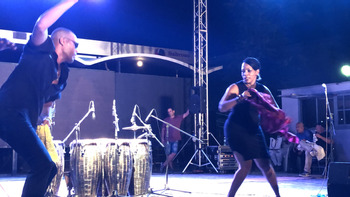
Yamilé dancing rumba guaguancó with Juan Carlos, Osaín del Monte performance in El Rumbazo Festival at the Salon Rosado of La Tropical on November 10, 2018. (Photograph by Author)

The same spiritual sentiment Silvia assigned to rumba is echoed by Black Cuban dancer and scholar Yesenia Fernández-Selier in her essay, “The Making of the Rumba Body” (Reference Fernández-Selier2012–2013). “Rumba,” she writes, “is ingrained in the repertoire of ritual practices that blossomed in the cabildos, organizations that allowed African descendants to unite by their ethnic backgrounds.… Through these institutions and oral transmission, dancers and musicians learned the codes of the divine” (2012–2013, 89). For Silvia and Fernández-Selier, rumba, albeit officially categorized by the Cuban Ministry of Culture as secular, revolved around and spilled out from these insurgent Black spaces of alternative worldmaking and mutual aid, which protect and permit, hinging on an insurgent belief in everyday reciprocity between the dead and the living. This makes rumba a form of cultural labor akin to what Christina Sharpe has termed “wake work”: rituals by and for Black people to think through their relationships with the dead (Reference Sharpe2016). In a similar vein, Aisha Beliso-de Jesús (Reference Beliso-de Jesús2017) has termed “co-presence” the embodied epistemology employed in the making of African diaspora bodies that senses the coming together of spirits of the dead with the living through Lucumí/Santería practice. Both frameworks gesture toward the kind of spiritual labor that rumba's improvisational practice put in motion.
This labor, I learned, should not be seen as isolated from techniques of embodied prayer. The dances of the cabildos cultivated a bodily connection to a creative source that allowed for Silvia and her family to survive their daily hardships, just as their ancestors had survived slavery and its afterlives in the Cuban Republic. For the women in Grupo AfroAmérica, this was the “essence from our ancestors,” that defined Black popular culture, and rumba by extension. To stress Silvia's point, Amelia jumped in: “It's this [putting her left hand on her chest to draw attention to a pulsing motion].” Amelia's embodied intervention both underscored the centrality of the body for making sense of rumba and also reminded me of the chastisements I had been given in classes taught by Yeni, insisting that I continuously bring my internal focus back to the steady pulse of my torso. After exposure to more Lucumí ritual drummings—obeying Yeni's homework assignments to “go to the source!”—I learned that divinities would often first announce their presence through this same torso motion. As in the devotional dances characteristic of African diasporic religious systems practiced in Cuba, rumba also demanded an inward meditative focus; feet in parallel, hip's width apart; low arms kept close to the body; a reverence for divine presence articulated in the torso; and structured improvisation (Berry Reference Berry2010). Rumberas would most frequently gesturally cite the signature gestures of Ochún (the Lucumí divinity of self-love) to affirm their relationship to this sacred feminine power.
Like Silvia, Black girls watching their grandmothers dance, accompanied by an abundant spiritual force to be reckoned with, then developed a conception of rumba richer than its common patriarchal representation. How to enter this communal conversation attuned to spiritual “co-presence” was foundational to the Black feminist choreographic aptitude they would learn. From a Black feminist standpoint, rumba's collective conversations exalted the choreographic virtuosity of everyday “possessed” women, improvising under conditions of patriarchy. Silvia's likening of rumba to a conversation resonated with the way rumbera improvisation was taught to me during private lessons.
The Something Else: Pleasure in Feminist Critique
The learning outcome of my private lessons was never about mastering a specific predetermined routine. Rather, my teachers aimed to get me to the level of proficiency necessary in order to enter an ongoing conversation about living while Black in community. Rumba has its own unique syntax oriented around the clave rhythm. Adherence to its grammar ensured that everyone was attentively listening to one another. My teachers aimed to transmit the necessary analytical tools for competency and discernment that would enable me to step into the representative role of the everyday spiritually possessed Black woman. That also meant adopting a Black feminist critical orientation toward finding pleasure in my own body during improvisation.Footnote 20 After I had proven the memorization of the basic steps and their variations, and learned how to make logical transitions between my phrases, my classes would inevitably turn toward teaching me how to think coherently on my feet in different scenarios that operated as case studies for the analysis of everyday patriarchy in motion.
Yamilé was an official member of the professional Havana-based rumba ensemble Clave y Guaguancó. Yeni had put us in contact in 2013 so I could continue my training during her stints abroad teaching master classes. I danced beside Yamilé, calibrating my proprioception to match her shifts of weight, the timing of her muelleo (the supple, coil-like buoyancy in the knees), the pulse in her torso, the effort quality of her arms, and the coordination of all the parts. The performativity of the rumbera's sensuality came from a technical skill inextricable from her nuanced ear for the music. After we danced side by side, she would sit down and play the same song to watch how much somatic information I was able to retain while dancing on my own. After the first class, I had convinced her that I more or less had a handle on the skills needed to “protect myself” from the inevitable male advances with an array of well-timed botaos. However, she determined “te falta una cosa”—I was still missing something.
Yamilé lowered the volume on the recorded music and took a breath. Although the threat of penetration always loomed, she explained that, if dancing with a seasoned “and respectful” partner, the vacunaos would actually come few and far between. Although constituting the majority of the dance, the time in between vacunaos is largely depreciated in the literature on rumba. Rather than solely dance in a state of bated suspense of the rumberos’ initiations, rumberas were adept at curating this more anticlimactic realm of dialogic exchange for their own pleasure. Although dancing with a male partner, she taught me that I needed to learn to establish a critical distance from his desire. Turning away from the more spectacular moments of male attempts at possession, the interstitial moments of relational improvisation was the gray matter toward which our lessons then turned.
She demonstrated this critical repertoire of “the something” my improvisation was missing through different role play scenarios for how to handle myself in relation to the partners I may encounter while dancing. She narrated the thought process behind her movements while simulating them in real time: “When he starts to move superfast and you see that he is using the attention to show off and make himself seem big, don't try to compete with him for attention by mirroring his same energy. Even if the drummers speed up, you are not going to play their [the man's] game. Instead, you do you.” She changed to suddenly slowing down and marking her steps at half tempo. The contrast was striking and gave the effect of dancing in slow motion. Her cadence bordered dangerously on being late, or behind the music—never quite breaking her pact with clave but asserting her capacity to make it more elastic. “You are saying, I'm not going to break a sweat for him and be ruled by his whim. You take your time and use the space in the music to articulate your body more fully, at your own pace.” She raised her right eyebrow and looked away from her imagined partner completely. “You see? Your ease and comfort in your body makes his efforts look erratic.… Ridiculous even.” Yamilé was teaching me something akin to what Black feminist performance theorists have often described as reading against the grain, a counterhegemonic looking relation that offers its own pleasure. Rather than assume an uncritical stance of reaction to her dance partner's displays of virility, she identified the fragility that undergirded these public assertions of manhood, exposing what could be interpreted as the rumbero's need for validation from other men. “Enjoy it,” she encouraged as she shaped her face to show the internal satisfaction to be had in creating room for her own self-expression against his flashy masculinist attention-grabbing moves for homosocial reputation. The remainder of our class consisted of her coaching me in how to apply this critical aptitude to the ways in which certain performances of masculinity bear on women's behaviors, and how to locate pleasure in my agentive capacity to interrogate them through my own improvisatory phrasing.
We would meet later in the week at El Palacio de la Rumba so she could assess how I applied this aptitude in practice on the dance floor. Given the many actors involved in sustaining rumba's live conversation (percussion, chorus, dance partner, clave, spirit), the level of musical sophistication and corporeal attunement required on the part of rumberas to deploy such a Black feminist critical lens during improvisation is nothing short of virtuosic. The Black feminist choreographic aptitude that she modeled in her pedagogy instilled in me the desire to find openings for, and insist upon, alternative terms of bodily engagement in rumba's gendered social relation. As in everyday life, there was a pleasure politics of creative negotiation with masculine domination.
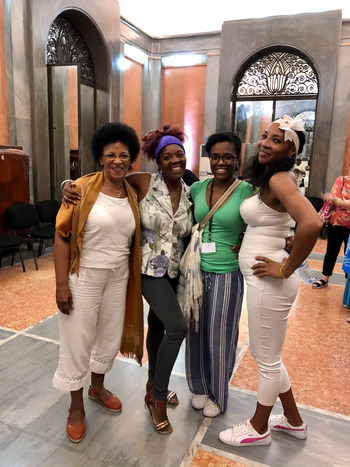
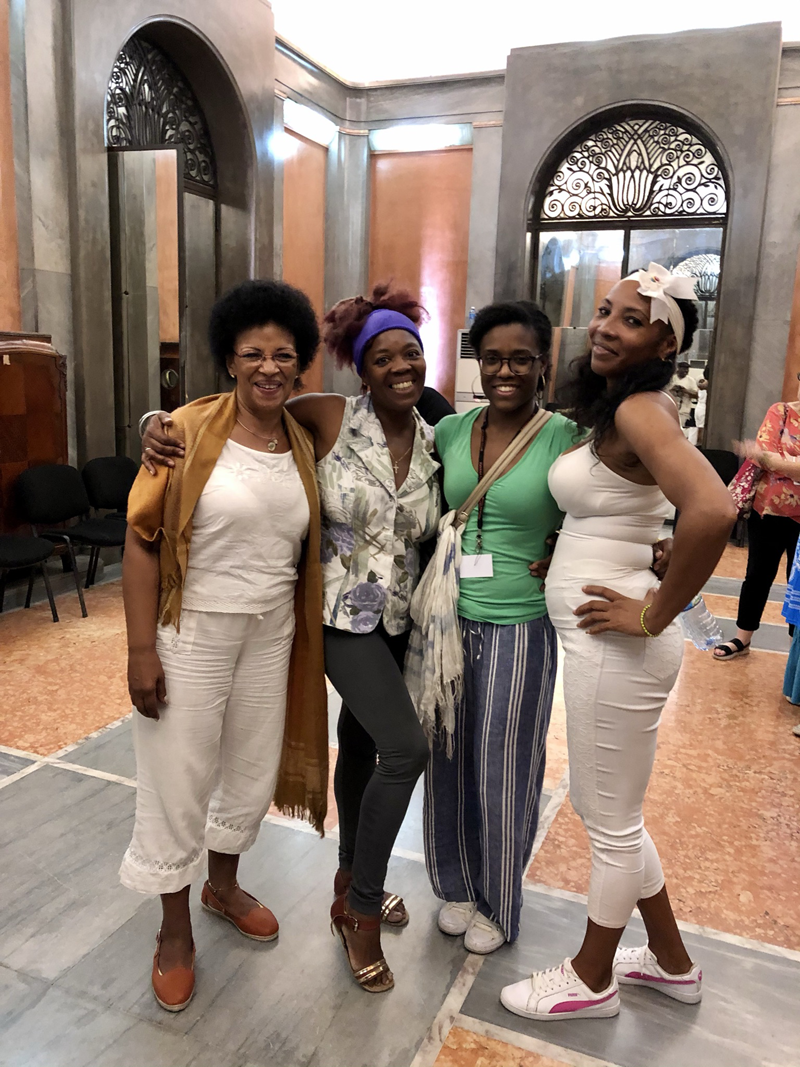
Women of Grupo AfroAmérica with author (right to left: Mercedes, Silvia, author, Amelia), after El Rumbazo Festival classes at Casa de la Amistad on November 11, 2018. (Author's personal photograph; photographer unknown)
I hold this unique aptitude for simultaneous deconstruction of rumba's patriarchal dynamics and reconstruction of the choreography as an affirmation of feminist agency beside hooks's theory of the “oppositional gaze” achieved by Black women spectators when watching representations of Black genders in film.Footnote 21 “Black women construct a theory of looking relations where cinematic visual delight is the pleasure of interrogation” (hooks Reference hooks2014, 126). After establishing that control over images is vital to the maintenance of systems of domination, hooks insists that the creation of other ways of seeing is fundamental for the possibility of other ways of being (Reference hooks1999, 1–8). Similarly, a rumbera's witty somatic retorts are as much for her own pleasure as they are for the other women watching who would see themselves, everyday Black women, in her dancing. Black women spectators of rumba laughed and cheered on the rumbera as their surrogate, taking pride in the way men were put on the spot to grapple with their repeated failure to figuratively penetrate her body or her psyche. Just as when María Elena, in between dancing guaguancó herself at the weekly rumba in the patio at EGREM studios, clapped along and nodded with pride at Yeni's improvisations, Yamilé smiled and clapped when observing me apply her lessons on the dance floor. Black women spectators have long found pleasure in seeing representations of themselves interrogate gender expectations and find creative ways to cooperatively move otherwise under systems of domination. The rumbera's pleasure in Black feminist critique is foreclosed or rendered mute by institutionalized male-centric definitions of the dance that systematically hold hermeneutical dominance over Black women's bodies.
When we take seriously rumbera pedagogy as not just the transmission of movement but rather an analytical lens that structures the decisions made during improvisation, we can appreciate rumba as a colloquial, cooperative, embodied space for the elaboration of Black feminist discourse. The framework of pedagogy exposes that which is perceived as “natural”—like gender expression (Butler Reference Butler1990), like Black performativity (DeFrantz and Willis Reference DeFrantz and Willis2016)—as rehearsed techniques of the body. Here, the performativity of Black womanhood through rumba's dance repertoire is exposed as resulting from a series of structured improvisations taught and honed with precise intention and skill under specific social conditions not of one's choosing. Rumba lessons, both formal and informal, are “serious rehearsals” performed in the everyday with political stakes (Phelan Reference Phelan1993). Learning to dance rumba impressed on me that Black popular dance, and the alternative frameworks Black women employ for interpreting one another's corporeal enunciations therein, gestures toward an underrecognized Black feminist choreographic aptitude necessary for more fully understanding, echoing Phelan, the seriousness of their continued investment in its embodiment.
By decentering the phallocentric politics of spectatorship, we can begin to understand the meanings rumberas teach one another and adopt for themselves within an ongoing collective conversation about Black life in the wake of slavery. This conversation took on added dimension for Black women experiencing new (or old) barriers to economic self-determination after the expansion of the private market. Teaching and learning rumba formed part of the agentive maneuvers executed by Black women to capitalize on their race and gender's market value while contending with the limitations of market solutions for eradicating their racialized and gendered economic marginalization.
Learning a Black Feminist Choreographic Aptitude during Private Market Expansion
Yeni and her posse of girlfriends affectionately conferred the nickname El Vecino (The Neighbor) on the resident who lived directly across the courtyard from the apartment off Calle Aramburu in Centro Habana where I often had my dance lessons. He was a soft spoken, plump, dark-skinned Black man from the countryside who they playfully teased on those grounds. He would greet me after class and give me pep talks after a particularly challenging lesson. He would eventually divulge that he befriended me mostly out of pity. El Vecino saw that Yeni taught foreigners but also fellow Afro-Cubans who hoped to become professional dancers. Young people from villages in the outer provinces came to Havana (legally or illegally) to try their luck in the shifting economic landscape of the capital city in hopes of “making it” and sending money back home to their families.Footnote 22 Professional dancers could be paid to perform or teach in hard currency (pesos cubanos convertibles, CUC) valued at nearly twenty-six times the national money (moneda nacional, MN). If they mastered their craft, they could have a shot at working in a folkloric ensemble that toured internationally, or maybe in a newly opened private nightclub or a fancy hotel.
Because of my phenotype, age, dress, and the verbal exchanges he overheard between my teacher and myself, El Vecino surmised that I was someone from the countryside, who, like himself, migrated to Havana in search of economic opportunity. My simple, unstylish clothes marked me as a new migrant, still too poor or provincial to keep up with the fashion that seasoned city girls flaunted with sass.Footnote 23 I was “dark-skinned but pretty,” so I had a chance at my talent taking me far if I listened to my teacher and applied myself to mirroring her behavior to a tee, El Vecino encouraged. By that he meant I had a lot to learn if I was to make the most of my body's currency in the consumer market for tropicalist fantasy. As a dance historian, Blanco Borelli reads the archive for bodily senses, offering a way to attend to how the mulata choreographs herself into being: “By choosing to perform whatever aspect of ‘mulata identity’ necessary for some recognition, a mulata enacting hip(g)nosis has some agency in how she is perceived,” she attests. Blanco Borelli's theory of hip(g)nosis as situational agency disrupts the male patriarchal gaze, calling upon the looker to do a “double take” when regarding “the mulata's hips” as overdetermined spectacle, and instead critically engage with the subject who wields them (Blanco Borelli Reference Blanco Borelli2016, 20). Dance lessons by and for Black women are unique times when the development of mastery of situational agency can be apprehended. El Vecino was wrong about my motivation for taking classes from Yeni. However, we could agree that private dance lessons were transactions of different kinds of capital driven by the convergence of variously articulated desires for value in an uneven field of exchange. He was not wrong to assess that, for the young Black women from humble origins whom I resembled, tropicalist typecasting made folkloric dance a viable career avenue in an exclusionary economic landscape.
The present-day socioeconomic landscape, marked by the 2010 expansion of the private market, is a reflection of the weakening of global trading partners and a trenchant US embargo. For racialized women and girls with limited options for upward mobility, this “updating” economic field has meant a return to, or intensification of, particular kinds of raced and gendered labor. For them, laboring in the newly expanded private sector has also meant suffering exploitative working conditions at the hands of Cuban and foreign small business owners. Specifically, the confluence of racial inequality and patriarchy have meant the resurgence of domestic service as a profession in which they are disproportionately vulnerable to sexual harassment with or without government oversight. Once regarded as a vestige of Cuba's slave society, Revolutionary leaders had long celebrated the eradication of domestic service after 1959, when women were empowered to labor for the state (Hynson Reference Hynson2020). As Anasa Hicks writes, “Notions of domestic service as the natural lot of women, especially women of African descent, were so deeply embedded into Cuban culture that the work emerged untransformed from such dramatic historical moments as slave emancipation, the 1933 Revolution, and the ratification of the 1940 Constitution” (Hicks Reference Hicks2019, 264). In Cuba post-2010, legal, private placement agencies freely cater to heterosexist requests for female servants grounded in enduring colonial associations of Blackness with promiscuity (Reference Hicks2019).
Structural conditions of economic exclusion have long reinforced notions about Black female sexuality (Fernandez Reference Fernandez and Kempadoo1999). Since tourism became Cuba's main source of revenue in the 1990s, Afro-Cuban women on street corners in busy tourist areas, wearing fruit-laden headdresses, seductively posed while smoking cigars, are mainstays in the city's visual landscape. For those largely excluded from the more lucrative positions of formal labor in tourism or lacking other links to foreign capital via remittances, “erotic economies” underwritten by commonsense understandings of racial and sexual identity, have been important means for making a living (Cabezas Reference Cabezas2009; Allen Reference Allen2011; Stout Reference Stout2014). After the “update” to the Revolution's economic model, the colorful images of “smoking habaneras” in the hotel gift shops reflected off the movements of domestics sweeping and rumberas swaying their hips, all seemingly sensuously abetting their subjection.Footnote 24 This institutionalized way of seeing Black women in the Cuban popular imaginary, as living caricatures inviting consumption, has supported a pastoral representation of a harmonious racial-sexual order alongside otherwise seismic shifts in Cuba's economy over time (Lane Reference Lane2010). Although the dance profession does not rely on servitude or exchanging sex for money, rumberas’ choreographies of their essentialized bodies were leveraged for material survival in a competitive labor market that reduced Black women subjects to sexual commodities (Álvarez Ramírez Reference Álvarez Ramírez2008). Later in our conversation, Silvia summed up the unfair playing field in the entertainment industry in two words, drawn out for emphasis: “rac-is-mo pro-fes-sion-al” (employment racism). Competing with one another for paid dance parts in nightclubs and cabarets crystalized rumberas’ experience of the silent gendering of employment racism in Havana.
In short, the state's adoption of increased market-oriented policies has implicitly endorsed the revival of pre-Revolutionary racialized gender hierarchies in the name of national development, effectively eroding some of the socioeconomic gains that Black women had made in the earlier decades of the Revolution. Taking seriously the teachings of Black women who dance rumba professionally affords them a self-consciousness they have historically been denied in the popular Cuban imaginary, and acknowledges contemporary rumba as an economic opportunity seized by Black women in agentive pursuit of a dignified living amidst an increasingly competitive labor market in Havana. In this context, Black women rely on the performativity of stereotypical tropes of Black womanhood to generate earnings largely dependent on the political economy of male consumer choice. As has been the case throughout the longue durée of national development in the Americas in the wake of slavery, “national progress” is often experienced by Black women as a changing same. In Cuba, the commodification of Black women's bodies as rightful objects of male desire endures in the figure of la rumbera.
Wherein Black women are incentivized to align their gender performance with male erotic desire in “Cuba's racialized heteronorm” (Allen Reference Allen2011, 4), the importance my teachers placed on cultivating a Black feminist choreographic aptitude established an important counterpoint to the overdetermined narrative about their body's sex appeal as the extent of their social worth. Even if the terms of rumba's demand in the tourist market diverged from the communal contexts from which rumberas may have first learned to dance, Black women praised one another's choreographies of sacred possession and applauded their critical interrogations of the rules of gender. Dancing and seeing rumba with this critical stance publicly affirmed Black women's spiritual accompaniment and created an avenue to cultivate pleasure from their own bodies in movement as they navigated the afterlife of slavery's libidinal economy. Indeed, “caught within the mulata trope, [the rumbera] has situational agency”(Blanco Borelli Reference Blanco Borelli2016, 20). By teaching and learning how to improvise with a Black feminist choreographic aptitude, Black women mediated their situated experience of racialized and gendered power relations, insisting upon alternate metaphors for their movements.
“The Smile We Wear When We Dance”
As a form of conclusion to our conversation, before heading together to the Rumbazo main stage performance that evening, Silvia lamented, “People don't understand that the smile we wear when we dance is a product of effort.” In as much as we seek to understand rumba from the standpoint of the women who dance it, the air of seduction ostensibly donned by rumberas can tell us more about the dominant framework that leaves her Black feminist critiques unrecognized than about any quality inherent to “Cuban femininity.” As Kutzinski succinctly states in her analysis of the ideological construction of the rumbera trope that overlaid Black women's subjectivity, “The reason we don't see her: because she is dancing” (Kutzinski Reference Kutzinski1993, 184). Dance pedagogy is one way to identify and take seriously the ways in which Black women in Cuba today make sense of their lives as constrained improvisations inextricable from neocolonial and heteropatriarchal flows of capital and power. Furthermore, it allows for exploration of how they conceptualize the sacred to exercise degrees of agency within these hegemonic systems of valuation and exchange. In this sense, the flirtatious smile is less a sexual invitation and more a trace of the libidinal economy within which Black women manipulate their legibility under the male gaze. From this alternative vantage, we might come to know rumba as a Black popular dance for rehearsing, if not liberatory, then at least more agentive gender relations.
Rather than see themselves solely from the standpoint of the male gaze, as objects for the onslaught of vacunaos, the rumberas I studied with fashioned guaguancó as an ongoing communal conversation in which Black women studied the everyday workings of patriarchy. Yet, the familiar meanings attached since the nineteenth century to the bodies and behaviors of Black women and men who have performed rumba continue to hold social currency for the interpretation of Cuban culture and the place of Blackness therein today. Subaltern discourses have often been drowned out or diluted by the demand in the tourist market for rumba's Black seductress. The overemphasis in institutional discourse on rumba from the phallocentric standpoint has muffled the ways in which rumberas’ improvisations just as readily theorize a racially positioned critique of patriarchal definitions of Cuban culture, as it performs a critical orientation toward a state-endorsed economic model that leans on the dominant narrative of rumba to naturalize Black women as cultural commodities or “selling points” for male consumption. In publicly staging an interrogation of the centuries-long narrative of male pursuit and possession, these rumberas created a space of refuge for their own pleasure within the circle of African diasporic dance practice.
Black feminism in Cuba has emphasized that Black experiences are distinctly gendered, and calls for urgency in teaching and learning counterhegemonic means of assigning self-worth to Black women's bodies (Guillard Limonta Reference Guillard Limonta2016). A Black feminist choreographic aptitude, taught and learned by rumberas, was perforce cognizant of the history and material stakes of the essentialized ideologies applied to their bodies. Nevertheless, they have been unrecognized within the scholarship on contemporary Cuban Black feminist thought, which largely looks to theorizations emerging from hip-hop, the visual arts/film, writers, and the academy (de la Fuente Reference de la Fuente2008; Saunders Reference Saunders2009, Reference Saunders and Patrick Johnson2016; Rubiera Castillo and Martiatu Terry Reference Rubiera Castillo and Martiatu Terry2011; Benson Reference Benson2019). Given the institutionalized ways that rumba has been defined, it is no wonder that the dance form is regarded as an unlikely site of Black feminist discourse. Likewise, rather than looking to other sources of feminist theory, my dance teachers held dear the feminist threads of conversation kept alive by women like them across the city. They taught in such a way that those conversations continued. Such critical consciousness is a hallmark of hemispheric Black feminisms. When afforded a Black feminist standpoint, rumba provides a window through which to see Black women dancing as subjects, knowledge producers, and pedagogues continually performing situational agency amidst the enduring intersections of race, nation, capital, and masculine domination.
Rarely are ethnographic accounts of Black popular culture in the region critically examined as reflections of the positioned perspectives and epistemological investments of the looker in a situated historical context, and thus constituted in and constitutive of larger relationships of power (Moore Reference Moore1994; Jordan Reference Jordan and Harrison1997; Walker Reference Walker2010; Garcia Reference Garcia2013). As Zeller astutely notes, “We may name genres and forms, and we may consider them whole entities, yet our unique bodies necessitate a substantial degree of variation inside these definitions” (Reference Zeller and L'Hotellier2017, 18). Learning to dance this Black popular dance allowed me to sense its layered meanings in the lives of Black women navigating neocolonial racial hierarchies, patriarchal gender expectations, and economic exclusions. The case for recognizing feminist definitional claims about rumba underscores the important contribution of Black studies for Cuban studies and African diasporic dance scholarship more broadly: Black popular dance must be understood as “a constellation of expressive practices and political circumstances” specific to Black lived experiences in space and time (DeFrantz Reference DeFrantz, Fischer-Hornung and Goeller2001b, 11). An analytical orientation toward pedagogy makes it possible to appreciate how the lived experiences of rumberas redirect narratives about the what and why of Black people dancing.