Introduction
Kawasaki disease is an acute vasculitis disease mainly affecting children under 5 years old. It is the leading cause of acquired heart disease in children worldwide. Reference Pilania, Tremoulet, Prinja, Dahdah and Singh1,Reference Jone, Tremoulet and Choueiter2 It is now being increasingly diagnosed even in low- and middle-income countries. Previous studies from Chandigarh have documented a steady rise in Kawasaki disease incidence between 1994 and 2019, which aligns with trends observed in several other Asian countries. Reference Singh and Bhattad3–Reference Dixit, Pilania, Nimesh, Singh and Prinja5 The emergence of the COVID-19 pandemic in early 2020, however, caused a significant disruption worldwide, including in India. Reference Rai, Shukla and Dwivedi6 Widespread public health measures—including lockdowns, school closures, mask mandates, and reduced social interactions—led to a notable decline in paediatric respiratory infections, which are believed to act as environmental triggers for Kawasaki disease. Reference Epitaux, Sekarski and Bressieux-Degueldre7,Reference Burney, Roberts and DeHaan8 At the same time, a new clinical entity, multisystem inflammatory syndrome in children, appeared with overlapping clinical features, further complicating the diagnosis and monitoring of Kawasaki disease. Reference Verdoni, Mazza and Gervasoni9 This study evaluated annual incidence, clinical features, seasonality, and coronary outcomes of Kawasaki disease in Chandigarh from 2020 to 2024 and compared these findings with previously published Chandigarh data from 1994 to 2019. Reference Singh and Bhattad3,Reference Pilania, Basu, Dixit, Kumrah, Jindal and Thangaraj4,Reference Singh, Aulakh and Bhalla10
Patients and methods
This was an observational study conducted in the Allergy Immunology Unit, Advanced Paediatrics Centre, Postgraduate Institute of Medical Education and Research, Chandigarh, India, between January 1, 2020, and December 31, 2024. The primary cohort comprised children with Kawasaki disease diagnosed during 2020–2024. For historical comparison and long-term trend analysis, we used previously published Kawasaki disease incidence data from Chandigarh for 1994–2019. Reference Singh and Bhattad3,Reference Pilania, Basu, Dixit, Kumrah, Jindal and Thangaraj4,Reference Singh, Aulakh and Bhalla10 Our institute is a federally funded, not-for-profit tertiary care teaching hospital in North-West India. Our unit is also a World Health Organisation Collaborating Centre for Education, Research, and Training in Paediatric Immunology. This study was approved by the Departmental Review Board, Department of Paediatrics, Postgraduate Institute of Medical Education and Research, Chandigarh [DRB 60-25 (B); dated 04.08.2025].
Kawasaki disease was diagnosed according to the American Heart Association criteria. Reference McCrindle, Rowley, Newburger, Burns, Bolger and Gewitz11 Children fulfilling the World Health Organisation criteria for multisystem inflammatory syndrome in children were excluded from the present analysis. 12 During the pandemic, children with Kawasaki disease-like features and evidence suggesting Severe Acute Respiratory Syndrome Coronavirus 2 (SARS-CoV-2)-related hyperinflammation were managed as multisystem inflammatory syndrome in children and were not included in the Kawasaki disease incidence estimates. Clinical, demographic, laboratory, and echocardiographic data were collected using a structured proforma. Two-dimensional transthoracic echocardiography was performed during the acute phase and follow-up. Coronary artery Z-scores were calculated using Dallaire reference equations. Reference Dallaire and Dahdah13 CT coronary angiography was performed when clinically indicated in children with Kawasaki disease having coronary artery abnormalities. Treatment followed institutional protocols, with intravenous immunoglobulin (IVIg)@ 2 g/kg as first-line therapy. Primary intensification of therapy and adjunctive therapies (corticosteroids, infliximab, and cyclosporine) were used according to unit protocol in infants, in patients with coronary artery abnormalities, and in cases resistant to IVIg. Reference McCrindle, Rowley, Newburger, Burns, Bolger and Gewitz11,Reference Barman, Pilania, Cv, Thangaraj, Arora and Singh14 The use of antiplatelet and anticoagulant therapies, including aspirin, warfarin, and statins, was in accordance with the 2017 American Heart Association guidelines. Reference McCrindle, Rowley, Newburger, Burns, Bolger and Gewitz11
To calculate the incidence of Kawasaki disease, we employed methods similar to those outlined in our earlier studies. Reference Singh and Bhattad3,Reference Pilania, Basu, Dixit, Kumrah, Jindal and Thangaraj4 Population estimates for Chandigarh are derived from the decennial National Census conducted by the Registrar General and Census Commissioner of India. Reference Pilania, Basu, Dixit, Kumrah, Jindal and Thangaraj4 Since the National Census scheduled for 2021 could not be conducted due to the COVID-19 pandemic, the most recent official population data available are from the 2011 Census. Therefore, we estimated the population for the years 2012 to 2024 using the decadal growth rate derived from the 2001 and 2011 census figures. Chandigarh’s population increased from 900,635 in 2001 to 1,054,686 in 2011, corresponding to a decadal growth rate of 17.19%. During the same period, the proportion of children aged 0–6 years declined from 12.83% to 11.18%, with the 2011 Census recording 119,434 children in this age group. The estimated number of children under five years was calculated on a pro-rata basis by reducing the 0–6 population by one-sixth. Using these figures, population estimates for 2012–2024 were generated by applying the 17.19% decadal growth rate from the Census data. 15
Annual incidence was calculated for Chandigarh residents aged <5 years and <15 years by using the number of Kawasaki disease cases as the numerator and the estimated population in the corresponding age group as the denominator. Trend analyses were performed for both age groups using the present 2020–2024 data and the previously published 1994–2019 incidence series. Reference Pilania, Basu, Dixit, Kumrah, Jindal and Thangaraj4 A two-sided p-value <0.05 was considered statistically significant.
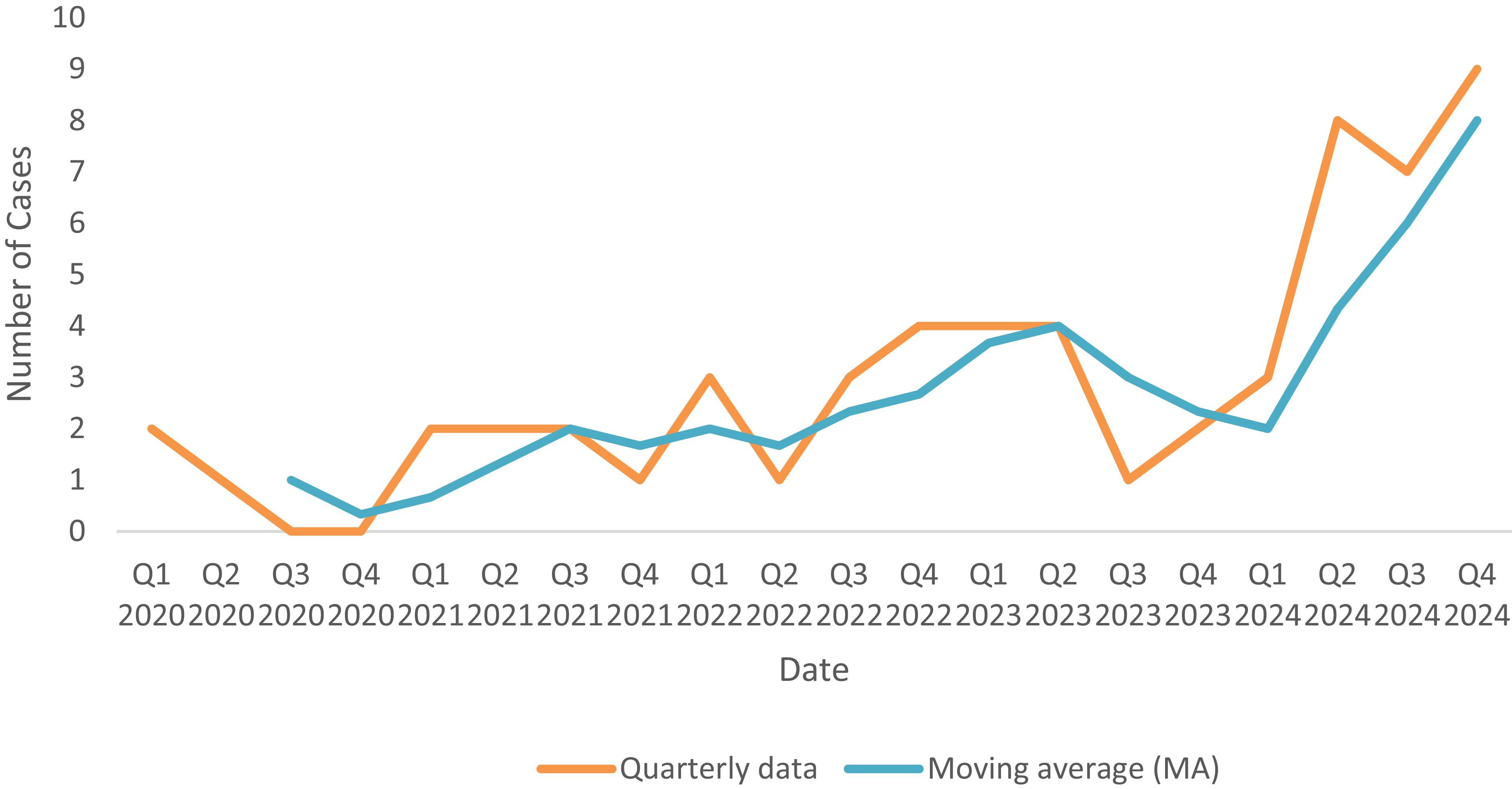
Seasonal distribution was assessed by calendar quarter: (i) Quarter 1—winter (January–February)/spring (March), (ii) Quarter 2—summer (April–June), (iii) Quarter 3—monsoon (July–August)/autumn (September), and (iv) Quarter 4—autumn (October)/winter (November–December). 16 The trend was estimated using the moving-average method, and seasonal variation was calculated using the ratio-to-moving-average method. The alteration in seasonal trends between 2015–2019 and 2020–2024 was analysed through linear trend estimation and the Chow test for structural breaks. A linear regression model was employed to estimate the trend:
 $Y_{t}=\beta _{0}+\beta _{1}*time+\beta _{2}\,\textit{*post}+\beta _{3}\,\textit{*timepost}+\in _{t}$
where Y t represents the moving-average incidence at time t; “time” is a continuous variable indicating the overall trend; “post” is a binary variable indicating whether the observation occurs before or after 2020; and “timepost” is the interaction term that models the difference in slopes. Linear regression and Chow tests were conducted separately for children aged <5 years and <15 years.
India has experienced three distinct waves of the COVID-19 pandemic, each characterised by its own duration, intensity, variant, public health response, and overall impact. The first wave lasted from January 2020 to February 2021. Reference Hazra, Pujari and Shekatkar17 The Government of India announced a strict lockdown starting 25 March 2020, lasting several months to control the initial spread. To curb the spread of COVID-19, the Government of India enforced a nationwide lockdown in four phases: Phase 1 (25 March–April 2020), Phase 2 (15 April–3 May 2020), Phase 3 (4–17 May 2020), and Phase 4 (18–31 May 2020). Reference Thayer, Hasan, Sankhla and Gupta18 From 1 June 2020, the nationwide lockdown was lifted, although targeted restrictions continued in containment zones identified by public health authorities. Reference Rai, Shukla and Dwivedi6 Daily cases peaked in September 2020 at over 90,000, then dropped to below 15,000 by January 2021. Reference Hazra, Pujari and Shekatkar17 According to serological surveys and modelling, approximately 35% of the population had been infected by the end of the first wave. Reference Hazra, Pujari and Shekatkar17 The second wave (March 2021–July 2021) began around mid-March 2021 and peaked in late April–early May 2021. Reference Samarasekera19 The third wave started in late December 2021, peaked in the first week of February 2022, and receded by March 2022. Reference Vohra, Dave and Sharma20–Reference Watson, Barnsley, Toor, Hogan, Winskill and Ghani22
We also summarised published studies reporting Kawasaki disease incidence trends during the COVID-19 pandemic, prioritising national datasets and large cohort-based analyses with time-stratified incidence data.
Results
Demography
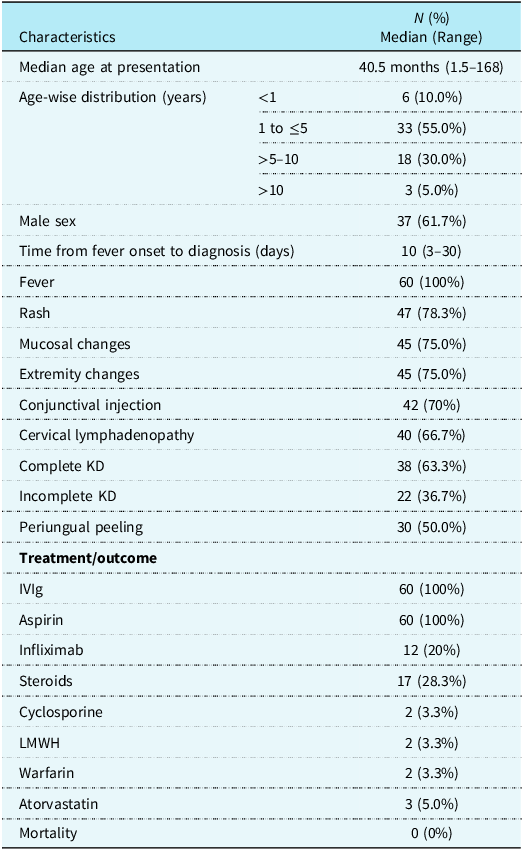
Between 2020 and 2024, 442 children were diagnosed with Kawasaki disease at our centre. Of these, 60 were UT Chandigarh residents and were included in the incidence analysis. The cohort included 37 boys and 23 girls, with a median age at diagnosis of 40.5 months (range: 1.5 months–14 years). Most patients (55%) were aged 1–5 years. Infants <1 year old and children >5 years old accounted for 10% and 35% of cases, respectively (Table 1). Specifically, median ages at diagnosis for males and females were 4 years and 3 years, respectively. Annual case counts declined during the peak pandemic years (3 in 2020 and 7 in 2021), then increased to 12 in 2022, 11 in 2023, and 27 in 2024.
Clinical characteristics and outcome of children with Kawasaki disease (N = 60)

Table 1. Long description
The table presents the clinical characteristics and outcomes of 60 children diagnosed with Kawasaki disease. It includes two main sections: characteristics and treatment/outcome. The characteristics section lists various attributes such as age-wise distribution, sex, time from fever onset to diagnosis, and specific symptoms like fever, rash, mucosal changes, extremity changes, conjunctival injection, cervical lymphadenopathy, complete KD, incomplete KD, and skin peeling. The treatment/outcome section details the treatments administered, including IVIg, aspirin, infliximab, steroids, cyclosporine, LMWH, warfarin, atorvastatin, and mortality. The table has 21 rows and 3 columns. Column headers are Characteristics and N (%). The table lists the median age at presentation as 40.5 months (range: 1.5-168). Age-wise distribution is broken down into categories: less than 1 year (6 children, 10.0%), 1 to 5 years (33 children, 55.0%), 5 to 10 years (18 children, 30.0%), and over 10 years (3 children, 5.0%). Male sex is represented by 37 children (61.7%). The time from fever onset to diagnosis is 10 days (range: 3-30). Symptoms include fever (60 children, 100%), rash (47 children, 78.3%), mucosal changes (45 children, 75.0%), extremity changes (45 children, 75.0%), conjunctival injection (42 children, 70.0%), cervical lymphadenopathy (40 children, 66.7%), complete KD (38 children, 63.3%), incomplete KD (22 children, 36.7%), and skin peeling (30 children, 50.0%). Treatments include IVIg (60 children, 100%), aspirin (60 children, 100%), infliximab (12 children, 20.0%), steroids (17 children, 28.3%), cyclosporine (2 children, 3.2%), LMWH (1 child, 1.6%), warfarin (1 child, 1.6%), atorvastatin (3 children, 5.0%), and mortality (0 children, 0.0%).
KD = Kawasaki disease; IVIg = intravenous immunoglobulin; LMWH = low-molecular-weight heparin.
Incidence, trend analysis, and seasonal distribution
The average annual incidence of Kawasaki disease during 2020–2024 was estimated at 6.66 per 100,000 children under 5 years of age and 3.44 per 100,000 children under 15 years of age. Over the five years from 2020 to 2024, annual incidence rates of Kawasaki disease among children under 5 years were 1.74, 3.43, 8.44, 5.81, and 13.90 per 100,000 children, respectively. The corresponding incidence rates for children under 15 years were 0.91, 2.10, 3.25, 3.20, and 7.72 per 100,000 children, respectively (Figure 1). Trend analysis illustrated a significant increase in Kawasaki disease cases from 2020 to 2024. The incidence of Kawasaki disease fluctuated year by year, with a peak in 2024, when the rate was 13.90 per 100,000 children under 5 years and 7.72 per 100,000 children under 15 years (Figure 1).
Incidence of Kawasaki disease among children aged <5 and <15 years in Chandigarh, India (1994–2024).

Comparison with previously published Chandigarh data showed an abrupt pandemic-period decline followed by a rebound that exceeded the highest earlier annual incidence estimates from our centre (Figure 1). Reference Singh and Bhattad3,Reference Pilania, Basu, Dixit, Kumrah, Jindal and Thangaraj4,Reference Singh, Aulakh and Bhalla10 Trend analysis of Kawasaki disease cases among children aged <5 years from 1994 to 2024 showed a statistically significant increasing trend. The estimated increase was 0.002 cases per month (p < 0.001) (Figure 2( a )). Trend analysis of Kawasaki disease cases among children aged <15 years from 1994 to 2024 also showed a statistically significant increasing trend. The estimated increase was 0.003 cases per month (p < 0.001) (Figure 2( b )). The positive slopes indicate a steady upward trend in the number of Kawasaki disease cases over the study period.
Monthly distribution and temporal trends in Kawasaki disease cases among children aged <5 years ( a ) and <15 years ( b ) from 1994 to 2024. Each vertical line represents the monthly number of Kawasaki disease cases, the fitted line represents the long-term linear trend, and the slope represents the estimated monthly increase in the number of cases over the study period.

The age-wise distribution of Kawasaki disease cases at diagnosis did not differ significantly across the pre-pandemic, pandemic, and post-pandemic periods (p = 0.667) (Figure 3 & Supplementary Table 1). Seasonal trends did not differ significantly between 2015–2019 and 2020–2024 (Figure 4); the interaction term was not significant for either children aged <15 years (p = 0.178) or <5 years (p = 0.225), and the Chow test did not identify a structural break (Supplementary Table 2). The overall demographic profile of Kawasaki disease patients remained largely unchanged throughout the COVID-19 pandemic period (Supplementary Table 1).
Age-wise distribution of Kawasaki disease cases during the pre-pandemic (2015–2019), COVID-19 pandemic (2020–2021), and post-pandemic (2022–2024) periods.

Seasonal variation of Kawasaki disease cases at Chandigarh, India, during 2020–2024.

Clinical features
Of these 60 children, 38 (63.33%) had complete Kawasaki disease, and 22 (36.67%) had incomplete Kawasaki disease. Fever was universal, followed by mucosal changes (75%), rash (78.3%), extremity changes (75%), conjunctival injection (70%), and cervical lymphadenopathy (66%) (Table 1). Periungual peeling was noted in 50% of cases. Two patients presented with Kawasaki disease shock syndrome. Gastrointestinal involvement in the form of loose stools was seen in 2/60 (3.33%), and infection was observed in 4/60 (6.66%) patients, including sore throat in 2 (3.33%), psoas abscess in 1/60 (1.66%), and Chikungunya IgM positive in 1 (1.66%). One child had laryngeal and pharyngeal muscle weakness, 3 had BCG-site reactivation, 1 had conductive hearing loss, and 1 had perioral desquamation.
Cardiovascular complications
Coronary artery abnormalities were detected in 8 patients (13.33%) during the acute phase of the disease. A total of 12 coronary aneurysms were identified across these 8 patients: 7 in the left anterior descending artery, 2 in the right coronary artery, 2 in the left main coronary artery, and 1 in the left circumflex artery. Of the 12 aneurysms, 5 were classified as small, 5 medium-sized, and 2 giant aneurysms. Two patients presented with symptomatic myocarditis—one with concurrent coronary artery abnormalities and the other with normal coronary arteries. At the 6-week follow-up, 2 patients (3.33%) had residual coronary artery abnormalities. CT coronary angiography was performed in 9 patients, revealing persistent abnormalities in 2. The 2 patients with giant aneurysms received low-molecular-weight heparin initially and were subsequently transitioned to warfarin.
Treatment
All patients received high-dose IVIg and aspirin. Adjunctive therapy was administered in 22 cases—of these, 10 received steroids, 5 received infliximab and steroids, 5 received infliximab alone, and 2 patients received all 4 agents: IVIg, steroids, infliximab, and cyclosporine. There was no mortality, and all patients were discharged in stable condition.
Discussion
This five-year epidemiological study provides critical insights into the changing incidence of Kawasaki disease among children in Chandigarh, India, from 2020 to 2024. Reference Singh and Bhattad3,Reference Pilania, Basu, Dixit, Kumrah, Jindal and Thangaraj4,Reference Singh, Aulakh and Bhalla10 This study documents a clear COVID-19 pandemic-associated interruption in the previously reported rising Kawasaki disease incidence in Chandigarh, followed by a post-pandemic rebound that reached the highest annual incidence recorded locally. The pattern supports the hypothesis that Kawasaki disease incidence is influenced by environmental exposures, infectious triggers, healthcare-seeking behaviour, or a combination of these factors. Reference Aggarwal, Pilania and Sharma23
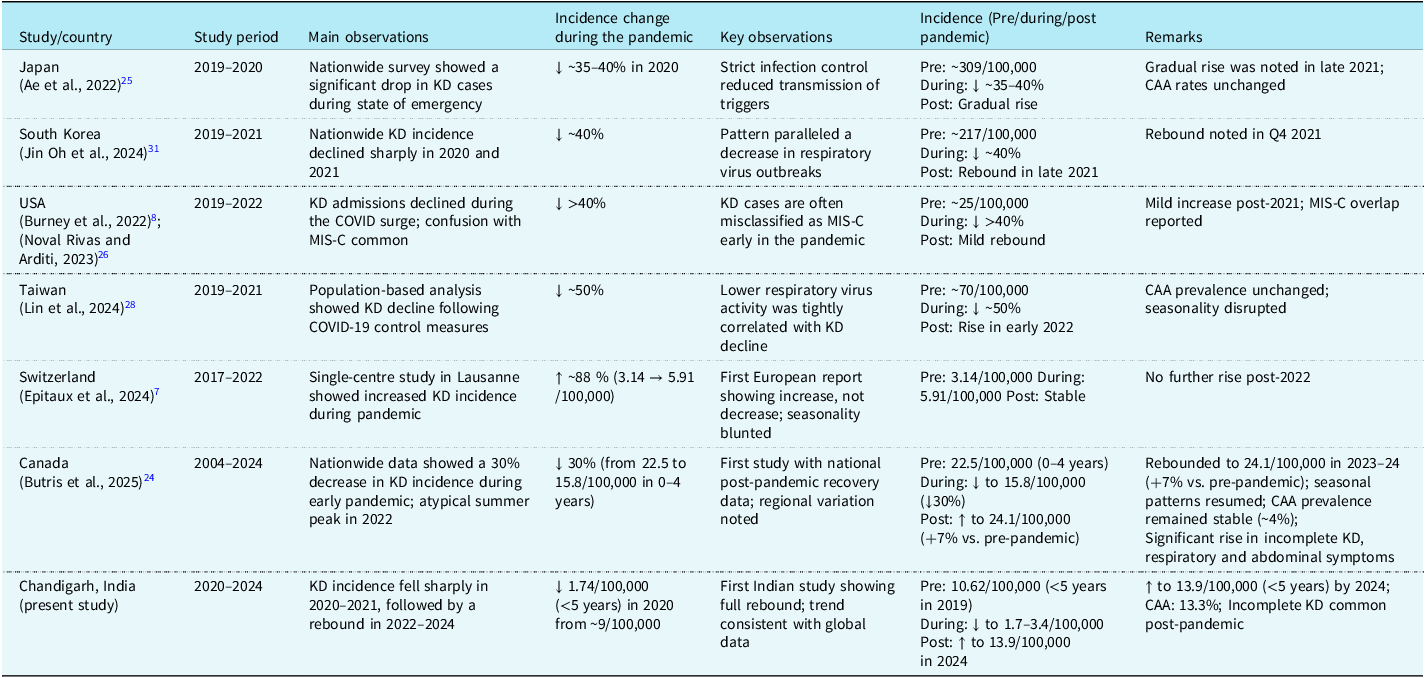
The most notable finding of our study is the marked decline in Kawasaki disease incidence during 2020 and 2021, coinciding with the peak of the COVID-19 pandemic. This decline mirrors similar patterns reported from Japan, Korea, Europe, and the United States, where public health interventions against SARS-CoV-2 dramatically reduced the incidence of various paediatric infections, including those postulated to act as Kawasaki disease triggers (Table 2). Reference Burney, Roberts and DeHaan8,Reference Butris, Gangemi and Farid24–Reference Noval Rivas and Arditi26
Review of published literature reporting the impact of the COVID-19 pandemic on the incidence of Kawasaki disease globally

Table 2. Long description
A table comparing the impact of the COVID-19 pandemic on Kawasaki disease incidence across different countries. The table has 8 rows and 6 columns. The columns are labeled Study/country, Study period, Main observations, Incidence change during the pandemic, Key observations, and Remarks. The rows provide data for different studies conducted in Japan, South Korea, USA, Taiwan, Switzerland, Canada, and Chandigarh, India. Each row includes details on the study period, main observations, incidence change during the pandemic, key observations, and remarks specific to each study.
KD = Kawasaki disease; CAA = coronary artery abnormalities; MIS-C = multisystem inflammatory syndrome in children.
An important consideration during the pandemic was the overlap between Kawasaki disease and multisystem inflammatory syndrome in children. Multisystem inflammatory syndrome in children, associated with SARS-CoV-2 infection, shares several clinical features with Kawasaki disease, including fever, mucocutaneous involvement, and cardiovascular complications. 12 In the present cohort, gastrointestinal symptoms were infrequent, and children meeting World Health Organisation criteria for multisystem inflammatory syndrome in children were excluded, supporting a predominantly classical Kawasaki disease phenotype. 12 Nevertheless, diagnostic overlap and misclassification cannot be completely excluded, particularly early in the pandemic. Reference Safi, El Rassi, Abou Mansour, Sleem, El Rassi and Arabi27
The temporal association between Kawasaki disease decline and the emergence of multisystem inflammatory syndrome in children suggests a complex interplay between infectious triggers and host immune responses. Several factors likely contributed to the observed decline in Kawasaki disease cases during the COVID-19 pandemic. Nationwide lockdowns, school closures, travel restrictions, mask-wearing, and enhanced hygiene measures significantly reduced the circulation of respiratory and enteric viruses. Reference Lin, Lin and Lin28 Given the hypothesised role of infectious triggers in Kawasaki disease pathogenesis, this decline in viral exposure may have led to fewer immune-activating events, particularly in genetically predisposed children. Reference Burney, Roberts and DeHaan8 Spatiotemporal studies by Burns et al. have shown seasonal and geographic clustering of Kawasaki disease, further supporting the influence of environmental or airborne agents. Reference Burney, Roberts and DeHaan8,Reference Burns, Herzog and Fabri29 These findings underscore the complex interplay between infection, immune response, and healthcare accessibility. Reference Burney, Roberts and DeHaan8 Reduced healthcare access may also have contributed to missed or delayed recognition of mild or incomplete Kawasaki disease. Conversely, the post-pandemic return of social mixing and routine paediatric services may partly explain the rebound observed in 2022–2024. Some diagnostic uncertainty during the early pandemic cannot be fully excluded, particularly for children with Kawasaki disease-like illness and evidence of recent SARS-CoV-2 infection. Reference Alfalasi, Snobar and Shaalan30
Comparison with global epidemiological data shows both shared patterns and regional heterogeneity. National and population-based studies from Japan, South Korea, Taiwan, the United States, and Canada reported a pandemic-period decrease in Kawasaki disease incidence. Reference Burney, Roberts and DeHaan8,Reference Butris, Gangemi and Farid24,Reference Ae, Makino and Kuwabara25,Reference Oh and Lee31 (Table 2) A subsequent study from Canada demonstrated a return to pre-pandemic epidemiological patterns, with resumed seasonality and a modestly higher incidence by 2023–2024. Reference Aggarwal, Pilania and Sharma23 However, a single-centred Swiss study reported an increase in cases of Kawasaki disease. Reference Epitaux, Sekarski and Bressieux-Degueldre7 Our findings closely mirror these global trends, with a marked rebound exceeding the pre-pandemic level, and warrant continued surveillance.
Despite fluctuations in incidence, the demographic and clinical profile remained broadly consistent with those reported in previous studies. Reference Singh and Bhattad3,Reference Pilania, Basu, Dixit, Kumrah, Jindal and Thangaraj4,Reference Singh, Aulakh and Bhalla10 One-third of children in the current cohort presented with incomplete Kawasaki disease, a proportion higher than reported in previous Indian studies. Reference Singh and Bhattad3,Reference Pilania, Basu, Dixit, Kumrah, Jindal and Thangaraj4,Reference Burns, Herzog and Fabri29 The relatively high proportion of incomplete Kawasaki disease may reflect improved clinical awareness and more systematic application of American Heart Association criteria, emphasising the importance of echocardiographic evaluation in suspected cases.
Coronary outcomes remained stable despite changing incidence patterns. Coronary artery abnormalities were observed in 13.3% of patients. This figure was comparable to that of previous cohorts at our centre and consistent with global figures. Reference Pilania, Basu, Dixit, Kumrah, Jindal and Thangaraj4,Reference Choi and Kim33,Reference Mossberg, Mohammad, Kahn, Segelmark and Kahn34 Most coronary artery abnormalities were transient, involving the left anterior descending artery, and resolved on follow-up. Persistent coronary changes were observed in 3.3% patients at 6 weeks.
While our findings are robust and build upon a well-maintained longitudinal registry, we identify some limitations in this study. Given the single-centre design, the results may not be generalisable to all regions of India. Although it could be argued that some cases might have sought care at other institutions, our hospital functions as the primary tertiary paediatric referral centre for the city of Chandigarh, making such occurrences unlikely. Some cases during the pandemic may have been missed or misclassified, particularly due to reduced healthcare access and overlap with multisystem inflammatory syndrome in children. Further, a few cases during the pandemic may have gone unreported or misdiagnosed. Therefore, the incidence reported here should be regarded as a minimum estimate. Finally, because precise annual population data were unavailable, the decadal population growth rate was used to estimate the denominator for incidence calculations.
Conclusion
This first Indian longitudinal report spanning the COVID-19 pandemic shows that Kawasaki disease incidence in Chandigarh declined during 2020–2021 and rebounded sharply thereafter, reaching the highest annual incidence recorded locally in 2024. Clinical features and coronary outcomes remained stable. These findings add Indian data to the global evidence that Kawasaki disease epidemiology is sensitive to pandemic-related environmental and healthcare disruptions and support continued surveillance and early recognition of Kawasaki disease.
Supplementary material
The supplementary material for this article can be found at https://doi.org/10.1017/S1047951126123683.
Data availability statement
Not applicable.
Acknowledgements
The authors gratefully acknowledge the role of all faculty members, clinical fellows, nursing officers, researchers, and technical staff who have been involved in the care of these patients.
Author contributions
RKP: Conceptualisation, preparation of the initial draft, critical revision of the manuscript, patient management and final approval of the manuscript. SB: Preparation of the initial draft, revision of the manuscript and patient management. YS, RDS, AT, ADa, ADh: Writing, review and editing of the manuscript, and patient management. AG, JD and SP: Statistical analysis, writing, review and editing of the manuscript. PV and DS: Critical revision of the manuscript and patient management. SSh, MD, JK, SN, MS and AR: Laboratory and/or radiological investigations, and writing, review and editing of the manuscript. SP and SS: Conceptualisation, critical revision of the manuscript and patient management. All authors reviewed and approved the final version of the manuscript.
Financial support
None.
Competing interests
All authors declare that they have no potential conflict of interest.
Ethical standard
All procedures performed in studies involving human participants followed the ethical standards of the institutional and/or national research committee, along with the 1964 Helsinki Declaration and its later amendments or comparable ethical standards. The Departmental Review Board, Department of Paediatrics, PGIMER, Chandigarh, approved the study [DRB 60-25 (B); dated 04.08.2025].