





This article traces the evolution and use of Jamaican kitchen gardens, also called “provision grounds” or “plots,” from their earliest manifestation on plantations to the present, where they exist in various forms—small farms, home, and school gardens—all promoted and supported through governmental initiatives. To do so, we utilise primary sources that emerged between 1655 and 1980 such as plantation papers, letters, literature, as well as recent government and newspaper reports and policies. Our discussion explores chronologically the role of gardens and plots, the people who farmed them, the gardens’ characteristics and the meanings they held for enslaved Africans, the crops grown, and the plots’ wider economic functions.
It is important to note that the term “creole” garden is not used in Jamaica outside of academic circles, and even then, it is very limited. While acknowledging the historical usages and meanings of the word creole, the authors draw attention to Cassidy and LePage’s definition: “anyone born, or anything grown or produced, in the West Indies or nearby territories, as distinct from one born or something grown elsewhere.”Footnote 1 They note that a contributing factor to its disuse was the belief that it was a racial term that implied “full or partial Negro ancestry.”Footnote 2 This is certainly so in the case of Jamaica.
With a land area of 10,990 km2, Jamaica is part of the Greater Antilles in the northern Caribbean. The island is mountainous with alternating rainy and dry seasons. The country can be generally divided into three landform regions: the eastern mountains, the central limestone valleys and plateaus, and the coastal plains. It is mostly on these coastal plains that crops of commercial importance were first established on plantations, except for coffee, which is grown in the eastern mountains and hilly regions in the central part of the island. The provision grounds that Enslaved Africans cultivated for subsistence were similarly situated in these hilly and mountainous interior zones with steep, rocky terrain such as the central limestone plateaus and eastern mountains that planters considered unsuitable for profitable export monocrops. This spatial arrangement was not incidental but rather an expression of the plantation system’s underlying logic: fertile lowland soils were monopolised for commodities destined for British markets, while the enslaved were relegated to the island’s more challenging, marginal landscapes to secure their own survival.
Kitchen gardens are said to be widespread in the tropics, known by various names including backyard garden, dooryard garden (Grenada), jardins nou (Dominica), and jardins du case (Martinique).Footnote 3 To these may be added jardin créole (also Martinique), creole gardens. The terms all signify “the area around a house cultivated intensively, mainly for food for the household.Footnote 4 Beyond providing food, Boum Make argues that “aside from plantation monocultures, gardening served as a vital means of survival and subsistence for enslaved individuals” as they had to grow their own food to sustain themselves and earn additional income.Footnote 5 These spaces have come to be theorised more recently within the context of care as spaces of sustenance and nurture for both humans and non-humans as able to supply “alternative social structures centring on mutual protection and distribution.”Footnote 6 This is juxtaposed against its colonial origin of oppression on plantations, the garden now representing “counter-plantation practice of mutual distribution.”Footnote 7
In the fifteenth century, the Spanish colonised and enslaved the native Taino prior to the English arrival in 1655. The Spanish introduced sugarcane cultivation and imported cattle and pigs for domestic purposes. They did not focus on agricultural cultivation but rather on pastoral activities.Footnote 8 The English introduced monocropping while conducting widespread privateering and piracy, following the template established by settlers in Barbados. Plantation agriculture produced sugarcane and its by-products, rum and molasses; as well as indigo, cacao, and coffee for export to Britain. Sugarcane, cacao, and coffee drove the trans-Atlantic slave trade that put enslaved Africans to toil in the fields under brutal conditions. Sugar was the most profitable commodity and sugarcane soon dominated landscapes across Jamaica and the Caribbean. Described by Richard Pares as a “factory set in a field,” plantation agriculture required vast tracts of land along with inputs of capital, and labour.Footnote 9 An exploitative capitalistic system that several scholars define as the plantation economy, extracted as much wealth as possible from the captive land and people.Footnote 10 The navigation laws used to support this plantation economy, relegated the English colonies to producers of raw material and markets for manufactured goods.
The spatial consequences of this plantation economy were ecologically devastating. Clearing forested areas and removing fauna to produce sugar on prime, fertile land disrupted the island’s natural biodiversity. The colonisers instituted a mercenary capitalist system that Haraway designated as the Plantationocene.Footnote 11 The labour to produce these raw materials to feed an overseas industrial system was forcibly sourced from West Africa. Enslaved West Africans were fed cheap imported foods such as salted meats and fish, and flour that were nutritionally deficient for the kinds of labour they engaged in. Slave laws required estates to provide the enslaved workers with salt fish, flour, and peas.Footnote 12 The limited nutritional value of these imported foods meant that enslaved workers were susceptible to malnutrition related diseases and were immunologically compromised. Sheer necessity forced plantation owners to grant their enslaved workers marginal estate lands to grow provisions to reduce production costs.Footnote 13 Proprietors were stipulated to allocate one acre of land for every four labourers.Footnote 14 The enslaved used these allocations to cultivate a variety of crops on thin soils or rocky terrain.
1. Representations of gardens and grounds
Cassidy and Le Page’s Dictionary of Jamaican English notes the terms “negro-ground” and “provision-ground” as descriptions of the plots of land originally assigned to enslaved Africans to grow their food.Footnote 15 Olive Senior in the Encyclopedia of Jamaican Heritage provides a thorough history of the usage of the word “Ground,” tracing it back to its English usage and its derivation from “provision-ground” or “negro-ground.”Footnote 16 Rampini vividly describes the ground and the attitude towards it, thus:
The only labour which is cheerfully performed by the negro in Jamaica is that which he bestows on his own “provision ground.” Of these “grounds,” each negro has at least one, varying in extent from half an acre to two or three acres. Out of this he supports himself and his family, pays his taxes and obtains his food.Footnote 17
Rampini correctly identifies three aspects of the value of provision grounds to black small farmers: the pride in their own property, the provision of food for the family, and income generation.Footnote 18 He also describes in vivid detail the crops grown, and their arrangement in the ground, as well as how they contributed to meals eaten by black families.Footnote 19
Hall sought to begin to rectify the gap in eighteenth and early nineteenth century historiography regarding horticulture, analysing “the farmers or small landowners whose income was in part derived from sales in the local markets; but also included the attention of sugar planters, and of slaves.”Footnote 20 Much of Hall’s examination is based on the diaries of Thomas Thistlewood, an Englishman who settled in Westmoreland, Jamaica, and who diarised his practice of gardening. While Hall began to close the aperture in the historiography, much remains to be addressed, including the symbolism as counter-plantation practice—repair and restitution—for those who worked and cared for them.
The Caribbean landscape is marked by the paradox of cultivation: spaces of growth and survival are simultaneously spaces of colonial domination. Both Kaneesha Parsard and Jamaica Kincaid interrogate this paradox, though from different vantage points.Footnote 21 Parsard’s analysis of provision grounds and Kincaid’s meditations on gardens converge in their insistence that cultivated plots, whether subsistence fields or ornamental gardens, cannot be disentangled from the plantation’s violent history. Provision grounds, as Parsard argues, were not simply sites of autonomy for enslaved Africans, but deeply embedded within the plantation’s economic logic.Footnote 22 While earlier scholars such as Sidney Mintz and Barry Higman emphasised their role in sustaining cultural continuity and resistance, Parsard complicates this narrative by showing how planters relied on provision grounds to reduce costs, thereby tethering subsistence directly to exploitation.Footnote 23 These plots were also gendered spaces: women disproportionately bore responsibility for their cultivation, linking subsistence labour to colonial constructions of femininity and domesticity. Thus, provision grounds reveal the contradictions of emancipation—spaces of survival that simultaneously reinforced racial and gendered hierarchies.
Kincaid, in turn, approaches the garden as a site where colonial aesthetics and violence converge. In My Garden (Book) and A Small Place, she reflects on the pleasures of horticulture while exposing its colonial underpinnings.Footnote 24 The “English Garden,” admired for its beauty, is revealed as a contrived landscape sustained by imperial wealth and botanical transfers from colonies. For Kincaid, the “Caribbean Garden” is haunted by the plantation: the flowers and exotic plants cultivated for leisure recall the forced transplantation of crops and people under slavery. Gardening becomes a meditation on memory, where beauty is shadowed by histories of displacement and exploitation.
Both Parsard and Kincaid’s interventions resonate with post-colonial ecocriticism, which examines how environments are shaped by colonial histories and how landscapes encode power relations. Provision grounds and ornamental gardens are not neutral spaces of cultivation but textual and material sites of colonial management, where survival and aesthetics are structured by empire. Their work also aligns with the post-colonial gothic that foregrounds haunting and spectrality: Kincaid’s gardens are haunted by the plantation’s ghosts, while Parsard’s provision grounds embody the contradictions of emancipation, where autonomy is shadowed by exploitation.Footnote 25 Furthermore, their critiques engage with theories of biopolitics, as both provision grounds and gardens reveal how colonial regimes managed life itself, through subsistence, reproduction, and aesthetics. The plantation system extended its reach into the most intimate aspects of survival and pleasure, making cultivated landscapes instruments of control. By foregrounding gendered labour and racial hierarchies, Parsard and Kincaid also contribute to feminist post-colonial theory, exposing how women’s work in cultivation was both indispensable and devalued, naturalised within colonial frameworks of domesticity.
Placed in the current discourse, Parsard and Kincaid illuminate the ambivalence of cultivated landscapes in the Caribbean. Provision grounds and ornamental gardens, though distinct in form and purpose, both embody the plantation’s enduring power. Parsard underscores how subsistence plots were never outside colonial management, while Kincaid insists that ornamental gardens are haunted by the plantation’s violence. Together, their work advances a theoretical understanding of Caribbean cultivation as sites of contradiction: survival and beauty are inseparable from exploitation and domination. The provision ground and the garden thus stand as twin figures of colonial ambivalence, reminding us that the Caribbean’s cultivated spaces are not neutral but deeply inscribed with the histories of empire.
2. Seventeenth century: provision grounds on estates
Provision grounds emerged in the seventeenth century as instruments to reduce the cost of feeding enslaved workers. Slave Laws made it obligatory for planters in Jamaica to provide the enslaved people with property to grow food.Footnote 26 While the enslaved people were at first free to use untilled estate land, in the eighteenth century, estate populations and production burgeoned, forcing the Enslaved Africans into marginal spaces away from the estates. The provision grounds climbed higher up the slopes of hills and mountains, separating those who worked them from both their dwellings and workplace. The grounds now had to produce high-yielding food crops to make the effort worthwhile. Cassava, a starch produced and consumed by the first island occupants, the Taino had been incorporated into the diets of Enslaved Africans.Footnote 27 Other mainstay starch crops included sweet potato, coco, yams, and plantains.Footnote 28 Easy to grow, these crops needed little tending; a positive factor as distant grounds prevented daily maintenance. Dasheen, a root plant, did not deplete the soil, and required fewer fallow periods to restore soil fertility.Footnote 29 The leaves, stem, and tubers of Dasheen were all eaten. The Enslaved Africans preferred to cultivate tuber crops as they resisted the strong winds from storms and hurricanes that plague Jamaica and other parts of the Caribbean. This resistance made up for the intensive land production required for planting such crops. Mountain areas with cooler climates became havens for planting “European” vegetables, with the Blue Mountains in eastern Jamaica becoming a principal area up until the present (Figure 1).Footnote 30
Plantain walk—bookkeeper—watchman and hut—man with casks of water/greattoe in stirrup by William Berryman. Library of Congress. LC-DIG-ppmsca-13410 (digital file from original drawing).

Figure 1. Long description
The drawing illustrates a lush tropical scene with a dirt path winding from the bottom center toward the left.
* In the foreground on the right, a man wearing a hat and light-colored clothing sits atop a horse or mule. The animal carries large wooden casks on its sides. The man’s foot is positioned with his great toe in the stirrup.
* In the middle ground, a tall, pale tree trunk leans diagonally from the center toward the top left. At the base of this tree stands a man in a long white coat, identified as the watchman.
* Further back and to the left on the path is another man in a blue jacket and white trousers, identified as the bookkeeper.
* To the right of the central tree is a small, rustic hut with a thatched roof, surrounded by a simple wooden fence.
* The background is filled with dense vegetation, including broad-leafed plantain trees and various tropical flora. A grassy hill rises on the right side under a pale blue sky with light clouds.
* The number 29 is written in the top right corner of the paper.
Of significance to Jamaican foodways was the introduction of ackee (Blighia sapida) from West Africa in 1778. The National Dish of Jamaica is ackee and saltfish which combines the salted fish imported for protein for the enslaved and the yellow, fleshy aril of the ackee. Other trees of dominance in the plantation grounds were breadfruit and mango, introduced by the British to expand food options for the growing numbers of enslaved Africans. The breadfruit had a rough start in the island as it was initially resisted by the enslaved people, but subsequently worked its way into the mainstream, becoming a highly prized food, especially the “Yellow Heart” variety. The evolution of attitudes towards breadfruit is likely due to the sturdiness of the plant in face of hurricanes and droughts; and its use as “bread” kind during periods of scarcity. Through its hardiness and reliability, breadfruit cemented its place in the heart of the Jamaican populace.Footnote 31
Other plants such as okra and tomatoes were planted in grounds and later kitchen gardens, appearing on tables in the huts and yards of enslaved persons. Calabash was crafted into containers, and indigo was used to dye garments. The Enslaved Africans used a wide variety of bark, leaves, withe, and herbaceous plants to cure ailments from fever to toothaches. New plants were tested based on similarity in appearance to plants from homelands, and still others became part of rituals and rites. Higman quotes an unnamed early 18th century writer who lists sage, rosemary, winter savory, marigolds, mint, scallions, leeks, parsley, and beets as plants that appeared in Jamaican kitchen gardens.Footnote 32 Radishes, turnips, carrots, parsnips, “sallary” (celery), and horseradish were also found in these kitchen gardens. Basil and mint were used medicinally. The cost of providing imported tea to the enslaved proved too expensive, and bush teas made from infusions of assorted herbs, mint, and barks became common.Footnote 33 Among the listed numerous plants used for tea were Jack-in-the Bush, Cerasee, Elder, “Ochro,” Vervine, Sage, Search-me-Heart, Lime-leaf, and Fever Grass (Lemon Grass).Footnote 34 Coffee and cacao also appeared in inventories of provision grounds and kitchen gardens where a few shrubs were maintained to supply household need. The lack of prevalence of these last two plants was linked to the processing required to produce the beverage. Habitually exhausted workers did not want to plant a crop that required labour-intensive production.
3. Seventeenth century: the gardens
A turning point in the positioning of the grounds came in 1791 when the Jamaican Assembly voted to encourage the cultivation of yams, cocos, maize, plantains, breadfruits, nutmeg, cloves, cinnamon, coffee, and other important crops to relieve the island’s dependence on America which was no longer a colony of England after the American Revolutionary War against Britain between 1776 and 1783. Brierley and Higman described these crops as part of the distinctive vertical and horizontal distribution of plants in the food forest that makes gardens and grounds seem chaotic, but which are in fact carefully engineered spaces.Footnote 35 The food forest’s vertical tiers imparted ecological, economic, and agricultural advantages.Footnote 36 In the novel The Harder They Come, Michael Thelwell describes a very vivid picture of this organisation:
A stranger might see there only an undifferentiated mass of lush tropical jungle. But to Miss Mando it was nothing of the kind—it was home and history, community and human industry, sweat, toil and joy. Towering over everything was not jungle but trees left there for shade and someday timber. Mahoe, cedar, mahogany, fustic, trumpet and the occasional dramatic blue-green bursts of bamboo. And food trees, dense with leaves and hidden fruit—the purple leaved star apple, regal breadfruit, mango, pear, ackee, jackfruit—each with its unmistakable contours darkly silhouetted against the blue evening light. Here and there, the broad crowns of coconuts swaying precariously on impossibly slender sun seeking trunks.
Beneath these giants she could make out the shrubs, the cocoa trees, apple trees, coffee patches, bananas, plantain and the textured yam vines shooting up the poles that were their ladders to the sun. And hard against the earth the broad heart shaped leaves of coco, yams and baddoe, dasheen, yampee, and patches of sorrel, of red peas and gungo.Footnote 37
Similar imagery is also found in Michelle Cliff’s novel No Telephone to Heaven, where she enumerates the trees, such as coconut and citrus, and cultivated crops such as coffee, afu (a yam), fufu, plantain, and cassava from a previous occupation of the land.Footnote 38 The small areas of ornamental flowers are also recorded. Over time, gardens moved from mere subsistence and economic spaces to being pharmacopeia and mainstays of internal food supply and household necessities. A coconut tree provided branches for thatch roofing and brushes to shine floors, coconut water, and dried nuts for flesh for coconut milk (Figure 2).
Sketch plan (a) and picture (b) of a small farm in Turnberry, St. Ann, Jamaica. Credit: Thera Edwards.

Figure 2. Long description
The figure is divided into two vertical panels.
Top Panel: A site plan of plot G 10. At the top North, a compass needle points Northwest. A drain or water course runs horizontally through the upper third.
* North of the drain: Three distinct zones contain Sugar Cane (135), Papaya (98), Plantain (105), Pumpkin (113), and Yam (143).
* South of the drain: A large central area is divided into sub-plots. The western sub-plot contains Sugar Cane (135), Pumpkin (113), and Papaya (98). The eastern sub-plot contains Yam (143), Red Peas (117), and Peanut (99).
* Southeast area: Features a Tank, a Shelter, and an Animal pen used for cooking. Nearby are Scotch Bonnet Pepper (126), Cassava (22), and Papaya (98). A large patch of Grass is located to the East.
* South: An arrow points down toward a Road.
* Northeast: An arrow indicates Slope Down.
* Key: Lists 10 plant types with numerical codes and scientific names, including Cassava (22), Papaya (98), Peanut (99), Pineapple (103), Plantain (105), Pumpkin (113), Red Peas (117), Scotch Bonnet Pepper (126), Sugar Cane (135), and Yam (143).
Bottom Panel: A photo of the actual field. In the foreground, reddish-brown soil is planted with young crops and several tall banana or plantain trees with large green fronds. To the left, rows of climbing plants on thin wooden stakes are visible. The background shows a grassy slope rising toward a dense treeline under an overcast sky.
4. Reconstituted lives on marginal grounds
Although provision grounds first emerged on the plantations, initially serving a capitalistic purpose—reducing the cost of feeding their enslaved labour force, they became so much more.
Simon Gikandi commented on the aesthetic value of provision grounds; noting that plants were selected for their functionality and their aesthetic appeal:
At the centre of this redefinition was the transformation of the landscape of death and suffering into a space of pleasure, of aesthetic value, one that could be made visible only through above-ground crops. Indeed, these were the crops that enchanted observers who, on encountering the provision ground for the first time, were struck by its beauty and its forceful sublimity.Footnote 39
To illustrate this point, he provided the following description from Tom Cringle’s Log written by the Scottish writer and erstwhile overseer, Michael Scott:
At a distance it had the appearance of one entire orchard of fruit trees, where were mingled together the pyramidal orange, in fruit and in flower, the former in all its stages from green to dropping ripe,—the citron, lemon, and lime-trees, the stately, glossy-leaved star-apple, the golden shaddock and grape-fruit, with their slender branches bending under their ponderous yellow fruit,—the cashew, with its apple like those of the cities of the plain, fair to look at, but acrid to the taste, to which the far-famed nut is appended like a bud,—the avocado, with its brobdingnag pear, as large as a purser’s lantern,—the bread-fruit, with a leaf, one of which would have covered Adam like a bishop’s apron, and a fruit for all the world in size and shape like a blackamoor’s head; while for underwood you had the green, fresh, dew-spangled plantain, round which in the hottest day there is always a halo of coolness,—the coco root, the yam and granadillo, with their long vines twining up the neighbouring trees and shrubs like hop tendrils,—and peas and beans, in all their endless variety of blossom and of odour, from the Lima bean, with a stalk as thick as my arm, to the mouse pea, three inches high,—the pineapple, literally growing in, and constituting, with its prickly leaves, part of the hedgerows,—the custard-apple, like russet bags of cold pudding,—the cocoa and coffee bushes, and the devil knows what all, that is delightful in nature besides; while aloft, the tall graceful cocoa-nut, the majestic palm, and the gigantic wild cotton-tree, shot up here and there like minarets far above the rest, high into the blue heavens.Footnote 40
This description lays out the aesthetic appeal of the provision ground; demonstrating the process, the thought and care behind it. Crops were selected not only for their efficacy but also for visual appeal. This visual appeal was transgressive; “One of the tactics and manoeuvres the slaves could deploy was to transform the provision ground from a utilitarian space to an aesthetic object.”Footnote 41 The visual appeal was also measured by the time, heart, and energy invested in the provision ground which allowed them time away from the constant gaze of the planter. The provision ground was perceived as their personal space and investment; something they could lavish care on and which, in its turn, would care for them.
Provision grounds were the hub of reconstituted communities, thought, and customs. On these provision grounds, Enslaved Africans reconstituted cultural and ecological practices steeped in memory and psychical and physical healing and nutrition, becoming what Jamaican scholar, writer and activist Sylvia Wynter describes as “a source of cultural guerrilla resistance to the plantation system.”Footnote 42 They used creativity, communal practices, and innovation to extend the meagre imports the plantation offered them. They grew yam, plantains, beans, herbs, various greens known eponymously as callaloo, and raised pigs, goats, or chickens.Footnote 43 Enslaved Africans on estates near rivers, streams, or the sea fished to supplement their diet. Those who lived close to the Rio Cobre River, for example, consumed fish such as mullets and mudfish, eels, crawfish, and prawns.Footnote 44 The provision grounds were intended for their subsistence, however, enslaved workers often sold the surplus they managed to produce to others, including white settlers.Footnote 45 These provision grounds became the foundation for what noted anthropologist of the Caribbean and food, Sidney Mintz, termed the proto peasantry, a thriving internal market system that restored some economic and personal autonomy to the enslaved people.Footnote 46 We can see the provision grounds as sites of black repair that helped to mitigate the pervasive and extreme inequality of the plantation. On these grounds, African agrarian practices, musical traditions, food heritage, and notions of community were revitalised in the interstices of the plantation, creating rich legacies that could be transferred from one generation to the next.Footnote 47 The provision grounds became hubs of black life away from the white-centred prominence of the plantations.
5. Nineteenth century: apprenticeship, emancipation, and the rise of the peasantry
Originally established to ease the burden of feeding enslaved persons, provision grounds quickly became sources of dietary and economic independence. Mintz records a writer who noted that provision grounds were producing so much surplus that their production supplied the majority of agricultural production.Footnote 48 Although legally bound to the estates until emancipation, enslaved individuals began earning income from these lands in the final years of slavery. From their provision grounds and kitchen gardens emerged the beginnings of a proto-peasantry that foreshadowed their post-emancipation agrarian life.Footnote 49 Immediately after emancipation, the newly freed people established thriving agriculture-based industries on lands bought with their own savings or through free village systems using their planting and marketing skills acquired in slavery.Footnote 50 The provision grounds and gardens were launch pads for vibrant agriculture-based livelihoods. But in a point of departure from Wynter’s positioning of the plot-plantation connection, Parsard presents the siphon as a more appropriate metaphor for “the overlapping literary-historical conjunctures of West Indian emancipation and the post-colonial.”Footnote 51 She sees the relationship to novelistic plot as being more through action than through the metaphor of place. Accordingly, “the device [the siphon] has two modes: the original feeding of the liquid into the tube and the flow that follows.”Footnote 52 She presents a reorientation of Wynter’s “ambivalence,” which she finds suggests objection and resignation to the order of things; a completed state. “The siphon shifts a sense of formal plot from ‘action-transpiring-in-time’ to a pulling downward or subterfuge. It is a term of value, a verb that acknowledges the political-economic doing or strategy of Caribbean working people.”Footnote 53 She argues that the provision grounds were spaces of “outright deprivation” as well as of ambivalence through property disputes between Enslaved Africans and Free Blacks, and, in current terms, this is evident in the post-colonial garrison or ghetto, the result of “carving up space” and the “distribution of scarce resources.”Footnote 54 The siphon represents a process rather than a completed state, therefore, and is a term by which “the projects of emancipation, the post-colonial, and our criticism … might continue to move.”Footnote 55 Thus, Parsad leaves room for resistance to occur in spaces where the descendants of enslaved Africans tend gardens (kitchen and school) and grounds.
This post-emancipation shift marked a turning point. Free men and women were unwilling to work on their former estates for low wages, as their provision grounds and independent earnings provided a “comfortable subsistence” and allowed them to secure all they required.Footnote 56 Plantations such as Montpelier complained about the diversion of labour and the competition for time of enslaved workers between their work in the fields and on their provision grounds. This became particularly acute when the planting cycle of provision grounds clashed with that of the estate. In some instances, the newly emancipated people organised themselves and demanded to be paid by the day rather than by task.Footnote 57 Pay per task was less advantageous, especially when the tasks—such as cutting or planting a certain acreage of sugar, might take days or even weeks to complete, creating much uncertainty. Payment by the day was more advantageous for the worker whose immediate needs were met, rather than the uncertainty of delayed payment per task.
Eventually, the struggle between personal and estate employment in the shadows of slavery’s legacy led to the emergence of the small farming sector of the island. Sadly, small farmers were constantly vilified for their backward techniques, irregular cultivation practices, and their role in land degradation through soil erosion and lack of fallowing. Small farmers maintained either a principal farm near their main dwelling or multiple plots dispersed around where they lived. They selected these plots for soil quality, access to water, distance from dwelling, and other factors rooted in indigenous technical knowledge, knowledge that came from West Africa and was tailored to fit Jamaica’s reality—achieved through centuries of trial and error, in the process becoming indigenised. The grounds evolved into farms, while kitchen gardens with “a little this and a little that” persisted as farmers tried to maintain dietary diversity and spread their risk across loss of the crops.
6. The kitchen garden and foodways
Kitchen gardens contributed to sustainable and healthy food habits and helped create the Jamaican cuisine. The labour of enslaved cooks and cultivators, Mintz argued, influenced the breadth and the stability of cuisine.Footnote 58 This occurred through what they produced and sold at markets and what they cooked, supporting Parry’s argument that food habits in the West Indies had already been fixed by the end of the eighteenth century.Footnote 59 Mintz distinguishes the meaning of cuisine as:
-
(1) what the enslaved ate upon arrival—boiled or roasted plantains and yams, beans, and greens known eponymously as callaloo—which was prepared by other enslaved people;
-
(2) what they cooked for themselves, by choice, through efforts such as fishing and trapping—including eels, crawfish, mullets from rivers and streams, as well as rats that consumed sugarcane; and
-
(3) what they cooked for their masters and the masters’ family—often including not only items such as plantains but also roasts of animals such as pigs and goats; cakes and pastries from English recipes.Footnote 60
All three point to exposure to a range of ground provisions, protein, herbs, and spices that enabled enslaved people to expand the repertoire of items grown for sale and for domestic use. The products of these gardens formed the foundation for many of the dishes and the foodways of Jamaicans post-Emancipation. Herbs and spices such as annatto, scallion, cooking tomato, scotch bonnet pepper, and bird pepper became essentials in gardens for seasoning and colouring in the case of annatto. A variety of peas and beans, as well as vegetables such as okra and callaloo, were characteristic ingredients in stews and soups, along with yams, sweet potato, and cassava, boiled, baked, or roasted.
7. Twentieth century: decline of small farming
After emancipation, sugarcane and coffee continued as monoculture crops. Bananas rose in prominence from the late 1800s and held sway until the 1980s when globalisation forces and the loss of preferential tariffs led to the decline of the industry. Small farming persisted even after independence. But the enduring legacy of slavery saw the most valuable crops (carrots, beets, string beans) being sold versus consumed by the farmers who continued to eat starch-based diets.Footnote 61
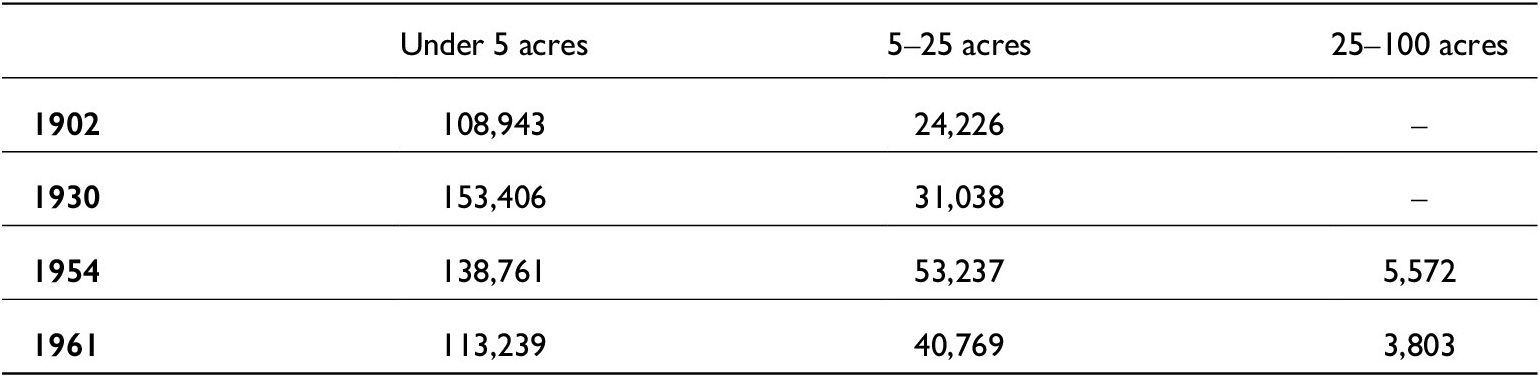
Post-emancipation, the number of small farmers climbed from 19,397 in 1845 to 184,444 in 1930. After that, this number steadily declined as the following Table 1 demonstrates.
Peasant properties in Jamaica, 1902–1961

Table 1 Long description
The table consists of four columns and five rows including the header. The columns are categorized by property size: Under 5 acres, 5 to 25 acres, and 25 to 100 acres.
* Row 1 (1902): Under 5 acres has 108,943 properties; 5 to 25 acres has 24,226 properties; 25 to 100 acres is not recorded.
* Row 2 (1930): Under 5 acres has 153,406 properties; 5 to 25 acres has 31,038 properties; 25 to 100 acres is not recorded.
* Row 3 (1954): Under 5 acres has 138,761 properties; 5 to 25 acres has 53,237 properties; 25 to 100 acres has 5,572 properties.
* Row 4 (1961): Under 5 acres has 113,239 properties; 5 to 25 acres has 40,769 properties; 25 to 100 acres has 3,803 properties.
The data shows a peak in the smallest property category in 1930 and a peak in the 5 to 25 acre category in 1954.
Source: Marshall Reference Marshall, Shepherd and Beckles1993, 102.
Broad trends in agricultural production between 1962 and 1979 saw the sector’s contribution to gross domestic product (GDP) and exports declining.Footnote 62 The contribution to export crop production of farms ranging in size from 0 to 4.9 acres and 5.0 to 24.9 acres declined, while domestic crop production increased by roughly 50 percent.Footnote 63 By 1987, the number of single farmholders for 0–4.9 acres and 5.0–24.9 acres, representing small- to medium-sized holdings were 70.0–86.0 percent, respectively. In 1963, the island’s government established an Agricultural Marketing Corporation (AMC) to improve efficiency. However, conditions in the farming sector continued to deteriorate, prompting the government to establish the Rural Agricultural Development Authority (RADA) on 1 August 1990.Footnote 64
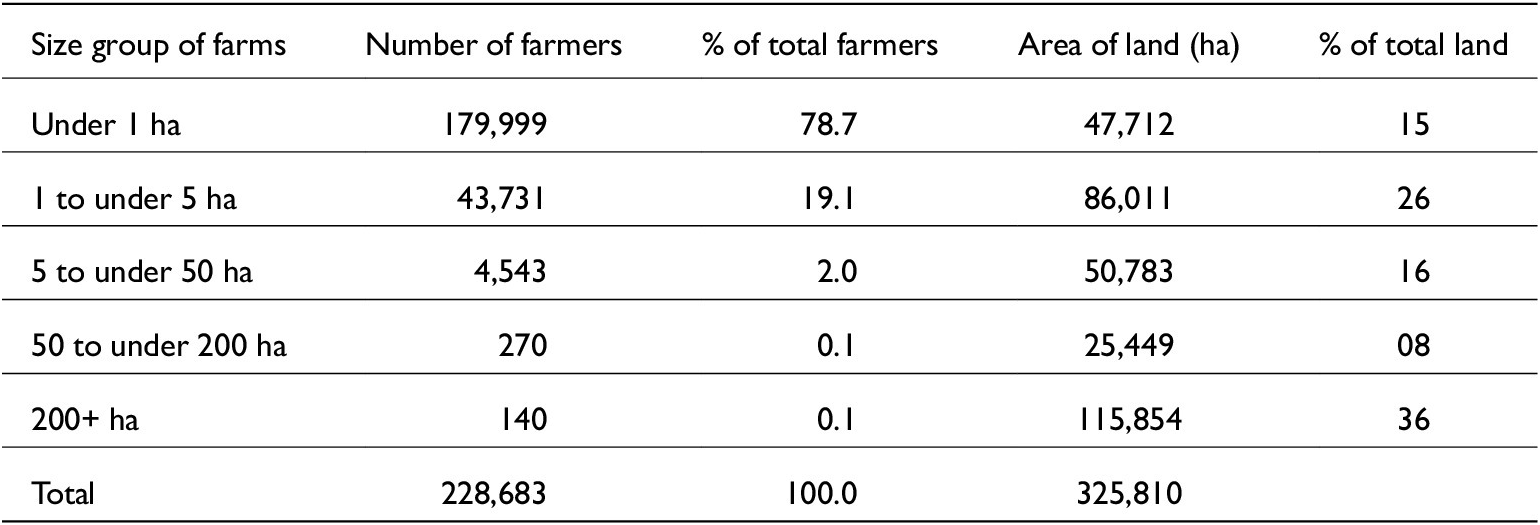
The last census of agriculture was conducted in Jamaica in 2007. The findings then showed that there were approximately 228,000 farmers. As shown in Table 2, the vast majority of farmers are small farmers. Nearly 80 percent of the farmers occupy less than 1 ha of land with only 0.2 percent of farms being larger than 50 ha. What is also shown is that nearly 80 percent of small farmers occupy only 15 percent of the land. More often than not, these farmers are located on the worst lands, situated on steep and difficult to access sites with very little access to irrigation sources. The large farms taken up with mainly sugarcane, citrus, and banana occupy the best lands on the plains and enjoy access to most of the country’s irrigation infrastructure. In recent years, however, with the rapid decline of the sugar industry, much of the former sugarcane lands are being diversified to other uses including housing and other forms of agriculture.Footnote 65
Lands under cultivation by size group of farms in 2007

Table 2 Long description
The table consists of five columns: Size group of farms, Number of farmers, percent of total farmers, Area of land in hectares (h a), and percent of total land.
* Under 1 h a: 179,999 farmers (78.7 percent) occupying 47,712 h a (15 percent of land).
* 1 to under 5 h a: 43,731 farmers (19.1 percent) occupying 86,011 h a (26 percent of land).
* 5 to under 50 h a: 4,543 farmers (2.0 percent) occupying 50,783 h a (16 percent of land).
* 50 to under 200 h a: 270 farmers (0.1 percent) occupying 25,449 h a (08 percent of land).
* 200 plus h a: 140 farmers (0.1 percent) occupying 115,854 h a (36 percent of land).
* Total: 228,683 farmers (100.0 percent) occupying 325,810 h a.
The data shows a high concentration of farmers in the smallest size group, while the largest land area is held by the fewest farmers in the 200 plus h a category. Source: Statistical Institute of Jamaica (S T A T I N).
Source: Statistical Institute of Jamaica (STATIN) 2007. Page xii
As farm families grow, there is an increasing trend towards further fragmentation of these farms. In the intercensal period of 1996 and 2007, the number of farms of less than 1 ha grew by 32 percent. In 1996, approximately 0.5 percent of the total number of farms in Jamaica accounted for 50 percent of all the land under cultivation. In 2007, this figure declined further to 0.2 percent, accounting for 44 percent of lands under cultivation.
This fragmentation has the potential to undermine food security and reduce the ability of the country to feed itself if the rate and pace of fragmentation lead to economically unviable subsistence farms. Eventually such farmers may leave their lands in search of more viable options, thereby exacerbating the rural-urban drift and further contribute to rural decline
The rise in natural disasters, and adverse effects of globalisation, produced what O’Brien and Leichenko describe as “double exposure.”Footnote 66 This dual vulnerability forced many small farmers to abandon agriculture because their efforts no longer generated sufficient income for a sustainable livelihood. In addition, rural to urban migration increased, and the small farming sector slipped into decline. There were now more urban centres in Jamaica that grew from their early nuclei. As demand for land increased, lot sizes in urban areas became smaller. Kitchen gardens, once a staple of every backyard with familiar patches of callaloo, cooking or salad tomatoes, bird pepper, banana, and fruit trees, became relics of the past. There was simply no space. Twenty-first century Jamaica in the Kingston Metropolitan Area (KMA) is experiencing a significant transition in suburban neighbourhoods where single lots become apartments or townhouses. These new developments afford very small yard space around the house.
8. Twenty-first century: precarity and the gardens’ renaissance
In Jamaica, the vulnerability of the agriculture sector to climate hazards and droughts, in particular, is both historical and recent. The Vision 2030 Medium Term Framework (MTF) for 2012–2015 reported that there were notable declines in production for the years 2013 and 2014. These declines were heavily driven by severe droughts reported by the Meteorological Service of Jamaica. Key issues of concern were climate change and the performance of two important sub-sectors in agriculture, crop production, and livestock. Crop production is dominated by small holdings, which are almost entirely rainfed with no supplemental irrigation. This induces an inherent vulnerability to rainfall extremes (floods and droughts). The frequency of storms with accompanying crop and agricultural infrastructure losses—40 percent of bananas lost in tropical storm Nicole in 2010 and 90 percent of greenhouses destroyed in Hurricane Dean—battered an already precarious agriculture sector.
Poverty remains prevalent in rural areas, where the rate reached 14.2 percent in 2019, compared to the national average of 11.0 percent.Footnote 67 Food poverty recorded a similar trend, with rural areas experiencing a 6.7 percent rate compared to the national average of 4.0 percent (2019 data).Footnote 68 While rural areas form the backbone of agricultural production, these figures show that in prioritising earnings, farmers were not feeding themselves or their families adequately. Notably, food poverty also exists in the Kingston Metropolitan Area.Footnote 69
Further exacerbating improper nutrition and food poverty are the costs of a nutritionally balanced meal and the higher cost for the highest ranked foods in the Jamaican diet, namely, yam, Irish potato, callaloo, red peas versus bread, bulla, crackers, vegetables, and peanuts. Many Jamaicans report that eating healthily is more expensive, and very often vegetables are only eaten on Sundays. This reality, coupled with the effects of the COVID-19 pandemic and the severe impact of recent hurricanes such as Hurricane Beryl in 2024 and Hurricane Melissa in 2025, further spurred the development of innovative programmes to strengthen food security at the household level.
Gardens and backyard gardening became more popular and were repositioned when Rural Agricultural Development Authority (RADA) in the Ministry of Agriculture, Fisheries, and Mining launched a “Backyard Gardening Kit” initiative that recognises that this useful feature “plays an important role in our pursuit of a sustainable and reliable food supply” (see Figure 3). By cultivating a variety of crops in backyards, not only is there immediate access to fresh and nutritious produce, but also an active contribution to bolstering local food security. The initiative encourages urban and peri-urban populations to plant vegetables and herbs in private or communal spaces to reduce food expenses and decrease dependence on imported foods.
Backyard gardening kit distributed by RADA.

The kits from RADA contain callaloo, pak choi, lettuce, tomato, sweet potato, a small hand fork, a small hand shovel, a seed tray, potting mixture, and a nutrient to aid growth. Applications for the kit are online and face-to-face at RADA offices across the island. Support was provided in the form of videos by way of RADA’s YouTube channel. Demonstrating the need for interventions such as these, the Ministry of Agriculture, Fisheries and Mining reported that the demand for the kits far outweighed the supply.Footnote 70 Despite rising land prices, the increased concretisation and building of vast apartment structures, the response to these kits demonstrate that kitchen gardens and plots are well needed in the twenty-first century and demonstrate how traditional knowledge and practices can be re-tooled and re-packaged to meet current needs/goals. Long-term goals include improving the nutritional diet of families by facilitating access to vegetables. Research analysing national diet compositions through food baskets shows vegetable consumption is a significant challenge in all Jamaica’s parishes. The impact of the “backyard gardening kit” part of the New FACE of Food initiative is yet to be fully determined. However, as word spreads, the demand outstrips the supply, with government bodies requesting public/private partnerships which would see businesses contributing to the effort. The demand alone illustrates the efficacy of the intervention.
Efforts to promote backyard gardening continue with features on local radio such as an interview with Joel Price of RADA by Theodore Henry of the Jamaica Information Service radio programme “Get the Facts” on 21 January 2026. In that feature, Mr Price sought to show that backyard gardening was very simple and did not need expensive inputs as summarised next:
So, backyard gardening is simply producing, you know, in the small space that you have, either in your backyard, in your front yard, or even in the space, any space that you think you don’t have, like your balcony, in containers and so forth. So, everyone can make it in their own way. So, it’s more about growing in whatever space you have, not necessarily needing a backyard, like your family in country [rural area] right now … What sort of containers are we looking at here? You can utilise whatever it is that you have. You know, they are, you know, like tyres, used tyres, your bottles, like a five-gallon bottle, so you can cut them, tubs, even old refrigerators it can be repurposed for growing crops. Crops ranging from Cucumbers, Tomatoes, Pak Choi, Lettuce. you want to ensure that wherever you place your containers, that there is access to full sunlight.
You want to ensure that the plants are watered, and the containers have proper drainage.Footnote 71
A second gardening intervention, another project emanating from the New FACE of Food initiative, is the renewed support and promotion of school gardens. School gardens are generally defined as the land near a school on which vegetables, fruits, ornamental plants, and produce are grown. Strgar et al. note another definition that includes plants grown on school grounds and within the school.Footnote 72 These gardens serve the dual purpose of introducing students to agricultural science and production by applying theoretical knowledge of science, environmental and nutrition education in a hands-on, applied context while supplying food for school canteens to promote balanced diets that include vegetables. Greene states that school gardens also instil in children “a love for outdoor work and such knowledge of natural forces and laws as shall develop character and efficiency.”Footnote 73 In some resource-challenged communities, the productions from school gardens are used to supplement breakfast and/or lunches provided to the students from the school canteen.
One notable school in this initiative is Papine High School which has a small farm with a green house, drip irrigation, and solarised beds with assorted vegetables including lettuce, tomato, scotch bonnet peppers, and pumpkins (see Figure 4). The school garden initiative is already yielding positive response. Reports indicate enhanced educational outcomes, healthier eating habits, and environmental awareness, as well as useful agricultural skills among student participants.Footnote 74 Like the “Backyard Gardening Kit,” the school gardens mark a new twist on an old model and one that is bearing fruit. It demonstrates that the kitchen gardens/provision grounds of the enslaved people continue to be useful in the twenty-first century, as it promoted then and now, food security, if not food sovereignty.
Papine High School farm.

9. Rise, Resilience, and Reinvention of Grounds and Gardens
The article has traced the progression of provision grounds (referenced as Creole Gardens in this special issue) in Jamaica, from their genesis on plantations through their evolution into small farms and kitchen gardens, and finally into refugia in small spaces in the form of backyard kits and school gardens. While their typology with respect to size, economic role, and social relevance have changed over time, these agricultural spaces continue to play a role in food diversity, income generation, and the alleviation of food poverty. The crops cultivated represent the foods that were accessible, and the dishes prepared embody the amalgamation of foods and foodways. Whether named provision ground, ground, small farm, kitchen garden, backyard garden, or school garden, these spaces and the crops grown in them speak to the range of experiences of enslaved Africans and their descendants. They reveal centuries of resistance, resilience, and the repair of fractures imposed by colonial systems, local and global economic forces, extreme weather and climate impacts, cultural shifts, and modernisation.
Author contribution
Conceptualization: T.E., N.P.; Data curation: T.E.; Formal analysis: T.E., N.P., C.M.; Methodology: T.E., N.P., C.M.; Visualization: T.E.; Writing - original draft: T.E., N.P., C.M.; Writing - review & editing: T.E., N.P., C.M.; Investigation: T.E., N.P., C.M.
Conflict of interests
The authors declare no competing interests.




 Open access

