Hurricane Sandy struck New Jersey and New York on October 29, 2012, leading to 159 deaths, affecting millions of residents and causing over US $70 billion in damage. Reference Neria and Shultz1,2 Existing literature suggests that natural disasters have potentially significant impacts on the mental health of survivors. Reference Neria and Shultz1-Reference Kessler, Galea and Gruber3 This is reflected by the fact that rates of mental illness among the survivors of Sandy are more than twice the national average (as detailed below). However, it remains unclear whether the risk of mental illness differs among the socioeconomic groups exposed to Hurricane Sandy. Here we focus on the direct impact of Sandy reported by individual survivors together with both their perceptions of social trust and the social support they received following Sandy. We seek to clarify the relationships between hurricane disaster, mental illness, race/ethnicity, and social support and trust.
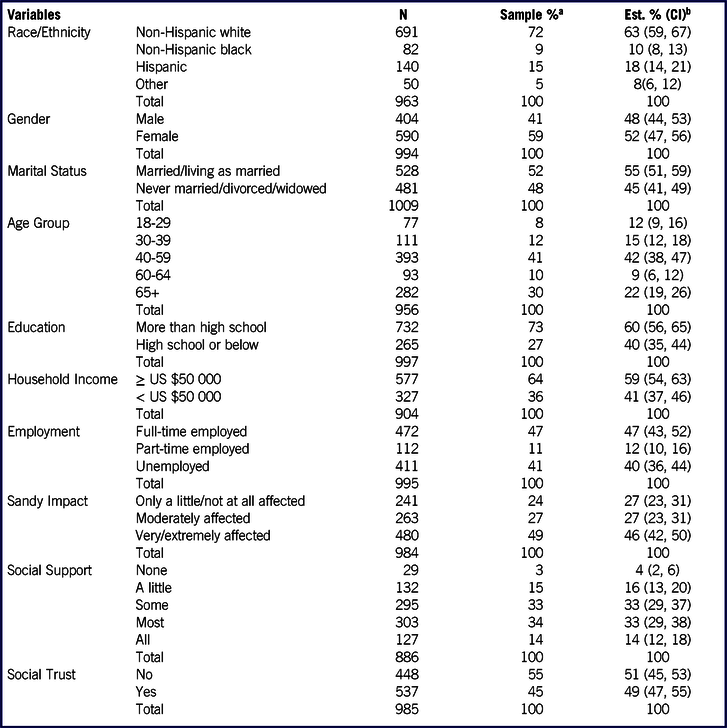
This study draws conceptually on a number of previous studies of the effects of Hurricane Katrina in New Orleans, which resulted in nearly 1000 deaths and US $161 billion in damage. Reference Kessler, Galea and Gruber3-9 Immediately after Katrina, a higher prevalence of mental illness was found among racial minority groups, and among socially and economically disadvantaged groups. Reference Kessler, Galea and Gruber3-Reference Sastry and VanLandingham5 For example, Sastry and VanLandingham Reference Sastry and VanLandingham5 found higher prevalence rates (weighted population) of probable serious mental illness (SMI) among blacks (32%) vs whites (6%), among low income (38%) vs higher income (15%), among unemployed (39%) vs employed (21%), among women (27%) vs men (9%), and among those with education not exceeding high school (15%) vs those with higher education levels (30%). Also, Galea and his colleagues Reference Galea, Tracy, Norris and Coffey6 found that, after Katrina, both SMI and moderate mental illness (MMI) were consistently associated with low family income and unemployment status. Other studies found that low income and unemployed residents affected by Katrina had higher rates of psychological distress than their higher income and employed counterparts. Reference Rhodes, Chan and Paxson4,Reference Sastry and VanLandingham5 For example, Rhodes et al. Reference Rhodes, Chan and Paxson4 found that nearly half (47%) of their study group (low-income mothers) in the city of New Orleans exhibited probable posttraumatic stress disorder (PTSD), which points to the particular vulnerability of low income and African American mothers. Similarly, Galea and his colleagues Reference Galea, Tracy, Norris and Coffey6 found a higher prevalence (weighted population) of PTSD (30.3%) among residents of the New Orleans Metropolitan area than other areas of Louisiana, Alabama, and Mississippi. They also found that New Orleans residents who were unemployed and had low income were more likely to have PTSD (odds ratio [OR] = 4.0-5.3). As a result of these studies, much is known about the impact of Hurricane Katrina on the residents in and around New Orleans, but it is not known whether similar patterns of mental health outcomes to those following Katrina are also found in the neighborhoods of New Jersey and New York damaged by Hurricane Sandy. In particular, the sociodemographic composition of these areas (especially racial demographics) is different from that of New Orleans, 10-12 as detailed in Table 1, and further discussed later.
Sample and Population Characteristics

a Percent of the sample.
b Estimated population percentages and 95% confidence interval (CI) based on AP-NORC weights.
In addition to the above-noted sociodemographic associations with mental health outcomes, existing disaster research has begun to look at the influence of social relations on pre- and post-disaster vulnerability and resilience. Reference Cagney, Sterrett, Benz and Tompson13 In particular, social support has been described as “helping behaviors that are being provided” to victims by their communities. Reference Norris and Kaniasty14 For example, Galea and his colleagues Reference Galea, Tracy, Norris and Coffey6 found that lower social support was associated with the risk of PTSD among the survivors during the first 2 years after Hurricane Katrina. In contrast, social trust has been described by Wind and his colleagues Reference Wind, Fordham and Komproe15 as an individual’s “subjective experience of … mutual support and reciprocity in a community.” These authors also found, in their study of the 2008 flood in Morpeth, England, that “Perceptions of higher levels of social trust … decreased the negative relationship between coping intensity and mental health outcomes,” specifically PTSD and anxiety. Reference Wind, Fordham and Komproe15 But while existing studies of disasters such as Katrina Reference Galea, Tracy, Norris and Coffey6,Reference Wind, Fordham and Komproe15 suggest that social support and social trust may mitigate mental health impacts on disaster survivors, the questions of how and for whom continue to be debated. Reference McKenzie, Whitley and Weich16,Reference Kaniasty, Norris, Neria, Galea and Norris17 With respect to “how,” some researchers have hypothesized that social support received by disaster victims may act as a buffer against negative psychological consequences. Reference Kaniasty, Norris, Neria, Galea and Norris17,Reference Goldmann and Galea18 To date, clear and consistent evidence to support this hypothesis for Sandy victims is lacking. With respect to “who,” Galea and his colleagues Reference Galea, Vlahov and Tracy19 found that received support after September 11 was an important determinant of differences in PTSD risk for Hispanics. But, in terms of Sandy, the major demographic groups in New York and New Jersey include non-Hispanic blacks and whites, and these groups have yet to be compared with Hispanics for possible differences in the moderating effects of both social trust and social support.
Thus, the main objectives of this study are to identify which racial/ethnic groups were most vulnerable (susceptible) to mental illness after Hurricane Sandy, and to examine whether and how social support and social trust affected these groups. More specifically, we address the following 3 research questions. First, among those groups found by Sastry and VanLandingham Reference Sastry and VanLandingham5 to be at risk for mental illness after Hurricane Katrina in New Orleans – Were the same groups also vulnerable (susceptible) to mental illness following Hurricane Sandy in New Jersey and New York? Second – To what extent did social support and social trust affect the mental illness status of these Sandy victims? Finally – To what extent was vulnerability to mental illness among racial/ethnic groups moderated by social support and social trust?
METHODS
Sampling and Sample Characteristics
The present study is based on publicly available survey data from the Associated Press NORC (AP-NORC) Center for Public Affairs Research. 20 This survey was designed to explore the disaster resilience of Hurricane Sandy survivors and was conducted approximately 2 years after the event (from June 28 to September 9, 2014). The multi-mode address-based sample design (Web, telephone, or in-person) was used to survey residents of 12 neighborhoods in New York and New Jersey that the Federal Emergency Management Agency (FEMA) designated as having been “highly impacted” 20(p4) by Sandy. The survey was conducted in English and Spanish and yielded sample data for 1009 victims residing in the 12 neighborhoods, which were a mix of urban, suburban, and rural communities. The final response rate was 24%, as calculated by Response Rate Method 3 of the American Association of Public Opinion Research. 20 This response rate appears to be typical of similar recent public affairs surveys, such as the California Health Interview survey. 21(p6-12) However, to guard against possible nonresponse bias, AP-NORC calculated sampling weights for these 12 neighborhoods in order to adjust for differential response rates across various demographic groups. Further details of the sampling procedure are available on the AP-NORC website. 20
Table 1 shows the numbers of respondents (N) in each variable category, together with both the corresponding sample percentages of the total respondents for that variable and the weighted population percentages associated with these respondents (in terms of sampling weights constructed by AP-NORC). In particular, of the 963 respondents who reported their race/ethnicity, 72% (691) were non-Hispanic whites. In addition, 9% (82) were non-Hispanic blacks, 15% (140) were Hispanic, and 5% (50) were of other races or ethnicities. Of the 995 respondents who reported employment status, 47% (472) were employed full-time, 11% (112) were employed part-time, and 41% (411) were unemployed. Of the 997 who reported education level, 27% (265) were at the high-school graduate level or lower. Finally, of the 904 who reported annual household income, 36% (327) earned lower than US $50 000.
Measurement
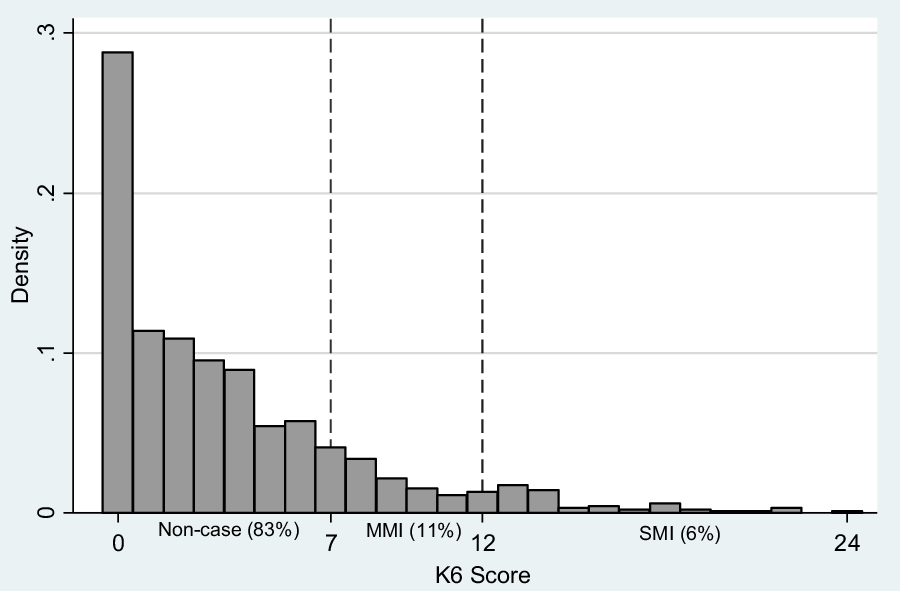
The measure of mental health status used in our study was based on the short screening K6 scale. Reference Kessler, Andrews and Colpe22 This K6 scale is a rigorously validated community epidemiological measure of nonspecific psychological distress that has been used in the United States and abroad since the end of World War II. Reference Sastry and VanLandingham5,Reference Galea, Brewin and Gruber7,Reference Kessler, Andrews and Colpe22,Reference Kessler, Barker and Colpe23 The classifications are derived from scored answers to 6 questions regarding the nonspecific psychological status of respondents during the 30-day period before the interview. K6 questions addressed depressed mood (2 questions), motor agitation, fatigue, worthless guilt, and anxiety. Answers to each question were coded from 0 (none of the time) to 4 (all of the time), with a total score ranging from 0 to 24. Following Kessler and his colleagues, Reference Kessler, Galea and Gruber3,Reference Kessler, Andrews and Colpe22,Reference Kessler, Barker and Colpe23 the respondents in our study with K6 scores of 0-7 were classified as no mental illness (NMI); those with scores of 8-12 were classified as probable mild or MMI; and those with scores of 13-24 were classified as probable SMI. Reference Kessler, Galea and Gruber3(p376) A more detailed distribution of K6 scores among respondents is shown in Figure 1.
K6 Scores for Hurricane Sandy Survivors by Probable Mental Illness Categories.

Notably, the same K6 scoring procedure was used to study the nonspecific psychological effects of Hurricane Katrina on survivors in and around New Orleans. Reference Kessler, Galea and Gruber3-Reference Sastry and VanLandingham5,Reference Galea, Brewin and Gruber7 These Katrina studies showed that there was a high prevalence of MMI after the hurricane, Reference Kessler, Galea and Gruber3 and that over time there was a substantial risk of its transition to SMI. In the group of survivors studied by Kessler and his colleagues, Reference Kessler, Galea and Gruber3 the prevalence (weighted population) of SMI increased from 10.9% in the first 6 months following Katrina to 14% 1 year later. Thus, 1 objective of the present study was to examine the prevalence of MMI (as well as SMI) 2 years after Hurricane Sandy.
The socioeconomic covariates in our analysis include the respondents’ race-ethnicity, gender, marital status, age, post-Sandy employment status, education attainment, and household income (with specific measurement categories detailed in Table 1). To measure the direct impact of Hurricane Sandy, the AP-NORC study asked respondents how seriously they personally were affected by the hurricane, using the response categories of “very or extremely affected,” “moderately affected,” and “little or not at all affected.” 20(p6) (The desirability of more objective measures of damage is also mentioned in the Discussion section.)
The AP-NORC study asked hurricane survivors about the adequacy of the support they received, which was our study’s interest as well. As such, we used this AP-NORC item in our analyses: “Do you think that most people in your neighborhood have gotten the help they need to recover and restore their lives after Superstorm Sandy?” The corresponding response categories were “all,” “most,” “some,” “a little,” or “none.”
Understanding that social relationships are multidimensional, we also examined how social trust might have affected the survivors’ mental health 2 years after the hurricane. Although “social trust” is often conceptualized as a part of social capital Reference Kawachi, Kennedy, Lochner and Prothrow-Stith24,Reference Harpham, Grant and Rodriguez25 or a result of social network cooperation, Reference Albrecht26 social trust is viewed in both the AP-NORC study and our study as the degree to which an individual feels confident in the supportive actions of others in the community. To gauge social trust, AP-NORC asked respondents: “Generally speaking, would you say that most people can be trusted or that you can’t be too careful in dealing with people?” The 2 possible responses were “most can be trusted” or “cannot be too careful in dealing with people.”
Statistical Analysis
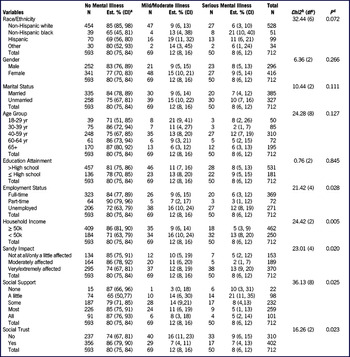
The analysis begins with weighted cross tabulations of mental health illness by respondent characteristics (race-ethnicity, gender, marital status, age, household income, education attainment, employment status after Hurricane Sandy, direct impact by Sandy, social trust, and social support). Each characteristic is treated as a categorical variable, where, for example, the values of “gender” are “male” and “female.” In this context, a design-based F-test was used to identify possible significant disparities in mental health outcomes among the various categories for each characteristic, as reported in Table 2.
Weighted Cross-Tabulations Probable Mental Illness by Survivors’ Characteristics

a Estimated population percentages and 95% confidence interval (CI) based on AP-NORC weights.
b Chi2 = chi-square test.
c Degree of freedom.
d P = P-value.
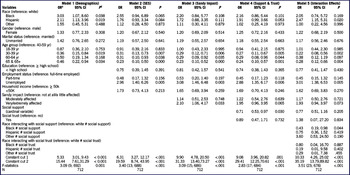
This approach was then refined by constructing a series of 5 ordered logistic regression models (nested by sets of appropriate characteristics) to estimate the contributions of each characteristic category to the severity of mental health outcomes, as reported in Table 3. These analyses used the sample weights mentioned previously, together with design-based estimates of standard errors based on Taylor linearization methods. All analyses were performed in STATA 14 (StataCorp, College Station, TX).
Weighted Ordered Logistic Regressionsa,b to Estimate Mental Illness by Respondent Characteristics

a In STATA 14, the add-on program, gologit2, includes options for analyzing ordered logistic regression models based on weighted survey data. In particular, this procedure allows both global and partial parallel-line tests to be carried out in terms of appropriately defined sequential Wald tests. In the present case, such tests confirmed that the global parallel-line assumption is warranted.
b The Taylor linearization method was used to calculate standard errors.
c Odds ratio.
d Design-based F-statistics (df1; df2) and P-values were reported for all 5 models.
The key regression analyses reported in Table 3 were carried out using ordered logistic regression to allow more meaningful interpretations of results than is possible in simpler categorical models (such as multinomial logistic regression). For the analysis of survey data, in particular, we used the gologit2 procedure in STATA 14 Reference Williams27 to verify that the standard proportional-odds condition for ordered logistic regression was satisfied in all cases. More specifically, by letting NMI denote “no mental illness,” it was verified that the estimated parameter effects for independent variables were proportional across all relevant comparisons between the ordered states (NMI, MMI, SMI).
Finally, it should be stressed that 29% of this respondent data (297 observations) exhibited missing values for 1 or more variables studied (including 36 missing for our dependent variable). While multiple imputation techniques, in principle, could be used here, all such methods require some form of “missing at random” (MAR) assumption. 20 In view of the many correlations between patterns of missing values, we consider this assumption questionable for the present data. Therefore, we employed list-wise deletion in all contingency-table and logistic regression analyses, reducing our effective sample size to 712. For logistic regression, in particular, it is well known Reference Allison28 that list-wise deletion is the single most robust procedure to violations of MAR. While this procedure yields a smaller sample size, it is our view that this smaller sample allows more statistically reliable results. In addition, we note that any remaining biases in this approach tend to understate significance levels, thus providing conservative estimates of effects.
RESULTS
The mental-health impacts of Hurricane Sandy are perhaps best summarized by the fact that the overall weighted population rates of mental illness among survivors, 2 years after Sandy (see Figure 1), are almost twice the national average. Specifically, the percentages were 11% for MMI (mild-to-moderate mental illness) and 6% for SMI versus the national averages of 6% for MMI and 3% for SMI, as reported by the US Department of Health and Human Services, 2014. Reference Blackwell, Lucas and Clarke29
With respect to the summary of individual characteristics shown in Table 1, we highlight the key differences between this population and those of Hurricane Katrina survivors in New Orleans (also in terms of weighted population percentages). Turning first to race-ethnicity, the single most important difference is the small proportion of non-Hispanic blacks (10%) in our Sandy study versus the dominant proportion of non-Hispanic blacks (more than 50%) reported in a comparable Katrina study. Reference Sastry and VanLandingham5 A second key difference is educational attainment. While 60% of Sandy survivors achieved education levels beyond high school, this figure was only 30% for Katrina survivors. Reference Sastry and VanLandingham5 Even more dramatic is the difference in unemployment rates, which was 40% for Sandy survivors, but only 9% for Katrina survivors. Reference Sastry and VanLandingham5 This partly explains why the relationship between unemployment and mental illness found in that Katrina study is far less significant than for Sandy.
Turning to the weighted cross-tabulations in Table 2, there are significant disparities in probable mental health outcomes with respect to race/ethnicity, employment status, household income, perceived impact level by Hurricane Sandy, social support, and social trust (as later discussed further in the regression models). Of most interest for our present purposes is the fact that survivors experiencing the most extreme effects of Sandy also exhibited uniformly higher rates of mental illness, especially SMI.
Finally, the results of our ordered logistic regressions are summarized in Table 3, where 5 nested regression models are considered. Model 1 controls for all demographic variables: race-ethnicity, gender, marital status, and age group. Model 2 adds 3 socioeconomic variables: education, income, and employment. These 2 models are directed to our first research question. Model 3 then adds Hurricane Sandy impact as perceived by survivors. Model 4 further includes social support and social trust. Together, these 2 models focus on our second research question. Finally, to address our third research question, Model 5 includes interaction effects between race-ethnicity attributes and the variables of social support and social trust.
Turning first to the common features of these models, in all models involving unemployment in Table 3, this is the single most significant predictor of increased mental illness (with all P-values below 0.01 and OR above 2.8). This finding dramatically differs from Katrina, where the unemployment rate was much lower (9% for Katrina vs 40% for Sandy) and the relation between unemployment and mental illness was far less significant. Reference Sastry and VanLandingham5 But these differences are most likely the result of external economic factors just prior to the 2 disasters. Katrina occurred in 2005, when the national unemployment rate was only 5.3%, whereas Sandy occurred in 2012 when the unemployment rate was still very high, 8.3%, following the Great Recession of 2008–2009. 30 In particular, the economic stress created by the Great Recession may well have accounted for much of the mental stress experienced by unemployed Sandy survivors. Thus, in terms of Sandy itself, these significant results should be interpreted with caution.
We also note that, with respect to age, mental health effects are most severe among the middle age (reference) group (40 to 59 years), with all ORs less than 1. This result is consistent with previous findings Reference Sastry and VanLandingham5 that middle-aged residents in New Orleans were more likely to suffer mental illness after Hurricane Katrina.
Turning next to a comparison of Model 1 (M1) and Model 2 (M2), the most striking difference here is the decrease in ORs and significance levels for both Hispanics and blacks when controlling for socioeconomic variables and, in particular, unemployment (OR = 3.03 [M1] vs OR = 2.55 [M2] for blacks and OR = 2.11 [M1] vs OR = 1.76 [M2] for Hispanics; P = 0.04 [M1] vs P = 0.07 [M2] for blacks and P = 0.02 [M1] vs P = 0.08 [M2] for Hispanics). This suggests that the more probable levels of SMI and MMI among those with higher unemployment (as well as less income and education) are largely attributable to the disproportionately higher number of blacks and Hispanics with these characteristics.
When adding perceived levels of Sandy impact in Model 3, the OR and significance of blacks and Hispanics further decrease (OR = 2.20 and P = 0.11 for blacks; OR = 1.72 and P = 0.11 for Hispanics). The highest perceived impact (very/extremely affected) is by far the most significant (OR = 2.10 and P = 0.03), suggesting that part of the significance of blacks and Hispanics in Model 2 is now being accounted for by differences in mental health effects among those perceiving higher levels of Sandy impact. This was further confirmed by an auxiliary ordered logistic regression of perceived impact on all demographic and socioeconomic variables (not shown), where blacks and Hispanics were indeed seen to be more likely to experience extreme rather than moderate Sandy effects.
When we add social support and social trust in Model 4, it is seen that social support is far more significant than social trust in reducing mental illness (OR = 0.71 and P = 0.03 for social support; OR = 0.89 and P = 0.73 for social trust). This difference can be partly explained by the differences of blacks and Hispanics (vs whites) with respect to these variables. Auxiliary regressions of these 2 variables on the demographic and socioeconomic variables (not shown) indicate that blacks and Hispanics held significantly lower perceptions of social trust than whites, but that was not the case for social support. Thus, the slight increase of significance for blacks and Hispanics in Model 4 may partly account for the insignificance of social trust.
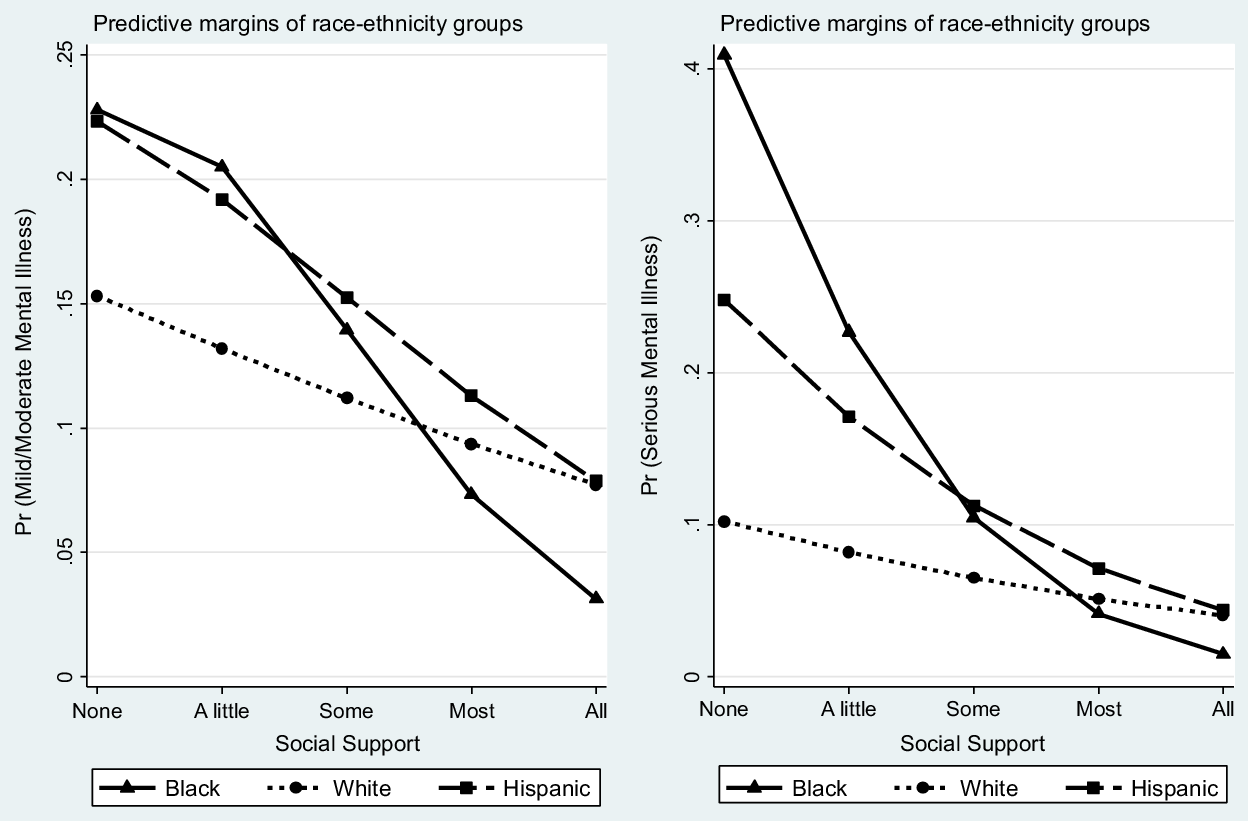
Finally, in Model 5, social support and social trust are interacted with the race/ethnicity variable. Here, the most striking effect is the significant reduction in mental illness for blacks (vs whites) with high levels of social support (OR = 0.43 and P = 0.04). Indeed, this effect is so strong that it appears to account for the main differences between the mental illness of blacks and Hispanics vs whites. This can also be seen visually in terms of the margin plots from STATA 14 in Figure 2, where changes in mental health probabilities are plotted against changes in social support for each group while holding all other variables at their mean values. Here, again, it is evident that, while social support is a stronger mitigating factor for blacks and Hispanics than for whites, it is clearly most pronounced for blacks.
Predictive Margins of Mental Illness Probabilities by Levels of Social Support for Race/Ethnicity Groups.

DISCUSSION
Our analysis produced 4 main findings. First, within this study group of Hurricane Sandy victims, the prevalence of both MMI and SMI 2 years after the hurricane is much higher than prevalence rates nationwide. Second, there are significant mental health disparities among the race/ethnicity groups in this study. In particular, the disparities between both black and Hispanic survivors compared with white survivors are largely due to the former 2 groups’ lower socioeconomic status, as well as to their stronger perceived impacts from Sandy. (Similar disparities were found among the survivors of Hurricane Katrina Reference Sastry and VanLandingham5 ; so, even though the representation of blacks is much smaller in our study (11% vs 56%), our present results add support to those findings.) Third, while both social support and social trust may help mitigate the severity of mental illness, social support is far more significant than social trust for these Sandy victims. This, in part, may be due to the more immediate relation between social support (as defined) and the hurricane disaster itself. Finally, social support is particularly significant in reducing mental illness among blacks in our study group. In this regard, there is some evidence to suggest a higher prevalence of church participation among blacks than whites in our study group (53% vs 45%), which may contribute to the strength of their social networks.
These findings have a number of possible policy and practice implications. First, the high prevalence of mental illness among blacks and Hispanics suggests that psychological interventions after such disasters, including anxiety management Reference Hembree and Foa31 and supportive therapy, Reference Devilly32 should focus more heavily on these groups. Second, the strong moderating effects of social support (rather than social trust) on mental health outcomes suggest that community intervention programs Reference Ursano, Fullerton and Norwood33,Reference Iversen and Armstrong34 should place more emphasis on the provision of tangible support, especially for the identified socially vulnerable groups. Finally, while the unusually high levels of unemployment among Sandy victims may be largely due to the nationwide recession of 2008–2009, Reference Luciano and Meara35 which continued to negatively impact employment rates across the United States at the time of Sandy, the strong relationship between unemployment and mental health found in this study suggests that community interventions should focus on restoring local economies, especially in the aftermath of both financial catastrophes and natural disasters, and particularly when the 2 intersect.
As with all such studies, a number of limitations must be stressed when evaluating the results. First, while K6 has been widely used in previous research, Reference Kessler, Galea and Gruber3-Reference Sastry and VanLandingham5,Reference Galea, Brewin and Gruber7 this scoring system is based on self-reported data rather than on clinical diagnoses of mental illness. Second, in the absence of any controlled experimental setting, the directionality of relationships found between survivor views and their states of mental health is not clear. Ideally, one would like to augment survivor views of Sandy’s effects with objectively measurable variables, such as property loss or physical injuries. However, such data are currently not publicly available.
CONCLUSION
In summary, this study provides the first analysis of factors influencing the mental illness of individual survivors following Hurricane Sandy. The strongest buffering effect on mental illness was provided by the social support they received. Among racial/ethnicity groups, in particular, this effect was strongest among black survivors. As outlined previously, we believe that these findings should assist policy-makers and health providers in directing post-disaster assistance to where it is most needed. Without a proper assessment of both vulnerability and support factors relevant for specific disasters, existing policies might actually be missing the target populations most in need of public resources.
Conflict of Interest Statement
The authors have no conflicts of interest to declare.