Introduction
In clinical assessments of copying, the copy may sometimes be made inappropriately close to the model, a behavior known as “closing-in behavior” (CIB) (Mayer Gross, Reference Mayer Gross1935; McIntosh, Ambron, & Della Sala, Reference McIntosh, Ambron and Della Sala2008). This sign can take different forms, varying in severity from veering toward the model (“near type” CIB) to drawing directly over it (“overlap type CIB”). CIB has been often associated with poor fidelity of the copy (Gainotti, Reference Gainotti1972), consistent with its classical interpretation as an aspect of constructional apraxia (Critchley, Reference Critchley1953).
CIB has been noted in a variety of brain diseases, including stroke, carbon monoxide poisoning, corticobasal degeneration, encephalitis, and epilepsy (Conson, Salzano, Manzo, Grossi, & Trojano, Reference Conson, Salzano, Manzo, Grossi and Trojano2009; De Ajuriaguerra, Zazzo, & Granjon, Reference De Ajuriaguerra, Zazzo and Granjon1949; Kwon et al., Reference Kwon, Kang, Lee, Chin, Heilman and Na2002; Muncie, Reference Muncie1938; Stengel & Vienna, Reference Stengel and Vienna1944; Suzuki et al., Reference Suzuki, Otsuka, Endo, Rjima, Saito, Fujii and Yamadori2003). However, it is most frequent in patients with dementia and becomes more common with increasing dementia severity (Gainotti, Reference Gainotti1972). In particular, CIB has been considered as a typical manifestation of Alzheimer's disease (AD) (Gainotti, Marra, Villa, Parlato, & Chiarotti, Reference Gainotti, Marra, Villa, Parlato and Chiarotti1998), although recent evidence suggests that the phenomenon may be equally common in other forms of dementia, such as vascular dementia (Chin et al., Reference Chin, Lee, Seo, Kim, Suh, Kang and Na2005) or fronto-temporal dementia (Ambron, Allaria, McIntosh, & Della Sala, Reference Ambron, Allaria, McIntosh and Della Sala2009).
The cognitive nature of CIB has been debated recently (Ambron, McIntosh, Allaria, & Della Sala, Reference Ambron, McIntosh, Allaria and Della Sala2009; Serra, Fadda, Perri, Caltagirone, & Carlesimo, Reference Serra, Fadda, Perri, Caltagirone and Carlesimo2010), and two main hypotheses have been put forward to account for it: the “compensation hypothesis” and the “attraction hypothesis.” Neither hypothesis excludes some involvement of visuo-spatial deficits, but they differ over the main cognitive deficit responsible for CIB. The compensation hypothesis implicates memory impairments as the major causes of CIB, and posits that the copy is made in close proximity to the model to compensate for an inability to remember its representation for long enough to transpose it to a remote location (Lee et al., Reference Lee, Chin, Kang, Kim, Park and Na2004). The attraction hypothesis instead considers CIB to reflect the disinhibition of an automatic tendency to act towards the focus of attention. Advocates of this latter hypothesis suggest that attention and executive deficits are the main factors responsible for the release of CIB (Kwon et al., Reference Kwon, Kang, Lee, Chin, Heilman and Na2002; McIntosh et al., Reference McIntosh, Ambron and Della Sala2008).
Although CIB has been strongly linked with dementia, it is not known whether it can be observed in mild cognitive impairment (MCI) (Petersen et al., Reference Petersen, Smith, Waring, Ivnik, Tangalos and Kokmen1999, Reference Petersen, Doody, Kurz, Mohs, Morris, Rabins and Winblad2001), a “transitional zone between normal cognitive function and dementia” (Kume et al., Reference Kume, Hanyu, Murakami, Sato, Hirao, Kanetaka and Iwamoto2011). However, if CIB does arise in MCI, this would offer a valuable opportunity to test whether or not memory impairment plays a significant role in this sign (Lee et al., Reference Lee, Chin, Kang, Kim, Park and Na2004). People with MCI can present with memory problems, either in isolation or in conjunction with other cognitive impairments, whereas others have deficits in other cognitive domains (attention, executive functions, language, visuo-spatial abilities), without memory problems (Winblad et al., Reference Winblad, Palmer, Kivipelto, Jelic, Fratiglioni, Wahlund and Petersen2004). If memory is critical, then CIB should differentially affect people with amnestic forms of MCI.
To address this question, we have reviewed the clinical records of a sizeable sample of people with MCI (n = 154). Beyond the primary distinction between amnestic and non-amnestic sub-groups, we were also able to identify a sub-sample of 86 people with MCI who had completed the same test battery assessing executive, visuo-spatial and memory tasks, allowing for further exploration of the cognitive determinants of CIB in MCI.
Methods
Participants and Cognitive Assessment
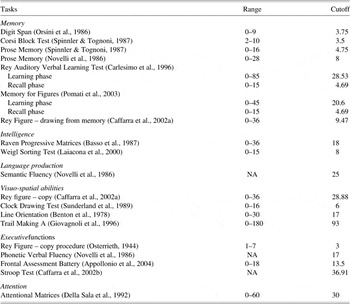
This retrospective study explored CIB in MCI using two approaches. First, a total of 313 neuropsychological records of MCI patients were reviewed. These patients attended the Neurology Ward, Sacco Hospital, Milan, Italy, from 2001 to 2010. Records were included that met the following criteria: (1) clinical diagnosis of MCI (Winbland et al., 2004); (2) Mini Mental State Examination (MMSE, Folstein, Folstein, & McHugh, Reference Folstein, Folstein and McHugh1975) score equal to or above 26; and (3) availability of original response sheet for the Rey Figure Copying Task (Caffarra, Vezzadini, Dieci, Zonato, & Venneri, Reference Caffarra, Vezzadini, Dieci, Zonato and Venneri2002a; Osterrieth, Reference Osterrieth1944; Rey, Reference Rey1941). There were 154 patients fulfilling these criteria (78 males and 76 females). Their median age was 75.3 years (range, 46–88 years), their median education was 8 years (range, 1–19 years), and their median MMSE score was 27 (range, 26–30). A variety of cognitive tasks were used to explore the cognitive profile of this cohort (see Table 1). These tasks (see Table 1) had not been determined in advance, but were selected individually by clinicians for each patient. All the tasks used for the neuropsychological assessment have published norms and cut off scores derived from Italian populations.
Tasks used for the cognitive assessment of people with MCI with their relative score range and cutoff scores

Note. All these tasks have published norms and cutoff scores. NA, not available.
We classed MCI patients, according to the criteria of Winbland et al. (2004), as: (i) single-domain amnestic, if they showed a specific impairment in memory, performing below the cutoff in one or more of the memory tasks; (ii) multidomain amnestic if they showed impairment in memory and in one or more other cognitive domains (intelligence, visuo-spatial and visuo-constructional abilities, language, attention, and executive functions); (iii) single-domain non-amnestic, if they showed a specific impairment in a single cognitive domain, performing below the cutoff in one or more tasks belonging to one non-memory domain, but normal performance on all memory tasks; (iv) multidomain non-amnestic, if they showed impairment in more than one cognitive domain, but normal performance on memory tasks.
A sub-group of the total MCI cohort was identified that had been assessed with an identical battery of cognitive tasks, covering memory, visuo-spatial abilities and executive functions. There were 86 patients in this sub-group (48 males and 38 females), with a median age of 76.0 years (range, 50–88 years), a median education of 8 years (range, 3–18 years), and a median MMSE score of 28 (range 26–30). These patients had all completed five tests of relevance to our research questions, described below: Raven Progressive Matrices Test (Basso, Capitani, & Laiacona, Reference Basso, Capitani and Laiacona1987; Raven, Reference Raven1965), Rey Figure Drawing from Memory (Caffarra et al., Reference Caffarra, Vezzadini, Dieci, Zonato and Venneri2002a), Trail Making A (Giovagnoli et al., Reference Giovagnoli, Del Pesce, Mascheroni, Simoncelli, Laiacona and Capitani1996), Clock Drawing Test (Sunderland et al., Reference Sunderland, Hill, Mellow, Lawlor, Gundersheimer, Newhouse and Grafman1989), and the Frontal Assessment Battery (Appollonio et al., Reference Appollonio, Leone, Isella, Piamarta, Consoli, Villa and Nichelli2004; Dubois, Slachevsky, Litvan, & Pillon, Reference Dubois, Slachevsky, Litvan and Pillon2000).
Raven Progressive Matrices Test (Basso et al., Reference Basso, Capitani and Laiacona1987; Raven, Reference Raven1965) requires completion of 2 × 2 matrices in which one element is missing, and is considered as an overall measurement of intelligence and logical reasoning. The Rey Figure Drawing from Memory Task assesses the accuracy of reproduction of the Rey Complex Figure, after a delay of approximately 15 min. This was considered as a test of memory, although with a strong visuo-spatial component. The Trail Making A and the Clock Drawing Test were taken as immediate measures of visuo-spatial abilities. Trail Making requires visual scanning and visuo-motor accuracy since participants are asked to connect a series of numbers presented in circles, as fast as they can; in the Clock Drawing task, people are asked to draw a clock and to set the time at 45 min past two. This task is used as a test of constructional abilities, but it also requires some level of executive control (Cosentino, Jefferson, Chute, Kaplan, & Libon, Reference Cosentino, Jefferson, Chute, Kaplan and Libon2004). Finally, the total score of the Frontal Assessment Battery (FAB: Appollonio et al., Reference Appollonio, Leone, Isella, Piamarta, Consoli, Villa and Nichelli2004; Dubois et al., Reference Dubois, Slachevsky, Litvan and Pillon2000) was included as an assessment of executive functions. The FAB includes six sub-tests: Similarities, Lexical fluency, Motor series, Conflicting instructions, Go-No-Go, and Prehension behavior.
All patients whose records have been included in the present study signed an informed consent for the use of their data for research purposes. Moreover, ethical approval for the study was obtained from the medical ethics committee of Luigi Sacco Hospital.
Assessment of CIB
The patients’ immediate Rey figure copies were scored for CIB and for copy accuracy, using criteria identical to those previously applied to score the performance of patients with AD (Ambron, McIntosh, et al., Reference Ambron, McIntosh, Allaria and Della Sala2009). CIB was scored as present when the copy invaded the model's space, or touched the edges of the model (overlap type), or if it was placed in close proximity to the model (≤10 mm distance with the model) (near type). The use of this latter, more liberal criterion for CIB, maximizes sensitivity to mild manifestations of this sign, which might be expected among patients with MCI. The accuracy of the copy was assessed independently of its positioning, being rated as poor when the original model was not recognizable or was only partially recognizable, and as accurate if the original model was recognizable.
Results
In line with previous evidence (Rasquin, Lodder, Visser, Lousberg, & Verhey Reference Rasquin, Lodder, Visser, Lousberg and Verhey2005), we found that multidomain MCI subtypes (n = 127; 82%) were more common than single-domain subtypes (n = 27; 18%). Multidomain amnestic was the most common (n = 98; 63%), followed by multidomain non-amnestic MCI (n = 29; 19%), whereas 15 (10%) and 12 (8%) people respectively were affected by single-domain amnestic and non-amnestic subtypes. The primary cognitive domains affected in the non-amnestic MCI groups were executive functions in the single-domain non-amnestic MCI (n = 8; 66%) and visuospatial abilities in the multidomain non-amnestic MCI (n = 25; 86%). Visuospatial deficits in this group were related in most of the cases (n = 23; 79%) to poor performance in the Rey Figure copying task.
Overall CIB was identified in 33 cases (21% of total sample), the clear majority being of the near-type (n = 27), with the overlap type observed in only 6 cases. The presence of CIB did not correlate with demographic characteristics (age: rho = −.048, n.s.; education: rho = −.048, n.s.) or with MMSE score (rho = .062, n.s.). Of interest, CIB did not correlate significantly with copy accuracy judged from the same drawings (rho = .09, n.s.), being associated with good copy accuracy only slightly less often than with poor accuracy (n = 13 vs. n = 20), and poor copy accuracy being quite often observed without CIB (n = 51). Regarding the copying procedure, most of the patients with CIB (n = 24; 73%) showed a tendency to reproduce the shape in a segmented manner, such that they appeared to be adding the different elements of the figure as if composing a puzzle (n = 12; 36.5%) or drawing them independently without providing a general structure to the copy (n = 12; 36.5%). These behaviors were also common in patients without CIB (57.5%) and did not specifically distinguish patients with CIB [χ2(1) = 2.41, n.s.].
To test for a special role of memory, our key comparison was between the frequency of CIB (near and overlap combined) in amnestic and non-amnestic MCI sub-groups. Numbers among the multi-domain sub-groups were sufficient to show clear sub-group differences, with CIB more than twice as common in the multidomain non-amnestic (n = 12; 41%) as in the multidomain amnestic sub-group (n = 19; 19%). A χ2 test confirmed that this difference was significant [χ2(1) = 5.86; p < .02]. Few cases of CIB were found among the single-domain MCI sub-groups: none among the 12 single-domain non-amnestic sub-groups, and 2 among the single-domain amnestic sub-group.
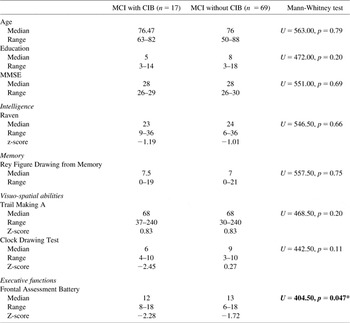
Finally, to further explore the cognitive predictors of CIB, we studied the sub-sample of 86 patients who had completed the same cognitive assessment of memory, visuo-spatial and executive functions. CIB (near and overlap considered together) was found in 17 (20%) people among this sub-sample, being absent in the other 69 (80%). CIB was associated with good accuracy of the copy in 40% (n = 7) of the cases and with poor accuracy in 60% (n = 10) of the cases. An opposite pattern was observed in patients without CIB, whereby the copy was accurate in most of the cases (n = 45; 65%), while 24 patients (35%) presented constructional problems. However, this association between CIB and poor accuracy in the current sample did not reach significance [χ2(1) = 3.29; p = .07]. As shown in Table 2, those with CIB did not differ in age, education or MMSE from those without CIB, nor did they differ in memory performance or general intelligence.
Median, range and Mann-Whitney U test results of the demographic characteristics and performance in the different cognitive tasks of MCI with and without CIB

Note. Z-score equivalents are also included, calculated from normative data for Ravens Progressive Matrices (Basso et al., Reference Basso, Capitani and Laiacona1987), Trail Making A (Giovagnoli et al., Reference Giovagnoli, Del Pesce, Mascheroni, Simoncelli, Laiacona and Capitani1996), the Clock Drawing test (Sunderland et al., Reference Sunderland, Hill, Mellow, Lawlor, Gundersheimer, Newhouse and Grafman1989), and the Frontal Assessment Battery (Appollonio et al., Reference Appollonio, Leone, Isella, Piamarta, Consoli, Villa and Nichelli2004). Z-scores are not reported for the Rey Figure Drawing from Memory, as mean and standard deviation of the normal controls could not be found for this test.
*p value uncorrected for multiple comparisons.
The comparison between groups for visuospatial performance approached but did not reach statistical significance (p = 0.20 and p = 0.11), suggesting that their contribution was to some extent more important than other factors, such as memory or general intelligence. Overall, the FAB was the only task that significantly distinguished participants with and without CIB. Numerically, this effect was slight (one-point difference), but it was nonetheless reliable.
Discussion
The present study shows for the first time that CIB, often studied in dementia, can also be observed in people with MCI. Ambron, McIntosh, et al. (Reference Ambron, McIntosh, Allaria and Della Sala2009) estimated the frequency of CIB to be 25% in a sample of 797 patients with AD copying simple geometric forms, and found that the frequency of CIB increases with the severity of the cognitive decline (see also Gainotti, Reference Gainotti1972). In this context, the observed frequency of 21% in the present MCI sample (and 41% in the multidomain non-amnestic sub-group) may seem surprisingly high. However, the observed frequency of CIB in the MCI population is likely to have been biased considerably upward by the use of the Rey Figure, the most complex copying stimulus in common clinical use. It is indeed well established that more complex copying tasks are more likely to elicit CIB (e.g., Ambron, McIntosh, et al., Reference Ambron, McIntosh, Allaria and Della Sala2009; Ambron, Della Sala, & McIntosh, Reference Ambron, Della Sala and McIntosh2009). It should also be noted that the clear majority (82%) of CIB manifestations in MCI were of the mild, “near” type, in which the copy is drawn close to the model, with only 18% of cases actually overlapping the model. Ambron, McIntosh, et al. (Reference Ambron, McIntosh, Allaria and Della Sala2009) found a more prominent representation of overlap type CIB (40% overlap, 60% near) in patients with AD, even with their simpler copying task.
The complexity of the Rey Figure also makes it sensitive to subtle constructional problems, and some constructional abnormalities were found in almost half (46%) of the MCI sample. Nonetheless, there was no significant association between these constructional abnormalities and CIB itself, reinforcing the idea that CIB is not a canonical manifestation of constructional apraxia (cf., Critchley, Reference Critchley1953). Rather, it may be a sign with distinct cognitive underpinnings, but which happens to be elicited often by constructional tasks (Ambron, McIntosh, et al., Reference Ambron, McIntosh, Allaria and Della Sala2009; Ambron, Della Sala, et al., Reference Ambron, Della Sala and McIntosh2009; McIntosh et al., Reference McIntosh, Ambron and Della Sala2008).
The cognitive underpinnings of CIB were explored in MCI in the present study. First, to test the idea that CIB reflects an adaptative strategy to compensate for memory deficits (Lee et al., Reference Lee, Chin, Kang, Kim, Park and Na2004), CIB frequency was compared between multidomain amnestic and non-amnestic MCI sub-groups. CIB was twice as common in the non-amnestic sub-group, in direct contradiction to a memory-based account. This main finding was strongly bolstered by the observation that patients with and without CIB did not differ on an explicit assessment of visuo-spatial memory, the Rey Figure Drawing from Memory. This could arguably be considered an ideal test for the idea that CIB reflects an inability to hold a representation of the model in mind, since retention of the model is the key ability targeted. The lack of difference between CIB and non-CIB sub-groups on this task is strong evidence against memory-based compensation accounts of CIB (Lee et al., Reference Lee, Chin, Kang, Kim, Park and Na2004).
Our comparison of CIB and non-CIB sub-groups, who were matched on major demographic and clinical variables, found that the only task discriminating between them was the FAB. The FAB is a well established assessment of executive functioning (Dubois et al., Reference Dubois, Slachevsky, Litvan and Pillon2000; Kume et al., Reference Kume, Hanyu, Murakami, Sato, Hirao, Kanetaka and Iwamoto2011), often applied to patients with dementia (Kugo et al., Reference Kugo, Terada, Ata, Ido, Kado, Ishihara and Kuroda2007; Lipton et al., Reference Lipton, Ohman, Womack, Hynan, Ninman and Lacritz2005). Impairments of executive functions have been proposed to be responsible for the release of CIB within the framework of the attraction account (Kwon et al., 2002; McIntosh et al., Reference McIntosh, Ambron and Della Sala2008). The general idea is that CIB is the expression of a default sensorimotor organization in which the person tends to make manual responses towards the current focus of attention (i.e., the model during copying tasks). Executive control mechanisms normally inhibit this default tendency, allowing for actions to be decoupled from the attentional focus, but this inhibition can break down under conditions of reduced executive resources. The present findings are consistent with this hypothesis, and convergent with similar patterns of association in patients with AD (Ambron, McIntosh, et al., Reference Ambron, McIntosh, Allaria and Della Sala2009), and in pre-school children displaying CIB during normal development (Ambron, McIntosh, & Della Sala, Reference Ambron, McIntosh and Della Sala2010). In the present study, the use of the Complex Rey Figure to assess CIB may have further emphasized the role of executive functions, as problems in planning might have caused some people to allow insufficient space for their copy, with the copy coming close to the model as a result.
It has further been proposed (McIntosh et al., Reference McIntosh, Ambron and Della Sala2008) that visuospatial factors may contribute additionally to the appearance of this default tendency, increasing the subjective difficulty of the task. This hypothesis could account for the high frequency of CIB in multi-domain non-amnestic MCI, whereby visuospatial functions were often compromised. On the other hand, the phenomenon was absent in single domain non-amnestic MCI. However, FAB performance, which proved to be predictive of CIB, was within normal limits in all but two of these patients. A dysexecutive basis for the release of CIB suggests a possible association of the phenomenon with other manifestations of dysexecutive impairment involving voluntary movements, such as the repetition of voluntary initiated movements (i.e, perseverations, Luria, Reference Luria1966), or automatic grasp (magnetic apraxia) (Denny-Brown, Reference Denny-Brown1958) or the compulsive use of visually or tactically presented objects (utilization behavior; Boccardi, Della Sala, Motto, & Spinnler, Reference Boccardi, Della Sala, Motto and Spinnler2002; Lhermitte, Reference Lhermitte1983). To date, associations between these phenomena have been noted in passing by several studies but never systematically investigated. CIB has been associated with perseverations (Muncie, Reference Muncie1938; Wolfe et al., Reference Wolfe, Babikian, Linn, Knoefel, D'Esposito and Albert1994), utilization behavior (Conson et al., Reference Conson, Salzano, Manzo, Grossi and Trojano2009), and grasping reflex (De Ajuriaguerra et al., 1960; Kwon et al., Reference Kwon, Kang, Lee, Chin, Heilman and Na2002), in particular in patients suffering from specific frontal lobe dysfunctions (Conson et al., Reference Conson, Salzano, Manzo, Grossi and Trojano2009; Kwon et al., Reference Kwon, Kang, Lee, Chin, Heilman and Na2002). On the other hand, this relation has not been supported in a study with patients with AD; Serra et al. (Reference Serra, Fadda, Perri, Caltagirone and Carlesimo2010) found the same frequency of primitive reflexes in patients with and without CIB. A possible explanation is that CIB may have a different nature in patients with AD and in patients with frontal lobe damage (Ambron, Allaria, et al., Reference Ambron, Allaria, McIntosh and Della Sala2009). It has been proposed that visuospatial deficits may play a greater role in the appearance of CIB in AD, while the phenomenon may have a more primitive and automatic nature in patients with frontal lobe damage. Following this interpretation, CIB may be more likely to appear in conjunction with other primitive automatisms in patients with frontal lobe damage, as a direct expression of a dysexecutive impairment, than in patients with AD.
Reduced executive resources may thus be the principal determinant of CIB, but it should be emphasized that this conclusion applies especially to the relatively mild near-type CIB, most prevalent in the present MCI population. A similar study of a large AD sample (Ambron, McIntosh, et al., Reference Ambron, McIntosh, Allaria and Della Sala2009) supported the association of near-type CIB with attentional function (measured by Digit Cancellation performance), but also found additional involvement of visuo-spatial impairments in the more severe overlap form of CIB. A further study (Serra et al., Reference Serra, Fadda, Perri, Caltagirone and Carlesimo2010), which looked at the predictors of overlap-type CIB only, in patients with AD, found an association with poor performance on visuo-spatial tests, but not with executive dysfunction. These studies, like the present one, were based on the analyses of pre-existing clinical records. The interpretation of such archival studies is limited by the fact that the cognitive assessments were not precisely targeted at the cognitive domains of interest, but were mapped onto those categories post hoc; and comparison between such studies is complicated by the different measures available in different archives. The lack of association between overlap-type CIB and executive resources suggested by Serra et al. (Reference Serra, Fadda, Perri, Caltagirone and Carlesimo2010) was based on a non-significant difference between patients with an without CIB on a modified card sorting test; but it is possible that a wider-ranging assessment of executive functions, such as the FAB (used in this study), might have resulted in a stronger association.
A further limitation of our study is that the scoring procedure used to classify CIB was relatively arbitrary and may not have been sensitive enough to detect all the possible degree of CIB. A more quantitative measure of the phenomenon may possibly have provided a more sensitive measure of the phenomenon, detecting more subtle changes in the misplacement of the copy and being suitable for parametric analysis. On the other hand, the present assessment of CIB is consistent with several recent studies exploring CIB and provides reassurance that the observed behavior in patients with MCI is the same phenomenon classified as CIB in children (Ambron et al., 2010) and patients with dementia (Ambron, Allaria, et al., 2009; Ambron, McIntosh, et al., 2009). Moreover, information regarding the specific order in which the different elements were reproduced was not available. A detailed flow chart (Kaplan, 1998) would have increased and enriched the present classification of CIB, establishing whether a tendency to draw toward the model was characterized by a progressive or a more instant approach to the model. These different forms of migration toward the model have been noted in a previous study (McIntosh et al., Reference McIntosh, Ambron and Della Sala2008), but it is still unclear whether they represent different degrees or qualities of CIB.
The conclusions from archival studies ultimately need to be tested in more precisely-targeted prospective studies. However, a consistent picture is emerging from the recent analyses of CIB. Visuo-spatial impairments may be necessary for extreme manifestations of CIB in figure copying, which include scribbling over the top of the model, but the emergence of more subtle misplacement of the copy toward the model's space (near-type CIB) is primarily associated with reduced executive resources. The evidence from MCI supports this view. Moreover, the contrast between amnestic and non-amnestic sub-groups refutes the idea that CIB is associated with memory deficits (Lee et al., Reference Lee, Chin, Kang, Kim, Park and Na2004).
Acknowledgments
This work was supported by Rita Rudel Foundation (E.A.), the Neuroscience Programme of the Compagnia San Paolo (Torino) (E.A.) and the “Associazione per la Ricerca sulle Demenze”—ARD ONLUS (S.F., F.C., and C.M.). The authors declare no conflicts of interest regarding the material reported and discussed in this manuscript.