





Introduction
Loneliness is a perceived discrepancy in quality or quantity between one’s desired and actual social relationships (Perlman & Peplau, Reference Perlman, Peplau, Gilmour and Duck1981). Adolescence is a developmental period characterized by heightened susceptibility to loneliness (Blakemore, Reference Blakemore2019). Cumulative evidence shows that adolescent loneliness is associated with various health risks, such as smoking, drinking, substance abuse, and suicidal behaviors (Hosozawa et al., Reference Hosozawa, Cable, Yamasaki, Ando, Endo, Usami, Nakanishi, Niimura, Nakajima, Baba, Oikawa, Stanyon, Suzuki, Miyashita, Iso, Hiraiwa-Hasegawa, Kasai and Nishida2022). It is also linked with physical and mental health conditions that may last into adulthood (Narita et al., Reference Narita, DeVylder, Knowles, Yamasaki, Miyashita, Stanyon, Yamaguchi, Shinozaki, Sasaki, Zhou, Ando, Morgan, Dazzan, Furukawa, Kasai, Kelleher and Nishida2026; Xerxa et al., Reference Xerxa, Rescorla, Shanahan, Tiemeier and Copeland2023). There has been a growing public health concern that adolescent loneliness may be increasing owing to societal shifts, such as changes in family structure or advances in digital technology, which have altered how adolescents communicate and form social relationships (Hosozawa, Yamasaki, Igami, & Cable, Reference Hosozawa, Yamasaki, Igami and Cable2025; Luhmann, Buecker, & Rüsberg, Reference Luhmann, Buecker and Rüsberg2023).
Research investigating the long-term trends in adolescent loneliness is limited and has predominantly focused on single high-income Western countries, yielding mixed results (Surkalim et al., Reference Surkalim, Luo, Eres, Gebel, van Buskirk, Bauman and Ding2022). Although some studies report an increasing trend (Kaur et al., Reference Kaur, Hamilton, Chen, Hasin, Cerda, Martins and Keyes2022; Madsen et al., Reference Madsen, Holstein, Damsgaard, Rayce, Jespersen and Due2019; Myhr, Anthun, Lillefjell, & Sund, Reference Myhr, Anthun, Lillefjell and Sund2020), others report no change (Barreto et al., Reference Barreto, Victor, Hammond, Eccles, Richins and Qualter2021). This inconsistency extends to the few multi-country studies that have been attempted. For example, one study of primarily Western, high-income countries reported an increasing trend in loneliness (Twenge et al., Reference Twenge, Haidt, Blake, McAllister, Lemon and Le Roy2021), whereas another study covering 28 non-Western countries reported a mix of increasing, decreasing, and stable trends (Smith et al., Reference Smith, López Sánchez, Pizzol, Yon, Oh, Kostev, Gawronska, Rahmati, Butler, Barnett, Ball, Shin and Koyanagi2024). These discrepancies across studies may reflect genuine differences in adolescent loneliness and its changes over time among countries. However, methodological variations (such as differences in populations and time frames) and the means of assessment limit our ability to gain a comprehensive picture of current trends. Furthermore, the COVID-19 pandemic, which began in early 2020, brought unprecedented changes to adolescents’ daily lives and may have exacerbated feelings of loneliness (Riddleston et al., Reference Riddleston, Shukla, Lavi, Saglio, Fuhrmann, Pandey, Singh, Qualter and Lau2024). However, the existing evidence is largely limited to high-income countries, and it remains unknown whether a similar phenomenon occurred in low- and middle-income countries.
Another critical gap in evidence is whether certain sociodemographic groups are more vulnerable to experiencing loneliness or have become more susceptible over time (Luhmann et al., Reference Luhmann, Buecker and Rüsberg2023). Although several studies from high-income countries have reported higher levels of, and greater increases in, loneliness among adolescent girls (Kaur et al., Reference Kaur, Hamilton, Chen, Hasin, Cerda, Martins and Keyes2022; Twenge et al., Reference Twenge, Haidt, Blake, McAllister, Lemon and Le Roy2021), studies involving primarily low- and middle-income countries report that gender differences and trends vary by national context (Igami et al., Reference Igami, Hosozawa, Ikeda, Bann, Shimizu and Iso2023; Smith et al., Reference Smith, López Sánchez, Pizzol, Yon, Oh, Kostev, Gawronska, Rahmati, Butler, Barnett, Ball, Shin and Koyanagi2024). For example, a cross-national study of adolescent loneliness across 70 primarily low- and middle-income countries identified regional differences in the gender disparities. In the Americas, girls were more likely to report loneliness in nearly all surveyed countries, whereas gender differences were not apparent in almost all African countries (Igami et al., Reference Igami, Hosozawa, Ikeda, Bann, Shimizu and Iso2023). Even less is known about this trend in relation to socioeconomic status. Lower individual-level socioeconomic status has been associated with higher degrees of adolescent loneliness in several Western high-income countries, such as the United Kingdom, Norway, and Denmark (Madsen et al., Reference Madsen, Holstein, Damsgaard, Rayce, Jespersen and Due2019; Myhr et al., Reference Myhr, Anthun, Lillefjell and Sund2020; Qualter et al., Reference Qualter, Hennessey, Yang, Chester, Klemera and Brooks2021); however, its influences on long-term trends or the existence of such associations in other countries remain understudied.
Investigating the trends and sociodemographic patterns of adolescent loneliness across different income groups can help understand its etiology and current burden. This knowledge can inform policy by identifying sociodemographic groups most in need of intervention. Therefore, we aimed to investigate global trends and patterns of gender and socioeconomic disparity in adolescent loneliness over the last 20 years. We analyzed individual data for school-based loneliness from the Programme for International Student Assessment (PISA) spanning from 2000 to 2022. School loneliness is conceptualized as contextual, stemming from a lack of broader peer networks or group affiliations within the school environment: therefore it differs from global loneliness, which arises from a lack of close, intimate bonds (Goldman, Qualter, Walibhai, & Verity, Reference Goldman, Qualter, Walibhai and Verity2025). However, the PISA dataset is uniquely suited to examining global trends, as it is the only dataset to have repeatedly assessed loneliness over the last 20 years across more than 80 countries with diverse national contexts. Importantly, our dataset includes only a single observation point after the onset of the COVID-19 pandemic; hence, we cannot isolate the pandemic’s effect from preexisting long-term trends. Nevertheless, including these data provides empirical evidence for the contemporary status of adolescent loneliness globally, allowing us to examine how gender and socioeconomic inequalities evolve with the changing global landscape due to the pandemic.
Based on prior evidence, we hypothesized that overall, adolescent school loneliness would increase over time, and that girls and adolescents with lower socioeconomic status would report higher loneliness levels and greater increases over time. We also hypothesized that this trend might differ by country income level. Comparable evidence remains scarce; hence, analyses stratified by country income level were considered as exploratory.
Methods
Data source
The PISA is a nationally representative repeated cross-sectional survey of 15-year-old students administered by the Organisation for Economic Co-operation and Development (OECD), with a two-stage, probabilistic, stratified, and clustered survey design (Organisation for Economic Co-Operation and Development, 2023). First, schools were stratified and randomly selected from a pool of at least 150 schools per country, based on a probability proportional to their size. Minimum response rates of 85% for schools and 80% for pupils were required for inclusion, and all PISA metrics were established to ensure consistent meaning across translations (Organisation for Economic Co-Operation and Development, 2023). The PISA survey has been administered every 3 years since 2000. The latest dataset available at the time of analysis was from 2022. The datasets from 2006 and 2009 were excluded because the PISA surveys for those years did not include school loneliness-related questions. Therefore, this study included data from the 2000, 2003, 2012, 2015, 2018, and 2022 surveys. Thirteen regions and territories with no national representative samples were excluded (n = 104,973). We focused on 87 countries that had measured adolescent school loneliness at least once in these six survey years (N = 2,631,784). Data for survey years for countries lacking data on school loneliness (six countries, n = 46,155) and socioeconomic status (five countries, n = 21,747) at the country level were excluded. Students with missing data on school loneliness (n = 398,207), gender (n = 2,451), and socioeconomic status (n = 10,178) were also excluded. The final sample comprised 2,155,046 students from 87 countries across 5 World Health Organization (Geneva) regions (Supplementary Figure S1).
Measurements
Adolescent school loneliness in schools was assessed according to the total of the individual scores for the following six statements: (1) ‘I feel like an outsider (or left out of things) at school’; (2) ‘I make friends easily at school’ (reverse-scored); (3) ‘I feel like I belong at school’ (reverse-scored); (4) ‘I feel awkward and out of place in my school’; (5) ‘Other students seem to like me’ (reverse-scored); and (6) ‘I feel lonely at school’. Responses of ‘Strongly Agree’, ‘Agree’, ‘Disagree’, and ‘Strongly Disagree’ were assigned scores of 1–4, respectively, resulting in total scores ranging from 6 to 24, with higher scores indicating greater adolescent school loneliness as in previous studies using these items (Twenge et al., Reference Twenge, Haidt, Blake, McAllister, Lemon and Le Roy2021). Cronbach’s alpha coefficient ranged from 0.58 to 0.89 across countries and surveys, indicating acceptable internal consistency. Together, these items capture school loneliness, reflecting adolescents’ perceived social belonging and peer integration within the school environment.
In PISA 2022, the six items were administered using a within-construct matrix sampling design. Consequently, students did not receive all items, and item missingness was generated by design (Organisation for Economic Co-Operation and Development, 2023). We calculated the loneliness score for students with one missing item by imputing the respondent-specific mean of their completed items to maintain comparability across all survey years. Missingness in PISA 2022 was structurally introduced by the survey design and can therefore be taken as missing completely at random; thus, person-mean imputation represents a methodologically robust approach.
Self-reported gender (girl or boy) and socioeconomic status were included for assessments of individual-level correlates. Socioeconomic status was measured using the Economic, Social, and Cultural Status (ESCS) score, a composite score based on the highest level of parental educational attainment, parental occupational status, household/family income, and possessions provided by the Organisation for Economic Co-operation and Development (OECD), allowing cross-national socioeconomic status comparisons. We standardized the ESCS scale within each country by survey year to allow comparison across countries and survey years. Lower ESCS scores indicate lower socioeconomic status within the country, rather than absolute poverty. Information on each country’s income classification was obtained from the World Bank for the year 2000 to establish the baseline year for this study. These were the exceptions: owing to missing data, income classifications for 2006 and 2008 were used for Serbia, Montenegro, and Kosovo, respectively. Owing to the small number of low-income countries included, the low- and lower-middle-income countries were combined for analysis.
Statistical analysis
First, descriptive analyses were conducted each year by country, and a sample bias analysis was performed to examine whether the demographic characteristics of students excluded due to missing data at the student level differed from those of included students. Subsequently, a two-stage individual participant data meta-regression approach was used to analyze time trends in school loneliness scores according to gender and individual-level socioeconomic status. The general principles of this two-stage approach and the specificities of handling PISA data have been described in detail elsewhere (Brunner et al., Reference Brunner, Keller, Stallasch, Kretschmann, Hasl, Preckel, Lüdtke and Hedges2023). Briefly, the first stage involved fitting country- and PISA-cycle-specific linear models to estimate the effects of gender and the rescaled ESCS score (continuous) on the school loneliness score. The vectors of estimated coefficients (i.e. the intercept and the gender and socioeconomic status coefficients) from each fitted model were extracted, along with their covariance matrix. In the second stage, these effects were pooled through a meta-analytic approach, and the potential effects of time and country income groups were further assessed through meta-regression (Sera, Armstrong, Blangiardo, & Gasparrini, Reference Sera, Armstrong, Blangiardo and Gasparrini2019). The country- and year-specific coefficient vectors were first combined by fitting a multivariate, three-level, mixed-effects meta-analytic model with normally distributed random effects at the country and PISA cycle levels (Model 1). The effect of time on the three coefficients was subsequently modeled by including year (centered on 2000) in the linear predictor of the previous model (Model 2). Interaction terms between time and the country-income groups (low- and lower-middle-income countries, upper-middle-income countries, and high-income countries) were introduced to assess differing time trends across income groups (Model 3). We further evaluated the nonlinear effect of time on coefficient trajectories by adding a quadratic time term to the linear predictors in the three meta-regression models (Model 4) and a model with an interaction term between the quadratic time term and country-income groups (Model 5). The results of analyses based on the linear time effect are presented to provide easily interpretable values that describe the time trends of the three model coefficients. The interpretation of the analyses is based on the quadratic effect of time denoted by the predicted school loneliness score trajectories by gender (boy vs. girl) and socioeconomic status (+1 vs. −1 standard deviation of the rescaled ESCS score), which are shown in a graph. Descriptive and first-stage analyses were performed using Stata version 18.0 MP (StataCorp, College Station, TX, USA), and balanced repeated replication weights were applied to adjust for the complex survey design (Avvisati & Keslair, Reference Avvisati and Keslair2014). The second-stage analysis and result graphing were performed using R statistical software (version 4.3.1; https://www.r-project.org/). The ‘mixmeta’ package (version 1.2.0) was used for the multivariate, three-level, mixed-effects meta-regression analysis (Sera et al., Reference Sera, Armstrong, Blangiardo and Gasparrini2019). Equations for the various fitted meta-regression models are provided in the Supplementary Material. This study used open-access secondary data; therefore, institutional review board approval was waived. This study followed the Strengthening the Reporting of Observational Studies in Epidemiology guidelines in reporting the results.
Results
The final sample included 2,155,046 students from 87 countries across 6 survey years. Of the students included, 50.9% were girls (Supplementary Table S1). Descriptive statistics for socioeconomic status by country and survey year are presented in Supplementary Table S2. Overall, average school loneliness scores increased from 10.8 in 2000 to 12.1 in 2022 (Table 1). A sample bias analysis revealed that boys and students with lower socioeconomic status were more likely to have been excluded from the final sample owing to missing data (Supplementary Table S3).
Descriptive statistics for school loneliness score by country and survey year

Table 1. Long description
This table presents descriptive statistics for school loneliness scores by country and PISA survey year. Countries are grouped into low- and lower-middle-income, upper-middle-income, and high-income categories. For each survey year from 2000 to 2022, the table reports the sample size and mean school loneliness score with standard deviation; missing country-year data are shown with dashes.The overall mean loneliness score increased from 10.8 in 2000 to 12.2 in 2018, then remained similar at 12.1 in 2022.
Note: Unweighted numbers and weighted means are shown. SD, standard deviation. Data for Japan (2000), Albania (2015), Argentina (2015), Kazakhstan (2015), and Malaysia (2015) were unavailable due to incomplete data (PISA, 2000 Technical Report, PISA, 2015 Technical Report). The country’s income group is based on the annual report from the World Bank (2000). Income classification for the year 2006 was used for Serbia and Montenegro, and 2008 for Kosovo.
The meta-analysis (Model 1, Supplementary Table S4) of country- and year-specific coefficients estimated an average school loneliness score of 11.593 (95% confidence interval [CI]: 11.442 to 11.744) for boys. The linear time model (Model 2, Table 2) showed that adolescent school loneliness scores increased over time, with a linear time slope of 0.044 per year (95% CI: 0.036 to 0.052). A considerable gender difference existed at baseline in 2000, with girls reporting lower average school loneliness than boys (−0.372, 95% CI: −0.475 to −0.270). However, this gender gap narrowed by 0.027 points annually (95% CI: 0.023 to 0.032). At baseline, higher socioeconomic status was associated with lower school loneliness scores (−0.244, 95% CI: −0.273 to −0.216), and this socioeconomic gap widened over time (−0.002, 95% CI: −0.004 to −0.001).
Trend of gender and socioeconomic status effect on school loneliness score (linear model)

Table 2. Long description
Table 2 presents linear model estimates for school loneliness scores in 2000 and their yearly change over time. Across all countries, school loneliness increased over time. Girls had lower school loneliness scores than boys at baseline, but this gender gap narrowed each year, indicating a faster increase among girls. Higher socioeconomic status was associated with lower loneliness at baseline, and this socioeconomic difference widened slightly over time.
Note: CI, confidence interval; SES, socioeconomic status.
a The results show a 1-year increase in time (centered in 2000).
b Boy is set as a reference.
c Index of SES is based on the Economic, Social, and Cultural Status (ESCS) score provided by the Organisation for Economic Co-operation and Development. We rescaled ESCS to be standardized to each country by survey year. Higher ESCS represents higher SES within each country.
A model including interaction with country-income groups (Model 3, Table 2) revealed that baseline school loneliness was highest in low- and lower-middle-income countries (11.262, 95% CI: 10.905 to 11.620), followed by upper-middle income countries (10.772, 95% CI: 10.410 to 11.134) and high-income countries (10.731, 95% CI: 10.495 to 10.968). School loneliness scores increased over time across all country income groups, as indicated by the positive linear time slopes for each group. Although boys reported higher loneliness at baseline across all income groups, indicated by the negative gender coefficients, the rate of increase over time was faster for girls in high-income countries (gender difference in linear time slope: 0.034, 95% CI: 0.028 to 0.039) and upper-middle-income countries (gender difference: 0.030, 95% CI: 0.021 to 0.040). This differential trend by gender was not evident in low- and lower-middle-income countries (0.009, 95% CI: −0.000 to 0.018). Higher socioeconomic status was associated with greater baseline loneliness across all income levels. Over time, this relationship diverged by income level; higher socioeconomic status was associated with a slower increase in loneliness in high-income countries (−0.006, 95% CI: −0.008 to −0.004), but a faster increase in loneliness in low- and lower-middle-income countries (0.006, 95% CI: 0.003 to 0.008), and no association was observed in upper-middle-income countries.
Finally, we modeled nonlinear trends using the quadratic time term (Model 4), with predicted trajectories illustrated in Supplementary Figure S2 (estimated coefficients shown in Supplementary Figure S3). School loneliness scores increased over time for both genders, and students with lower socioeconomic status consistently experienced greater school loneliness. Although boys reported higher school loneliness in 2000, girls’ scores increased more and surpassed boys around 2018.
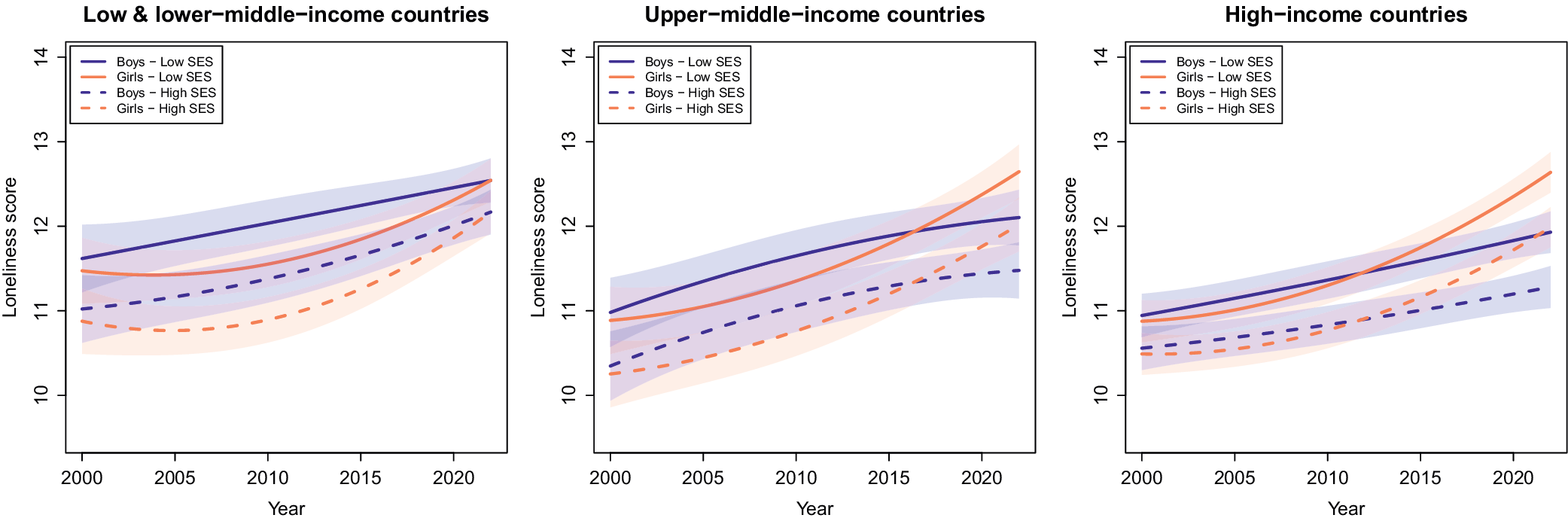
A subsequent model in which the quadratic time term and income-level groups interacted (Model 5) revealed distinct gender patterns by income level (illustrated in Figure 1; coefficients shown in Supplementary Figure S3). School loneliness scores were higher for boys than for girls across all income groups at baseline. However, in high-income countries, girls’ school loneliness scores increased sharply after 2010, exceeding boys’ levels around 2012 and resulting in a wider gender gap by 2022. A similar reversal occurred in upper-middle-income countries, with girls’ school loneliness surpassing that of boys around 2018. Boys’ school loneliness in low- and lower-middle-income countries remained consistently higher than girls’ throughout the study period, though the gender gap narrowed over time, reaching similar levels by 2022. Across all income groups, students with lower socioeconomic status reported higher levels of school loneliness. A sensitivity analysis limited to 73 countries with data from multiple time points yielded similar results (Supplementary Table S5).
Predicted school loneliness score trajectories by country income groups.
Note: School loneliness score trajectories predicted using a meta-regression are shown for low- and lower-middle-income, upper-middle-income, and high-income countries. High and low socioeconomic status refer to values 1 standard deviation above and below the Economic, Social, and Cultural Status score standardized to each country by survey year. Each country’s income classification is based on the World Bank classification for the year 2000, except for Serbia and Montenegro, which were based on the income classification for 2006, and Kosovo, which was based on the income classification for 2008. SES, socioeconomic status.

Figure 1. Long description
Figure 1 shows model-based trajectories of school loneliness scores from 2000 to 2022, stratified by country income group and displayed by gender and socioeconomic status. At baseline, boys had higher school loneliness scores than girls in all income groups. In high-income countries, girls’ loneliness scores increased markedly after about 2010, overtook boys around 2012, and remained higher through 2022. In upper-middle-income countries, a similar crossover occurred later, with girls surpassing boys around 2018. In low- and lower-middle-income countries, boys remained higher than girls throughout the study period, although the gender difference narrowed over time and the two groups were similar by 2022. Across all income groups and survey years, students with lower socioeconomic status consistently showed higher school loneliness than students with higher socioeconomic status.
Discussion
The present study, analyzing comparable data across 87 countries from 2000 to 2022, revealed a global increase in adolescent school loneliness across all income groups. Boys initially exhibited higher levels of school loneliness, whereas the increase was more pronounced for girls in wealthier countries, with their school loneliness levels surpassing those of boys around 2012 in high-income countries, and around 2018 in upper-middle-income countries. This gender-based reversal was not observed in low- and lower-middle-income countries. Students with lower socioeconomic status consistently had higher school loneliness scores throughout the study period across all income groups.
Studies on adolescent loneliness trends before the COVID-19 pandemic have reported inconsistent results, possibly reflecting the methodological differences across studies (Kaur et al., Reference Kaur, Hamilton, Chen, Hasin, Cerda, Martins and Keyes2022; Madsen et al., Reference Madsen, Holstein, Damsgaard, Rayce, Jespersen and Due2019; Myhr et al., Reference Myhr, Anthun, Lillefjell and Sund2020; Smith et al., Reference Smith, López Sánchez, Pizzol, Yon, Oh, Kostev, Gawronska, Rahmati, Butler, Barnett, Ball, Shin and Koyanagi2024; Twenge et al., Reference Twenge, Haidt, Blake, McAllister, Lemon and Le Roy2021). Our study uses a consistent methodology across countries (i.e. the same set of questions and the same survey time point) to provide unique, comparable data, confirming a global rise in adolescent loneliness over the last two decades. Several potential factors may account for the observed increase. Changes in family arrangements, such as an increase in single-parent households or migration from rural to urban areas, have been suggested to weaken ties to traditional communities (Buecker et al., Reference Buecker, Mund, Chwastek, Sostmann and Luhmann2021; Luhmann et al., Reference Luhmann, Buecker and Rüsberg2023). Advances in digital technology and the widespread adoption of social media, combined with issues such as increased sleep deprivation and online bullying (Kaur et al., Reference Kaur, Hamilton, Chen, Hasin, Cerda, Martins and Keyes2022), can also contribute to increased loneliness (Orben, Przybylski, Blakemore, & Kievit, Reference Orben, Przybylski, Blakemore and Kievit2022; Twenge, Reference Twenge2020). Finally, the global shift toward individualism that has occurred with economic development (Santos et al., Reference Santos, Varnum and Grossmann2017) may weaken social and societal integration mechanisms, leading to increased loneliness among adolescents. This study was unique in that it included data after the onset of the COVID-19 pandemic. A direct comparison between survey years revealed that although average loneliness scores were higher in 2022 compared to the 2000 baseline, the immediate change from 2018 to 2022 was relatively small and not evident in some countries. Our dataset included only a single observation point after the onset of the pandemic; hence, we were unable to disentangle the pandemic-driven effects from preexisting, long-term secular trends. Further longitudinal research extending these data points and identifying the factors driving the increasing trend in adolescent school loneliness, including its association with the COVID-19 pandemic, is useful in order to provide the additional information needed to implement effective, targeted intervention strategies.
The effect of gender on adolescent school loneliness trends varied across national income groups. Previous research from high-income countries has indicated that adolescent loneliness is higher among girls than boys (Kaur et al., Reference Kaur, Hamilton, Chen, Hasin, Cerda, Martins and Keyes2022; Riddleston et al., Reference Riddleston, Shukla, Lavi, Saglio, Fuhrmann, Pandey, Singh, Qualter and Lau2024; Twenge et al., Reference Twenge, Haidt, Blake, McAllister, Lemon and Le Roy2021). In line with those studies, we found that in high-income countries, girls’ school loneliness increased faster and surpassed boys’ around 2012. The emergence of this reverse gender gap occurred later in upper-middle-income countries, whereas it was not observed during the study period (up to 2022) in low- and lower-middle-income countries. These differing gender-based trends may suggest that social structures in economically developed countries may have disproportionately affected girls’ social relationships. For example, the proliferation of digital media, which is more widespread in high-income countries, may have a greater negative impact on the well-being and loneliness of girls than on those of boys (Twenge, Reference Twenge2020). The rising prevalence of online victimization and harassment among girls, including sexual violence, is potentially tied to increased social media usage and can severely exacerbate feelings of loneliness (Savoia et al., Reference Savoia, Harriman, Su, Cote and Shortland2021). In addition, girls in economically developed settings may face simultaneous pressures to achieve high academic success while conforming to traditional gender expectations in close relationships, which can contribute to social strain and loneliness (Stentiford, Koutsouris, & Allan, Reference Stentiford, Koutsouris and Allan2023). Alternatively, the rapid rise in loneliness among girls in high-income countries may reflect gendered differences in emotional recognition and expressiveness that emerge under affluent conditions. In wealthier settings where basic needs are more likely to be met, sex-specific tendencies diverge and widen the gender gap in emotional expression (Herlitz, Hönig, Hedebrant, & Asperholm, Reference Herlitz, Hönig, Hedebrant and Asperholm2025). Conversely, although the absence of gender reversal in low- and lower-middle-income countries could indicate a true absence of the phenomenon, it might also reflect selection biases; girls who regularly attend school in these countries may come from relatively affluent households and be less likely to experience loneliness. Although the present study cannot conclude these underlying mechanisms, our findings correspond to the recent evidence of rising emotional disorders in high-income countries, particularly among adolescent girls (Armitage et al., Reference Armitage, Kwong, Tseliou, Sellers, Blakey, Anthony, Rice, Thapar and Collishaw2023). Together, these patterns highlight that the widening gender gap in mental health, including loneliness, may be linked to broader societal changes, warranting further research to better understand the mechanisms.
Consistent with our hypothesis, lower socioeconomic status was associated with higher loneliness levels across all national income groups. The persistent vulnerability of socioeconomically disadvantaged students, regardless of national wealth, warrants urgent attention. For instance, a study from the United Kingdom reported that adolescents from lower socioeconomic backgrounds experienced higher levels of loneliness than their more affluent peers (Qualter et al., Reference Qualter, Hennessey, Yang, Chester, Klemera and Brooks2021). Our study extends this evidence by demonstrating a similar pattern across countries at varying levels of economic development. Furthermore, our longitudinal analysis revealed a nuanced association between socioeconomic status and trends in loneliness. In high-income countries, higher socioeconomic status was associated with a decrease in loneliness over time. In contrast, in low- and lower-middle-income countries, it was associated with increased loneliness over time. At the individual level, socioeconomic disadvantages often hinder adolescents’ opportunities to build social relationships in everyday life through organized activities, or limit access to social resources (Viner et al., Reference Viner, Ozer, Denny, Marmot, Resnick, Fatusi and Currie2012). These adolescents may face greater pressure than their affluent peers to work or assist with domestic responsibilities. They may also live in less safe neighborhoods with fewer social connections, which may negatively impact their social identification or interfere with their social participation, leading to increased loneliness. As the platform for interpersonal relationships shifts from the real world to online virtual spaces, students without reliable internet access can experience even greater feelings of exclusion (Twenge, Reference Twenge2020). However, all this evidence comes from high-income countries; hence, it may not directly apply to low- or lower-middle-income countries. Instead, the rising loneliness observed among adolescents from higher socioeconomic status in low- and lower-middle-income countries over time may be driven by the compounding pressures of rapid globalization and economic transition. Relative socioeconomic advantage in developing countries is often linked to a competitive academic environment and private schooling. Such adolescents are often early adopters of digital lifestyles, which together may isolate them from traditional community-based social networks despite their material advantages, leading to increased loneliness. Although the underlying mechanism remains to be explored, the present findings highlight that a country’s economic development does not alleviate adolescent loneliness. Such sentiments must be addressed through strategies that reduce loneliness by combating social deprivation and incorporating country-specific approaches.
Furthermore, our analysis revealed a notable intersectionality of gender and socioeconomic status. Specifically, in 2022, in high-income and upper-middle-income countries, girls from low socioeconomic backgrounds exhibited the highest loneliness scores. By contrast, adolescents from lower socioeconomic backgrounds showed elevated loneliness scores in low-and lower-middle-income countries regardless of gender. These results indicate that the intersection of female gender and low socioeconomic status may place adolescents at a particular disadvantage in more economically developed countries. The findings underscore the importance of developing targeted public health interventions, tailored to the unique vulnerabilities of socioeconomically disadvantaged girls in affluent countries.
This study has many strengths, including the repeated measurement of adolescent school loneliness across a variety of culturally and economically diverse countries, allowing for multi-country comparisons overall and by income-level groups. The two-stage statistical analysis enabled meta-regression of individual participant data from a complex survey design. We were able to examine the effect of individual-level socioeconomic status and gender through this design. There are also several limitations. First, PISA is a nationally representative school-based survey; therefore, adolescents not attending school owing to poverty, medical problems, or other factors could not be included, despite their potentially increased vulnerability to experiencing loneliness. Our sample bias analysis revealed that boys and those of low socioeconomic status were more likely to have been excluded, owing to missing information. However, the effect of individual-level low socioeconomic status on school loneliness remained evident, despite the potential bias toward selecting students with higher socioeconomic status. Second, data were collected only once in 2022 after the onset of the COVID-19 pandemic, which may be insufficient to fully capture its long-term impact. Future studies are needed to determine whether the COVID-19 pandemic altered the long-term trend. Third, although this study is the most extensive investigation of adolescent school loneliness conducted to date, data were unavailable for certain regions, especially in African countries where many such adolescents currently reside. Fourth, the PISA loneliness score measures school-based loneliness and may not adequately reflect general loneliness. Nonetheless, school is a primary social environment for adolescents, and school-based social relationships are an important contributor to adolescent loneliness (Hosozawa et al., Reference Hosozawa, Cable, Yamasaki, Ando, Endo, Usami, Nakanishi, Niimura, Nakajima, Baba, Oikawa, Stanyon, Suzuki, Miyashita, Iso, Hiraiwa-Hasegawa, Kasai and Nishida2022). Fifth, although all items in the PISA surveys undergo a careful translation process, differences introduced during translation may still influence how participants interpret and respond to the questions. Finally, this study relied on self-reported data, which may have been influenced by social desirability bias, leading to the underreporting of loneliness; however, internal traits, including loneliness, are most accurately measured by self-rating scales (Vazire, Reference Vazire2010).
In conclusion, our findings demonstrate that rising adolescent school loneliness is a global public health concern, and interventions to combat it should be prioritized within national and international policy agendas. The rapid increase in loneliness among girls in high-income and upper-middle-income countries suggests that societal factors may be driving the emerging gender gap, potentially leading to long-term health inequalities. This highlights the need for gender-responsive public health approaches. Furthermore, future research clarifying the precise mechanisms underlying the rising loneliness and its gender differences, particularly the role of digital technology and social media, is essential to develop effective, tailored interventions. Another important finding is that socioeconomic disadvantages are common predictors of loneliness among young people worldwide. Addressing this issue requires a coordinated, multi-pronged approach. At the systemic level, policies need to address structural inequalities and institutional environments; for example, school-based programs designed to improve school climate by fostering student autonomy, empowerment, and fairness, while reducing power imbalances, can enhance school connectedness and mitigate loneliness (Holt-Lunstad, Reference Holt-Lunstad2024). Simultaneously, at the individual level, targeted interventions such as social skill training, enhancing social and emotional support, or adopting new hobbies can reduce adolescent loneliness (Eccles & Qualter, Reference Eccles and Qualter2021). Combating adolescent loneliness requires a multi-level approach that integrates individual-level interventions and systemic structural approaches.
Supplementary material
The supplementary material for this article can be found at http://doi.org/10.1017/S0033291726105510.
Data availability statement
Datasets supporting the conclusions of this study are available online at: https://www.oecd.org/pisa/data/.




 Open access

