Introduction
Bipolar disorder (BPD) is highly heritable but the genetic architecture underpinning the disorder is complex. Despite considerable advances in genetics, the precise aetiologies of the disorder remain largely unknown. The well-known difficulty in identifying susceptibility genes for BPD is due in large part to the small individual effects of contributing loci (Gershon, Reference Gershon2000) and the dichotomous nature of clinical diagnosis in classifying individuals as gene carriers or non-gene carriers. Although the constellations of symptoms used as diagnostic criteria in the DSM are useful for clinical practice, it is unlikely that they are the optimal phenotype definitions for genetic analyses (Almasy & Blangero, Reference Almasy and Blangero2001; Gottesman & Gould, Reference Gottesman and Gould2003).
The use of endophenotypes (intermediate quantitative traits) has been proposed and used successfully as a strategy to aid gene identification for complex disorders (Freedman et al. Reference Freedman, Coon, Myles-Worsley, Orr-Urtreger, Olincy, Davis, Polymeropoulos, Holik, Hopkins, Hoff, Rosenthal, Waldo, Reimherr, Wender, Yaw, Young, Breese, Adams, Patterson, Adler, Kruglyak, Leonard and Byerley1997; Gottesman & Gould, Reference Gottesman and Gould2003; Dick et al. Reference Dick, Jones, Saccone, Hinrichs, Wang, Goate, Bierut, Almasy, Schuckit, Hesselbrock, Tischfield, Foroud, Edenberg, Porjesz and Begleiter2006). Endophenotypes are intermediary measures of neuropsychiatric functioning that are involved in the direct aetiological pathway between genotype and the clinical syndrome, but may have a relatively simpler genetic architecture than clinical diagnoses (Gottesman & Gould, Reference Gottesman and Gould2003). For a trait to be an appropriate endophenotype, it should have several key characteristics, such that it should be: (a) associated with the illness; (b) a stable trait that can be reliably measured; (c) heritable; and (d) observed in genetically at-risk but behaviourally unaffected individuals (Gottesman & Gould, Reference Gottesman and Gould2003; Meyer-Lindenberg & Weinberger, Reference Meyer-Lindenberg and Weinberger2006; Braff et al. Reference Braff, Freedman, Schork and Gottesman2007). In addition, it is optimal if the endophenotype can be analysed as a quantitative trait (Almasy & Blangero, Reference Almasy and Blangero2001; Gottesman & Gould, Reference Gottesman and Gould2003).
Event-related potentials (ERPs) of auditory P300 and mismatch negativity (MMN) are well-studied measures in the schizophrenia literature. Twin studies of healthy individuals have provided compelling evidence that both measures are heritable and can be reliably measured (van Beijsterveldt & van Baal, Reference van Beijsterveldt and van Baal2002; Hall et al. Reference Hall, Schulze, Bramon, Murray, Sham and Rijsdijk2006a). However, the question of whether P300 and MMN measures can be regarded as candidate endophenotypes for BPD is far less explored. MMN seems to reflect a pre-attentive stage of auditory information processing (Naatanen, Reference Naatanen2003). Deficits in MMN have been replicated extensively in chronic schizophrenia patients (Javitt et al. Reference Javitt, Spencer, Thaker, Winterer and Hajos2008) but have not been observed in bipolar patients (Catts et al. Reference Catts, Shelley, Ward, Liebert, McConaghy, Andrews and Michie1995; Umbricht et al. Reference Umbricht, Koller, Schmid, Skrabo, Grubel, Huber and Stassen2003). To our knowledge, no family study of MMN in BPD has been reported.
Auditory P300 deficits (amplitude reduction and latency prolongation) have been reported in patients with BPD (Muir et al. Reference Muir, St Clair and Blackwood1991; Souza et al. Reference Souza, Muir, Walker, Glabus, Roxborough, Sharp, Dunan and Blackwood1995; Salisbury et al. Reference Salisbury, Shenton and McCarley1999; O'Donnell et al. Reference O'Donnell, Vohs, Hetrick, Carroll and Shekhar2004). However, few studies have investigated whether P300 deficits are valid endophenotypes for BPD. A small family study (n=19) by Pierson et al. (Reference Pierson, Jouvent, Quintin, Perez-Diaz and Leboyer2000) reported reduced P300 amplitude and delayed latency in relatives of bipolar patients. Using a much larger and more homogeneous sample of bipolar patients and their unaffected first-degree relatives, our group has previously observed prolonged P300 latency in both BP patients and their unaffected relatives (Schulze et al. Reference Schulze, Hall, McDonald, Bramon, Marshall, Walshe and Murray2008). However, the fact that a trait ‘runs in families’ is not sufficient evidence to assume that the observed association is genetic because families may share predisposing environments as well as genes. Direct estimates of genetic and environmental associations with BPD are not feasible in a family study design (Martin et al. Reference Martin, Boomsma and Machin1997).
The Maudsley Bipolar Twin Study reported by our group revealed impaired P300 amplitude in twin pairs concordant and discordant for BPD compared to healthy control twins (Hall et al. Reference Hall, Rijsdijk, Kalidindi, Schulze, Kravariti, Kane, Sham, Bramon and Murray2007a). This amplitude reduction was due mainly to shared genetic factors with BPD. The P300 latency component and MMN, on the contrary, were not associated with BPD. However, the sample size in this twin study was relatively small and dizygotic (DZ) twin pairs concordant and discordant for BPD were not available. These limitations could potentially weaken the validity and generalizability of the findings.
Combining twin and family samples provides an opportunity to overcome the limitations encountered by each design. First, it increases the sample size and improves statistical power; second, discordant and concordant affected sibling pairs in the family study can be a substitution for DZ twin pairs; and third, the familial overlap of BPD with P300 or MMN measures can be partitioned out in a genetic and environmental component. The current study includes a substantial dataset combining P300 and MMN data from the Maudsley Twin and the Bipolar Family Study. Our aims were to: (1) assess the relationship between BPD and MMN, (2) substantiate the association between psychotic BPD and P300 variables, and (3) verify the genetic overlap of BPD with P300 amplitude reported previously (Hall et al. Reference Hall, Rijsdijk, Kalidindi, Schulze, Kravariti, Kane, Sham, Bramon and Murray2007a). In addition to the conventionally reported central–posterior midline scalp locations (PZ or CZ) of P300 variables, we also assessed genetic influences (heritability) on the bilateral temporal scalp locations of P300 variables and examined the relationship of P300 variables at these sites with BPD.
Method
Sample
The cohort was drawn from the Maudsley Twin Study of Bipolar Disorder (Hall et al. Reference Hall, Rijsdijk, Kalidindi, Schulze, Kravariti, Kane, Sham, Bramon and Murray2007a) and the Maudsley Family Study of Psychosis (Schulze et al. Reference Schulze, Hall, McDonald, Bramon, Marshall, Walshe and Murray2008). A total of 301 subjects were included in this study, comprising 92 twin pairs [10 pairs of monozygotic (MZ) twins discordant for BPD and six pairs of MZ twins concordant for BPD, 43 pairs of psychiatrically healthy control MZ twins and 33 pairs of DZ control twins], 31 bipolar families (31 index bipolar patients, six concordant ill siblings, four concordant ill offspring, 26 discordant (i.e. unaffected) siblings, seven unaffected parents, and nine unaffected offspring) and 39 unrelated psychiatrically healthy controls. All BPD patients had experienced psychotic symptoms (delusions and/or hallucinations) during one or more affective episodes. All patients were out-patients at the time of assessment. The majority of patients were symptom free at the time of testing [Beck Depression Inventory (BDI) score <14] with the exception of eight patients who presented with mild to moderate depressive symptoms (BDI score 14–24). Bipolar patients had a mean duration of illness of 21 years (s.d.=10.8 years) and a mean age of illness onset of 22.5 years (s.d.=7 years). Fourteen patients were unmedicated. Of the remaining patients, nine were on a single mood stabilizer and others were on combinations of mood stabilizers, antipsychotics and antidepressants. Controls were free of a personal or family history, to second-degree relatives, of psychotic or BPD. Exclusion criteria applied to all groups included a history of neurological disorder, hearing impairment, a history of head trauma resulting in loss of consciousness for more than 10 min, and current substance (excluding nicotine or caffeine) dependence. The study was approved by the UK Multicentre Research Ethics Committee.
Structured diagnostic interviews were performed for all participants using the Schedule for Affective Disorders and Schizophrenia – Lifetime Version (SADS-L; Spitzer et al. Reference Spitzer, Endicott and Robins1978), the Schedule for Clinical Assessment in Neuropsychiatry (SCAN) version 2.1 or the Structured Clinical Interview for DSM-IV (SCID; First et al. Reference First, Spitzer, Gibbon and Williams1997). Additional information regarding the timing and nature of symptoms was obtained for subjects who were interviewed using the SADS-L to enable DSM-IV diagnoses to be made. Data on medication history were collected at the time of assessment. None of the participants was an in-patient at the time of assessment. Zygosity was determined using 12 highly polymorphic DNA markers.
Procedure and tasks
Identical P300 and MMN methodology was used in both the twin and family studies and is described in detail elsewhere (Hall et al. Reference Hall, Schulze, Rijsdijk, Picchioni, Ettinger, Bramon, Freedman, Murray and Sham2006b). Data were collected using Neuroscan software. Electroencephalogram (EEG) data were recorded according to the 10/20 International System (Jasper, Reference Jasper1958), referenced to the left ear. Eye movements were recorded from the outer canthus of each eye, above and below the left eye. Electrode impedances were below 6 kΩ. EEG activity was amplified 10 000 times with 0.03 high-pass and 120 low-pass filters, and digitized at a 500 Hz rate. Subjects were not allowed to smoke within a minimum of 40 min before data collection (Adler et al. Reference Adler, Hoffer, Wiser and Freedman1993).
MMN
MMN was elicited by a duration auditory oddball task using four blocks of 400 binaural 80 dB stimuli [interstimulus interval (ISI) 0.3 s] with 85% standards (25 ms, 1000 Hz, 5 ms rise/fall time) and 15% deviants (50 ms). EEG data were epoched (−100 to 300 ms), filtered (0.1–30 Hz) and baseline corrected. Epochs were rejected if amplitudes exceeded 100 μV in any channel. Eye-blink artefacts were corrected as above. MMN was extracted by subtracting standard from deviant averaged waveforms. Peak MMN amplitude in the 50–200 ms latency range was measured at FZ, CZ, F3 and F4. We report MMN as the average amplitude of the four electrode sites.
P300
P300 was assessed using an auditory oddball paradigm [400 binaural 80 dB, 20 ms stimuli, 20% target (1500 Hz) and 80% standard (1000 Hz) tones]. Participants pressed a button in response to a target tone. EEG data were epoched (−100 to 800 ms), digitally filtered (0.15–40 Hz), low-pass filtered (8.5 Hz) and baseline corrected. Eye-blink artefacts were corrected using regression-based weighting coefficients (Semlitsch et al. Reference Semlitsch, Anderer, Schuster and Presslich1986). Epochs were rejected if amplitudes exceeded 50 μV in F7, F8, Fp1 or Fp2 or if residual horizontal eye movements were present in the −100 to 800 ms period. Separate average waves for target and standard tones were calculated. P300 was measured at PZ, CZ, P3, P4, T3 and T4 between 280 and 600 ms. For each individual, midline P300 score was based on the average of PZ and CZ electrode sites and temporal posterior P300 scores were based on the average of P4 and T4 electrode sites for the right and of P3 and T3 electrode sites for the left respectively.
Statistical analyses
Comparison of means
Linear regression analyses with standard errors robust against non-independence of observations from individuals within families (clusters) and against departures from normal assumptions were carried out in Stata version 9.0 (Stata Corp., College Station, TX, USA). Four groups were compared in the means analysis: bipolar patients, unaffected parents and offspring (combined into one group because of small sample size; n=7 and n=9 respectively), unaffected siblings (including discordant MZ well twins), and the control group (including MZ/DZ healthy twins and singletons).
The patient group and the two unaffected relative groups (parents/offspring; siblings) were compared to the control group for each ERP variable separately, with P300 amplitude, latency or MMN amplitude as the dependent variable while controlling for age and gender. For analysis of P300 latency measures, a quadratic function of age was included to model any non-linear effects of age on P300 latency (Schulze et al. Reference Schulze, Hall, McDonald, Bramon, Marshall, Walshe and Murray2008). Paired t tests were applied to test differences between left and right temporal-posterior P300 components for each of the four groups. A simple t test was used for assessing ERP differences between medicated and unmedicated patients. Partial correlation coefficients including age and gender as covariates were performed to assess the relationships between each ERP variable and medication effects (i.e. mood stabilizers, antipsychotics or antidepressants) and also number of hospitalizations. Linear or logistic (for categorical variables) regression analyses were used to assess overall group differences in demographic variables. A 0.05 level of significance was used for the mean analyses.
Structural equation modelling
Correlations between relatives and genetic analyses were estimated using raw ordinal maximum likelihood in the statistical program Mx (Neale et al. Reference Neale, Boker, Xie and Maes1999). We applied liability-threshold models for both BPD and ERP variables in which the bipolar phenotype has one threshold and each ERP variable has multiple thresholds (Falconer & Mackay, Reference Falconer and Mackay1996). The liability-threshold models for the bipolar phenotype assume that risk is normally distributed on a continuum and that the disorder occurs only when a certain threshold is exceeded (Neale & Kendler, Reference Neale and Kendler1995). For each ERP variable, data were categorized into seven equal ordinal classes, which should capture most of the information of the continuous distribution (Rijsdijk et al. Reference Rijsdijk, van Haren, Picchioni, McDonald, Toulopoulou, Pol, Kahn, Murray and Sham2005; Hall et al. Reference Hall, Rijsdijk, Picchioni, Schulze, Ettinger, Toulopoulou, Murray and Sham2007b). Sex and age effects were regressed out prior to categorization of ERP data. The genetic model-fitting method has been described in detail by Rijsdijk et al. (Reference Rijsdijk, van Haren, Picchioni, McDonald, Toulopoulou, Pol, Kahn, Murray and Sham2005) and Hall et al. (Reference Hall, Schulze, Sham, Kalidindi, McDonald, Bramon, Levy, Murray and Rijsdijk2008). In brief, in the genetic models, parameters for BPD (i.e. variance components and prevalence) were fixed to adjust for sample ascertainment. We used three different sets of fixed values for the bipolar parameters: the point estimates (model 2: h2=0.85, c2=0, e2=0.15), the lower (model 3: h2=0.73, c2=0, e2=0.27) and upper 95% confidence interval (CI) (model 1: h2=0.93, c2=0, e2=0.07) based on the report by McGuffin et al. (Reference McGuffin, Rijsdijk, Andrew, Sham, Katz and Cardno2003), which includes the largest affected twin pair sample ascertained so far, as no published meta-analysis is available. In addition, we fixed the bipolar liability threshold to the prevalence rate of a lifetime risk of 1%. The shared genetic and environmental effects between BPD and each ERP variable and also the specific genetic and environmental ERP factors are free parameters to be estimated in the model.
Polychoric correlations
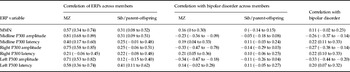
Polychoric correlations (i.e. correlations between multiple ordinal variables) between each ERP variable and bipolar liabilities were constrained to produce: (a) one within-member bipolar–ERP correlation in the sample estimated over all individuals; (b) one cross-member cross-trait correlation and one cross-member within-trait correlation for sib pairs, DZ pairs and parent–offspring pairs because they all have the same genetic relationship; and (c) one cross-member cross-trait correlation and one cross-member within-trait correlation for the MZ twin pairs (Table 2).
Genetic model fitting
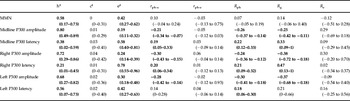
Genetic model fitting was applied to estimate (1) the heritability of each ERP variable (MMN, midline P300 amplitude and latency, left temporal-posterior P300 amplitude and latency, and right temporal-posterior P300 amplitude and latency), and (2) genetic and environmental correlations of BPD with each ERP variable. A bivariate model was used to analyse BPD and MMN phenotypes. A multivariate model was used to analyse BPD, P300 amplitude and P300 latency phenotypes because these components are correlated (Hall et al. Reference Hall, Schulze, Bramon, Murray, Sham and Rijsdijk2006a). Within-trait cross-member correlations are used to estimate the heritability of the ERP variables, whereas the correlation between one family member's bipolar liability and his/her relative's ERP score informs on the source of the phenotypic correlations. For example, a significantly greater MZ bipolar–P300 amplitude cross-member correlation compared to that estimated from the non-MZ family members would suggest that genetic effects contribute to the bipolar–amplitude association. The genetic (r g) and environmental (r e) correlations shown in Table 4 indicate the extent to which genetic (or environmental) factors on BPD overlap with those on the ERP components. A genetic correlation of 1 would indicate that genetic influences on BPD and the ERP variable completely overlap, whereas a genetic correlation <1 indicates that at least some genes are specific to only one of the traits.
A goodness-of-fit index (χ2) was obtained by computing the difference in likelihoods (and degrees of freedom) between the genetic models and the polychoric correlation model. Submodels of the full ACE model were evaluated by comparing the difference in χ2 relative to the difference in degrees of freedom, according to principals of parsimony, operationalized by the significance of the difference in χ2. CIs of parameter estimates were obtained by the maximum likelihood method (Neale & Miller, Reference Neale and Miller1997).
Results
Subjects
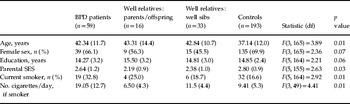
There was no group difference in the proportion of female/male participants or in the prevalence of past alcohol or substance (excluding smoking) dependence (Table 1). However, the control subjects were younger than all other groups (p=0.01). Controlling for age and sex, there were significant differences in parental socio-economic (SES) status, the proportion of current regular smokers and the number of cigarettes per day between groups. Parental SES was significantly lower for the parent/offspring than for the other three groups, who did not differ from each other. The proportion of current regular smokers was significantly higher in patients than in the other three groups [patients versus controls odds ratio (OR) 2.69, 95% CI 1.26–5.74], who did not differ from each other. In addition, among smokers, patients smoked significantly more cigarettes per day than control subjects (p=0.006) and well relatives (p<0.03). Unmedicated patients did not differ significantly from the remaining patient sample in terms of ERP scores (all had p values >0.14) and there were no significant correlations between variables concerning medication and each ERP measure.
Demographic characteristics of the sample
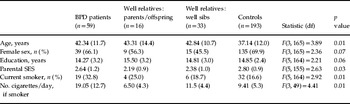
BPD, Bipolar disorder; SES, socio-economic status; df, degrees of freedom.
Data are presented as mean (s.d.) unless otherwise indicated.
Among the relatives, 15 individuals had a history of a non-psychotic DSM-IV axis I disorders, mainly major depressive disorder (n=12; anxiety n=1; past alcohol dependence n=1; past substance-induced mood disorder n=1). Twenty-three control subjects also had a lifetime diagnosis of non-psychotic disorder (major depressive disorder n=21; past PTSD n=1; anxiety n=1) but were euthymic and not receiving any psychotropic medication at the time of assessment.
Comparison of means
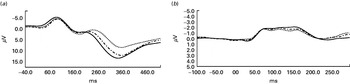
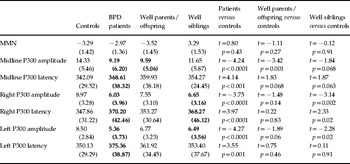
Means and standard deviations of MMN amplitude, midline and bilateral temporal-posterior P300 amplitude and latency are shown in Table 2. Figure 1 show mean P300 amplitude at central-posterior and MMN at FZ electrode positions for each participant group.
Grand average waveforms of (a) P300 and (b) mismatch negativity (MMN). –––, Controls; – · –, well relatives; … …, patients.

Group means (standard deviation) and results of mean group comparisons for P300 and MMN indices
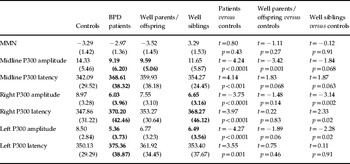
p values refer to the comparison of each of the three groups (BPD patients, well parent/offspring, and well siblings) to the control group. Significant group mean difference from control is indicated in bold.
No significant between group differences in MMN amplitude were found. For P300, there was a significant main effect of group on all P300 variables: midline P300 amplitude [F(5, 163)=7.42, p<0.001], latency [F(6, 163)=9.29, p<0.001], left P300 amplitude [F(5, 160)=6.88, p<0.001], left latency [F(6, 160)=7.31, p<0.001], and right P300 amplitude [F(5, 155)=4.91, p<0.001], right latency [F(6, 155)=6.92, p<0.001]. Patients showed widespread P300 deficits compared to controls across midline and bilateral temporal-posterior scalp areas. In the relatives, well siblings of patients showed significantly reduced amplitude and delayed latency compared to controls at the right temporal-posterior site and also reduced amplitude on the left site. The differences at the midline were at trend level. The well parent/offspring group showed significantly reduced midline P300 amplitude. Differences in midline amplitude and left temporal-posterior latency between these relatives and controls were at trend level (Table 2). Within each group, no significant differences emerged between amplitude or latency at left compared to right temporal-posterior sites (all p's>0.10).
Excluding relatives and control subjects with axis 1 disorder
Some of the relatives (n=15) and control subjects (n=23) had a lifetime diagnosis of a non-psychotic axis 1 disorder, which may be associated with changes in ERPs. Repeating the linear regression analyses on all ERP variables after excluding these participants did not materially affect the results (details available upon request).
Model fitting results
Heritability of MMN
The full multivariate genetic ACE model fitted the P300 data poorly. However, additional genetic analyses by fitting the relationship of P300 variables with BPD separately as bivariate models (i.e. BPD with amplitude; BPD with latency) instead of the multivariate models had a good fit of the data (amplitude p=0.10; latency p=0.05), with very similar parameter estimates (results available upon request). As amplitude and latency are not independent from each other, we present here the standard ACE model-fitting results based on the multivariate models.
Table 3 shows maximum likelihood estimates for the MZ and sibling (including DZ twins)/parent-offspring correlations. Genetic model-fitting results are presented in Table 4. MZ cross-member correlations for all ERP variables were greater than the corresponding sibling/parent-offspring correlation, suggesting genetic contributions (Table 3). Significant heritabilities were found for all ERP variables: MMN h2=0.58, midline P300 amplitude h2=0.80 and latency h2=0.38, right temporal-posterior amplitude h2=0.72 and latency h2=0.21, left temporal-posterior amplitude h2=0.68 and latency h2=0.56. No shared environmental influences were found for any of the ERP variables (Table 4).
Maximum likelihood estimates of correlations between bipolar disorder and ERP variables and MZ/sib correlations (with 95% confidence intervals)
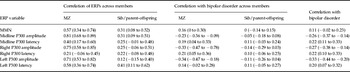
ERP, Event-related potential; MZ, monozygotic.
Confidence intervals including zero indicate non-significance. Sibling values include dizygotic (DZ) twin pairs.
Heritability (h2), shared environmental (c2) and non-shared environmental (e2) estimates and the phenotypic correlations (Rph), the decomposed source of the correlations (rph-a and rph-e) predicted by the full ACE models and the genetic (Rg) and shared environmental (Re) correlation estimates (with 95% confidence intervals)
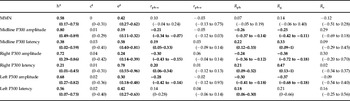
r ph, Total phenotypic correlation; r ph-a and r ph-e, phenotypic correlation due to additive genetic and specific environmental influence respectively; R g and R e, genetic and specific environmental correlations respectively.
Confidence intervals including zero indicate non-significance. Significant values are indicated in bold.
Three sets of genetic models for bipolar disorder were used: (1) h2=0.93, c2=0, e2=0.07; (2) h2=0.85, c2=0, e2=0.15; and (3) h2=0.73, c2=0, e2=0.27. The results do not differ substantially between the three models, therefore only model 2 (point estimate) results are reported.
Relationship with BPD
Genetic model fitting showed that MMN was not associated with BPD across all three sets of BPD models (Table 4). All P300 variables were associated with BPD such that BPD was associated with reduced P300 amplitude and prolonged latency on midline and bilateral temporal-posterior scalp areas (Table 4): midline amplitude r ph=−0.26, 95% CI −0.37 to −0.14 and latency r ph=0.22, 95% CI 0.12–0.33; right temporal-posterior amplitude r ph=−0.24, 95% CI −0.36 to −0.12 and latency r ph=0.21, 95% CI 0.09–0.32; and left temporal-posterior amplitude r ph=−0.30, 95% CI −0.41 to −0.18 and latency r ph=0.18, 95% CI 0.06–0.30.
Across all three BPD heritability models, shared genetic factors (r g) were the main source of the phenotypic correlations between BPD and P300 variables. Environmental correlations (r e) were not significant. Genetic correlations (r g) for midline amplitude and latency were estimated to be −0.25 and 0.33 respectively, for right temporal-posterior amplitude and latency to be −0.38 and 0.47 respectively, and for left temporal-posterior amplitude to be −0.37. The genetic correlation for left temporal-posterior latency was not significant (Table 4).
Discussion
To our knowledge, we report here the first twin-family cohort study of MMN and of P300 indices in the psychotic bipolar population. MMN was preserved in patients with BPD compared to controls; no genetic or environmental association with BPD was found. By contrast, BPD was significantly associated with reduced P300 amplitudes and prolonged latencies and this association was largely due to shared genetic factors. The present results substantiate findings from our previous twin study of a significant genetic association between psychotic BPD and P300 indices and strengthen the suggestion that MMN is not an endophenotype for the disorder.
MMN
Duration MMN amplitude is a heritable trait with little or no evidence of shared environmental effects. The heritability estimate for MMN was very similar to that reported in our previous twin study (i.e. twin study h2=0.55 for MMN at Fz; combined sample h2=0.58 for MMN average across four sites). We found no evidence of significant MMN deficits in either patients with psychotic BPD or their unaffected relatives or co-twins, consistent with our previous twin results (Hall et al. Reference Hall, Rijsdijk, Kalidindi, Schulze, Kravariti, Kane, Sham, Bramon and Murray2007a) and with reports from the literature (Umbricht et al. Reference Umbricht, Koller, Schmid, Skrabo, Grubel, Huber and Stassen2003; Javitt et al. Reference Javitt, Spencer, Thaker, Winterer and Hajos2008). In addition, in agreement with Umbricht et al. (Reference Umbricht, Koller, Schmid, Skrabo, Grubel, Huber and Stassen2003), we found that the number of hospitalizations showed a significant correlation with MMN (partial correlation r=0.36, p=0.02); MMN was not correlated with age at onset (partial correlation r=−0.05, p=0.74); nor with duration of illness (partial correlation r=0.20, p=0.20). MMN did not therefore emerge as an endophenotype for psychotic BPD.
It is of note that three studies of patients with schizophrenia have observed normal MMN during early stages of the illness but significantly reduced MMN in patients with an illness duration of ⩾12 months (Salisbury et al. Reference Salisbury, Shenton, Griggs, Bonner-Jackson and McCarley2002, Reference Salisbury, Kuroki, Kasai, Shenton and McCarley2007; Umbricht et al. Reference Umbricht, Bates, Lieberman, Kane and Javitt2006). Salisbury et al. (Reference Salisbury, Kuroki, Kasai, Shenton and McCarley2007) reported on MMN in groups of patients with BP, with SZ and controls; at the time of the patients' first hospitalization, no significant group differences in MMN emerged. However, at the 1-year follow-up, patients with schizophrenia showed significant MMN reduction whereas patients with BPD and control subjects did not (Salisbury et al. Reference Salisbury, Kuroki, Kasai, Shenton and McCarley2007).
Considering the above findings on MMN in schizophrenia and BPD samples, one possible hypothesis is that MMN deficits occur selectively in chronic schizophrenic patients, reflect additional neural-network disruption and index progressive structural and functional changes not seen in patients with other neuropsychiatric disorders. These changes may be independent from psychosis in general, as evidenced by their absence in BPD with psychosis. Of course we cannot rule out the possibility that, during acute illness exacerbation, MMN may be impaired in a state-dependent manner in bipolar patients. MMN has been associated with psychosocial functioning in both schizophrenic patients and clinically normal healthy subjects (Light & Braff, Reference Light and Braff2005; Light et al. Reference Light, Swerdlow and Braff2007). The significant correlation of MMN and number of hospitalizations is compatible with previous reports of a relationship between MMN and higher-order cognitive and social functioning.
P300
The present study, with a substantially larger sample and improved statistical power, found a widespread reduction of P300 amplitude and latency delay across midline and bilateral temporal-posterior scalp areas in both patients and their unaffected relatives. Consistent with the mean score analyses, model-fitting analyses substantiated significant phenotypic associations between psychotic BPD and impaired P300 functioning. Shared genetic influences were the main factors for the phenotypic associations. These results provide further supporting evidence that P300 amplitude and latency components are valid endophenotypes for psychotic BPD.
It is of interest to note that genetic correlations of P300 components at temporal-posterior locations were higher than for midline P300 in our sample. The greater genetic correlations at temporal-posterior locations may be due to the use of an auditory oddball task. P300 has multiple brain generators, including areas in the hippocampus, thalamus, temporal, frontal and parietal lobes (Knight et al. Reference Knight, Scabini, Woods and Clayworth1989; Smith et al. Reference Smith, Halgren, Sokolik, Baudena, Musolino, Liegeois-Chauvel and Chauvel1990). Intracranial recordings have shown that the superior temporal gyrus in the auditory cortex is one of the key generators of the auditory P300 (Smith et al. Reference Smith, Halgren, Sokolik, Baudena, Musolino, Liegeois-Chauvel and Chauvel1990).
The heritabilities of P300 amplitude estimated here were consistent with the results of our group's bipolar twin study and are remarkably similar at midline (twin sample: h2=0.77 at Pz; current study h2=0.8 for average of Pz and Cz). This consistency in results is reassuring, especially given the argument sometimes raised that twin data might not be generalizable to the normal (non-twin) population. Heritability of latency in our previous twin report (h2=0.16 at Pz) was not significant. Using the current sample we found significant heritability at midline and right temporal-posterior positions (h2=0.38 for midline, h2=0.21 on the right). The difference for midline heritability may be due to increased power in the present study because of larger sample size and the use of averaged P300 latency across Pz and Cz, assumed to reduce measurement error.
The heritability of P300 latency at the left temporal-posterior site (h2=0.56) was significantly higher than that at the right, but a significant genetic correlation with BP was found only for the right site. The group mean comparison revealed that well siblings of BP patients had delayed latency on the right site, but no significant deficit on the left site, which is consistent with the model-fitting results. This demonstrates an important point that a trait with higher heritability may not be a good endophenotype if unaffected relatives do not carry such a trait.
A portion of the sample of relatives and controls whom we classified as clinically unaffected qualified for axis I diagnoses. The most common diagnosis was a past history of non-psychotic major depression. Although there may be an overlap in aetiology between major depression and mania (McGuffin et al. Reference McGuffin, Rijsdijk, Andrew, Sham, Katz and Cardno2003), the main results remained essentially unchanged after excluding people who qualified for major depression from the analyses, suggesting that major depression did not account for the significant genetic correlation between BPD and P300 components.
The current study sample consisted of a large, well-characterized group of BP patients with psychotic features and their unaffected first-degree relatives. In some families the unaffected relatives may be parents or offspring. The age range in this type of family study is therefore wide. Although the effects of age and other demographic variables on ERP measures have been dealt with statistically, it is possible that this does not fully address the effect of potential confounders.
In summary, MMN exhibits many properties of an early stage, automatic, memory-based comparison process whereas the P300 indexes higher-level, attention-dependent cognitive functions. Information processing dysfunction in SZ seems to be present from a very early stage through to higher-level cognitive functions. By contrast, people with BPD seem to have a normal early preattentional auditory information processing indexed by the MMN paradigm. P300 indexes are not a specific endophenotype for SZ but also for psychotic BPD. It is possible that similarities in P300 deficits observed in SZ and psychotic BPD patients and their unaffected relatives originate from two independent sets of genes, with the downstream effects of these gene sets converging on a final common pathway. Alternatively, the two disorders may share overlapping genetic susceptibility mediated by the P300 components. Molecular genetic studies including P300 endophenotypes in the analyses will be able to clarify specific or pleiotropic effects of genes on SZ and BPD.
Acknowledgements
Funding for this study was provided by the Kaplen Fellowship, Harvard Medical School (M.-H. Hall) and the National Alliance for Research on Schizophrenia and Depression (NARSAD) Sidney R. Baer, Jr. Foundation Young Investigator Award (M.-H. Hall), the Adam Corneel Young Investigator Award (M.-H. Hall), the Wellcome Trust, and the Schizophrenia Research Fund. We thank all of the subjects who participated in this study.
Declaration of Interest
None.