Introduction
Pulse oximetry (POX) has been confirmed as an effective and reliable screening method for critical congenital heart disease (CCHD) in newborns.Reference Hu, Ma and Zhao 1 – Reference de-Wahl, Wennergren and Sandberg 4 A number of developed countries have enacted recommendations to use POX as a screening tool for newborns.Reference de-Wahl, Meberg, Ojala, Steensberg, Oskarsson and Mellander 5 , Reference Singh and Ewer 6 While we are committed to improving the detection rate of CCHD through POX, it is imperative that we understand that there are still many simple major CHD patients (e.g. those with large septal defects, defined as defects that require intervention in the first year of life) in developing countries who are not diagnosed in a timely fashion due to insufficiencies in training of clinicians with regards to auscultation, thus leading to Eisenmenger syndrome or heart failure.Reference Saxena 7 – Reference Saxena 11 Thus, the importance of cardiac auscultation should be emphasised, highlighting the need to improve the ability of paediatricians to accurately discern a heart murmur. This not only decreases the need for unnecessary echocardiographic studies, but can ensure that major CHD can be detected during the neonatal period as many as possible. However, it may be difficult even for experienced paediatric cardiologists to accurately distinguish an innocent murmur from a pathologic one in the early neonatal period.Reference Shenvi, Kapur and Rasiah 12 – Reference Brunetti, Rosania and D’Antuono 17 Targeting the same study population as that of our previous multicenter pilot study in 2011,Reference Zhao, Ma and Ge 2 we evaluated the accuracy of cardiac auscultation by general paediatricians. It also provides a reference for the understanding of neonatal murmurs in the maternity hospital setting.
Methods
Study design and participants
Five general paediatricians from three secondary maternity facilities participated in the study (three from Songjiang Maternity Hospital, one from Minhang Maternity Hospital, and one from Songjiang District Central Hospital). These paediatricians had between 3 and 15 years of paediatric clinical experience. Resource allocation and the number of annual births at these three hospitals are typical of most maternity facilities in China.
We conducted a prospective study at three hospitals. All deliveries of asymptomatic newborns during this period, with the exception of those who were diagnosed with CHD prenatally, underwent cardiac auscultation, POX measurement, and echocardiography. We made a data collection plan before we started to recruit study participants at all sites.
This study was approved by the Ethics Committee of the Children’s Hospital of Fudan University (CHFU). Verbal informed consent was obtained from parents of participating newborns.
Procedures
Cardiac auscultation. Prior to the study, five paediatricians simultaneously underwent simple cardiac auscultation simulation training at CHFU. Training tools included audio files of normal heart sounds, standard murmurs from common CHD, and of different intensity heart murmurs, as well as a newborn manikin labelled with standard auscultation sites. The character and phase of the murmur was also introduced in the training but were not used as criteria for judgement in the study. The objectives of training were to discern the presence or absence of the murmur, the intensity of the murmur, and to identify standard auscultatory sites. During the study, a standard paediatric stethoscope (Jiangsu Yuwell Medical, Nanjing, China), the most common model used in community hospitals, was used. Auscultation took place in five auscultation areas (pulmonic, aorta, Erb’s point, tricuspid, and mitral) for each newborn under typical conditions of the general maternity ward. It was imperative for the newborn to be quiet during auscultation, and that duration of auscultation be no less than 20 seconds. After auscultation, the grade of murmur was recorded as follows: 0 for no murmur; 1 for barely discernable murmur; 2 for soft but easily noticeable murmur; and ≥3 for murmurs that are noticeably loud or those with thrill. Five doctors auscultated and carried out POX measurements in their respective hospitals for all asymptomatic newborn infants during the study period.
Echocardiographic diagnosis. The first author, a paediatric cardiologist with 5 years’ experience in paediatric echocardiography, visited each of the study sites daily and carried out echocardiographic scans for each participant. Auscultation of each asymptomatic participant occurred only after the first author was on site. All echocardiographic scans were completed at the bedside with a Vivid Q Ultrasound Machine, ensuring echocardiography was completed within 1 hour of cardiac auscultation. The paediatric cardiologist was blinded to auscultatory findings of the infant.
Determination of CHD and severity. The following conditions were not included in the scope of CHD: (1) patent ductus arteriosus (PDA) which spontaneously closed within 3 months; (2) atrial septal defect (ASD) <5 mm diameter after 3 months; (3) physiological pulmonary branch stenosis which had resolved at follow-up; (4) Pulmonary stenosis (PS) or aortic stenosis (AS) with pressure gradient of <20 mmHg with no further deterioration during follow-up; (5) simple patent foramen ovale (PFO). The main outcomes analysed for this study were major CHD, including all cyanotic heart disease and other acyanotic lesions determined to require intervention during infancy (e.g. atrioventricular septal defect, large VSD, large PDA, large ASD, severe PS, and critical coarctation). All CHD were followed up with repeat echocardiography at 3 months, 6 months, 1 year, and 2 years to confirm severity. For those that were unable to be followed up at CHFU, parents were contacted by telephone to gain an understanding of echocardiographic findings from other institutions and for presence of CHD symptoms and whether interventions had been carried out.
Statistical analysis
Sample size calculations were explained in the previous studyReference Zhao, Ma and Ge 2 : On the basis of a prevalence of CHD of eight per 1000 livebirths (and assuming a 50% sensitivity and 90% specificity of routine clinical assessment), and with a sample size of 6700 (including 54 cases of CHD), the study had 99% power to prove the sensitivity was at least 80% with a two-sided test with type-I error of 5%. The sample size needed to detect a 5% increase in specificity from 90% was 552 on the basis of a two-sided test with type-I error of 5% (99% power).
The sensitivity, specificity, and positive and negative predictive values were calculated for different murmur grades. The Wilson method was used to calculate the 95% CI of sensitivity and specificity. Spearman’s correlation analysis was used to evaluate the relationship between the FPR from the murmur and auscultation time in 1-hour increments. Using false positive and true negative murmur findings from raw data during each auscultation time in 1-hour increments, the optimal auscultation time for minimising false positives was derived from the ROC curve. P<0.05 was considered statistically significant.
Results
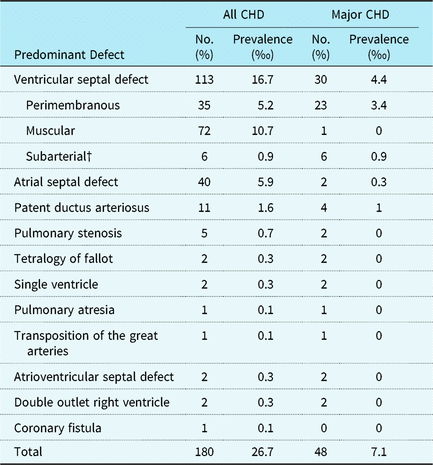
A total of 6785 newborns were born in the three participating hospitals during the study period, of which 6750 were asymptomatic at the time of clinical assessment and included in the study. Median age at auscultation was 43 hours (2–97 hours). A total of 180 infants were diagnosed with CHD (incidence rate of 26.7‰), of which 48(0.71%)were classified as major CHD. The types and incidence of CHD are shown in Table 1.
The prevalence of CHD and each specific CHD subtype by severity

† Three newborns were diagnosed as subarterial ventricular septal defect combined with coarctation of the aorta.
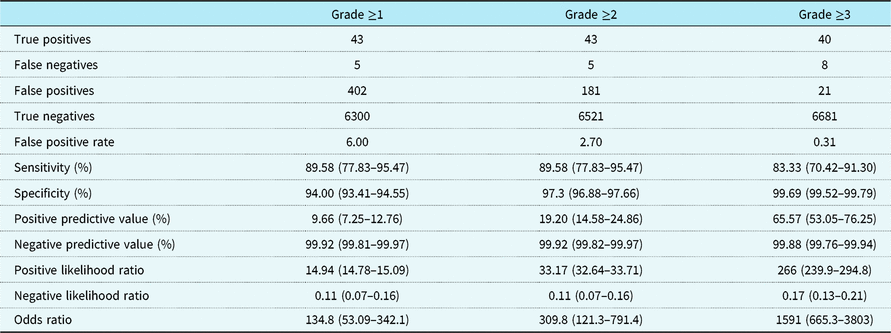
Cardiac murmurs were identified in 6.6% (445/6750) of newborns, of which 49.7% (221/445) were grade 1, 36.6% (163/445) were grade 2, and 13.7% (61/445) were grade ≥3. For all CHD, 44.4% (80/180) had varying degrees of murmurs, 39.1% (70/180) were grade ≥2 and 28.3% (51/180) were grade ≥3. For major CHD, 89.6% (43/48) had varying degrees of murmurs, all of which were grade ≥2. The diagnostic accuracy of murmurs of different grades for detecting major CHD are shown in Table 2.
Accuracy of cardiac murmurs for detection of major CHD in asymptomatic newborn babies

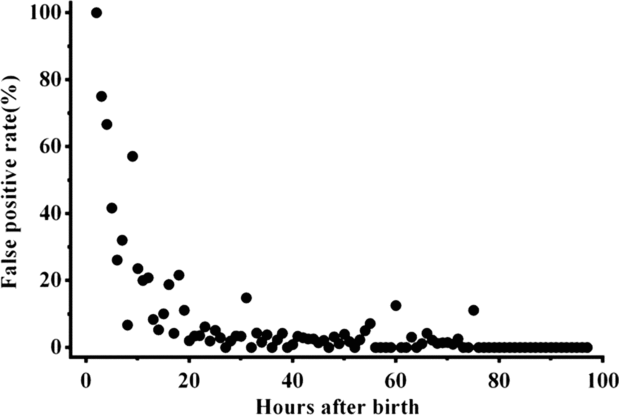
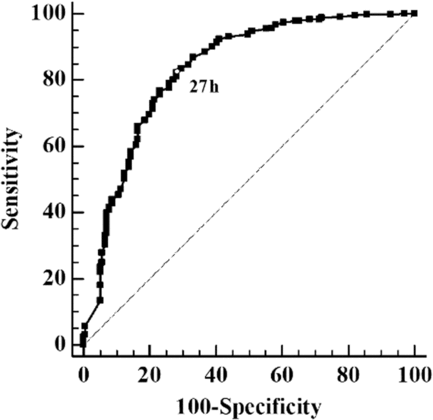
Murmurs of grade ≥2 had higher diagnostic accuracy in detecting major CHD than grade ≥1 and ≥3. This is despite the difference being statistically insignificant to murmurs of grade ≥3 (AUC 0.932 versus 0.917, Z = 0.800, P = 0.424), but significantly greater than murmurs of grade ≥1 (AUC 0.932 versus 0.916, Z = 13.258, P<0.0001). The overall FPR of murmurs of grade ≥2 in screening for major CHD was 2.7% (180/6702), and was significantly negatively related to auscultation time (in 1-hour increments) (Spearman R = −0.78, P<0.0001) (Fig 1). The ROC curve (Fig 2) identified the best time period for predicting true negatives (i.e. the probability of a false positive being significantly reduced) was ≥27h (AUC = 0.832, sensitivity 82.27%, specificity 71.94%). Screening in this time period can decrease the FPR to 0.9% (51/5390), indicating murmurs of grade ≥2 at ≥27 hours of life may be used as a standard in detecting major CHD by auscultation.
The relationship between the false positive rate and auscultation time in major CHD with murmurs of grade ≥2.

The ROC curve predicting a time when the probability of false positives in major CHD is significantly reduced for murmurs of grade ≥2.

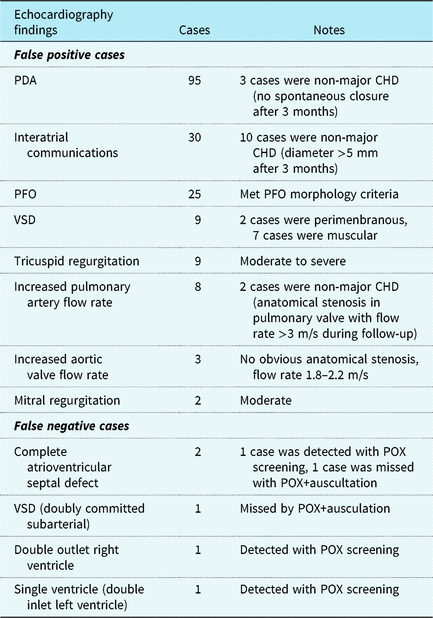
With major CHD as a screening target, there were 181 false positive cases (Table 3), of which, 24 (13.3%) were non-major CHD. Though 132 (72.9%) were not categorised as CHD, they were cardiac conditions that required regular follow-up. Only 25 (15.6%) were simple PFO cases. In the five false negative cases, three cases of complex CHD could be detected by POX; one simple and one complex CHD case were missed by POX.
False positive and false negative cases of major CHD with murmur of grade ≥2

Discussion
Due to the challenges in recognising neonatal murmurs and the lack of standard guidelines, even at tertiary hospitals, heart auscultations may produce a number of false positive results which can cause unnecessary parental anxiety and a waste of healthcare resources. Conversely, many doctors in remote areas may be lacking in the understanding of murmurs. This, compounded with the absence of a comprehensive follow-up system for neonates, can result in many children with simple CHD not presenting until there are symptoms of cardiac insufficiency.Reference Ho, Ouyang, Lu, Young, Chintala and Detrano 10 , Reference Hu, Yuan, Rao, Zheng and Hu 18 There has been no previous report on the accuracy of cardiac auscultation by general paediatricians in the Chinese maternity hospital setting. This study shows that general paediatricians have a high detection rate and acceptable false positive rate for major CHD through cardiac auscultation.
Correlation between cardiac murmurs in the days after birth and their relationship with CHD is rather complex, and results from different studies vary greatly. For example, prevalence of neonatal murmurs ranged from 0.9 to 77.3%, rates of CHD in neonates with murmurs ranging from 32.6 to 84%, and the detection rate of CHD being between 40 and 83%.Reference Shenvi, Kapur and Rasiah 12 – Reference Brunetti, Rosania and D’Antuono 17 , Reference Ainsworth, Wyllie and Wren 19 – Reference O’Reilly, Hall, Richens, Cunningham and Simpson 22 Our study has the following characteristics: (1) This prospective study has a uniform set of murmur criteria and diagnostic criteria for CHD. (2) All newborns are diagnosed using echocardiography within 1 hour of auscultation, with the number of echocardiographic studies done 15 times greater than previous retrospective studies.Reference Du, Roguin and Barak 20 (3) Judging only the grade of murmur is more realistic for general paediatricians to carry out. We found that when the median auscultation age was 43 hours, the incidence of all murmurs at grades ≥1, ≥2, and ≥3 was 6.6%, 3.3%, and 0.9%, respectively. 44.4% of all CHD and 89.58% of major CHD had murmurs of varying degrees. Excluding minor CHDs (e.g. small VSD, ASD, and PDA) that spontaneously closed during the 2-year follow-up period, 81.48% (66/81) of CHDs had murmurs of varying degrees.
As the auscultation of neonates is affected by the presence of PDAs, relatively fast heart and respiratory rates, and increased peripheral blood flow, pathological murmurs are more difficult to discern as compared to those in older children and adults. The skills held by paediatricians at maternity hospitals in different countries and regions also vary. It is a challenge to require each doctor to determine whether murmurs are significant through its location, timing, and characteristics in most maternity hospitals that have 20–40 deliveries per day, while paediatricians are relatively scarce.Reference Xu and Zhang 23 Our study found that murmurs of grade ≥2 can be used as a criterion for major CHD with a sensitivity of 89.58%. For asymptomatic newborns, confirmation of murmurs is recommended after 27h of life, which can reduce the FPR of major CHD to 0.9%. Moreover, with major CHD as the screening target,84.4% of “false positives” found with murmurs of grade ≥2 were not completely normal, and included mild CHD, valvular regurgitation, and increased flow rates. It is necessary to identify these infants through auscultation and carry out regular follow-up with echocardiography. We also found that although only 16.7% (8/48) of major CHD were detected by POX, which was because most CHD were large septal defects without hypoxemia, POX can detect 60% (3/5) of false negatives produced by cardiac auscultation alone (Table 3). These missed cyanotic CHD may need earlier intervention. POX plus cardiac auscultation can increase the detection rate of major CHD to 95.8% (46/48).
This study also has some limitations. First, although performing echocardiography for 6750 continuous births is a huge workload, the overall incidence of cyanotic CHD is not particularly high (10 cases in our study), this study can only demonstrate that auscultation has a relatively high sensitivity for major CHD (because most major CHD are still classified as simple large septal defects). For some critical CHDs, such as pulmonary atresia, truncus arteriosus, single ventricle, and critical coarctation of aorta, the value of auscultation may be lower. Secondly, because of the prospective nature of this study, the reason behind the high sensitivity level of detecting murmurs is somewhat attributable to our emphasis on cardiac auscultation. However, data on the accuracy of detecting murmurs by untrained general paediatricians from Chinese maternity hospitals were absent. Third, since the study population was asymptomatic newborns in the maternity hospital setting (generally 1-3 days after birth), it was infeasible to compare the accuracy of cardiac auscultation by paediatric cardiologists in this population.
Conclusion
Cardiac auscultation is as important as POX in detecting major neonatal CHD. The presence of murmurs of grade ≥2 at ≥27 h of life for detecting major CHD by auscultation by general paediatricians has high sensitivity with an acceptable false positive rate.
Author ORCIDs
Lin Wu 0000-0001-6737-4646
Acknowledgements
We thank all the newborn infants and their parents who participated in this study. We thank all participants from Songjiang District Central Hospital, Minhang Maternity Hospital, and Songjiang Maternity Hospital for their continuous cooperation and support.
Financial Support
This study was funded by National Key Research and Development Program (2016YFC1000506) and Shanghai Public Health Three-Year Action Plan Sponsored by Shanghai Municipal Government (2015–82).
Conflict of Interest
None.
Ethical Standards
The authors assert that all procedures contributing to this work comply with the ethical standards of the relevant national guidelines on human experimentation and with the Helsinki Declaration of 1975, as revised in 2008, and was approved by the Ethics Committee of the Children’s Hospital of Fudan University.