The reproductive success of hummingbird-pollinated plants often depends on complex interactions between environmental conditions and pollinator biology (Navarro Reference NAVARRO1999, Stiles Reference STILES1985, Wolf et al. Reference WOLF, STILES and HAINSWORTH1976). The effect of environment on reproductive success of hummingbird-pollinated plants is particularly pronounced at high altitudes, where large daily fluctuations in temperature, relative humidity and solar radiation limit the effective time for photosynthesis (Cavieres et al. Reference CAVIERES, RADA, AZOCAR, GARCIA-NUNEZ and CABRERA2000) and affect foraging activity (Navarro Reference NAVARRO1999) and abundance of pollinators (Rahbek Reference RAHBEK1997). At high altitudes in the tropical cloud forests of Costa Rica these factors may have serious impacts on fruit production.
Three main hypotheses have been proposed to explain the factors limiting fruit production in ornithophilous plants. The resource-limitation hypothesis claims that variation in fruit production is regulated by variation in available resources over time or space (Lloyd Reference LLOYD1980). The pollinator-limitation hypothesis states that insufficient pollen deposition, mainly due to inadequate pollinator services, prevents many flowers from developing into fruits (Schemske Reference SCHEMSKE1980). Finally, low fruit set may be explained by trade-offs between male and female fitness; an increase in flower number may augment male fitness via pollen production, thus compensating for the reduction in female fitness due to low fruit-set (Bateman Reference BATEMAN1948, Janzen Reference JANZEN1977, Stephenson Reference STEPHENSON1983, Willson Reference WILLSON1979).
Here, we explicitly test predictions of the pollinator-limitation and fitness-trade-off hypotheses by investigating the phenology and pollination biology of Macleania rupestris H.B.K. (Ericaceae), an epiphytic or terrestrial shrub common in the understorey of Neotropical cloud forests. These data, collected over 12 mo of field observation in a Costa Rican cloud forest, suggest that pollinator limitation is the primary cause of low fruit set in high-altitude populations of M. rupestris.
Flowers of M. rupestris are hermaphroditic with tubular red corollas (c. 3 cm long) tipped by white lobes (Wilbur & Luteyn Reference WILBUR and LUTEYN1978). The main pollinators of this plant are the fiery-throated hummingbird Panterpe insignis Cabanis & Heine and the green violet-ear Colibri thalassinus Swainson (Trochilidae). Fruits bend upward and turn purple-black when ripe, allowing for easier removal by frugivorous birds such as the sooty thrush (Turdus nigrescens Cabanis) and the sooty-capped bush-tanager (Chlorospingus pileatus Salvin). The study was conducted at the Cerro de La Muerte Biological Station (09°33′N, 83°44′W; 3100–3350 m asl) in the Costa Rican Talamanca mountain range. The Cerro de la Muerte region receives an average annual precipitation of 2500 mm, mostly between April and December. The mean temperature is c. 12 °C, with large daily fluctuations (from –5 °C to 35 °C), particularly during the dry season. The study site includes mainly high-altitude oak forest and páramo vegetation. The landscape is a mixture of trees and shrubs such as Quercus, Viburnum and Gaiadendron, with patches of páramo vegetation dominated by herbs of the Asteraceae and Poaceae as well as dwarf shrubs from the Rosaceae, Hypericaceae and Ericaceae and the bamboo Chusquea (Cleef & Chaverri-Polini Reference CLEEF, CHAVERRI-POLINI, Balslev and Luteyn1992).
We marked and counted the number of inflorescences, number of newly opened flowers and number of fruits per inflorescence every week between January 2004 and January 2005 on 33 plants of M. rupestris along a 1.5-km transect ranging in altitude from 3100 to 3350 m asl. Total flower production was estimated following Fuchs et al. (Reference FUCHS, LOBO and QUESADA2003). Four species of hummingbird were observed at the study site: P. insignis, C. thalassinus, the magnificent hummingbird (Eugenes fulgens), and the volcano hummingbird (Selasphorus flammula). Of these, only P. insignis and C. thalassinus were regular visitors of M. rupestris; we recorded the number of visits and number of flowers visited per plant by both species. Observations were performed between 6h00 and 11h00, 3 d wk−1 during the study period, on two randomly selected plants each day.
Additionally, we conducted three censuses of hummingbirds at five different altitudes in the highlands of Costa Rica: Cerro de la Muerte (Talamanca mountain range), Irazú, Barva and Poás volcanoes (Central mountain range) to evaluate changes in abundance of P. insignis along an altitudinal cline (2650–3300 m asl). To make these censuses comparable we conducted them during the hummingbird breeding season (i.e. November–January) and in habitats with vegetation characteristics similar to the study area (Barrantes & Loiselle Reference BARRANTES and LOISELLE2002). In each location, we counted the number of hummingbirds along a 1.5-km transect, walking at a steady pace from 6h00 to 7h30. All data were Box–Cox-transformed for regression analyses.
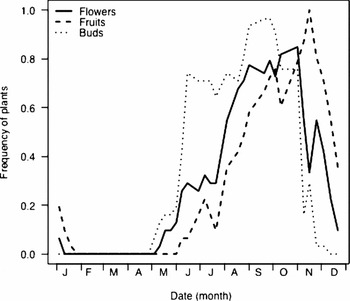
In our high-altitude population of M. rupestris, flowering extended from May to January, with a maximum during the months of highest precipitation (July–November, Figure 1). Each branch bore a mean (± SE) of 4 ± 1.05 inflorescences and each plant on average produced 2 ± 1.05 open flowers per day and a total of 571 ± 88.6 flowers over a 9-mo period. Fruit production lasted from June to January. Fruit-set was low, averaging 0.10 ± 0.02, and inflorescences produced between 0 and 23 fruits, with an average of 3.75 ± 0.07 fruits. Peak fruit production occurred in December at the onset of the dry season (Figure 1), when all plants in our population bore fruits. Plants produced an average of 31 ± 3.71 fruits.
Relative frequency of Macleania rupestris plants (N = 33) with flower buds (dotted line), flowers (solid line) and fruits (dashed line) over a period of 12 mo.

Panterpe insignis was the predominant pollinator in our population, visiting the majority of flowers (n = 362) and plants (n = 18) in the study area. Panterpe insignis also visited individual plants more often (6.22 ± 1.07 visits) than did C. thalassinus (4.02 ± 1.09 visits), though both species visited similar numbers of flowers during a given foraging bout (P. insignis 5.06 ± 1.68; C. thalassinus 5 ± 3.05). In contrast to its behaviour at lower altitudes, P. insignis did not establish territories in our population, behaving instead as a trap-liner, visiting several plants in sequence in a short period of time. This behavioural difference is likely due to the relatively low abundance of flowers in our study site. During the entire study period, C. thalassinus was recorded visiting only five of the censused plants, perhaps reflecting the more aggressive behaviour of P. insignis, which limits access of other hummingbirds to flowering plants (Wolf et al. Reference WOLF, STILES and HAINSWORTH1976). Furthermore, P insignis is present year round in the study site, although part of the population may migrate to lower altitudes after the breeding season (Stiles & Skutch Reference STILES and SKUTCH1989), whereas C. thalassinus occurs in the area at very low density and for only few months a year (Wolf Reference WOLF1976).
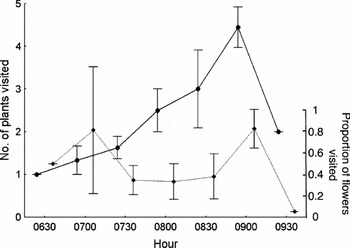
Feeding activity of hummingbirds, measured as the number of flowers visited in a single feeding event divided by the number of available flowers on a plant, showed two peaks during the morning, the first one at 7h00 and the second at approximately 9h00, whereas visits to plants increased steadily during the morning, from dawn to 9h00 (Figure 2). Hummingbird activity decreased drastically after 9h00, with a moderate increase at dusk (G.B. pers. obs.). The first peak of flower visitation is possibly determined by the energetic requirement of hummingbirds, which generally coincides with the peak of nectar production in hummingbird-pollinated flowers (Stiles & Wolf Reference STILES and WOLF1979). After satiation, flower visitation decreases only to rise again after a short period to fulfil the energy needs imposed by the low temperatures prevalent during the morning hours (Calder & King Reference CALDER, KING, Farner and King1974). The increase in plant visitation observed during the morning likely reflects the depletion of nectar that occurred after the first period of visitation: hummingbirds have to visit more plants to satisfy their energy demands.
Mean (± SD) number of plants visited (solid line) and proportion of flowers (dotted line) visited by hummingbirds (number of flowers visited in a single feeding event/total flowers on a plant) in the Cerro de la Muerte population.

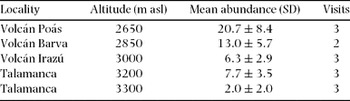
The fitness-trade-off hypothesis predicts that plants with larger floral displays should receive more pollinator visits. We observed no such relationship (linear regression, P = 0.26). We did, however, observe the positive relationship between pollinator visitation and fruit set (β = 1.27, R2 = 0.58, P < 0.001) predicted by the pollinator-limitation hypothesis. Results from our hummingbird census (Table 1) point to an overall negative correlation between altitude and pollinator abundance (β = −0.026; R2 = 0.88; P = 0.019), consistent with the idea that pollinator habitat may deteriorate with altitude (Rahbeck Reference RAHBEK1997). In our transect at Cerro de la Muerte, however, we see no such relation (β = 0.002, R2 = 0.005, P = 0.664), likely due to the much smaller range of altitudinal variation within the site as well as its place at the upper end of the altitudinal range. Additionally, we cannot rule out the potentially important role of locally varying habitat and climatic conditions in patterning the spatial and temporal abundance of pollinators. For example, extreme early morning temperatures along our transect at Cerro de la Muerte likely affect the foraging activity of hummingbirds and the number of effective foraging hours (Gómez Reference GÓMEZ1986).
Average abundance (no. individuals per census) of Panterpe insignis censused along a 1.5-km transect at five localities of Costa Rica highlands.

Our data thus strongly suggest that low fruit set in our population is not explained by fitness trade-offs via an increase in male fitness as flower production increases, and instead support the idea that fruit production is limited by pollinator availability. While we cannot explicitly test the resource-scarcity hypothesis with our data, they nonetheless suggest that resource limitation is of less significance than pollinator limitation in our population. For example, resource scarcity may place an upper limit on the number of fruit produced in the harsh environments of high-altitude cloud-forest populations, and might explain the lower (cf. Wolf et al. Reference WOLF, STILES and HAINSWORTH1976) flowering intensity and extended flowering period of M. rupestris in our population. But resource scarcity alone cannot explain the relationship between hummingbird visitation and fruit set, and the observed pattern may be better explained by variation in pollinator abundance. The prolonged flowering period observed is likely to be a consequence of pollinator limitation, since the rate of visitation by hummingbirds to individual plants is largely dependent on the phenology of an individual or population (Feinsinger et al. Reference FEINSINGER, MURRAY, KINSMAN and BUSBY1986, Rathcke Reference RATHCKE, Hunter, Ohgushi and Price1992). When faced with pollinator scarcity, plants may adopt a bet-hedging strategy (Udovic & Aker Reference UDOVIC and AKER1981) in which the flowering period is prolonged in order to take full advantage of rare periods of pollinator availability and ensure reproductive success. Selfing may also become more prevalent at high altitudes due to pollinator scarcity (Berry & Calvo Reference BERRY and CALVO1989, Kalisz & Vogler Reference KALISZ and VOGLER2003) which may contribute to the observed lack of correlation between fruit-set and altitude in the transect at Cerro de la Muerte. Recent evidence suggests that our observation of pollinator limitation is common in biodiversity hotspots like the Neotropical cloud forest (Vamosi et al. Reference VAMOSI, KNIGHT, STEETS, MAZER, BURD and ASHMAN2006), and may act synergistically with habitat loss or climate change (Rull & Vegas-Vilarrúbia Reference RULL and VEGAS-VILARRÚBIA2006) to increase extinction risk. Finally, this study additionally serves to highlight the importance of considering both biotic and abiotic factors in further investigations of plant reproductive success.
ACKNOWLEDGEMENTS
We want to thank F. G. Stiles for comments on previous versions of this manuscript, Federico Valverde for his logistic support, MICIT-CONICYT, Vicerrectoría de Investigación – UCR, Idea Wild for support to EJF during preparation of manuscript and the students of U-Latina Biology Dept. for field assistance, and two anonymous reviewers for their valuable contributions and comments on earlier versions of this manuscript.