1. INTRODUCTION
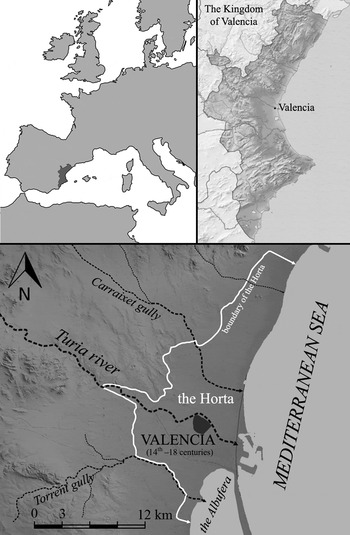
Today, the city of Valencia sits on a wide plain on Spain's east coast, surrounded by an extensive irrigated area known as the Horta of Valencia (Figure 1). Although this part of the Iberian peninsula was densely populated during the Roman period, the origins of the Horta of Valencia as an agricultural ecosystem date from the early Middle Ages, when Muslim conquerors arrived and created al-Andalus in the eighth century. The earliest irrigated areas grew up quite separately along the canals on the the lower reaches of the river Turia. Over time, however, the irrigated areas grew in extent, particularly after the Christian conquest in the thirteenth century, and new irrigated systems emerged, until the great huerta we see today came into being. The Spanish word huerta is often translated into English as ‘orchard’, but this is incorrect; a huerta is not akin to a small field planted with trees. Rather than translating the term it is more common to retain the word huerta, or, less frequently, its Catalan equivalent, horta. Both come from the Latin term hortus, meaning vegetable garden, but this original word does not convey the idea of extensive irrigated areas to which the Spanish and Catalan words refer. In this article we will use the word huerta to refer to large irrigated areas in general, but will retain the traditional Catalan name for the Horta of Valencia, or simply refer to ‘the Horta’ for short.
Valencia and the Horta in the medieval and early modern periods. Source: F. Esquilache, 2017.

Although similar irrigated areas exist elsewhere in the Mediterranean, the Horta of Valencia was special on account of its size. At its maximum extent in the nineteenth century it covered over 11,000 hectares; even more if the areas that could occasionally be irrigated at times when surplus water was available are included. Prior to the invention of water-storage systems that allowed very large areas to be irrigated in modern times, the Horta of Valencia was second only in size to the Ghūta of Damascus, in Syria. Numerous nineteenth-century travellers and researchers, such as the French agronomist, François Jaubert de Passa, and the English geographer, Sir Clements R. Markham,Footnote 1 made much of it in their accounts, probably because of its size, visual impact, and high productivity. In sharp contrast to the archetypal idea of Spain as an arid country, the Horta produced two crops each year.
The Horta has also received much attention from researchers considering its institutional organisation. Since the late Middle Ages, irrigation in Mediterranean Spain has mainly been under the control of individual municipalities. The Horta of Valencia was unusual, however, in that its irrigation was organised by eight irrigation communities, one for each of its canals, and stood autonomous from any higher municipal, or even state, control. The eight communities were made up of those owning the irrigated land, and small landowners played a significant role in their operation, particularly during the nineteenth and twentieth centuries. Each community of the Horta of Valencia had from the late Middle Ages its own administrative and judicial organisation. But from the end of the eighteenth century, judicial activities concerning irrigation were concentrated in the well-known Tribunal de les Aigües de València, Valencia's Water Tribunal, a unique court with eight members, one from each of the communities.
Traditional historiography suggests that this collective court that dealt with questions relating to irrigation in the Horta of Valencia had a Muslim origin, but this is highly unlikely, given the evidence of its creation late in the eighteenth century. It was composed, in the past as today, by small peasant landowners, and it attracted a good deal of attention in its own right from visitors from elsewhere in Europe during the nineteenth and twentieth centuries. This was due to the fact that its members were not professional judges possessing university education, but only peasants with personal experience in the traditions and uses of irrigation in the Horta of Valencia. In this way, a historiographical tradition was born about the mythic existence in Spain of an irrigation institution formed only by ‘peasants’ and with very old medieval origins.Footnote 2
Here we use the term ‘peasants’ in a general sense, in the same way as English historians of the Middle Ages who write about the ‘peasantry’. That is, by ‘peasants’ we mean families who worked the land and lived from it as their principal activity. In the kingdom of Valencia there were craftsmen who worked plots of land as a supplement to their primary occupation, but for us they were not peasants. It is clear that there were different economic strata within the peasantry, and some members of this group did not work the land personally.Footnote 3 The peasants also experienced varied legal circumstances and different kinds of legal rights over the land they worked. Thus there were free peasants in royal cities and districts, who were owners of the land, but also other peasants who lived in small seigneuries within the royal district of the city of Valencia, whose land was established under the emphyteutic system. Other peasants in Valencia were free men, but they worked and lived in plots established individually within the emphyteutic system by great propietary lords: the nobility, the church, and burghers. However, free men living in royal cities and vassals in seigneuries were all members of the peasant social class: they lacked legal privileges, they paid tax, and their incomes came from the land.
As background to the discussion that follws, it is also necessary to clarify the character of emphyteutic tenure its social consequences. In the kingdom of Valencia, and so in the Horta, from the mid-thirteenth century to the mid-nineteenth century, ownership of the land was generally shared between landlords, such as the nobles, burghers and the church, and those cultivating it. This form of shared ownership was legally regulated by emphyteutic lease contracts based on Roman law. Emphyteusis allowed peasants considerable freedom in the management of the land and gave them entry to the land market, in exchange for rent. It did not amount to full ownership, however, the situation for peasants who were owners was very similar to that of emphyteutic holders. It was not until the nineteenth century, after the Liberal Revolution in Spain (1808–1837), which saw the confiscation of ecclesiastical property, the abolition of feudal rights and also the abolition of seigneuries of the aristocracy, that the emphyteutic regime came to an end and the cultivators were able to take full ownership.Footnote 4
Returning to irrigation, in the second half of the twentieth century Arthur Maass and Thomas Glick, two North American scholars, became interested in that distinctive European institution, Valencia's Water Tribunal, administrated by peasants, without state intervention. Their first approach was to look at the late twentieth-century form of the institution, drawing comparisons between the system of irrigation used in the Horta and those used elsewhere. However, in addition to this contemporary research, Glick delved into the historical records to examine how irrigation was organised during the Muslim and late Medieval periods in his work Irrigation and society in medieval Valencia. He then raised questions over how the social structures relating to irrigation were translated from the Muslim to the Christian period.Footnote 5
Glick was particularly concerned with the question of how technology was transmitted between past societies and this, along with his interest in the social and institutional organisation of irrigation, chimes well with the work of the economist Elinor Ostrom. In her famous work Governing the commons, Ostrom included a discusion of how communities governed irrigation in the Horta of Valencia, and in the nearby huertas of Alicante, Orihuela and Murcia, presenting them as successful examples of ‘long-enduring, self-organized and self-governed peasant institutions’.Footnote 6 Her study of these, and other similar examples, such as irrigation systems in the Philippines, in the grazing areas of Switzerland and in Japan, led Ostrom to develop a list of eight common features that contributed to the long-term success of all these systems, despite any updates of the institutions involved being superficial at best.Footnote 7
One reason Ostrom included the communities of the Horta of Valencia in her study was their centuries-long continuity as a ‘peasant-controlled’ organisation. Ostrom noted that
for at least 550 years, and probably for close to 1,000 years, farmers have continued to meet with others sharing the same canals for the purpose of specifying and revising the rules that they use, selecting officials, and determining fines and assessments.Footnote 8
Ostrom understood the communities as institutions of collective action, run by self-regulated and self-governed peasant-irrigators. She also believed that this system of organisation had been set up in the Middle Ages and had remained in place, essentially unchanged, ever since.
It is important to bear in mind that Ostrom neither studied the operation of the communities directly nor consulted the relevant historical archives. Her work was based entirely on the observations of Maass and Glick, who did not intend to provide an overview of the long-term historical evolution of irrigation in the Horta of Valencia. Maass limited his analysis to the organisation of the communities during the twentieth century, while Glick's more comprehensive study focused on the organisation of irrigation in the fourteenth and fifteenth centuries and on the possible Andalusi origins of the Horta. The authors did not make a link between their works on which any measure of continuity could be based.
Ostrom has, therefore, largely been responsible for the dissemination among international scholars of this idea of continuity in Valencia's irrigation communities and their organisation, although the idea of this continuity was not, in fact, original. Maass and Glick were greatly influenced by traditional local historians such as Borrull, Guillén, Giner Boira and FairénFootnote 9 who tended to extrapolate the modern operation of the Horta's irrigation back to earlier historical periods, sometimes as far back as the Andalusi period.Footnote 10 The idea of a long continuity found favour, no doubt, in the bourgeois and Romantic culture of the late nineteenth century, which in Spain tended to associate the popular social classes with medieval institutions, such as guilds, which were understood as challenging the authority of the nobility. In our view, however, such extrapolations are not acceptable. Although other social scientists may approach the evidence from a different perspective, it seems clear that the idea of continuity in the Horta of Valencia, is based on an inadequate knowledge of the archival records, especially those dealing with the medieval period.
In recent years historians have attempted to clarify these issues. Glick originally believed that there had indeed been continuity from the Andalusi period to the feudal era in matters such as water distribution, the rules applied and the institutional arrangements within the Horta of Valencia, even though there were differences between the operation of the medieval and modern irrigation systems. He has since revised his work, modifying some of the arguments he put forward in 1970, particularly those concerning the direct continuity of irrigation institutions from Andalusi to feudal Valencian society.Footnote 11
More recently, Martínez Sanmartín has studied the internal operation of the irrigation communities in the Horta of Valencia in the fifteenth century, focusing particularly on technical issues and the management of the water distribution systems.Footnote 12 This work is based on that of Glick and, to some extent, follows Ostrom's arguments regarding the self-management of irrigation institutions. The aim of Martínez's study was to understand the technical aspects of irrigation, which he refers to as a ‘techno-system’, and how these were managed by the peasant-irrigators, whom he calls ‘techno-experts’. He did not, however, examine how different social groups participated in the running of the irrigation communities, something we aim to address in this study.
Samuel Garrido has challenged the idea that all of Ostrom's famous eight ‘design principles’ of stable local common-pool resource management can be observed in the late twentieth-century Valencian huertas, even if, in general, he accepts the value of Ostrom's proposals. Garrido stresses that many of Ostrom's arguments rely heavily on Maass's original interpretations that he, Garrido, argues are open to question.Footnote 13
Tomás Peris Albentosa recently tried to update the arguments of Maass, Glick and Ostrom.Footnote 14 He stressed that in the early modern period an urban oligarchy controlled Valencia's irrigation communities, suggesting that the latter were thus not quite as autonomous as hitherto believed. Peris also argued that, in practical terms, there was no difference between the way in which the communal irrigation systems of the Horta and those under municipal control elsewhere in the kingdom of Valencia were managed. The reason for this was that the municipal government of the city of Valencia, which ruled the city and the Horta, were constantly meddling in issues related to irrigation and the use of water in this rural space around the city.Footnote 15 Although Peris's argument that the same oligarchy controlled both the irrigation of the eight communities in the Horta and the Valencia city council is broadly correct, his interpretation confuses the origins of irrigation communities and municipal government, and how these relate to the Andalusi legacy. How these questions are inter-related is still far from clear, and as a consequence there persists a tendency among scholars studying Valencia to extrapolate later practices back into the Middle Ages and to assume they operated both before and after the Christian conquest in the thirteenth century.
Both Garrido and Peris, working on unpublished archival documents from the early modern period, and Guinot, drawing on documents from the late medieval era, have revealed the actual social composition of the irrigation communities in the Horta of Valencia in those centuries.Footnote 16 As early as the thirteenth century, membership of a community was limited to those who owned land, not those who cultivated it by the emphyteutic system. This was highly significant in a feudal society because an irrigation community composed of nobles, the urban classes, artisans and peasants, would have been quite different from the sort of organisation, composed solely of peasants, that many scholars, including Ostrom, have suggested existed in the Horta of Valencia.
In this article we intend to examine the origin and operation of the eight irrigation communities in the Horta of Valencia in the late Middle Ages, in order to ascertain whether this model of collective government did indeed continue from the Middle Ages to the present day. We shall begin by reviewing what is known about the control of irrigation in al-Andalus before the Christian conquest of Valencia in the thirteenth century. We will then consider the different ways in which the region's irrigation was organised in the medieval period. Special attention will be paid to the model of organisation based on communities; one of the most idiosyncratic and least widespread forms of organisation. We shall also examine the social composition of community members in the Middle Ages, and show that it was very different from that of the modern period. We will describe the two aspects of the community necessary for its operation: the institutional side, related to administration of the community and relations with the society, and the everyday, technical aspects of irrigation, which were left exclusively in the hands of those cultivating the land: the peasants, some of them small landowners, but for the most part emphyteutic holders. Finally, we will briefly discuss the operation of the technical management of the irrigation canals, or ‘operating procedures’ as Maass called them, in the medieval period and highlight how these differed from the procedures used in the modern period. These differences are important as those who have previously argued that peasant communities were self-organised collectives have based their view on their understanding of how the technicalites of irrigation were managed.
2. CONTINUITY AND CHANGE: IRRIGATION MANAGEMENT BEFORE AND AFTER THE CHRISTIAN CONQUEST
After their conquest of Sharq al-Andalus, the eastern portion of the Iberian peninsula, in the thirteenth century, Christian colonists settled first in the major huertas, the region's most fertile areas. Before the conquest, the huertas were very different from those of today. They were not large expanses of cultivated land, but small, irrigated areas located around the multiple villages and hamlets that peppered Valencia city's hinterland, with large areas of uncultivated land between them. Soon after the conquest, these irrigated areas began to expand until they eventually formed the vast, continuous tracts of agricultural land still seen today.Footnote 17 As a result of the physical changes that took place as the irrigation systems expanded, the Christian colonists ‘inherited’ the Andalusi huertas in an essentially altered form, and as a result issues to do with their management and control soon emerged. Did the feudal colonists inherit Andalusi modes of management well as their dams, canals, channels and watermills, or did they adopt brand new systems of management, imported from other feudal societies in Aragon and Catalonia, or did they create new ones combining elements from all?
There is no easy answer to this question, for three reasons. First, there is a dearth of surviving documents that explain specifically whether, and if so how, management systems were transferred from the Muslim population to the Christian colonists. Second, understanding of water management in al-Andalus before the thirteenth century is limited; and we cannot be sure that the systems that are known operated throughout the region. Third, as we shall see, in late medieval feudal Valencia as many as three different systems of irrigation management were operating, all with features in common.
Working in the 1970s, Glick presented a plausible scenario of continuity between pre- and post-conquest irrigation systems and institutions in the Horta of Valencia, based on documents laying out the laws and royal privileges decreed by James I of Aragon (r. 1213–1276), who conquered Valencia, then a Muslim city, in 1238. In both 1239 and 1250 James decreed that use of the irrigation systems was to continue ‘as in the times of the Saracens’ (com en temps de sarraïns) and according to ‘the old customs’ (antiquitus consuetum).Footnote 18 Ostrom later reproduced Glick's vision of continuity, but more recent research has revealed that, after the conquest, the Horta actually underwent major physical and social change.
Glick observed that the Christians referred to many of the officials involved in irrigation using adaptations of their Arabic names, which suggested that the roles of the new officials had been inspired by those of their Islamic predecessors. Several examples exist; for instance the Catalan terms ‘sequier’ and ‘savaçéquies’ and the Aragonese ‘zabazequias’ derive from the Arabic ‘ṣāḥib al-sāqiya’ (an official responsible for monitoring irrigation). The Catalan ‘mostassaf’ and the Castilian ‘almotacén’ both refer to an ‘inspector of weights and measures’ who was also responsible for many other aspects of urban life and water; the two terms derive from the similar Arabic role of muḥtasib. In southern Castile the post of ‘juez de aguas’, or ‘water judge’, is a translation of the Arabic ‘qāḍi al-miyāh’ and that of ‘fiel de aguas’ is a translation of the Arabic for ‘water bailiff’, ‘amīn al-mā’.Footnote 19
Glick recognised that the officials responsible for water, and the water systems they managed, were not uniform across al-Andalus, concluding that this reflected different regional practices. Glick believed that water was generally managed by public officials, but that in certain conditions, for example in the particularly arid areas of Alicante and Murcia, some provision was made to allow the purchase of private irrigation rights. It must be remembered that the different types of official did not all exist at the same time, nor were they found in every region: the ṣāḥib al-sāqiya was exclusive to Sharq al-Andalus; the title of muḥtasib only appears in the last decades of Andalusi rule; and qāḍi al-miyāh and the amīn al-mā only appeared in the regions of Murcia and Andalusia after the thirteenth-century conquest. Furthermore, it is not always easy to determine which functions the officials performed. The muḥtasib seems to have been exclusively concerned with the management of water within a town, whereas the ṣāḥib al-sāqiya and the water bailiffs dealt with water-related lawsuits, at least during the Christian period. In short, the sources suggest that the officials and their functions had to be flexible in order to adapt to different conditions, such as those holding sway in post-conquest feudal society.Footnote 20
In work published several years after Irrigation and Society, Glick pointed out that, while urban areas in al-Andalus had public officials who dealt with water management, there were also commune-owned irrigation systems that remained autonomous from the power of the state.Footnote 21 Glick claimed that under Maliki law, the predominant legal system in al-Andalus, irrigation channels were owned collectively by those who constructed them. If a community built a water channel, or channels, then they had the right to use the water for irrigation and to manage it without external interference. The community would allocate each member's access to the water, and no member was allowed to build a watermill on, or a bridge over, the channel without the consent of the community. Carmen Trillo has identified similar collective models of organisation in Muslim Granada in the thirteenth, fourteenth and fifteenth centuries and even earlier, although she also documents a tendency for water rights to become privatised in Granada during the later years of Muslim rule.Footnote 22
Following the emergence of new evidence and the publication of work on Andalusi society by Pierre Guichard and Miquel Barceló,Footnote 23 Glick moderated his position considerably, accepting that under Muslim rule, irrigation management systems were locality specific, run by local tribes.Footnote 24 From his revised position he suggested that after the conquest communal-run forms of irrigation management evolved. The structure of these institutions were, he argued, inspired by the guilds and municipal councils in Crown of Aragon, the nearest examples of collective action in the feudal world. It is certainly tempting to draw a direct link between Andalusi models of collective governance and the forms of communal organisation that emerged, with royal support, post-conquest in the Horta of Valencia, and below we shall analyse whether this narrative had any factual basis. First, however, we must examine the other forms of water management which emerged in medieval Valencia.
3. INSTITUTIONAL STRUCTURES OF IRRIGATION MANAGEMENT IN MEDIEVAL VALENCIA
As previously noted, there is evidence suggesting that there were three forms of water management in the medieval kingdom of Valencia. In the first, irrigation was managed by officials appointed directly by the Crown, but this was only in use during the central decades of the thirteenth century, and there are only three documented examples, each of which is somewhat idiosyncratic. The Royal Canal of Montcada, for example, was the only Andalusi irrigation system in the Horta of Valencia that was directly controlled and managed by the Crown from 1238 to 1268, when it was converted into a community. Montcada may have had special stutus in al-Andalus, but if so no trace of this survives in the sources. The other known examples of direct management of irrigation systems constructed after the conquest by the Crown are the Royal Canal of Alzira and the Main Canal of Vila-real. Their construction during the colonisation period was promoted and funded by the Crown and overseen by special royal officials who also distributed land and laid the foundations of towns as part of the colonisation process.Footnote 25 Management of the irrigation systems of Alzira and Vila-real seems to have been a heavy financial burden for the Crown, and royal involvement was brief; before the end of the thirteenth century, responsibility for the management of these canals had been passed to the municipalities in which they lay.
In the second form of water management, responsibility lay with local town councils. This was the most common form of management in the late medieval period, particularly in those towns that were under the jurisdicton of either the king or an overlord. Glick describes the councils as owning the water and being responsible for its allocation, often through the sequiers, persons elected annually to implement the water policies enacted by the council.Footnote 26 This description requires qualification. When a council was under the jurisdiction of an overlord, it is likely that council decisions reflected the lord's interests to some extent, and this may have been reflected in the appointment of officials such as the sequier. However, it is more frequent that the lord intervened by giving support to his vassals when a conflict or disagreement arose with a neighbouring community over access to a watercourse or spring. It is more a case of collaboration of interest between a lord and his vassals, in acting against other lords and peasants.
It is also worth clarifying that the municipal management of irrigation was not established immediately after the conquest, as the councils themselves were only established progressively throughout the long period of transition that ran from 1233 to around 1283. The feudalisation of the new kingdom of Valencia over the middle decades of the thirteenth century saw the foundation of hundreds of rural communities and several dozen market towns. Initially, these towns served as urban centres, not legally established municipalities. Nevertheless, in political and legal terms they were seen as ‘collectives’ (universitas), and from their inception they were recognised as such by the king and lords alike. Their populations were granted charters outlining the conditions under which land could be settled and declaring the revenues to be paid to the king or the overlord.Footnote 27
Control of the irrigation channels, and the water that they conveyed, was generally granted to a universitas by means of a charter, or as an additional privilege. Once a universitas was recognised as having full municipal status, responsibility for the irrigation system passed to the governing council. This form of governance became the norm across the kingdom of Valencia from the late thirteenth century onwards; and survived until new water laws were enacted in the nineteenth century.Footnote 28
Under the third form of water management seen in late medieval Valencia the irrigation channels were run by autonomous communities. This system of management has received most attention from historians for several reasons: first, because of its different organisation; second, because it was used in the Horta of Valencia, the largest and most important one; and, third, because it incorporated unusual institutions such as the Tribunal de les Aigües (Valencia's Water Tribunal). All the available evidence suggests that irrigation systems run by communities were most common during the first few decades after the conquest, when primitive universitates in effect operated as irrigation communities in both social and practical terms. Certainly, thanks to the post-conquest land distributions, all colonists owned irrigated land. This has had a considerable effect on how the emergence of post-conquest irrigation institutions have been viewed by historians. The clear predominance of this form of management soon after the conquest has helped propagate the idea that it had evolved from the Andalusi communal systems. We must always bear in mind the considerable differences between the Andalusi form of collective water management, which had at its roots the highly cohesive kinship-based nature of that society, and the form of collective management more typical of feudal society where communities were more inclusive, and those working the land took a different approach to cooperation.Footnote 29
As increasing numbers of municipalities were established during the second half of the thirteenth century, responsibility for the irrigation systems was assumed by the municipal councils; but by this period not every town dweller owned an irrigated field. There were two major exceptions to this model of municipal management; the huertas of the two major Andalusi cities from the new Christian kingdom: Valencia and Xàtiva.Footnote 30 The municipal territory of each of these cities included multiple irrigation systems, each of which was managed by a community. Little is known about the Horta of Xàtiva, due to a lack of surviving documents, hence our focus on the Horta of Valencia.
Traditionally, it has been held that the communities in the Horta of Valencia were established in December 1239, one year after the Christian conquest of the city and the expulsion of its former Muslim inhabitants. At that date King James I of Aragon granted ownership of the irrigation canals, channels and water to all those arriving to settle into the city's houses and onto the land.Footnote 31 In fact, the document laying out the terms of the grant makes no mention of communities at all, nor do they appear in any records for several decades afterwards. The rights granted by the king were given to the city universitas, all the newly settled land owners, just the same as in all the other towns and villages of the kingdom, regardless of whether they were under royal jurisdiction or not. In 1250 a royal privilege was granted to the city of Valencia, which meant that supervision of the office of sequier fell to the city councillors (the jurats). This ‘chain of command’ was a common feature of municipally controlled irrigation systems, but not of those managed by communities.Footnote 32
By contrast, when the king surrendered direct control of the Royal Canal of Montcada in 1268, he handed it specifically to the landowners, not to the population in general as in 1239. Soon afterwards, a community, identical to those of the Horta of Valencia was established to manage this system of channels.Footnote 33 Had anything happened between 1250 and 1268 to justify this change? We do not know. But the available evidence is that there was not a continuity from supposed irrigation communities in al-Andalus to the new communities of colonists in the thirteenth century. There was a period of transition during the construction of Valencia's new feudal society. More importantly, it has become clear that the communities in the Horta grew out of a royal concession, and not because water users came together voluntarily to form management collectives.
4. THE SOCIAL COMPOSITION OF MEDIEVAL COMMUNITIES IN THE HORTA OF VALENCIA
As noted in the introduction, the notion that irrigation communities were composed solely of peasants has been particularly popular among scholars studying the Horta of Valencia. However, although this was largely true from the nineteenth century right up to the present day, it was not the case for most of the Horta’s history. The truth is that membership in the irrigation communities was always restricted to those who owned land. James I stated this clearly in 1239: the channels and their associated infrastructure, along with the water that they conveyed, were the property of those who had colonised Valencia and its huerta. Studies of the irrigation communities should not, nevertheless, be approached ahistorically, assuming that no change ever occurred; as over the centuries social relations underwent profound transformations, and these brought about changes in the irrigation communities as well. The landowners eligible to join a community in the late Middle Ages and the early modern period were not the same as those in the nineteenth century.
The explanation for this is linked to what was said at the beginning concerning the historical form of possession of the land in the kingdom and Horta of Valencia, the emphyteusis, which prevailed from the mid-thirteenth century to the mid-nineteenth century. During more than six centuries, the majority of the cultivators of the land were not full proprietors, but emphyteutas, especially in the Horta of Valencia. Only after the Liberal Revolution in Spain (1808–1837) did the emphyteutic regime come to an end. The cultivators were then able to take full ownership of the land they worked and were eligible to become members of the irrigation communities.Footnote 34
That Liberal Revolution changed the communities radically, laying the foundation for the current form of management, which has received so much scholarly attention, but has, in many cases, been spuriously attributed to earlier periods. The fact is that, for most of its history, those owning land in the Horta of Valencia were a small minority of the population, generally members of the ruling and wealthiest classes typical of the medieval and the early modern periods: aristocrats, the clergy, burghers, professionals and merchants. This pattern of land ownership stems from the process of conquest and colonisation of the city of Valencia and its huerta between 1237 and 1242. After the conquest, the Crown created large properties in the city's hinterland, tracts of irrigated land between 30 and 60 hectares in size, as well as smaller holdings based on former Andalusi hamlets but now inhabited by Christian colonists who had migrated from Aragon, Catalonia and other territories in the the north.Footnote 35 Over the following centuries the land market served to concentrate property in the hands of the region's social elites and ecclesiastical institutions, rural real estate being increasingly held by the urban elite.Footnote 36 There were exceptions: in some villages at a distance from the urban centre, in the thirteenth century the peasants were granted full ownership of the land they tilled, so that from their inception certain communities had a few free peasants as members.
The membership of the irrigation communities was thus composed of nobles, merchants, notaries, rich artisans and peasants, but this last category included only owners, not emphyteutic holders. Interestingly, members of the clergy are never listed as sitting on the community committees during the fifteenth and sixteenth centuries, despite ever-increasing amounts of land being owned by the church; their presence did not become the norm until the seventeenth century. Unfortunately, the earliest surviving list of the full membership of a community dates from the eighteenth century; for the medieval period the only information available comes from the minutes of the biannual assemblies. The oldest of these, dating from the fifteenth century, relates to the communities of Mislata and Favara. Between 20 and 40 members attended the assemblies and proceedings were recorded by the notary of the community.Footnote 37
The lists of attendees at the Favara assemblies are ordered to reflect the local social hierarchy. Five noble owners of land in the irrigated area of the canal and community were listed first. They were, significantly, present at all the general assemblies, most often in person but occasionally by proxy. The names of the next five to fifteen people listed were preceded by the term ‘en’, which in late fifteenth-century Valencia was reserved for the social group of ciutadans (citizens), the rich merchants and burghers recognised by the law in the medieval Crown of Aragon as privileged and who had political control of the municipalities, as in other areas such as Italy and France. The lists then close with the names of any remaining attendees presented in two columns. The latter are not easy to identify, but it is possible to cross-reference some individuals in the the 1510 tax inventory of the city of Valencia, which has survived in full and lists all heads of household, including those in a number of suburban villages. This exercise confirmed that names preceded by particle ‘en’ correspond to landowning citizens, while the remaining names belonged to urban artisans and peasants.Footnote 38
The number of attendees at each community assembly in Favara varied considerably. Few members attended the meetings consistently and, as the period covered by the minutes spanned almost 30 years at the end of fifteenth century, it is possible that the repetition of names indicates attendance by different members of the same families. The most consistent attendees were the nobles and some of the citizens. The most regular attendees from among the peasants were the veedors who held secondary management positions within the community.Footnote 39 Evidence is thin, but it would seem that the veedors were members of the rural elite, an ever-present feature in medieval agricultural contexts. The membership lists thus appear to confirm our hypothesis that the communities were far from being egalitarian. This, we would argue, affected the way that they made decisions concerning irrigation.
5. INSTITUTIONAL ORGANISATION: OFFICIALS OF IRRIGATION COMMUNITIES
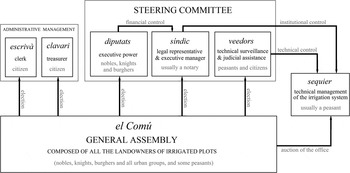
It must be emphasised that in the late Middle Ages and the early modern period the irrigation communities of the Horta of Valencia were institutions of collective power, constructed around a steering committee. Each committee was elected by a general assembly (el Comú) composed of the landowners served by the system of channels for which the community was responsible.Footnote 40 Assemblies were held every two years, and in the intervening period, the steering committee ran the community. Figure 2 outlines how this institution was organised. It suggests that the modus operandi of the communities was very similar to that of the guilds and councils found in the Crown of Aragon between the thirteenth and the seventeenth centuries.
The organisational structure of the irrigation communities of the Horta of Valencia in the fifteenth century. Source: F. Esquilache, 2017.

The assembly was the heart of each community, and, at least from the fourteenth century onwards, would have been held in a spacious location in Valencia, such as a convent cloister or the City Council meeting room. In both cases permission would have had to be granted by Governor of the kingdom of Valencia, and his representative would have been required to attend the meeting, as happened in the meetings of the guilds. At the biannual assembly, decisions were taken, accounts were approved and improvement work was discussed. During the medieval period, the post of sequier would have been auctioned during the assembly. The sequier, who held his post for either one or two years, was the person in charge of maintaining the dam that diverts water from the river to the canal and ensuring that water circulated correctly and kept members of the community properly supplied. He had to keep the channels free from obstruction and carry out any necessary repairs as well as ensure that everyone followed the rules concerning the allocation or water. He was also entrusted with improvement work and the collection of maintenance fees (the sequiatge). Until recently scholars devoted a great deal attention on the sequier, believing that his was the most important role in the community. It has now been demonstrated, however, that, until the seventeenth century, the sequier was no more than a technical expert; sometimes a member of the community or, more frequently, a hired specialist, who had no executive power within the organisation.Footnote 41
Executive power lay with the diputats, who were elected by the assembly. The oldest internal regulations – from Mislata (1415) and Favara (1446 and 1493) – indicate that, as a rule, diputats were knights and lords from the small manors situated in the Horta of Valencia, as well as rich burghers from the city of Valencia.Footnote 42 Their powers extended to the institutional, financial and administrative management of the community. One of the diputats’ most important jobs was to monitor the síndic and the sequier (see Figure 2). For example, the conditions laid out for the auction of the post of sequier in the community of the Canal of Favara in 1446, gave the diputats legal permission, should the sequier fail in his duties, to seize his property and hand it to the community's treasurer (clavari).Footnote 43
The collective administration of the community was facilitated by the síndic and, from the mid-fifteenth century onwards, by the presence of a clerk and a treasurer. The síndic appears to be the oldest of these official posts; it features in the records of all assembly minutes and contracts of the sequier from the fifteenth-century Mislata, Favara and Benàger communities.
In Mislata, and probably in the other two communities as well, the síndic was a notary, but also was a landowner and, therefore, a member of the community. His job was to supervise the performance of the sequier and to represent his community before the municipal council of Valencia, before royal officials and in court cases (see Figure 2). These roles increased the likelihood that the síndics would appear in the records, ensuring that they have enjoyed historiographical prominence second only to the sequiers.Footnote 44 According to the two surviving regulations from Benàger, dated 1421 and 1435 respectively, the síndic had his annual communal-tax waived in exchange for carrying out his duties. In Favara the sequier was obliged to pay the síndic a day's wages and food for each day he spent assessing the freedom of the channels from obstruction.Footnote 45
Communities also appointed minor officials known as veedors (from the Catalan verb veure, ‘to see’), whose function was more closely related to the daily management of the irrigation channels. Their role was to ensure that water was correctly distributed to those entitled to it, to escort the síndic on his annual visit to the main canal and secondary channels, and to advise the sequier in water-trials. Glick refers to the veedors as ‘inspectors’ (see Figure 2).
In the fifteenth century, there were six veedors in Mislata and eleven in Favara. The evidence indicates that the number of veedors depended on the size of the irrigated area, on the number of secondary channels and on the number of villages situated alongside the main channel. In all documented cases, they were citizens or peasant-landowners, and they were no doubt appointed as veedors because they were well acquainted with the technicalities of the water distribution system, unlike urban groups, clerks and lawyers who occupied the executive offices of diputats and síndic. The late fifteenth-century minutes from the Community of Favara are clear that of the eight veedors mentioned in 1490, at least two were certainly ciutadans of Valencia; Damià Bonet and Lluís Amalric. There was, therefore, a clear distinction between the executive and the management class.
The surviving registers from the Community of Favara indicate that it was effectively governed by a committee composed of the diputats, the síndic and the veedors (see Figure 2). For example, on 12 December 1493, a meeting called by the síndic Joan Pla was attended by the diputats – nobleman Giner Rabaça de Perellós and the knight mossén Bernat de Castellví, representing the nobleman Joan Sanoguera – along with the veedors Damià Bonet, Pere Ceriol, Joan Ceriol, Joan Gil, Martí Vayà, Antoni Serra, Pere Orient and Jaume Mestre.Footnote 46 A comparison with the composition of the municipal council of Valencia in these centuries (from thirteenth to seventeenth) is very tempting, as it included jurats, who held executive power, and consellers, who represented the different social groups in the city, including the guilds and brotherhoods. In both cases, meetings were open to all members, but given the social structure in the late Middle Ages and the early modern period, it is unlikely that decisions were made on an egalitarian basis, taking ‘all sides’ into account, especially as, according to Glick, not all landowners attended every meeting.Footnote 47
It is not clear at what date the organisation of the communities came to focus on a steering committee composed of diputats, síndic and veedors. No records survive from before the fifteenth century apart from an isolated document, from 1362, from the Community of Favara, which mentions some measurements being taken by a technician, who was being escorted by a sequier and two veedors. This inspection had been ordered by the assembly, suggesting that even at that early date, the community was already organised along fifteenth- and sixteenth-century lines.Footnote 48 Certainly, the organisational structure of the Favara community did not change during the fifteenth and sixteenth centuries. Comparison of regulations from Favara between 1446 and 1597 makes clear that most of the innovations introduced were concerned with the management and allocation of water rights, not with the community's institutional structure.Footnote 49 The only significant change was the introduction, in 1452, of the new office of clerk, in order to avoid having to hire an external notary. The clerk's role was, however, an administrative, not an executive one. The introduction of the síndic and of the clerk suggest that the community was becoming increasingly bureaucratic; and by 1597 regulations enacted in Favara looked very much like those of today.Footnote 50 This, however, did not affect the role of diputats and veedors, who remained at the heart of government in each community.
6. TECHNICAL MANAGERS AND ADMINISTRATORS OF JUSTICE: FROM ṢĀḤIB AL-SĀQIYA TO SEQUIER
In the previous section, we noted that the sequier of a community was responsible for the management of the irrigation system, but the origins of the post are far from clear. The post of ‘technical irrigation officer’, the savaçéquia or zabacequia, emerged in the new cities of Catalonia and Aragon conquered by the Christians in the twelfth century. These titles were local adaptations of the Arabic words ṣāḥib al-sāqiya, used to describe a public official with jurisdiction over irrigation. Little is known about the functions these officials performed in the Muslim period of al-Andalus, but some inferences may be made, based on the roles played by other aṣḥāb (plural of ṣāḥib). For example, the ṣāḥib al-sūq served as both a policeman and a judge responsible for each market; the ṣāḥib al-madīna took on similar roles, but for a whole town, while the ṣāḥib al-šurṭa dealt with serious criminal matters. All of these official public posts were created during the caliphate in the tenth century. Each of them answered to the qāḍī or supreme judge who presided over legal matters in a particular urban area.
The aṣḥāb performed the dual function of both policeman and judge because Islamic tradition merged these two roles. The aṣḥāb al-sāqiya, along with their Christian counterparts, the savaçéquies, ensured that irrigation systems were being used according to the rules and also sat in judgement over any wrongdoers. It should be remembered that Andalusi society was, if not tribal, at least kinship-based, and any internal conflicts, including those to do with irrigation, were generally dealt with within the local community, or jama‘a. It is likely that the Andalusi allocated water to particular clans or family groups at a council of elders known as shuyukh (Arabic plural of sheikh). This system of allocation has been identified in some areas of Granada.Footnote 51 When a conflict affected more than one community, or involved inhabitants from an urban area, the state would ask the qāḍī or the aṣḥāb to mediate. This was the model adopted and adapted by the Christian municipalities in Aragon and Catalonia during the twelfth and thirteenth centuries, where the municipal office of savaçéquia was created.
In Valencia, the savaçéquies are mentioned in the laws – els Furs – enacted by James I in 1238 or 1239, shortly after the Christian conquest of the city, with the same functions as in the era of al-Andalus.Footnote 52 Nothing is said in els Furs about how they were to be appointed. It is unlikely that, as early as the winter of 1238–1239, any Christian savaçéquies were actually in post in the Horta of Valencia, unless they had been appointed directly by the Crown. It would seem logical, however, that when the king granted ownership of the irrigation channels and the water they contained to the inhabitants of Valencia in December 1239,Footnote 53 allegedly founding the communities, he also handed over responsibility for the appointment of the savaçéquies. Certainly the king retained ownership of the Royal Canal of Montcada until 1268, and as we have seen the savaçequia of this canal was appointed directly by the Crown until the same date. A new feudal society was being created, with new institutions and we should not be surprised if certain changes and adjustments had to be adopted during this process.
In January 1250, James I awarded new privileges to the city of Valencia, which were incorporated into els Furs one month later, making them applicable to the whole kingdom. The charter laying out the privileges mentions sequiers for the first time in the Christian era and defines their functions more precisely than those of the savaçéquies. It is not certain whether the post of sequier was different from that of savaçequie. It seems more likely that they were the same, given their functions were so similar. In 1250, the sequiers were given the authority to punish those contravening certain rules, just like the savaçéquies in 1238–1239. However the role of the sequiers extended beyond that of the savaçéquies; they were expected to keep the main irrigation channel clear (escurar), to repair any dams (assut) or fixed water divisors (partidors) in the irrigation system, and to ensure that the irrigation infrastructure was maintained.Footnote 54 If they ever were two different offices, the post of savaçéquia was soon subsumed into that of sequier in the Horta of Valencia.
The sequier carried out his duties using funds contributed by those who owned the irrigated land. The post was not an elected one, however, but was filled by auction. The candidates stated the communal-tax, or sequitage, which they would levy from members of the community. The difference between the amount of sequitage collected, and the expenses laid out on maintenance went to the sequier as profit, in addition to one third of any fines he collected from those breaking the rules.Footnote 55 The man making the most acceptable bid, was awarded the post. Although the sequier could be a member of the community, generally he was more likely to be an outsider because, not owning land, he had no personal interest in manipulating the distribution of water. The new royal privileges granted to Valencia from 1250 made it clear that the sequier who won the auction had to have the means to pay for any maintenance work out of his own pocket until the landowners had paid their communal-tax (sequiatge). The duties, and process of appointing, the sequiers are well documented for the fourteenth and fifteenth centuries, but it is clear that they were regulated from the outset in the thirteenth century. It remains unclear whether ‘appointment by auction’ followed Muslim practice or, more likely, had its origins in Catalonia and Aragon in the twelfth century, where the savaçequies were municipal officials, but sometimes the office was apropiated by a lord too, attracted by the profit he could make from the taxes levied.Footnote 56
As noted, the sequier in charge of the management and policing of an irrigation system was often, like his Muslim predecessors, from outside the irrigation community and was not one of its members. This would suggest that the community was not ‘self-managing’, at least with respect to the maintenance of the irrigation infrastructure and the policing of water allocation rules, if ‘self-management’ is taken to mean that the members of the community carried out these duties themselves. Ostrom certainly admitted, in the fourth of her famous principles cited in our introduction, that the existence of external auditors, who ensured that members of the community abided by its rules, did not necessarily indicate a lack of self-management.Footnote 57 In the Horta of Valencia the sequier answered to the landowners who formed the communities but seldom used the irrigation water themselves, since the real peasant-irrigators were the emphyteutic holders and tenants. Elsewhere in the kingdom of Valencia the sequier was under the direct authority of his municipal council, as laid down by the Furs in 1250.
It has been argued by some that the rules and internal regulations, capítols and ordenances, of a community, which the sequier was expected to enforce, were largely self-imposed. Certainly the regulations were approved in the community assemblies, and they were reiterated every time the office of sequier was auctioned. As we have seen, however, the assemblies were attended by the landowners, not those who worked the land (emphyteutic holders). Furthermore, while the assemblies enjoyed a good deal of autonomy that allowed them to adapt their regulations to suit local conditions, in practice those they imposed were remarkably similar, mainly because they had to conform to the legal definitions of the role of the sequier laid out by the king in 1238–1239 and 1250.Footnote 58 Indeed, the 60 shilling fine that King James I imposed for damaging a channel or stealing water, was incorporated into the internal regulations of the communities, and elsewhere in the towns and villages of the kingdom it was incorporated into the council-approved municipal laws (establiments), remaining unaltered at this amount for centuries.
In conclusion, this section has shown that the ṣāḥib al-sāqiya, the state-appointed official in charge of water allocation and the resolution of inter-community conflict in the Muslim period was replaced in the feudal period by the sequier, an external technician who was responsible for the irrigation system. It was only at the end of the eighteenth century that the sequier was replaced by a collective tribunal, the Tribunal de les Aigües, which was composed of eight landowners, one from each community of the Horta of Valencia which made use of the irrigation system, and had jurisdiction over all aspects of irrigation.Footnote 59 This transformation was, however, preceded by a change in the social composition of the communities. In sum, evolution of the management of irrigation in the Horta of Valencia progressed from the state-controlled administration of justice in Andalusi times to the community-based management of today. It is clear that, viewed from a historical perspective, irrigation systems in the Horta of Valencia cannot be considered the ‘long-enduring, self-organized and self-governed’ common-pool resources that Ostrom believed them to be.
7. CONCLUSION
The autonomous irrigation communities that have existed in the Horta of Valencia since the late Middle Ages have long attracted the attention of scholars because of the uniqueness of this form of management, particularly in a context in which municipal control of such infrastructure was the norm. From the end of the eighteenth century the Tribunal de les Aigües, composed of representatives from each of the Horta’s irrigation communities and independent from the state, was able to take oral evidence and pass swift judgement on those water users who broke irrigation laws. These singular attributes have also made the Tribunal de les Aigües a subject of great interest for many specialists.
Most studies of the Tribunal de les Aigües de Valencia and the irrigation communities consider their history, organisation and functioning during the nineteenth and twentieth centuries, after the Liberal Revolution in Spain (1808–1837). Often, however, local historians, antiquarians and international scholars have assumed, without adequate documentary evidence, that these institutions have been in existence, unchanged, for many centuries. This has helped to create an illusion of continuity over time and across cultural boundaries; from al-Andalus, to feudal and then bourgeois society. From this viewpoint, the irrigation communities of Valencia have been presented as being pre-eminently formed by peasants and virtually independent from the state. In recent years, however, this perspective has been challenged, by Glick and by other scholars of Valencia. Three particular questions have been raised: whether the irrigation communities had their origins in the al-Andalus period; if so, how were these transmitted to the feudal, Christian society of the thirteenth century; and whether membership of the communities was drawn exclusively from among the region's peasants.
In our opinion, the Andalusi legacy was important, but by no means integral, to the way feudal society dealt with water distribution, rule infringements and the appointment of expert officials such as the sequiers. It must be borne in mind that most of the colonists arriving in the kingdom of Valencia in the thirteenth and fourteenth centuries came from regions in Aragon and Catalonia, where Andalusi irrigation systems were also common, so it is likely that they already had experience adapting Andalusi irrigation techniques to work in feudal society.
Our analysis of previously untapped archival documents has also allowed us to show that in the late Middle Ages, the members of the irrigation communities, both in the city of Valencia and in the Horta were drawn from all classes, not just from among the peasants. This challenges previous views of how the collective water resources were managed.
In other respects the possible Andalusi legacy in the collective organisation of the irrigation systems in Valencian feudal society from the thirteenth century, is a rather more complex question to answer. Irrigation was organised in a variety of ways, depending on whether royal officials, a local council or, in the case of the Horta of Valencia, an irrigation community was in charge.Footnote 60 The system of communities might have originated in the Andalusi period, but such collective action was found elsewhere in medieval Europe, in the shape of guilds, religious corporations and grazing commons.Footnote 61 If an Andalusi legacy did exist it was easily assimilated into the new feudal society that emerged after the Christian conquest of Valencia. Given that the communities were founded by royal privilege in 1239 they cannot be seen as being totally self-organised; initially at least, communities were imposed on landowners by the king, although this does not appear to have stopped them from becoming self-organised later.
Our analysis of unpublished fifteenth-century documents has revealed that the membership of the communities in the Horta of Valencia spanned all social classes although, importantly, most of the land was not in the hands of peasants, but owned by the social elites such as the nobles, the Church and the bourgeoisie. Those who actually worked the land in the Horta, which had a population of approximately 50,000 in the fifteenth century, were largely emphyteutic tenants who were not eligible to become members of an irrigation community.
As we have shown, the communities in the Horta were internally organised, in both administrative and practical terms; they were governed by members of the urban oligarchies who owned large tracts of the land. Furthermore it is very unlikely that meetings of community members, in which nobles, members of the urban classes and peasants all participated, were conducted in an atmosphere of social equality, as this would have been against all principles of feudal society. The allocation of water rights and the administration of everyday technical issues was left to the sequiers, irrigation specialists who typically came from outside the community. As the sequiers were in charge of distributing the irrigation water, enforcing rules, judging offenders and imposing fines they would undoubtedly have interacted directly with the local peasants. Some of the latter would have been landowners and members of the community; the majority, however, would have been tenant farmers who took no part in the management of the community or its irrigation system.
The clear division of labour between the nobles and bourgeois landowners who governed the community and the peasant landowners who worked the land and dealt with the everyday minutiae of irrigation, stands in sharp contrast to the modern myth of medieval peasants as self-regulating and managing their own resources. A community would certainly have had internal regulations to prevent the overuse of the common resources, or ‘free-riding’ to use Ostrom's phrase. Most of those using the irrigation water did not participate in the formulation of the regulations, and this, in our opinion, does not sit well with the idea of self-managing peasants.
Irrigation communities should be seen as institutions of collective action; their organic structure was similar to that of guilds, which were also non-egalitarian. In both forms of institution, as well as in the municipal councils, the nobles and urban oligarchs could, if they wished, defend their interests by exerting pressure on the the rest of the population. In conclusion, we suggest that the notion of the irrigation communities in the Horta of Valencia during medieval and pre-modern times being the same as the ‘democratic’ and ‘egalitarian’ institutions of the twentieth century should be revised. This view of the communities has been extrapolated backwards across time, creating a false impression of continuity. Our conclusions may prove to be incorrect, as many aspects of the debate are still unclear, but we hope that we have demonstrated that the notion of the unchanging nature of the Horta’s irrigation communities should be challenged.
ACKNOWLEDGEMENTS
This article is part of the research project ‘Crecimiento económico y desigualdad social en la Europa Mediterránea (siglos XIII-XV)’, HAR2014-58730-P, financed by the Ministry of Economics of the Spanish government. We wish to thank the anonymous reviewers and the editors of Continuity and Change for their suggestions, which have contributed greatly to the improvement of this article.