Introduction
The widespread existence of informal settlements in cities of the global south has long been a source of alarm for those concerned with social and political rights, primarily because residents without land titles are frequently subject to violent displacement, abuse, clientelism, and unequal treatment more generally. Scholars have thus argued that informal settlers are often treated as second-class citizens and, as such, are denied a ‘right to the city’ (Holston and Appadurai, Reference Holston and Appadurai1996: 190; Plyushteva, Reference Plyushteva2009: 90; Subadevan and Naqvi, Reference Naqvi2017: 78). In response to these conditions, some urban development professionals began to argue for the introduction of individual property rights, building on claims that land titling would give the urban poor both assets and recognition, thus strengthening their social and political capacity to make citizenship claims and demand equal treatment.Footnote 1 In recent years, the adoption of neoliberal economic policies in the social housing sector has further reinforced the turn to private property rights. This has been particularly the case across Latin America, where state downsizing has led government authorities to transfer the responsibility for housing production to market actors (Kopper, Reference Kopper2016: 186). The private provision of affordable housing both derives from and strengthens the embrace of individual property rights, particularly as social housing recipients are required to purchase private bank mortgages in order to qualify for state housing subsidies – in a set-up that many have characterised as subsidising developers rather than low-income consumers of housing (Monkkonen, Reference Monkkonen2018: 5). One additional consequence is greater spatial segregation and limited access to urban services for social housing recipients, as market-provided affordable housing tends to be built on the cheapest land, which is often in the far, underdeveloped periphery of the city.
In such conditions, questions emerge as to whether alternative property arrangements might be better able to equitably address basic housing or urban service needs, while also reversing the displacement and spatial exclusion that continues to undermine the right to the city experienced by poorer populations. Could collective property rights, for example, reinvigorate or produce more robust repertoires of citizenship for city residents (‘urban citizenship’)? In what follows we consider the community land trust (CLT) as one such mechanism that can help remediate housing inequities and, at the same time, create a new basis for urban social solidarity and collective claim-making. We focus our attention primarily on rapidly urbanising cities in Latin America, where in the face of neo-liberalisation collective property rights in the housing sector have been slow to materialise – despite the fact that collective property rights and communal management of land has a long tradition in this region. We ask why CLTs have been slow to emerge in contemporary urban Latin America, regardless of the recent proliferation of such collective arrangements in cities across Europe and the US. In the process, we consider whether different citizenship expectations, legal traditions, or political practices will enable or constrain adoption of CLTs.
The article proceeds as follows. First, we discuss the ways that neo-liberalisation and rapid urbanisation have affected land practices in rural and urban settings of Latin America, reinforcing the primacy of private property rights. We then examine the use of collective property rights, such as CLTs, to advance citizenship. A final section documents recent struggles to adopt CLTs in Puerto Rico and Brazil. We conclude with an overview of the barriers and enablers to the adoption of collective property rights as a means for expanding citizenship in contemporary Latin America.
Property and citizenship in a rapidly urbanising world: losing ground?
The possibility of owning a piece of land was key in the construction of the notion of civil and political citizenship in the eighteenth and nineteenth century, at least according to T.H. Marshall (Reference Marshall1973: 73–74). Although such ideas may have initially materialised in Europe, and since then have been embraced in the US and elsewhere, in the last few decades many countries in the developing world also have adopted these sentiments. The preference for individual property rights now permeates the urban development agenda in most cities of Latin America. This has happened with encouragement (via both carrots and sticks) from multilateral agencies like the World Bank and the IMF (Trubek and Santos, Reference Trubek and Santos2006: 2), who have promoted programs such as land titling and state subsidies for private developers of residential buildings. Their logic – shared by all those who have jumped on the neoliberal bandwagon – is that private land and housing ownership helps citizens secure their financial foothold, which itself serves as a basis for further personal acquisition of goods while also driving national economic growth (Bloemraad, Reference Bloemraad2018: 14; Monkkonen, Reference Monkkonen2018: 13).
In adopting this stance, authorities in Latin America are now seen as prioritising a policy position consistent with the best practices in national and international law, which themselves have developed in the context of liberalism and which build on the assumption that private market dynamics must be protected in the contemporary era of economic globalisation. The embrace of private property rights is also consistent with a turn in the urban development field towards a wide range of programs that reinforce private property ownerships as the principal means for distributing assets, strengthening civil society’s capacities for autonomous self-development, and pushing back against state control or clientelist mediation of informal settlements (De Soto, Reference De Soto2001: 42).
Mexico is a good case in point. Over the course of the twentieth century, the strengthening of private property rights in Mexican cities began to push back against the collective ownership arrangements associated with the agrarian land tenure system known as the ‘ejido’ (DuBroff, Reference DuBroff2009: 23; Morett-Sánchez and Cosío-Ruiz, Reference Morett-Sánchez and Cosío-Ruiz2017: 127–128).Footnote 2 Historically, ejidal lands were confined to rural areas where agriculture was the predominant mode of production, and where subsistence economies predominated. Yet because the growth of cities implied not only the migration of people from the country to the cities, but also a physical expansion of the urban footprint onto agricultural land, in Latin America the collective and the individual types of ownership soon began to overlap. This encounter generated social and political tensions among urban residents, primarily because ejido lands located close to urban areas has been used for the development of new residential areas or urban megaprojects (Flores Dewey and Davis, Reference Flores Dewey and Davis2013: 538). Yet instead of embracing this peculiar mixture of individual and collective property, over the late 1980s and early 1990s Mexico joined its Latin American neighbours to pursue a neoliberal economic mode, changing its Constitution to facilitate the privatisation of the ejidos (Rello, Reference Rello1996: 140). The two-fold assumption was that by replacing collective with individual property rights, the social, political, and economic autonomy of the poor would be strengthened and ejidal residents would become equal to other citizens in the eyes of the law.
Although the recent embrace of more ‘modern’ forms of individual property rights have often been framed through the lens of citizenship rights, such views fail to take into account the urban context in which the hegemony of market-based individual property rights may actually limit the capacity of certain residents to equalise access to basic goods and services in the city. This is so because of the ways that market forces operate in cities generally, and with respect to vulnerable communities in particular (Harvey, Reference Harvey2008: 36). All this raises the possibility that, at the scale of the city at least, efforts to guarantee widespread formal citizenship through granting individual property rights will not necessarily produce widespread substantive citizenship – with the latter defined by the capacity for all to equally partake in the same rights to the city (Stewart, Reference Stewart1995: 67; Purcell, Reference Purcell2003: 572; Giband and Siino, Reference Giband and Siino2013: 646). That is, for urban residents a robust form of social or political claim-making may depend less on formal citizenship mechanisms like voting, and more on the creation of social and political opportunities where people can channel local claims over specific servicing or livelihood issues that produce inequalities, such as the lack of housing. In this context, the best scale for negotiating grounded claims about housing and other basic needs or citizenship rights will not be the national scale, but the local and sometimes even the block level (Holston and Appadurai, Reference Holston and Appadurai1996: 188–189; Bloemraad, Reference Bloemraad2018: 12). After all, this is the scale where inequalities in citizenship and claim-making power most clearly materialise – particularly as understood in the right to the city discourse (Harvey, 2000: 183 as cited in McCann, Reference McCann2002: 78).
This is particularly the case when it comes to housing. According to Lefebvre (Reference Lefebvre1996: 158), ‘the right to the city is designed to further the interest “of the whole” and firstly of all those who inhabit.’ In other words, how and where people are allowed to live, rather than formal status of citizenship, can be considered a basis for urban citizenship. Along these lines, Kofman and Lebas (1996: 34 as cited in Purcell, Reference Purcell2003: 577) further argue that Lefebvre’s position is that ‘we must reformulate the framework of citizenship such that the right to the city brings together the urban dweller (citadin) and the citizen.’ To dwell, to inhabit, or to use the city is precisely the agenda being advanced by advocates of CLTs, who are more concerned with appropriating city spaces for collective dwelling than the mere holding of ownership rights, particularly with respect to housing (Lefebvre, Reference Lefebvre1996 as cited in McCann, Reference McCann2002: 77). Their aspirations are consistent with those who view citizenship as more than just a certain legal status, but also as reflecting effective membership in a community through which claim-making about critical needs can be channelled, a conception that is variously termed by scholars as democratic citizenship (Stewart, Reference Stewart1995: 65), substantive citizenship (McFarlane, Reference McFarlane2004: 896), or even informal citizenship (Bloemraad, Reference Bloemraad2018: 9).
The community land trust: a third way?
To focus on CLTs as a mechanism for strengthening urban citizenship requires a new way of thinking about the possibilities for challenging private property and markets in cities of the global south. Although it is common to think of such challenges as falling on a left-right continuum (Saunders, Reference Saunders1984: 202) – with those motivated by progressive or socialist ideals mobilising against capitalist market dynamics, and more conservative liberals or moderates embracing the private property rights regimes that sustain such dynamics – there is in fact a third way. And this is where the CLT comes in, building not just on the legacy of preexisting collective property rights institutions, such as were formulated in the Mexican ejidos, but which also offers a mechanism to channel socio-political demands of the poor for the right to inhabit in high demand locations or even to ‘stay put’ in the face of resident-displacing urban market dynamics (Weinstein, Reference Weinstein2014: 144). Stated differently, in the context of scholarship on CLTs, these alternative property arrangements are intended to produce spaces of collective ownership and solidarity even in the context of a functioning private property market at the scale of the city (Davis, Reference Davis2010: 184–185). The CLT achieves these demands by advancing two positions central to the right to the city discourse: ‘1) the right to appropriate urban space; and 2) the right to participate centrally in the production of urban space’ (Purcell, Reference Purcell2003: 577).
In recent years, CLTs have been used in the United States and Europe for promoting community participation in the production, preservation, and management of affordable housing units (Davis, Reference Davis2010: 402). This arrangement involves the transference of land in perpetuity to a non-profit entity, which in turn counts on the active participation of an organised community in its governance (Davis, Reference Davis2010: 398). Thus, CLTs seek to foster more democratic citizenship because residents not only participate in the communal acquisition of a dwelling but remain engaged in the political development of the organisation (Davis and White, Reference Davis, White and Ziccardi2013: 11).
As for its internal functioning, in a CLT the land is administered by the organisation (Davis, Reference Davis2010: 290). It usually has a tripartite board (Davis, Reference Davis2010: 263), comprised of the beneficiaries of the housing units, the neighbours of the area and representatives of the city government. What the families formally receive from the CLT is ownership of their dwellings – the building itself – and a lease for the use of the supporting plot (Davis, Reference Davis2010: 290). Although the families become owners of their houses, any subsequent transfers or sales must be made with the participation of the CLT (Davis, Reference Davis2010: 261). It is the latter set of arrangements that allows the CLT to serve as a bulwark against property speculation, thus allowing for residents to push back against displacement dynamics.
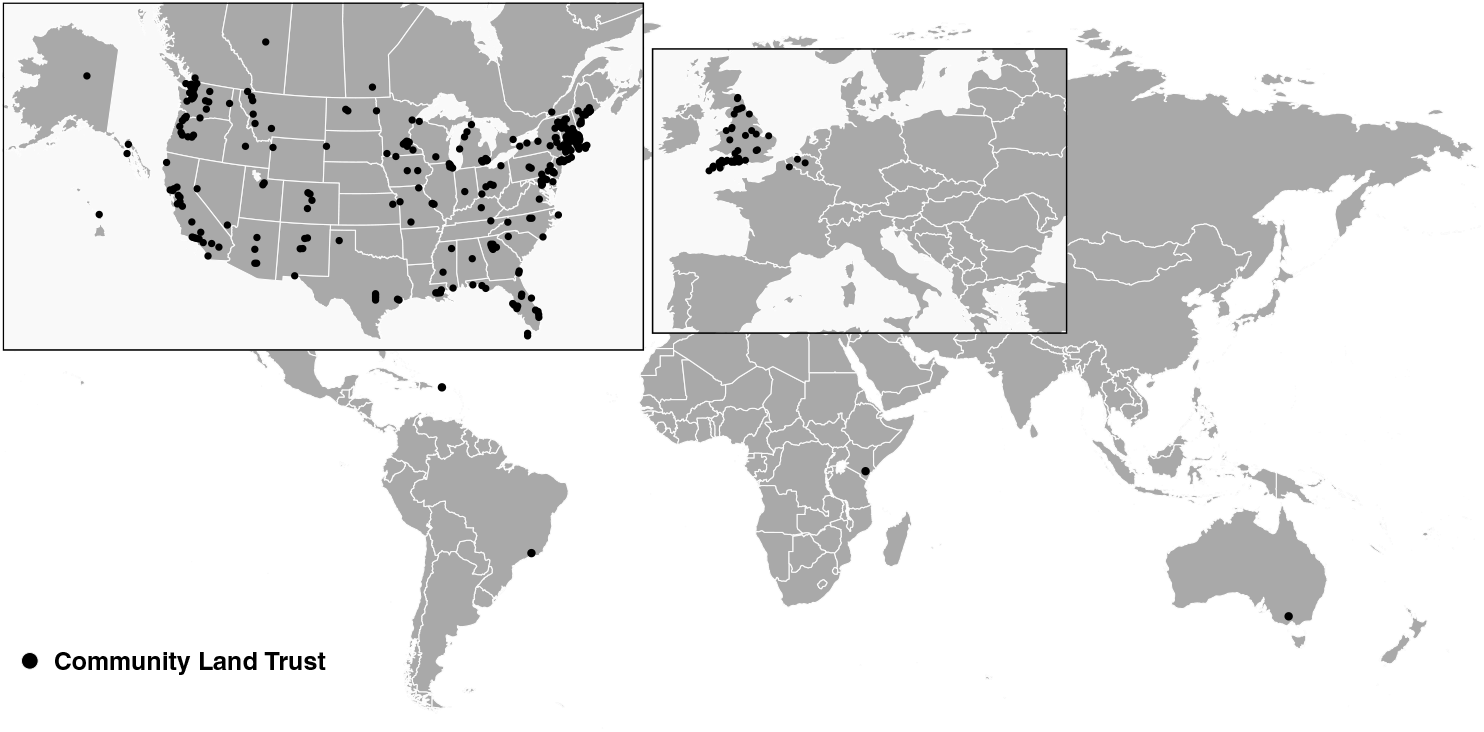
The CLT has met with considerable success in the United States with more than two hundred cases across the country (Davis, Reference Davis2010: ix) and versions of this mechanism have been implemented or proposed in other countries (Davis, Reference Davis2010: ix, 449). However, CLTs are by no means everywhere. As noted at the outset, it is not just that they are more common in the US and Europe (see Figure 1); one region where they are still extremely rare is Latin America, despite the fact that many countries in that region have strong collective property rights traditions.Footnote 3 One of the main features of the CLT is that it is primarily a ‘place-shaping’ initiative that builds on the existence of strong community ties at the neighbourhood level (Davis, Reference Davis2010: 454). In that sense, CLTs have emerged most regularly in democratic contexts where communities are already well organised at the local level, not just around property rights but also around other critical urban claims, such as in US and European cities. In much of Latin America, however, centralised governing institutions have prevailed historically, thus limiting the autonomy of local and community arrangements, owing to prior encounters with colonialism and authoritarianism. As such, the unique history of governance may serve as a barrier to the adoption of CLTs; and, as we shall see shortly, in such settings the confluence of community mobilisation and/or responsiveness by local authorities becomes central to the development of new CLT initiatives in Latin America.
Community land trusts in the world.

Citizenship through collective property rights: barriers and enablers in Latin America
To advance this claim, we examine two Latin American countries that are considered exceptions to the rule, in that they have adopted CLTs: Puerto Rico and Brazil.Footnote 4 Granted, Puerto Rico’s legal and political system is a mixture. Although currently a territory of the United States, its historical legacies straddle different political and legal systems, producing a hybrid set of governing institutions and practices. Puerto Rico has embraced the CLT model for more than a decade, to considerable success. Brazil, for its part, has only recently introduced its very first CLT. But both cases can be seen as forging pathways for new forms of urban citizenship, particularly with respect to laying the foundations for securing rights to housing and collective governance of community lands. Through closer interrogation, we assess the conditions that led to the Puerto Rican and Brazilian adoption of the CLT model, using these cases as a basis for reflecting on the role of CLTs as mechanisms for expanding citizenship rights to poor urban residents in countries of the Latin American region.
Puerto Rico
Starting in 2001, residents in a highly vulnerable neighbourhood in downtown San Juan de Puerto Rico mobilised to demand recognition of their right to land and the subsequent organisation of a CLT (Hernández Torrales et al., Reference Hernández Torrales, Algoed and Rodriguez del Valle2018: 13). Called the Fideicomiso de la Tierra del Caño Martín Peña, this initiative was born of community efforts to prevent displacement and became a framework that enabled residents to make claims on local authorities. The claims of the community referred to the recognition of their land rights as well as to the improvement of services in a well-located neighbourhood threatened by both environmental degradation and real estate speculation.Footnote 5 The case is useful for the analysis of the progressive expansion of hybrid property arrangements in Latin America not only for its local success, but also because of the particular legal regime of Puerto Rico. The Fideicomiso de la Tierra was not a simple reproduction of the American model. Puerto Rico’s legal system has a strong Spanish influence because of its history as a Spanish colony (Hernández Torrales et al., Reference Hernández Torrales, Algoed and Rodriguez del Valle2018: 6).
In 2009, the board of administration of the Fideicomiso de la Tierra was appointed and the Government of Puerto Rico transferred the land for the organisation to start its operations (Hernández Torrales et al., Reference Hernández Torrales, Algoed and Rodriguez del Valle2018: 26). However, that same year the project had to face a major legal setback that ultimately represented an interesting example of exercises of claims-making by the community. The legislature of Puerto Rico, driven by the then-mayor of the city, passed a law ordering the return of the land to the government. This brought legitimate concern about the different political, economic and legal factors that endangered this project in comparison to other CLT initiatives in other geographies (Davis and White, Reference Davis, White and Ziccardi2013: 23–31). In the opinion of Hernández Torrales and colleagues (Reference Hernández Torrales, Algoed and Rodriguez del Valle2018: 33), the return of the land to the government was meant to allow ‘the promoters of the law to continue with the clientelistic practices that had occurred for decades in order to hold the power.’
However, after a long legal dispute and due to the pressure put by the organised residents of the area as well as professionals, professors and students, media representatives, activists and others, the 2009 law was revoked in August of 2013 and the land was returned to the Fideicomiso de la Tierra. The Fideicomiso de la Tierra, then, was able to start its operations and played a central role in enhancing the quality of housing for around 2,000 families living in informal settlements along the Cano Martin Pena (Hernández Torrales et al., Reference Hernández Torrales, Algoed and Rodriguez del Valle2018: 1). In addition to the lessons that the experience left in reference to its legal situation, the community emerged strengthened and more conscious of the possibilities of recognition of their claims-making when acting as a collective entity. Indeed, the benefits of the Fideicomiso de la Tierra were not just the creation and preservation of social housing; the collective way of organising the housing claims of the community helped strengthen their citizenship claims in the face of other political actors (Hernández Torrales et al., Reference Hernández Torrales, Algoed and Rodriguez del Valle2018: 40–41). The Fideicomiso de la Tierra reinforced the sense of belonging and of mutual protection in the community and the residents have portrayed it as a powerful community ‘giant’ composed by all the members of the organisation united against the pressures of gentrification and displacement (World Habitat, 2019). This reputation arose in part from the number of activities and support that the Fideicomiso de la Tierra gives to the community in addition to the duties related to the provision of social housing (World Habitat, 2019).
The importance of this case derives from the fact that it was the first time that the processes of the CLT were reproduced in a country in the Latin American region. This involved the translation not only of terms but also of legal institutions in order to adapt them to a different legal tradition. For that reason, the Fideicomiso de la Tierra is the closest model that countries like Brazil can take as a reference when developing projects for introducing the CLT in their cities.
Brazil
Following Washington Consensus policies, Brazil had a neoliberal restructuring in the late 1980s, due to the drive of large transnational conglomerates, particularly in the agribusiness sector (McGuirk, Reference McGuirk2014: 111; Maricato, Reference Maricato and Angotti2017: 47). Nonetheless, the deeply progressive Brazilian Constitution of 1988, approved in the initial years of democratisation, included a regulation of property rights that produced the foundation for progressive change because it established explicitly the social function of property. This was the basis for the development of social movements, academic research, and democratic local governments during the 1990s, which eventually led to the approval of significant legal and institutional achievements such as the City Statute enacted in 2001 (Maricato, Reference Maricato and Angotti2017: 52). The progressive ideals underlying the City Statute have been hard to implement because urbanisation has created conditions unfavourable to the guarantees of socio-spatial equity. Like the entire Latin American region, Brazil is a country with an overwhelming majority of its population in urban areas. In particular, the population living in informal settlements called favelas has been growing at a faster rate than that of both the urban population and the total population (Maricato, Reference Maricato and Angotti2017: 44). Thus it may not be that surprising that the first efforts to try to introduce a CLT in Brazil occurred in the favelas of Rio de Janeiro.
The favelas are some of the most consolidated informal settlements in Latin America and in many cases have provided dwellings to communities for more than fifty years (Williamson, Reference Williamson2018: 13). In the past decade, the position of the federal government towards the favelas has been either to issue orders for slum clearing or to streamline the procedures for individual land titling (Herzog, Reference Herzog and Angotti2017: 172). In line with these policies, the government has also launched housing programs such as the 2008 ‘Minha Casa Minha Vida’, whose predominant outcome was the mass production of low-quality housing in the peripheries of cities (Kopper, Reference Kopper2016: 186). Some viewed this program as intending to create jobs in the construction sector rather than to address the issue of affordable housing in the favelas (McGuirk, Reference McGuirk2014: 127). Yet what is most striking about these prior efforts is the fact that what authorities were promoting diverged somewhat from the social function of property mandates recognised in the Brazilian Constitution, a national-level directive which should have guided the design of solutions to the affordable housing deficit (Ondetti, Reference Ondetti2016: 29).
In the face of such failures by authorities, local residents began to take matters into their own hands. A key motivating force was the accelerating pace of displacement of favela residents, whose location near central areas of the city problematised their capacities to stay put, particularly as pressures on land markets driven by rapid urbanisation made their properties prime real estate. Pressures for displacement began accelerating especially around the time of the 2014 World Cup and the 2016 Summer Olympic Games, two nationally-sponsored mega-events that further drove real estate speculation in the city (McGuirk, Reference McGuirk2014: 135). Not unlike the Puerto Rico case, in Rio de Janeiro a non-profit organisation called Catalytic Communities began to organise around these events, identifying the fight against displacement as their number one priority. As one of the tools in their arsenal, they identified a CLT as a priority. The first debates about the proposal of a CLT occurred in 2014 and have continued since then, including in recent months (Williamson, Reference Williamson2018: 17).
The advantages of CLTs are being framed not only as a response to local increases in real estate valuations, but also as a means to consolidate the existent organisations of residents that already operate in the favelas. According to Williamson (Reference Williamson2018: 21), in the favelas people ‘…prefer their community to manage [their] own development rather than relying on government agencies, which are often absent or ineffective.’ Williamson (Reference Williamson2018: 20) goes even further and poses that, in essence, the favelas might already be viewed as some sort of ‘informal’ CLT because (i) their members already have a sense of belonging to the community, (ii) the land is property of the government for a ‘social benefit’, (iii) the house structures are mainly owned by the residents, (iv) every community is required to have a residents’ association and (v) affordability of the housing has been maintained throughout the years. In the most recent workshops carried out in August 2018 the conclusions were that, in addition to the objective of collectively acquiring and managing their land, residents have prioritised the goal of strengthening the existing qualities of their life in community.
As in Puerto Rico, Catalytic Communities is involved in the struggle for the long haul. It continues to promote workshops and community mobilisation around the issue of affordable housing without displacement, and to promote the idea of the CLT. In parallel it also has started the process of translating and adapting legal institutions required for the implementation of the CLT in Rio de Janeiro. The latter is crucial because in the favelas the housing stock already exists; thus the focus is less on undertaking the nuts and bolts of project development and more on enhancing the community’s legal capacities to manage property collectively (Williamson, Reference Williamson2018: 18). What is still lacking is the support from local authorities to turn these ambitions into reality. Yet even in the absence of complete success to date, what matters is the struggle. History shows that citizenship rights granted on the national scale have come only because of mobilisation and struggle, and we should not expect any different at the scale of the city. And even though clamouring for collective property rights may generate pushback from a range of private sector opponents, the fact that the Brazilian Constitution enshrines the right to the city means that one should not be surprised if local residents may be able to count on other social and political allies in the struggle over displacement in Rio de Janeiro.
Conclusion: collective property rights as a pathway to substantive citizenship
We have seen that inequalities in social citizenship unfold locally at the scale of the city, often through the exclusion of specific communities from access to affordable and well located housing. National housing programs in Latin America that rely on the provision of individual property titles in most instances have failed to achieve the goal of providing a sustainable solution to the demand for affordable housing in large metropolitan areas. In contrast, sufficiently mobilised local communities can carve out alternative social, political, and territorial spaces to counter-act the limitations of these programs (Isin, Reference Isin2009: 374). CLTs are key in doing so. They not only serve as a mechanism to provide housing affordability for low-income segments of the population, they also exist as political communities which provide avenues for building more localised forms of citizenship, or what we might term as ‘urban citizenship’ (Garcia, Reference Garcia2006: 753; Donzelot, Reference Donzelot2011: 118; Subadevan and Naqvi, Reference Naqvi2017: 77; Giband and Siino, Reference Giband and Siino2013: 645; Brogger, Reference Brogger2019: 2).
In arriving at this conclusion, we substantiate the work of others who have argued that the rights and obligations — in general, the subjectivity — of a person in the city are not only insured by means of her membership in the national community but also, and more effectively, through membership in local communities (Lund, Reference Lund2011: 73). Yet we also recognise that the enactment of new forms of citizenship through struggles over CLTs will involve more than community residents themselves, particularly in Latin America. Indeed, one reason we see success in Puerto Rico but less so in other global south cases owes to the mediating role played by a few key local authorities who held urban governance priorities that motivated them to accommodate such claims. As such, any new forms of urban citizenship produced through struggles over collective property rights must by definition involve a citizen-state relationship, and not merely social mobilisation (Lund, Reference Lund2016: 1205).
Although CLTs may lead to new forms of citizenship by offering new terrain for making social claims, they are bound to be controversial and difficult to implement, precisely because their adoption is contingent on many mediating factors. In a region which has received a strong push toward a more neoliberal conception of property rights, the CLT approach has the virtue of straddling political divisions. Having, on the one hand, the equity values defended by the left and, on the other, the market-based system advocated by the right, the CLTs may be able to transcend ideological bifurcation (Saunders, Reference Saunders1984: 202; Davis, Reference Davis2010: 343). Even so, the construction of substantive citizenship also requires a process of broad-based institutional capacity building in which the work of the NGOs and other housing advocacy organisations must also be considered of critical importance (Holston and Appadurai, Reference Holston and Appadurai1996: 189). In Brazil, such organisations have become the primary driver for the analyses and discussions of alternative possibilities for responding to the threat of displacement faced by the residents of favelas, thus helping convince local government authorities of the value of their collective experiments.
The cases of Brazil and Puerto Rico suggest a wider embrace of CLTs across urban Latin America may actually be possible, not just as a basis for addressing the housing crisis, but also as mechanisms to enable more active citizenship at the local level. One result would be the provision of opportunities for membership in a ‘political community’ capable of channelling citizen claims for affordable housing and other livability claims in increasingly unequal, market-dominated urban environments. Although the efforts to implement this mechanism do face obstacles, we suggest that the long-lasting tradition of collective property rights in Latin American countries, if it were to be recovered, could help reinforce a form of citizenship that lays the groundwork for future challenges to the ascendant neoliberal preoccupation with individual property rights. Such battles will be more likely to be waged at the scale of the city, particularly as we see that many contemporary political mobilisations are shifting from the traditional national-scale to that of the more localised scale of neighbourhoods, districts, and municipalities (Purcell, Reference Purcell2003: 573; Holston and Appadurai, Reference Holston and Appadurai1996: 188).
In many ways, a return to collective action at the urban scale as the basis for citizenship echoes the history of the concept in the first place, which emerged through claim-making and protection in the city, not the nation (Prak, Reference Prak2018: 42–43). And because in today’s world, cities are the territorial sites where deficits in substantive citizenship are often most visible – owing to the impacts of market dynamics on urbanisation – struggles over CLTs and other forms of collective property provide one means for remedying these deficits and strengthening urban citizenship. When successfully adopted, they may even help facilitate the upward rescaling of political decision-making and citizenship claims from local to national terrains, thus driving larger debates over collective property rights in ways that challenge longstanding assumptions that individual property rights are the best way to realise citizenship.
Acknowledgments
The research for this article has been made possible thanks to the support of a grant from the Harvard Joint Center for Housing Studies.