1 Introduction
Since its discovery in Hamano (Reference Hamano1998; originally published in 1986) and its subsequent analysis in Mester & Itô (Reference Mester and Itô1989), palatalisation in Japanese mimetic words has fascinated many phonologists. The four-layered pattern as originally described by Hamano is illustrated in (1) (we revise this description below). In polysyllabic CVCV roots, palatalisation affects only one consonant. Given a root with a coronal and a non-coronal consonant, the coronal is systematically palatalised (1a). When this choice is not forced, however, two distinct edge effects are observed. The leftmost of two non-coronal consonants is palatalised (1b), but with two coronals, the rightmost one is palatalised (1c). The coronal liquid /r/ complicates this system, because it acts like a non-coronal. It does not obey the rightmost coronal generalisation in the second C position (1d.i), nor does it exhibit a preference for palatalisation over a non-coronal (1d.ii).
(1)


As discussions in linguistics textbooks emphasise (Kenstowicz Reference Kenstowicz1994, Tsujimura Reference Tsujimura1996), this system has been tremendously important to the development of feature theory. The first complete autosegmental analysis, Mester & Itô (Reference Mester and Itô1989), focused on its implications for feature specification, arguing that (1d) constitutes evidence for a restricted theory of feature underspecification in which only redundant features are underspecified. Mester & Itô (Reference Mester and Itô1989) 's analysis also accounts for (1a–c) by assuming two principles of mapping palatal feature structure to the CV tier: a right-to-left mapping principle for coronals, and, in the absence of a coronal consonant, a default left-to-right association principle for all other consonants (cf. Archangeli & Pulleyblank Reference Archangeli and Pulleyblank1994).
With the advent of theories of feature alignment (McCarthy & Prince Reference McCarthy and Prince1993, Itô & Mester Reference Itô, Mester, Merchant, Padgett and Walker1994), an alternative analysis of (1) emerged that sees the opposite edge orientations of these patterns as the satisfaction of two conflicting constraints that require palatal feature structure to appear at opposite edges of a word (Zoll Reference Zoll1997). To avoid some of the implications of the alignment-based analysis, however, additional alternative analyses have been proposed that treat the position of palatal feature structure as a combination of categorical alignment and feature affixation constraints (McCarthy Reference McCarthy2003), or the prosodic integration of featural morphemes controlled by constraints on linear precedence (Horwood Reference Horwood2004).
The purpose of this article is to re-examine the evidence supporting Japanese mimetic palatalisation and call into question the evidence supporting the two edge-orientation patterns in (1b, c). After some background information is given in §2, two kinds of evidence are examined in §3: evidence of actual words from mimetic word dictionaries, including the words studied in Hamano (Reference Hamano1998), and the results of an exhaustive search of the Japanese mimetic stratum for the crucial data supporting (1b, c), elicited from six native speakers. Both datasets show that there is no empirical basis for the generalisations in (1b, c). As a result, the theoretical assumptions that have built upon these generalisations, outlined above, are reconsidered in §4.
2 Background
The data in question are mimetic or iconic words of Japanese traditionally called giseigo/giongo (voice/sound-imitating) and gitaigo (designating manner or state). Since the mimetic stratum of the Japanese lexicon is characterised by a specific set of linguistic properties, which may differ from other lexical strata, we review the facts of this stratum below that are relevant to our empirical examination, drawing primarily from Hamano (Reference Hamano1998) ; see also McCawley (Reference McCawley1968) and Itô & Mester (Reference Itô, Mester and Goldsmith1995) on the configuration of the mimetic stratum in the Japanese lexicon.
According to Hamano (Reference Hamano1998), the morphology of these words involves a bimoraic root, to which one or more non-concatenative processes can be applied, either with specific meanings associated with them or triggered in order to meet certain phonological requirements. C and V positions in roots may have ‘phono-semantic associations’ in which a particular sound structure correlates strongly with specific meanings. For example, the mimetic adverb [koro-koro] ‘rolling on’ is formed from reduplication of a basic CVCV root /koro/. The meaning of the root is determined in part from the association of C1 /k/ with ‘hard surface’ and C2 /r/ with ‘rolling fluid movement’. Palatalisation of a base consonant likewise appears to have a specific set of semantic associations, as shown by the similar word [kʲoro-kʲoro] ‘looking around inquisitively’, in which palatalisation of /k/ contributes a meaning of ‘unfocused movement’. Other common associations with the occurrence of palatal consonants identified in Hamano (Reference Hamano1998: 238) are ‘childishness, immaturity, instability, unreliability, uncoordinated movement, diversity, excessive energy, noisiness, lack of elegance, cheapness’ and ‘lack of restraint’. The analysis of mimetic palatalisation is concerned with the rules governing the distribution of these palatal consonants.Footnote 1
The prosodic morphology of mimetic words restricts their maximal size. Mimetic roots have the canonical structure CVV, CVN (N=moraic nasal), CVQ (Q=moraic obstruent) or CVCV, which supports a bimoraic templatic requirement (Itô & Mester Reference Itô, Mester and Goldsmith1995, Hamano Reference Hamano1998). Mimetics that undergo morphophonological gemination and reduplication are also subject to a prosodic upper bound of four moras, or two prosodic feet, given the bimoraic foot characteristic of Japanese prosody (Mester & Itô Reference Mester and Itô1989, Poser Reference Poser1990). Because of these two constraints, examples given in support of the generalisations in (1) have been mimetic words exclusively formed with CVCV roots. Restrictions on coda consonants in CVN/CVQ roots and the limited number of suffixes that attach to mimetic roots preclude the free combination of two consonants in forms based on monosyllabic roots.
The distribution of palatal consonants in mimetic words is also subject to constraints on the following vowel and position within a word. The phonological inventory of Japanese is symmetrical, in the sense that there is a palatal consonant corresponding to every plain consonant (excluding the glides), as shown in (2) (cf. Vance Reference Vance1987, Tsujimura Reference Tsujimura1996, Ito & Mester Reference Ito and Mester2003).Footnote 2
(2)

As with other strata in the Japanese lexicon, plain consonants do not occur before the high front vowel /i/, and palatal consonants do not appear before the mid vowel /e/ (McCawley Reference McCawley1968, Vance Reference Vance1987, Itô & Mester Reference Itô, Mester and Goldsmith1995). In other words, the plain/palatal distinction is not contrastive before front vowels. This fact is relevant to the placement of palatal consonants in CVCV roots, because it is another principle predicting palatalisation in C1 or C2. Notice too that in the mimetic stratum /r/ almost exclusively occurs in C2 position. The analysis of the distribution of /rʲ/ is a matter of whether or not it can occur in C2.
Finally, Hamano (Reference Hamano1998) argues that the mimetic stratum is special in that it does not contain words with more than one palatal consonant. This is in contrast to other words of Japanese that may have more than one palatal consonant, e.g. [kʲaʃa] ‘to be fragile’. In mimetic words like [pʲiʧa] ‘splashing water’, however, Hamano treats the phonetically palatal consonants before /i/ as phonologically plain, because they would be inconsistent with two otherwise general patterns of the mimetic stratum (1998: 183ff); but see McCawley (Reference McCawley1968). Since one of these patterns, namely palatalisation of leftmost non-coronals, is shown in this article not to be a true generalisation for the stratum, this assumption may not be valid. However, it does not present an obstacle for our conclusions, because even if we follow Hamano (Reference Hamano1998) in assuming that phonetic [Cʲi] strings are phonologically plain, we can still find empirical evidence against the generalisations in (1b, c) that do not involve these strings.
3 Re-examining the evidence
3.1 Dictionary evidence
To validate the patterns in (1), a list of CVCV-based manner and sound symbolic adverbs was compiled. The items are drawn from several sources: two published dissertations, Hamano (Reference Hamano1998) and Tsuji (Reference Tsuji2003), and two dictionaries of Japanese mimetic vocabulary, Asano (Reference Asano1978) and Kakehi et al. (Reference Kakehi, Tamori and Schourup1996). Although Tsuji (Reference Tsuji2003) examines both standard and dialectal (the dialect of Iwate) mimetic vocabulary, only mimetic items from the standard were included in our corpus. The list contains 100 items with a palatalised consonant. While some of the palatalised forms are listed in just one source (16 items), there is considerable overlap among the sources. Thus, 49 of these items were listed in all four sources, 19 were listed in at least three sources and 16 were listed in at least two sources. In addition, a list of 486 items without palatalisation was also compiled from the same sources to investigate certain questions raised below. Sixty of these items were paired with palatalised items (cf. Schourup & Tamori Reference Schourup and Tamori1992).Footnote 3
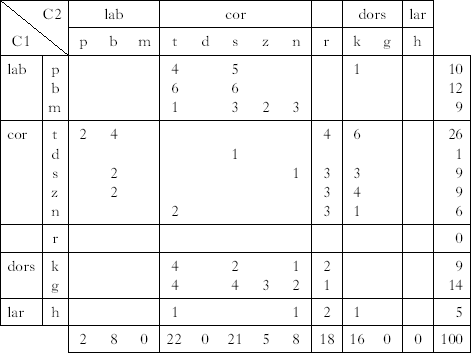
Details of consonant combinations in our corpus of palatalised items are summarised in Table I (cf. Hamano Reference Hamano1998: 180). Over three-quarters of all CVCV items consist of a non-coronal (labial, dorsal or laryngeal) and a coronal consonant, the coronal either as C1 (n=24), e.g. [ʃaka-ʃaka], or C2 (n=52), e.g. [kaʃa-kaʃa]. All of the consonants in (2) occur in such combinations. As discussed above, /r/ patterns differently from the other coronals, never occurring as C1 in CVCV roots (except in the two forms [rero-rero] and [rori-rori]). It can be preceded by either non-coronals (but there are no examples with labials) or other coronals, as in [kʲoro-kʲoro] and [ɲuru-ɲuru]. CVCV words that contain either two coronal consonants or two non-coronal consonants are rather rare in the corpus. There are only four items where both consonants are coronal: [doʃa-doʃa], [neʧa-neʧa], [niʧa-niʧa] and [ʃana-ʃana], and only two items where both consonants are non-coronal: [hʲoko-hʲoko] and [pʲoko-pʲoko].
Combinations of C1 and C2 in CVCV mimetic words with at least one palatalised consonant found in the corpus (n=100(.

Counts of vowel combinations in the corpus showed that most items had back vowels only: /a/, /u/ or /o/ (72 items), e.g. [ʧoku-ʧoku] and [moʤo-moʤo]. Combinations of front vowels /i/ and /e/ with non-high back vowels in either order are also possible, as shown by [meʧa-meʧa] and [ʤoki-ʤoki] (28 items). All items with back/front vowel combinations have coronals before back vowels, and non-coronals or /r/ before front vowels. (Items where both vowels are front were excluded, since palatalised consonants before /i/ are assumed in Hamano Reference Hamano1998 to be phonetically conditioned, and palatalised consonants are not permitted before /e/, as discussed in §2.)
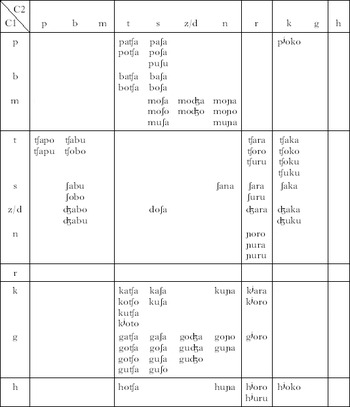
Since Japanese does not contrast plain and palatalised consonants before front vowels, the items with front vowels are not directly relevant to the investigation of the generalisations in (1). This leaves us with only 72 items with back vowels, given in Table II.
Roots with palatalised consonants in back vowel contexts (n=72).

The dataset above can be used to return to the generalisations in (1) in an effort to confirm the four distinct components of this system. In combinations of non-coronals (labials, dorsals and laryngeals) with coronals charted above (54 items), coronals are consistently palatalised, confirming the pattern in (1a). There is only one exception to this pattern, [kʲoto-kʲoto], possibly formed by analogy to [kʲoro-kʲoro] (as noted by Hamano Reference Hamano1998: 178, n. 4), or, alternatively, to create an opposition with another word with a palatalised coronal, namely [koʧo-koʧo]. There are 14 words with various non-rhotic consonant–/r/ combinations, and /r/ is never palatalised, consistent with (1d).
Of particular interest to the empirical evidence for conflicting directionality is the paucity of mimetic words supporting (1b) or (1c). While it is true that C1 is always palatalised in non-coronal–non-coronal words, there are only two items that exemplify this pattern, [pʲoko-pʲoko] and [hʲoko-hʲoko]. Furthermore, there is only one valid example supporting rightmost coronal palatalisation (1c) in words with two coronal consonants, [doʃa-doʃa]. The only other coronal–coronal item, [ʃana-ʃana], shows the opposite pattern: leftmost palatalisation. It is simply not the case that the inventory of actual mimetic words provides a sufficient number of examples to support the generalisations in (1b, c), and even the small dataset relevant to (1c) contains a counterexample.
It appears that the discrepancy between our findings for (1b, c) and the conclusions of Hamano (Reference Hamano1998) and Mester & Itô (Reference Mester and Itô1989) is a matter of interpretation rather than empirical evidence. The discrepancy cannot be due to differences in actual words, because our corpus closely corresponds to the corpus used in Hamano (Reference Hamano1998), the empirical basis for Mester & Itô (Reference Mester and Itô1989). The original corpus of CVCV-based reduplicated adverbs in Hamano (Reference Hamano1998) consisted of 85 forms. The 15 additional items in the current corpus include seven non-coronal–coronal forms, five coronal–non-coronal forms, one non-coronal–/r/ form, one coronal–/r/ form and one coronal–coronal form. Of these items, only the last, [ʃana-ʃana], is directly relevant to the evaluation of the edge effects in (1b, c).Footnote 4 Mester & Itô (Reference Mester and Itô1989: 270) and Tsujimura (Reference Tsujimura1996: 96) (citing Mester & Itô) provide one more coronal–coronal example, [noʃo-noʃo] ‘slowly’, and another non-coronal–non-coronal example, [gʲobo-gʲobo] ‘gurgling’, presumably derived from [noso-noso] and [gobo-gobo]. These items were not included in our corpus, because they did not occur in our sources, nor were they recognised as meaningful Japanese words by our native speaker informants (see §3.2). However, even if they are included, these additions do not increase the datasets to such an extent that (1b, c) could be considered generalisations for the mimetic stratum. Generative linguistics does not provide a predetermined number of examples such that this number supports a generalisation that is cause for analysis. But even with these additional examples, C1 palatalisation in non-coronals (1b) is observed just three out of three times, and C2 palatalisation in coronals (1c) is observed two out of three times. Because the choice in CVCV forms is between just C1 and C2, the occurrence of C1 or C2 palatalisation is statistically parallel to tossing a coin. Treating, for example, the non-coronal cases as an important generalisation would be like treating three ‘heads’ observations in three consecutive coin tosses as a statistical fact requiring analysis.
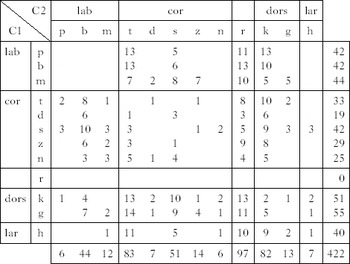
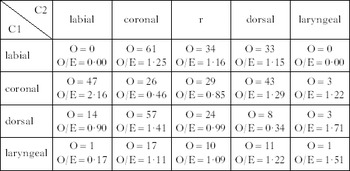
Both Hamano (Reference Hamano1998: 178) and Mester & Itô (Reference Mester and Itô1989: n. 28) acknowledge that there is a small number of examples supporting the rightmost coronal generalisation (1c), but nonetheless consider the observed examples to be significant, and suggest the small number derives from a general constraint on the co-occurrence of two coronal consonants. More recent work has shown a statistical tendency against the co-occurrence of homorganic consonants in native Yamato words (Kawahara et al. Reference Kawahara, Ono, Sudo, Vance and Jones2006). Our examination of 422 CVCV-based non-palatalised mimetic words with the same consonants shows a similar effect in the mimetic stratum: same-place consonants are statistically underrepresented in CVCV roots, categorically for some places (labials) and gradiently for other places (coronals and dorsals) (see Tables III and IV, and Hamano Reference Hamano1998: 42). These two analyses are consistent, and seem to account for the small number of coronal–coronal CVCV words. However, we reject the tacit analytical assumption of Hamano (Reference Hamano1998) and Mester & Itô (Reference Mester and Itô1989), namely that the co-occurrence restrictions mask a linguistic generalisation about attested words with two coronals. As the dictionary evidence discussed above and the investigation below show, there are counterexamples to the rightmost coronal generalisation (1c), and the words identified by Japanese native speakers are just too small in number to support a generalisation.
Combinations of C1 and C2 in CVCV mimetic words without palatalised consonants found in the corpus (items with consonants that do not occur in Table I, i.e. /w/ and /j/, and with /r/ as C1 are excluded) (n=422).

Counts of observed items (O) and observed/expected ratios (O/E) for each combination category in words without palatalisation. A ratio below or above 1·00 indicates that the combination occurs less or more frequently than would be expected based on random distribution (see Kawahara et al. 2006 for a similar approach to co-occurrence restrictions in the Yamato stock of Japanese). These O/E values show that items with two labials, two coronals and two dorsals are underrepresented in the corpus.

3.2 An exhaustive search for edge effects
It could be the case, however, that (1b, c) constitute linguistic generalisations that are not represented in lexicographical resources. After all, the use of specific mimetic words is subject to interspeaker or dialectal variation, and their marginal status as words of Japanese may preclude their inclusion in some dictionaries. Kakehi et al. (Reference Kakehi, Tamori and Schourup1996: xiii), for example, do not include in their dictionary mimetic words that are ‘rare, slangy, used in highly restricted dialect areas’, also noting that ‘the concentrated use of sound-symbolic elements in Japanese lends itself to new creations’. To overcome the limitations of dictionary evidence, an exhaustive search for the crucial evidence for the patterns in (1b, c) was conducted, using the following methods. A questionnaire was created containing examples of CVCV-based forms in which one of the consonants was palatal. Both vowels were back, because palatalisation is predictable before front vowels (§2). /r/ was excluded because of its special distribution, and because it is orthogonal to the generalisations in (1b, c). Since there are five coronal consonants /t d s z n/, six non-coronals /p b m k g h/ and three back vowels /u o a/, there are 450 forms with coronal combinations (=(5×5)consonants×(3×3)vowels×2C1/C2) and 648 non-coronal combinations (= (6×6)consonants×(3×3)vowels×2C1/C2). The questionnaire contained all of these possible coronal–coronal and non-coronal–non-coronal combinations, i.e. 1098 in total.
These forms were randomised and presented as a list in katakana orthography. Six native speakers were asked to examine the list carefully and select actual mimetic words of Japanese. To ensure that the judgements were of mimetic words, and not some other type of word, participants were explicitly instructed to identify mimetic words. The intended focus on mimetic words was supported further by the structure of the items in the questionnaire, which were reduplicated CVCV forms, because this structure is almost exclusively mimetic. Participants were asked to identify the items that they had used, heard or seen used as meaningful words. For words identified as mimetic, the participants were asked to provide a meaning and a sentence illustrating its usage in Japanese. All instructions were in Japanese. Completion of the questionnaire was self-paced; participants generally finished it in under an hour. Three of the speakers were in their twenties and three in their thirties. Four were from the Eastern dialect area (Tokyo, Kanagawa, Shizuoka, Sapporo); the other two were from the Western dialect area (Okayama, Shiga) (see the dialect areas of Shibatani Reference Shibatani1990). All participants were living in Canada at the time of the experiment.Footnote 5
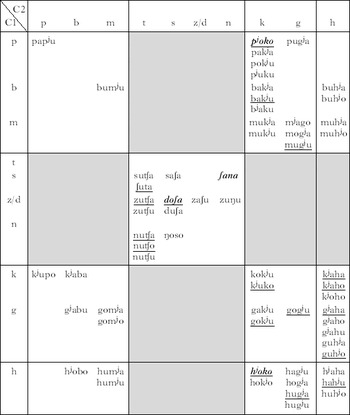
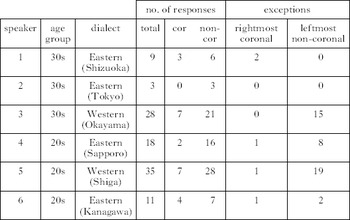
The results reported below confirm that, while there is some variation in speaker responses, the patterns are indeed consistent with the conclusion above, namely that neither leftmost non-coronal nor rightmost coronal palatalisation is systematically represented in Japanese mimetic words. The number of forms recognised ranged from three to 35, with an average of approximately 17 forms per speaker (see Table V). Of the 1098 logically possible forms, only 64 forms were recognised at least once, and of these, only 17 forms were recognised by two or more speakers, suggesting that these combinations are indeed underrepresented in the Japanese lexicon. The full list of identified forms, arranged by consonant combination, is shown in Table V. As with the dictionary forms, the glosses and examples for all elicited forms are given in the online supplementary materials.
CVCV-based palatalised mimetic words with two coronals or two non-coronals identified in the exhaustive search. Italicisation indicates forms that appeared in our dictionary corpus; underlined items were identified as words by at least two speakers. Shaded cells show combinations that are irrelevant to the search.

We first examine the 17 forms recognised by at least two speakers. There were fewer coronal–coronal forms than non-coronal–non-coronal forms, presumably an effect of the avoidance of the co-occurrence of homorganic consonants. Of the four forms not in the dictionary corpus, three have C2 palatalisation and one has C1 palatalisation, as shown in (3).
(3)

Of the ten additional forms given by only one native speaker, three of them also have initial palatalisation: [ʤota-ʤota], [ɲoso-ɲoso] and [ʃana-ʃana]. It is difficult to draw any conclusions from such a small dataset, but this is consistent with our findings in dictionaries. Coronal–coronal combinations are vanishingly rare, and there are indeed counterexamples to the generalisation of rightmost coronal palatalisation.
There are a few more non-coronal–non-coronal forms that did not occur in the dictionary corpus. The forms in (4) show that there is no generalisation at all about the position of palatalisation: six have C1 palatalisation and seven have C2 palatalisation. Furthermore, for both coronal–coronal and non-coronal–non-coronal roots, items with the same consonant combinations may have different patterns of palatalisation, for example, [ʃuta-ʃuta] vs. [suʧa-suʧa], [bʲaku-bʲaku] vs. [bakʲu-bakʲu] and [hʲaha-hʲaha] vs. [hahʲu-hahʲu], a point reported by some of the participants.
(4)

To further probe the empirical support for (1b, c), Table VI shows the exceptions to the two generalisations for each speaker. As the table shows, exceptions to the generalisations were found in responses of five of the six speakers; three of these speakers showed both types of exceptions – for coronals and non-coronals. The only speaker who did not have exceptions was speaker 2, who had the lowest number of responses among all the speakers (only three). Overall, this shows that exceptions are not limited to particular individuals, but are representative of the group as a whole. Moreover, patterns of exceptions do not seem to be tied to age or dialect, as exceptions are exhibited by speakers of both age groups and apparently regardless of the dialect region.
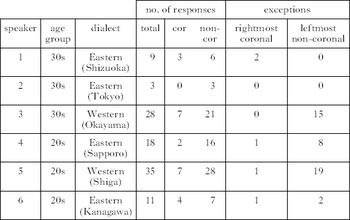
At the same time, there appear to be some dialect or age-specific tendencies in overall numbers of responses: on average more items were reported by the two speakers from the Western dialect area and by the younger speakers from both areas. The age difference can be at least in part attributed to different degrees of exposure to manga and anime (Japanese comics and animation), where novel mimetic items are commonly used. The increasing use of novel mimetic vocabulary in online chat and on Facebook was also noted by one of the younger participants.
4 Discussion
The investigation above confirms two of the generalisations in (1), namely (1a) and (1d). However, a comprehensive examination of the original evidence and an exhaustive search of CVCV mimetic roots did not confirm generalisations (1b, c).
(5)

These findings raise two important questions, one concerning the correct analysis of Japanese, and another about theoretical implications of theories of edge effects for segmental features. Starting with the first question, part of the interest of prior work on Japanese mimetics, including early generative works like Mester & Itô (Reference Mester and Itô1989) and later analyses in OT (Zoll Reference Zoll1997, McCarthy Reference McCarthy2003, Horwood Reference Horwood2004), is that it shows how the same theoretical assumptions that account for (1b, c) can also account for (1a, d) when these generalisations are treated as edge effects. For example, Zoll (Reference Zoll1997) accounts for the preference for palatalisation of coronals and avoidance of /rʲ/ with the same constraint system responsible for the opposite edge effects in (1b, c). Zoll's analysis employs two alignment constraints on palatal feature structure. One constraint, Align-L(ComplexSeg, PrWd), applies specifically to palatalisation in non-coronals and /r/ because they are complex segments, and requires this secondary palatalisation to appear in the beginning of the word. A more general constraint, Align-R([−ant], PrWd), applies to all palatal consonants, both coronal and non-coronal, and requires them to appear at the right of a word. The fact that non-coronals and /r/ are complex segments, while non-rhotic coronals involve a change in palatalisation (from [+anterior] to [−anterior]), makes it possible to collapse the four distinct patterns below into just two patterns: avoidance of palatalisation in C2 position when C2 is a complex segment (6a.i, b, d), but preference for C2 palatalisation when C2 is a coronal (6a.ii, c). The members of the two collapsed patterns have identical violation profiles, shown here in a comparative tableau (Prince Reference Prince, Carpenter, Coetzee and de Lacy2002), because the constraints treat the members of these sets as exactly the same.
(6)

The problem posed by this type of analysis of Japanese is that it incorrectly predicts conflicting directionality in words with two coronals or two non-coronals. Given two non-coronals, the ranking of Align-L above Align-R predicts the absence of C2 palatalisation, but such words exist, e.g. [gokʲu-gokʲu]. Likewise, this ranking prohibits C1 palatalisation in coronal–coronal words, but this prediction is also not borne out, e.g. [ʃana-ʃana]. The facts brought to light in this article therefore require a separation of the analysis of (1a, d) from (1b, c), at least in the case of Japanese.
The finding that coronal preference and avoidance of /rʲ/ in Japanese are not edge effects is actually not at all a surprise when one considers cross-linguistic parallels. To take one example, Rose (Reference Rose1997) argues for a palatalisation hierarchy in several Ethio-Semitic languages that ranks segments in terms of their eligibility to receive palatal feature structure in certain morphophonological operations. This hierarchy distinguishes more classes than are involved here, but the observation directly relevant for Japanese is that palatalisation of non-coronals is marked with respect to palatalisation of coronals, while palatalisation of rhotics is marked with respect to other coronals. In Harari, for example, marking of 2nd person singular feminine subjects involves both suffixation of /-i/ and morphophonological palatalisation of a segment closest to the right edge of a stem, as in /kifat+i/→[kifaʧ-i] ‘open!’. However, when the stem ends in a non-coronal and the penultimate consonant is coronal, the non-final coronal is palatalised, as in /kitab+i/→[kiʧab-i] ‘write!’. In general, this morphophonological palatalisation targets coronals but excludes /r/; when the form lacks a non-/r/ coronal, the feminine marker is expressed by the suffix /-i/ alone, e.g. /k'ibar+i/→[k'ibar-i] ‘bury!’ (see Rose Reference Rose1997, Reference Rose2004 for additional details of this system). Similar cases documenting the markedness of coronals with respect to non-coronals and /r/, independent of their edge properties, can also be found in Slavic, Celtic, Finno-Ugric and West Chadic languages, among others (Bhat Reference Bhat, Greenberg, Ferguson and Moravcsik1978, Kochetov Reference Kochetov2002, Schuh Reference Schuh2002, Bateman Reference Bateman2007).
A full analysis of these preferences in Japanese is beyond the scope of this paper; we simply note here that the markedness of palatalisation in non-coronals and /r/ relative to coronals can be accomplished with well-formedness constraints that do not refer to edges. Rose's (Reference Rose1997) PalatalisationMarkedness constraint, which encapsulates the palatalisation hierarchy discussed above, is sufficient for this task, because it establishes within-segment markedness generalisations of the right kind. Likewise, Akinlabi (Reference Akinlabi1996) applies the same reasoning to the unmarkedness of coronal palatalisation in his discussion of Japanese mimetic palatalisation, arguing for a feature co-occurrence constraint ‘if [−back] then [coronal]’ which simply applies to the domain of the segment ([−back] represents palatalisation here). Since the preference for coronal palatalisation is not an edge effect in Japanese, segment-internal featural markedness constraints such as these can be ranked with respect to faithfulness constraints to account for the salient distributional patterns. In sum, there are cross-linguistic parallels to the coronal preference of Japanese, and a clear approach to these facts as segment-internal markedness effects exists in the literature.
Finally, we address the cross-linguistic implications of prior work on Japanese mimetics for segmental edge effects. These analyses, based on Hamano (Reference Hamano1998) 's original description, assume that Japanese has the two edge effects in (1b, c). Indeed, it is the opposite directionality for these edge effects that supports a parallel made explicitly in Zoll (Reference Zoll1997) to default-to-opposite stress (Prince Reference Prince1983, Halle & Vergnaud Reference Halle and Vergnaud1987, Gordon Reference Gordon2000). As intriguing as this parallel may seem, the empirical investigation above showed that Japanese does not have the edge effects in (1b, c).Footnote 6 Since Japanese mimetic palatalisation is the only example argued to be a case of segmental conflicting directionality in prior work, it is worth considering the implications of these analyses for future empirical investigation. In particular, what would future valid examples of segmental conflicting directionality tell us about theories of docking and edge effects for feature structure? Furthermore, what if no examples of conflicting directionality are ever found?
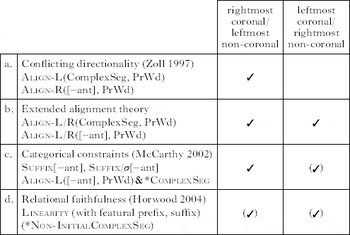
Table VII illustrates the predictions made by prior analyses of segmental conflicting directionality. For each theory, the operative constraints are repeated from these works and the specific edge effects they predict, if any, are given on the right. For concreteness, the specific constraints in Table VII refer to palatal feature structure on coronals and non-coronals, but similar patterns could be predicted for other types of features with analogous constraints.
Theories of segmental conflicting directionality.

As illustrated in Table VII, Zoll (Reference Zoll1997) 's alignment-based theory predicts a rightmost coronal/leftmost non-coronal pattern, because of the specific edge settings in the alignment constraints assumed. A more general theory, based on Zoll's idea that alignment constraints drive the analysis, also predicts the opposite pattern (b). The parallel with stress systems made in Zoll (Reference Zoll1997) suggests this more general theory, since the alignment constraints standardly employed in default-to-opposite stress (Baković 1998) are likewise symmetric. On the other hand, Zoll motivates constraints like Align-L(ComplexSeg, PrWd) with the idea that complex segments are positionally licensed at the left edge of a word, so if the cross-linguistic generalisations support this positional licensing approach, then the asymmetric theory of segmental conflicting directionality in (a) is justified.
The predicted edge effects of these two theories is also predicted by McCarthy (Reference McCarthy2003) 's theory of feature docking (c), in which the violations of the constraints guiding association of a feature are assessed categorically. Two types of constraints are employed in this analysis: Suffix[feature] constraints (and the analogous constraints on prefixes) which are violated in structures where a segment (Suffix[−ant]) or syllable (Suffix/σ[−ant]) intervenes between the right edge of the prosodic word and the featural suffix [−anterior]. To get the opposite edge orientation for the subset class, in this case complex segments, McCarthy employs local conjunction of two constraints, as in Smolensky (Reference Smolensky1995), which produces a categorical constraint that in essence prohibits non-initial complex segments. Because the edge settings for these constraints are not restricted, and given the availability of the Prefix constraints, this theory could also predict a leftmost coronal/rightmost non-coronal pattern. However, it could also appeal to the markedness of non-initial complex segments, as Zoll (Reference Zoll1997) appears to do, to exclude this pattern.
Finally, we note that one theory, that of Horwood (Reference Horwood2004) in (d), is potentially more powerful, in that it can account for the two patterns in Table VII or none at all. This approach assumes that floating features are morphemes, and as morphemes, they have an inherent precedence structure with respect to the stems they attach. Therefore, faithfulness constraints like Linearity (McCarthy & Prince Reference McCarthy, Prince, Beckman, Dickey and Urbanczyk1995) have the ability to control their integration and position in the stem. In particular, Linearity predicts that floating features will tend to be as close as possible to their affix position: leftmost if the floater is a prefix, rightmost if it is a suffix. As shown in Horwood's (Reference Horwood2004) sketch of Japanese, this theory can employ a positional markedness constraint like *Non-initialComplexSeg to produce conflicting directionality of the kind in (1b, c). As nothing in this theory precludes the opposite positional markedness constraint, the precedence faithfulness approach could account for either kind of conflicting directionality (Table VIId). Interestingly, the absence of any of these additional constraints predicts the non-existence of conflicting directionality altogether, which is consistent with the fact that segmental conflicting directionality is at present unattested.
The above discussion has reviewed the ways in which contemporary theories do and do not predict certain patterns of conflicting directionality. We hope that these predictions can help focus future data collection and the interpretation of valid examples of segmental conflicting directionality within theories of feature docking and realisation.