Contemplating a vast (and ever-expanding) digital treasure-trove of information and critical thought on the subject of music such as MGG Online is an exhilarating experience. It is clearly impossible for one person realistically to survey its contents, and to sum up the value it offers, on more than a selective basis. With that caveat, what follows represents the outcome of a months-long acquaintance with the site, during which I have benefited from a variety of help and advice from members of the MGG team as well as my colleagues in Oxford and elsewhere.Footnote 1
After some further introductory remarks, the two main parts of the review concern, first, the content and its management, and secondly the platform and its development, with the inevitable overlap between them, before rounding off with a couple of concluding paragraphs.
While MGG has inevitably tended to be thought of as the German equivalent to Grove, these two giants of musical lexicography have had very different histories up to the point where they appeared online.Footnote 2 Friedrich Blume (as a kind of latter-day George Grove) masterminded the first edition of MGG starting from 1946 onwards, some 70 years after the original Grove Dictionary appeared in print.Footnote 3 Grove’s Dictionary had a more eventful trajectory, going through a series of editions over the span of about a century up to 1980, when the major expansion represented by Grove 6 (New Grove) appeared in print, spawning a plethora of offshoots, before the revised and expanded edition of New Grove was published in 2001, both in print and online.Footnote 4 MGG meanwhile spread the publication of its second, revised edition over a period of some 15 years, divided into the two basic categories of ‘Sachteil’ and ‘Personenregister’; their contents (including updated versions of selected articles, supplemented by new commissions) were finally transferred to the online version in November 2016.Footnote 5
These two leading resources of their kind need not be seen as uncomfortably in competition with each other, but rather might be regarded as forming a complementary pair. Writing prior to the launch of MGG Online, Laurenz Lütteken, its Editor in Chief, expressed the thought that as ‘the product of a serious and established publishing house [actually two publishers jointly, Bärenreiter and J.B. Metzler]’ the new MGG was to be considered ‘an endeavour parallel to the enterprise of Grove Online by Oxford University Press’; he went on to suggest that ‘such competition can be quite productive’.Footnote 6 We might note that following the launch of MGG Online, Grove online has recently transformed its home page quite noticeably and refashioned the layout of its contents, providing users with a new video tour of the dictionary to guide them in their searches (accessible via the Help page). A modicum of comparative comment with reference to Grove is included in what follows here.
Content
In articulating his vision for the new MGG Online, Lütteken was deeply concerned to distinguish it from the culture represented by Wikipedia, ‘the structure of … which claims to be the true democratic, non-hierarchical, politically correct way of producing highly differentiated knowledge’.Footnote 7 In contrast to that culture, MGG Online ‘aims at producing highly supervised scholarship, while adapting to the technological conditions of the twenty-first century’.Footnote 8 While Lütteken’s commanding vision underpins the structure and contents of the encyclopaedia overall, his team of some 60 editors responsible for different areas within the project, together with the authors of the articles belonging in those editorial divisions, have naturally been able to develop a variety of angles on the fields of scholarship they represent.Footnote 9 The overall impression formed by Lütteken’s project, both in the plan and in its execution, is of an extremely well organized and lively enterprise, working to the highest standards. The balance of factual information and critical observation, and the weight given to fundamental elements of scholarship such as method and result, or documentation and interpretation, is finely tuned to the subjects of the individual entries. This in turn reflects the increasingly multi-faceted impression produced by developments in the discipline of musicology over recent decades: MGG Online comes at an exciting time in the history of the discipline.
To date, the online version of MGG has been able to absorb the added bibliography resulting from these developments into only a proportion of the articles imported from MGG2. This lacuna constitutes possibly the most counter-productive aspect of those articles online that are still waiting to be updated: an ongoing schedule for updating is planned in a series of annual cycles.Footnote 10 The bibliographies of the as yet unrevised articles typically stop at a point a year or so before the date of their original publication in MGG2. The implications of this are obviously particularly limiting for fields in which considerable progress has been made over the past few decades, as for instance is the case with studies in women composers. Thus the item with the latest date of publication in the bibliography for Fanny Hensel is 2002. Among publications on Hensel that have appeared since, this misses the major contribution of R. Larry Todd to the literature on her life and works, and that of Cornelia Bartsch to our understanding of the intricate network of intertextuality between Fanny’s music and Felix’s.Footnote 11
The representation of a previously neglected area of scholarship such as the study of women composers raises questions beyond the entries on the women themselves. Their inclusion in core areas of the ‘mainstream’, for example in entries on genres, forms, style categories and places, is of equal importance. In this respect I hope the updating planned for MGG Online will reflect awareness of the need to rethink what have traditionally been presented as all-male narratives of these kinds of topics. Indeed, MGG could perhaps thereby be leading the way in this for other encyclopaedic and lexicographical works in the discipline. An important corrective to the male-dominated tradition has been the production of new dictionaries dedicated to women composers. Ideally, MGG Online with its article on Musiklexika, imported from MGG2 (1997),Footnote 12 when it is updated would acknowledge the work of such enterprises as MUGI in Hamburg with their online resource, as well as the pioneering volumes brought out in print, such as Sophie Fuller’s Pandora Guide and the New Grove Dictionary of Women Composers edited by Julie Anne Sadie and Rhian Samuel.Footnote 13
Among the topics I sampled, the history of the nineteenth-century Lied in the online article transferred from MGG2 (1994), is told as an almost exclusively male-centred story.Footnote 14 The only woman composer I could find featured here is Fanny Hensel,Footnote 15 who is recognized for her extensive production of Lieder, ‘the best of which … exceed her brother’s in respect of their dramatic and expressive power, and their harmonic scope’; yet she receives only 78 words of comment in total on her songs, compared with 115 words on Felix Mendelssohn in the preceding portion. She enters the article as if her work is an appendix to Felix’s (signalled by the opening reference to some of her Lieder having been included within his published collections).Footnote 16 Jost’s incisive commentary on individual songs by Fanny was made, as he indicated, at a time when her oeuvre had ‘only in recent years been evaluated’. The development of Hensel studies in the intervening decades has transformed the study of her Lieder and is set to continue. More widely, the updating of the ‘Lied’ article will be in a position to reflect the increasing recognition of women’s contribution to the genre and to adjust the gender balance accordingly. A wealth of opportunity beckons for achieving greater inclusivity as regards the acknowledgement of women’s work across broad areas.
Another branch of musical scholarship we have seen transformed in recent decades is the study of concert life. Like the article on ‘Lied’, MGG Online on ‘Konzertwesen’ dates back to the 1990s (MGG2, 1996).Footnote 17 Among the substantial production of valuable new writing on the subject since its (extensive) bibliography was compiled, recent work from William Weber has opened up fresh perspectives on the historical development and social function of the concert.Footnote 18 So too have studies of individuals and institutions, such as Christina Bashford’s major evaluation of John Ella and the definitive volume on the London Proms edited by Jenny Doctor and David Wright,Footnote 19 as well as the publication of conference proceedings, including those of ‘Recital e Paesaggio Urbano nell’ Ottocento’ (2013, published 2014–15):Footnote 20 among earlier literature, another omission that might be remedied is that of Michael Musgrave’s in-depth study of the Crystal Palace concerts.Footnote 21
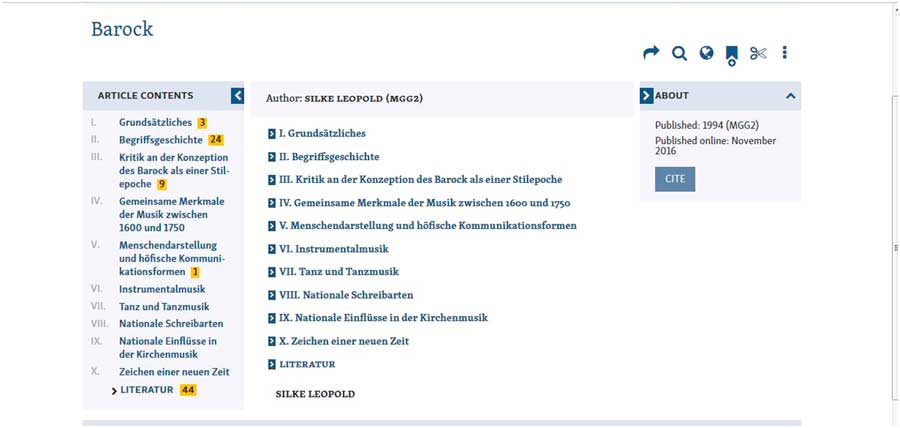
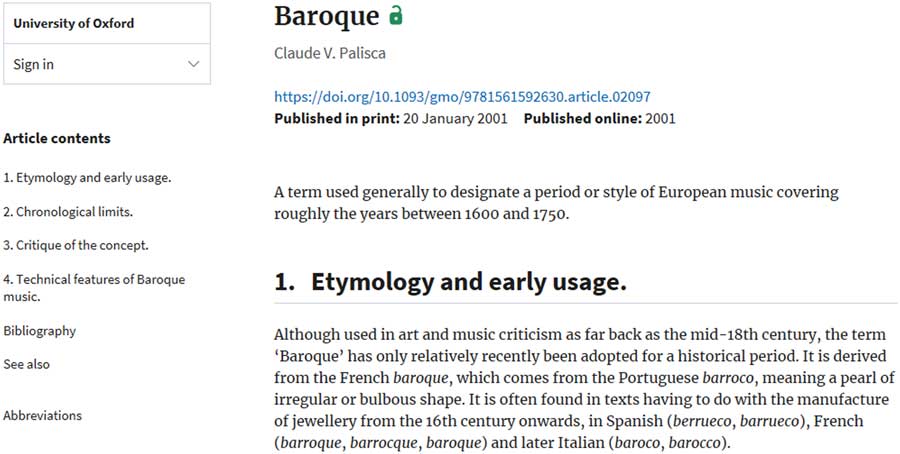
Reading through the ‘Konzertwesen’ article in its current form, I wondered (as with some other articles of various types in comparable format) whether the longer sections under one general heading would benefit from additional sub-headings: section 2 here on basic features and models (‘Hauptzüge und Grundformen’), following on from the shorter introduction defining the genre (‘Systematische Bestimmungen’), lacks any such signposting within its approximately 1,800 densely written words of text.Footnote 22 With some larger topics, though, MGG features more divisions than Grove, reflecting their differing conceptual approach: Figures 1 and 2 show their respective organization of ‘Barock/Baroque’.Footnote 23
MGG, ‘Barock’, captured 30 November 2017

Grove, ‘Baroque’, captured 4 March 2018

Clearly a case where the need for updating of MGG2 is strongly indicated is that of living composers. The 173 words on the life and career of Judith Weir, together with just 79 words on her work, from MGG2 (2007), must surely seem insufficient now for this distinguished and prolific figure.Footnote 24 It took me a moment to realize who the mysterious ‘P.M. Davies’ was, with whose music hers is compared. Contemporary British composers are generally well represented (among them Diana Burrell, Oliver Knussen, Nicola Lefanu, David Lumsdaine, Nigel Osborne and Robert Saxton – I would have hoped for an entry on his distinguished predecessor at Worcester College, Oxford, Robert Sherlaw Johnson); I was surprised to find that Simon Bainbridge seems to have been missed. In a different field, I wondered if space might be found for an entry on Cyril Ehrlich, who was one of the most influential scholars helping to achieve the remarkable renewal of interest in history of music in modern Britain over recent decades: he is featured in Grove, as well as in the Dictionary of National Biography.
Among the coverage of twentieth-century composers, it is gratifying to see generous space allotted to Egon Wellesz, one of the wave of émigrés who enriched British cultural life and academia from the 1930s onwards after fleeing continental Europe.Footnote 25 A uniquely wide-ranging figure, he was active as a leading Byzantinist (appointed Reader in Byzantine Music at the University of Oxford), scholar of Barockmusik, and composer (pupil – as well as biographer – of Arnold Schoenberg), as well as an inspiring teacher. The richly drawn account of the life and career does justice to Wellesz’s stature as ‘one of the great personalities of the twentieth century as a creative musician, as well as in diverse areas of musicology’. The works receive appreciative and illuminating attention. Mention might have been made in the article of Elizabeth Mackenzie, Fellow and Tutor in English, of Lady Margaret Hall, Oxford, who was a positive force in the renewal of Wellesz’s urge to compose following his displacement from his homeland and the loss of his native language and culture. Besides her influence on him as literary scholar, she was the librettist for his Oxford opera, Incognita, and Wellesz set her poetry.Footnote 26
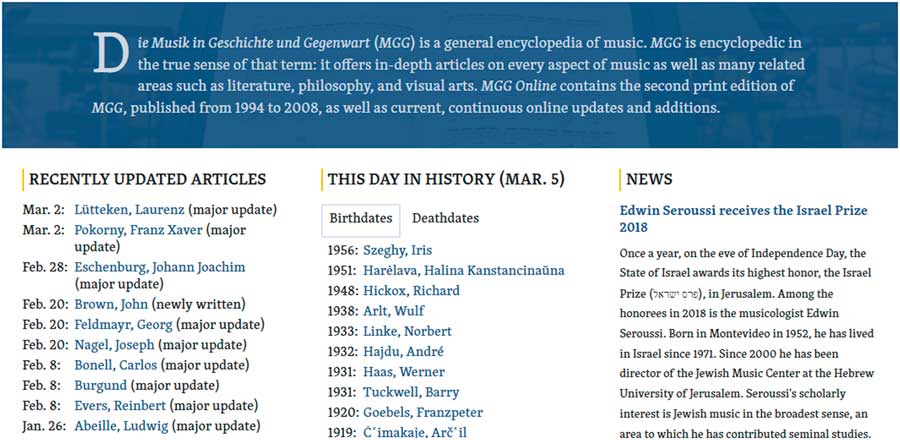
Major updates of articles have already been achieved since the launch of MGG Online for a variety of subjects, among them entries on scholars – Laurenz Lütteken (March 2018), composers – Pierre Boulez (October 2017), performers – Julian Bream (January 2018), and cities, countries or continents – Paris (November 2016), the United States (July 2017). Newly minted articles uploaded in recent months include items in the fields of music consumption (‘Spotify’, defined bilingually as ‘Kunstwort aus englisch »spot« und »to identify«’) and musical criticism (‘George Bernard Shaw’, a surprising omission from MGG2);Footnote 27 plans for new commissions are focused particularly on the areas of popular music, jazz, gender studies, American and Canadian music, contemporary composers and new media. Updates are regularly announced on the home page (with links to the articles concerned), as well as in MGG’s continuing publicity beyond the online platform.Footnote 28 The home page also carries topical reports. Its news column is the repository for items across a range of interest: beyond information on new or projected developments within MGG itself, these include announcements of prizes, new findings, such as the previously unknown viola piece by Shostakovich discovered by scholars investigating the estate of the violist Vadim Borisovskij, and obituary notices (see Fig. 3). Among recent obituaries posted online, it was good to see Walther Dürr, guru of Schubert scholarship (and author of the much-admired entry on Schubert in MGG), commemorated gracefully in this way shortly after his death in January 2018.Footnote 29
MGG ‘News’, captured 5 March 2018

Platform
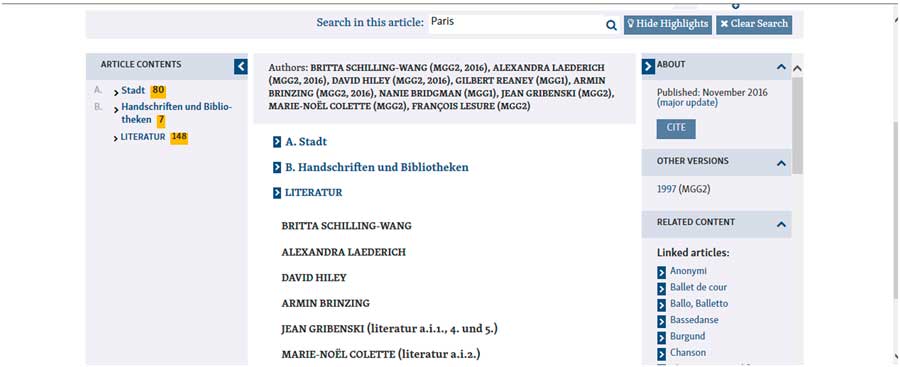
Altogether the setup of MGG Online offers a visually pleasing and helpfully arranged site – outstanding of its kind – devised with a plethora of ‘user-friendly’ features that should be welcomed by both the veteran reader of MGG and the newcomer to the work, and with interface available in a choice of English or German. The partnership with RILM that has been entered into for the production, marketing and distribution of MGG Online enables continuing development of its platform, enhancing the content by providing links with RILM Abstracts and offering what are described as ‘cutting-edge search and browse functions’, together with other attractive features such as easy toggling between article versions. (When articles are called up, any differing versions on file are indicated in the right-hand panel with links to access them: see Fig. 4).Footnote 30 Individuals can create user accounts in which to store and share their personal bookmarks and annotations. Since the launch of MGG Online a new ‘Share’ button has been introduced, enabling the posting of items extracted from MGG Online on Facebook or Twitter.
MGG ‘Paris’, captured 30 November 2017

The ‘Help’ section in the menu on the MGG home page offers the equivalent of Grove’s video tour, with clearly set out guidance on such essential aspects as search terms, as well as how to limit the search, for example to worklists or bibliographies; interpreting and filtering the results list; and navigating the articles themselves.Footnote 31 Both the search process and the content it produces are enhanced by a generous provision of sortable features. At an early stage in my exploration of the site, it was only after typing the three-word title Frauen und Musik into the search box and receiving a bizarre response, that I saw among the guidance the warning that typing more than one term in the box would give results for each independently; to search for a phrase it’s necessary to surround it in the box with quotation marks. (For all my subsequent efforts I didn’t find an equivalent in MGG Online to the Grove entry dedicated to ‘Women in music’, although MGG includes the topic in its ‘Gender Studies’ article.Footnote 32) The MGG guidance seems not to mention the procedure for citation of articles, but it’s self-evident, as shown in Figures 1 and 4: clicking on ‘Cite’ in the box next to the article text gives the correct formula, with option to copy the citation to clipboard. (Grove more economically gives the citation at the head of each article accessed, as shown in Figure 2). MGG’s array of icons includes an interactive function enabling the reporting of typographical or factual errors in the article texts (click on the wrench).
Among technical problems I encountered (some of which were probably owed to the computer I was using), I found that essential formatting was regularly lost in the process of downloading articles from MGG Online: this affected such features as spacing, initial capitals and (more seriously) italic font for titles of works and publications, which totally disappeared. With the longer entries I accessed and wanted to save in my own files, to restore the lost paragraph spacing to the copied and pasted word document for greater ease of reading, I tried toggling between the articles on screen and my saved versions in order to transfer the paragraphing to the latter. For a less laborious method of achieving this, and to retain more of the formatting generally, Jonathan Greenberg, product manager for MGG Online at RILM, advised that downloading articles via the print icon (three dots at the top right-hand side of the article page) should give better results from the printable version.
Conducting my informal survey of colleagues for their opinions on MGG Online, I learnt from their responses that for some institutions the cost was a barrier that needed considering, and that the language barrier was also perceived as a problem. As regards the former obstacle, the cost of institutional subscriptions is adjusted depending on various factors. (Individual subscriptions are not yet available.) On the question of language, MGG is linked with Google Translate (click on the globe), giving options for translation of article texts into around 100 languages. While the results of applying this are variable in quality – the samples I took tended to feature some mystifying gobbets of gobbledegook among what were otherwise largely faithful versions of the original text – MGG is concerned to point out that Google Translate is constantly aiming to improve its quality control.Footnote 33
Finally, MGG should perhaps include a warning to its customers: this product could become addictive. During the course of my guest subscription I found myself looking forward intensely to my regular MGG-fix, and was conscious of feeling bereft of it on days when I was unavoidably offline. In sum, the careful and thoughtful planning underpinning the production, development and maintenance of MGG Online offers a distinctive, high-quality resource that is poised both to inform the devotee of music reliably, and to inspire new scholarship in the field of musicology. This landmark development in the history of this distinguished publication deserves the widest possible readership.