Introduction
The incidence of iron deficiency anaemia has been observed in 30–50% of children in developing countries. Reference Piednoir, Allou and Driss1 Therefore, anaemia is one of the most common preoperative comorbidities observed in cardiac surgical patients, and it is estimated to affect 25–40% of these patients. Reference Puri, Price and Spinner2 Among numerous aetiologies of anaemia, iron deficiency has been reported in 80% of the children supposed to undergo cardiac surgery. Reference Faraoni, DiNardo and Goobie3 Anaemia is known to exacerbate left ventricular dysfunction and has been implicated in poor functional recovery, excessive morbidity, and mortality after cardiac surgery. Reference Cutrell, Barros and McBroom4 Furthermore, preoperative anaemia has been reported to increase the risk of allogeneic transfusion, acute renal failure, pulmonary complications, stroke, or death. Reference Lau, Low and Ling5–Reference Karkouti, Wijeysundera and Beattie7
Several studies have reported promising postoperative outcomes and reduced transfusion requirements after iron supplementation among non-cardiac surgery patients Reference Guinn, Schwartz and Arora8,Reference Klein, Chau and Yeates9 Additionally, preoperative iron supplementation among adult cardiac surgery patients has been shown to be efficacious in reducing the majority of adverse primary end points Reference Spahn, Schoenrath and Spahn10,Reference Bolliger, Mauermann and Buser11 However, meta-analyses did not find a consistent beneficial effect of preoperative iron supplementation due to poor study design, lack of control, and varying duration and dosage of iron supplementation. Reference LaPar, Hawkins and McMurry6
Postoperative blood transfusion increases the risk of prolonged hospital stay, need for mechanical ventilation, and oxygen supplementation in children with acyanotic CHD. Reference Khan, Natarajan and Sallaam12 Moreover, preoperative anaemia increases the risk of postoperative blood transfusion. Preoperative iron supplementation would replenish iron stores and may augment haemoglobin to reduce allogeneic blood transfusion and is likely to reduce the incidence of postoperative anaemia. A lower risk of transfusion and a higher perioperative haemoglobin may decrease the risk of cardiopulmonary and renal complications. Therefore, the study hypothesised that preoperative iron supplementation may reduce allogeneic blood transfusion, morbidity, and ICU stays.
Materials and methods
This investigator-initiated, randomised, controlled, open-label, assessor-blinded, pragmatic, and parallel-arm study was conducted in a large tertiary care centre. Ethical approval of this study (protocol no. JIP/IEC/2022/109) was provided by the Institute Ethics Committee. The trial was registered at the clinical trial registry of India (https://ctri.nic.in; Study Identifier: CTRI/2022/12/047861 (https://ctri.nic.in); Date of Registration: 02/12/2022). The study enrolled patients after trial registration and was conducted according to the Helsinki Declaration. The study adhered to the CONSORT guideline. The parents or legal guardians provided written informed consent to participate in the study. Children aged 6 months to 12 years with a haemoglobin level of <13 g/l undergoing cardiac surgery for acyanotic CHD were included in this study. Children who had known haemoglobinopathies, malabsorption syndrome, a history of haematemesis, iron intolerance, and received iron supplementation within 3 months and were undergoing emergency surgery were excluded.
The patients were enrolled and randomised at the time of the outdoor visit to seek an appropriate date for the proposed surgery or during index hospitalisation for surgery. The randomisation was done using a computer-generated block randomisation sequence in variable blocks of 2–4 participants in age group blocks of 6 months-2 years, 3 years–6 years, 7 years–9 years, and 10 years–12 years. The allocation was concealed in serially numbered opaque sealed envelopes. The random allocation sequence and allocation concealment (serially numbered opaque sealed envelopes) were done by a senior resident/nurse who was not part of this study. The patients were enrolled in a 1:1 ratio.
The children in the intervention arm received
Colloidal iron = 3 mg/kg/day, and folic acid = 80 mcg/day (7–12 months), 150 mcg/day (1–3 years), 200 mcg/day (4–8 years), 300 mcg/day (9–12 years)
Cyanocobalamin = 0.4 mcg/day (7–12 months), 0.5 mcg/day (1–3 years), 0.9 mcg/day (4–8 years) and 1.2 mcg/day (9–12 years)
The medications were administered in a syrup formulation (Tonoferon syrup, East India Pharmaceutical Works Limited, Kolkata). Each 5 ml of syrup contains 80 mg of iron, 200 mcg of folic acid, and 2 mcg of cyanocobalamin. The volume of syrup was adjusted according to the body weight and age of the children. All children continued to receive preoperative supplementation for a minimum of 7 days up to the day of surgery. All other relevant medications related to the treatment of acyanotic CHD were continued in the intervention and control arm. The control arm did not receive a placebo and continued receiving all other medications prescribed by the treating team. The children who received <3 days of iron supplementation were withdrawn from the study. Syrup-containing medications were discontinued if bloating or diarrhoea or pain in the abdomen persisted >1 day. Medication was re-administered after 5 days.
The preoperative medication, anaesthesia procedure, and monitoring modalities were left to the discretion of the attending anaesthesiologist. A single dose of tranexamic acid (20 mg/Kg) was administered after anaesthesia induction. Cardiopulmonary bypass was initiated using non-pulsatile flow @2.5–3.5 L/min/m2 with the roller pump and membrane oxygenator using mild hypothermia (30–34°C). The priming solution consisted of fresh-packed red blood cells, fresh-frozen plasma, Plasmalyte, and mannitol. The haematocrit level during cardiopulmonary bypass was maintained between 25 and 30%. After cross-clamping, the children received 20 ml/kg of Del Nido cardioplegia (a 1:4 mixture of blood to crystalloid cardioplegia). Cardioplegia was repeated when bypass time exceeded 60 min. Weaning from cardiopulmonary bypass, inotropic and vasopressor choices, and postoperative intensive care was decided by the intensive care physician. The postoperative management plan, monitoring, and extubation strategies in the paediatric cardiac critical unit were decided by the intensive care team. The intensive care team was unaware of the treatment arm. Furthermore, allogeneic blood product transfusion was decided by the team comprised of the anaesthesiologists and ICU consultants, and it was based on clinical judgement and prevailing haemodynamic parameters. Nonetheless, allogeneic blood transfusion was avoided whenever haematocrit was >27.
Outcome measures
The primary outcome was the number of allogeneic blood transfusions during hospitalisation for index surgery. The secondary outcome measures were the length of hospital stay, duration of mechanical ventilation, surgical site infection, acute kidney injury, major adverse cardiac and cerebrovascular events, pulmonary complications, death within 30 days, and readmission to the hospital within 6 months. Compliance with medications was recorded. All side effects pertaining to medication, namely bloating, dry mouth, diarrhoea, constipation, and loss of appetite, were recorded. All uncertainty related to outcomes will be resolved with the help of paediatricians, intensivists, neurologists, cardiologists, radiologists, and cardiac surgeons.
Outcome definitions
Cardiovascular complications: A composite of persistent inotrope or vasopressor requirement, lactate > 2 mmol/lit, cardiac arrest, and arrhythmia 48 hours after surgery.
Central nervous system complications: a composite of stroke or infarct or sensory/motor and cranial nerve deficits or poor mentation during the hospital stay 48 hours after surgery.
Renal complications: A rise in creatinine by at least 2 times or requirement of peritoneal dialysis during the hospital stay 48 hours after surgery.
Pulmonary complication: A composite of a new-onset collapse or consolidation or effusion or requirement for oxygen supplementation or non-invasive or invasive ventilation to maintain saturation >94% during the hospital stay 48 hours after surgery.
Statistical analysis
The volume of perioperative allogeneic blood transfusion in a retrospective cohort of children who underwent cardiac surgery under cardiopulmonary bypass was 12.5 ± 3.83 ml/kg. Reference Otsuka, Naraine, Switzer and Faraoni13 We assumed a 10% reduction in the mean (1.25 ml/kg) amount of allogeneic blood consumption in the perioperative period after iron supplementation. The mean difference of 1.25 ml/kg with 80% power and type 1 error of 5% provided an initial sample population of 148 (74 in each group). A final sample estimate was 162, assuming a dropout rate of 10%. A primary safety and efficacy analysis was planned after 50% of the enrolment. The predefined Haybittle-Peto stopping rule was based on the reduction in allogeneic blood transfusion, favouring the overwhelming treatment effect of iron supplementation with a required significance value of 0.001. The study was stopped once we had recruited 86 children at the time of interim analysis.
Analysis was done using the intention-to-treat principle, comprising all children in the group they were randomised to. Data were analysed using SPSS 24.0 version. Outcome measures were assessed for normality using the Kolmogorov–Smirnov test. Independent t-tests were used for all outcome measures satisfying normal distribution. The Mann–Whitney u test was used for outcome measures not satisfying the normal distribution curve. Categorical variables were also assessed for normality and were analysed using the Chi-Square test, or Fisher”s exact test, or Wilcoxon test, as appropriate. The one-way analysis of covariance was used to find differences in means and statistical significance after adjusting for the covariate. A P-value < 0.05 was considered significant.
Results
One hundred children were assessed for eligibility, and 86 children were included for randomisation (Figure 1). Forty-three children received intervention (iron supplementation), and 43 were in the control arm.
Consort diagram (flow of information).

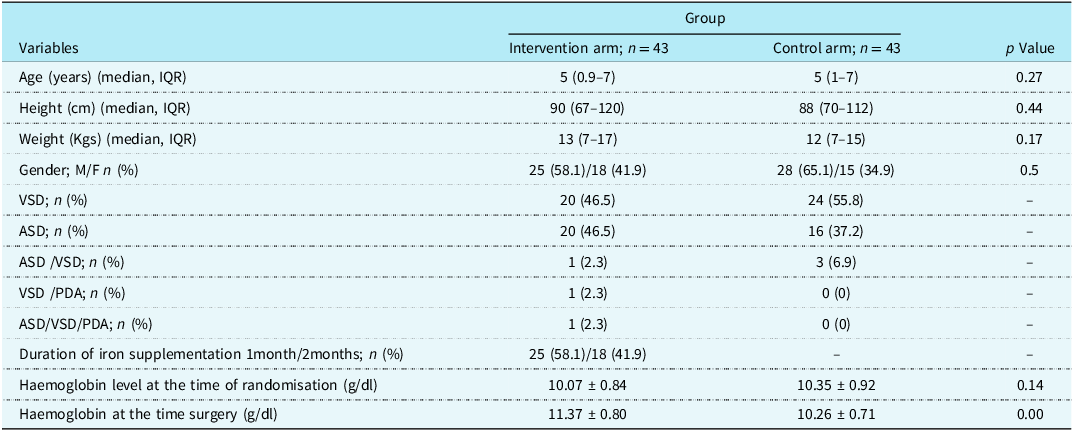
The median age of the children was 5 (0.9–7) and 5 (1–7) years, respectively, in the intervention and control arm. Isolated ventricular septal defect and atrial septal defect closure were performed commonly in both arms. A total of 58.1% of the children received iron supplementation for at least 1 month, and the remaining children received 2 months of iron supplementation in the intervention arm. A total of two children had bloating while receiving oral iron supplementation. The medication was stopped for 5 days and continued thereafter.
The patients in the intervention arm had a significant mean increase (1.34 g/dl) in haemoglobin level from the time of enrolment to the time of surgery (p < 0.001) (Table 1).
Demographic variables

Data has been expressed as median (IQR), number (percentage), and mean ± SD.
ASD = atrial septal defect; VSD = ventricular septal defect; PDA = patent ductus arteriosus.
The duration of cardiopulmonary bypass, aortic cross-clamp time and vasoactive inotropic score are mentioned in Table 2.
Intraoperative variables

Data has been expressed as Median (interquartile range).
Primary outcome
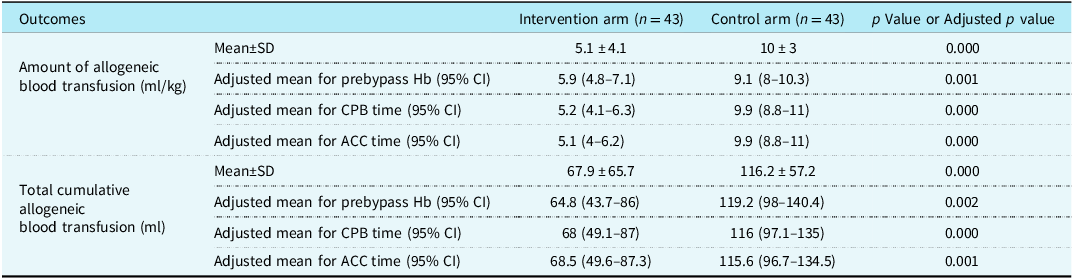
In unadjusted analysis, the allogeneic blood transfusions (ml/kg; median (IQR) were significantly lower in the intervention group 5 (0–8) vs 10 (8–12) p < 0.001). Furthermore, total cumulative allogeneic blood transfusion was also significantly lower in the intervention arm (60 ml (0–100) vs 100 ml (70–140); p < 0.001) (Table 3). A significant difference in allogeneic blood transfusion remains unchanged when adjusted for pre-bypass haemoglobin (p = 0.001), cardiopulmonary bypass time (p = 0.000), and aortic cross-clamp time (p = 0.000) (Table 4).
Primary outcome

Data has been expressed as Median (interquartile range).
*p value <0.05 is significant.
Adjusted primary outcomes for age, pre-bypass haemoglobin, cardiopulmonary bypass time, aortic cross-clamp time

Data expressed as mean ± SD or mean (95% CI).
CPB = cardiopulmonary bypass; ACC = aortic cross clamp; CI = confidence interval.
Secondary outcomes
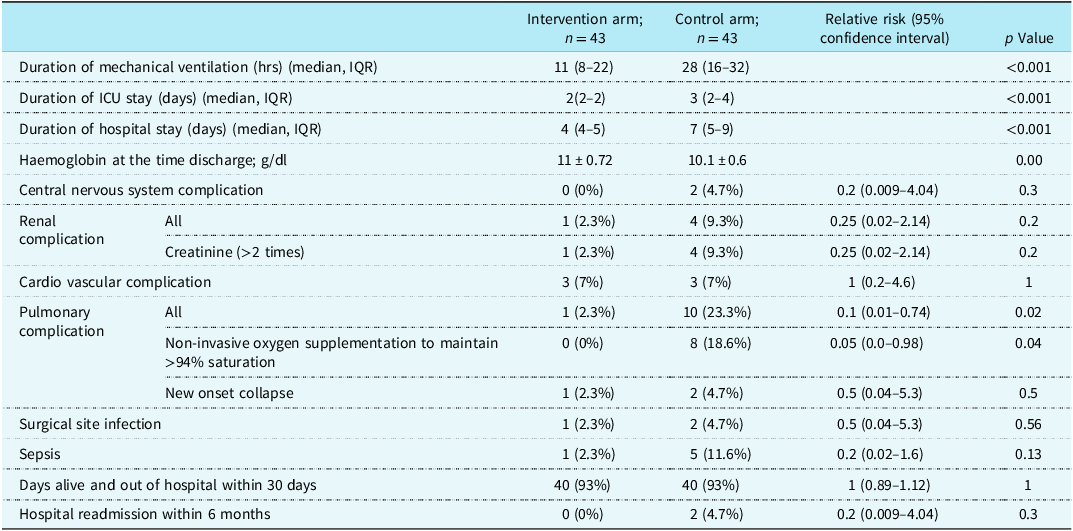
The duration of mechanical ventilation (hours) {(12 (8–22) vs 28 (16–32)}; p < 0.001) and duration of ICU stay (days) {(2 (2– 2) vs 3 (2–4); p < 0.001)} were significantly lower in the intervention arm. Furthermore, the duration of hospital stay (days) was (4; 4–5 vs 7; 5–9; p < 0.001) was significantly lower in the intervention arm (Table 5). The incidence of cardiovascular, central nervous system, renal complications, surgical site infections, and sepsis were comparable. However, the control arm had significantly higher pulmonary complications (23.3% vs 2.3%; p = 0.004). Furthermore, days alive and out of the hospital within the 30th day after the index operation and readmission to the hospital within 6 months were similar (Table 5).
Secondary outcomes

Data has been expressed as Median (interquartile range) or number (percentage); mean ± SD.
Out of the 43 children in the intervention arm, none of them had central nervous system complications, 3 (7%) had cardiovascular, 1 (2.3%) had renal, and 1 (2.3%) had pulmonary complications. A total of one (2.3%) had a surgical site infection, and 1 (2.3%) had sepsis. A total of 40 (93.0%) children were alive and out of the hospital within 30 days, and none required hospital readmission within 6 months.
Out of the 43 children in the control arm, 2 (4.7%) had central nervous system, 4 (9.3%) had cardiovascular, 3 (7%) had renal, and 10 (23.3%) had pulmonary complications. A total of two (4.7%) had surgical site infections, and 5 (11.6%) had sepsis. A total of 40 (93.0%) children were alive and out of hospital within 30 days, and 2 (4.7%) required hospital readmission within 6 months. A total of 3 children died due to severe pulmonary artery hypertension, 2 died due to severe sepsis, and 1 died due to a pulmonary complication.
Discussion
In this truncated, pragmatic, randomised, open-label clinical trial, we observed a significant reduction in allogeneic blood transfusion in anaemic children with acyanotic CHD after oral iron supplementation during interim analysis. Additionally, the duration of mechanical ventilation, ICU, and hospital stays was significantly lower in the intervention arm (graphical abstract). However, there were no significant differences in major organ complications, sepsis, surgical site infections, or mortality. Of note, pulmonary complications were more frequent in the control arm.
Preoperative anaemia and allogeneic blood transfusion have been shown to increase post-operative morbidity and mortality. In a retrospective cohort of 296 children with CHD, no statistically significant difference was reported in exposure to red blood cells (50% vs. 61%; p = 0.93) after preoperative iron supplementation. Nevertheless, the requirement of red blood cells (1 (0–14) mL/kg vs 12 (0–23) mL/kg, p = 0.004) and volume of autologous blood transfusion 11 (7–17) mL/kg vs 17 (11–31 mL/kg, p < 0.001) during the intraoperative period were significantly less in the preoperative iron supplementation group. Reference Otsuka, Naraine, Switzer and Faraoni13
In another retrospective analysis of 314 children with CHD, absolute iron deficiency increased postoperative blood transfusion (OR 1.837, 95% CI 1.016–3.321, p = 0.044). However, there was no significant difference in postoperative morbidity, mortality, and the length of hospital stay. Reference Gao, Wang and Zhang14
These findings are consistent with our study. Nonetheless, we did not measure serum iron levels, and we may assume that iron deficiency is the most common cause of anaemia in developing countries. Therefore, most children in our study must have been iron-deficient.
Miceli et al. noted a higher length of hospital stay >7 days (54% vs 36.7%, p < 0.0001) in anaemia groups who didn”t receive iron supplementation. Additionally, in propensity-adjusted, multivariable logistic regression analysis, preoperative anaemia (odds ratio, 1.44; 95% confidence interval, 1.02–2.03) and length of hospital stay >7 days (OR 1.3; 95% CI 1.15 to 1.47) were independent predictors of mortality. Reference Miceli, Romeo, Glauber, de Siena, Caputo and Angelini15
In another study, a lower preoperative haematocrit level led to a longer duration of mechanical ventilation and required increased postoperative mechanical ventilation. Reference Tsukinaga, Takaki and Mihara16
Blood transfusion during cardiopulmonary bypass increases postoperative blood loss (86 ± 125 vs 32 ± 16 mL/kg, p < 0.001), duration of mechanical ventilation (214 ± 268 vs 99 ± 75 hours, p < 0.001), and stays in the ICU (10.9 ± 12.1 vs 5.3 ± 3.5 days, p < 0.001). Reference Redlin, Boettcher, Kukucka, Kuppe and Habazettl17
Independent of transfusion strategy, the number of transfused red blood cell units was an independent risk factor for clinical complications or death at 30 days (hazard ratio for each additional unit transfused, 1.2 (95% CI, 1.1–1.4); p = .002). Reference Hajjar, Vincent and Galas18 However, we noted no significant difference in major organ complications, infection, or death. Of note, pulmonary complications were significantly higher in the control group in our study (p < 0.001). The supplemental oxygen requirement to maintain >94% oxygen saturation was noted as the most frequent pulmonary complication. The postoperative lower haemoglobin (10 gm/dl) in the control arm could have resulted in a higher incidence of oxygen requirement (pulmonary complications) after surgery.
In a double-blinded randomised clinical trial in non-anaemic adults undergoing cardiac surgery, intravenous iron supplementation significantly lowers a mean number of red cell unit transfusions {(0.3 (0.8) vs 1.6 (4.4); p = 0.007}. The mean haemoglobin concentrations on postoperative Day 4 were {9.7 (1) g/dl and 9.3 (1) g/dl; p = 0.03)} in the intervention arm. Reference Friedman, Dann and Bitton-Worms19
In another large prospective trial in adult cardiac surgery patients, an ultra-short-term combination treatment with intravenous iron, subcutaneous erythropoietin alpha, vitamin B12, and oral folic acid reduced RBC transfusions from a median of one unit in the placebo group (IQR 0–3) to zero units in the treatment group (0–2), during the first 7 days (odds ratio 0.70 [95% CI 0.50–0.98] for each threshold of number of RBC transfusions, p = 0.036) and until postoperative day 90 (p = 0.018). Reference Bolliger, Mauermann and Buser11
In adult cardiac surgery, an expert panel suggested evaluating iron deficiency irrespective of anaemia in all patients undergoing cardiac surgery. It recommended parental iron and erythrocyte-stimulating agents before cardiac surgery. Reference Corwin, Shander and Speiss20
Contrary to the above-mentioned studies, Garrido-Martin et al. did not observe a reduction in postoperative blood transfusion requirement after preoperative oral or intravenous iron supplementation. Reference Garrido-Martín, Nassar-Mansur and de la Llana-Ducrós21 Additionally, in a systematic review, the authors reported the paucity of studies and biases within them. Therefore, the current evidence for preoperative management with intravenous iron before cardiac surgery is weak.
Similarly, studies related to preoperative iron supplementation in paediatric cardiac surgery are limited, and we need to generate evidence to strengthen the blood management practices in the paediatric cardiac surgical population.
Clinical implications
Anaemia is prevalent in developing countries, and preoperative anaemia has been shown to affect postoperative outcomes. Preoperative iron supplementation builds iron stores, transferrin saturation, ferritin, and haemoglobin concentrations. Both absolute and relative iron deficiency may impair haemoglobin synthesis. In children, rapid growth, parasitic infection, and chronic inflammation may lead to depletion in iron stores. Low haemoglobin impairs tissue oxygen delivery and leads to tissue hypoxaemia-induced major organ damage. In addition to the role of iron in haemoglobin synthesis, it plays a vital role in oxygen transport, mitochondrial activity, myocardial muscle bioenergetics, cell signalling, and gene expression. Therefore, iron is likely to affect cellular haemostasis at several levels. Patient blood management and blood conservation are crucial in cardiac surgery, and the demand for allogeneic blood transfusions in cardiac surgery is substantial. Though a patient blood management programme is structured, organised and widely recognised in adult cardiac surgery, the lack of data prevents us from implementing these organised blood management practices in paediatric cardiac surgery. Furthermore, preoperative oral iron supplementation appears to be a simple, feasible and attractive intervention to improve patient blood management practice and allogeneic transfusion requirements.
Therefore, preoperative haemoglobin optimisation and anaemia correction will likely improve blood conservation and may reduce allogeneic blood transfusion. Furthermore, reduced allogeneic blood transfusion may lessen the risk of major organ complications and mortality. This prospective study unravels the role of preoperative oral supplementation in reducing the need for allogeneic blood transfusion.
Strengths and limitations
There is a paucity of literature on preoperative iron supplementation in paediatric cardiac surgery. Furthermore, limited data have yielded conflicting results. This was a prospective, pragmatic, randomised trial aimed at assessing allogeneic blood transfusion requirements in acyanotic CHD. We captured data till 6 months after surgery. Outcome assessors and cardiac anaesthesiologists were blinded to minimise bias. Intravenous iron supplementation may not be possible in children due to several reasons. Therefore, oral iron supplementation appears physiologically justified, considering the compliance, feasibility and tolerance.
The study has a few limitations too. Small sample size and single-centre study are notable limitations. The study showed an overwhelming treatment effect of iron supplementation, and we decided to stop the trial prematurely based on our prespecified interim analysis plan and statistical boundary. Therefore, the overestimation of the treatment effect, limited safety data on oral iron, and lack of adequate power for key secondary outcomes are noticeable limitations. This was an open-label trial, and children and caregivers were not blinded, as we could not find a matched placebo (colour, consistency, and taste) for children. We recruited anaemic children with haemoglobin <13 gm/dl. However, we did not characterise anaemia and assumed all children had iron deficient anaemia. We did not determine iron, ferritin, transferrin, and hepcidin levels. Determination of iron status could have further helped in the stratification of children based on the extent of iron-deficiency status. Nevertheless, iron supplementation, irrespective of haemoglobin level, has been shown to improve oxygen delivery, bioenergetics and cell signalling. Furthermore, the findings may not be generalisable as iron deficiency anaemia, unlike developing countries, is not prevalent in developed nations. We chose oral iron supplementation, and children reported good compliance and tolerability. All children in the intervention arm had at least a 1 gm/dl rise in haemoglobin level before cardiac surgery compared to the time of enrolment.
Conclusion
Preoperative oral iron supplementation in anaemic children with congenital acyanotic heart disease significantly reduces the perioperative need for allogeneic blood transfusion. Additionally, iron supplementation reduces the duration of mechanical ventilation, ICU and hospital stays. However, major organ complications and mortality remained similar. Larger multicentre trials are required to validate the findings of this study.
Acknowledgements
None.
Financial support
This research was supported by intramural funding of the institute Jawaharlal Institute of Postgraduate Medical Education and Research, Puducherry, India.
Competing interests
None of the authors reported conflicts of interest.
Ethical standard
Ethical approval of this study (protocol no. JIP/IEC/2022/109) was provided by the Institute Ethics Committee of Jawaharlal Institute of Postgraduate Medical Education and Research, Puducherry, India (Chairperson: Dr Reba Kanungo) on 28th July 2022.
Author contributions
Ajay Kumar Jha, MBBS, MD, DM: This author helped with intellectual content, study design, writing and editing all sections of the manuscript, and approving the manuscript for publication.
Abishek Murugaiyan, MD, DM: This author helped with intellectual content, study design, writing and editing all sections of the manuscript, and approving the manuscript for publication.
Satyen Parida, MBBS, MD, PDCC: This author helped with intellectual content, study design, data collection, writing and editing all sections of the manuscript and approving the manuscript for publication.
Chitra Rajeswari Thangaswamy, MBBS, MD: This author helped with intellectual content, study design, data collection, writing and editing all sections of the manuscript and approving the manuscript for publication.
Hemachandran Munuswamy, MBBS, MS, MCH: This author helped with intellectual content, study design, data collection, writing and editing all sections of the manuscript, and approving the manuscript for publication.
Data availability statement
The data underlying this article will be shared on reasonable request with the corresponding author.
Declaration of AI in writing
None of the content of this paper was written with the help of AI or AI-assisted technologies.
Consent to participate
Written informed consent from parents or legal guardians.
Consent to publish
Written informed consent from parents or legal guardians.
Clinical Trial Registry India number
CTRI/2022/12/047861 (https://ctri.nic.in); Principal Investigator: Abishek M; Date of registration: 2/12/2022)
Link: https://ctri.nic.in/Clinicaltrials/pmaindet2.php?EncHid=Nzc1NDE=&Enc=&userName=