In February 1979, Idi Amin, one of the world's most notorious dictators, escaped Uganda, the chaotic country he had led for almost two decades. Some 300,000 people are believed to have died as a result of Amin's reign. Ultimately Amin died in Saudi Arabia in August 2003, never having answered for his crimes. Milton Obote, Amin's successor (who, ironically, Amin had forced into exile eighteen years earlier), was by some accounts guilty of torturing and killing even more people than Amin. Toppled in a coup in 1985, Obote obtained asylum in Zambia, where he died in October 2005 seeking hospital treatment in South Africa.1
See “Obituary: The Buffoon Tyrant,” BBC News, 16 August 2003; and “Obituary: Milton Obote,” BBC News, 18 October 2005. Available at http://news.bbc.co.UK/2/h1/africa/597725.stm. Accessed 26 March 2006.
“No One Writes to the Tyrants,” Guardian Unlimited, 20 January 2003. Available at 〈http://www.guardian.co.uk/Iraq/Story/0,2763,878739,00.html〉. Accessed 26 March 2006.
Such cases are disturbing for at least two reasons. First, there is the obvious normative concern that perpetrators of atrocities are not being punished for their crimes. Second, there is the more practical question of deterrence—if leaders who commit atrocities are able to get off scot-free, what hope is there of deterring such crimes in the future? In part to help prevent the recurrence of cases such as those described above, a group of states created the International Criminal Court (ICC) in 1998 after a half-century of on-again-off-again negotiations. The ICC entered into force in summer 2002, and in summer 2003 the Court's first Chief Prosecutor, Luis Moreno-Ocampo, was appointed.3
Information on current events at the ICC is available at 〈http://www.icc-cpi.int/otp/otp_events.html〉.
While the modal opinion in legal journals probably supports the creation of the ICC, the Court has been the object of virulent criticism from both legal scholars and policymakers. Unfortunately neither the Court's proponents nor its detractors have been particularly rigorous in how they have made their arguments, so it is difficult to tell if the disagreement stems from faulty logic or simply from differences in unstated assumptions. This article attempts to contribute to the debate by offering a more formal argument about the possible implications of the creation of the ICC. I focus on two criticisms of the Court: (1) the ICC will fail to be effective because it lacks enforcement, and (2) the ICC will prolong the reign of leaders who have abused human rights and make it more costly to get rid of them.
Goldsmith offers a forceful example of the first critique:
[T]he ICC is unlikely to punish the Husseins and future Miloševićs of the world because it is unlikely to get a grip on them. The ICC has no inherent enforcement powers. It depends completely on member states to arrest and transfer defendants. So the efficacy of … prosecutions depends on the uncertain resolve of nations to use military or economic force to extricate the oppressive leader from his country.4
If this argument is correct, then by implication the ICC cannot be expected to fulfill the goal of deterring atrocities.5
For a focus on the ICC's capacities (or lack thereof) to deter atrocities, see Wippman 2000; and Smidt 2001. For a more positive assessment, see Akhavam 2001.
Baby Doc Duvalier … ended up living on the French Riviera…. Idi Amin, … has lived in Saudi Arabia for the last twenty years now…. [W]hen you think about justice and especially Idi Amin, who killed a lot of people, the question is this: was it better to offer him sanctuary in Saudi Arabia, or would it have been better to say to him when he was still in power, “We are going to prosecute you?” The reaction of any autocratic ruler under those circumstances would be to hold on to power as long as he possibly can…. Threatening these actors with prosecution may make it more difficult to get rid of them.6
I analyze these criticisms within the context of a game-theoretic model. I show that despite the lack of an international police force to enforce its indictments, the ICC may still deter leaders from committing atrocities at the margin because it offers potential asylum-granting states the option of refraining from offering asylum to atrocious leaders who are so likely to be deposed that they would willingly surrender to the ICC to avoid retribution from domestic political rivals (which I assume is worse than the punishment handed out by the Court). Since all leaders know that there is some chance (however remote) they will be in that position, the expected present value of committing atrocities is reduced, and at the margin some leaders will refrain from committing them.
The model also suggests that the concern that the ICC will prolong tyrants' reigns may be exaggerated. The ICC, as with any international institution, must be self-enforcing. States will only comply with it if they have the incentive to do so. The ICC has no power to punish states that harbor atrocity committers, so states will refrain from doing so only when it provides at least as high a payoff as not doing so. In this model they will only refrain from offering such leaders asylum when those leaders are so likely to be deposed that they are willing to surrender to the ICC, and therefore the reign of atrocity-committing dictators will not be prolonged as a result of the creation of the institution.
A second contribution of this article concerns the role of enforcement in making international regimes effective. International relations scholars have known for some time that “trigger strategies” can induce states to comply with international regimes despite their lack of a higher authority to enforce those rules as long as the states' interactions are repeated indefinitely and they do not discount future payoffs too heavily. According to other literatures, these enforcement provisions are unnecessary for regimes to be effective. Compliance is either simply a management problem or enforcement is unnecessary because norms or new knowledge created by the regime induce states to comply with its rules.
This article offers a rational choice model of an international institution that alters states' behavior even though it is not enforced by trigger strategies or any other mechanism. Furthermore, the model does not resort to “epistemic community” or norms arguments, nor does it treat noncompliance as a management problem. There is no outside intervention either by states or international organizations to depose leaders who commit atrocities, and states that harbor such leaders are not punished in any way. Still, states may refrain from offering asylum when the dictator's hold on power is sufficiently tenuous because they know the dictator would be willing to surrender to the ICC. States only comply with the institution's indictments when it is costless to do so. They will regularly fail to comply with the regime modeled here, by which I mean they will continue to grant asylum to leaders who have committed atrocities; however they will comply with it enough to deter atrocities at the margin.
In short, the article contributes to both the policy debate surrounding the ICC and the theoretical literature on enforcement and international cooperation. While the model offers no hope that the creation of the ICC will bring about a world free of atrocities, it does offer a set of conditions under which there will be marginally fewer atrocities thanks to the creation of the institution. Furthermore, there is no downside to creating the institution in this model since the reign of atrocity-committing leaders is not prolonged as a result. Second, the model offers an interesting example of a rational choice model in which an international institution is effective even though no punishments (whether tit-for-tat, grim trigger, and so on) are employed to enforce compliance.
In the next section I review the debate on the necessity of enforcement for regime effectiveness and discuss the implications of the model for that debate. In the second section I turn to a discussion of the literature on the ICC. The third section offers an informal discussion of the model and its results. I highlight a few features and extensions of the model in the fourth section before concluding in the final section.
Is Enforcement Necessary for Regimes to Be Effective?
The main implication of this research for broader international relations theory concerns enforcement and the efficacy of international regimes.7
I would like to thank the editor and the two anonymous reviewers for pointing out this contribution of the model.
This discussion is necessarily brief. For a fuller discussion, see Martin and Simmons 1998; Simmons 1998; Raustiala and Slaughter 2002; and Simmons and Martin 2002.
The game-theoretic approach provides one answer via the “folk theorem.” If the interaction between states is repeated indefinitely, states can enforce their treaty commitments by employing trigger strategies. Cooperation is enforced by the credible threats (either implicit or explicit) of the other members of the agreement to revert to noncooperation for some subsequent amount of time in punishment for any deviation from cooperation. Even in cases where noncompliance is a dominant strategy in the one-shot interaction, states will comply with their commitments. According to these theories, states would fail to comply with agreements and the agreements would have no effect on state behavior without such enforcement mechanisms.
More recently, scholars have questioned whether these types of enforcement mechanisms are the best way to understand states' compliance with their treaty commitments and whether they are necessary or even desirable for international agreements. One such group of scholars has been dubbed the “managerialists” by Downs and colleagues, who provide a nice summary of managerialist thinking:
Its message is that (1) compliance is generally quite good; (2) this high level of compliance has been achieved with little attention to enforcement; (3) those compliance problems that do exist are best addressed as management rather than enforcement problems; and (4) the management rather than the enforcement approach holds the key to future regulatory cooperation in the international system.9
Downs and colleagues are quite critical of this argument. They question whether the relatively good record of compliance indicates that enforcement is unimportant since in equilibrium, regimes will be designed to bring about compliance. One cannot infer from the sterling record of compliance whether enforcement measures are unnecessary or very necessary but also very effective. Furthermore, if enforcement provisions are weak or nonexistent as managerialists contend, high rates of compliance are probably due to shallow treaties. They argue that we should not be sanguine about the combination, touted by managerialists, of weak or nonexistent enforcement and high rates of compliance because that combination implies shallow treaties.10
Downs, Rocke, and Barsoom 1996. Also see Simmons 1998, 80, for a discussion of this debate. Tallberg 2002 takes the middle ground, arguing that within the European Union (EU) both approaches are used and both are valuable in promoting compliance.
Another school of thought that regards enforcement as unimportant for regime effectiveness is the normative approach (often associated with constructivism). According to this approach, credible punishments for noncompliance are not what change state behavior. Instead, regimes change states' preferences away from noncooperation toward cooperation by establishing new norms that alter states' perceptions of what behaviors are acceptable.11
Simmons 1998 offers a review of this literature. A few examples from the large norms literature include Kratochwil and Ruggie 1986; Franck 1990; Nadelman 1990; Klotz 1995; Florini 1996; Finnemore 1996; Legro 1997; Finnemore and Sikkink 1998; Keck and Sikkink 1998; Price 1998; Clark 2001; and Rudolph 2001.
Dai 2005.
Similar to the accounts described in the preceding paragraph, the regime modeled in this article has no enforcement provisions either explicit or tacit, and states are not punished for noncompliance. Unlike those accounts, neither norms nor learning play any role in the model, nor does the model treat compliance as a simple management problem or rely on pressure from domestic constituencies. States in the model often will strictly prefer noncompliance (that is, offering asylum to indicted leaders) and will fail to comply in such situations. Indeed, contrary to the accounts described above, noncompliance will be quite frequent in this model, and yet it is still effective in that states comply with it enough that it does deter atrocities at the margin. The regime modeled here is crucial to this change in state behavior because without it, the foreign state would continue to offer asylum to dictators in those cases where it refrains from doing so after the creation of the regime.
Indeed, this discussion raises the issue of whether a good record of compliance is even necessary for regimes to be effective. The two concepts, compliance and effectiveness, are sometimes conflated in the literature. However, as Raustiala and Slaughter point out, “[R]egimes can be effective … even if compliance is low. And while high levels of compliance can indicate high levels of effectiveness they can also indicate low, readily met and ineffective standards.”14
Raustiala and Slaughter 2002, 539.
Downs, Rocke, and Barsoom 1996.
In summary, the model provides a rational choice account of a regime that changes state behavior but where enforcement is unnecessary and perhaps even undesirable because it may introduce commitment problems and prolong atrocious leaders' reigns. Members of the regime frequently will fail to comply with the regime but they will occasionally comply, which is enough to deter atrocities in some cases. Harsher punishments for members who offer asylum to indicted leaders would induce more compliance but may come with the added cost of prolonging the rule of atrocious dictators.
Previous Research on the ICC
The legal literature on the ICC is voluminous, so a thorough review of it is beyond the scope of this article. The political science literature on the topic is sparser, and can be divided into theoretical and empirical contributions. Turning first to the theoretical contributions, the only other game-theoretic treatment of the ICC of which I am aware is Moghadam, who argues that the ICC may deter atrocities.17
Moghadam 2004.
In a rational-choice-based case study of a related topic—treaties on treatment of prisoners of war—Morrow argues that states refrain from violating POW treaties in times of war because if they did, their enemies may retaliate by doing the same.18
Morrow 2001.
Meernik also raises some of the questions raised here: “To what extent should we expect the international community to hold individuals accountable? Will individual leaders comply with international law? Most importantly, what factors will influence the level of enforcement of and compliance with international law?”19
Meernik 2004, 356.
Turning to empirical studies, Meernik and Shairick examine the kind of states that have acceded to the ICC and find that states with high degrees of civil liberties are more likely to do so. They also find that states with a greater dependence on foreign aid and more foreign debt are more likely to sign the Rome Statute. Meernik and Shairick interpret this latter finding as evidence that economically strong states with a commitment to the ICC have been able to use economic leverage to induce smaller states to sign the treaty.20
Meernik and Shairick 2005.
Kelley 2005. In these agreements, states pledge to refrain from surrendering each other's citizens to the ICC. The agreements are allowed under Article 98 of the Rome Statute (thus the name). The American Service Members' Protection Act of 2001 requires such agreements before member states of the ICC are eligible for U.S. military aid. As of this writing, the United States has concluded ninety-two of these agreements.
Rudolph's paper was published before the Rome Statute entered into force, so his discussion is understandably highly qualified. Applying a constructivist norms-based approach to case studies of three ad hoc international criminal tribunals and the negotiations over the Rome Statute, he infers: “The evidence suggests that expanding liberal norms of state conduct and protecting human rights certainly explain the existence of tribunals in locales with little strategic or material importance.”22
Rudolph 2001, 681.
In short, research on the ICC has been dominated by empirical studies, both qualitative and quantitative, on the negotiations of the Rome Statute and of the types of countries that have signed it and most closely adhered to the spirit of it by refraining from Article 98 agreements. Given the youth of the regime, it is understandable that none of this work offers much insight into the prospects for an effective ICC. What theoretical work there has been either assumes away the problem of enforcement by including an “international community” that intervenes to impose the Court's indictments or addresses war crimes treaties, which (as Morrow has convincingly argued) plausibly possess the self-enforcing features which are common in rational choice models of international cooperation but which are absent in the case of the ICC. Thus, this article contributes to the literature on the ICC by offering a model of the regime that explicitly addresses its inherent lack of enforcement in a rational choice framework. I now turn to that model.
Informal Presentation of the Model and Results
In this section I will first provide a brief overview of the logic of the argument. I will then turn to a fuller discussion of the players and their preferences. Following that, I will discuss the timing of the model and then present the results in somewhat more detail and offer some intuition and comparative statics for the results. The model is presented more formally in the appendix.
Logic of the Argument
The logic of the argument can be summarized as follows:23
I thank an anonymous reviewer for this cogent summary of my argument.
- Dictators' payoffs (in expected present value) of committing atrocities are increased if they can expect asylum when they have low odds of retaining power and they face domestic retribution that they could avoid by asylum.
- Foreign countries prefer not to have atrocity-committing dictators in power in other countries and so cannot credibly commit to deny asylum to an asylum-seeking human rights abuser.
- Voluntary surrender to the ICC is worse for human-rights-abusing dictators than asylum but may in some cases be better than attempting to stay in power because of the risk of retribution from their domestic political rivals (which I assume is worse than the punishment imposed by the ICC) if they are deposed.
- The existence of the ICC allows foreign countries to credibly reject requests for asylum in these cases, because dictators will voluntarily step down peacefully and surrender to the ICC.
- Thus the existence of the ICC lowers the expected present value of committing atrocities in the first place, because there is a chance dictators will find themselves in the position of preferring to surrender to the ICC, when without the ICC they would have obtained asylum in a foreign land in such a case. This is the ex ante deterrence effect.
- Since states that are potential safe havens for dictators can ignore the ICC without penalty, the regime does not reduce their incentive to grant asylum except in cases where dictators prefer surrendering to the ICC than staying in power, and because surrendering to the ICC is completely voluntary, the option does not increase dictators' incentive to hold on to power to avoid ICC prosecution. Thus the regime does not increase dictators' incentive to cling to power to avoid prosecution.
In a nutshell, the existence of the regime modeled here allows states to credibly refuse asylum in some cases when, without it, they would prefer to offer it, and it does so without prolonging the reign of atrocity-committing dictators.
Players and Their Preferences
There are three players in the model at any given time: the leader (Li, i∈{1, 2, 3,…}), the foreign state (S),24
The model generalizes straightforwardly to multiple foreign states.
Timing of the Model
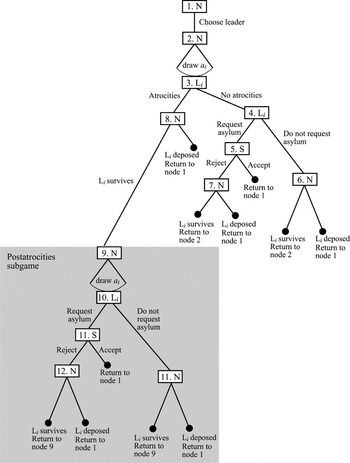
The extensive form of the game is presented in Figure 1. The timing in the model is as follows. A new leader (Li) is chosen by Nature (N). Nature then chooses the probability that that leader Li will be deposed if he or she commits atrocities and, knowing that probability, the leader chooses whether or not to commit atrocities. If leaders do not commit atrocities, they can request asylum abroad or they can take their chances on surviving in office. If they survive, the game repeats and a new survival probability is drawn. If however leaders commit atrocities, they face a lottery over their political survival. If leaders survive until the following period they enter the postatrocities subgame. In each iteration of that subgame a new at is drawn. Knowing that probability, leaders decide whether to request asylum or to take their chances on the lottery over their political survival. If the leaders request asylum, the foreign state has the choice of granting it or not granting it. If the foreign state refuses to grant asylum, leaders face a lottery over their survival as described above. Committing atrocities has an irreversible effect in that once leaders commit atrocities, their probability of survival is given by the random variable at in each period thereafter, and if they are deposed, they suffer a retribution punishment regardless of whether they commit atrocities in that period or not.

Game form of the stage game, preinstitution
In short, leaders' decision of whether or not to commit atrocities is a trade-off between the increase in their probability of surviving politically that committing atrocities may afford versus the extra costs of the more severe punishment they will suffer if they are deposed. The possibility of asylum abroad mitigates this latter concern because the leaders know that if their probability of surviving in office becomes too low, they have the option of requesting asylum and (assuming that request is honored) going into exile with impunity.
Results
In this section I will describe the results in somewhat more detail and provide the intuition for them. Readers should turn to the Appendix for a complete explication of the model. First, I will describe the outcomes in the model before the international court is created. I will then turn to the outcomes in the model after the creation of the international court to show the effects of the institution on the leaders' incentive to commit atrocities and to show that leaders have no increased incentives to hold on to office longer than they would without the institution.
Preinstitution
In the preinstitution setting the foreign state has a dominant strategy to accept the leader's request for asylum. The foreign state is assumed to suffer disutility from there being a leader in power who has committed atrocities. Once a leader commits atrocities, the foreign state would prefer that that leader be removed from power because there is some chance (depending on Nature's draw of at+1) that the subsequent leader will not commit atrocities. Thus by accepting the current leader's request for asylum the foreign state will get rid of an atrocious dictator for sure. However, if the foreign state rejects the leader's request, it is rid of the current leader only with probability 1 − at.
The leader's equilibrium behavior is equally straightforward. Leaders will commit atrocities if doing so increases their probability of remaining in office by a sufficient degree. Leaders will not commit atrocities for a small increase in their probability of remaining in office, because once leaders commit atrocities they “cross the Rubicon” in the sense that they will have to pay the retribution costs for their past atrocities whether they continue to commit atrocities or not. Once leaders commit atrocities they will play the lottery over their political survival in subsequent periods as long as Nature draws a high enough probability that they will survive. If, however, Nature draws too low a probability, leaders will choose to request asylum. In such a case, their expected present value from exile with asylum is higher than from attempting to hold on to political office where there is a chance they may be deposed and have to pay the retribution cost. In fact there is a cutoff level of at, which I call α, for which leaders are indifferent between requesting asylum and playing the lottery over their survival. For values of at lower than α, the leader strictly prefers asylum in a foreign land to attempting to stay in office, and as I already discussed, the foreign state has a dominant strategy to accept such a request. Therefore, in such a situation the leader will request asylum and it will be granted.
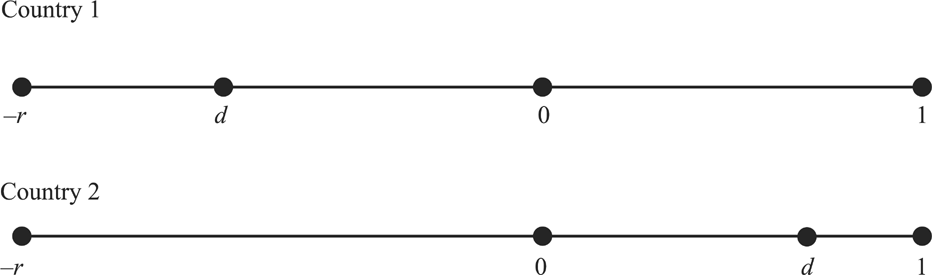
Leaders commit atrocities in this model when doing so increases their chances of surviving politically and when the penalty they suffer if they are deposed having committed atrocities (−r) is small relative to the payoff of being deposed not having committed atrocities (d). The italicized qualification is important because casual empiricism would suggest that the penalties from being deposed in states most plagued by atrocity-committing leaders are quite high and may include assassination or execution possibly preceded by torture. The point is that the penalties of being deposed not having committed atrocities are also quite high in these states, and may also involve torture and death. By comparison, being deposed in states not prone to atrocities is not that unpleasant. Financially lucrative book deals and speaking engagements are the norm; assassination and detention are quite rare.
Figure 2 illustrates this difference between two hypothetical states. In country 1 the norm for political succession is assassination. In country 2 the norm for political succession is well-ordered transfers of power with the loser going into august retirement. In other words, d is considerably higher in country 2. Assume that the retribution costs of being deposed having committed atrocities are the same in both states. As illustrated in Figure 2, the difference in the penalty of being deposed after committing atrocities compared to the penalty of being deposed after not committing atrocities is quite small in country 1. In country 2, by contrast, the difference between these two penalties is quite large. In both cases the penalty to the leader from committing atrocities is identical, but d is lower in country 1 because of the two different norms of succession. As such, the leader would have more incentive to commit atrocities in country 1 than in country 2.

Differences in scale arising from different norms of succession in two different states
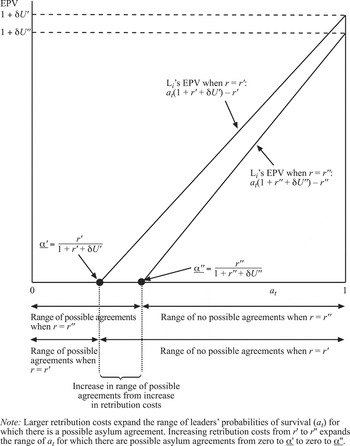
Figure 3 illustrates the effect of increasing the retribution costs. Higher retribution costs reduce leaders' expected present value of committing atrocities. As such, leaders' expected present value of committing such abuses will be lower for any given value of at and leaders prefer asylum to attempting to stay in power for relatively higher values of at. Leaders will step down with higher probabilities of surviving in office and they are less likely to commit atrocities in the first place (that is, Nature must draw higher values of at before they are willing to commit atrocities).

Comparative statistics on at and r
Postinstitution
The institution modeled in this article creates a nonstrategic actor, the prosecutor, who automatically indicts any leader who commits atrocities.25
Obviously this assumption is not general. Allowing the prosecutor to choose which atrocity committers to indict and which to ignore is a possible extension of the current model.
Admittedly there may be some uncertainty as to whether the leader will actually be convicted after he turns himself in, and there may also be some ambiguity a priori about what the leader's punishment will actually be in the end. I abstract from those complications here. I also do not consider the possibility that the prosecutor may negotiate a “plea bargain” with the leader in which the leader surrenders and receives a payoff with an expected present value less than zero but still greater than −m. As discussed below, there are circumstances in which allowing such a possibility will enhance the deterrent effect of the institution.

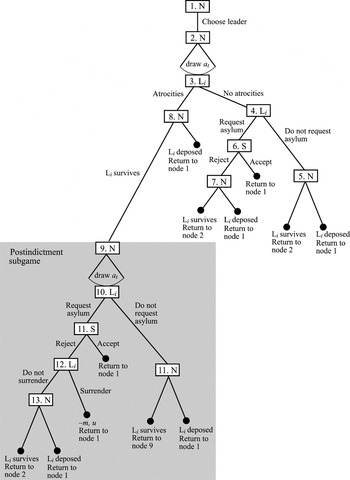
Game form of the stage game, with institution
The expected present value of asylum is normalized to 0; however, leaders may still be willing to surrender to the prosecutor if the foreign state turns down their request for asylum because by doing so they avoid retribution from their domestic political rivals. Indeed there is a cutoff value of at, which I call

, for which leaders are indifferent between surrendering to the prosecutor and attempting to remain in power. I also define another cutoff value of

, which is the value of at for which leaders are indifferent between stepping down and not doing so if they receive asylum from the foreign state. Obviously

; that is, the probability of survival for which leaders would be willing to step down and be punished must be lower than the probability for which they are willing to step down with impunity.
An important feature of the game is that it does not give the prosecutor any means of enforcing its indictment on the foreign state. The foreign state does not pay any costs for granting the leader asylum. Obviously this is an extreme assumption; however, it does have some basis in fact. The Rome Statute contains several loopholes that allow members fairly wide latitude as to whether they must comply with the Court's requests, and the ICC has no explicit enforcement provisions. The Court must rely on the cooperation of its members.27
Henquet 1999.
Without any higher authority to enforce the foreign state's compliance with the new institution, all commitments that the foreign state has made by joining it must be self-enforcing—the foreign state cannot obtain higher utility from accepting the leaders' requests for asylum than it does from rejecting them. Still, the addition of the prosecutor alters the foreign state's incentives in important ways. First, while the foreign state still has a strictly dominant strategy to accept leaders' requests for asylum when

, the foreign state no longer does when

, because when leaders' probabilities of survival are that low, leaders will actually surrender to the prosecutor if the foreign state rejects their request. Therefore, when leaders' probabilities of survival are that low, the foreign state is rid of them whether it accepts their requests or not. Note that if the foreign state complies with the prosecutor's indictment it is not doing so to avoid punishment from the regime's other members, because by assumption there are no such punishments. Instead, the foreign state complies simply because it is costless to do so. In fact, because it is costless to comply with the prosecutor's indictment, when leaders' probabilities of survival are that low, the foreign state may as well do so regardless of whether it is a member of the regime or not.
The effect of this change on the foreign state's behavior may in turn affect leaders' behavior. I say “may” because the effect depends on leaders' beliefs about what the foreign state will do if a value of

is actually drawn. If leaders do not believe that the foreign state will reject their request in those circumstances, the regime will have no effect on their behavior. However, if leaders believe that the foreign state will comply with the regime when it is costless to do so, their expected present value of committing atrocities will be reduced. Before the creation of the regime, leaders' expected present value if Nature drew

was 0, because the leader would obtain asylum in the foreign state under such circumstances. Under such beliefs, leaders' expected present value if Nature draws at in that range is lower as a result of the regime (namely −m < 0). The possibility that leaders may be forced to accept punishment for atrocities if Nature draws a sufficiently low value of at reduces their expected present value of committing atrocities, and therefore makes it less likely that they will do so in the first place. Specifically, the value of at that Nature must draw to make it worthwhile for the leader to commit atrocities is higher and therefore less likely to be drawn.
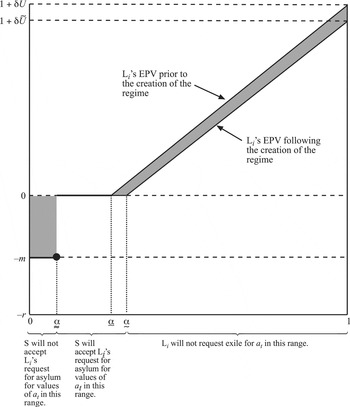
Figure 5 illustrates what might be called the “total” effect of the new regime on leaders' expected present value of committing atrocities when leaders believe the foreign state will reject their request for asylum when it is costless to do so. There is a direct effect and an indirect effect. The direct effect is that for values of

leaders will surrender to the prosecutor and receive a punishment with an expected present value of −m rather than 0. The indirect effect is the reduction in leaders' expected present value of being in the postindictment subgame, as compared to the postatrocities subgame before the creation of the regime. This indirect effect in turn causes an increase in the value of at for which leaders will request asylum from

and a downward shift in leaders' expected present values for draws of

. The total change in the expected present value as a result of the direct and indirect effects can be found by integrating the expected present value in each of the two scenarios (pre- and postregime) over all possible values of at. As shown in Figure 5, the total expected present value of committing atrocities is smaller by the amount of the gray shaded area as a result of the institution and therefore leaders are less likely to commit atrocities in the first place.

Total effect on the regime when Li believes S will comply when
Discussion
A few points are worth highlighting to clarify the model and its results. First, the model points to a problem with the criticism, mentioned in the introduction, that the ICC will fail to deter because it has no enforcement power. That criticism assumes that foreign military or economic intervention is the only way human rights abusers may be brought to justice, but of course that is not the case. As Akhavam put it:
[P]olitical … fortunes change, and the seemingly invincible leaders of today become the fugitives of tomorrow. Whether their downfall comes through political overthrow or military defeat the vigilance of international criminal justice will ensure that their crimes do not fall into oblivion undermining the prospect of an easy escape.28
Akhavam 2001, 7.
The mechanism modeled in this article is akin to the one that Akhavam describes. The institution modeled here has no means of sanctioning either atrocity-committing leaders or the states that offer them sanctuary. Despite the extreme weakness of enforcement powers for both the institution and foreign states, the institution may, in the right circumstances, still have some deterrent effect because leaders may recognize that a time may come when their best option is surrendering to the international prosecutor. Under those circumstances they may have little hope of obtaining asylum because states have no incentive to offer it. Indeed, the record of the International Criminal Tribunal for the Former Yugoslavia provides some examples of this process at work. As of 2003, of the sixty-nine indicted war criminals in the custody of the ICTY or on provisional release, a plurality (twenty-seven) surrendered voluntarily.29
International Criminal Tribunal for the Former Yugoslavia 2003. Of the remainder, twenty-four were detained by international forces, eleven were arrested by Serbia, and seven were turned over by other states. Eighteen remain at large.
A second implication of the model is that the number of periods in which atrocities are committed will not increase as a result of the creation of this institution. This result is in stark contrast to the concerns mentioned in the introduction that fear of prosecution will induce some atrocity-committing leaders to hold on to office longer than they otherwise would have. The institution potentially reduces leaders' expected present values of committing atrocities, which in turn means that leaders are less likely to do so in the first place (Nature will have to draw a higher at for them to choose to do so). In doing so, however, the institution does not prolong the reign of leaders who have committed atrocities. As I show in the Appendix, the cutoff point of at (leader's probability of survival), below which the leader will step down, cannot be lower with the institution than without it and in general it will be larger. In other words, the institution modeled here will not increase the number of periods of atrocities and may reduce them.
The motivation for this criticism is the realization that leaders will be less willing to step down if they are going to be punished for their crimes than if they will not be punished. Those incentives are illustrated by a comparison of

, the maximum value of at for which the leader would be willing to surrender to the prosecutor, and

, the maximum value of at for which the leader would be willing to step down if granted immunity. The former is unambiguously lower than the latter; meaning that the range of at for which leaders would be willing to step down and be punished is smaller and therefore less likely to be drawn from. The point is that surrendering to the prosecutor is not the only way that leaders who have committed atrocities might leave office even after the creation of the new regime. Foreign states may still agree to grant asylum if it is the only way to get rid of an atrocious dictator.
This criticism appears to be based on one of two assumptions. The first is that states will comply with the Court's indictments even when it is not in their interests to do so. Under this assertion, mutually beneficial asylum agreements between beleaguered dictators and foreign states will be foregone because they would be contrary to the requirements of the ICC. In this model, states only comply with the institution's indictments when it is costless to do so; that is, when doing so offers them at least as high an expected present value as not doing so. On occasion (when

), states may refuse to offer asylum but only because they know that the leader will surrender to the prosecutor anyway. The scenario in which the reign of atrocity-committing leaders is prolonged cannot occur in this model because in such a case, states would simply not comply with the indictment and would offer the dictator asylum.
Alternatively, this criticism could be based on the assumption that the ICC has some enforcement power—that it can impose costs on states that do not comply with its indictments or somehow make it easier for other states to do so. If the ICC had such power then the kind of asylum agreements between a leader and a foreign state modeled here would become impossible because they would no longer be credible.
30The timing of the costs is important. If the foreign state were to pay one-time costs for making such an agreement, then agreements would still be possible if those costs were not too high. Such costs would be paid once, at the time the leader went into asylum, and therefore would be irrelevant to any future decision making. The scenario discussed above is a case where the ICC is somehow able to impose costs after that dictator has gone into asylum. The foreign state cannot credibly accept a request for asylum in those circumstances because it has a dominant strategy to turn the leader over to avoid such costs.

.
The assumption that the ICC has such enforcement power is problematic. Indeed, the ICC's lack of enforcement power is one of the central criticisms of the regime as discussed above. More importantly, membership in the ICC, while fairly broad, is far from universal. States that are not members of the ICC have not committed themselves to comply with the prosecutor's indictments and have no legal responsibility do so. Of course, individual states and the UN Security Council can always impose sanctions or other punishments on a country for harboring atrocity committers, but those entities had that option before the creation of the ICC and the creation of the ICC does make it any easier or less costly to avail themselves of that option. The point is not that commitment problems do not exist, but that there is nothing to indicate that the ICC will make them more severe.31
Suppose, however, that the creation of the ICC does, despite all of the indications to the contrary, make punishing states that harbor atrocity committers easier—including states that did not even sign the Rome Statute. The effect of the ICC is ambiguous in such a case. The deterrent effect of the ICC would make atrocities less likely. That effect would be offset by the effect of prolonging the reign of atrocity committers. Which of these effects will dominate is unclear.
Third, the model has implications for the criticism that ICC will create a system of “Cadillac justice” in which leaders are tried fairly by the ICC and low-level perpetrators are subjected to harsh and unfair trials at home. The point of this criticism, which was raised by Roth, among others, is mainly normative—such a result is unfair on its face.32
Roth 2002. This criticism was raised about the Rwandan tribunal in particular. Because of this and other problems with the tribunal, the Rwandan government actually voted against the establishment of the tribunal; see Akhavam 1996; and Henquet 1999.
Fourth, the institution in this model does not really do anything. The prosecutor merely waits for human-rights-abusing dictators to surrender to the Court. As such, this analysis may beg the question: why did the world need an ICC at all? It is true that what the institution modeled here accomplishes could be accomplished simply by states pledging not to harbor human rights abusers unless those abusers pay some agreed-on punishment (recognizing that states will fail to comply with those pledges when

). However, such a treaty would still leave the practical problem of whom the leader would surrender to and who would extract the “payment” of −m. These tasks could have been delegated to a state member of the agreement, but the creation of a prosecutor's office seems as good a choice as any.
Fifth, the model has implications for a potential problem that participation in the regime is far from universal. Will nonmembers of the ICC make the regime irrelevant by continuing to offer atrocity-committing dictators asylum? This model suggests that there is no reason for them to do so as long as those leaders' probability of surviving in office is sufficiently low. The effect of the regime in this model is not the creation of some enforcement mechanism that induces the regime's members to comply with their treaty obligations. Rather, the effect of the regime is the creation of an international agent to whom atrocity-committing dictators can surrender and who can hand out punishments to those dictators. The regime fulfills a jurisdictional gap that previously existed in international criminal law. A country that is not a member of the regime has no less incentive to refrain from offering a leader asylum than does a member of the regime.
A sixth point is that it may appear that the problem of atrocities is too easily solved in this model. If the international community wants to eliminate atrocities, all it has to do is set the punishment handed out by the prosecutor (m) at a high level, which will produce a large reduction in the expected present value of being in the postatrocities subgame, and atrocities will be deterred. However, that interpretation of the role of m in the model would be incorrect; m is the cost of punishment to the outgoing leader. The prosecutor does not really have that much control over that parameter. The prosecutor has limitations on how harsh a punishment it can set, and the prosecutor cannot alter the leader's valuations of certain outcomes. Regarding the ICC in specific, life in prison is the worst punishment that it can hand down, and it is likely that that punishment is simply not that bad compared to what many leaders could expect to receive from their domestic opposition. I might also mention that the model implies that making m very large would lead to more offers of asylum.33
I thank Lisa Martin for pointing this implication of the model out to me.
Finally, the model suggests a possible role for plea bargaining. Before the creation of the institution in this model, leaders who draw at less than α enter into an asylum agreement and receive a payoff with a present value of 0. Such leaders are receiving a surplus from asylum. They would have actually been willing to “pay” in some sense for asylum but are not required to do so. The lower their value of at is, the greater their surplus from an asylum agreement. Following the creation of the institution, leaders with sufficiently low values of at are required to “pay” through the imposition of punishment cost m. It is the prospect of this “payment” that reduces the expected present value of committing atrocities and thereby deters some marginal human rights abusers.
Granting the prosecutor some ability to make “plea bargains” could actually enhance the deterrent effect of the institution in this model. If the prosecutor were allowed to make such agreements, he or she could tailor the punishment to each leader's value of at, thereby obtaining some punishment from every leader who draws a sufficiently low at that their expected present value of holding office is less than 0. Via these plea-bargained punishments, leaders would be required to “pay” so that they obtained no surplus from the plea agreement. The prosecutor would be playing a role akin to that of a price-discriminating monopolist. All leaders who drew an at that offered an expected present value of staying in power less than 0 would be punished to the maximum extent possible while still being induced to step down, so that the expected present value of committing atrocities in the first place would be even lower, and the deterrent effect would be greater.34
Unfortunately the plea bargains would have to be tailored to the leaders' probability of political survival and not to the severity of their crimes.
Conclusion
The model in this article considers the effects of an ICC-like institution on the strategic interaction between an atrocity-committing leader and a foreign state that would like to facilitate the transition to a more palatable leader. Before the creation of the institution, foreign states strictly prefer accepting any request for asylum from an atrocity-committing leader, and following the creation of the regime they no longer do in certain circumstances. If the leader is so likely to lose power that he or she would willingly accept punishment by the regime in return for protection from domestic political rivals, the foreign state has no reason to offer the leader asylum because regardless of whether it does or not, the atrocity-committing leader will step down.
The analysis addresses certain criticisms of the ICC in the literature. First, it provides some conditions under which the ICC may deter atrocities at the margin despite its lack of enforcement power. Second, the institution does not prolong the reign of atrocious leaders, as some commentators have worried. Leaders who would step down if granted asylum but who would not step down if forced to be punished for their crimes are granted asylum in this model. The only leaders who are actually punished in this model are those who willingly accept punishment to avoid retribution from domestic political rivals. As such, their reigns are not prolonged.
In addition to these policy considerations, the article makes a theoretical contribution to understanding the necessity of enforcement for the effectiveness of international regimes. The model provides an example of a regime that is efficacious despite the fact that none of the usual trigger strategies are employed to insure compliance. The institution deters atrocities under specified conditions even though foreign states never intervene to depose atrocity-committing dictators. Most interestingly, foreign states occasionally comply with the indictments of the prosecutor even though there is no punishment for noncompliance. Furthermore, the model does not rely on norms arguments or learning, or pressure from domestic constituencies, nor does it assume away the enforcement problem by asserting that it is a management problem.
A natural extension of the argument would be to better model the domestic political milieu—in particular, the process by which atrocities increase leaders' ability to hold on to power. Recent work by Bueno de Mesquita and colleagues has addressed this topic, although obviously without reference to the ICC.35
Bueno de Mesquita et al. 2003, chap. 8.
The main remaining question, of course, is how substantively important the potential deterrent effect discussed in this article will be. As Cameron has pointed out, there is little evidence that making punishments harsher lowers crime rates even within relatively well-functioning domestic criminal justice systems.36
Cameron 2004, 92–93.
Appendix
Basic Set-up of the Model
Players are described in main text. I assume the leader (Li) and the foreign state (S) have identical one-period discount rates of δ. Li derives per period utility of 1 from holding office and per period utility of 0 from not being in office. In the absence of atrocities by Li, S's per period payoff is 1, unless Li has committed atrocities, in which case S's per period utility is u < 1. S does not care whether Li holds onto power or is deposed, only whether atrocities have been committed or not.
If Li commits atrocities and is subsequently removed from office, Li suffers a one-time retribution cost of −r < 0, leaves office and the game ends for Li. If Li is deposed not having committed atrocities, he receives a one-time payoff of d ∈ (−r, 1) and the game ends for him. If Li goes into exile the game ends for him, but he avoids the retribution cost, −r, and does not receive the one-time payoff from being deposed, d. Once Li leaves office, either by being deposed or stepping down, the game ends for him, he has no prospect of returning to power and he receives a payoff of 0 each period from that point forward.
Nature (N) chooses the probability that Li will keep power in a given period if Li commits atrocities. I call this probability at where t indexes the current period. This probability is chosen from a known distribution F(a), with support [0,1] and associated density f (a). The value of at is common knowledge among all players. The probability that the leader holds on to power if he does not commit atrocities is fixed at q.
The game form of the stage game, which corresponds to the complete reign of a given leader, Li, and as such may cover several periods, is illustrated in Figure 1. The game form for the reign of a given leader after the first period in which he commits atrocities, which I refer to as “the postatrocities subgame,” is shaded gray. The remainder of the game form in Figure 1 corresponds to “the preatrocities subgame,” which is the subgame up to and including the first period (if any) that Li commits atrocities.
Play proceeds over discrete time periods t ∈ {1, 2, 3…}. In the preatrocities subgame the following moves occur sequentially in each time period. N chooses the probability that Li will be deposed if he commits atrocities. Li then decides whether or not to commit atrocities. If Li decides not to commit atrocities he can request asylum. The foreign state then decides whether or not to accept the request. If the foreign state accepts the request, Li steps down and the game ends for Li, returning play to the beginning of the preatrocities subgame. If the foreign state rejects the request, Li faces a lottery in which he keeps power with probability q and is deposed with probability 1 − q. If instead Li decides to commit atrocities, he faces a lottery over his political survival.37
A straightforward alteration of the game would be to allow Li to request exile after committing atrocities in the preatrocities subgame. Doing so would be superfluous, however, because if Li is planning to step down and go into exile in the first period of his reign, there is no reason to commit atrocities before doing so.
Sequence of play is similar in the postatrocities subgame. N chooses the probability that Li will be deposed. Li then decides whether to request asylum or not. If Li does not request asylum he faces a lottery over his political survival—he survives with probability at and is deposed with probability 1–at. If Li does request asylum, the foreign state then decides whether to accept the request or not. If the foreign state accepts, Li steps down, the game ends for him, and play returns to the beginning of the preatrocities subgame. If the foreign state chooses “reject,” Li faces a lottery over his political survival as described above.
I employ Markov perfect equilibrium (MPE) as a solution concept.38
Fudenberg and Tirole 1991, chap. 13.
Solving the Postatrocities Subgame
The only slight wrinkle in solving the postatrocities subgame is S's incentives at the last node of the game, which can be summarized as follows:
Lemma 1: If at > 0 and if there exists at+1 ∈ (0,1] such that Li+1 will refrain from committing atrocities, S has a strictly dominant strategy to accept Li's request for asylum.
The intuition for the result is that if S accepts Li's request for asylum, then, with some probability p > 0, which I describe in greater detail below, S will obtain a payoff of 1 in the subsequent period and obtain a payoff of u < 1 with probability 1 − p. If, however, S rejects Li's request, S will obtain a payoff of 1 only with probability p(1 − at). The important point is that S has a strictly dominant strategy to accept Li's request for asylum prior to the creation of the regime. MPE is crucial to this result, because it assumes players respond only to payoff-relevant information. As such, by rejecting a request for asylum, S does not change future leaders' beliefs about what it will do in the future, and therefore does not deter future atrocities.
Turning to Li's decision at the second node of the postatrocities subgame, Li's expected present value (EPV) of not requesting asylum at that node is:

Unsubscripted U in equation (1) is a constant, the formula for which is:

where

, and α is defined below. U is Li's EPV from the next period (before at+1 is known) forward of being in the postatrocities subgame—that is, U is Li's EPV at the first node of the postatrocities subgame.
If the EPV in equation (1) is less than or equal to 0, Li will request asylum, the EPV of which is normalized to 0, S will accept, and Li will step down. Leaders will not step down voluntarily until a sufficiently low at is drawn. If a leader is going to be willing to request asylum the following must be true:

Lemma 2: In any MPE of the game, the outcomes of the postatrocities subgame are:

Solving the Preatrocities Subgame
I begin the discussion of this subgame with S's decision to accept or reject a request for asylum. For ease of exposition, define S's EPV from node 1 forward as Ω and define S's EPV from node 9 forward as W. Ω is S's EPV when there is a new leader and W is S's EPV when it is already in the postatrocities subgame. More formally:

and

where p is the (constant) probability that N will draw a sufficiently low at in the next period that Li will refrain from committing atrocities in that period. Equations (3) and (4) can be combined to solve for values of W and Ω solely as functions of the constants

, and therefore W and Ω are themselves constants.
If Li has yet to commit atrocities, S has a weakly dominant strategy to accept a request for asylum. S's payoff from accepting such a request is 1 + δΩ. The highest payoff that S can receive from rejecting a request for asylum in the preatrocities subgame is 1 + q(δΩ) + (1 − q)δΩ = 1 + δΩ. This is the substantively uninteresting case where Li does not commit atrocities and steps down in the first period of his reign, so I simply stipulate that all such requests are accepted.
Turning to Li's decision at the third node of the preatrocities subgame, Li will commit atrocities if the EPV of doing so is higher than the EPV of not doing so. Li's EPV of not committing atrocities in the current period is:

Li can guarantee an EPV of 0 by stepping down in the first period. If the first term in the curly brackets is negative (which could happen if d or U were negative and large enough in magnitude) then the highest payoff that Li can receive when he does not commit atrocities is 0, which he obtains by stepping down. In such a case, Li will either not commit atrocities and step down, or if at is high enough, Li will commit atrocities.
A necessary condition for Li to choose to commit atrocities is that the EPV in equation (1) is higher than the EPV in equation (5). This will be the case if:

As indicated, this is only a necessary condition—obviously it must also be true that at > q since Li would not choose to commit atrocities if it lowered his probability of keeping office. Li will commit atrocities if at > α. Notice that α = α if the first term in the curly brackets in equation (5) is negative. In such a case Li would commit atrocities only if at > α = α, which by definition is the value of at for which the EPV of committing atrocities is equal to 0. Li will never commit atrocities in the preatrocities subgame if the EPV of doing so is negative because he can guarantee a higher EPV (0) by not committing atrocities and stepping down. Incidentally, p is the probability that at ≤ α.
Lemma 3: In any MPE of the game, the outcomes of the preatrocities subgame are:

Outcome 4a is the substantively uninteresting case where Li steps down and goes into exile in the first period of his reign. This occurs when Li's EPV of remaining in office is negative whether he commits atrocities or not. I will ignore this outcome for the remainder of the Appendix.
Adding an International Criminal Regime
Now suppose an international institution that is staffed by a nonstrategic actor P (the prosecutor) is created. P automatically indicts any leader who commits atrocities. The game form of the preatrocities subgame is unaltered by this change, but the postatrocities subgame is amended as indicated by the game form in Figure 5. I will call this subgame, the game form for which is shaded in gray in Figure 5, the “postindictment subgame” to distinguish it from the postatrocities subgame discussed above.
The postindictment subgame begins just as the postatrocities subgame did, with a draw of at by N. Li then chooses whether or not to request asylum. If Li chooses not to request asylum he is then faced with a lottery over his political survival in the usual way. If, however, Li requests asylum, he presents S with a choice to accept or reject that request. If S accepts Li's request, Li steps down and the game ends for Li as described previously. If S does not accept Li's request, then Li must choose whether to surrender to P and receive, with certainty, a one-time penalty of −m ∈ (−r, 0). If Li surrenders he steps down, returning play to the beginning of the preatrocities subgame. Alternatively, Li can choose not to surrender, in which case he takes his chances at holding onto office according to the usual lottery.
Solving the Postindictment Subgame
I will begin the discussion of equilibria in this new situation with Li's decision at the last node of this subgame where S has turned down his request for asylum. Li's EPV of not surrendering at that point is:

Unsubscripted

in equation (7) is Li's EPV in the next period (before at+1 is known) of being in the postatrocities subgame in this new situation following the creation of the regime. It is Li's EPV at the first node of the postindictment subgame.

is a constant, the value of which depends on Li's beliefs about what S will do in the future, as discussed below.
Define:

as the level of at for which Li would be indifferent between stepping down and not stepping down, if he could obtain asylum from S in this new situation following the creation of the regime. It is the value of at for which Li's EPV is 0 in this new situation. The only difference between

is that

has

in the denominator rather than U. I also define a new cutoff point:

This is the value of at below which Li would be indifferent between surrendering to P and attempting to stay in power. Li's EPV from surrendering to P is −m, so

corresponds to the level of at for which Li's EPV of attempting to stay in power was −m. If

, Li Li would prefer surrendering to P rather than attempting to stay in office, if S rejects his request for asylum. If

, Li would not be willing to surrender to P but would be willing to step down if he received asylum. If

, Li would be unwilling to step down even if granted asylum by S.
Turning to S's decision of whether to accept Li's request, the foregoing discussion implies that while S still has a strictly dominant strategy to accept Li's request when

, it no longer has a strictly dominant strategy to accept Li's request for asylum when

, because Li would be willing to surrender to P. S is indifferent between rejecting and accepting Li's request under those circumstances because, regardless of whether it accepts or not, Li will step down. Therefore Li can no longer be certain that S will accept his request for asylum. This is true regardless of whether S is actually a member of the agreement or not—that is, regardless of whether S has formally committed itself to comply with P's indictments or not. To summarize, the same two outcomes that occurred in the postatrocities subgame without the regime also occur, mutatis mutandis, in the postindictment subgame; however, in addition there is a new outcome in the postindictment subgame in which Li surrenders to P. These outcomes are formalized in the following lemma.
Lemma 4: In any MPE of the game, the possible outcomes of the postindictment subgame are:

The significance of 3b′ is that, despite P's lack of enforcement power, some atrocity committers may surrender to him. For low enough values of at, S will be indifferent between accepting Li's request for asylum and rejecting it, because S knows that even if it rejects the request, Li will surrender to P and step down. This is in contrast to the outcome in the previous section where S clearly had a dominant strategy to accept Li's request.
Note that there is some ambiguity about the equilibrium when

. S is indifferent between accepting and rejecting Li's request for asylum in those circumstances because either way Li will step down. In a MPE, S has no reason to reject Li's request for asylum for the purpose of sending a signal to leaders Li+1 and beyond because in MPE, players only make decisions based on payoff-relevant information. If I had assumed that S gets some very small utility increment, ε, from seeing atrocity committers punished, it would eliminate this ambiguity and make rejecting such a request a dominant strategy for values of at in the neighborhood of

and below. However, I do not make that assumption because it seemed ad hoc.
Solving the Preatrocities Subgame
The structure of the preatrocities subgame is identical to that of the subgame prior to the creation of the regime. As in the previous case, I will set aside the substantively uninteresting question of S's decision to offer asylum in this subgame, if asked.
39This is the case in which Li requests asylum in the first period of his reign. As before, the foreign state has a weakly dominant strategy to accept such a request, and so to dispense with this case I stipulate that it always does.

. I will dispense with the obvious case first: if Li believes that S will grant him asylum when

(in other words, he believes that equilibrium 3b′ will not occur), then the effect of the new regime on the equilibria in the preatrocities subgame will be nil. Li's behavior will be identical to that described in the previous section.
If however Li believes that outcome 3b′ will occur if N draws a low enough at, then his behavior in the preatrocities subgame will be quite different because his EPV of committing atrocities will be lower and this in turn will affect the cutoff values of at for which he would be willing to commit atrocities. At the third node of the preatrocities subgame, Li's EPV of choosing to commit atrocities is given by equation (7) where, given these beliefs:

Li's EPV of not committing atrocities at that node is:

where

is the (constant) probability that N will draw a sufficiently low at in the next period that Li will choose to refrain from committing atrocities. The new regime has no effect on Li's payoffs if he never commits atrocities because d and q remain fixed. The only difference in Li's EPV of not committing atrocities compared to the earlier case is in the change from U to

and from p to

.
As before, Li will commit atrocities if the EPV of doing so exceeds the EPV of not doing so—that is, if equation (7) is greater than equation (9). I define

as the value of at that makes these two equations equal, analogous to α in the previous section. According to the same line of argument in the previous section, Li will commit atrocities if N draws and

. I summarize these possible outcomes in Lemma 5.
Lemma 5: If Li believes that equilibrium 3b′ will occur when

, the possible outcomes of the preatrocities subgame following the creation of the regime are:

Finally, the analysis shows that the reign of a leader who has committed atrocities will not be prolonged as a result of the regime modeled in this article. Prior to the creation of the institution, Li would leave power whenever at < α, and after the creation of the institution, Li will leave office whenever

. Since

, a comparison of equations (2) and (8) shows that

.