Introduction
Patients with dementia living in Dutch nursing homes are generally housed in a ward with approximately 30 other patients. In each ward, there are two to three living rooms where about 10 to 15 psychogeriatric patients spend their days together. The nursing home staff endeavor to create a pleasant living environment: the radio and the television are often on, CDs are occasionally played, and activities are frequently organized which take account of the psychological and physical capacities of the patients. Unfortunately, limitations in terms of space and personnel inhibit an individually tailored approach. Today, with the wide-scale implementation of more experience-driven care, most nursing homes seek to provide activities that are attuned to the needs of their psychogeriatric patients (Kooij, Reference Kooij1998; Lange et al., Reference Lange, Dröes, Finnema and Kooij1999; Droës et al., Reference Dröes, Lange, Vink, Finnema, Jonker, Verhey and Slaets2001).
Dementia is often accompanied by behavioral disturbances, such as wandering, compulsive walking, verbal and vocal agitation, aggression, irritability and sleep disturbances (Zuidema et al., Reference Zuidema, van der Meer, Pennings and Koopmans2006; Reference Zuidema, Koopmans and Verhey2007). Wandering and agitation (verbal and vocal) are common among patients with dementia living in nursing homes, with prevalence rates ranging between 17% and 71% for wandering and between 10% and 39% for agitation. These disturbances can be taxing for both the patients and their carers. Except for physical aggression, healthcare providers report that wandering, compulsive shouting and verbal aggression are the most stressful incidents experienced in working with psychogeriatric patients (Bright, Reference Bright1986). Shouting appears to be associated with the experience of physical pain and depression, as well as with loneliness and the absence of structured activity (Cohen-Mansfield et al., Reference Cohen-Mansfield, Marx and Rosenthal1989; Reference Cohen-Mansfield, Werner and Marx1990). Verbal and vocal agitation is characterized by repeated shouting, screaming, complaining, moaning, negativity, and constantly demanding attention. Agitation occurs in the absence of justifiable circumstances and is highly disruptive to the patient's environment (Cohen-Mansfield and Werner, Reference Cohen-Mansfield and Werner1997; Vink, Reference Vink and Aldridge2000).
By carefully taking stock of the behavioral problems of patients with dementia, it is possible to improve our ability to provide tailored care. The physical and psychological causes of behavioral problems, as well as the environmental factors that exacerbate such problems, must be considered. The underlying determinants of and factors influencing behavioral problems are diverse. Consequently, interventions should endeavor to tackle those factors and determinants that are most relevant and most applicable to the patient in question (Cohen-Mansfield, Reference Cohen-Mansfield2001; Reference Cohen-Mansfield2003; Camp et al., Reference Camp, Cohen-Mansfield and Capezuti2002). If the nature of the behavioral problem and the capacity of the team allow it, a non-pharmacological intervention is preferred as this can limit the use of pharmaceutical drugs and their corresponding side effects (Kok and Verhey, Reference Kok, Verhey, Jonker, Verhey and Slaets2001). In fact, recent research has demonstrated that psychopharmaceutical drugs have only a limited effect on the above mentioned behavioral problems (Sink et al., Reference Sink, Holden and Yaffe2005). At the same time, studies investigating the effects of non-pharmacological interventions tend to be anecdotal (Cohen-Mansfield, Reference Cohen-Mansfield2001). To date, there is still little evidence regarding the influence of non-pharmaceutical interventions on the behavior of patients with dementia (Ayalon et al., Reference Ayalon, Gum, Feliciano and Areán2006; Spira and Edelstein, Reference Spira and Edelstein2006). Nonetheless, given that non-pharmaceutical interventions do not appear to be detrimental to patients with dementia, and given that limiting the use of pharmaceutical interventions – and especially the use of antipsychotic drugs – has clear advantages, we contend that non-pharmaceutical interventions should continue to be applied in clinical settings while we await more extensive research on the effects of such interventions (Kunik et al., Reference Kunik2007).
Like frequent interpersonal contact (proximity), music appears to have a calming effect on the behavior of patients with dementia (Koger and Brotons, Reference Koger and Brotons2000). In many Dutch nursing homes music is frequently offered, both in passive listening form (e.g. radio and CDs in the communal living room), and as ‘live' music in the form of song and dance, small orchestras, bands, and singing during church services and celebrations. These latter forms can be considered recreational music. Most often, however, music is provided with little consideration given to the preferences of the individual patients. In short, music is rarely tailored to the individual needs, wants and preferences of psychogeriatric nursing home residents.
In addition to the provision of music in the ways illustrated above, music is used by musical therapists intentionally to influence the behavior of patients with dementia (Vink, Reference Vink and Aldridge2000; Gerdner and Swanson, Reference Gerdner and Swanson1993; Gerdner, Reference Gerdner2000). In this study, we limited our analyses to the general provision of music (radio and CDs) and thus did not explore the effects of music therapy or ‘live' music.
The research questions in this study were as follows:
1. What is the current supply of music, both non-specific and tailored, to patients with dementia and verbal and vocal agitation (VVA) living in Dutch nursing homes during various care activities?
2. Are the musical preferences of the residents known and are these preferences taken into account when determining the kind of music to be played?
Method
Research design
In this descriptive study, which was conducted in 2002, data on dementia patients with VVA in Dutch nursing homes were collected using interviews. Because this explorative study did not endeavor to establish causal relationships, such as the effect of music on the behavior of these patients, we chose to employ a survey design (Baarda and Goede, Reference Baarda and Goede1995).
In order to gain insight regarding the music being offered to patients, a large number of interviews were conducted. We opted for face-to-face interviews with a semi-structured survey as this tends to generate relatively high response rates. It also allows the researcher to take into account the care context as well. With face-to-face interviews, the researcher knows who answered the questions and from which position or perspective those answers were offered (Baarda and Goede, Reference Baarda and Goede1995).
Selecting nursing homes
Twenty nursing homes, selected at random, were included in this study. All nursing homes, regardless of their clinical capacity, had an equal chance of being included in the study. Once selected, a recruitment letter was sent to the head of medical and paramedical services to ask for willingness to participate. The head of medical and paramedical services determined the psychogeriatric ward that would be included in the study.
Interviews
In each participating nursing home, we interviewed a nursing home physician and a staff member (team leader, primary care provider, care attendant, or activity facilitator) working in care provision, both of whom were working on the ward in the study. The first author (EvdG) conducted the interviews.
At the start of the interview, the interviewer explained the definition of verbal and vocal agitation (VVA) – residents who show irritability, make lewd remarks, swear and show verbal aggression, demand for attention continuously and excessively, repeat sentences or questions, make unusual noises, shout, scream and shriek, complain and show negativity (Cohen-Mansfield and Werner, Reference Cohen-Mansfield and Werner1997; Vink, Reference Vink and Aldridge2000). The respondent then selected the patient records of up to three residents who displayed symptoms of VVA. Following this, the interviewer read survey questions aloud to the respondent and asked him or her to provide an answer that reflected the selected residents' situation. The nursing home physicians contributed to the study by providing medical data while the staff members working in care provision answered questions regarding the provision of music to the residents.
The order of questions was kept consistent throughout all interviews. If the respondents discussed fewer than three residents, the number of interviews conducted was adjusted accordingly.
Survey
The survey used in the interview was pretested in the nursing home where the primary researcher (EvdG) works and included the following items:
a. Characteristics of the resident, including age, sex, cognitive impairment(s) diagnoses, time since being admitted to the nursing home, score on the Global Deterioration Scale (Reisberg et al., Reference Reisberg, Ferris, de Leon and Crook1982) and the nature and intensity of VVA;
b. The role music plays in the life of the resident, including the resident's musical preferences;
c. The kinds of music (genre) and the frequency of music provided during all care activities over the seven days prior to the interview, either directed to the individual or to a group;
d. Alternatively, the genre and frequency of music that is chosen in accordance with the preferences of the individual and/or group.
Care activities included: being woken up, helping the resident get ready for the day, breakfast, mid-morning coffee, lunch, the “rest” hour, afternoon tea, dinner, getting ready for bed, and going to sleep. These care activities can be tailored to the individual (i.e. being woken, getting ready for the day) or can be done as a group (i.e. morning coffee, afternoon tea).
The interview questions covered the music being offered during the seven days prior to the interview. Seven days was considered sufficient to get a clear idea of the kind (genre) and frequency of music being offered as most activities occur either daily or weekly.
Data analyses
The data gathered from the closed questions were analyzed using SPSS 10. As the number of participating nursing home was relatively small (n = 20), the results are primarily descriptive.
Results
In 17 of the 20 selected nursing homes, both the nursing home physician and the staff member working in care provision participated in an interview. In three institutions, only a staff member was available for an interview.
The physicians interviewed had been employed as nursing home physicians for an average of 9.6 years (range 0.5–28 years) and in their current job for an average of 3.7 years (range 1–12 years). The staff members had been working in their field for an average of 9 years (range 1–28 years) and in their current job for an average of 5 years (range 0.5–17 years). The number of psychogeriatric residents in each ward ranged from 22 to 43, with an average of 30.5.
The resident population with VVA
Of the 51 residents included in this study, 12 were male (24%) and 39 were female (76%). The average age of the residents was 84.5 years (range 58–99 years). The average time since being admitted to the ward was 1.8 years and ranged from 1 month to more than 8 years.
With respect to the Global Deterioration Scale (GDS), two residents (4%) were classified in phase 4, eight (16%) in phase 5, 29 (57%) in phase 6, and 12 (23%) in phase 7.
The nature and extent of VVA
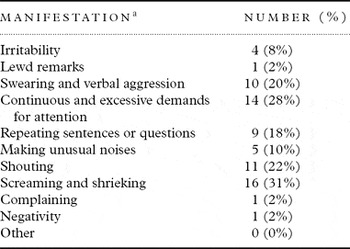
The various forms of VVA manifested by the 51 participating residents are presented in Table 1.
Manifestations of verbal and vocal agitation present in psychogeriatric residents (n = 51)

Note: aMore than one manifestation is possible.
In all participating residents, the VVA behavior had been present for at least three months. In most cases, the behavior had been present since admission to the ward. The number of times the residents displayed VVA behavior varied from occasionally (n = 8, 16%) to more than once a day (n = 33; 65%) and almost the entire day (n = 10; 19%). The displays of behavior varied from less than half an hour (n = 13; 25%) to between half an hour and two hours (n = 18; 35%) and more than two hours (n = 8; 16%). For 12 residents (24%), the amount of time this behavior was displayed varied significantly from one incident to the next.
Musical preferences
The respondents indicated that 38 of the 51 (75%) selected residents enjoyed listening to music. For ten residents (20%), the respondents did not know if the resident in question enjoyed listening to music. For 28 residents (55%), the respondents reported that the resident in question enjoyed singing or had sung in the past. Six (12%) of the selected residents had sung in a choir in the past. Six (12%) residents had played an instrument, namely piano (4), organ (1), and violin (1). The violinist mentioned above had played in an orchestra. For 41 residents (80%), respondents reported knowing their musical preferences. Most often, this preference was provided to the care providers or activity facilitator during the admission and intake or shortly thereafter. The preferences of the residents varied from classical music (49%), traditional folk (44%), religious (29%) and children's (10%), with pop and new age being only incidental preferences.
In 24 of the 41 cases where the musical preference was known, this was reported in the patient's records.
Music offered during care activities over the seven days prior to interview
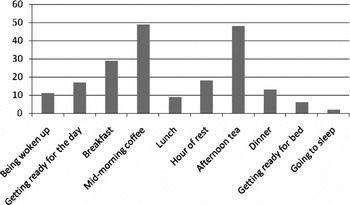
Figure 1 shows the number of psychogeriatric patients who were offered music during care activities in the seven days prior to the interview. While the music supply was relatively limited during patient centered morning and evening care activities, as well as during meals, music was offered to the residents almost daily during the mid-morning coffee and the afternoon tea.
The number of psychogeriatric residents with verbal and vocal agitation who were offered music during care activities (n = 51)

Musical preferences in relation to provision: individually tailored or geared to the group
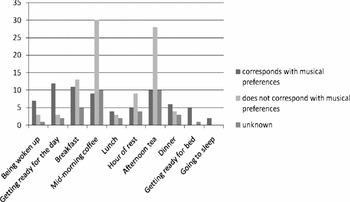
Figure 2 shows the degree to which the music offered during the various care activities corresponded with the musical preferences of the residents. In general, the music that was played when residents were getting ready for the day or getting ready to go to sleep corresponded with the residents' preferences. However, during the mid-morning coffee and the afternoon tea, the music offered did not often correspond with the residents' preferences.
Correspondence between the music offered to psychogeriatric residents with verbal and vocal agitation (n = 51) during care activities and their musical preferences

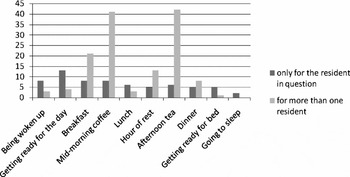
Figure 3 shows to whom the music was oriented, namely the resident in question or more than one resident. Music played while residents got ready for the day and ready to go to sleep was generally geared to the individual resident whereas, during breakfast, the mid-morning coffee and the afternoon tea, music was usually geared to the group of residents.
The degree to which music was tailored to individuals or groups during care activities for psychogeriatric residents (n = 51)

It is interesting to note that when the music was tailored to the individual, it usually corresponded with that individual's music preferences. When music was offered to a group of residents, it tended not to correspond with those residents' musical preferences.
Discussion
This modest exploratory inventory has endeavored to provide some insight into the extent to which music is offered to dementia patients with verbal and vocal agitation in Dutch nursing homes. It has also sought to reveal the degree to which this provision corresponds with the musical preferences of the patients.
The musical preferences of residents
This study has shown that the musical preferences of most residents were either known or approximated by care providers. In fact, musical preferences were described in half of the patients’ care records. Further, this study has also shown that care providers generally know something about the patient's relationship to music. In fact, for 80% of the residents, the care providers knew if the resident in question enjoyed listening to music or singing.
Music provision
Our study also demonstrates that a significant amount of music is offered to nursing home residents through the loudspeaker system. Although not included in our inventory, we were informed that nursing homes also have frequent gatherings with live music. So, it is quite possible that nursing home residents are actually exposed to more music and sound in the nursing home than they were before being admitted. Given this potential increase in exposure, along with our finding that much of the music offered did not correspond with residents' musical preferences, it is quite possible that, in some cases, music actually may exacerbate residents' agitation. This possibility has been suggested by others and needs further scientific investigation (Ragneskog and Kihlgren, Reference Ragneskog and Kihlgren1997; Cohen-Mansfield, Reference Cohen-Mansfield2001). The volume of the music should also be carefully monitored by the staff.
We found that music is almost always played in the nursing home living rooms during the mid-morning coffee break and at afternoon tea. During these times, in which music is offered to a group of residents, the music supply rarely corresponded with the musical preferences of the residents. However, when music was offered to individual residents during more patient-centered care activities, it was generally in accordance with the resident's musical preferences. Literature has shown that music that is tailored to the preferences of an individual resident may have a positive effect on the shouting behavior that is characteristic of patients with dementia and VVA (Gerdner and Swanson, Reference Gerdner and Swanson1993; Gerdner, Reference Gerdner2000).
Furthermore, if residents display agitation, well-chosen music may have a positive effect on patients' behavior during meals and while bathing (Ragneskog et al., Reference Ragneskog, Kihlgren, Karlson and Norberg1996; Clark et al., Reference Clark, Lipe and Bilbrey1998). Music could therefore be used during these care activities to calm VVA behavior. Again, more studies are necessary to confirm this.
In this rather limited study, we have seen that, when offered to an individual, music is generally in line with that individual's preferences. When offered to a group, this is often not the case. In a living room where 10 to 15 residents spend their time, it is very difficult to tailor music to the preferences of each and every resident present. Whether music that does not correspond with preferences is experienced as unpleasant is something that this study did not explore. However, if this is the case, we recommend adjusting the type of music where possible. Alternatively, the amount of music played should be limited or even discontinued altogether.
Nevertheless, in daily practice, individual tailoring will demand ingenuity, resourcefulness and flexibility from care providers and other members of staff.
Comments on the methods employed
The number of nursing homes included in this study was 20. In every participating nursing home, three psychogeriatric residents with VVA were chosen from one psychogeriatric ward. This generated a sample size of 51 residents. Clearly, both the number of nursing homes and the number of residents included in the study were limited. Additionally, when forming the sample, no special consideration was given to the size of the nursing homes or to their potential specializations regarding their approach to caring for psychogeriatric patients with VVA. Furthermore, the participating residents were not selected at random – the nursing home physician and/or the nursing staff were asked to choose up to three residents in their ward. It is possible that those residents with the most pronounced VVA behaviors were selected and it is also possible that, because of their VVA behavior, these residents were offered more tailored music than other residents. It is unlikely that knowledge of the musical preferences of the residents played an important role at the time of their selection. After having been given the definition of verbal and vocal agitation by the interviewer, the nursing home physician and/or nursing staff selected the patient records. In most cases (17/20) they discussed which of the resident had the most appropriate behavior for this research. The attention was focused on the resident's behavior rather than on musical preferences or the music offered. The music directed at group settings tended to be standardized. It is therefore unlikely that the method of selecting residents influenced the results relating to music offered to groups.
Despite the above limitations, the results reported here provide some useful preliminary insights. This study is, as far as we know, the first to compile an inventory on music provision to dementia patients with VVA in nursing homes.
The amount of time that the interviewed care provider had been working in the health care sector and on that ward was sufficient enough to assume that the respondent was acquainted with the ward and its residents. All staff members interviewed were directly involved in caring for residents. One potential limitation or bias that results from conducting face-to-face interviews is that respondents are occasionally inclined to provide socially desirable answers. However, given the topics discussed in the interviews, we contend that, in this study, this was unlikely.
In conclusion, music is frequently offered to psychogeriatric patients with verbal and vocal agitation living in Dutch nursing homes. When offered to a group of patients, the music tends not to be tailored to their general preferences. In contrast, when music is made available on an individual basis, it tends to meet specific tastes. Because care providers have access to information regarding their patients' musical preferences, tailoring available music to individual tastes should not be difficult. It appears that many professionals caring for residents with dementia underestimate the positive effect music may have on them despite the fact that a number of case studies have demonstrated this positive effect (Koger and Brotons, Reference Koger and Brotons2000; Clark et al., Reference Clark, Lipe and Bilbrey1998; Vink et al., Reference Vink, Birks, Bruinsma and Scholten2003). Unfortunately, the evidence for the use of music in targeting challenging behavior in residents with dementia is still limited. We therefore recommend further research in this field by executing a well-designed randomized control trial.
Conflict of interest
None.
Description of authors’ roles
E. van der Geer designed the study, collected the data and wrote the paper; A. Vink, J. Schols and J. Slaets assisted with the study design and with writing the paper.