1. Introduction
Somewhere in Utah, a man loses his job. Where will he turn? Various government programs are designed to help people in just this situation. If he was fired for no fault of his own, then he may be eligible for the Department of Labor's Unemployment Insurance. He may become eligible for the Supplemental Nutrition Assistance Plan, better known as food stamps. If he has children, he may become eligible for Temporary Assistance for Needy Families. But there is another welfare program that he might receive. Rather than asking a public employee for assistance, he might talk to a local bishop in the Church of Jesus Christ of Latter-day Saints (the Church).Footnote 1 At the bishop's discretion, he could then receive in-kind or monetary aid from the Church, as part of the Church Welfare Plan.
How should we analyze these welfare programs? Welfare, including private welfare given by the Church, is often thought of as a grant, a “one-way transfer” in which “A gives something exchangeable to B, B gives nothing exchangeable to A” (Boulding et al., Reference Boulding, Pfaff and Horvath1972: 19). Yet the Church Welfare Plan also contains significant elements of exchange, because it typically includes work by the welfare recipients, as well as prior and future contributions to the welfare pot. The Church's teachings emphasize work and self-reliance. The Church Welfare Plan reinforces these themes and seeks to inculcate a strong work ethic in both aid-recipients and aid-givers. All members of the Church are expected to work, regardless of whether they receive welfare. This means that the offer of aid to those who work is not a simple quid pro quo exchange, but the gift of an opportunity to participate in a community with fellow religious adherents. Interdependent utility functions, which Boulding sees as characteristic of the grants economy, are pervasive in this heavily communal mutual aid context.
While “giving a grant diminishes a donor's net worth,” donors still give grants because there exists “interdependence of utility functions among individuals,” which leads donors to value the recipients’ welfare (Boulding et al., Reference Boulding, Pfaff and Horvath1972: 26). Yet these other-regarding preferences can lead to what Buchanan (Reference Buchanan and Phelps1975) calls the Samaritan's dilemma, in which a Samaritan prefers to give aid regardless of the actions of the recipient. This creates incentives for the recipient to work less or fail to pursue skills and education that would increase the recipient's income. The Samaritan's dilemma suggests why aid can create dependency, prolonged unemployment, and other unintended consequences. Boulding and his colleagues were aware of such problems and noted that “the grant economy often leads to results quite opposite from those intended by the policy makers” (Boulding et al., Reference Boulding, Pfaff and Horvath1972: 23).
We argue that decision-makers within the Church have effectively transformed the Samaritan's dilemma into a different game, ameliorating the unintended consequences of their grants for the social welfare of members. They accomplish this through a variety of formal and informal rules that strongly emphasize responsibility, work, and self-reliance. They place significant discretionary power in the hands of the bishop in each local ward, which provides a strong linkage between the actions of the recipient and the commitment of the donor. The design also integrates this aid system within the global structure of the Church. In addition to governing the administration of grants, the institutions built around welfare help reinforce broader Church teachings regarding responsibility, work, and self-reliance. In other words, the Church not only governs gifts, it also uses gifts as a tool for governance of individual behavior.
Although many religious groups give to the poor, we focus on the Church of Jesus Christ of Latter-day Saints because it successfully carries on a tradition of mutual aid that has declined in the United States. Mutual aid is distinct from charity. While charity involves donors giving to external recipients, mutual aid typically involves reciprocity and buy-in. Members regularly pay into a broad pool, and then can receive benefits if they fall on hard times. Fraternal societies based on such logic were once pervasive in the United States. Working-class people organized themselves and pooled resources to provide low-cost healthcare and other club goods (Beito, Reference Beito1990, Reference Beito2000; Siddeley, Reference Siddeley1992). However, these organizations were crowded out by the welfare state, the rise of commercial health insurance, and regulatory interventions (Beito, Reference Beito1990, Reference Beito2000; Chapin, Reference Chapin2015; Long, Reference Long1994).
Unlike the charitable approach of most religious organizations, the Church operates their welfare program with a strong mutual aid logic. While non-members can receive aid from the program, it is largely focused internally. Funds come primarily from ward-level contributions, particularly those given as part of a Sunday fasting ritual. This mutual aid logic is key to how the Church resolves the Samaritan's dilemma. We extend McBride's (Reference McBride2007) analysis of the Church's provision of collective goods to those activities and exchanges that most clearly fit the logic of donor and recipient. Specifically, we focus on how decision-makers vested with authority about welfare address the Samaritan's dilemma within their communities.
There is an extensive historical literature on the organization of the Church's aid programs (Arrington, Reference Arrington1954, Darowski, Reference Darowski, Cannon and Embry2009, Dunn, Reference Dunn, Hann and Dunn1996, Mangum and Blumell, Reference Mangum and Blumell1993). Within economics, literature on the Church focuses more on religious and social club goods and the tithes to maintain activities within the Church (Dahl and Ransom, Reference Dahl and Ransom1999; McBride, Reference McBride2007) than on the Church Welfare Plan. Economists have also examined the Church's early collective economic arrangements (Ely, Reference Ely1903; Gardner, Reference Gardner1917, Reference Gardner1922; Israelson, Reference Israelson1978), but have offered less attention to the contemporary welfare organization. This paper explains how the member-crafted institutions of the Church protect its members’ economic welfare and avoid the worst consequences of the Samaritan's dilemma. In doing so, we combine insights from grants economics (Boulding et al., Reference Boulding, Pfaff and Horvath1972) and public choice theory (Buchanan, Reference Buchanan and Phelps1975; Gibson et al., Reference Gibson, Andersson, Ostrom and Shivakumar2005; Ostrom, Reference Ostrom1990, Reference Ostrom2000, Reference Ostrom2005, Reference Ostrom2007). Boulding (Reference Boulding.1969) noted strong commonalities between grants economics and public choice, and this paper illustrates how these two research programs can strengthen one another. Moreover, we emphasize how gifts, social norms, culture, and ideology are mutually reinforcing. This confirms themes and findings that have been emphasized heavily in sociological and anthropological work on gift exchange (Berking, Reference Berking1999; Durkheim, Reference Durkheim1964; Mauss, Reference Mauss2002). For instance, Mauss (Reference Mauss2002) emphasized the role of gifts in promoting solidarity and reciprocity while affirming and reinforcing social norms. While we recognize the importance of this literature, we are primarily building our analysis on foundations from economic theory rather than these sociological accounts. The Maussian conception of gifts does not necessarily map neatly onto the grants economics framework that we are applying to anti-poverty aid programs. However, some of our findings suggest that this sociological framework may apply to the Church Welfare Plan.
In what follows, we explain how the Church has administered welfare without succumbing to the Samaritan's dilemma. Section 2 discusses the Samaritan's dilemma. Section 3 explains the organizational structure of the Church, with emphasis on the welfare program. Section 4 explains how the Church uses institutions to reshape members’ beliefs, values, and incentives and thus to overcome the Samaritan's dilemma. Section 5 concludes.
2. The Samaritan's dilemma
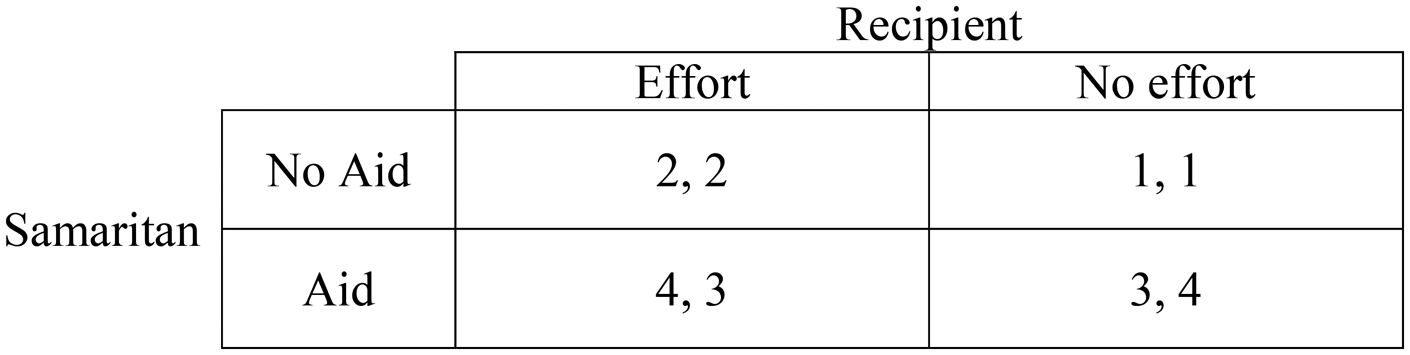
The Samaritan's dilemma is represented by a two-player game, shown in Figure 1 (Buchanan, Reference Buchanan and Phelps1975; Skarbek, Reference Skarbek2016). Samaritan strictly prefers to give aid regardless of what Recipient chooses to do. This is likely due to Samaritan valuing Recipient's welfare, and therefore having an interdependent utility function that motivates grant giving (Boulding, Reference Boulding.1969, Reference Boulding1973; Boulding et al., Reference Boulding, Pfaff and Horvath1972). While Samaritan always prefers to offer aid, Recipient's best move depends upon what Samaritan chooses to do. If no aid is offered, Recipient will work. But when Samaritan offers aid, Recipient will refuse to work. The dilemma is exacerbated if Recipient knows Samaritan's preferences, because Recipient can then strategically exploit those preferences, choosing not to work in the expectation that Samaritan will provide aid regardless. Indeed, this outcome, in which the Samaritan provides aid while the recipient does not work, is the pure strategy Nash equilibrium. Unless the players can be constrained, the Samaritan will transfer aid to a shirking recipient. While the Samaritan would prefer the recipient to work, withdrawing aid in order to deter shirking would require the Samaritan to suffer disutility. As a result, the recipient has incentives to shirk and exploit the Samaritan. The long-run consequences can be quite destructive, as more resources are shifted towards transfers and away from productive effort (Gibson et al., Reference Gibson, Andersson, Ostrom and Shivakumar2005). A Samaritan's dilemma can have particularly perverse consequences in the long run, because “if the situation is repeated … the donor may be creating a situation where the recipient actually loses skill and motivation over time” (Gibson et al., Reference Gibson, Andersson, Ostrom and Shivakumar2005: 39). In the context of the Church Welfare Plan, an individual who receives aid rather than working may lose skills and become unable to succeed in the workforce. To deter this behavior, Samaritan must endure disutility by refusing to aid someone in need.
The Samaritan's dilemma

Withholding aid to overcome the Samaritan's dilemma requires strategic courage (Buchanan, Reference Buchanan and Phelps1975; Schmidtchen, Reference Schmidtchen, Brennan, Kliemt and Tollison2002; Skarbek, Reference Skarbek2016). Strategic courage is “the purposive self-imposition of constraints on action” to shift the recipient's expectations and prevent shirking (Skarbek, Reference Skarbek2016: 374). Schmidtchen (Reference Schmidtchen, Brennan, Kliemt and Tollison2002) articulates three conditions that are necessary for strategic courage: acknowledgment of the strategic relationship; rules that account for both short and long-term welfare of agents; and some third-party enforcement mechanism to enforce the agreement. In using this framework, Skarbek (Reference Skarbek2016: 375) argues that private organizations can better meet these conditions and promote strategic courage than governments for three key reasons: “owners of private associations are residual claimants of their efforts, private organizations face competition, and individuals self-select into private groups.” Leeson (Reference Leeson2011) suggests that while both public and private organizations can establish constitutional rules to constrain their members and leaders, private organizations are more likely to effectively enforce them. These institutional differences mean that private organizations can implement self-enforcing constitutions that bind Samaritans and prevent dependency. Skarbek illustrates this process by explaining how the Chicago Relief and Aid Society successfully recognized the Samaritan's dilemma and crafted rules to overcome it. The Church has engaged in similar constitutional craftsmanship in order to resolve the Samaritan's dilemma.
Variations in the rules used to organize relief systems can either exacerbate the Samaritan's dilemma or empower people to solve it (Gibson et al., Reference Gibson, Andersson, Ostrom and Shivakumar2005). For a general discussion of how institutional design impacts the ability of individuals to solve social dilemmas, see Ostrom (Reference Ostrom2005). By studying the institutions within the Church, we examine how members overcame the Samaritan's dilemma and created a sustainable system of mutual aid. In order to do this, however, we first must understand this system's structure.
3. The structure of the Church Welfare Plan
The Church is a polycentric system in which authority is located at many levels, with most governing of individuals taking place at the local ward level. Church leaders at the highest level, the General Authorities, set broad policy for administering welfare needs based on work and self-reliance, from which lessons and resources are developed for use by local ward leaders. The hierarchy of authority in the Church shapes the framework of welfare policies and accounts for major shifts in Church Welfare history (Mangum and Blumell, Reference Mangum and Blumell1993). During the Great Depression, Church leaders at the highest level restructured welfare arrangements, creating the modern system.
The Relief Society, which is the Church's women's organization, once had considerably greater authority regarding welfare policy. The shift in 1936 to the modern Church Welfare Plan constrained this role. As Mangum and Blumell (Reference Mangum and Blumell1993) explain:
The Relief Society retained its role in providing aid to the needy, but its public and economic activities were gradually restricted. No longer autonomous, it was placed under the direction of male leaders who instituted programs that emphasized women's role as dutiful mothers and wives.
Today, the Relief Society does not have formal discretion over who receives financial welfare from the formal Church Welfare system, but its members have important roles within the welfare process at the local levels. They are particularly important in the implementation of welfare policy and in the distribution of short-term, temporary assistance such as food and clothing assistance (Church of Jesus Christ, 2010). Likewise, women's roles are critical in terms of maintaining social linkages with families in the ward through informal activities and home visits.
In addition to altering women's roles in 1936, the General Authorities promulgated new Church-wide policies and infrastructure, including a chain of thrift stores called Deseret Industries to provide work for vulnerable people, food produced at Church-owned farms, and a sophisticated commodities distribution center that can distribute food to bishop's storehouses around the world. Despite these general resources and policies, most detailed welfare decisions are made more locally, empowering decision-makers to incorporate local knowledge.
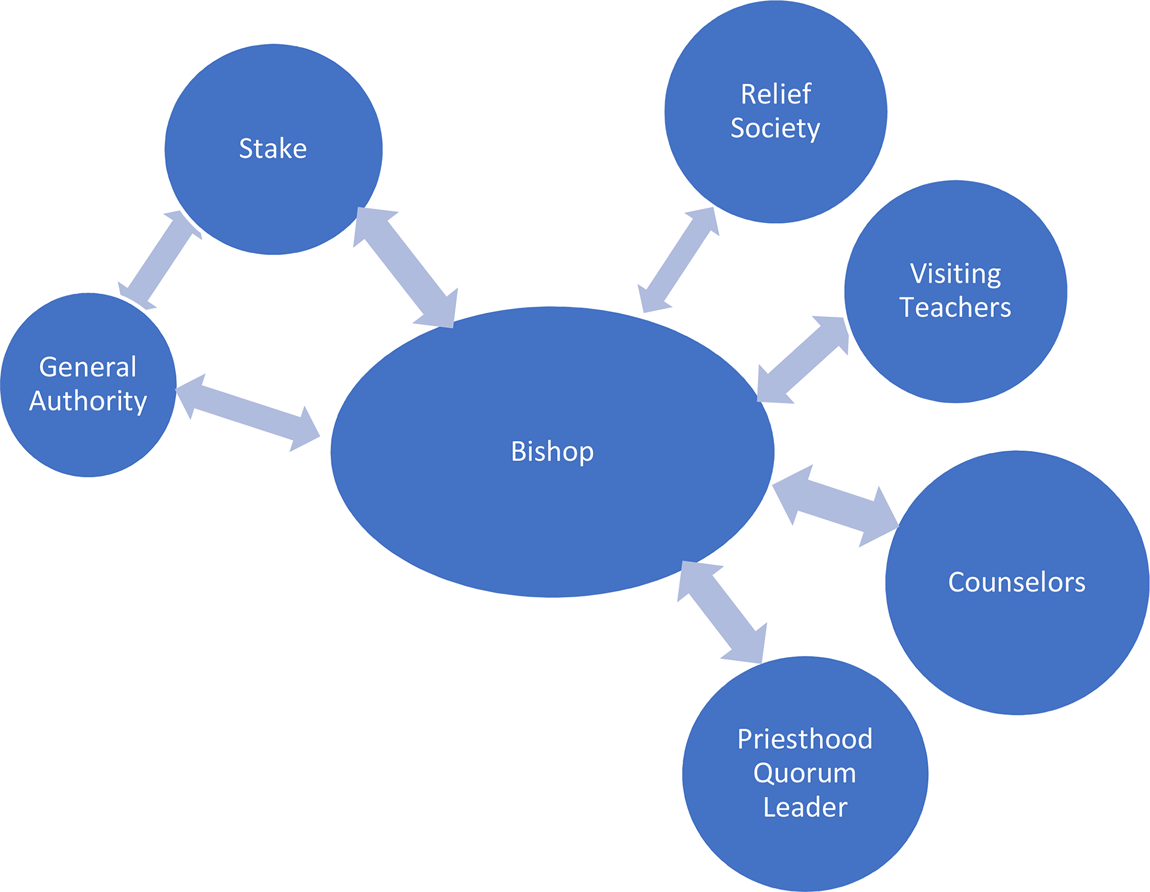
Latter-day Saints divide their church into “regional units called ‘stakes,’” each of which “contains from six to ten local units called ‘wards,’ each presided over by a bishop and two counselors” (Durham, Reference Durham1942: 51). A bishop, along with his counselors, has significant discretion to administer welfare resources and policy to meet the local needs of his ward. Through close monitoring, education, and sanctions of members’ decisions and undesirable behaviors, bishops manage the demands of those seeking aid from the community. At each level of the Church, the welfare decision process has several decision-making positions informing policy as shown in Figure 2. Bishops identify and administer to the welfare needs of their wards, which have around 300 members each. Decisions are reached locally by the bishop with guidance from his ward advisors as well as input from higher levels. While there is a formal hierarchy within the Church, decisions about welfare take on a polycentric character because individuals with diverse roles communicate, share information, and influence key decisions about welfare.
The polycentric structure of ward welfare

Bishops’ skill sets and experiences with respect to welfare policy vary, since bishops are drawn from various backgrounds. General Church policy is important in maintaining some consistency between wards, but the specific application and interpretation of that policy in each ward permits it to reflect community interests as well (LDS.org, 2018a). At the 2011 General Conference, President Dieter F. Uchtdorf explicitly directed members to address welfare concerns locally:
Once you have studied the doctrines and principles of the Church-wide welfare plan, seek to apply what you have learned to the needs of those within your stewardship … What this means is that in large measure, you're going to have to figure it out for yourself. (Uchtdorf, Reference Uchtdorf2011)
Most individuals who become bishop would have served in many other roles in the ward (counselor to the bishop, Elders quorum leader, etc.). Thus, they have a good sense of the community and the policies practiced within the ward. This arrangement facilitates finding solutions and implementation strategies within general Church policy that would reflect the unique needs of their community. It combines the value of the local knowledge from the ward with the expert guidance and authority of Church hierarchy in a form similar to polycentric arrangements outlined by E. Ostrom and V. Ostrom (McGinnis, Reference McGinnis1999).
Several institutional features of the Church encourage polycentric arrangements and keep power from being concentrated in an absolute hierarchy. First, almost every position within the Church is a volunteer position, occupied as a member's calling for the community. As volunteers, members’ time and expertise in these roles is limited when compared with those of full-time professionals. Second, positions of authority below the highest level of the Church are assigned as temporary callings (appointments). Since they are temporary, each individual can expect to be in different positions over time, so behavior while in the position is likely to be moderated by the norms of the Church community. Moreover, these limited terms reduce strategic expertise. There is less of an expertise distinction between decision-makers and members when drawing on amateur volunteers for most localized positions of authority. Third, almost every adult has a calling of some sort within the Church, so power is shared rather than concentrated and perpetuated. Over time, any bishop or leader will face others within the community who have held the position or may hold it in the future. As a result, the asymmetric power and knowledge associated with more permanent hierarchical structures is reduced.
Church teachings suggest that the bishop and his leadership team play a proactive role in identifying members in need, but also in monitoring behavior to ensure that dependency is limited (LDS.org, 2018b). General guidelines for how welfare is to be administered are included in teaching materials for Church leaders at all levels: Providing in the Lord's Way: A Leaders Guide to Welfare (Church of Jesus Christ of Latter-day Saints, 2010). These guidelines emphasize work, responsibility, and thrift for recipients. In identifying need, guidance materials suggest that members should first provide for themselves and their family. Then, if needed, turn to extended family, and finally, look to the Church through their ward for assistance. Given this perspective, members may be hesitant to reach out even when help is needed. However, even if members do not reach out, the bishop may still become aware of their welfare needs. Church guidance encourages local members and leaders to “identify those members who need assistance” (Church of Jesus Christ, 2010). Local members are often assigned to visit the homes of other ward members to provide religious instruction. In the process, they also can observe whether someone is in need.
4. Escaping the Samaritan's dilemma
The Samaritan's dilemma arises because the Samaritan experiences disutility from the suffering of the prospective recipient. Withholding aid from someone who shirks therefore pains the Samaritan (Buchanan, Reference Buchanan and Phelps1975; Skarbek, Reference Skarbek2016). The interdependent utility functions that Boulding (Reference Boulding.1969, Reference Boulding1973) describes as a key motive for grant giving therefore sow the seeds of a social dilemma. To overcome this dilemma, potential Samaritans must exercise strategic courage, constraining themselves to prevent dependency and exploitation (Buchanan, Reference Buchanan and Phelps1975; Skarbek, Reference Skarbek2016). The Church promotes strategic courage using a mixture of formal rules and informal norms to constrain Samaritans, penalize shirking, and exalt self-reliance. These rules reduce the risks of dependency and keep the Church Welfare Plan sustainable. Resolving the social dilemma associated with gifts through the Church also promotes a set of values and rules that encourage work, self-reliance, and social cooperation among the membership more generally.
As Schmidtchen (Reference Schmidtchen, Brennan, Kliemt and Tollison2002) argues, three conditions must be met for a Samaritan to exercise strategic courage and overcome the Samaritan's dilemma. The first is recognizing the “strategic relationship between donor and recipient” (Skarbek, Reference Skarbek2016: 374). This recognition can be seen in widespread concerns about dependency. Such concerns have long been prevalent in the Church, even before the welfare program was established in its modern form. Brigham Young, the Church's second president, wrote:
My experience has taught me, and it has become a principle with me, that it is never any benefit to give, out and out, to any man or woman, money, food, clothing, or anything else, if they are able-bodied and can work and earn what they need, when there is anything on earth for them to do. This is my principle and I try to act upon it. To pursue a contrary course would ruin any community in the world and make them idlers. (Quoted in Arrington and Hinton, Reference Arrington and Hinton1964: 70)
Church leaders took these concerns seriously when they designed the Church Welfare Plan. In a 1939 speech the President of the Church, Heber J. Grant, argued that under the plan the “curse of idleness would be done away with, the evils of the dole abolished, and independence, industry, thrift and self-respect be once more established amongst our people.…Work is to be once again re-enthroned as the ruling principle of the lives of our Church membership” (quoted in Arrington and Hinton, Reference Arrington and Hinton1964: 79). Church leaders continue to make similar statements. In a speech to the General Conference, Elder Stanley G. Ellis said, “The Lord has taught us the need to promote self-reliance. Even if we are able to help, we should not give or provide what they can and should do for themselves. Everywhere it is tried, the world learns the evils of the dole” (Ellis, Reference Ellis2013). Such statements show awareness of the dangers of dependency.
Second, Samaritans must “choose rules that account for the welfare of agents in both the short-run and the long run … [and] constrain Samaritans from responding to their own preferences to help on a one-off basis” (Skarbek, Reference Skarbek2016: 374). Schmidtchen's third condition is that these rules be enforced. In this section we discuss the rules the Church uses to resolve the Samaritan's dilemma, the enforcement mechanisms that underlie them, and how internalizing religious values can make these rules largely self-enforcing.
Work is a key condition for receiving Church aid. Individuals who receive aid and are capable of work are expected to work. This “workfare” structure filters out potential recipients who wish to shirk. Church leaders expect recipients to cut their spending and develop habits of self-reliance. Before receiving aid, the prospective recipient must fill out a form called a “Self-Reliance Plan” with a Church representative (Church of Jesus Christ, 2010: 23). To fill out this form, the applicant must list their monthly income “from all household members” as well as government assistance and any other sources of income (LDS.org, 2018c). The potential recipient must also explain their monthly spending, identify expenses that can be cut, and identify resources that they can draw on to improve their situation. Perhaps most importantly, they must suggest “work or service [to] contribute in return for any assistance” received (LDS.org, 2018c). The form contains a space for the prospective recipient to suggest ideas for this work, as well as a space for them to specify the work assignment that they agree upon with the bishop or branch president.
By making this form a requirement for receiving Church Welfare, the Church shifts the payoff structure away from that of a Samaritan's dilemma. For the Samaritan (the bishop), this sets up clear rules that prohibit welfare provision to a recipient who does not work. The bishop would face a backlash from others in the ward if he gave aid to someone who could work but chose not to, as this would violate core values of work and self-reliance. Multiple people are involved in crafting self-reliance plans, which implies that several ward members would be aware if a bishop bypassed the self-reliance plan process (Church of Jesus Christ, 2010: 23). Within the Samaritan's dilemma game, offering aid is a strictly dominant strategy for the Samaritan, which means he will give aid regardless of whether the recipient works. Rules requiring self-reliance plans make it costly for him to give welfare funds to anyone who has not agreed to some type of work.
In addition, the self-reliance plan alters incentives for the prospective recipient. Specifically, it shapes the recipient's expectations. In a standard Samaritan's dilemma game, Recipient anticipates that Samaritan will offer aid even if Recipient does not work. The self-reliance plan directly communicates a work requirement to the prospective recipient, making it clear that aid will not be offered without effort.
Another rule defines not when aid is given, but what type of aid is given to the recipient. Bishops are told to administer aid that “helps needy members by providing them the goods and services necessary to sustain life … [but] does not provide members the means to maintain affluent living standards” (Church of Jesus Christ, 2010: 12). To do this, the Church emphasizes in-kind assistance rather than monetary assistance. Official documents direct the bishop to “give members goods rather than cash” whenever possible (Church of Jesus Christ, 2010: 13). When “members do not have the cash to pay all of their immediate and essential obligations, the bishop normally makes payments directly to the provider of the goods or services” (Church of Jesus Christ, 2010: 13). This allows the bishop and other decision-makers in the ward to control how the recipient uses aid. By contrast, cash can be spent on whatever the recipient values most, even if that spending promotes short-term pleasure over long-run self-reliance. In-kind aid therefore offers a lower payoff to recipients, reducing incentives to shirk.
Position rules also play an important role. The Church expects all members to contribute to the welfare program through fast offerings. Even the poorest members of the Church are encouraged to participate and donate what they can. This places all members on an equal footing where they all contribute to aid for the poor. President Uchtdorf (Reference Uchtdorf2011) has emphasized the obligation for all members to contribute fast offerings. This allows each member to satiate the impulses that would entice them to act as a Samaritan. The funds they donate are then allocated at the discretion of the bishop, who has institutional tools at his disposal to avoid the Samaritan's dilemma. This reduces the cost of coordinating potential Samaritans. Church members can then satisfy their desire to help the needy without having to decide whether to give to someone who shirks. This resembles Schmidtchen's (Reference Schmidtchen, Brennan, Kliemt and Tollison2002) argument that hiring an agent is the most effective way to address the Samaritan's dilemma. In this case, the bishop acts as an agent for the ward community.
The bishop did not always have this role. Prior to 1936, women in the Relief Society controlled welfare decisions, but mostly provided in-kind aid. Today, the general division of authority is that women in the Relief Society address short-term and immediate member needs and the bishop and his advisors work together to oversee and administer financial or longer-term welfare needs. Since these long-term needs are those most vulnerable to dependency and abuse, this transfer of authority to men in the 1936 reform suggests Church leaders recognized the challenge posed by Samaritan's dilemma incentives and sought to reduce those among their membership. Vesting decision rights in those with greater authority helps resolve the dilemma, because religious “authority solves problems of social coordination by creating shared expectations” (McBride, Reference McBride2016: 411). The bishop's position of authority empowers him to enforce rules.
Enforcing rules requires monitoring recipients. In addition to self-reliance plans, bishops have other ways to monitor behavior and identify need or abuse of the system. First, bishops draw on the advice of their counselors, visiting teachers, and Relief Society leaders to provide information regarding members and their social welfare needs. Men and women in a ward are assigned families to visit or interact with each month to provide religious teaching and general assistance. This provides an ongoing source of information on the needs and lifestyle of those currently receiving assistance and those who may be at risk. It also builds a sense of reciprocal commitment that binds the members of a ward together. Additionally, the bishop has individual counseling meetings with members, including an annual meeting to reconcile tithing commitments and family finances. Tithing is an essential part of being considered in compliance with church doctrine and worthy of a temple recommend. A temple recommend is required for entering temples, which host important rituals such as weddings (Dunn, Reference Dunn, Hann and Dunn1996). Tithing is not a requirement to be eligible for welfare. However, the institutions and practices surrounding tithing enable both monitoring and the reinforcement of values that help the Church Welfare Plan function. This provides a powerful sanction on devoted members where individual interests align with collective interests, but would have less effect on non-members or members less committed to church theology. Such monitoring plays a crucial role in helping Church members resolve the Samaritan's dilemma.
Administering the welfare plan within local wards allows a great deal of monitoring and bishops have access to formal rules of sanction, which helps with enforcement. These rules can work well at structuring aid within the Church, but are problematic when aid is outward facing. Without the assurance of shared values, monitoring and sanctioning costs increase to ensure compliance with the work condition by non-members. Likewise, it may be more difficult to apply the Church's rules to external parties. This may account for the way in which the Church structures internal versus external assistance. Short-term assistance such as help during a disaster or the provision of food when someone falls ill are given readily to broad recipient groups. Longer-term financial assistance that could alter incentives of the recipient are structured carefully, with many rules to govern the behaviors of recipients and encourage work (LDS.org, 2018b).
These rules might be ineffective if a prospective aid recipient could easily shop around for a Samaritan that will not abide by such rules. As Schmidtchen argues:
if the population of Samaritans is heterogeneous, “enlightened” Samaritans … might now have to compete with those having chosen the “soft option.” With “potential parasites” preferring to get help from the latter group, something described by Gresham's law result. “Bad” Samaritans drive the “good” ones out of the market. (Schmidtchen, Reference Schmidtchen, Brennan, Kliemt and Tollison2002: 483, quoted in Gibson et al., Reference Gibson, Andersson, Ostrom and Shivakumar2005: 75)
The Church, however, uses clear boundary rules that help avoid this competitive process. The welfare structure operates within clearly defined user boundaries, with each ward defined as approximately 160 geographically contiguous families. Ward boundaries are drawn by Church leadership as membership patterns change, so members can only choose a ward based on housing decisions. In much of Utah, this size restriction results in multiple wards in a single neighborhood. Members who wish to participate in Church activities must engage with their assigned or home ward. Several wards make up each stake and many stakes make up a region or area of the Church. This nested and polycentric structure clearly defines which users can access ward welfare resources.
Most relevant to Schmidtchen's concern about “bad” Samaritans driving out the “good” ones, there is guidance for provision to transient members (those from other wards): “The bishop … should be discerning about the type and amount of assistance he gives. Whenever possible, he should contact the transient's home ward bishop before providing assistance” (Church of Jesus Christ, 2010: 15). Clearly, the design is intended to have decisions reached within a well-defined and relatively small community. This establishes clear boundary rules that prevent individuals from moving among wards to seek generous bishops.
These various rules are further reinforced by moral teachings, which alter the payoffs that individuals associate with various choices. The Church presents work requirements not as compelling recipients to work, but as providing them with “opportunities to work to the extent of their ability for what they receive” (Church of Jesus Christ, 2010: 13). They emphasize that this helps the recipient, because “[w]hen members work for assistance, they remain industrious, maintain their self-respect, and increase their ability to be self-reliant” (Church of Jesus Christ, 2010: 13). This language is important. In a Samaritan's dilemma game, the Samaritan's concern for the aid recipient makes it difficult for him to refuse to provide aid. By celebrating work, the Church's rhetoric orients Samaritans to see the recipient's welfare as served by teaching them self-reliance. The payoffs in any game are defined by the players’ perceptions. Rhetoric, values, and beliefs can therefore reshape the payoffs.
A Samaritan who believes welfare without work harms the recipient no longer wants to give unconditionally. A bishop who had fully internalized this doctrine would feel he was hurting a recipient by giving them aid while they shirked. A prospective Samaritan who has fully internalized these beliefs will prefer to only give to those who work, though his underlying altruistic intentions toward the recipient are unchanged. Church rhetoric shapes the bishop's values and beliefs, so rules requiring that he only give to those who work should be largely self-enforcing. Similar self-enforcing norms have evolved in diverse empirical contexts (Ostrom, Reference Ostrom2000). However, formal rules serve as an institutional backstop to ensure the bishop exercises strategic courage.
Norms that celebrate work alter payoffs not only for the Samaritan, but also for the prospective recipients. Thus, members (both Samaritans and Recipients) believe that working, when possible, dominates not working. As a result, the outcome (Aid/Effort) emerges as a Nash equilibrium. The dilemma, however, may continue when the Samaritan faces someone who may not share these values. In this case, the Samaritan still believes dependency will harm the recipient, so he makes aid conditional on working. However, the recipient may value aid without working more than aid with work, and therefore attempt to shirk. In this case, two possible stable outcomes emerge – (Aid/Effort) and (No Aid/No Effort). By organizing welfare within the small ward, the Samaritan has greater assurance that members will coordinate around the Aid/Effort outcome, as they are more likely to share values with others in their community. But even within the ward values may differ, so the Church has rules that serve both to condition aid on preferred behaviors and to socialize members into those values.
The Church resolves the problem of the Samaritan's dilemma through a mix of values and institutions that promote strategic courage. These values and institutions help govern not just Samaritans and Recipients, but all members. Developing and sustaining institutions to support strategic courage incentivizes hard work, self-reliance, and religious adherence throughout the Church. Not all these norms and rules were consciously designed. Instead, norms and rules evolve, as cooperative individuals elicit cooperation from others and functional norms persist even when individuals do not understand their functions (Coleman, Reference Coleman1990; Ostrom, Reference Ostrom2000). Evolutionary and artifactual processes both help individuals overcome the Samaritan's dilemma.
5. Conclusion
The Church Welfare Plan successfully uses institutions to transform a Samaritan's dilemma into a different game that deters shirking. This suggests that individuals who want to give to the poor can craft institutions to help them avoid social dilemmas that plague aid arrangements. Moreover, the institutions built for this purpose can provide governance more broadly. Governing gifts can lead to gifts as governance. Despite this success, it is questionable whether these institutions can be replicated outside of these special circumstances. Religious ideology plays a key role in this system, and these approaches may not be viable among people with less religious adherence. Yet similar systems of polycentric governance exist in diverse cultural and ideological contexts (Aligica et al., Reference Aligica, Boettke and Tarko2019).
This case study suggests multiple avenues for future research. One hypothesis is that the Church would find it harder to overcome the Samaritan's dilemma in its outward-facing humanitarian aid operations than it does in welfare services offered at the ward level. Members of the Church live together in close-knit communities, allowing effective monitoring and shared values. These demanding conditions are often not met in cases where aid is offered to people outside the community. Future research could directly compare outcomes of external versus internal welfare programs. If the hypothesis is refuted, analysts could engage in more detailed qualitative work to study which institutional mechanisms are at play in the Church's outward-facing humanitarian missions.
Another question for future research asks whether recipients of Church assistance are more likely to escape poverty than recipients of aid that is less oriented toward self-reliance. This may be part of why recent research by Chetty et al. (Reference Chetty, Hendren, Kline and Saez2014) finds that Salt Lake City, Utah, has the greatest degree of intergenerational mobility among American metropolitan areas examined. The tight-knit local ward structure should promote social capital, a factor that Chetty et al. (Reference Chetty, Hendren, Kline and Saez2014) find to be highly correlated with upward mobility. Future research could test whether the Church Welfare Plan helps explain Salt Lake City's strong upward mobility (McArdle, Reference McArdle2017).
Our analysis suggests complementarities between rational choice literature and sociological literature. As our discussion shows, members’ beliefs shape their incentives, implying that what people believe and think is crucial for economic analysis. Interpretive research complements rational choice theory (Chamlee-Wright, Reference Chamlee-Wright2011). In addition, our analysis shows that welfare practices reinforce and perpetuate the values of the Church and bring members closer together as a community. This supports the findings of sociological and anthropological research arguing that gifts are a key part of how communities establish norms, reinforce reciprocity, and promote solidarity (Berking, Reference Berking1999, Mauss, Reference Mauss2002). Individuals’ efforts to overcome social dilemmas and perverse incentives can help explain the broader social phenomena that sociologists and anthropologists have studied.
Future researchers could examine how lessons from the Church Welfare Plan apply to state-administered welfare. Workfare, implemented at the federal level by the Clinton Administration, superficially resembles the Church Welfare Plan. Readers should be careful, however, not to assume that what works in a religious community can be implemented by a nation-state. The Church can inculcate recipients in shared values within a community setting. The federal government cannot promote values in this way. The Church is a religious community with a shared set of values, while the American government is supposed to provide secular governance to a pluralistic society with diverse values. Moreover, scale matters. While welfare policy in the Church is often set by central authorities, ultimately it is administered within local wards, and therefore incorporates local knowledge and the social capital of tight-knit neighborhoods. While street-level bureaucrats within a state's welfare system may have some relevant local knowledge, there is no reason to expect them to have social relationships with aid-recipients or their neighbors in the same way that the bishop, the Relief Society, and others involved in ward welfare do. The polycentric structure of the Church is crucial to their success overcoming the Samaritan's dilemma, which means that this success is difficult to replicate in organizations with different scales and structures.
Finally, we suggest that the experience of the Church Welfare system provides support for work on the importance of the voluntary sector and civil society in maintaining a free society (Aligica, Reference Aligica2014; Cornuelle, Reference Cornuelle1965; Ealy, Reference Ealy2015; Haeffele and Storr, Reference Haeffele and Storr2019). Civil society is frequently challenged by the growth of state programs that substitute for some of the benefits that these voluntary organizations once delivered (Beito, Reference Beito2000). Where such organizations continue to thrive, they indicate the continued capacity of individuals for free and voluntary solutions, even in the face of a growing state. But, the specifics of this case also suggest the challenge of rebuilding this capacity and the many demands of such self-governance models. Moving from where we are now to a more vibrant voluntary sector to address social needs requires a rich institutional mix of rules that may be difficult to achieve.
Acknowledgments
This research is generously supported by the Mercatus Center at George Mason University and by a grant from the John Templeton Foundation. We thank the Editors and three anonymous referees, Anthony James DeMattee, Lenore Ealy, Tate Fegley, Scott King, Jordan Lofthouse, Alain Marciano, participants at the 2019 Association of Private Enterprise Education annual meeting, and participants in the Mercatus Center Graduate Student Paper Workshop for their very helpful comments and feedback. Any remaining errors and shortcomings are our responsibility.