INTRODUCTION
Grazing equines are exposed to a number of helminth infections throughout their lives. Of these, cyathostomins (small strongyles) are considered the most problematic (Love et al. Reference Love, Murphy and Mellor1999). Since the introduction of macrocyclic lactone (ML) anthelmintics in the 1980s, cyathostomins have been reported as the most prevalent nematodes in equine populations, accounting for over 95% of the nematode infections detected (Lind et al. Reference Lind, Höglund, Ljungström, Nilsson and Uggla1999; Kornas et al. Reference Kornas, Cabaret, Skalska and Nowosad2010). Of the 3 modern anthelmintic classes (benzimidazoles (BZs), tetrahydropyrimidines (THPs) and MLs) licensed for use in equines, widespread cyathostomin resistance has been recorded against 2 (BZs and THPs), with ML resistance emerging (reviewed by Stratford et al. Reference Stratford, McGorum, Pickles and Matthews2011; von Samson-Himmelstjerna, Reference von Samson-Himmelstjerna2012). Reduced efficacy of the ML, ivermectin, against the small intestinal nematode Parascaris equorum is also an issue in equine populations containing large numbers of young horses (von Samson-Himmelstjerna, Reference von Samson-Himmelstjerna2012). Thoroughbred (TB) breeding studs in the UK rely very heavily on anthelmintic treatments to control helminth infections: many premises administer frequent treatments to all animals, often using the same anthelmintic class (Relf et al. Reference Relf, Morgan, Hodgkinson and Matthews2012). Such practices facilitate anthelmintic resistance (Kuzmina and Kharchenko, Reference Kuzmina and Kharchenko2008). Should resistance to all 3 classes occur, this will have a major impact on equine health as no new products appear to be under development for horses and reversion to anthelmintic sensitivity does not readily occur in parasitic nematodes (Matthews, Reference Matthews2008).
The assessment of helminth distribution patterns in managed equine populations will yield useful information for developing improved control methods that are less reliant on chemical compounds. Previous studies indicate that, within populations, a relatively small proportion of individual horses are responsible for excreting the majority of strongyle eggs and that there is an element of consistency in the excretion patterns (Nielsen et al. Reference Nielsen, Haaning and Olsen2006). It is proposed that by identifying animals regarded as ‘high egg shedders’, this will enable farms and studs to implement more targeted treatment approaches to helminth control. The acquisition of information on natural distribution patterns will help in establishing appropriate fecal worm egg count (FWEC) thresholds at which horses should be treated with an adulticidal anthelmintic (commonly quoted as 200 eggs per gramme, epg; Uhlinger, Reference Uhlinger1993). Minimizing unnecessary anthelmintic treatments in animals excreting no or low numbers of eggs at certain times of year has been proposed to increase the proportion of parasites unexposed to anthelmintic (referred to as refugia), an important component in delaying anthelmintic resistance (van Wyk, Reference van Wyk2001).
Several studies describe host factors influencing strongyle egg excretion in horses (Döpfer et al. Reference Döpfer, Kerssens, Meijer, Boersema and Eysker2004; Becher et al. Reference Becher, Mahling, Nielsen and Pfister2010), as well as those environmental factors that affect development and survival of the free-living stages (reviewed by Nielsen et al. Reference Nielsen, Kaplan, Thamsborg, Monrad and Olsen2007); however, few describe the combined effect of age, gender and management on the prevalence of infection as determined by FWEC analysis (Kornas et al. Reference Kornas, Cabaret, Skalska and Nowosad2010). To our knowledge, there are no published studies that have focused solely on breeding TBs, in which frequent anthelmintic administration is commonplace (Relf et al. Reference Relf, Morgan, Hodgkinson and Matthews2012). On TB studs, the incidence of infection is likely to be elevated due to the high proportion of young animals, which have been demonstrated to have a higher odds ratio risk for strongyle egg shedding (Hinney et al. Reference Hinney, Wirtherle, Kyule, Miethe, Zessin and Clausen2011). The aim here was to investigate the prevalence of patent helminth infections on a cohort of UK TB studs and to assess the level of strongylid and P. equorum egg shedding in relation to age, gender and management. The distribution of strongyle FWECs amongst individuals was also explored across age and gender categories. Helminth distribution is almost universally over-dispersed within host populations (Shaw and Dobson, Reference Shaw and Dobson1995; Shaw et al. Reference Shaw, Grenfell and Dobson1998) and, by characterizing the distribution of FWEC in terms of statistical theory, we aim to provide a basis for predicting the consequences of selective treatment strategies on pasture contamination rates.
MATERIALS AND METHODS
Equines and establishments
From February 2010 to August 2011 inclusive, fecal samples were examined from 1237 TBs (range; 9–258, equines per stud) resident at 22 UK studs with available grazing area of 40–1200 acres (median 172·5 acres). Studs were selected on a first come/first served basis from questionnaire respondents (see Relf et al. Reference Relf, Morgan, Hodgkinson and Matthews2012 for further details), but had to contain a minimum of 20 permanently resident equines. Of the 22 studs, 1 was in Scotland, while all others were located in England; 2 in the north, 4 in the Midlands and 15 in the south (8 within the county of Suffolk). Sixteen animals were excluded from data analysis as their age was not provided at the time of sampling. The remaining equines (N = 1221) were categorised by age (<1, 1, 2–4, 5–14 and >14 years). Here, the term ‘yearling’ refers to equines born during the year prior to sample analysis (1 year old), ‘foal’ refers to equines born in the same year as sampling (<1 year-old, including weanlings). Personnel at the studs were asked to provide the following information: animal age, gender, anthelmintic type administered prior to sampling and date of treatment. Fecal samples were obtained a minimum of 6 weeks post-IVM, pyrantel (PYR) or fenbendazole (FBZ) treatment, or 12 weeks post-moxidectin (MOX) treatment. Details of management practices were also available from a survey conducted in 2009–2010 (Relf et al. Reference Relf, Morgan, Hodgkinson and Matthews2012). Stud managers or owners were asked to complete a questionnaire composed of 47 questions divided into 5 sections (general information, grazing practice, worm control practices, worm control in foals and knowledge/use of FWEC analysis). Here, results received from the 22 studs that participated in the FWEC analysis were considered in relation to FWECs to determine whether practices influenced strongyle prevalence and level of egg shedding.
Fecal worm egg counts
Participants were asked to collect freshly voided fecal samples from identified individuals and place each sample in a sealable plastic bag, expelling all excess air to minimize larval development during transit. All samples were analysed within 4 days of collection and were stored at 4 °C prior to analysis. FWECs were determined using a modification of a salt-flotation method (Jackson, Reference Jackson1974), with a detection limit of 1 epg. Briefly, 10 g of fecal material were thoroughly mixed in 100 ml of tap water. A 10 ml aliquot of the mixture was dispensed over a 1 mm sieve, washed through using 5 ml of tap water and centrifuged at 203 g for 2 min. After removal of the supernatant, the fecal pellet was re-suspended in saturated sodium chloride solution (NaCl), specific gravity 1·204 (Ministry of Agriculture, Fisheries and Food, 1986), and centrifuged at 203 g for a further 2 min. Eggs within the positive meniscus of the NaCl solution were transferred to a cuvette and examined under a compound microscope at 40X magnification. Initially, individual samples were analysed in triplicate (N = 87 received from 3 studs); however, due to time constraints in handling the large volume of fecal samples, subsequent samples were analysed in duplicate and an average epg value determined. Eggs were differentiated as ‘strongyles’, P. equorum, tapeworm spp. and Strongyloides westeri following published guidelines (Thienpont et al. Reference Thienpont, Rochette and Vanparijs1986).
Data analysis
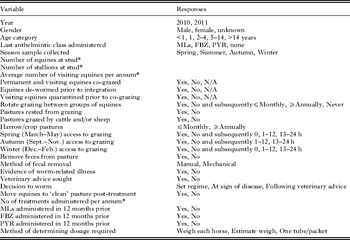
Descriptive statistics were performed using Microsoft Excel (2007). Percentages were rounded to the nearest integer. Associations between management practices and prevalence and level of egg shedding, as determined by FWEC (⩾200 epg), of strongyle and P. equorum infections were tested using logistic regression (Minitab Version 15, Minitab Inc., State College, PA, USA). Regression models were initially populated with all potential explanatory factors and the least significant removed in turn until the most parsimonious model, with only significant factors, remained. The factors included in initial models are shown in Table 1. P values ⩽0·05 indicate factors with a significant influence on strongylid or P. equorum egg shedding in the final model. For strongyles, in which variation in individual FWEC is most likely to serve as a criterion for treatment, FWEC distribution between individual horses was investigated using maximum likelihood. Counts were assumed to follow a negative binomial distribution (Shaw et al. Reference Shaw, Grenfell and Dobson1998), and the likelihood, Pr, of observing a given FWEC, s, assuming a specified distribution mean, m, and aggregation parameter, k, was estimated using equation 1:
 $$Pr \left\{ {o_i = s} \right\} = \displaystyle{{\Gamma (k + s)} \over {\Gamma (k)s!}}\left( {1 + \displaystyle{m \over k}} \right)^k \left( {m \over {k + m}} \right)^{\vskip3pt s} $$
where Γ is the gamma distribution (Hilborn and Mangel, Reference Hilborn and Mangel1997).
Variables included in the initial logistic regression model: MLs, macrocyclic lactones; FBZ, fenbendazole; PYR, pyrantel
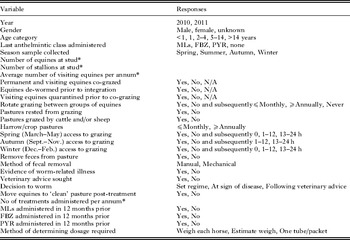
* Indicates a scale variable.
Raw FWECs were divided by 25 and rounded to the nearest integer to avoid calculation overflow arising from factorials of high egg counts. The overall likelihood of the observed dataset given the assumed underlying distribution was expressed as the negative log of the likelihood, −LL:
 $$ - LL = \prod\limits_{i = 1}^n Pr ( - \ln \{ o_i = s\} )} $$
This was minimized by iteration using the Solver software add-in to Excel (Microsoft Corp, USA), to find the values of k and m that best explained the observed FWECs. The starting value of k before iterative fitting was the corrected moment estimate:
 $$k_{CME} = \displaystyle{{m^2 - \displaystyle{v \over n}} \over {v - m}}$$
where m is the mean, v is the variance, and n is the number of counts.
To compare these parameters between equine age categories, likelihood ratio tests were used (Torgerson et al. Reference Torgerson, Schnyder and Hertzberg2005). Thus, a model using the arithmetic mean of each age class (<1 year, 1–2, 2–4, 5–14 and >14 years) and a separate fitted k for each age class was compared with the starting (null) model, in which a single k value was fitted, and the overall arithmetic mean count used. The difference in the negative log likelihoods of each model was multiplied by 2 and compared with the chi-square distribution, with degrees of freedom equal to the difference in the number of parameters between models (Hilborn and Mangel, Reference Hilborn and Mangel1997). A value of P < 0·001 was taken to indicate a significantly better fit by the more complex model. Model complexity was then reduced in a step-wise fashion to identify the most parsimonious model. The fitted values of k that were closest to each other were replaced by a common value, and –LL minimized to achieve the best fit. The procedure was repeated for k and then for m until the minimum number of class-specific values was reached, which significantly improved the fit to the data in comparison with the null model. To detect gender differences in m and k, the final age-class model was further refined to include gender-specific m and k nested within each age-class. Following comparison of the fitted gender-specific model with the null age-class model using the likelihood ratio test, gender-specific parameters were fitted in turn to each age class, first for k across all classes and then for m, while retaining significant differences in k values. For this step-wise procedure, the critical P value was adjusted for multiple comparisons by dividing alpha = 0·05 by the number of comparisons made (Sokal and Rohlf, Reference Sokal and Rohlf1995). The final model therefore included age- and gender-specific values for k and m where these significantly improved the fit to the data, and common values where they did not. To avoid inaccuracies introduced by the rounding procedure, the final description of within-class parameters comprised arithmetic mean and a direct maximum likelihood estimate of k using the method of Wessa (Reference Wessa2008).
To evaluate the relationship between prevalence and mean FWEC, prevalence in each host class was predicted from the class mean using the term for the zero count of the negative binomial distribution (Hilborn and Mangel, Reference Hilborn and Mangel1997):
 $$Predicted\; Prevalence = \left( {\displaystyle{k \over {k + m}}} \right)^k $$
Prevalence predicted in this way was compared with that observed using Pearson correlation.
RESULTS
Fecal sample analysis: the distribution of strongyle and P. equorum FWECs in populations
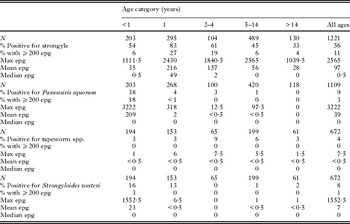
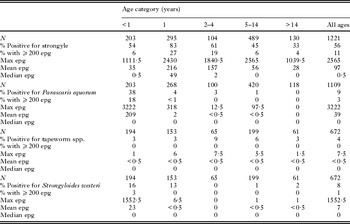
Of the 1221 fecal samples analysed, 54% were from mares. The remainder were derived from yearlings (24%), foals (17%), stallions (1%), teasers (1%) and geldings (3%). Of the foals, 17% were 0–4 months old, 63% were 5–8 months old and the remainder were >8 months old at sampling. The mean values of strongyle, P. equorum, tapeworm spp. and S. westeri eggs were 97, 39, <0·5 and 7 epg (medians of 0·5, 0, 0 and 0 epg, respectively), with individual strongyle and P. equorum FWECs ranging from 0 to 2565 epg and 0 to 3222 epg, respectively (Table 2). Overall, 11% of all TBs excreted 80% of the total strongyle eggs enumerated (FWECs ranged from 234 to 2565 epg). Of these animals, 7% were foals, 54% yearlings, 15% 2–4 year olds, 21% 5–14 year olds and 3% >14 year olds. In the case of P. equorum, 80% of the eggs enumerated were present in 2% of samples (FWECs ranged from 787·5 to 3222 epg), all of which were from 5–8 month old foals. All relevant raw data pertaining to the FWECs are attached as Supplementary material (Appendix I, online version only).
The proportion (%) of horses positive for strongyle, Parascaris equorum, tapeworm spp. and Strongyloides westeri eggs (expressed as eggs per gramme of feces, epg), the proportion (%) observed to have counts ⩾200 epg and, the maximum, mean and median epg values observed within each age category
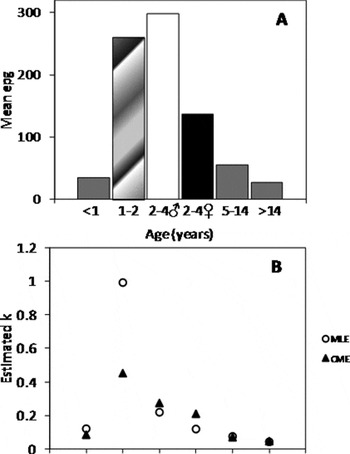
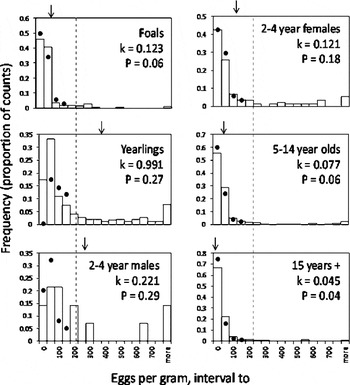
The distribution of strongyle eggs between individuals was highly over-dispersed, with an overall arithmetic mean of 95 epg and an inverse aggregation parameter, k, of 0·11. Strongyle mean FWEC and degree of aggregation between individuals varied significantly between age and gender categories (Fig. 1). The most parsimonious age-specific model retained 2 fitted values for m and 4 for k. This produced a significantly better fit to the data than the null model (χ 2 = 209·42, 4 d.f., P < 0·001). Mean strongyle FWEC was significantly higher in horses aged 1–4 years than in other age classes (Fig. 1A), while there was no difference between classes above or below this range, or between horses aged 1 or 2–4 years, when gender was not taken into account. Foals (<1 year) and horses aged 5–14 years shared the same fitted k, while degree of aggregation in all other age classes differed (Fig. 1B). Fitting gender-specific k within these age classes further improved the model fit (χ 2 = 14·949, 7 d.f., P = 0·037). Step-wise fitting of gender-specific k identified a significant departure from the age-specific null model only within the 2–4 years age class (χ 2 = 6·871, 1 d.f., P = 0·009). Fitting a separate k for every age and gender class did not improve on this model (χ 2 = 8·078, 6 d.f., P = 0·23). Mean FWEC also differed between genders within this age class, but not in others (χ 2 = 6·110, 10 d.f., P = 0·013). In horses aged 2–4 years, m and k were higher in males (N = 14, all geldings) than in females (N = 89). Differences in fitted parameters between age and gender classes are summarized in Fig. 1 and all details of the model fit are presented as Supplementary material (Appendix II, online version only).
Mean strongyle fecal worm egg count (eggs per gramme, epg) (A) and distribution of egg counts between individuals (B), with age. k = aggregation parameter of the negative binomial distribution, whereby high k indicates a less-aggregated distribution. MLE, maximum likelihood estimate using method of Wessa (Reference Wessa2008); CME, corrected moment estimate (see Equation 3). Egg count and k are plotted separately for male and female 2–4 year olds, since these parameters were found to differ significantly with gender in this, and only this, age category. Mean epg in columns shaded differently are significantly different (see text).

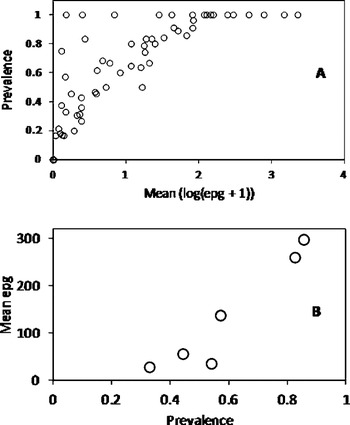
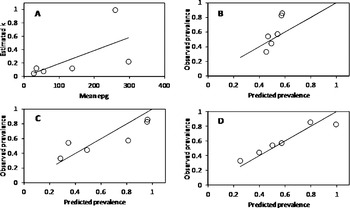
Aggregation parameter k tended to track the mean (Fig. 1), indicating a tendency for FWECs to be more evenly spread between individuals at high means, and more clumped between individuals at low means. However, k was highest in yearlings even though mean FWEC was higher in 2–4 year old males (Fig. 1). The corrected moment estimate of k provided a reasonably good approximation to the maximum likelihood estimation in most cases, although it underestimated k in yearlings (Fig. 1B). As might be expected, groups with a higher mean FWEC tended to have a higher prevalence of strongylid egg shedding (Fig. 2). Prevalence was quite predictable from the negative binomial distribution (Fig. 3). Prediction was improved by using a separate k parameter for each age-gender class, estimated from the regression of k on mean FWEC (Fig. 3A). This resulted in a similar correlation coefficient between predicted and observed prevalence to when a common k value was used (Fig. 3B), and spread the predicted prevalence over a more realistic range (Fig. 3C). The most precise prediction of prevalence was obtained when differences in aggregation between groups were taken into account through separate age-gender specific maximum likelihood estimates (Fig. 3D). Differences in aggregation modified the effects of mean FWEC on the proportion of horses shedding high numbers of eggs (Fig. 4).
Relationship between mean strongyle fecal worm egg count (eggs per gramme, epg) and prevalence in groups of horses in consistent age-gender groupings on different studs (A), and across the whole dataset (B). In (A), groupings were foals (<1 year old), yearlings (1 year old), geldings, mares and stallions/teasers on 22 UK studs (Pearson r = 0·81, N = 68, P < 0·001). In (B), groups were <1 year old, 1 year old, 2–4 year old males, 2–4 year old females, 5–14 year olds and horses >14 years old (Pearson r = 0·95, N = 6, P = 0·004). The horizontal and vertical axes are interchangeable since the mean can be used to predict prevalence and vice versa.

Prevalence predicted from the group mean strongyle fecal worm egg count, using the negative binomial term for the zero class (see Equation 4). Over-dispersion parameter k was estimated from regression against the mean (A; Pearson r = 0·636, P = 0·175, N = 6 in all cases), or by maximum likelihood, for each gender class (<1 year old, 1 year old, 2–4 year old males, 2–4 year old females, 5–14 year olds and horses >14 years old ). The value of k used to predict prevalence was taken to be the common maximum likelihood estimate across the entire dataset (B; r = 0·91, P = 0·011), the age-gender class specific estimate from regression against the mean (C; r = 0·90, P = 0·016), or separate maximum-likelihood fits within each age-gender class (D; r = 0·96, P = 0·002). Trend lines represent the fitted linear regression (A) and the 1:1 relationship between predicted and observed prevalence (B-D).

Change in distribution of strongyle fecal worm egg count (eggs per gramme, epg) with age and gender. k is the aggregation (over-dispersion) parameter of the negative binomial distribution. P is the proportion of fecal worm egg counts above the arbitrary treatment threshold of 200 epg, indicated by the dotted vertical lines. Arrows indicate the mean strongyle fecal worm egg count, and dots the frequencies predicted by the negative binomial distribution for the first 4 count intervals.

Prevalence of strongylid and P. equorum infections and factors associated with prevalence
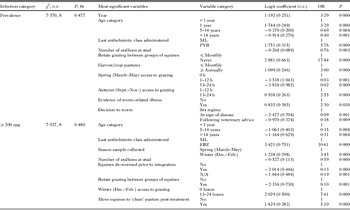
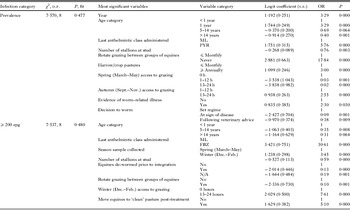
Although 44% of samples analysed were negative for strongyle eggs, this parasite group was by far the most prevalent detected and strongylid eggs were identified in samples submitted from all studs. P. equorum, tapeworm spp. or S. westeri eggs were detected in samples received from 11/21, 9/20 and 8/20 of studs, respectively. Samples with P. equorum or S. westeri ⩾200 epg accounted for only 3% and 1% of the cohort, respectively (Table 2). Age had a significant effect on strongyle prevalence, with the highest level recorded in 1 year olds (83%, Table 2): horses in this age category were, on average, 3 times more likely to be positive for strongyle eggs than those <1 year old (Table 3). Horses in the ⩾5 year old category had the lowest prevalence of infection (33–45%, Table 2) and were 0·40–0·69 times more likely to have lower strongyle FWECs than those that were in the ⩽1 year old category (Table 3). The prevalence of positive strongyle FWECs was also associated with management practices and year (Table 3). For example, horses positive for strongyle eggs were, on average, most likely to have been sampled during 2011, administered PYR at last treatment and resided at studs that did not perform rotational group grazing. Rotational group grazing was the most significant factor: studs implementing rotation on a monthly (or more frequent) basis were nearly 18 times less likely to have animals positive for strongyle eggs at screening than those studs which did not implement rotation (Table 3).
Significant predictors of the prevalence and level of strongyle egg shedding using logistic regression
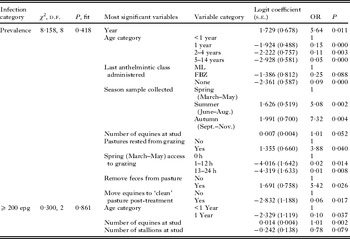
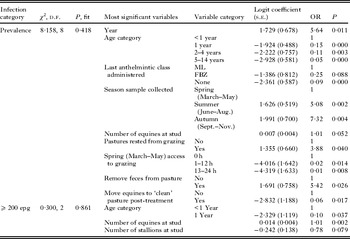
Parascaris equorum eggs were predominantly observed in samples from horses <1 year old, whilst all samples from horses >14 years old were negative for these eggs (Table 2). Of the P. equorum FWEC-positive foals (N = 78), 82% were 5–8 months old, while the remainder were 0–4 or >8 months old (1 and 17%, respectively). In addition to age, equines positive for P. equorum by FWEC analysis were most likely have been sampled during 2011, sampled in summer or autumn at studs where pastures were ‘rested’ from grazing, and where feces were removed from pasture (Table 4).
Significant predictors of the prevalence and level of Parascaris equorum egg shedding using logistic regression
Level of strongylid and P. equorum nematode egg shedding and factors associated with levels of shedding
Strongyle FWECs ⩾200 epg were measured in samples received from 16/22 studs; however, these accounted for only 11% of the total samples screened (Table 2). Equines with ⩾200 strongyle epg were most likely to have been administered FBZ at their last treatment (OR = 30·61), were from studs that grazed >13 h per day from December to February (compared to those grazing for shorter periods of time) and from studs that moved horses to ‘clean’ pasture after treatment. Samples analysed during December to February had a higher OR, being >200 strongyle epg compared to those analysed in spring, (March to May) (Table 3). The highest OR (1·01, Table 4) associated with a P. equorum FWEC >200 epg was the number of horses present at the stud.
DISCUSSION
There is a critical need to deploy parasite control strategies that are less dependent on anthelmintic use and more reliant on management-based control on equine breeding enterprises. A prerequisite to developing such strategies is an improved understanding of the distributions of the relevant helminth species in field settings. The information generated here informs on the prevalence of the target pathogens and their distributions in horses of different age categories on UK TB studs. As observed many times previously (Mfitilodze and Hutchinson, Reference Mfitilodze and Hutchinson1989, Reference Mfitilodze and Hutchinson1990; Epe et al. Reference Epe, Ising-Volmer and Stoye1993; Bucknell et al. Reference Bucknell, Gasser and Beveridge1995; Beelitz et al. Reference Beelitz, Göbel and Gothe1996; Höglund et al. Reference Höglund, Ljungström, Nilsson, Lundquist, Osterman and Uggla1997; Epe et al. Reference Epe, Coati and Schnieder2004; Kornas et al. Reference Kornas, Cabaret, Skalska and Nowosad2010; Hinney et al. Reference Hinney, Wirtherle, Kyule, Miethe, Zessin and Clausen2011), strongyles were the most prevalent helminth type detected. The prevalence of P. equorum was similar to previous studies (Epe et al. Reference Epe, Ising-Volmer and Stoye1993, Reference Epe, Coati and Schnieder2004; Kornas et al. Reference Kornas, Cabaret, Skalska and Nowosad2010; Hinney et al. Reference Hinney, Wirtherle, Kyule, Miethe, Zessin and Clausen2011). Prevalence and egg-shedding levels of this nematode species were greatest in 5–8 month old foals. This, coupled with reports of ML resistance in P. equorum (Reinemeyer, Reference Reinemeyer2009), suggests that effective control of this potentially pathogenic parasite in young horses is essential. The finding of S. westeri eggs in foals was expected, given that they acquire infections via transmammary transmission as well as from the environment (Lyons et al. Reference Lyons, Drudge and Tolliver1973). Environmental transmission during housing and creep feeding may account for the higher prevalence observed here (16%), than reported previously, where there was no indication of foals being creep fed (Lyons et al. Reference Lyons, Tolliver, Harold Drudge, Granstrom and Collins1993; Lyons and Tolliver, Reference Lyons and Tolliver2004). Lyons and Tolliver (Reference Lyons and Tolliver2004) noted a decline in S. westeri prevalence, presumably due to the impact of ML treatments on transmammary transmission (Ludwig et al. Reference Ludwig, Craig, Bowen, Ansari and Ley1983). The low prevalence of tapeworm here is similar to previous coprology-based studies (Epe et al. Reference Epe, Ising-Volmer and Stoye1993; Reference Epe, Coati and Schnieder2004; Lyons and Tolliver, Reference Lyons and Tolliver2004). However, our data must be interpreted with caution since the FWEC methodology used has not been thoroughly validated for this species and egg-counting methods modified for the detection of tapeworm eggs are typically performed on a larger volume of feces (Proudman and Edwards, Reference Proudman and Edwards1992).
The relatively low proportion of strongyle FWEC-positive animals, compared to studies on non-TBs (Beelitz et al. Reference Beelitz, Göbel and Gothe1996; Osterman Lind et al. Reference Lind, Höglund, Ljungström, Nilsson and Uggla1999; Hinney et al. Reference Hinney, Wirtherle, Kyule, Miethe, Zessin and Clausen2011; Kyvsgaard et al. Reference Kyvsgaard, Lindbom, Andreasen, Luna-Olivares, Nielsen and Monrad2011), may reflect the extremely high frequency of ML administration on these studs (Relf et al. Reference Relf, Morgan, Hodgkinson and Matthews2012). A cut-off for anthelmintic administration in horses of 100–300 helminth epg has been suggested, with 200 epg often chosen (Uhlinger, Reference Uhlinger1993). In the current dataset, a cut-off value of 200 strongyle epg would indicate that only 11% of the population sampled would have required treatment at the time of sampling. It is worthy of note here that, in all cases, the stud personnel involved were keen to administer anthelmintic treatments to all horses at the time that they submitted feces for FWEC analysis: indicating the substantial change in behaviour patterns that will be required for more sustainable helminth control on UK TB studs. In relation to the generally accepted adage that indicates that 20% of horses excrete 80% of the egg contamination (Stratford et al. Reference Stratford, McGorum, Pickles and Matthews2011), only 11% of horses sampled here were responsible for excreting 80% of strongyle eggs based on the FWECs performed. Our findings also support the application of specific treatments for P. equorum in foals, since those responsible for excreting 80% of eggs were all <1 year old. Although age was identified as a contributing factor in determining strongyle and ascarid prevalence and level of egg shedding, FWECs can differ considerably among adult horses (Boersema et al. Reference Boersema, Eysker, Maas and van der Aar1996; Eysker et al. Reference Eysker, Bakker, van den Berg, van Doorn and Ploeger2008), indicating that some are susceptible to high levels of infection, and hence disease, throughout their lives (Jasko and Roth, Reference Jasko and Roth1984). In agreement with this, our results clearly demonstrate that strongyle FWECs were highly over-dispersed between horses within all age and gender categories, as observed previously (Nielsen et al. Reference Nielsen, Haaning and Olsen2006; Vidyashankar et al. Reference Vidyashankar, Kaplan and Chan2007; Hinney et al. Reference Hinney, Wirtherle, Kyule, Miethe, Zessin and Clausen2011). Mean FWEC and degree of aggregation differed between genders in the 2–4 year old category with males displaying, on average, higher and less aggregated FWECs than females, possibly due to an effect of sex steroid expression on immunocompetence (Hamilton and Zuk, Reference Hamilton and Zuk1982; Klein, Reference Klein2004; Bouman et al. Reference Bouman, Heineman and Faas2005; Lamason et al. Reference Lamason, Zhao, Rawat, Davis, Hall, Chae, Agarwal, Cohen, Rosen, Hoffman and Nagaraju2006; Monteiro et al. Reference Monteiro, Dietz, Beck, Baker, Martins and Jansen2007). These findings must be interpreted with caution, however, as the low sample size of 2–4 year old males (N = 14) meant that a small number of high individual counts were responsible for the high mean FWEC. An additional confounding factor may be differences between pastures on which the horses grazed, as male and female horses >1 year old were generally grazed separately.
Mean FWEC and k were highest in horses aged 1–4 years and lower in foals and in older horses, in agreement with previous studies (Larsen et al. Reference Larsen, Lendal, Chriel, Olsen and Bjorn2002; Fritzen et al. Reference Fritzen, Rohn, Schnieder and Von Samson-Himmelstjerna2010; Kornas et al. Reference Kornas, Cabaret, Skalska and Nowosad2010). Despite the lower degree of overdispersion within the 1–4 year class, the judicious application of a targeted treatment approach still has potential to protect younger horses from high burdens while leaving refugia for anthelmintic-susceptible genotypes (van Wyk, Reference van Wyk2001): even at higher FWEC means, aggregation was marked, and k low relative to that for FWECs in grazing ruminants (Morgan et al. Reference Morgan, Cavill, Curry, Wood and Mitchell2005). This provides considerable scope for the successful application of a targeted treatment plan based on FWECs in horses of all age categories. By characterizing the statistical distribution of FWECs in different age classes, we provide a basis for exploring the consequences and efficient application of targeted treatment strategies through simulation (Morgan et al. Reference Morgan, Cavill, Curry, Wood and Mitchell2005; Eysker et al. Reference Eysker, Bakker, van den Berg, van Doorn and Ploeger2008). Although in practice k is unlikely to be known for a given group of horses, our data indicate its likely range. Furthermore, the apparent correlation between mean FWEC and k provides the opportunity to apply an indicative k to horse populations based on observed mean FWEC. The value of k will affect the proportion of horses with high FWECs at a given group mean, the accuracy of observed FWEC in a subsample of horses as an estimate of underlying group mean epg and the proportion of the parasite population removed as a result of threshold-based anthelmintic treatment (Morgan and Wall, Reference Morgan and Wall2009). The data presented here will therefore assist development of strategic recommendations for implementation of targeted treatment approaches in TBs, and operational decision support tools for its practical application. Although other statistical methods could be used to investigate variation in FWEC between horses, and characterize distribution patterns, the explicit use of the negative binomial distribution is in keeping with valuable previous work in other taxa (Shaw and Dobson, Reference Shaw and Dobson1995; Shaw et al. Reference Shaw, Grenfell and Dobson1998) and will permit our conclusions to be generalized in support of a range of objectives in the wider equine population. We show that relationships between prevalence and mean FWEC are predictable, and can be more precisely characterized when differences in k between age categories are taken into account. The use of a highly sensitive FWEC method, with a detection limit as low as 1 epg, provided an opportunity to characterize parasite distribution and prevalence-mean relationships in some detail. Inference from data generated using other, less-sensitive FWEC methods would have to take into account measurement error, such that observed FWEC is a function of Poisson error around the true value (Torgerson et al. Reference Torgerson, Paul and Lewis2012).
In terms of management practices that affected prevalence or levels of nematode egg shedding, studs implementing rotational group grazing (especially between age categories) were more likely to have a lower prevalence and lower strongyle FWECs, confirming the value of rotation to reduce transmission via pasture, as previously described in sheep (Leathwick et al. Reference Leathwick, Miller, Atkinson, Haack, Waghorn and Oliver2008). Not surprisingly, time spent grazing also influenced the parasitological parameters, presumably due to longer grazing periods increasing exposure to third stage larvae. Regular removal of roughs, areas where larvae can remain protected from desiccation (Herd and Willardson, Reference Herd and Willardson1985), by harrowing or cropping, was associated with reduced strongyle prevalence, similar to observations on German stud farms (Fritzen et al. Reference Fritzen, Rohn, Schnieder and Von Samson-Himmelstjerna2010). FWECs of ⩾200 epg were more likely to be detected on studs where horses were moved to ‘clean’ pasture after anthelmintic treatment suggesting that the perception of ‘clean’ may be inappropriate, as highlighted previously (Larsen et al. Reference Larsen, Lendal, Chriel, Olsen and Bjorn2002; Hinney et al. Reference Hinney, Wirtherle, Kyule, Miethe, Zessin and Clausen2011). In addition, anthelmintic inefficacy will also affect this, with animals still excreting eggs after treatment (and not detected as doing so) transferring infection to clean pasture. Animal movement to clean pasture immediately after anthelmintic treatment is no longer advised because of potential detrimental effects on levels of refugia (van Wyk, Reference van Wyk2001): further knowledge on the impact of refugia needs to be translated to UK veterinary surgeons and stud managers. Where PYR and FBZ were administered as the last treatment prior to FWEC analysis, strongyle prevalence and FWECs were likely to be higher, respectively. The less persistent activity of PYR and FBZ (Eysker et al. Reference Eysker, Boersema and Kooyman1992; Uhlinger, Reference Uhlinger1992) along with the higher possibility of resistance in cyathostomins to these active ingredients (Kaplan, Reference Kaplan2002, Reference Kaplan2004; Traversa et al. Reference Traversa, Klei, Iorio, Paoletti, Lia, Otranto, Sparagano and Giangaspero2007), are likely reasons for these observations. The increased likelihood of higher levels of strongyle egg-shedding in animals sampled during winter (December to February), in comparison to those sampled in spring (March to May) may reflect changes in grazing management patterns, keeping in mind that those horses that grazed for >13 h per day at this time of year were more likely to have higher levels of strongyle egg shedding. This, linked to the potential effects of climate change, i.e. milder autumns/winters in the UK, may lead to an increase in development and survival of nematode larvae in winter (van Dijk et al. Reference van Dijk, Sargison, Kenyon and Skuce2010) resulting in alterations in egg-shedding patterns and hence the epidemiology of these infections. The fact that fecal samples obtained in summer, in this instance, were not associated with higher levels of shedding may be linked with a higher anthelmintic treatment frequency, and hence strongyle egg suppressive effect, at this time of year.
Few studies have attempted to investigate the prevalence, distribution and level of strongyle and P. equorum egg shedding in relation to host and management factors (Kornas et al. Reference Kornas, Cabaret, Skalska and Nowosad2010). The findings here indicate that a number of specific host and management factors play an important role in determining the prevalence, distribution and intensity of nematode infections in breeding TBs, all of which need to be taken into account in designing sustainable control programmes for the future.
ACKNOWLEDGEMENTS
The authors would like to thank the studs and veterinary surgeons that participated in this study.
FINANCIAL SUPPORT
This work was supported by funding from The Horse Race Betting Levy Board, HBLB (grant number HBLB vet/prj/755).