



Introduction
The Jōmon culture of Japan (c. 12 500–2350 BP; Table 1) is considered one of the best contexts for analysing complex prehistoric hunter-gatherer groups (Rowley-Conwy Reference Rowley-Conwy, Panter-Brick, Layton and Rowley-Conwy2001). Although often discussed as a single culture that dominated the archipelago for over 10 000 years, the Jōmon actually comprised various subgroups with differing traits across regions (Bleed & Matsui Reference Bleed and Matsui2010). These traits were specifically defined by the geography and climate of the various latitudinal zones from subarctic to subtropical, a result of the extreme north–south orientation of the islands. This variation in climatic conditions meant that subsistence systems practised by Jōmon hunter-gatherers in each area were highly varied, with different prey species, tool technology, hunting methods and environmental adaptations (Underhill & Habu Reference Underhill, Habu and Stark2006). Even within a small area in Japan, a mosaic of different environments is possible. Due to these variables, different degrees of complexity can be expected among the various Jōmon subcultures.
Dates of the Jōmon phases.

This paper focuses on the Jōmon subculture that inhabited the eastern side of the main island, Honshu, hereafter referred to as the Pacific Honshu Jōmon (Figure 1). At the beginning of the Holocene, this region of Japan experienced a distinctive transition to environmental conditions that allowed Jōmon foragers to flourish in a forest-estuary ecotone consisting of abundant, nut-bearing deciduous trees, shellfish, coastal fish and forest ungulates such as sika deer (Cervus nippon) and wild boar (Sus scrofa leucomystax), which made up the majority of their diet. Also unique to this part of Jōmon Japan is the occurrence of the individual burials of domesticated dogs (Canis familiaris), only a few of which have previously been discussed outside of the Japanese literature. Researchers have long presumed that hunting dogs were kept by Jōmon foragers (e.g. Kraus Reference Kraus1953; Nishinakagawa et al. Reference Nishinakagawa, Matsumoto, Otsuka and Kawaguchi1994), and in Japan “boar-hunting with dogs is seen as a quintessential Jōmon activity” (Knight Reference Knight, Ellen, Parkes and Bicker2003: 153). Yet this idea has not moved beyond the theoretical, even though archaeological dog remains have been systematically surveyed across Japan (see Kaneko Reference Kaneko1978; Shigehara Reference Shigehara1985; Niwa Reference Niwa1987; Kojima & Kikuchi Reference Kojima and Kikuchi1999). Here, I discuss a possible relationship between the isolated clustering of Jōmon dog burials in just one region and the specialised adaptations to changing environments and prey in this locality. I document a strong association between the first appearance of Jōmon dog burials in eastern Honshu and a shift to primarily hunting terrestrial ungulates in the new Holocene deciduous forests of the region, signifying the probable use of dogs as a dense-forest hunting adaptation after the Pleistocene–Holocene transition.
Map of Japan with the location of the Pacific Honshu Jōmon region.

Palaeoenvironments, subsistence and regional variation
The Japanese islands have a largely mountainous terrain with areas of low-lying coastal plains and a longitudinal orientation that creates distinct environmental regions from north–south (Figure 2). As with other areas of the northern temperate zone, the Pleistocene–Holocene transition brought about significant and rapid climate change in Japan (see Yasuda Reference Yasuda1978). Prior to the transition, the islands were mainly covered by conifer forests. The onset of warming in the early Holocene triggered a dramatic vegetation change, with temperate deciduous forests, which had been in retreat in the southern islands, spreading north onto the main island of Honshu (Aikens & Akazawa Reference Aikens, Akazawa, Straus, Eriksen, Erlandson and Yesner1996). This environmental shift, in combination with the topographic and latitudinal range of the islands, led to the creation of new exploitation niches for Jōmon foragers, including important variations in plant availability, coastal resources and terrestrial prey species. In contrast to the oft-cited seasonal, broad-spectrum Jōmon diet (see the ‘Jōmon Calendar’; Kobayashi et al. Reference Kobayashi, Hudson and Yamagata1992), the different Jōmon subcultures may have aligned much more with Binford's (Reference Binford1980) theory of collectors: specialists who rely on a few key resources (Aikens et al. Reference Aikens, Ames, Sanger, Akazawa and Aikens1986; Habu Reference Habu2004). Leaving aside the subarctic and subtropical environments on the extreme northern and southern islands, regional variation—reflected in the analysis of subsistence remains, dietary isotopes and tool kits—resulted in three generalised subsistence niches on the main islands (e.g. Akazawa Reference Akazawa, Akazawa and Aikens1986; Minagawa Reference Minagawa2001; Hoover & Williams in press): Hokkaido and the northern border of Honshu with primarily marine mammals and fish; south-western Honshu and the southern islands with primarily plant and marine foods; and north-central Honshu with mixed economy with terrestrial animals, plants and marine foods.
General environments across Japan during the Jōmon period (adapted from Tsuji Reference Tsuji2001).

The Jōmon of Pacific Coast Honshu
The spread of deciduous forests into north-central Honshu increased the variety of edible plant foods and strengthened the habitat for forest ungulates. This led to flourishing Jōmon populations, particularly along the Pacific coast (Aikens & Akazawa Reference Aikens, Akazawa, Straus, Eriksen, Erlandson and Yesner1996; Habu Reference Habu2004). Here, post-glacial rising sea levels also increased coastal biotic productivity, resulting in a proliferation of large shell midden sites along the low-lying coastal plains (Habu et al. Reference Habu, Matsui, Yamamoto and Kanno2011). The convergence of abundant upland deciduous forests and coastal resources created an ecotone unparalleled in other regions of Jōmon Japan. Akazawa (Reference Akazawa, Akazawa and Aikens1986) and Uchiyama (Reference Uchiyama, Grier, Kim and Uchiyama2006) speculate that the majority of large Jōmon settlements were located in this region due to a productive transitional zone, allowing for the use of both coastal and forest resources within a minimal distance.
Post-glacial shifts of flora and fauna in north-central Honshu prompted a reorganisation of subsistence strategies, requiring adaptations away from hunting the large terrestrial megafauna of the Pleistocene—e.g. Naumann's elephant (Palaeoloxodon naumanni) and Yabe's giant deer (Sinomegaceros yabei)—and towards a strategy of taking smaller, quicker ungulates in a densely forested environment (Inada Reference Inada1986; Tsuji Reference Tsuji1997). Changes in prey are reflected in the technological advances seen from the region, including a shift to smaller, triangular points used for the bow and arrow (Aikens & Higuchi Reference Aikens and Higuchi1982; Inada Reference Inada1986), which were designed to induce heavy bleeding in ungulates (Friis-Hansen Reference Friis-Hansen1990; Churchill Reference Churchill1993). This change in blade technology began in the southern islands, moving north with the changing biota, suggesting strong connections between Jōmon environmental and cultural changes (Aikens & Akazawa Reference Aikens, Akazawa, Straus, Eriksen, Erlandson and Yesner1996).
In the temperate deciduous forests of north-central Honshu, there may have been variation between Jōmon on the Japan Sea and Pacific coasts, with an increased reliance on plant resources along the Japan Sea, although more dietary isotopic work is needed for this region. The Japan Sea coast, west of the central mountain range, is well known for its heavy, long-lasting snowfall, which sika deer and boar migrate to avoid (Tsujino et al. Reference Tsujino, Ishimaru and Yumoto2010). Minaki (Reference Minaki1988) suggests that extensive chestnut cultivation occurred along this coast, with raised-floor longhouses—associated with the winter storage of nuts in high snowfall areas—found predominantly in this region (Kitagawa & Yasuda Reference Kitagawa and Yasuda2008). In contrast, a substantial primary dependence on sika deer and wild boar by Jōmon on the Pacific Honshu coast has long been established by researchers (Koike Reference Koike, Akazawa and Aikens1986; Hongo et al. Reference Hongo, Anezaki, Yamazaki, Takahashi, Sugawara, Albarella, Dobney, Ervynck and Rowley-Conwy2007). In these two productive temperate forest environments, however, the importance of ungulate hunting on the Pacific coast, as compared to the Japan Sea coast, is probably closely related to the availability of prey during the key autumn and winter months.
It is important to note that in addition to regional variation, there is significant temporal and population variation during the Jōmon phases, which cannot be thoroughly discussed here. In Pacific Honshu, populations were generally higher than in the rest of Japan, probably due to the productive environment and access to a variety of resources. Populations in Honshu appear to have peaked in the Middle phase with a decline in the later phases, although the number of shell midden sites increases in these later phases (Habu et al. Reference Habu, Matsui, Yamamoto and Kanno2011). In contrast, populations in south-western Japan begin small, increasing through the later phases, suggesting either dispersal from highly populated Honshu, an influx of groups from mainland Asia, or both. Climatic and environmental fluctuations during the Jōmon phases—including dramatic sea-level rise between 7400–5900 BP known as the Jōmon Transgression, and a cooling period during the Late and Final phases (Tsukada Reference Tsukada, Pearson, Barnes and Hutterer1986)—probably contributed to these population variations.
Dogs as hunting technology
A hunting partnership between dogs and humans has long been postulated in the archaeological literature, with some researchers suggesting that such a collaborative alliance was the basis for the initial domestication of dogs (e.g. Davis Reference Davis1982; Clutton-Brock Reference Clutton-Brock and Serpell1995). A partnership of this nature has often been proposed between Jōmon hunters and their dogs, given that terrestrial game hunting was an important part of the subsistence economy of some regional subgroups (Nishinakagawa et al. Reference Nishinakagawa, Matsumoto, Otsuka and Kawaguchi1994; Kobayashi Reference Kobayashi2004). The shift in hunting strategies following the Pleistocene–Holocene transition probably included hunting dogs as a combined, dense-forest technological innovation along with the bow and arrow. The innate ability of a dog to sniff out, track, chase and hold prey can significantly enhance the success of human hunters in forested environments (e.g. Dwyer Reference Dwyer1983; Ngima Mawoung Reference Ngima Mawoung2006). Dogs are an important, and in some cases indispensable, hunting aid for many modern forager groups, as they probably were for foragers in prehistory. Their use is often a critical factor in the minimisation of subsistence risk and the maximising of hunting returns; they can prove an invaluable extension of the hunter and their toolkit (Mitchell Reference Mitchell, Badenhorst, Driver and Mitchell2008).
The rapid spread of post-glacial temperate forests in north-central Japan increased the total ungulate biomass, which may have been a crucial variable in human behaviour, organisation and populations in the early Holocene (Mellars Reference Mellars, Evans, Limbrey and Cleere1975; Rowley-Conwy Reference Rowley-Conwy and Zvelebil1986). These areas of high-value prey species were ideal hunting grounds for the Jōmon, yet the density of the temperate forests and swiftness of medium-sized ungulates would have required adapted hunting methods compared to the more open habitats and large herd animals of the previous glacial period. Clutton-Brock (Reference Clutton-Brock and Mason1984) suggests that hunting dogs were heavily used in the early Holocene—in conjunction with microlith technology—to track and retrieve wounded game in difficult, forested environments. Wild boar are particularly sensitive to vegetation type, preferentially inhabiting areas with the densest cover (Melis et al. Reference Melis, Jędrzejewska, Apollonio, Bartoń, Jędrzejewski, Linnell, Kojola, Kusak, Adamic and Ciuti2009; Saïd et al. Reference Saïd, Tolon, Brandt and Baubet2012), making dogs particularly useful for boar hunting.
The use of dogs as hunting tools is widespread in the ethnographic literature, especially in the hunting of deer and wild boar in forested environments (e.g. Ngima Mawoung Reference Ngima Mawoung2006; Pannell & O'Connor Reference Pannell, O'Connor and Hardy2010). Modern hunters emphasise the importance of hunting dogs in dense woodland, where human sensory and locomotor skills are diminished (e.g. Ellen Reference Ellen1999; Chitwood et al. Reference Chitwood, Peterson and Deperno2011). Injured deer often run, leading hunters on long chases, and wild boar can be aggressive and quickly learn to evade capture. Hunting dogs mitigate these factors by tracking blood trails, forcing game into vulnerable positions (e.g. in water) and holding prey until the hunter can make the final kill (Rühe et al. Reference Rühe, Baumgart and Riemer2006; Saïd et al. Reference Saïd, Tolon, Brandt and Baubet2012). Specifically, the successful hunting of wild boar often requires highly skilled dogs, which are prized above all others, and without which many hunters attest boar hunting would be virtually impossible (Bulmer Reference Bulmer1968; Dwyer Reference Dwyer1983). The effectiveness of hunting dogs in the Pacific Coast Jōmon environment, along with the presence of many dog burials in this region, indicates that Jōmon hunters were probably using dogs as tools for the hunting of sika deer and wild boar, as hunters in Japan still do today.
Jōmon dog burials
Due to their significant contributions to the subsistence economy of some forager groups, the ethnographic record is full of examples of the revered treatment of hunting dogs. They are often given proper names, treated as members of the family and considered separate from all other dogs (e.g. Ikeya Reference Ikeya1994). This treatment frequently extends to the burial of hunting dogs in remarkably human-esque ways, often with grave goods and markers (e.g. Grøn & Turov Reference Grøn, Turov, Hårdh, Jennbert and Olausson2007; Koler-Matznick et al. Reference Koler-Matznick, Yates, Bulmer and Brisbin2007). Dogs that are exceptional hunters or that die during a hunting expedition are often particularly venerated (e.g. Olowo Ojoade Reference Olowo Ojoade and Willis1990). Their value as important hunting companions affords the possibility of status: they are a living weapon that can seemingly be elevated to ‘personhood’ based on their skills as an individual. The same may have been true for valuable hunting dogs in the past, especially in an egalitarian society such as the Pacific Coast Jōmon (cf. Mizoguchi Reference Mizoguchi2002). In life, and thus in death, the social position merited by those hunting dogs that proved to be skilled and valuable hunting tools was similar to that of skilled human hunters.
A comprehensive survey was undertaken of Jōmon dog burials in the archaeological literature (Japanese and Western language; details are available in the online supplementary material). Over 110 burials are identified from 39 archaeological sites (Figure 3). The dog burials discussed are all isolated burials: intentional, buried alone and with no obvious signs of butchery or human-induced death noted (cf. Perri in press). While 110 burials have been individually documented, some reports were ambiguous, noting only that dog burials were encountered. This implies the actual number of isolated burials is greater than 110. Importantly, isolated dog burials from Jōmon Japan are found almost exclusively in the eastern half of north-central Honshu, correlating with the deciduous forest-terrestrial ungulate economy of the Pacific Coast Jōmon. Burials begin in the Initial phase, with single burials at two sites, including the only example not located in north-central Honshu (Figure 4; Table 2). By the Early phase, burials occur farther north and in greater numbers. In the Middle phase, burials become more widespread across the Pacific coast of north-central Honshu, with more sites and more burials. The Middle phase also has the only reported inland dog burial(s), although the number of animals and details are not given. Large numbers of sites and burials continue during the Late and Final phases, with burials widespread across the entire Pacific coast of north-central Honshu. After the Final phase the practice of dog burials seems to terminate, as dog burials are unknown in the ensuing agricultural Yayoi period (beginning c. 2350 BP), further suggesting that dog burials are closely related to hunting activities during the Jōmon period.
Locations of the isolated dog burials from Jōmon Japan.

Sites with isolated dog burials from each Jōmon chronological phase; multi-phase sites, in which burials are not attributed to one phase, are included across each phase of the site.

Number of sites and dog burials assigned to each Jōmon phase; some burials come from multi-phase sites where the burial has not been assigned to a particular phase; + denotes phases with additional burials identified, but the exact number is unknown.

The association between Jōmon dog burials and the deciduous forest-estuary ecotone is strongly supported by the fact that 37 of the 39 dog burial sites are shell middens. Injuries, mostly healed broken bones, were evident on dog remains from seven sites. It is possible these are related to the hunting of ungulates, as has been suggested for other prehistoric dogs (Warren Reference Warren2004) and modern wolves (Mech & Nelson Reference Mech and Nelson1990). The ages of the dogs range from newborn to over 12 years old. The burial of immature dogs may not normally be associated with those distinguished as capable hunters, yet the ethnographic record shows that puppies in hunter-gatherer groups are often valued for their potential as future hunting partners (e.g. Terashima Reference Terashima1983; Koster Reference Koster2008), as Clutton-Brock (1995) has previously suggested for prehistoric puppies. Grave goods (an oyster shell bracelet; Horikoshi Reference Horikoshi1977) were noted from only one burial, although another dog burial was covered with stones (Otake Reference Otake1983).
Discussion
The high proportion of dog remains at archaeological sites with evidence for intensive microlith use and ungulate subsistence has been one of the main arguments for the use of prehistoric hunting dogs (e.g. Aaris-Sørensen Reference Aaris-Sørensen1977; Clutton-Brock Reference Clutton-Brock and Mason1984). Although the burial of dogs has often been described as a Jōmon trait, their occurrence is not ubiquitous across Jōmon Japan. Instead, they occur predominantly in a single region, where a significant focus on forest ungulate prey is documented. Even though the preservation of bone in shell middens is often better due to the calcium content (compared to the normally acidic, volcanic Japanese soil), the presence of dog burials in Pacific Honshu does not appear to be the result of differential preservation. Dog burials are not found in shell middens from other regions of Jōmon Japan, and scattered dog skeletal elements are found at most Jōmon sites without the presence of dog burials (see Kaneko Reference Kaneko1978; Niwa Reference Niwa1987). The burials also do not appear to be a trait of one specific Jōmon population, but are present within several defined subgroups in the region (cf. Kobayashi et al. Reference Kobayashi, Hudson and Yamagata1992), co-occurring with groups dependent on the deciduous forest-estuary ecotone. Dog burials from Pacific Coast Jōmon sites seem to reflect a specific subsistence lifeway, wherein sedentary populations, tied to static coastal resources (resulting in large shell middens), used hunting dogs to extract terrestrial game from nearby upland forests. While other site types (pit-dwellings and settlement sites) decreased after the Middle phase, the number of shell midden sites in Pacific Honshu stayed stable during the Middle and Late phases, with a slight increase in the Final phase (Habu et al. Reference Habu, Matsui, Yamamoto and Kanno2011), a pattern mirrored in the occurrence of dog burials (see Table 2).
It is also possible that hunting dogs played an important role in maximising hunting returns in an increasingly resource-strained seasonal environment. Rowley-Conwy (Reference Rowley-Conwy, Panter-Brick, Layton and Rowley-Conwy2001) and Torrence (Reference Torrence, Panter-Brick, Layton and Rowley-Conwy2001) stress that when resources have to be procured in a short period, due to seasonality, hunting pressure or both, technology becomes more specialised. Davidson (Reference Davidson1989) and Torrence (Reference Torrence and Torrence1989) also note the importance of reducing the risk of failure when dealing with a short seasonal hunting schedule, emphasising that every hunting episode needs to be successful. Horikoshi (Reference Horikoshi1972) suggests that the territory of each Jōmon settlement in Tokyo Bay (Pacific Honshu) was only 2–3km in radius, so that as populations increased and hunting territories decreased towards the end of the Jōmon period, resources became strained. The hunting of younger deer, the collection of younger shellfish and an increased use of plant foods seen over time in Pacific Honshu further denotes subsistence pressure (Koike & Ohtaishi Reference Koike and Ohtaishi1985; Koike Reference Koike, Aikens and Rhee1992). Given this demand on resources, the increasing number of dog burials during the later Jōmon phases may signify an increasing use of, and dependence on, hunting dogs as specialised technology to extract ungulate prey from nearby forests.
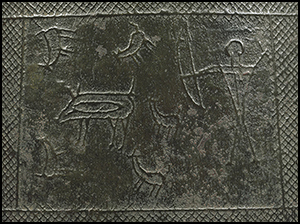
The importance of hunting dogs in this region is also demonstrated by the numerous dog-shaped clay figures (dogū), including a set that features a dog barking at three wild boar (Fujinuma Reference Fujinuma1997: 45). Dogs are minimally represented in the art of the subsequent agricultural Yayoi period (Hudson Reference Hudson1992). One Yayoi representation of dogs is found on a ceremonial bronze bell (dotaku) depicting a number of scenes, one of which is a boar surrounded by a hunter and a pack of dogs (Figure 5). Sahara (Reference Sahara and Tsuboi1982) argues that the scenes represent a temporal narrative, suggesting the boar-hunting human and dogs represent a way of life in the ancestral past (during the Jōmon period), prior to agricultural subsistence. This hypothesis is further supported by the abrupt termination of dog burials with the advent of agriculture around 2350 BP, which has previously been attributed to their loss of importance as hunting companions (Funk Reference Funk and Hasebe2008). In contrast to the careful burial of the Jōmon dogs discussed here, the butchering and eating of dogs becomes a regular practice in later agricultural groups in Japan (Tanabe Reference Tanabe2006).
Ceremonial bronze bell (dotaku) from the Pacific Honshu region depicting a hunter with a bow and arrow hunting a wild boar, surrounded by a pack of dogs (image courtesy of the Tokyo National Museum).

The ethnographic record illustrates the importance of dogs in some deer- and boar-hunting groups, as well as the revered treatment of these animals upon their death. The frequent burial of Jōmon dogs in such an intentional manner, sometimes with grave goods, may indicate that they held a similar position as valued hunting partners. These burials emulate the burials of humans from the same sites, individuals who are generally considered to be egalitarian, but who earned distinguished social positions through roles such as skilled hunters (Mizoguchi Reference Mizoguchi2002; but see Watanabe Reference Watanabe1990; Nakamura Reference Nakamura2000). In Jōmon Japan, intentional dog burials are closely associated with a specific environment and subsistence economy, suggesting that dogs were valued as important forest hunting technology. An association between forest ungulate subsistence and intentional dog burials is seen not only in Jōmon Japan, but also in several other post-glacial deciduous forest forager groups (e.g. Bourque Reference Bourque1975; Larsson Reference Larsson, Vermeersch and Van Peer1990; Morey & Wiant Reference Morey and Wiant1992), suggesting that hunting dogs were a widespread adaptation to forest ungulate hunting in the northern temperate zone.
Acknowledgements
I would like to thank Akira Matsui, Masashi Maruyama, Hiroki Kikuchi and the researchers at the Nara National Research Institute for Cultural Properties for their assistance during my time in Japan. I would also like to thank Peter Bleed and Simon Kaner for their helpful comments on this manuscript. This research was partially funded by the British Association for Japanese Studies, the Great Britain Sasakawa Foundation, the Japan Foundation, the Tweedie Exploration Fellowship and the Rosemary Cramp Fund.
Supplementary material
To view supplementary material for this article, please visit http://dx.doi.org/10.15184/aqy.2016.115.



