INTRODUCTION
Across the trajectory of cancer care, from diagnosis to end-of-life issues, patients are burdened with physical, psychosocial, and spiritual distress. Healthcare professionals address these burdens by forming multidisciplinary teams to deliver support services to patients and families (Fadul et al., Reference Fadul, Elsayem and Palmer2009). These support services originated from the need to provide a comprehensive pain management approach for patients with cancer and have subsequently expanded to address a broad range of physical, psychosocial, and spiritual challenges. Integration of these services can be referred to as supportive or palliative care (Fadul et al., Reference Fadul, Elsayem and Palmer2009).
Increasing evidence shows the value of integrating supportive care services (SCS) into oncology. For example, the relief of pain and other symptoms common during oncology treatments increases patient survival (Smith et al., Reference Smith, Staats and Deer2002; Temel et al., Reference Temel, Greer and Muzikansky2010) and is considered standard compassionate care (Janjan, Reference Janjan2011; Lown et al., Reference Lown, Rosen and Marttila2011). The integration of supportive care into oncology combines support services with disease-directed treatment (von Roenn & Temel, Reference von Roenn and Temel2011), which leads to better symptom management; increased emotional well-being; improved quality of life; enhanced satisfaction with care; and decreased caregiver burden (Bakitas et al., Reference Bakitas, Lyons and Hegel2009; Dennis et al., Reference Dennis, Librach and Chow2011; McMillan & Small, Reference McMillan and Small2007).
Several nationwide activities also demonstrate the need for developing and implementing SCS. The National Consensus Project was organized to address the definition and clinical practice guidelines for quality palliative care. Such care involves a multidisciplinary team to provide the “relief of suffering for patients facing serious life-threatening or debilitating illness and support for the best possible quality of life for both patients and their families” and includes focusing on the physical, psychological, spiritual, and practical burdens of illness (National Consensus Project for Quality Palliative Care, 2009). In addition, the 2008 Institute of Medicine (IOM) report, “Cancer Care for the Whole Patient: Meeting Psychosocial Health Needs,” defined SCS as psychological and social services aimed at addressing the psychological/behavioral and social aspects of illness that affect both patient and family (Institute of Medicine, 2008). Another definition created by the Multinational Association of Supportive Care in Cancer defined supportive care as the “prevention and management of the adverse effects of cancer and its treatment” (Multinational Association of Supportive Care in Cancer, 2013). The National Comprehensive Cancer Network's (NCCN) Clinical Practice Guidelines in Oncology provide direction for the delivery of SCS, as well as recommendations for palliative care and pain, fatigue, and distress management (Holland et al., Reference Holland, Andersen and Breitbart2013). These national initiatives have drawn attention to the need for increased supportive care services at cancer treatment centers, including cancer centers designated by National Cancer Institute (NCI).
The scope of SCS in NCI-designated comprehensive, clinical, and planning cancer centers was assessed by Coluzzi and colleagues (Reference Coluzzi, Grant and Doroshow1995). The present work sought to replicate that study to identify changes in the field and the increased need for these types of services. We provide an updated assessment, comparing the changes that have occurred and describing the current status of SCS in comprehensive cancer settings. For consistency, our survey focused only on NCI-designated comprehensive cancer centers due to the fact that they follow the same SCS standards. Overall, we found that both the quantity and quality of SCS have improved.
METHODS
Survey Development and Process
We used Coluzzi and colleague's 60-question survey from their 1995 publication to frame our 98-question survey (see Appendix) of the current study (Coluzzi et al., Reference Coluzzi, Grant and Doroshow1995). Both surveys included questions regarding center characteristics, number of supportive care team members, number of services provided, elements of pain management teams, subjective rating of the effectiveness of services (now and five years prior to the survey), emotional counseling services, community partnerships, spiritual care services, educational services for patients and staff, research, and survivorship services. We added questions to the original survey to accommodate changes that have occurred in the types of SCS offered over the past 17 years. These questions addressed the use of a palliative care team in combination with a pain management team, implementation of distress screening for inpatients and outpatients, program evaluation, and new types of program content, such as complementary services.
Our survey was uploaded to an electronic survey engine for the convenience of participants. The flexibility and intuitive nature of the survey engine allowed for a variety of question types, including multiple-choice, open-ended, fill-in, and Likert-type scale. The study design and survey were approved by the City of Hope Institutional Review Board. Completion of the survey implied consent.
Setting and Sample
The survey was emailed to the medical directors of all NCI-designated comprehensive cancer centers (n = 11). Contact information for the medical directors was collected from the NCI website (National Cancer Institute, 2011).
Data Collection
Medical directors were sent an email requesting they partner with the research team and other NCI-designated comprehensive cancer centers by completing the survey and returning it within one week. Medical directors were offered the opportunity to request a copy of the final results. The email included a cover letter and a unique link to the survey for each institution. After a week, a reminder email was sent to each medical director or their assigned colleagues. To increase the response rate, personal calls and emails were also made to palliative care directors at the centers who had not yet responded, requesting they complete the survey on behalf of their institution. Non-responding institutions were then FedEx'd a package that included a letter encouraging them to complete the survey.
Statistical Analysis
Once the survey was closed, data from the electronic website was exported to SPSS (version 15.0) for data analysis. Descriptive statistics were employed to make summary conclusions about the collected data. A limitation of the current study was the inability of the authors to access raw data from the 1994 survey, rendering comparison of scores within subjects impossible.
RESULTS
Center Characteristics
We obtained a 76% response rate (n = 31) from NCI-designated comprehensive cancer centers. The number of beds per center ranged from 10 to 924, as compared to the 1994 survey, for which centers reported a range of 0 to 530 beds. New cancer patients per year ranged from 112 to 31,952.
Supportive Care Services
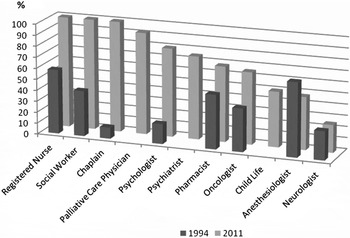
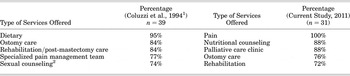
Of the 31 comprehensive cancer centers that responded, only 19% (n = 6) currently incorporated their SCS into one department. Over the past 17 years, there has been an increase in the number of centers that offer pain management services, and it is now the most frequently offered service, in contrast to dietary services in 1994 (Coluzzi et al., Reference Coluzzi, Grant and Doroshow1995). Pain management was offered by all centers, followed by nutritional counseling (88%), a palliative care clinic (88%), ostomy care (76%), and rehabilitation (72%), as shown in Table 1 (Coluzzi et al., Reference Coluzzi, Grant and Doroshow1995). Figure 1 shows the percentage of institutions that involved specified occupations as part of their SCS teams. Because the 1994 survey included a question regarding the number of anesthesiologists and oncologists on these teams, we also assessed participation of these occupations on SCS teams. Registered nurses were the most frequently identified team members in our present study, followed by social workers, chaplains, and palliative care physicians (Figure 1).
Percentage of institutions involving the specified occupations in supportive care services teams (1994 N = 39; 2011 N = 31). In 1994, palliative care physician, psychiatrist, and child-life were not options on the survey (see Coluzzi et al., Reference Coluzzi, Grant and Doroshow1995).

Five most common supportive care services offered (1994 vs. 2011)

1 Coluzzi et al. (Reference Coluzzi, Grant and Doroshow1995).
2 2011 survey asked about availability of a fertility program instead of sexual counseling.
Pain and Palliative Care
Every surveyed institution reported offering pain management, in contrast to only 77% in 1994. These data indicate that pain management teams in 1994 ranged in size from 2 to 22 team members, whereas in 2011 the size of teams was similar, ranging from 2 to 30. Only 3% of centers in 1994 combined their pain and palliative care clinics, as compared to 40% in 2011.
Other Services
Terminal Illness Management
Some 32% of institutions in the current survey offered designated inpatient hospice/palliative care beds.
Emotional Support Counseling
In 1994, emotional support counseling was most often provided by social workers (84%), followed by nurses (79%), psychologists (72%), and psychiatrists (67%). The disciplines most frequently offering emotional support counseling in the current survey were social workers (77%), psychologists (77%), spiritual counselors (71%), psychiatrists (58%), and nurses (42%).
Additional Services
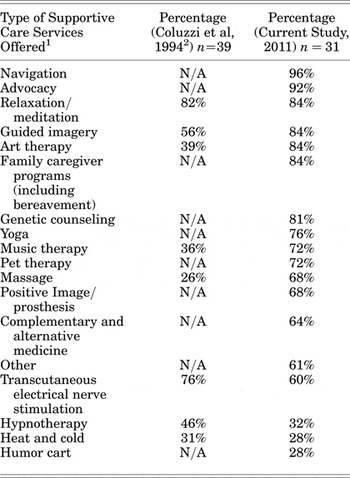
Institutions continue to promote complementary services, as can be seen in Table 2 (Coluzzi et al., Reference Coluzzi, Grant and Doroshow1995). The most commonly offered services were navigation (96%) and advocacy (92%). The following programs were offered by 84% of the institutions surveyed: relaxation/meditation, guided imagery, art therapy, family/caregiver programs, and bereavement services, while genetic counseling was offered at 81% of the surveyed institutions. This shows a trend across all institutions toward offering a greater variety of services than 17 years ago.
Percentage of institutions reporting additional supportive care services (1994 vs. 2011)

1 N/A denotes items that were not an option on the 1994 survey
2 Coluzzi et al.(Reference Coluzzi, Grant and Doroshow1995).
Spiritual Care Services
Spiritual care services continued to be well established, with 96% of institutions now offering such services.
Educational Services Targeting Supportive Care
The current study showed a 29% decrease in the number of institutions offering professional education programs (from 97 to 68%). The number of institutions offering patient education programs also decreased, from 89 to 74%. However, the percentage of institutions offering a community education program (65%) remained relatively constant. In addition, 65% of institutions reported offering caregiver education programs.
Research
The number of institutions reporting research programs specific for SCS slightly increased from 62 to 64%; however, the amount of funding for research had increased significantly. The number of institutions receiving outside funding increased from 51 to 68%, with 52% of institutions currently receiving peer-reviewed funding (13% increase) and 26% receiving funding from private industry (2% decrease). The overall increase in funding is of particular importance, given the reduction in federally funded research.
Survivorship
Because cancer treatment has long term side effects, follow-up programs for survivors are an essential aspect of comprehensive care. Some 88% of surveyed institutions offered long-term follow-up clinics. Breast cancer was the most frequently offered survivorship clinic (42%), followed by prostate and urology (26%), and colorectal (23%). Half of the surveyed institutions offered transition visits, 73% offered survivor treatment summaries, and 68% offered survivor care plans. Survivorship services were not reported in the 1994 survey.
Distress Screening
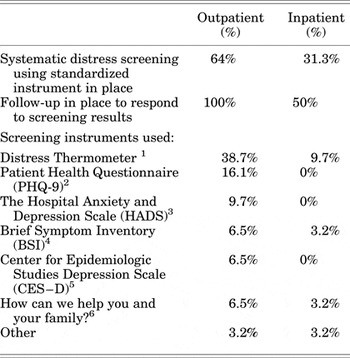
Although data on psychosocial screening were not collected in 1994, we have added this data (see Table 3) (Derogatis & Melisaratos, Reference Derogatis and Melisaratos1983; Kroenke et al., Reference Kroenke, Spitzer and Williams2001; Loscalzo & Clark, Reference Loscalzo and Clark2007; Radloff, Reference Radloff1977; Zigmond & Snaith, Reference Zigmond and Snaith1983; Ransom et al., Reference Ransom, Jacobsen and Booth-Jones2006) to the current study because guidelines and standards from the NCCN and the American Society of Clinical Oncology (ASCO) endorse biopsychosocial screening as a standard of care for all cancer patients. A systematic biopsychosocial distress screening system for outpatients was in place at 64% of the institutions; the Distress Thermometer (Ransom et al., Reference Ransom, Jacobsen and Booth-Jones2006) at 39% was the most commonly reported screening instrument. Each institution that employed a distress screening system reported having a standard follow-up process for responding to screening results.
Percentage of institutions reporting distress screening for outpatients and inpatients (2011; N = 31)

1 Ransom et al. (Reference Ransom, Jacobsen and Booth-Jones2006).
2 Kroenke et al. (Reference Kroenke, Spitzer and Williams2001).
3 Zigmond & Snaith (Reference Zigmond and Snaith1983).
4 Derogatis & Melisaratos (Reference Derogatis and Melisaratos1983).
5 Radloff (Reference Radloff1977).
6 Loscalzo & Clark (Reference Loscalzo and Clark2007).
Approximately one third of surveyed institutions reported offering a systematic inpatient distress screening, with the Distress Thermometer (13%) again being the most commonly used tool. Some 50% of institutions with inpatient screening had a standard follow-up process in order to respond to inpatient screening results.
Program Evaluation
Evaluating programs encourages services to continually improve and meet the needs of patients. A total of 54% of institutions reported collecting evaluation data on their programs, 71% of which asked patients and 46% asked professionals to evaluate programs.
Personal Evaluation of Pain Management and Supportive Care Services
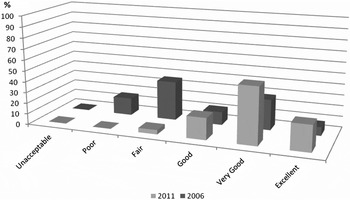
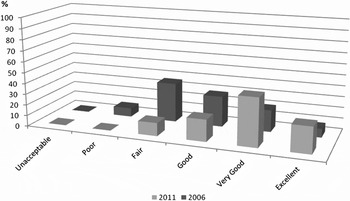
To replicate the 1994 survey and to assess the improvement of supportive care services, surveyed institutions were asked to rate the pain management and SCS offered at their institution, both in the present and five years prior (2006), using a Likert-type scale of unacceptable to excellent. The general trend found an increase in these ratings over time, for both SCS and pain management, and more institutions reported ratings of “very good” and “excellent” for 2011 (Figures 2 and 3).
Evaluation of pain management effectiveness (2011 N = 31).

Evaluation of the effectiveness of supportive care services (2011 N = 31).

DISCUSSION
Just as healthcare in 1994 faced obstacles arising from reform initiatives focused on efficiency (Coluzzi et al., Reference Coluzzi, Grant and Doroshow1995), the proposed initiatives for 2013 create similar challenges. Competing political views on healthcare and the dramatic changes proposed by the Patient Protection and Affordable Care Act (ACA) have created uncertainty (Public Law 111-148, 2010). The ACA aims to increase the number of Americans with insurance coverage; however, changes to Medicaid and Medicare may limit an institution's ability to accept patients (Moy et al., Reference Moy, Polite and Halpern2011). SCS have been charged to provide comprehensive integrated services, as recommended by a 2008 IOM report (Institute of Medicine, 2008) and NCCN guidelines (Holland et al., Reference Holland, Andersen and Breitbart2013). However, Hui et al.'s (2003) survey data evaluating NCI-designated cancer centers and non-NCI cancer centers' integration of palliative care services demonstrates inconsistencies with respect to SCS and their integration into oncology services.
Although our study sample was based on the small number of NCI-designated comprehensive cancer centers, it is geographically representative and the results have an overall trend toward increased services. Because the population of the United States is aging (American Cancer Society, 2012), it is not surprising that the number of beds dedicated to cancer care has almost doubled over the past 17 years, and, coincidentally, access to pain management services has increased as well. In the 1994 study (Coluzzi et al., Reference Coluzzi, Grant and Doroshow1995), 26% of institutions did not offer pain management at all, despite the high occurrence of pain in cancer patients (Smith et al., Reference Smith, Staats and Deer2002). This situation has improved significantly, with 100% of the surveyed institutions now reporting the availability of pain management services. Additionally, the percentage of institutions including various healthcare occupations in SCS has increased in all areas except for anesthesiology (Figure 1). Although palliative care physicians, psychiatrists, and child-life positions were not options on the 1994 survey, we found that many institutions now include these disciplines in SCS teams, and palliative care physicians are now on staff at approximately 90% of institutions.
While the percentage of institutions offering pain management has increased, only 32% of them offer designated hospice beds. Further research is needed to determine whether this low offering of hospice beds is a result of referrals to outside hospice facilities, which have grown tremendously since 1994 (Medicare Payment Advisory Commission, 2009). Given the need for cost-effective end-of-life care, it is difficult to understand why there continues to be a gap in end-of-life services. It is troubling that the number of hospice beds decreased from already low numbers in comprehensive cancer centers, and it appears that Coluzzi and colleagues' statement that “true integration of palliative care and terminal services in cancer care is inadequate” may still hold. The American Cancer Society estimated that in 2012 there would be 577,190 cancer-related deaths, approximately 35% of the estimated 2012 new cancer diagnoses (American Cancer Society, 2012). Unfortunately, delayed hospice referrals remain the trend in oncology services (Bruera & Hui, Reference Bruera and Hui2012; Hui et al., Reference Hui, Elsayem and de la Cruz2010). Pain is prevalent throughout the cancer trajectory (van den Beuken-van Everdingen et al., Reference van den Beuken-van Everdingen, de Rijke and Kessels2007) and was the most commonly reported symptom of patients in a tertiary cancer center seven days prior to death (Caraceni et al., Reference Caraceni, Zecca and Martini2012). To appropriately and comprehensively care for patients, the integration of hospice services earlier in the cancer trajectory could decrease the number of patients who experience pain at the end of life.
Even with this deficit in providing hospice care, the current study suggests that supportive care services are becoming more patient centered, as evidenced by the 65% of institutions that now offer a patient and family advisory council. Previously, such councils were ad hoc and poorly organized. Over time, the benefits of having an official forum for airing the perspectives of the patient and family became multidimensional. Patient and family advisory councils focus on the humanistic functions of institutions, making them powerful allies and objective spokespersons for the expansion of SCS. They have been found to positively impact quality, safety, satisfaction, and financial metrics within healthcare institutions (Conway et al., Reference Conway, Johnson and Edgman-Levitan2006).
A wide variety of services are now offered at a significantly higher rate than 17 years ago, showing a trend toward comprehensive psychosocial services that provide whole-person care. With the addition of so many new services, it is vital that institutions formally evaluate their programs for efficiency and effectiveness, yet less than half of the institutions reported doing this. Furthermore, the ACA has called for efficiency in healthcare delivery (Public Law 111-148, 2010). It is therefore imperative that programs be evaluated to improve efficiency and effectiveness and enhance wise utilization of resources.
An additional benefit of evaluation data can drive the acquisition of external funding by demonstrating the need for specific services. This is extremely important for supportive care services because many do not directly generate income for the parent institution. It is also important for SCS to receive funding from outside the institution to prevent budget cuts that could eliminate these services (Coluzzi et al., Reference Coluzzi, Grant and Doroshow1995). Consistent with this need, institutions reported a 17% increase in outside funding for SCS, which will promote their ongoing availability to patients. In addition, successful SCS programs include both research and education (Loscalzo et al., Reference Loscalzo, Bultz, Jacobsen and Holland2010). Sharing research that demonstrates the overall benefits of SCS for patients and families provides educational opportunities to stakeholders and can assist in gaining funding to further develop these programs.
Disease-specific and health management education programs during treatment are essential for patients and caregivers, as is continuing education for professionals. It is noteworthy that the 2008 Institute of Medicine report discussed the lack of health education as a barrier to care. Our study demonstrated a trend toward decreasing the number of educational programs offered for both patients and professionals. However, caution should be employed when interpreting this decrease, as it may be due to a movement toward having community organizations (e.g., Cancer Support Community, CancerCare) provide some educational programs for patients and caregivers. Transferring educational services into the community can reduce the financial impact on SCS programs, allowing them to expand in other directions. However, given the severe challenges faced by community-based organizations, which are often dependent on philanthropic support, patient and family education continues to be at a particularly high risk.
Our study found that the availability of psychosocial screening programs is growing. This may be because the NCCN and the ASCO have endorsed distress screening guidelines and standards (Holland et al., Reference Holland and Bultz2007; Reference Holland, Andersen and Breitbart2013; Jacobsen, Reference Jacobsen2007). There has been tremendous growth in the percentage of NCI-designated comprehensive cancer centers offering distress screening: 64% reported offering screening in at least some outpatient clinics and 39% in inpatient units. By implementing distress screening as a standard of care, data analysis could potentially strengthen evidence that proactive measures taken to decrease distress can improve clinical outcomes for patients (Jacobsen, Reference Jacobsen2007). Thus, the results of screening can drive research and funding to advocate for ongoing improvement of supportive care services (Conway et al., Reference Conway, Johnson and Edgman-Levitan2006).
Both the current and 1994 surveys offered participants the opportunity to provide a subjective review of their overall pain management and supportive care services. In 1994, only 52% of NCI-designated cancer centers rated their pain management and SCS programs as excellent or very good, while some centers considered their programs unacceptable (Coluzzi et al., Reference Coluzzi, Grant and Doroshow1995). None of the centers surveyed in 2011 rated their programs as unacceptable at present or five years prior to the study (2006), illustrating an overall trend toward improvement in both pain management and SCS. In addition, centers tended to show improved ratings in 2011 as compared to five years prior. However, when interpreting these results, it is important to recognize that these data were based on subjective reports and thus may be inflated. This points to the need for increased use of patient satisfaction measures to provide evidence for the value of pain management and SCS programs for patients and families (Coluzzi et al., Reference Coluzzi, Grant and Doroshow1995).
Our study indicates that further research is needed to assess the effectiveness of organized pain management teams and the barriers to timely patient referrals to hospice for appropriate end-of-life care. Given the pressure to implement psychosocial distress screening guidelines, research is also needed to evaluate the impact of distress screening on clinical outcomes. In addition, further research is needed to investigate the causes of the reported decrease in professional and patient education. As concern grows regarding the cost of healthcare, it is essential that resources be used to their optimum potential. Therefore, it behooves comprehensive cancer centers to follow the 2008 IOM report and NCCN guidelines during this time of healthcare uncertainty due to changes in funding and to advocate for inclusion of supportive care services into future policies in an effort to not lose momentum or funding (Fann et al., Reference Fann, Ell and Sharpe2012; Holland et al., Reference Holland, Andersen and Breitbart2013; Institute of Medicine, 2008).
ACKNOWLEDGMENTS
We acknowledge the following participating institutions: the University of Alabama at Birmingham Comprehensive Cancer Center; the University of Arizona, Arizona Cancer Center, Tucson; Beckman Research Institute, City of Hope Comprehensive Cancer Center, Duarte, California; University of California at Los Angeles, Jonsson Comprehensive Cancer Center, Los Angeles; University of Southern California Norris Comprehensive Cancer Center, Los Angeles; University of California, Irvine; Chao Family Comprehensive Cancer Center, Orange; University of Colorado Cancer Center, Aurora; Georgetown University Medical Center, Georgetown Lombardi Comprehensive Cancer Center, Washington, DC; University of South Florida, H. Lee Moffitt Cancer Center and Research Institute, Tampa; University of Chicago Comprehensive Cancer Center, Chicago; Northwestern University, Robert H. Lurie Comprehensive Cancer Center, Chicago; The University of Iowa, Holden Comprehensive Cancer Center, Iowa City; Johns Hopkins University, Sidney Kimmel Comprehensive Cancer Center, Baltimore; Dana–Farber Cancer Institute, Dana–Farber/Harvard Cancer Center, Boston; University of Michigan Comprehensive Cancer Center, Ann Arbor; Wayne State University School of Medicine, The Barbara Ann Karmanos Cancer Institute, Detroit; Mayo Clinic, Mayo Clinic Cancer Center, Rochester, Minnesota; Washington University School of Medicine and Barnes-Jewish Hospital, Alvin J. Siteman Cancer Center, St. Louis; Dartmouth–Hitchcock Medical Center, Norris Cotton Cancer Center, Lebanon, New Hampshire; Roswell Park Cancer Institute, Buffalo, New York; University of North Carolina Lineberger Comprehensive Cancer Center, Chapel Hill; Duke University Medical Center, Duke Cancer Institute, Durham; Wake Forest University, Wake Forest Comprehensive Cancer Center, Winston-Salem; Case Western Reserve University, Case Comprehensive Cancer Center, Cleveland; Ohio State University, James Cancer Hospital and Solove Research Institute, Columbus; University of Pennsylvania, Abramson Cancer Center, Philadelphia; Fox Chase Cancer Center, Philadelphia; Vanderbilt University, Vanderbilt-Ingram Cancer Center, Nashville; University of Texas MD Anderson Cancer Center, Houston; Fred Hutchinson Cancer Research Center, Fred Hutchinson/University of Washington Cancer Consortium, Seattle; University of Wisconsin, Paul P. Carbone Comprehensive Cancer Center, Madison.
Research support was not obtained for this study. The manuscript is an original contribution that was not previously published or presented elsewhere. The authors have no conflict of interest to declare.
Supplementary Materials and Methods
To view supplementary material for this article please visit http://dx.doi.org/10.1017/S1478951514000601.