1. Introduction
Articulated crowns and cups of early Palaeozoic crinoids are rare fossils in the British Isles, except for those uncommon, yet significant, sites – starfish beds – where they abound through accidents of preservation (Donovan, Reference Donovan1989; Donovan et al. Reference Donovan, Lewis and Fearnhead2012a, b). Disarticulated columnals, pluricolumnals, brachials and cup plates are more common than crowns and cups by some orders of magnitude. We document the recent discovery of a single, well-preserved, external mould of one side of a crown with proxistele, an unexpected and significant find by JPB and LAM. This new discovery provides fresh data, adding a new piece to the jigsaw of early Palaeozoic Crinoidea of the British Isles. It is encouraging, even if exceptionally rare, that such new specimens continue to be found sporadically, improving our understanding of the recovery of the crinoids following the end Ordovician mass extinction event (Donovan, Reference Donovan1994; Donovan et al. Reference Donovan, Widdison, Lewis and Fearnhead2012b).
2. Geological setting and locality
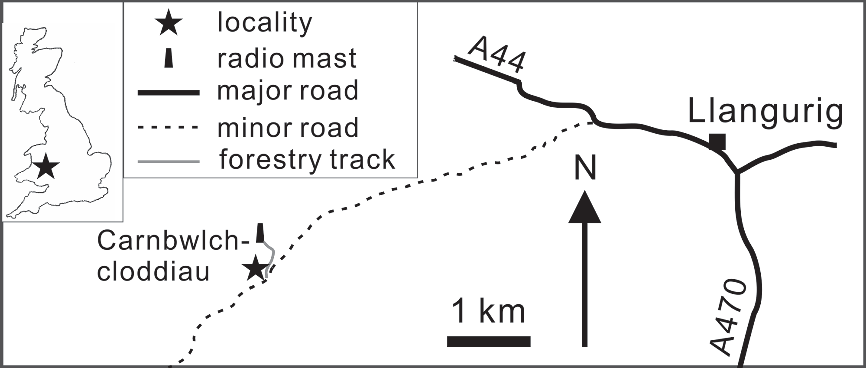
This specimen is from a small quarry in an area of forestry that is assigned to the Pysgotwr Grits Formation (Davies, Reference Davies1933), a few miles west of Llangurig, Powys (Montgomeryshire), mid-Wales [NGR SN 85533 78616] (Fig. 1). The formation is dominantly turbiditic, consisting of thick sandstone sequences and localized conglomerates, with some slumped mudstones intervals. The sequence is poorly fossiliferous, but is assigned to the Monograptus griestonensis Biozone of the Telychian Stage (uppermost lower Silurian); lists of graptolites and acritarchs were provided by Davies et al. (Reference Davies, Fletcher, Waters and Wilson1997). The specimen was recovered from a 3-m thick green mudstone interval exposed in the trackside quarry (used for the construction of forestry roads), between more typical massive turbiditic sandstones that are virtually unfossiliferous, except for rare trace fossils. The mudstone is indurated, splintery and shows few bedding structures, and was probably deposited rapidly as a single mass-flow unit, or a rapid succession of such deposits without intervening non-deposition surfaces. Although bioturbated hemipelagites in this formation can appear superficially similar (Davies et al. Reference Davies, Fletcher, Waters and Wilson1997), no evidence was seen for pervasive burrow mottling or lamination.
Locality map of the Llangurig area, Powys, mid-Wales. Inset map of the British Isles shows location (*).

Environmental interpretation of the depositional setting is challenging, but must be assumed to represent relatively deep water, compared with other crinoid-bearing faunas from the Welsh Borderland. Although the sediment was certainly transported, the delicacy of the specimen implies only very limited post-mortem transport of the crinoid. This suggests either the genuine occurrence in an unusually deep-water environment for crinoids at this time or, more likely, transport occurred before the death of the individual (see ‘Discussion’).
3. Materials and methods
The specimen was collected on a chance visit, being found loose in the quarry rubble, but clearly tied to the distinctive mudstone band adjacent to it. A second visit was made by FEF, JPB and LAM (together with Kevin Knell, Llandrindod), during which no body fossils were found during an entire day of examining both loose blocks and outcrop. The counterpart was not found, and is presumed to now form part of the forestry tracks; no isolated ossicles, or even indeterminable fragments of other taxa such as brachiopods or graptolites, were discovered.
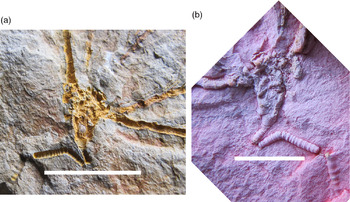
Observations and measurements of this specimen were made using a Nikon SMZ-10 binocular microscope with a camera lucida facility. The specimen is preserved as a natural external mould without counterpart (Figs 2, 3a), and was cast with latex rubber (Fig. 3b) using standard techniques (Feldman et al. 1989). Standard software packages were used to manipulate images.
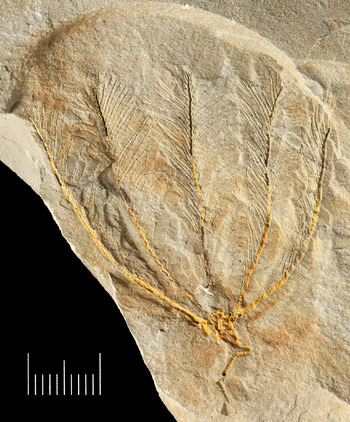
Euptychocrinus longipinnulus sp. nov., NMW 2019.27 G.1, holotype, natural external mould. Whitened with ammonium chloride. Scale in millimetres.

Euptychocrinus longipinnulus sp. nov., NMW 2019.27G.1, holotype, details of the proxistele and lower part of crown. (a) Natural mould, uncoated. Scale bar: 10 mm. (b) Latex cast, coated with ammonium chloride. Scale bar: 5 mm.

Terminology of the crinoid endoskeleton follows Moore et al. (Reference Moore, Ubaghs, Rasmussen, Breimer, Lane, Moore and Teichert1978), Ubaghs (Reference Ubaghs, Moore and Teichert1978) and Webster (Reference Webster1974). The description of the new crinoid follows the recommendations of Fearnhead (Reference Fearnhead2008). The specimen is deposited in the collection of the National Museum of Wales, Cardiff (prefix NMW).
4. Systematic palaeontology
Class CRINOIDEA J.S. Miller, Reference Miller1821
Subclass CAMERATA Wachsmuth & Springer, Reference Wachsmuth and Springer1885
Order DIPLOBATHRIDA Moore & Laudon, Reference Moore and Laudon1943
Superfamily Dimerocrinitoidea von Zittel, 1879
Family Dimerocrinitidae von Zittel, 1879
Genus Euptychocrinus Brower, Reference Brower1994
Type species. Glyptocrinus fimbriatus Shumard, Reference Shumard1855, by the original designation of Brower (Reference Brower1994, p. 577), from the Upper Ordovician (Hirnantian) Girardeau Limestone of Illinois and Missouri, USA (Brower, Reference Brower1973, pp. 446–8, plates 69–72, text-fig. 42; Donovan et al. Reference Donovan, Widdison, Lewis and Fearnhead2012b, p. 156; Webster & Webster, Reference Webster and Webster2014, p. 1116).
Other nominal species. Euptychocrinus skopaios Brower, Reference Brower1994, Middle Ordovician Dunleith Formation, Iowa and Minnesota; Euptychocrinus longibrachialis (Brower, Reference Brower1975), Telychian, Llandovery, Deerhope Formation, Scotland (Donovan et al. Reference Donovan, Widdison, Lewis and Fearnhead2012b, p. 156; Webster & Webster, Reference Webster and Webster2014, pp. 1116–7); Euptychocrinus longipinnulus sp. nov., Telychian, Llandovery, Wales. A questionable Euptychocrinus sp. is also known from the Katian Stage of Morocco (Botting, 2018), that is, Gondwana (Fortey & Edgecombe, Reference Fortey and Edgecombe2017, p. 312).
Diagnosis. (After Brower, Reference Brower1994, p. 577) “Dimerocrinitidae with two unbranched, uniserial, pinnulate arms per ray. Aboral cup conical, not lobate: median-ray, anal series ridges present; interbrachial areas depressed; cup plates smooth, swollen or covered with small nodes. Radials in contact except in CD interray; primibrach 1 always hexagonal; primaxil pentagonal to heptagonal; proximal secundibrachs fixed into cup of adults. Tegmen surface somewhat flexible, consisting of irregular and undifferentiated plates; anal tube absent. Column round.”
Remarks. As noted by Brower (Reference Brower1994, p. 577), Euptychocrinus is easily differentiated from Ptychocrinus, differing in its arm geometry and cup sculpture. Ptychocrinus bears two arms per ray, which branch once or several times well above the cup, and it also possesses stellate cup plates. In contrast, Euptychocrinus has two unbranched arms in each ray and lacks stellate ridges on its cup plates.
Range. Mainly Laurentian: Middle–Upper Ordovician strata of USA; Katian Stage (Upper Ordovician) of Morocco(?) (Gondwana); lower Silurian strata (Llandovery, Telychian) of Scotland and Wales. The Scottish Llandovery occurrence was on the Laurentian landmass (Aldridge et al. Reference Aldridge, Siveter, Siveter, Lane, Palmer and Woodcock2000, p. 4). Avalonian Euptychocrinus longipinnulus sp. nov. is therefore the first member of this genus to be identified with confidence from the opposite shore of the Iapetus Ocean.
Euptychocrinus longipinnulus sp. nov.
Etymology. Latin longus, long, and pinna, feather, describing the feather-like pinnulation of the long arms.
Type material. Holotype, NMW 2019.27G.1, an external mould without counterpart of crown and proxistele (Figs 2, 3). The only specimen known.
Type locality. Quarry at side of track, Carnbwlchcloddiau, near Llangurig, Powys, Wales [NGR SN 85533 78616].
Diagnosis. (Following the recommendations of Ausich & Copper, Reference Ausich and Copper2010, p. 16.) A species of Euptychocrinus with a high, shuttlecock-like crown; a conical, unsculptured cup; infrabasals low, but apparent in lateral view; IBr1 hexagonal; 10 long, slender, feather-like uniserial arms composed of numerous low brachials bearing long pinnules; proxistele heteromorphic, N3231323.
Description. Crown medium-sized, broad, 42.0 mm from the tip of brachials to base of cup. The overall appearance is conical and similar to a shuttlecock.
More distal column and attachment structure not preserved. Proxistele slender, most proximally about as wide as base of cup, 0.53 mm, with which it still articulates; gradually increasing to 0.76 mm at the widest part of preserved column. Preserved as short section at base of cup, plus three other short sections in close association; each section is longer and more robust (longer, wider) than the one immediately proximal to it, and columnals in successive fragments become more robust more distally. Proxistele circular in section, regularly heteromorphic, N3231323 (best seen in Fig. 3b); nodals highest et seq; all but the lowest order of internodals have convex latera. Latera unsculptured. Articular facet not seen.
Cup small, dicyclic, vase-like, high conical with a sub-horizontal base; tall (5.82 mm) with respect to width, 2.90 mm at the widest part of the cup. Cup unsculptured, smooth; all plate circlets apparent in lateral view. Two pentagonal infrabasal plates seen; infrabasal plates wider than high; base slightly(?) concave. Two large, prominent, smooth basal plates apparent, wider than high (height 0.90 mm), hexagonal; basals at least twice as high as the largest infrabasal. Radials poorly seen, convex, in contact laterally, not as high as basals, inverted pentagonal, sub-equal(?), higher than wide; facet central, raised. Radials in contact laterally.
Details of plating immediately above cup confused, poorly preserved (Fig. 3). Tegmen and anal series unknown; interbrachial plating present just above cup, but not extensive.
Arms two per ray, long, slender, uniserial, pinnulate; branched isotomously at primaxil; tapering gently to tip. Arms poorly preserved proximally (Figs 2, 3). Five feather-like arms preserved in half-crown. Arms fixed proximally, free shortly above primaxillary. Brachial ossicles higher than wide, articulation appears synostosial. Pinnules numerous and slender, densely spaced, unbranched, long, but shorter towards arm tips; pinnular ossicles bearing tiny cover plates.
5. Discussion
Despite lacking a counterpart, this incomplete specimen shows features endorsing its confident assignment to Euptychocrinus (Brower, Reference Brower1994, p. 577) and allows comparison with congenitors. The type species, E. fimbriatus Shumard, has a more bowl-shaped dorsal cup with a sculpture of median-ray ridges, and relatively more robust pinnules and distal arms (Brower, Reference Brower1973, pp. 446–8, plate 69–72, text-fig. 42). The dwarf E. skopaios Brower has numerous closely spaced pinnules, but both the arms and pinnules are relatively more robust than E. longipinnulus (Brower, Reference Brower1994, pp. 579–84, fig. 12). The Moroccan species (Botting, 2018) shows a bowl-shaped dorsal cup with a strong sculpture. The other Telychian species, E. longibrachialis (Brower), is also only known from a unique holotype, albeit part and counterpart natural moulds, and has long brachial ossicles bearing sparse, short pinnules (Brower, Reference Brower1975, pp. 638–40, text-fig. 2, plate 74, fig. 3,; Donovan et al. Reference Donovan, Widdison, Lewis and Fearnhead2012b, p. 158, text-fig. 69).
The only British Llandovery crinoid to bear close comparison with E. longipinnulus is E. longibrachialis, as in the previous paragraph. Donovan et al. (Reference Donovan, Widdison, Lewis and Fearnhead2012b, table 7) recognized only three other diplobathrids from the Llandovery of the British Isles. Ptychocrinus mullochillensis Fearnhead & Donovan, Reference Fearnhead and Donovan2007, from the Girvan district of Scotland, is slightly older (Aeronian), with concealed infrabasals, 20 free arms and thecal plates bearing stellate sculptures. The Telychian Dimerocrinites? pentlandicus Brower, Reference Brower1975, from the Pentland Hills, Scotland, has a zygodiplobathrid-type cup plating with radials resting directly on infrabasals and the arms unknown. Previously, the only Welsh Llandovery diplobathrid was Chaosocrinus ornatus Donovan, Reference Donovan1993 from the Rhuddanian of Dyfed, which has a bowl-shaped cup, low infrabasals, prominent ray ridges and arms that branch heterotomously distally. Chaosocrinus ornatus is also the only British Llandovery diplobathrid to be known from more than one specimen.
The stratigraphic and palaeogeographic gap in the distribution of this genus suggests a strong taphonomic bias. Both of the Ordovician species of Euptychocrinus are known from multiple well-preserved specimens; the two British Telychian species are based on unique holotypes. Indeed, as already noted, Llandovery diplobathrids in the British Isles are based, at best, on a few individuals and E. longipinnulus is the only member of this genus from Avalonia. In short, the British Llandovery crinoids are sparse and species are commonly represented by few specimens at most (e.g. Donovan et al. Reference Donovan, Widdison, Lewis and Fearnhead2012b).
The contrasting preservation of stem versus arms in this specimen is unexpected and worthy of comment. In extant crinoids, it is the pinnules that start to disarticulate first upon death (Blyth Cain, Reference Blyth Cain1968). However, E. longipinnulus has a complete preserved pinnulation with cover plates; burial must have been the cause of death by comparison with numerous other specimens from throughout the Phanerozoic. Yet the stem only preserves part of the proxistele, which is broken into four discrete sections; the most proximal is still attached to the base of the cup. The absence of any other body fossils at this location is suggestive. We suggest that this crinoid was disturbed by, for example, a storm and tried to escape down-current by autotomizing the more distal stem (Donovan, Reference Donovan2012). The breakage of the proxistele into discrete lengths, each containing about the same number of columnals, is likely explainable by the ‘broken stick’ model of Baumiller & Ausich (Reference Baumiller and Ausich1992), lengths of fragments being controlled by the pattern of ligamentation of noditaxes. The stem was mostly autotomized and the crinoid was carried away by the storm current. However, instead of being carried to a more benign environment, it was buried alive; hence the exquisite preservation of the arms and pinnules.
Acknowledgements
Professor W. I. Ausich and Lena Cole (Ohio State University, Columbus) are thanked by FEF for thought-provoking discussions regarding the stability of characters in diplobathrid camerates. We also thank Harry Taylor (Photographic Unit, Natural History Museum, London) for providing the image in Figure 2 and Kevin Knell (Llandrindod) for assistance with fieldwork. This research did not receive any financial support. The comments of our peer reviewers, Professor CRC Paul (University of Bristol) and a second anonymous referee, are gratefully acknowledged.