INTRODUCTION: SCHOLARSHIP ON REGIONAL CONTEXTS OF ‘BRONZE TO IRON’
A range of publications in the 1970s–80s highlighted the importance of iron technology's innovation in the Old World and its relation to bronze use. Emerging science-focused and anthropological approaches queried ideas of the shift as an inevitable cultural evolution or diffusion; processual perspectives reacted to subjective readings of the motivations of ancient craftspeople (Maddin, Muhly and Wheeler Reference Maddin, Muhly and Wheeler1977; Snodgrass Reference Snodgrass1971; Reference Snodgrass1980; Reference Snodgrass and Snodgrass2006; Sørensen and Thomas Reference Sørensen and Thomas1989; Waldbaum Reference Waldbaum1978; Wertime and Muhly Reference Wertime and Muhly1980; for updated perspectives Blackwell Reference Blackwell2018; Erb-Satullo Reference Erb-Satullo2019; Eliyahu-Behar et al. Reference Eliyahu-Behar, Yahalom-Mack, Shilstein, Zukerman, Shafer-Elliot, Maeir, Boaretto, Finkelstein and Weiner2012; Palermo Reference Palermo2018). Such approaches have since been critiqued in turn for viewing technological innovation as both inherently rational and directly socioeconomically determinative; see e.g. the questioning of iron adoption as a ‘democratising’ phenomenon (Doonan and Mazarakis-Ainian Reference Doonan, Mazarakis-Ainian, Doonan and Mazarakis-Ainian2008); composition and contextual analyses undermining the idea of tin shortage as a straightforward spur to iron uptake (Pickles and Peltenburg Reference Pickles and Peltenburg1998; Kayafa Reference Kayafa, Deger-Jalkotzy and Lemos2006); studies informed by the anthropology of consumption, illustrating the socioeconomic context of early iron as a prestige material (Morris Reference Morris1989; Sherratt Reference Sherratt and Karageorghis1994; Reference Sherratt and Pare2000); and socially embedded perspectives on changing bronze technology (Kassianidou and Muhly Reference Kassianidou, Muhly, Cadogan, Iacovou, Kopaka and Whitley2010; Kassianidou and Knapp Reference Kassianidou, Knapp, Blake and Knapp2005). While iron use clearly diffused from east to west at a general level, we now recognise that different socioeconomic conditions, including those within the east Mediterranean, strongly affected how this occurred. These contrasting environments of change have still not been fully examined. We know that the complexity and wealth of Cypro-Levantine societies c. 1400–1200 BC, including the highly invested-in sphere of bronze metallurgy, provided a good ‘crossover’ context for early ironworking and consumption of iron as a novelty (N.H. Gale et al. Reference Gale, Bachmann, Rothenberg, Stos-Gale, Tylecote and Rothenberg1990; Sherratt Reference Sherratt and Karageorghis1994). A political and economic crisis, involving collapse of state structures in much of the east Mediterranean, occurred around 1200 BC, potentially freeing some aspects of travel and trade, and likely affecting continuing bronze use, the social connotations of that use, and the way the uptake of iron occurred.Footnote 1 Snodgrass highlighted the prestige character of iron in the twelfth- to tenth-century Aegean, suggesting that widespread embedding of practical ‘working’ iron occurred only during the tenth century. This model now requires qualification to take account of the ways in which iron's prestige continued later in some spheres, and the ways in which the social role of bronze changed in its own right, rather than simply as a foil to iron. In exploring how changes in the production and consumption of metal tied into social developments in the Iron Age–Archaic Aegean, Snodgrass did not extend his investigation of the social contexts of metal use back into the collapse era (increasingly considered the start of the ‘Iron Age’ in sociocultural terms, e.g. Wallace Reference Wallace2010a, 22–8; Sherratt and Sherratt Reference Sherratt and Sherratt1993). By contrast, recent work analysing changes in metal use is immersed in the culture of that period, especially the economic context of the Cypro-Levantine geopolitical zone (Jung, Mehofer and Pernicka Reference Jung, Mehofer and Pernicka2011; Sherratt Reference Sherratt and Karageorghis1994; Reference Sherratt and Pare2000; Sherratt and Sherratt Reference Sherratt and Sherratt1993). This work has made important chronological and distributional observations, highlighting the diversity of late Late Bronze Age (LBA) economic structures, and the changing status of travellers, craftsmen and traders around 1200 BC. Yet the effects of crisis on landscapes, subsistence, communities and networks at the regional level, and through these on technological culture, remain under-discussed.
In the Aegean, the effects of crisis appear to have been especially severe as a result of the only partly developed economic position of LBA state polities, which were located in between very widely connected and well-resourced east Mediterranean systems and non-state networks in the central Mediterranean (Wallace Reference Wallace2010a, 49–105; Knapp and Manning Reference Knapp and Manning2016). Aegean groups had held a prime position regarding contacts and exchange interests in the latter zone since the early LBA (c. 1700 BC). From the late thirteenth century, however, these connections were parallelled and extended by networks being controlled or supplied by groups based in the Cypro-Levantine zone (Borgna Reference Borgna, Borgna and Guida2009; Borgna and Cassola Guida Reference Borgna and Cassola Guida2005; Molloy Reference Molloy and Molloy2016; Sherratt Reference Sherratt and Pare2000). The east Mediterranean was witnessing increasing social diversity within the spheres of exchange, market development and long-distance contacts, within a still broadly state-controlled economy (in the Aegean, state authorities seem to have controlled most of the copper metal supply, mainly from Cyprus, right up until c. 1200 BC; see e.g. Michailidou Reference Michailidou2008). The rising empowerment of sub-state groups enabled them to build on existing Aegean-linked networks in the central Mediterranean (which do not seem to have been highly centralised) and to directly develop new networks.Footnote 2 Coastal urban bases in Cyprus and the Levant showed a marked degree of resilience through crisis, notwithstanding destructions and attacks, challenges to or displacement of state authorities, and economic and ethnopolitical restructuring involved. There was limited relocation of population in these zones, though significant rebalancing of settlement pattern and size in the interests of maritime trade/interaction is visible (Wallace Reference Wallace2010a, 86–8; 2018a, 344–6 and references). Newly defined elites here used a shifting mixture of prestige culture in metals, ceramics and cooking/dining practices (including legacy ‘Aegeanising’ cultural forms) to negotiate and signal their participation in changed political and economic networks (Wallace Reference Wallace2018a, 340–4, 348–50; Sherratt Reference Sherratt, Gitin, Mazar and Stern1998; Sherratt and Sherratt Reference Sherratt, Sherratt, Cline and Harris-Cline1998).
Aegean regions did not generally follow these patterns, though the sub-regional response was not uniform. Some areas (e.g. east mainland Greece and Crete) show evidence for active socioeconomic realignment, physical relocation and the restructuring of communities, often radical in nature (Lemos Reference Lemos2009; van de Moortel and Zachou Reference Moortel and Zachou2007; Wallace Reference Wallace2010a). These new parameters surely affected the way craft specialists worked at settlement level, and the routes and networks used to procure raw materials and distribute and acquire finished products. The apparently stark nature of some choices has encouraged generalisations in the past about the inherent limitations of post-crisis Aegean subsistence and economic systems, and the consequently passive nature of Aegean participation in large-scale trade and technology networks (such positions potentially bolstered by recent evidence on climate changes which may have contributed to destabilising state economies across the east Mediterranean region; e.g. Finné et al. Reference Finné, Holmgren, Shen, Hu, Boyd and Stocker2017). A partial retreat to pastoralism or to a simple subsistence base, linked to the rugged environments around some new settlements, and/or a major breakdown of existing complex contact and exchange networks and minimal development of new ones have been suggested.Footnote 3
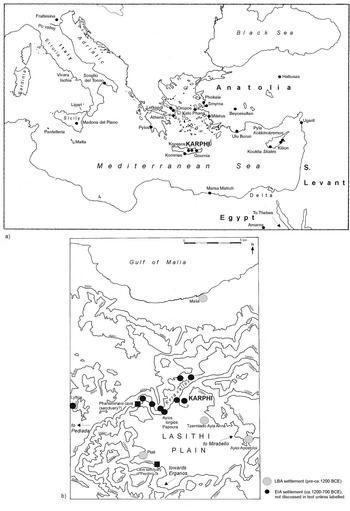
Detailed investigation of Aegean lifeways after c. 1200 BC offers a more complex picture (see, e.g. for Crete, Day, Klein and Turner Reference Day, Klein and Turner2009; Haggis et al. Reference Haggis, Mook, Scarry, Carter and Snyder2007; Nowicki Reference Nowicki2000). Karphi, in the high-altitude Lasithi landscape of central Crete (Fig. 1a), is an ideal case through which to examine the effects of crisis on craft and procurement. A large example within the group of defence-focused settlements founded across Crete c. 1200 BC, it was first excavated in the late 1930s (Pendlebury, Pendlebury and Money-Coutts et al. Reference Pendlebury, Pendlebury and Money-Coutts1938a). Recent systematic excavation and survey have elucidated how local economic networks engaged the newly founded community (e.g. Nowicki Reference Nowicki1995; Reference Nowicki2000, 147–70; Wallace Reference Wallace, Banerjea, Finch, Kyrillidou, Morris, Mylona, Nodarou, Ntinou, Scarry and Tickner2020). Below, I review the metal artefacts excavated from the settlement and its cemeteries from several different perspectives and at several different scales: local and regional settlement history and topography; findspot within the site; date; likely context of use, use-wear, manufacturing technique; type and its associations in the wider Mediterranean arena of object consumption; broad composition (tin/copper/lead by surface HH-XRF) in the context of the assemblage itself and of other similarly-analysed assemblages in the wider Mediterranean setting. In these joint ways I ultimately aim to elucidate the nature of disruption, and of new opportunities, in the sourcing and production of bulk refined metal and metal artefacts at this time – how sociocultural shifts around iron and bronze affected a site tucked away inland, yet on an island which was prominent on trans-Mediterranean routes; in a post-state, ‘collapsed’ social environment – yet in a large and complex community, within a well-populated region. I argue, drawing on the range of evidence sources listed above, that we can reasonably suggest a distinct and coherent regional outlook on, and system of, manufacturing and consumption of metal items within the Lasithi area, including the plain and surrounding mountains and coasts. This is in contradistinction to notions of local communities’ cultural and economic dependency on gateway sites elsewhere in Crete, such as Knossos. However, the relevant geographical boundaries in this respect are not clear. Only two sites (Karphi and Psychro) provide large enough quantities of well-preserved metals to base such an argument on and test it (and I have not yet restudied or tested the Psychro finds).
a. Map of the central and east Mediterranean, showing the sites mentioned; b. Lasithi map, showing Karphi and other relevant sites (S. Wallace).

KARPHI'S ECONOMIC LANDSCAPE: RESOURCES; TERRITORIES; ROUTES
The Lasithi plain, lying c. 800 m above sea level, is surrounded by mountains up to 2150 m above sea level (Fig. 1b). The main natural routes in from the surrounding low-lying coasts and valleys are: the Kera valley on the north with its branches, leading to the coast around Malia (this was one of the historically most-used links); the steep Tsouli to Mnima pass on the north-west, connecting the area to the large arable Pediada plain; a route through the southern mountains and Erganos valley into the arable Upper Mesara/Viannos region; and a route through the north-eastern foothills, including the Potamoi valley, to the Mirabello Bay (historically the most used; see Nowicki Reference Nowicki1998). Lasithi had significant settlement from at least Final Neolithic (c. 3500–3000 BC) through the latest Bronze Age; but a population spike occurred c. 1200 BC (Betancourt et al. Reference Betancourt, Davaras, Dierckx, Karkanas, Langford-Verstegen, McCullough, Muhly, Poulou-Papadimitriou, Stamos, Stravopodi, Tsiboukaki and Weng2014; Dawkins Reference Dawkins1914; Nowicki Reference Nowicki2014, 176–82; Pendlebury, Pendlebury and Money-Coutts Reference Pendlebury, Pendlebury and Money-Coutts1938b). Drastically altered security and economic circumstances made the Cretan residence pattern of the previous two millennia, which was focused on the coasts, minimally attractive (though continued use of large sites in the coastal zone like Knossos, Chania and Phaistos suggests there was interest by sizeable groups in maintaining some such territories and related external connections; Wallace Reference Wallace2010a, 68–71). Massive relocation, predominantly inland and to sites with natural defensibility, favoured the Lasithi region, with its defensible approaches. Several new towns here, including Karphi and its lower neighbour Papoura, overlooked the Kera valley. A major settlement site developed at Erganos Kefali on the southern route, and new settlements occupied inaccessible hilltops along the Potamoi valley (Nowicki Reference Nowicki2000, 120–7, 143–7, 157–64, 167–8; Wallace Reference Wallace2010b, 23–32). Ritual deposits intensified c. 1200–700 BC at the Psychro cave, in the hills south of the plain. This site had previous cult use but appears to have formed a newly important focal and meeting point for the sizeable regional population (Watrous Reference Watrous1996).
During the relocation process, there was clearly fragmentation of former community spaces and structures. Among Lasithi sites founded around 1200 BC, those located close to routes are especially large – over 3 ha for Karphi and Papoura, Erganos Kefali, Kritsa Kastello and Tapes Kato Kastello, the latter located on the north-eastern route (Nowicki Reference Nowicki2000, 120–7, 143–7, 155–7, 167–70). Complex socioeconomic structures surely emerged quickly at such new locations. Though some territorial reorganisation must have been necessitated in relocation, the spatially compressed ecological diversity typical of Cretan landscapes meant that most moves did not require a wholesale subsistence shift (Wallace Reference Wallace2003). Traditionally, cultivation was widespread on the upland slopes around Karphi, and there have been no geomorphological changes in the region which prevent such use being extrapolated to the period of occupation: excavated evidence of deciduous oak used extensively in construction suggests that these uplands had at least present-day rainfall levels at the time Karphi was founded (Wallace Reference Wallace, Banerjea, Finch, Kyrillidou, Morris, Mylona, Nodarou, Ntinou, Scarry and Tickner2020, 291–311). Recent archaeological data mirror those from contemporary sites at lower altitude, showing a broad-based economy and selective adaptation of LBA practices linked to the lowlands and coasts (olive production, cattle herding, shellfish consumption; see, e.g., Flint-Hamilton Reference Flint-Hamilton2017; Snyder and Klippel Reference Snyder, Klippel, Vaughan and Coulson1999; Snyder and Reese Reference Snyder and Reese2017). Some distribution networks, including those for clays and finished pottery, seem to have been reorientated during and after the relocation period (Wallace Reference Wallace2018b; Reference Wallace2021; Nodarou Reference Nodarou2020). The broader context of collapse of state-like regional centres (as for example Knossos and Chania seem to have been in the thirteenth century BC) and mass settlement relocation suggests that highly polarised or centralised procurement systems were absent, though the few continuing, contracted coastal sites probably concentrated some trade, and large inland communities like Karphi were clearly not economically self-sufficient units: for example, the community sourced pumice for tool-sharpening uses from the north coast (Wallace Reference Wallace, Banerjea, Finch, Kyrillidou, Morris, Mylona, Nodarou, Ntinou, Scarry and Tickner2020, 177). Crete did not return to networks and technologies focused on coastal polities and high-value trade: over the next 500 years, goods and materials moved through deeply changed internal systems. There were clearly restrictions on economic growth in many communities c. 1200–1000 BC. But complex polities developed from c. 1000 BC, predominantly at inland arable sites founded in the settlement relocation c. 1200 (Wallace Reference Wallace2010b). Rather than this being a smooth, even process, inter-settlement conflict might often be involved, as suggested by the burnt destruction of Karphi c. 1000 BC and Papoura's subsequent growth (Wallace Reference Wallace, Banerjea, Finch, Kyrillidou, Morris, Mylona, Nodarou, Ntinou, Scarry and Tickner2020, 311–13). Aegean groups and goods were developing increasingly active roles within east and central Mediterranean trade at this time, a trend which ultimately supported the development of larger production units (Wallace Reference Wallace2010a, 195–215).
BACKGROUND: CURRENT KNOWLEDGE OF METALS PROCUREMENT AND CONSUMPTION IN THE EAST AND CENTRAL MEDITERRANEAN BY C. 1200 BC
The interpretations to be made in this paper demand a historical and technical background. In the late LBA Aegean most copper used came from Cypriot sulphide ores. Circulating in alloyed and unalloyed forms, this copper was procured and distributed via state-level mechanisms to recognised smiths or institutions (e.g. temples), mostly at central, urban locations. Alongside its roles as a fairly widely used functional material, it could act as capital (including as part of grave wealth) or currency (see Giumlia-Mair and Craddock Reference Giumlia-Mair, Craddock and Curtis1988; Michailidou Reference Michailidou2008; Papasavvas Reference Papasavvas, Kassianidou and Papasavvas2012). Tin (most likely sourced from central Asia)Footnote 4 was often traded alongside unalloyed Cypriot copper, as suggested by the tin ingots on the Ulu Burun wreck, dated c. 1280 BC (Pulak Reference Pulak1988). Arsenical copper of non-Cypriot origin, typical of the earlier LBA, remained in circulation, often remelted. By the late thirteenth century, evidence such as the large volumes of metal including scrap found on the Gelidonya shipwreck (c. 1200 BC), and the mould for a Cypriot-type oxhide ingot at the major Syrian port of Ras Ibn Hani, indicate organised, large-scale remelting and recirculation.Footnote 5 Based on various types of compositional analysis carried out, including in the studies cited above and those cited later in the discussion here, 7–8 wt% tin bronzes seem typical of the period, with lead sometimes present as a casting-enhancing ingredient in levels up to c. 2 wt%. Bronze scrap assemblages at this time typically present greater compositional diversity than object assemblages, a fact indicating the existence of knowledgeable, selective re-alloying in making specific items (Giumlia-Mair and Craddock Reference Giumlia-Mair, Craddock and Curtis1988; see also Kassianidou Reference Kassianidou, Fourrier, Sourisseau and Treziny2016). Smelted iron, appearing consistently from the turn of the thirteenth century, was restricted to personal ornamental or luxury contexts, such as knives and small jewellery items in graves (Sherratt Reference Sherratt and Karageorghis1994; Snodgrass Reference Snodgrass and Snodgrass2006). From this same period bronze manufacture and consumption began to vary in new ways (discussed further below): these changes were well pronounced by the later Iron Age, with consumption becoming targeted on public ceremonial (Felsch Reference Felsch1996; de Polignac Reference Polignac1995; Morris Reference Morris1989). From the tenth century, the increasingly common deposition in graves of iron tools and weapons was associated with wealth and status in specific ways, not parallelling the consumption of similar types in bronze.
During the challenges to state systems c. 1200 BC, access to bulk tin and copper (which was already changing in the diversifying markets, routes and exchange systems of the late LBA) must have changed further, impacting the control of alloy production and circulation.Footnote 6 However, there is little necessary connection between this fact and the ironworking innovation. Models of a regional tin shortage to explain the rise of iron have been undermined by small-volume compositional analyses of contemporary bronze items, showing that tin was frequently being alloyed in the optimum amounts of later Bronze Age practice (c. 8–10 wt%). While remelting clearly continued (at Kition, a large crisis-surviving polity within a primary copper source region, smelting, pure-metal alloying and remelting operated in parallel; see Kassianidou and Karageorghis Reference Kassianidou and Karageorghis1999), some studies suggest a new variability in tin alloying levels. This is interpretable as showing either that unalloyed tin was now more unpredictable in supply or access, or that understanding of or requirements for its use changed.Footnote 7 There has been no suggestion of a metals shortage in central Mediterranean networks at this time: copper ores were available from sources including Sardinia and the south Alps (Artioli et al. Reference Artioli, Angelini, Nimis and Villa2016), and strengthening connections with the Cypro-Levantine area could also provide unalloyed or pre-alloyed copper, including through scrap. The lack of pre-existing complex systems in the region meant that no collapse had occurred to starkly disrupt ore recovery, smelting and exchange networks. However, shifted emphases in manufacturing consumption are seen here too from c. 1200 BC. The changing Levantine prestige sector was influential: for example, the fibula pin, originally developed in the LBA south Italian/Aegean sphere, became a standard form across large parts of both the central and east Mediterranean (see e.g. Sapouna-Sakellarakis Reference Sapouna-Sakellarakis1978, 34–41). Few Italian-made or Italian-type metal items had been used in the Aegean or Levant during the later LBA, and many metal items in the east Mediterranean continued to be made in traditional Cypro-Levantine forms after 1200 BC. When assessing the significance of changes in style and technology, it is vital to understand the relationship between continuing participation by Aegean smiths and consumers in east Mediterranean traditions and networks, and their developing interest in and access to other spheres of contact, manufacturing practice and exchange.
BACKGROUND OF RESEARCH DATA ON METAL ARTEFACT PRODUCTION AND CONSUMPTION CONTEXTS TECHNOLOGY BETWEEN THE LBA AND EARLY IRON AGE
The lack of large metals assemblages from settlements spanning this period in the Aegean currently limits our understanding of these themes, making the Karphi material especially important.Footnote 8 Many Aegean settlements have deposits of this date only partly preserved between extensive earlier and later occupation, and metals of the period are best known through excavations of cemeteries (e.g. Knossos and Lefkandi; see Coldstream and Catling Reference Coldstream and Catling1996; Popham, Sackett and Themelis Reference Pulak1980; Popham and Lemos Reference Popham and Lemos1996). The date of a site's last Iron Age occupation is also relevant. Prinias in Crete is a large settlement founded c. 1200 BC on a major north–south route. It has been extensively excavated, but its abandonment for occupation only in the seventh century prevents the extensive recovery of strata and objects from 1200–1000 BC in their original use context (Rizza Reference Roames2011); Azoria in east Crete is similar (Haggis et al. Reference Haggis, Mook, Scarry, Carter and Snyder2007). Among shorter-lived sites founded c. 1200 BC, most excavated examples are small. Their record often suggests either limited consumption of metals or circumstances of abandonment in which almost all metals were removed (e.g. for Kavousi Vronda in Crete see Day et al. Reference Day, Dierckx, Flint-Hamilton, Gesell and Glowacki2017).
We can review known locations for manufacturing metal artefacts at this period with a view to assessing likely production contexts at Karphi. Public buildings, sometimes associated with cult, are known to have been among the places used as locations for secondary metallurgy in LBA Cyprus and the Levant (Knapp Reference Knapp1986; Kassianidou Reference Kassianidou, Karageorghis, Matthäus and Rogge2004; Hitchcock Reference Hitchcock2006). A set of rooms within the monumental, likely public building known as the Unexplored Mansion at Knossos (UM), dates Late Minoan (LM) II–IIIA:1 (early to mid-fifteenth century to c. 1380 BC; Branigan Reference Branigan, Sackett, Branigan, Callaghan, Catling, Coldstream, Higgins, Popham, Price, Price and Waywell1992; Catling and Catling Reference Catling, Catling, Popham, Betts, Cameron, Catling, Catling, Evely, Higgins and Smyth1984). It contained crucibles and other equipment, melting waste (comprising 19 per cent of all metal present) and scrap (26 per cent). Large valuable items, however, were clearly salvaged during/after the building's destruction, since they are rarely present (though do appear in contemporary tombs). At Chania and Palaikastro between the later thirteenth century and the early twelfth, secondary bronze metallurgy was apparently located in a central-urban, non-monumental setting (Hemingway and Harrison Reference Hemingway and Harrison1996; Hallager and Hallager Reference Hallager and Hallager2000, 180). After a destruction and the collapse of palatial political and economic systems at the city of Tiryns, remodelled workshop spaces, in an urban area which had already been long-used for crafts, formed the locus of secondary leadworking and likely bronze scrap remelting (Brysbaert Reference Brysbaert, Rebay-Salisbury, Brysbaert and Foxhall2014). Turning to early ironworking, it appears closely integrated with bronzeworking in an urban context at contemporary Iron I Tell Tayinat in Syria (Roames Reference Roames2011). Later, separate bronze- and ironworking facilities without any monumental associations were recorded in the Early Iron Age (EIA) at the small settlement of Oropos in Euboea, with a date 1050–800 BC: at eleventh-century Phokaia, on the Anatolian coast, an ironworking-only workshop appears within the settlement (Doonan and Mazarakis-Ainian Reference Doonan, Mazarakis-Ainian, Doonan and Mazarakis-Ainian2008; Yalçin and Öyziğit Reference Yalçin, Öyziğit and Yalçin2013). In the Levantine Iron IIA (early tenth to mid-ninth century), the Tel-es-Safi settlement had adjacent and integrated workshops for secondary bronzeworking/refining, and iron smelting and working; iron was smelted at small scales in urban sectors at Hazor, Rehov and Beer-Sheba settlements of the same period, and smithed at Beth Shemesh (late tenth century), in proximity to the urban centre (Eliyahu-Behar et al. Reference Eliyahu-Behar, Yahalom-Mack, Shilstein, Zukerman, Shafer-Elliot, Maeir, Boaretto, Finkelstein and Weiner2012; Reference Eliyahu-Behar, Yahalom-Mack, Gadot and Finkelstein2013; Yahalom Mack Reference Yahalom Mack2009). A different, specialised and large-scale context of primary iron smelting (seasonal, proximate to ore sources) is seen in Iron IIA (late tenth century) in a large, specialised site at Tel Hammeh in the southern Levant (see Veldhuizen and Rehren Reference Veldhuizen, Rehren, LaNiece, Hook and Craddock2007). There are thus hints for the earlier Iron Age at a continuing close integration of metal technologies (a scenario likely to have produced early iron experimentation in the late pre-crisis period) but also at a possible change in the structuring of metalworking locales following the collapse of palatial state centres. They clearly still had a specialised nature, but physical and social positioning as a more ordinary part of the urban fabric might make them newly amenable to influence from the forces driving production and consumption in wider society.
Turning to alloy recipes recipes used for artefacts, some recent analytical studies of large LBA/EIA copper alloy assemblages from the Mediterranean (mainly using surface XRF,Footnote 9 supplemented by other methods) are relevant. I summarise them here because their results are the most closely comparable to those supplied for the Karphi assemblage as reported on by Wallace, Smith and Nerantzis (Reference Wallace, Smith and Nerantzis2021), and further discussed and interpreted here (though in each case variations in method and materials condition will have affected results). For the earlier part of the LBA (c. 1700–1500 BC), the metal artefacts from Gournia cover a type rangeFootnote 10 echoing that at later Karphi, and form a baseline from which to map developments in the later Bronze–Iron period (Giumlia-Mair, Ferrence and Betancourt Reference Giumlia-Mair, Ferrence, Betancourt, Hauptmann and Modarressi-Tehrani2015). From Cyprus come two large and almost contemporary post-crisis groups: early twelfth- through eleventh-century cemetery material from Kouklia Skales, and material from the late thirteenth- through early twelfth-century Pyla-Kokkinokremos settlement (Charalambous, Kassianidou and Papasavvas Reference Charalambous, Kassianidou and Papasavvas2014; Reference Charalambous, Kassianidou, Papasavvas, Photos-Jones, Bassiakos, Filippaki, Hein, Karatasios, Kilikoglou and Kouloumpi2016). Two large assemblages of late thirteenth- to eleventh-century date from Madonna del Piano, Sicily (cemetery), and Scoglio del Tonno, Apulia (settlement), offer a relevant geographical range of comparison and close contemporaneity (Bietti Sestieri, and Gorgoglione Reference Bietti Sestieri, Giardino and Gorgoglione2010; Giumlia-Mair, Procelli and Lo Schiavo Reference Giumlia-Mair, Procelli and Lo Schiavo2010). In the Gournia and related material (e.g. Northover and Evely Reference Northover and Evely1995) we see a scenario where tin and tin bronze were largely unavailable in quantity for everyday production.Footnote 11 About 50 per cent of the copper used in Gournia objects contained no tin. In the context of provenance and other scholarship about Aegean copper use in this period, it was most probably from Lavrion (Attica) or from Anatolian sources. Poor or incomplete refining, or use of specific ores, may be indicated by the presence of 2–3 wt% iron in some items (see e.g. Pernicka Reference Pernicka, Young, Pollard, Budd and Ixer1999, 165), while ingot fragments tend to be of pure copper, suggesting a variety of original sources and/or refining points for the metal used. Arsenic (up to 4 wt%) was common; this relatively high proportion and its variable occurrence (frequent in tools and weapons, especially daggers) could suggest deliberate alloying (with arsenic-rich minerals) for strength and castability: this had occurred in the Aegean as early as the Final Neolithic (Doonan, Day and Dimopoulou-Rethimiotaki Reference Doonan, Day, Dimopoulou-Rethimiotaki, Doonan and Day2007). The highest amount of lead present here was 3.5 wt%, in a low-tin chisel, possibly deliberately alloyed to improve castability. Tin was usually alloyed well below the optimum of 7–8 wt%, in a selective pattern focused on swords, daggers and some jewellery. That such alloying was expensive and highly focused on visual effect is indicated by widespread use of copper for simple items like needles, awls and fishhooks.
Analysis of the Cypriot and Italian assemblages from the thirteenth through eleventh centuries, at which time copper remained widely available in the Mediterranean and tin metal thereby continuingly useful (even if its circulation patterns had changed), shows notable contrasts with the early LBA scenario. The frequent selective addition of pure tin at optimum levels or above is seen in the objects from Kouklia Skales, especially prestige vessels of a certain local class (hemispherical bowls) even when these are hammered from sheet metal, with resulting brittleness. These typically have 17–18 wt% tin and up to 29 wt% in some cases, the lowest having 12 wt%. Similar use of high tin occurs in a minority of the jewellery, probably to impart a golden or even silvery appearance (Fang and McDonnell Reference Fang and McDonnell2011). A low widespread presence of arsenic suggests continued remelting of earlier LBA items. There was clearly deliberate and regular addition of lead (which is not present at these levels in Cypriot copper ores; see Pernicka Reference Pernicka, Young, Pollard, Budd and Ixer1999), sometimes at over the optimum addition for castability of c. 2 wt%, including in the specially alloyed objects (one high-tin bowl had exceptional lead levels). Relatively high lead alloying also appears in contemporary Cypriot ornamental tripods (e.g. Pickles and Peltenburg Reference Pickles and Peltenburg1998, 77), where size and weight were important features, and lead, present at up to 20 wt%, could act as a ‘filler’ (Smith, Russell and Keswani Reference Smith, Russell and Keswani1989). Elevated lead content was increasingly popular in bronzes from other regions after 1200 BC – cf. the Lefkandi objects studied by Jones (Reference Jones1980) and Orfanou (Reference Orfanou2009),Footnote 12 recently studied material from Palaikastro, Crete (Evely, Nodarou and Heim Reference Evely, Nodarou and Heim2012), and north Greek ritual assemblages analysed by Orfanou (Reference Orfanou2015a; Reference Orfanou2015b), who cites regular use of over-optimum lead alloying in the EIA bronzes deposited at the Kalapodi sanctuary. This trend occurred alongside an increasing focus on the size and visual appeal of certain bronze items and their use in ceremonial. Changing values seem to have been attached to the qualities of bronze as a material.
At the settlement of Pyla-Kokkinokremos, half of the 65 items studied were fragmentary/scrap pieces spread through houses. Their distribution, and that of tools and personal objects, offers close parallels to those at contemporary settlements like Karphi, or for example Deir el-Balah in the Levant (Dothan and Nahmias-Lotan Reference Dothan, Nahmias-Lotan, Dothan and Braundl2010). Tin content data at Kokkinokremos measured using XRF, following the same methods as for the Kouklia-Skales and early LBA Limassol material also studied by Charalambous, Kassianidou and Papasavvas (Reference Charalambous, Kassianidou, Papasavvas, Photos-Jones, Bassiakos, Filippaki, Hein, Karatasios, Kilikoglou and Kouloumpi2016), offers a good internal profile for the assemblage as well as cross-comparative potential with the other Cypriot studies. Alloyed tin was generally below the LBA regional optimum but not obviously restricted in use – about half the tested objects (29) had 5–9 wt% tin; the rest had below 5 wt%. None of the exceptional/luxury kinds of tin-rich items seen at Skales were encountered, despite the closeness of the sites in location and date. The presence of simple and sheet-manufactured items containing low or minimal tin, and the wide low-level presence of arsenic, suggests the regular remelting of older bronze, the possible targeting of certain object types for relatively high tin content, and not necessarily much use of tin metal.
The XRF studies of cemetery material from Madona del Piano (twelfth to eleventh centuries), covered 75 of 844 objects.Footnote 13 Tin content was 8–14 wt% across the sample, and averaged 9 wt%, suggesting regular, consistent and selective alloying with plentiful access to tin metal. Recalling the pattern at Skales, tin was consistently concentrated at up to 17 wt% in local ornamental types such as wheel-headed pins and pectorals. Some swords had tin content as low as 6 wt% (standard south Italian knives averaging 7–8 wt% tin). This suggests there were some limits on tin availability for alloying in large items, with certain ornamental objects being prioritised. Fibulas had a very standardised recipe (around 9 wt% tin), showing consistent use of tin at optimum or over-optimum levels in objects which were valued for appearance. High-lead alloying occurs in decorative cast-on bronze, where the lower melting point would assist the work: some cases were measured at 6 wt% lead. A pattern of selective but widespread high-tin alloying (11–20 wt%) applied to weapons as well as ornamental objects also appears in measurements by XRF on the Scoglio del Tonno settlement material (thirteenth to twelfth centuries). Again, lead was added in relatively high amounts as a bulker and in cast-on elements.Footnote 14
Mediterranean and European contexts at this time show various signs of a shifted socioeconomic role for bronze (e.g. Morris Reference Morris1989; Morgan Reference Morgan1986). The quality and/or hardness of the metal appears in some cases to have become less important than bulk and form (cf. the standard leaded bronze axes developing in Europe, including north Greece, from c. 1200 BC, and the other types of leaded bronzes discussed above: Bottaini et al. Reference Bottaini, Silva, Covita, Moutinho and Veloso2012; Huth Reference Huth and Giumlia-Mair2000; Montero et al. Reference Montero, Rovira, Delibes and Fernandez-Manzanon.d.; Orfanou Reference Orfanou2015a; Reference Orfanou2015b; Sherratt Reference Sherratt and Karageorghis1994, 76–81).Footnote 15 The change is linked to developing technology (e.g. the new specific applications of tin-alloy and lead-alloy manufactures discussed above), to shifts in contact and consumption patterns, and potentially to interest in iron as a working material. Yet it started well before iron use properly took off, in a context of changed socioeconomic structures, along with altered exchange and procurement networks.
KARPHI: CONTEXTUAL AND QUANTITATIVE STUDY OF THE METAL ARTEFACTSFootnote 16
The original Karphi excavation report of 1938–9 documented only the findspots of metal objects and broadly associated material, without detailing stratigraphic relationships or recovery methods between different areas of the site.Footnote 17 It additionally did not recognise the widespread burnt destruction which marked the end of the settlement's life c. 1000 BC.Footnote 18 Few meaningful patterns of artefact use and consumption were identified. Without further contextualised study, the material has remained liable to secondary misinterpretations. Here, I discuss distribution in quantitative and contextual terms for the first time, based on first-hand study of the artefacts and drawing on knowledge of the stratigraphic record gained from more recent Karphi excavations (Wallace Reference Wallace, Banerjea, Finch, Kyrillidou, Morris, Mylona, Nodarou, Ntinou, Scarry and Tickner2020, 311–14) as well as recent work at other contemporary sites in Crete and beyond (Day Reference Day2011; Glowacki Reference Glowacki, Day, Muhly and Mook2004; Wallace Reference Wallace, Glowacki and Vogeikoff-Brogan2011). The area excavated in the 1930s was almost 0.6 ha of the total c. 3 ha site area, and contained dense housing, at least one public building (Temple) and paved open areas. Twenty-one family-type built tombs were excavated – less than half of the minimum 50 tombs one would expect for the estimated minimum population of 1000 based on the size of the settlement (Nowicki Reference Nowicki1987). Thus, tomb find data is less numerically representative of consumption than the settlement find data. Based on the above facts, the metals assemblage from the 1930s excavation represents more than a fifth of the total residential population living at the site by c. 1000 BC, and about a tenth of the burial population c. 1200–1000 BC (assuming five people per family and one tomb for each family at any one time), without apparently relating to any specific social sub-group.Footnote 19
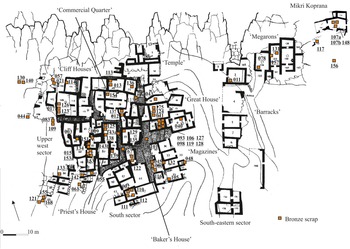
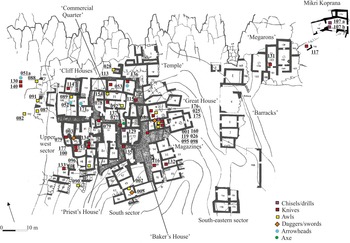
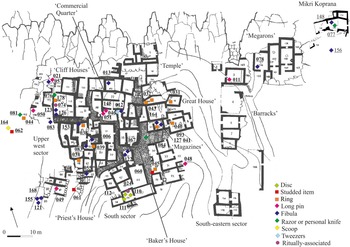
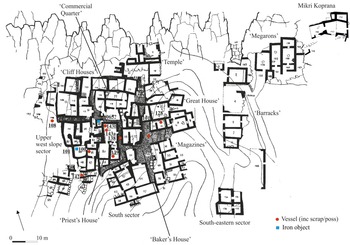
When the excavated objects are quantified and mapped according to their end use category, to their context and condition of deposition, and in relation to the wider processes now known to have affected the site, we see that the density of any category of object per room or building at the time of excavation cannot be taken straightforwardly to indicate either the original consumption circumstances of the object or the use of the space. This is due to two factors: a) the frequency and mode of metals scrapping, loss or discard, as revealed for the first time here; and b) the fact that large and/or valuable objects appear to have been removed from the site after its destruction and abandonment (probably soon after, given the otherwise undisturbed condition of the destruction layers; see Catling and Catling Reference Catling, Catling, Popham, Betts, Cameron, Catling, Catling, Evely, Higgins and Smyth1984, 215 for related circumstances at the Unexplored Mansion). Below, I describe the general item categories which I consider to be useful in assessing the significance of final distribution (Figs 2–6; Table 1; Online CatalogueFootnote 20 and Online Figs 1–8):
1. Scrap (subsumes all other original use categories and is defined on the basis of final condition of usability)
Fragmentary or cut-up items (none found in tombs) which had reached the end of their use life: their only use would appear to be as recyclable metal. Their wide scattering through the settlement suggests they were typically unsalvaged after the end of their use. Thus, their found distribution may be close to the original density of items lost, discarded or set aside for recycling across the site.
2. Large valuable items
Most intact versions of these items (e.g. vessels) appear to have been cleared from the settlement post-destruction, based on their very low representation compared to other categories, though they were clearly present, as the scrap assemblage bears out. Anomalies suggest occasional ‘oversights’, usually in areas which are otherwise well-cleared of metal.
3. Small personal items
These include, for example, jewellery, tweezers and small specialised knives, apparently overlooked or left behind during clearances focused on large items and/or special areas. Their final distribution may roughly represent consumption density at last use of the site, plus local loss/discard/scrappage of objects over time.
4. Small tools
These include, for example, knives and awls. Distribution patterns and representativeness are likely similar to those of category 3 items.
5. Metalworking debris
The morphology of this material suggests the by-products of melting and casting and could hint at secondary metallurgy at or near the settlement. The findspots (which do not cluster to indicate a metallurgical area) suggest this was kept for recycling or otherwise seen to have some use.
6. Small ritually associated items
These include miniature double axes. Their ritual character was apparently not significant enough to demand their retrieval following destruction of the settlement (as with the large ceramic figurines and other ritual items left in situ in various areas; see Pendlebury, Pendlebury and Money-Coutts Reference Pendlebury, Pendlebury and Money-Coutts1938a).
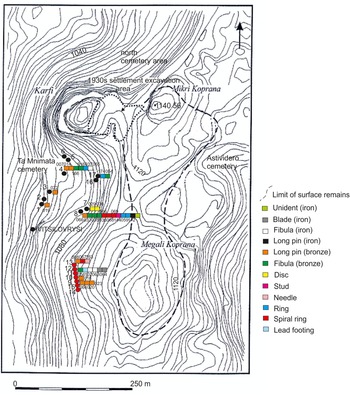
Map of the Karphi site, showing reported distribution of find types in the two distinct zones of ‘Ta Mnimata’ tombs excavated 1937–9, shown by black and red dots (S. Wallace).

Plan of the Karphi settlement as excavated in 1937–9, showing reported distribution of fragmentary/scrap objects (S. Wallace after Pendlebury, Pendlebury and Money-Coutts Reference Pendlebury, Pendlebury and Money-Coutts1938a).

Plan of the Karphi settlement as excavated in 1937–9, showing reported distribution of tools including scrap items (S. Wallace after Pendlebury, Pendlebury and Money-Coutts Reference Pendlebury, Pendlebury and Money-Coutts1938a).

Plan of the Karphi settlement as excavated in 1937–9, showing reported distribution of small personal objects including scrap items (S. Wallace after Pendlebury, Pendlebury and Money-Coutts Reference Pendlebury, Pendlebury and Money-Coutts1938a).

Plan of the Karphi settlement as excavated in 1937–9, showing reported distribution of iron and of metallurgical debris including scrap items (S. Wallace after Pendlebury, Pendlebury and Money-Coutts Reference Pendlebury, Pendlebury and Money-Coutts1938a).

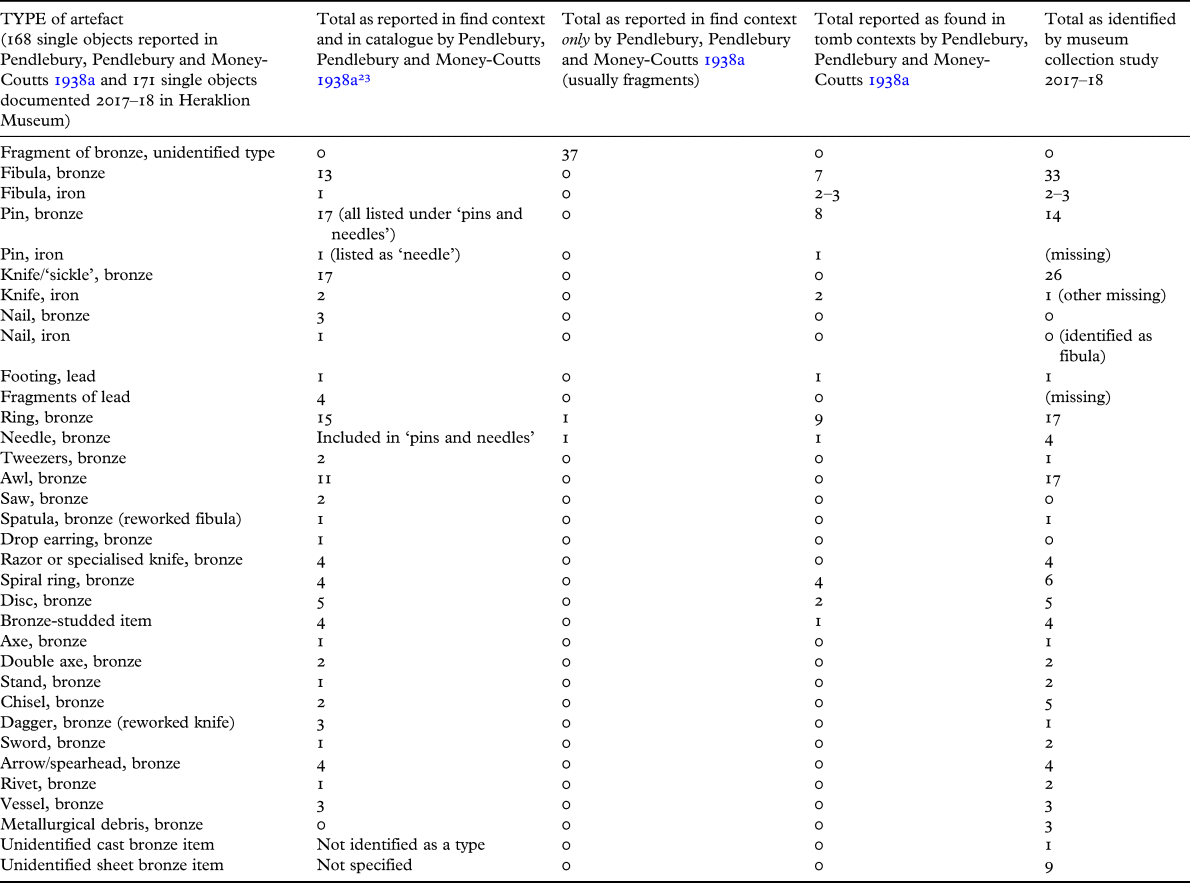
Identifications and quantities of metal objects (copper alloy, iron and lead) at Karphi, as reported from 1930s excavations and as documented 2017–18 in the Heraklion Museum

One-hundred-and-sixty-eight finds are referred to in the original report: some of the find numbers allocated there covered more than one object, while some iron and lead items are missing. Recent test excavations found three metal items of the small personal type (a hook-headed pin and two scrap fibula fragments; see Wallace Reference Wallace, Banerjea, Finch, Kyrillidou, Morris, Mylona, Nodarou, Ntinou, Scarry and Tickner2020, 173–4). Each reconstructable object from the 1930s excavations currently present in the Heraklion Museum is separately numbered here, making 171 items, 37 of them from tombs. The following statistics are focused on in the analysis below: proportional distribution of types in settlement versus tomb contexts; relative distribution of scrap items, personal items and tools; density of type distribution by room and building.
In the settlement and among tools, including scrap items (54) the main types are awls (17), arrrowheads (4), axe (1), chisels (5), swords (2), dagger (1), and knives (27) (Table 1). Personal item types in the settlement, including scrap items (51) cover long pins (6), fibulas (26), rings (8), and personal/toilet items – e.g. small knives/razors (4), spatulas/engravers (1) and tweezers (1). Decorative discs, spiral beads and studded items also appear in small numbers. The main crossover categories of item between settlement and tombs are pins and fibulas (there are two large fibulas with flattened bows found in the settlement; none were found in the tombs), rings, decorated (studded/disc-hung) items, and spiral beads. Scrap items were slightly higher in number among the personal items (30 of 51) than among the tools (27 of 54), perhaps reflecting other evidence for careful and prolonged use of tools, discussed below, as well as the overrepresentation of fibulas thanks to their easy fragmentation. Fibulas and knives were both commonly found in scrap form; awls and long pins, with their solid form, rarely, though chisels were found as scrap, as were large items like swords and stands.
Some studies have suggested that the earliest area of the site to be settled was the Karphi peak and its eastern slopes, an exposed area where excavation found poorly preserved structures and deposits (Nowicki Reference Nowicki and Chaniotis1999; discussion in Wallace Reference Wallace2005). A build-up of small items here over a long period is indeed supported by the large number of metal finds (35 of the 54 tools and 30 of the 51 personal items (including scrap items); see Figs 3–6. Thirty items come from the adjacent central/southern zone (16 personal items, 14 tools) and only between three and ten items (using the attribution method described in note Footnote 16, above) from the eastern zone of well-spaced buildings with mostly large rooms, seen in the above model as having the shortest use-span (Wallace Reference Wallace2005). A high proportion of objects comes from small inner rooms. After the final destruction, these were perhaps less likely targets for clearance than main rooms, especially if they were never major storage areas for metals. Of the 105 small tools and personal objects in the settlement, 46 came from small inner rooms, 13 from small outer rooms; 22 from main rooms; 4 from open spaces; and 20 from spaces of an unclear nature. The overall picture is of small objects being well-used over time and failing to be cleared out of minor rooms in domestic buildings, whether during the rooms’ use after discard/breakage/scrappage or at the end of the whole site's use. Small rooms are usually adjacent or linked to larger rooms within a house, and other evidence suggests they often had a food storage function: they could also have been preferentially used for small scrap collections. Scrap items demonstrably cluster in small rooms – for example in the set of rooms numbered in the 80s on the lower E slopes of Karfi, and in rooms 12 and 26 in otherwise well-cleared buildings – but perhaps again simply because these tended to be uncleared. Some scraps, especially from open spaces (e.g. 32, 54 and 56) surely represent items which were lost/fragmented during the settlement's lifetime; other scraps were clearly actively prepared for recycling where needed – for example through chisel-cutting and folding – before their deposition. Given the wide spread of scrap items suitable for remelting, it is not possible to identify a metallurgy workshop or area by mapping their density. However, three pieces of melting debris (none with recorded findspot) may demonstrate the existence of secondary metallurgy at or near the site for the first time: such a model could be supported by other elements in the discussion below, such as the identification of regional coherence and individuality in consumption trends and manufacturing techniques. Only a fifth of the settlement has been excavated, so the presence of a workshop here and/or in other large settlements of the region is possible and indeed likely, based on what we know of workshop locations in towns in the wider east Mediterranean, as discussed above, and on the volume, distribution and characteristics of bronze items consumed here, as discussed in this paper. That most people were holding only small amounts of scrap/recyclable metal at the time of Karphi's destruction suggests that such material was periodically circulated into the hands of specialised metallurgists. Any existing large in-settlement scrap metal collections were probably removed, with other sizeable metal items, at or after the destruction.
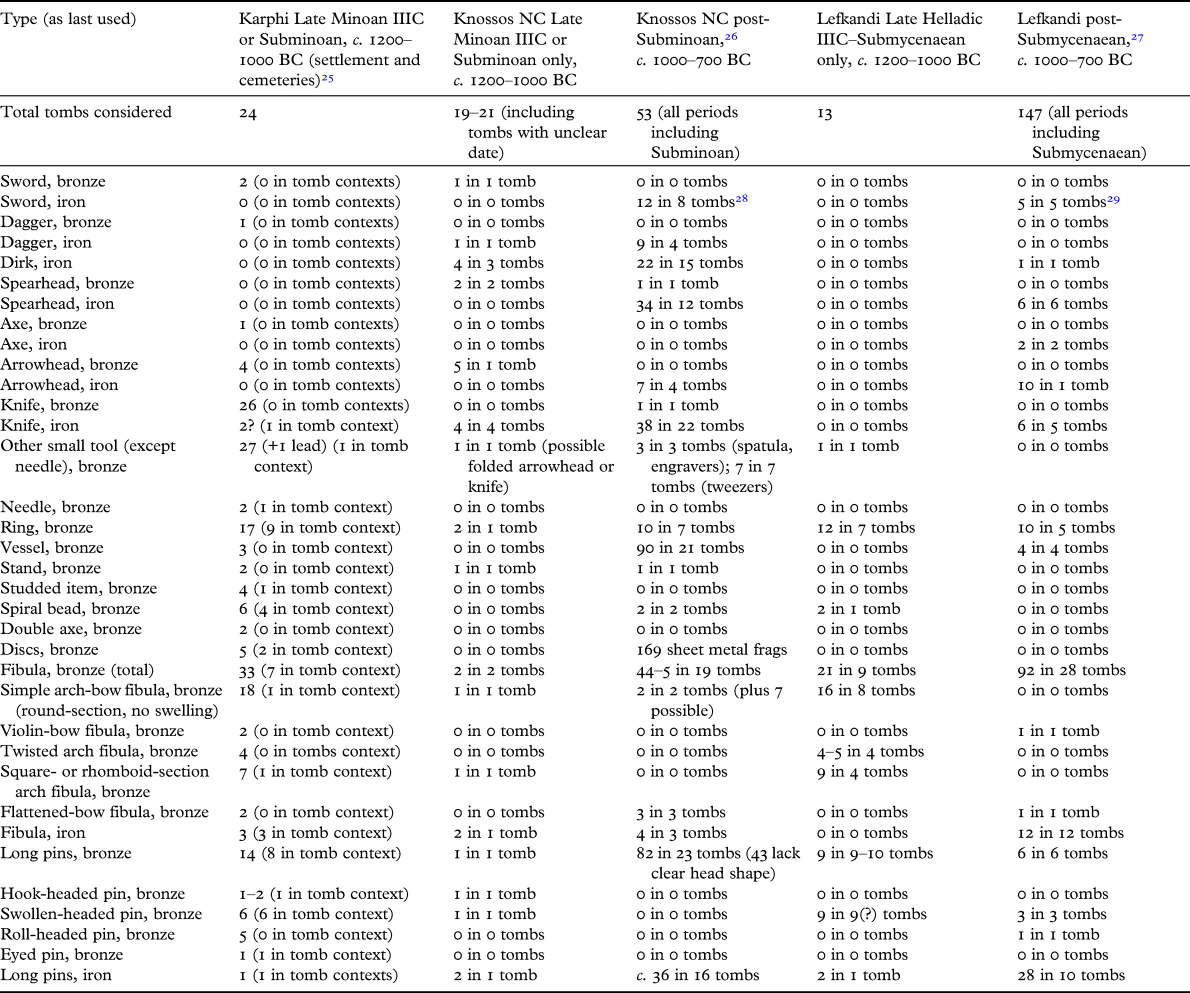
Since there is no equivalence in the duration of use, state of preservation and original population numbers between the excavated settlement area and the excavated tombs, it is unsurprising that the settlement has higher or roughly equal numbers even of the most typical tomb items, including fibulas, pins and rings. In this context, the strong weighting of special, decorative items like spiral rings towards tombs suggests these were specifically associated with the body in its grave setting. Settlement distribution shows that jewellery of emerging fashionable type, like the fibula, was very widely (and thus probably locally) made and worn, frequently enough to be regularly discarded, lost or treated as recyclable (23 out of the total 33 examples are scrap). The contemporaneously emergent long pin was similarly widely found in the settlement, though not so common (or so easy to break or lose). In contrast, there was a new unwillingness to include knives in tombs (except iron knives, which had a different category of meaning) even while they were widely used in the town, where a single (discarded?) iron blade was also found (Pendlebury, Pendlebury and Money-Coutts Reference Pendlebury, Pendlebury and Money-Coutts1938a, 121). Knives had been regular inclusions in wealthy LBA tombs (e.g. at Knossos and Mochlos). Bronze knives, tools and weapons are generally sparse in tombs at contemporary sites, too (with exceptions in the case of very wealthy tombs; see Table 2).Footnote 21 Large valuable items such as bronze vessels (another regular inclusion in LBA graves) are also lacking in Karphi tombs: this is not always the case elsewhere, as at Knossos North Cemetery (hereafter KNC) or Pantanassa in the Amari valley (Catling Reference Catling1996b; Tegou Reference Tegou and Stampolidis2001, figs 27–33). The fact of these omissions at Karphi could be due to limited local metal supply, yet there are no other indications of bronze shortage. There is, however, wider evidence supporting the notion that specific social rules emerged in the interests of social cohesion in large new settlements like Karphi (while not necessarily applying at continuing sites like Knossos). These discouraged extreme personal display in aspects of both the settlement sphere (e.g. architecture) and the burial sphere (Wallace Reference Wallace2005; Reference Wallace2010a, 104–69). Bronze vessels were certainly used in the Karphi settlement, as scrapped examples tell us, but were too valuable to be left behind after the final destruction. Personal prestigious items in iron (likely to have been kept on the person through destruction/abandonment) are missing in the settlement – but so is scrap or lost iron, except one blade and a possible fibula (100, 065), suggesting that no regular everyday types of consumption of this metal occurred. This was despite Karphi's occupation up to c. 1000 BC, when iron objects were available in quantities which allowed them to outnumber bronze items in some graves (e.g. the relatively large and rich TM 11).Footnote 22 This local feature, set alongside the wider parallels for the Karphi community's shift away from LBA bronze manufacture and consumption patterns (as discussed below), suggests that iron innovation was a marginal or non-direct factor in the shifting use of bronze. These combined patterns show that the community's approach to iron consumption did not arise from being cut off from wider developments in metals technology or access. The circumstances and effects of crisis in regional context (e.g. settlement relocation and linked social ‘levelling’ promoting cohesion) seem to have been much bigger driving factors in producing a specific set of rules on metals consumption.
Footnote 24Occurrences and frequencies of metal object types at Karphi from c. 1200 BC, compared with significantly sized contemporary and later Iron Age assemblages from Knossos North Cemetery and Lefkandi.

Buildings and rooms which appear important or wealthy in other respects seem likely often to have contained the most valuable metal objects prior to clearance (Wallace Reference Wallace, Glowacki and Vogeikoff-Brogan2011). Such objects, in fragmentary or deliberately scrapped form, include the tripod or vessel leg 157 in a ‘Megarons’ main room; the large crescentic knifeFootnote 30 001 in the ‘Great House’; the cut-up sword 003 from a south sector room; and the stand 017 in 106, a main room in a large building on the western saddle (Wallace Reference Wallace2005). The cut-up decorated stand 015 was found in the small inner room of a large complex. One scrapped, cut-up sword, 002, is from K96, a small inner room in an eroded house near the Karphi peak. The distribution of scrap material from bronze vessels (assuming a limited range of movement from the vessels’ original use context) suggests that a wide range of inhabitants could own these items, though the slight clustering of vessel scrap in the large Priest's House may be significant. The cluster of small tools/personal items (some of which were in cut-up, deliberately scrapped form) in the Great House inner room, 12, is rare. It may reflect the process of clearing within this important building: the inner room, containing ordinary or only slightly elevated levels of metal objects, was perhaps neglected in clearing the otherwise rich zone.
Tombs at Karphi contained all the types of decorative and jewellery items in use in the settlement. Ten tombs had metals preserved on excavation, three including iron objects: one pin (originally described as a ‘needle’) was in ironFootnote 31 and at least two iron fibulas were present (063, 064). A lead footing (102) is part of a decorated personal item – a stick or mace. Among the bronze items in tombs, eight were long pins and seven were fibulas, suggesting roughly equal access or equal use to the two types in tomb depositions, as probably in life (figures for the settlement being likely distorted by fibulas’ fragility).Footnote 32 Nine of the 17 rings found across the site came from tombs; other decorative items in tombs were spiral beads and disc-embellished/studded objects including clothes and belts. Pins, rings and fibulas were also the commonest finds at contemporary large cemeteries like Knossos and Lefkandi (fibulas have a notably larger range of subtypes at some sites).Footnote 33 While elsewhere (as at KNC) tomb jewellery could be deposited in a spectrum of wealth, alongside vessels and other large items, at Karphi bone pins/needles, ceramic figurines, tripods and drinking vessels, and animal sacrifices were the differentiative features. There was no absence of differentiation in the funerary sphere; rather, differentiation was not predicated on large metal items, and perhaps not mainly on convertible wealth in general.Footnote 34 Though some tombs seem to have been slightly disturbed at an unclear date, it is not likely that only the very largest metal items were removed in looting, leaving all other metal tomb finds in excellent condition.
KARPHI OBJECTS: TYPOLOGICAL STUDYFootnote 35
With the aim of elucidating how the new inland community at Karphi developed existing traditions in manufacture and consumption and accessed emergent wider networks, I compare types found here to Late Bronze I–III settlement and cemetery assemblages from the Aegean/east Mediterranean; large well-published cemetery assemblages from contemporary Knossos and Lefkandi (coastal sites which show continuous contacts with Mediterranean exchange networks c. 1200–1000 BC: settlement material from the small excavated area at Lefkandi published in 2006 [Evely Reference Evely and Evely2006] is also considered); and a wider contemporary range of settlement and cemetery sites in the east/central Mediterranean.Footnote 36
Fibula types at Karphi include both the violin-bow and simple arched-bow form (the bow being mainly round in section; a minority have a twisted or square section). The large violin-bow type with flattened ellipsoidal bow appears in three examples (Online Catalogue and Online Figs 2 and 7). The two to three iron fibulae are all likely arched-bow types. Long pins have swollen, eyed, hooked or rolled heads. Restriction of pins to a relatively few types and forms within each class is striking, suggesting that a coherent local tradition of manufacture and/or consumption was quickly established within new wider fashions. The type of pin with tight-rolled head (e.g. 049, 050) seems particularly favoured in the region, being regularly consumed at Karphi and at the Psychro sanctuary, but not widely elsewhere in the Aegean. Yet other typological, compositional and distributional evidence discussed below suggests that Karphi was part of a wider set of actively connected groups undertaking metals manufacture and consumption. Taking into account the boosted importance of the Kera valley route in the new patterns of settlement c. 1200 BC, I suggest that Lasithi may have formed a self-directed production node in or from this period,Footnote 37 not systematically or predictably tied to specific major coastal communities/gateways such as Knossos in terms of contact, technique-learning or consumption. Consistencies in both typology and composition across the assemblage, and very strong links to Psychro, offer no reason to suppose that the vast majority of items found here were manufactured remotely, even while production and consumption were influenced by a wide suite of contacts. The Karphi and Psychro assemblages show closely similar kinds of typological innovation with connections to the central Mediterranean (indicating shared, consistent and defined choices about consumption) alongside a close grasp on traditional and innovative manufacture and sourcing practice in the east Mediterranean sphere (use of iron prestige goods, uptake of fibulas and pins, shifts in bronze recipes).
Of 24 objects identifiable as novel in type for the region,Footnote 38 most are strongly connected to central Mediterranean networks. Bronze knives are generally poorly known from contemporary Aegean settlements, due to the low volume of studied evidence. The Karphi assemblage reveals everyday consumption in this area to have been changing extensively, with repeated and specific new features (see Online Catalogue and Online Figs 1–8). Straight-backed bronze knives related to those of the preceding local LBA (e.g. 073, 080) were consumed. But there are also new crescentic forms (001, 079, 176) as well as Italianising concave-bladed types, some with the novel features of forked haft or edge-groove on blade (075, 115, 116, 119, 177) (Milojčić Reference Milojčić1955, 156). Tang-hafted small personal knives or razors, often with crescentic or concave blades, also have strong Italianising connections (076, 077, 081). The connection with central Mediterranean innovation appears not only in these fairly frequent items (see also Catling and Catling Reference Catling and Catling1980, 260–2) but in rarer items such as the spatula 164, axe 027 and eyed pin 014. We must assess the meaning of these changes in relation to our developing understanding of radical sociocultural change at this period in Crete, including the restructuring of economy and community and new rules on consumption. In this context, such connections cannot simply be explained, as in the past, in terms of a group of Italian incomers (based, e.g., at Knossos) engaging in down-the-line transfer of people, products and culture to the rest of the island (Milojčić Reference Milojčić1955, 165; see also Kanta and Kontopodi Reference Kanta and Kontopodi2011). Rather, society was being actively structured in regionally referent ways, including through metals production/consumption: large new inland sites like Karphi, able to control local physical access to goods through trade and manufacture, might in fact blaze more of a trail in this respect than established coastal units.
Overall, metals innovation (in type, use or composition) at Karphi is not associated with clear categories such as imported goods, consumption in particular contexts or consumption by a particular social class. Rather, elements of innovation seem to go with personal (and personally communicated) demand, signification and expectation. Bearing in mind the consistent composition data discussed below, as well as the contextual information, they were able and likely to have been promoted and accessed via a regionally based producer network. Individual choice about and access to items was surely related to status, but within the confines of the ‘levelled’ consumption rules discussed above. New knife types were clearly potential vehicles for prestige. However, their wide consumption here, apparently entirely outside the funerary sphere, suggests they were essentially valued in working, daily visible modes of use, private and public. Consumption of innovative forms in the category of small, affordable personal items was widespread, providing opportunities for social distinction and mobility within community-defined limits. The presence of consistent interest in and access to exotic traditions in objects which appear likely to have been mostly locally made (on the basis of their tightly consistent technologies and compositional recipes) suggests well-connected, experienced smiths serving large settlements like this.
In jewellery and decorative items, as well as in other tools such as awls and ‘traditional’ types of knife, producers and consumers seem to have been deeply connected to the regional past of metalworking. The finely made square-section awls, never placed in tombs (e.g. 089, 091), have forms dating back to the early LBA, and continuing through the whole period. Yet as discussed below, at Karphi this type was frequently made in a minority higher-tin recipe shared with some decorative items, suggesting a coherent new set of standards in manufacturing. Weapons, too, straddle tradition and innovation. The relative dominance of barbed arrowheads (3:1) shows how relatively recently encountered forms were being made here regularly for everyday use, alongside long-established and continuing east Mediterranean forms like the leaf-shaped arrowhead (see e.g. 051a, 171). Traditional choices are also represented in use of the shafted miniature double axe, a well-established ritual form (074, 024). Traditional-type manufacture of beaten bronze/copper vessels with riveted handles is seen in 101 and 109. Use of decorative techniques established in the LBA east Mediterranean is widespread (e.g. repoussé on 078, 112). Yet very local, up-to-date pottery-connected designs were also used by producers on items like the stand with running spiral decoration, 015. Smiths supplying the region were able and expected to make selected traditional forms, but also to innovate according to changing values and circumstances – including by adapting or reproducing a range of exotic forms, based on good experience and understanding of the latter. The remoteness of the Karphi settlement, the density of other large new settlements in the same region, the lack of any visible or expected centre–periphery pattern in the wider settlement distribution pattern, and economic data suggest these specialists travelled personally within consistent long-distance networks, enabling the acquisition of materials, skills and finished products, while retaining coherent conceptions of, and links to, local markets. Such a model also helps to explain the specifically controlled advent of locally made iron. The physical range of the networks engaged appears broadly the same as that accessed by Cretan LBA groups. But the nature, identity, ambitions and links of networks had changed. Greater levels of risk, competition and targeting seem to have been involved in the acquisition of metal materials and goods, and of related skills, post-1200 BC. The apparently direct involvement of Lasithi residents in this changing sphere illustrates both the opening up of new opportunities in the collapses of c. 1200 BC and the exploitation of those opportunities in ways which were socially conditioned and restricted.
KARPHI OBJECTS: TECHNOLOGICAL STUDY
Forming and finishing
Contemporary burials at Knossos show that whetstones were symbolically closely linked with personal knives in the funerary context (these are mainly iron knives, in accordance with the new depositional practices of this period; Catling Reference Catling1996a, 536–7). The Karphi data show a wide scatter of whetstones in ordinary domestic contexts and a similar distribution of bronze knives, discussed above (Wallace Reference Wallacein preparation; Pendlebury, Pendlebury and Money-Coutts Reference Pendlebury, Pendlebury and Money-Coutts1938a, 122). This indicates their use for everyday blade maintenance, while the complete absence of both tools from tombs in this case confirms the lack of bronze knives deposited there. Most knife blades at Karphi (of all types) were sharpened in a distinctive and vigorous manner, producing transverse scratches extending far across the blade, as documented in the catalogue entries and shown in Online Catalogue Figs 3 and 4.Footnote 39 There are no other existing studies of use-wear on LBA–EIA Aegean blades across large settlement assemblages, so noting this seems important as a first stage in comparison of regional practices of use. We can also note the intense use of most blades, with pronounced use-wear and erosion in some cases to a severe extent (e.g. 176, 077). This partly relates to the site's history, with only high-value items being removed at the time of destruction and mostly scattered small or scrap material being left in place. But it also shows the typically heavy and extended nature of metal items’ use here (clearly not a result of shortage, since so many whole and scrap items were left in situ at abandonment) and gives a sense of their value at the daily, practical personal level. These features apply as much to blades of ‘exotic’ as to those of traditional type, confirming that the former had rapid, wide takeup as locally available products, rather than being the possessions of any socially insulated or incomer group. Two examples of knife reworking (a knife reworked as a dagger 073 and a knife with reforged haft 019) confirm that knives were much-valued objects in practical daily use. Unless we believe these modest items were imported from elsewhere, they highlight a local base of expertise in secondary bronzeworking (as does the reworking of a large and valuable fibula as a spatula or engraver in 164).
A common early mode of Mediterranean long pin manufacture was the wrapping of melted sheet/wire around the head to hold the pin in place (seen e.g. at KNC). This is used here. Wire-wrapping was also used to make the twisted effect on fibula arches, in a minority type. The use of tight-rolled heads on long pins is not widely parallelled elsewhere, though it is perhaps linked to the hooked pin form, of which there are two at Karphi, one from the new excavations and 006. Over-hammering can often be reconstructed (through cracking at points of weakness) with 10x magnification or the naked eye on these and other items (008, 050), suggesting uncertainties about the appropriate level of annealing in an environment where frequent remelts could produce bronzes of variable strength. Another consistent manufacturing feature is the fact that in all the simple-arch fibulas where orientation is clear, the catch part (with upturn) is on the right and the spring on the left (016, 056, 059, 172). Almost all contemporary assemblages have left-hand spring fibulas as a minority type (as discussed in the Online Catalogue; see also references in Table 2). Exceptionally, however, the Psychro assemblage shows a relatively high proportion of left-hand types, echoing its other strong metallurgical connections with Karphi (Boardman Reference Boardman1961, as referred to in Online Catalogue). Whether for the convenience of users or makers, this consistency suggests that regional bronze manufacturing operated in a distinctive way. The technology of most other jewellery at Karphi is within a broad existing Aegean/east Mediterranean tradition – e.g. the open rings and spiral beads made from hammered wire or strip metal. The practice of casting rods/wires to be beaten into shaped tools is also standard (Catling and Catling Reference Catling, Catling, Popham, Betts, Cameron, Catling, Catling, Evely, Higgins and Smyth1984; Giumlia-Mair, Ferrence and Betancourt Reference Giumlia-Mair, Ferrence, Betancourt, Hauptmann and Modarressi-Tehrani2015). Most cast objects were well-finished by abrasion (likely with pumice or sand). In the mounting of objects, various organic materials were used consistently: many small tools such as 004 probably had bone handles, attached with adhesives or packing. Surface differences between haft and blade areas on some knives suggest the use of adhesives (an example appears on a large knife/sword from Kommos; Shaw and Shaw Reference Shaw and Shaw2000, pl. 5.25:41). Where studs or discs were attached, the base object was clearly often organic: the studs on 144 preserve traces of an organic mould growth. The attachment points on studs often seem to have been side-clips, perhaps attached to bands. Some decorative discs lack clear attachment points and may have been overstitched in place.
Chiselling and tearing were used on deliberately scrapped objects to produce pieces suitable for remelting, as at contemporary Deir el-Balah, where scrap and melt debris co-occur and some scrap groups were placed in jars (Dothan and Nahmias-Lotan Reference Dothan, Nahmias-Lotan, Dothan and Braundl2010, 189–90). Treatments like the folding of scrap sheet are common in ancient Aegean sites – e.g. the workshop in the Knossos Unexplored Mansion workshop and the workshops at the Classical sanctuary at Isthmia (Catling and Catling Reference Catling, Catling, Popham, Betts, Cameron, Catling, Catling, Evely, Higgins and Smyth1984; Rostoker and Gebhard Reference Rostoker and Gebhard1990). Frequent small regular pieces of cut blade suggest the common reworking of blades as rod blanks for new small tools (e.g. 117, 113, 135, 151).
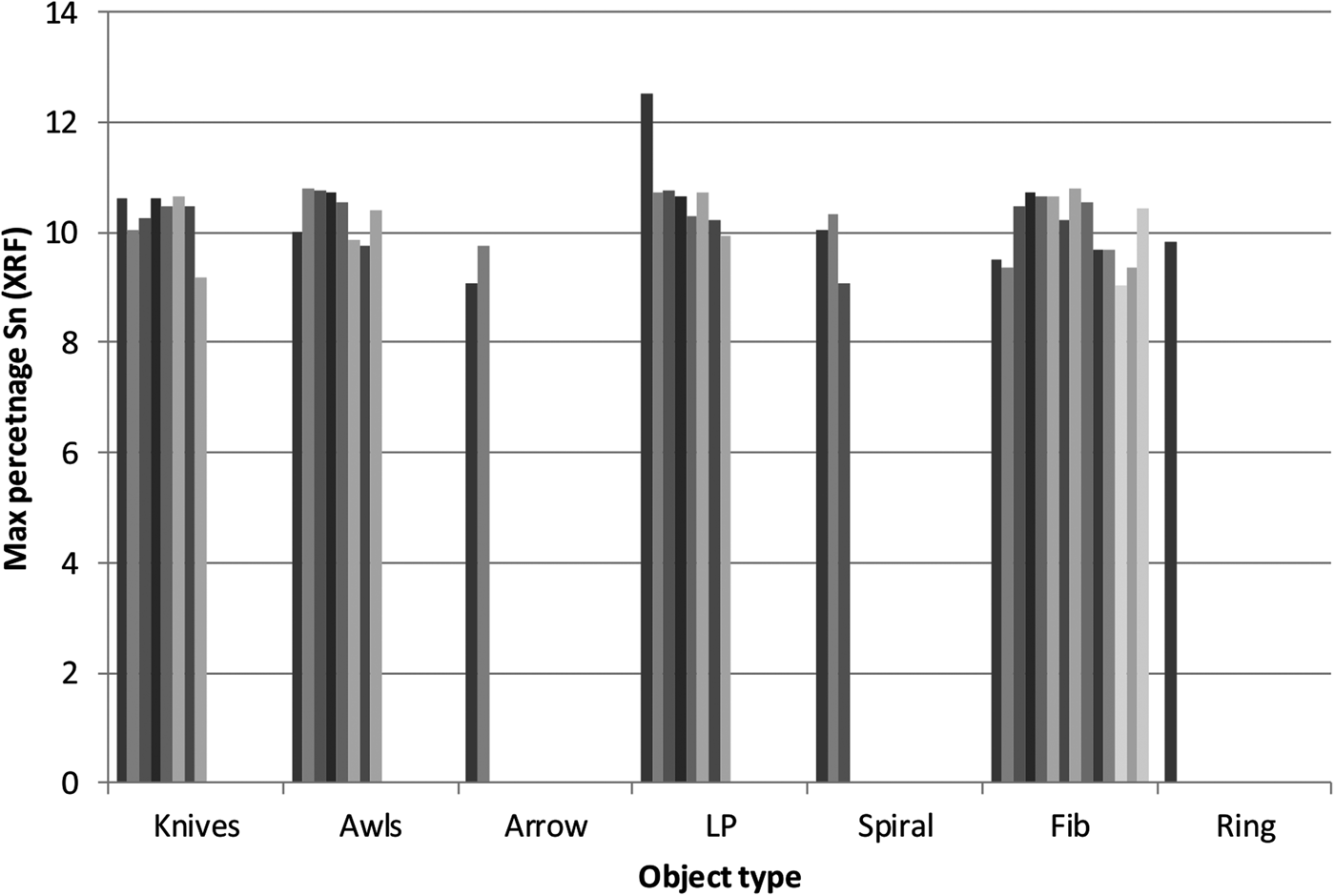
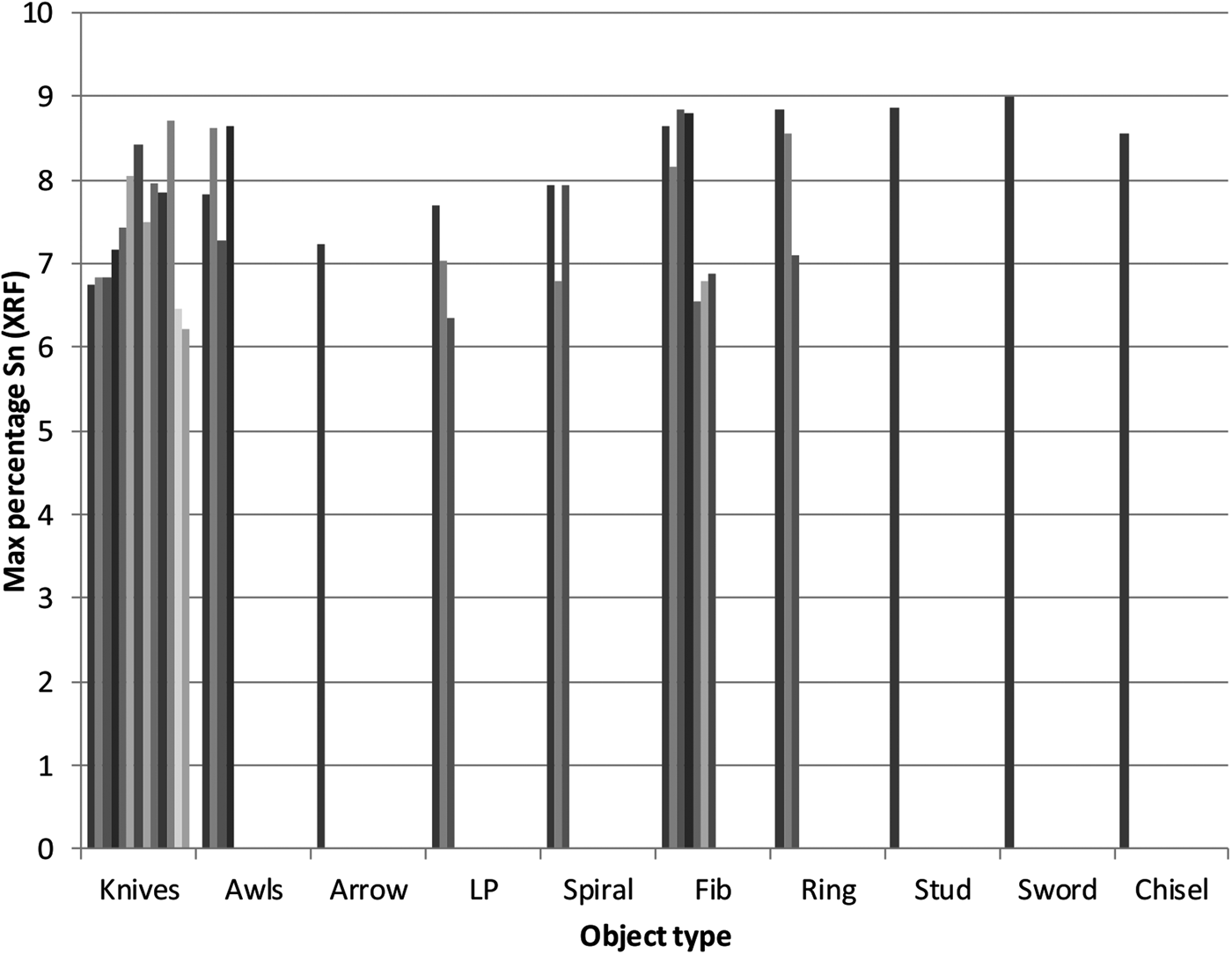
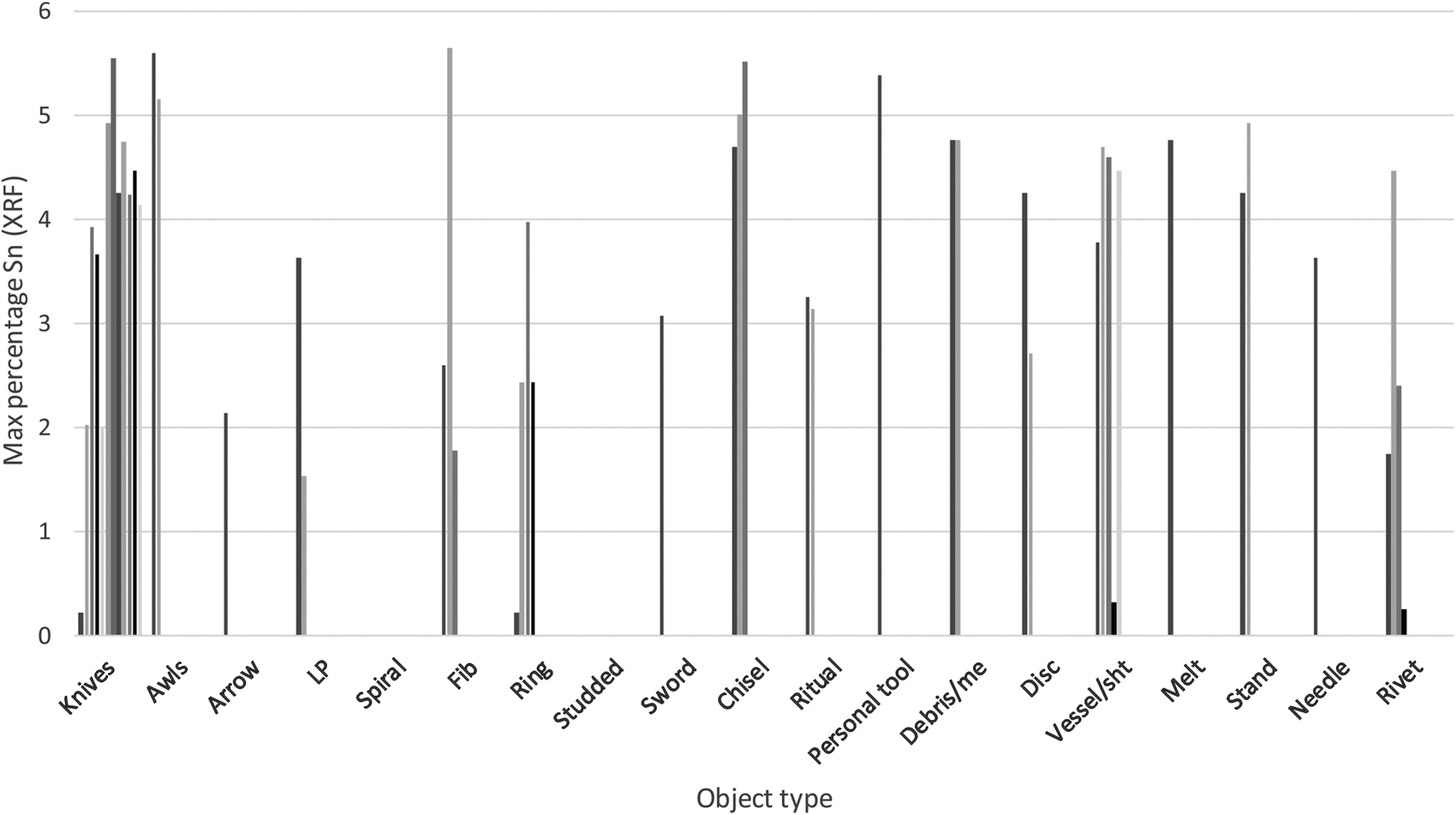
Compositional considerations (Figs 7–9)
The observations made below draw on recently published XRF results for the assemblage (Wallace, Smith and Nerantzis Reference Wallace, Smith and Nerantzis2021) where the advantages and limits of using this technique in archaeological interpretation across large-scale settlement assemblages are fully reviewed and the methodology of testing set out. The premise in the discussion below is that the results offer at minimum an internal profile of alloy composition at Karphi. This is because all objects were treated in the same way in analysis, have corroded in a broadly similar way (as the Reference Wallace, Smith and Nerantzis2021 work describes) and have been subject to the same conservation treatments, even if inflated figures for tin have been obtained, due to surface migration of the metal in corrosion (which does not actually seem to have been the pattern in this case, as the analysis paper explains). Comparisons with similarly large assemblages analysed by surface XRF, like the Cretan, Cypriot and Italian ones described above, are more limited, since variations in object condition and analytical approach will affect obtained percentages of copper, tin and lead. With these strong provisos, alongside the detailed breakdown and presentation of results offered in the companion paper, I offer here some archaeological interpretations of the alloying profile obtained for Karphi objects. I focus on a) whether alloying proportions were used at any consistent and preferred level across objects and distributions, identifying any anomalous patterns; and b) how any patterns emerging in this material sit with our current understanding of metal networks and technology change post-c. 1200 BC. The composition of 152 artefacts was studied; two spots were tested and compared on each object. Exposed metallic surface (present on 45 objects) was prioritised for testing, as explained by Wallace, Smith and Nerantzis (Reference Wallace, Smith and Nerantzis2021).
Broad alloy type distribution at Karphi by XRF-tested object: tin above 9 wt%. LP = long pin (S. Wallace).

Broad alloy type distribution at Karphi by XRF-tested object: tin above 6 wt%. LP = long pin (S. Wallace).

Broad alloy type distribution at Karphi by XRF-tested object: tin below 6 wt%. LP = long pin (S. Wallace).

Mode, median and mean figures for the whole set of copper alloy objects (on all measured spots) were as follows: tin: 4.25 wt%/7.8 wt%/7.3 wt%; lead: 2.8 wt%/2.2 wt%/2.1 wt%; arsenic 0.3 wt%/0.5 wt%/0.6 wt% (residual). Looking at the distribution of tin content across object classes led us to highlight 6–9 wt% tin as the ‘optimal’ alloy at this site (termed ‘medium tin’/MT) (Figs 7–9). Objects containing tin above 9 wt% stood out as a cluster (here termed ‘high tin’/HT: 66 per cent of such readings were above 10 wt%, and none above 13 wt%). This composition was mainly restricted to a small group of object type categories, which also often contained lead slightly above the 2 wt% optimum for castability improvement. In this context, objects with tin content below 6 wt% (most in this group had a tin content well below that figure) were classed as ‘low tin’/LT. The three composition ‘grades’ occurred in about the same number of objects (52 objects HT, 55 objects MT, 45 objects LT). This suggests that distinct alloying choices were available, with the alloying of limited tin metal or selected high-tin bronze to produce the deliberately high-tin items a possible strategy. The relatively easy achievement of 6–9 per cent tin alloying across a range of ordinary working and decorative artefacts is demonstrated, and could easily result from remelting of older bronze scrap. Yet the widest range of object types is in the low-tin group, suggesting optimal tin content was not always achievable or necessary, even for object types where it was useful. In object types where high tin was favoured, however, medium tin was the minimum usually achieved.
There is a weak positive correlation between tin and lead content across all tested items (0.7). In HT items it was 0.4, in MT items 0.3, and in LT items 0.6 (the latter being affected by the presence of numerous pure copper items). There are other hints at slightly higher lead alloying in HT items (61.5 per cent of all HT items had lead over 3 wt%, as compared to 16 per cent of MT items and 2.2 per cent of LT items). In HT objects, mode, median and mean figures for tin were 10.0 wt%/10.4 wt%/10.2 wt% and for lead 3.2 wt%/2.9 wt%/2.7 wt%. In the MT group they were 6.8 wt%/7.7 wt%/7.6 wt% for tin and for lead 2.8 wt%/2.3 wt%/2.2 wt%. Figures for the LT group were tin 4.2 wt%/4.1 wt%/3.7 wt% and for lead 2.0 wt%/1.3 wt%/1.4 wt%.
The frequency of a high-tin (and relatively high-lead) recipe in awls, pins and knives stands out. Regarding any possible association with ‘exotic’ types or imported objects, we can note that, of the 45 LT items, seven are exotic/innovatory in form, as the Online Catalogue explains (six being knives). Of the 52 HT items, seven are of this type; and of the 55 MT items, ten are of this type. This spread, the absence of very stark differences in alloying recipes across the assemblage, and the lack of very extreme type clustering according to recipe (e.g. the tang-hafted small knives of Italianising innovative type are spread across MT and HT classes) means that no class of object appears on the basis of composition to be of mainly imported origin, or deliberately made to conform to an exotic recipe. Bulky HT items are lacking, so the purpose of including slightly more generous lead in HT items appears most likely intended to improve castability or alter colour. We should consider also that even this slight, consistent generosity in the use of lead in high-tin objects was affected by awareness of higher-lead alloying as a generally growing Mediterranean/European practice in desirable bronzes, as discussed above. As with the limited, prestige use of iron, smiths supplying this region (in what we have already seen to be locally knowledgeable and distinctive ways) seem likely to have been aware of and practising within much wider innovations.
Further questions about alloying choices lead us to similar conclusions. For example, though knives were one of the main classes of objects where the HT alloy was used, why did this not either occur in all or most knives (only 8 of the 26 tested were HT), or else apply only to knives of a certain type? Limited amounts of available pure tin cannot explain the pattern, since smiths supplying the town clearly knew and could maintain a good hardness for knives and blades anyway, at MT level – of the majority (21) knives with above 6 wt% tin, only one had tin below 6.5 wt%: 16 had tin above 7 wt%; the two swords 002 and 003 are in the MT category. The high tin recipe was very much a choice within this large group. Overall, it seems most connected to the appearance of valued personal items in daily visible use, a category in which knives could function. In awls, as in knives, hardness conferred by tin was useful, but the very intensive use of the beyond-optimal HT recipe in these objects (mainly in the finely made square-section examples) seems related to other qualities, among them likely golden/silver appearance. Only two of the tested awls have tin below 6 wt%, with another three in the MT category. The remaining nine are HT. Higher-tin alloying in the long pins and other jewellery suggests changing perceptions of bronze and its appearance among the population of consumers living at Karphi (and the smiths serving them), as among wider Mediterranean and European consumers. Only three of the tested long pins have tin below 6 wt%: ten have the HT recipe. The eyed pin 014 has a rare shape parallel in a silver-copper-gold alloy with 17.2 wt% lead at Scoglio del Tonno (Bietti Sestieri, Giardino and Gorgoglione Reference Bietti Sestieri, Giardino and Gorgoglione2010, 461, 464, 466, fig. 4:17, table 1 noting parallels with pins in gold and silver-copper alloy at Enkomi) suggesting the recognised importance of a golden or silvery appearance in these ornaments. The range and amount of jewellery in use at Karphi means the HT recipe could never have been easily applied across the whole assemblage (with the rather limited excess tin, modest by comparison with that alloyed in objects from Kouklia Skales, for example, suggesting parsimony with any pure tin or tin-rich bronze available). Even so, we can note that of 27 fibulas tested, 10 had tin above 6 wt% and 15 were in the HT group: notably, all the minority square-section fibulae were included. There are no spiral beads in the LT group. The decorative value of the HT recipe is further supported by its dominant use in studs, with their almost wholly decorative function. Selectively, and following long-established practice, the manufacture of flexible tools like chisels and hammerable items like rivets shows a preference for the LT recipe (three of four chisels have under 6 wt% tin and none are HT; the majority of rivets tested have tin below 6 wt%). Sheet metal objects, too, are rarely HT, though the tin alloyed in seven of the 12 sheet objects tested is above 7 wt%. The neatly cut-up scrap blades (e.g. 117, 133, 135, 136, 137, 140, 151) include HT examples (e.g. 133). Thus tin-rich metal could be knowledgeably and precisely added to remelts to extend use of pure tin. The absence of many pure copper items suggests that smiths supplying Karphi and its region very often remelted tin bronze artefacts or pre-alloyed tin bronze ingots to make new items. At the same time, addition of some limited pure tin is strongly suggested by the selectivity and consistency in practice, as discussed above. Though perhaps restricted in the volume of pure bulk tin and copper they could acquire, smiths serving the Lasithi area were apparently aware of, and could adapt, the distinctive tin-rich recipes used at sites in both the central and east Mediterranean, where pure metal was plentiful in circulation. The way in which bronze recipes and their visual value/signification in consumed objects were communicated, accepted and implemented across the large, changing contact networks of the post-1200 BC Mediterranean, with no straightforward regard to, or restriction by, raw metal supply, is of great interest. We can link such compositional changes (likely seen also in the Psychro assemblage, given other indicators of shared or inter-aware production features, discussed above) to general shifts in perception of the socioeconomic role of bronze, themselves connected to new kinds of social organisation arising out of state collapse. The coherent nature of the composition strategies applied to objects consumed at Karphi, and most likely made locally, shows that bronzeworking expertise had not disappeared or diminished as a result of social fragmentation and relocation, changes in raw metals supply or the new interests in iron. Such expertise is in fact likely to have been highly valued as a status within groups experiencing relocation and socioeconomic readjustment, and perhaps especially in large developing communities requiring and using a high volume of copper tools and personal and ritual items.
CONCLUSIONS: UPDATING THE RECORD
These insights from Karphi position us better to assess how other communities and networks in Crete adapted their resourcing strategies and technological practices in the post-crisis period. But this only works if we are prepared to look at a number of material culture spheres in context and in a comparative way.Footnote 40 Due to the circumstances of the post-1200 BC period and the history of research, there are currently simply not enough large and well-preserved settlement metals assemblages to build models of regional route and contact networks for the supply, manufacturing and consumption of metals alone. We can only make a few observations on the present evidence, but these seem significant. The clear differences in metals consumption practices between Karphi and Knossos, for example, do not indicate that Karphi was either especially poor in metal supply (as some smaller new settlements of the period may have been) or cut off from international wealth/commodity circulation. Rather, the community here seems to have been independently linked into interregional networks of practice, knowledge and exchange. Its status as a new large settlement required radical types of social restructuring. Its relative remoteness from former centres enabled this, and appears to have pushed early outreach by locally based manufacturers to serve new consumption needs. It is in fact unsurprising, given its novelty, size and position, that the wider north Lasithi community apparently did not either closely match the social forms governing goods consumption at former coastal lowland centres or normally acquire the bulk of consumed goods/materials through those locations in down-the-line trade.
Recognising Karphi's difference helps us understand how deeply the breakdown of states and norms c. 1200 BC shaped new regional economic and political units, setting new trajectories for the movement of materials and goods moved in procurement, consumption and recycling. The process involved new types of material signification around age, gender and wealth status and changing spheres of ceremonial and ritual consumption (points highlighted when we compare the patterns of bronze manufacture and use in Karphi's settlement and cemeteries with those of LBA Mochlos or Gournia, for example, or examine the nature of bronze dedications at Psychro post-1200 BC). In the early EIA at Knossos – formerly a wealthy centre – we see evidence in cemetery data for a complex system of social ranking which was apparently different, and differently supported by metals wealth, than that operating at Karphi. Yet we cannot assume that this pattern related straightforwardly to the near coastal positioning of the Knossos community and related access to trade goods, since there are hints at differently orientated outward procurement at the cult/harbour site of Kommos on the south coast. Prinias, as a newly founded community, seems likely to have configured consumption in its region in special ways, including in connection to the developing Kommos hub: its large cemetery metals record, which will throw light on this, is currently being studied by H. Matthäus.
In interpreting metals assemblages, as those of other artefacts in this period, agency and innovation are important to recognise in post-collapse communities (whether in the latter's selective use of exotic imports and styles, in the emergence of coherent local technological traditions in manufacturing, or in new patterns of consumption in a restructured social world, in ways which fed back into changing perceptions of and approaches to materials). Technology innovation is highlighted by this study as heavily socially conditioned and conscious, rather than ‘rationally’ adaptive (Budd and Taylor Reference Budd and Taylor1995; Doonan and Dungworth Reference Doonan, Dungworth, Dungworth and Doonan2013; Pfaffenberger Reference Pfaffenberger1992). But changes both in the perceptions and use of bronze, and in the uptake of iron, seen from c. 1200 BC, do not seem straightforwardly characterisable as deliberate marketing strategies on the part of agents from a former social substrate, forming a newly powerful and successful LBA east Mediterranean manufacturing and trading class after collapse, as some consumption-focused models have suggested (e.g. Sherratt Reference Sherratt and Karageorghis1994). State crisis and concurrent re-networking produced bigger, less controllable driving factors in manufacture and consumption. The present study supports a view of technological innovation and restructuring as context-driven: messy, socially embedded, and of divergent long-term value, and not autonomously revolutionising manufacturing or consumption practices, but operating as a factor in their change, via overdetermining socioeconomic frameworks.
SUPPLEMENTARY MATERIAL
Online Supplementary Material is available for this article here: https://doi.org/10.1017/S0068245421000149.
ACKNOWLEDGEMENTS
Support for the project came from a three-year grant from the Society of Antiquaries of London, for which I am deeply grateful. INSTAP Publication Team support was essential in supporting illustration by D. Faulmann and conservation advice by K. Hall, as well as sourcing analytical expertise and equipment. I thank the staff of the Heraklion Museum, Stella Mandalaki, Giorgos Marakis, Georgia Flouda and Dimitris Sfakianakis in particular, for their patience and time in organising the project on behalf of the Hellenic Ministry of Culture. The British School at Athens administered the permits, for which I offer many thanks. I would like to thank Donald Haggis, an anonymous reviewer, Hartmut Matthäus, Barry Molloy and Vana Orfanou for their kind attention to and comments on my manuscript. Dimitra Mylona kindly and knowledgeably translated the abstract and title.