Implications
These results demonstrated that, in lactating Alpine female goats raised in subtropical latitudes, sexual activity can be induced during the anestrous season by exposure to males rendered sexually active by a long-day treatment. These results have an important practical application because they show that in subtropical latitudes the photoperiodic treatment of females is not necessary to stimulate their reproductive activity by the male effect, in contrast to that reported for the same breed under temperate latitudes.
Introduction
Reproductive seasonality is a characteristic of most breeds of goats from temperate latitudes and some from subtropical latitudes. In male and female goats from temperate latitudes, the breeding season lasts from early autumn to late winter (Delgadillo et al., Reference Delgadillo, Leboeuf and Chemineau1991; Amoah et al., Reference Amoah, Gelaye, Guthrie and Rexroad1996). This reproductive seasonality persists in male and female Alpine goats raised in subtropical latitudes (Mohammad et al., Reference Mohammad, Grossman and Vatthauer1984) or when subjected artificially to tropical photoperiodic variations (Chemineau et al., Reference Chemineau, Daveau, Maurice and Delgadillo1992). In Australian and Mexican bucks adapted to subtropical latitudes, the breeding season starts in late spring and ends in late autumn (Walkden-Brown et al., Reference Walkden-Brown, Restall, Norton, Scaramuzzi and Martin1994; Delgadillo et al., Reference Delgadillo, Canedo, Chemineau, Guillaume and Malpaux1999), while the breeding season of does of such breeds lasts from early autumn to late winter (Restall, Reference Restall1992; Duarte et al., Reference Duarte, Flores, Malpaux and Delgadillo2008). In the temperate and subtropical breeds mentioned above, photoperiod is the main environmental factor responsible for reproductive seasonality (Chemineau et al., Reference Chemineau, Martin, Saumande and Normant1988; Delgadillo et al., Reference Delgadillo, Cortez, Duarte, Chemineau and Malpaux2004). Therefore, artificial photoperiod treatments could be used to modify the reproductive seasonality in males and females. Indeed, exposure of animals to 2 or 3 months of long days followed by either short days or a melatonin treatment, a hormone that mimics the effects of short days, stimulates their sexual activity during the non-breeding season (Donovan et al., Reference Donovan, Boland, Roche and O’Callaghan1994; Delgadillo et al., Reference Delgadillo, Carrillo, Morán, Duarte, Chemineau and Malpaux2001; Chemineau et al., Reference Chemineau, Malpaux, Brillard and Fostier2007). Another possibility to stimulate the sexual activity in anestrous females is the use of socio-sexual relationships. Indeed, introducing a male into a group of anestrous females can induce and synchronize their endocrine and sexual activity in the five following days (Walkden-Brown et al., Reference Walkden-Brown, Martin and Restall1999; Delgadillo et al., Reference Delgadillo, Gelez, Ungerfeld, Hawken and Martin2009). However, the response of does to the male effect varies widely between seasons, breeds and locations. In breeds that are not very seasonal, the male effect can stimulate the sexual activity of does throughout the year (Chemineau, Reference Chemineau1983). In contrast, in highly seasonal breeds, a weak response is observed when does are exposed to males during mid-anestrus. In these breeds, the use of the male effect is limited to some weeks preceding the breeding season (Restall, Reference Restall1992; Flores et al., Reference Flores, Véliz, Pérez-Villanueva, Martínez de la Escalera, Chemineau, Poindron, Malpaux and Delgadillo2000). In the Alpine breed raised under temperate latitudes, estrous behavior and the ovulatory response of does exposed to males are high only when both males and females are submitted to a light treatment of long days followed or not by melatonin administration before teasing (Chemineau et al., Reference Chemineau, Normant, Ravault and Thimonier1986 and Reference Chemineau, Malapux, Pelletier, Leboeuf, Delgadillo, Deletang, Pobel and Brice1996; Pellicer-Rubio et al., Reference Pellicer-Rubio, Leboeuf, Bernelas, Forgerit, Pougnard, Bonné, Senty and Chemineau2007). In these later studies, the endocrine or sexual behavior response of the Alpine bucks subjected to these photoperiodic treatments was not described. In contrast to Alpine goats, in local subtropical Mexican does, the photoperiodic treatment of females is not necessary, and high rates of estrous and ovulatory responses were observed in does exposed to males rendered sexually active by exposure to artificially long days (Delgadillo et al., Reference Delgadillo, Flores, Véliz, Hernández, Duarte, Vielma, Poindron, Chemineau and Malpaux2002; Rivas-Muñoz et al., Reference Rivas-Muñoz, Fitz-Rodríguez, Poindron, Malpaux and Delgadillo2007; Fitz-Rodríguez et al., Reference Fitz-Rodríguez, De Santiago-Miramontes, Scaramuzzi, Malpaux and Delgadillo2009). The different responses between local Mexican goats and Alpine goats to the male effect could be due to a different degree of photoperiodic inhibition of the sexual activity existing in subtropical and temperate latitudes, or to possible differences in the degree of seasonality between these breeds, or both (Chemineau et al., Reference Chemineau, Daveau, Maurice and Delgadillo1992; Delgadillo et al., Reference Delgadillo, Canedo, Chemineau, Guillaume and Malpaux1999). The aim of this study was to test the first hypothesis and, therefore, to determine if a treatment with long days stimulates the sexual activity of Alpine males and if these light-treated males are able to induce the reproductive activity in anestrous Alpine female goats raised in subtropical latitudes.
Material and methods
General
The study was performed in subtropical northern Mexico (Latitude, 26°23′N and Longitude, 104°47′W) using male and female Alpine goats. Males and females were given ad libitum access to alfalfa hay (18% CP), water, mineral blocks and 200 g of commercial concentrate (14% CP; 1.7 Mcal/kg).
Experiment 1
The objective of this experiment was to determine if a treatment of long days (16 h of light/day) starting at the end of autumn stimulates the sexual behavior of Alpine male goats during the non-breeding season.
Photoperiodic treatments
Bucks were 2-year-old at the beginning of the study. Males of the control group (n = 4) remained in a 2 × 5 m open shed under natural day length and ambient temperature throughout the study. Day length varied from 13 h 41 min at the summer solstice to 10 h 19 min at the winter solstice. Males of the experimental group (n = 4) remained in a 2 × 5 m open shed and were exposed to artificial long days for 2.5 months from 1 December to 15 February combining natural and artificial light. Artificial light was given from 0600 to 0900 h and from 1700 to 2200 h to obtain a total of 16 h of light/day. On 16 February, males were re-exposed to natural photoperiodic variations until the end of the study. Artificial light was regulated by an electric clock and light intensity was at least 300 lx, measured at the animals’ eye level.
Measurements
Body weight (BW) was determined once a month. Testicular weight and the intensity of male odor were determined every 2 weeks (Delgadillo et al., Reference Delgadillo, Leboeuf and Chemineau1991; Walkden-Brown et al., Reference Walkden-Brown, Restall, Norton, Scaramuzzi and Martin1994). In all males, sexual behavior was observed for 20 min from 13 to 15 May, during individual tests, in which each buck was exposed to two anestrous does. The same person observed all bucks and recorded ano-genital sniffing, nudging, self-urination, flehmen and mounting attempts. In all males, blood samples were taken by jugular venipuncture and plasma was obtained after centrifugation at 3500 × g for 25 min and stored at −20°C until hormone concentrations were measured. Testosterone concentration in plasma was determined in samples obtained once a week from 27 January to 30 June. Plasma testosterone was measured in a single assay by RIA in duplicate, in 50-μl plasma samples as described by Garnier et al. (Reference Garnier, Cotta and Terqui1978). Sensitivity (2 SD from zero control) was 0.1 ng/ml. The intra-assay CV was 7.5%.
Experiment 2
The objective of this experiment was to determine if Alpine males treated only with artificially long days were able to stimulate reproductive activity in lactating Alpine anestrous females.
Photoperiodic treatments
Bucks were 4 years old at the beginning of the study. Males from the control group (n = 5) were exposed to natural photoperiod variations, while males from the experimental group (n = 5) received the same treatment of long days as described in experiment 1 (artificially long days between 1 December and 15 February).
Preparation of females exposed to the male effect
Multiparous anovulatory Alpine goats were used. They had given birth in January and all females were milked twice a day throughout the study. On 22 and 29 April, plasma progesterone concentrations were measured in blood samples by RIA to determine ovarian cyclicity.
Male effect
On 1 May, females were allocated to one of two groups (n = 45 each) balanced for BW and milk production (BW: 55 ± 0.4 kg v. 54 ± 0.4 kg; milk production: 2.5 ± 0.04 l/day v. 2.6 ± 0.04 l/day). They were placed in two open pens distant of about 1500 m from each other. On 3 May, three untreated and three long-day treated males randomly chosen were introduced to the does. Males remained with females for 20 days.
Measurements
Ovulations were inferred by the plasma progesterone concentrations determined from a blood sample from each doe obtained 20 days after introduction of the bucks. Fertility (does kidding/does exposed to bucks) and prolificacy (kids born/does kidding) were recorded. In all females, blood samples were taken by jugular venipuncture and plasma was obtained after centrifugation at 3500 × g for 25 min and stored at −20°C until hormone concentrations were measured. Progesterone concentration in plasma was measured by RIA (Saumande et al., Reference Saumande, Tamboura and Chupin1985). Sensitivity was 0.1 ng/ml. The intra- and interassay CV were 6% and 10%, respectively. Females with progesterone levels above 0.5 ng/ml were considered to have ovulated (Flores et al., Reference Flores, Véliz, Pérez-Villanueva, Martínez de la Escalera, Chemineau, Poindron, Malpaux and Delgadillo2000).
Statistical analyses
In males, effects of treatment on BW, testicular weight, plasma testosterone concentrations and sexual odor were analyzed by 2-way ANOVA with repeated measurements to test effects of photoperiod treatment and time. When interactions between treatment and time were detected, treatment effects were examined within each time point using pairwise comparisons among treatments followed by t-test or Mann–Whitney (male odor) for 2-by-2 comparisons. Frequencies of buck sexual behaviors were analyzed using χ 2 for goodness of fit. The proportions of females that ovulated and fertility were compared using χ 2. Prolificacy was analyzed using t-test. Analyses were computed using the SYSTAT 10 software (Evanston, IL, USA, 2000). Results were expressed as mean ± s.e.
Results
Experiment 1
Body weight
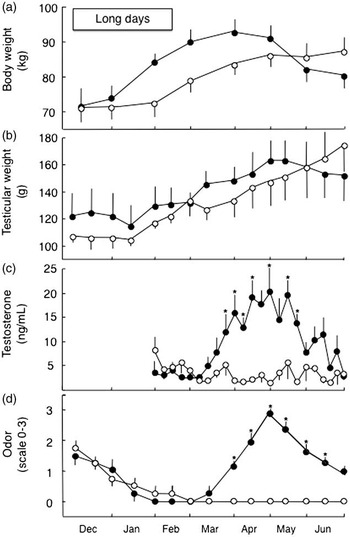
A treatment-by-time interaction (P < 0.001) was detected for BW. However, a comparison of groups at individual time points did not reveal differences (P > 0.05) for this variable (Figure 1a). In control bucks, the BW increase stopped after (June) than in light-treated ones (April).
Body weight (a), testicular weight (b), testosterone secretion (c) and intensity of odor (day; mean ± s.e.m.) in two groups of Alpine male goats raised in subtropical latitudes (26°N) and exposed to natural changes in day length (open symbols), or to 2.5 months of artificially long days (16 h of light by day) between 1 December and 15 February (closed symbols) followed by natural changes in day length. *P < 0.05.

Testicular weight
A treatment-by-time interaction (P < 0.001) was detected for testicular weight. However, a comparison of groups at individual time points did not reveal differences (P > 0.05) for this variable (Figure 1b). In males of both groups, testicular weight evolution was quite similar.
Testosterone secretion
A treatment-by-time interaction (P < 0.001) was detected for testosterone secretion. A comparison of groups at individual time points revealed numerous differences (P < 0.05). In males from the control group, low plasma testosterone concentrations were observed from March to June. Conversely, in light-treated males, testosterone secretion stared to increase in February and peaked in April. Then testosterone secretion decreased and low levels were observed in late June (Figure 1c).
Male odor
A treatment-by-time interaction (P < 0.001) was detected for the intensity of male odor. The intensity of odor was stronger (P < 0.05) in males exposed to long days than in controls from March to June (Figure 1d).
Sexual behavior of bucks
The number of ano-genital sniffing, nudging and flehmen in males exposed to long days was greater (P < 0.05) than that observed in controls (255 v. 44, 280 v. 5, 69 v. 20, respectively). In contrast, self-urination and mounting attempts did not differ (P > 0.05) between light-treated and untreated males (5 v. 1, 2 v. 3, respectively).
Experiment 2
Response of Alpine females to the male effect
The proportion of does that ovulated was greater in those in contact with light-treated males (40/45; 89%) than in those exposed to untreated ones (6/45; 13%; P < 0.001). Fertility was higher in does exposed to light-treated males (36/45; 80%) than in those exposed to untreated bucks (3/45; 7%; P < 0.001), but prolificacy did not differ (P > 0.05) between groups (1.8 ± 0.1 and 1.7 ± 0.3, respectively).
Discussion
It is clear from our results that a photoperiodic treatment of long days can induce sexual activity of Alpine bucks during the non-breeding season under a subtropical latitude. Indeed, 16 h of light/day between 1 December and 15 February induced significant stimulation of male testosterone secretion, odor and sexual behavior. In addition, and more importantly, the activation of these indicators of sexual activity by this photoperiod treatment enabled these males to induce ovarian and estrous activity in anestrous Alpine females raised under the same subtropical latitude, but left under natural photoperiodic conditions.
The sexual activity and response to photoperiodic treatment of Alpine bucks in the present experiment were in the range of what could be expected from studies under temperate latitudes. In experiment 1, the indicators of sexual activity of control bucks were low from February to June, which is consistent with the fact that this period corresponds to the non-breeding season of male goats under subtropical latitudes (Mohammad et al., Reference Mohammad, Grossman and Vatthauer1984). In addition, the values of these indicators found in experiment 1 were also similar to those reported in seasonally inactive bucks of the same breed under temperate latitudes (Delgadillo et al., Reference Delgadillo, Leboeuf and Chemineau1991). Conversely, 2.5 months of long days starting at the end of autumn resulted in the activation of all three indicators of sexual activity in our Alpine bucks, as it is also the case in local Mexican bucks under subtropical latitudes, the only difference being in the timing of the response, given that the timing of the natural breeding season differed between local (from May to December) and Alpine (from August to March) male goats (Delgadillo et al., Reference Delgadillo, Leboeuf and Chemineau1991 and Reference Delgadillo, Canedo, Chemineau, Guillaume and Malpaux1999). The photoperiod treatment also resulted in differences in the variations of BW of the Alpine bucks. The earlier increase in BW observed in light-treated bucks related to untreated ones is probably due to an effect of long days, which improve feed intake due to the extra hours of light and/or feed efficiency (Schanbacher, Reference Schanbacher1988). The increase in BW stopped in March probably due to the high levels of testosterone reached at that time (Walkden-Brown et al., Reference Walkden-Brown, Restall, Scaramuzzi, Martin and Blackberry1997). In untreated bucks, the increase in BW occurred later than in light-treated males probably due to the stimulatory effect of increasing natural day length (Walkden-Brown et al., Reference Walkden-Brown, Restall, Norton, Scaramuzzi and Martin1994; Delgadillo et al., Reference Delgadillo, Canedo, Chemineau, Guillaume and Malpaux1999).
The changes of sexual activity resulting from the treatment by long days permitted our Alpine bucks to induce the reproductive activity of Alpine does during seasonal anestrous, despite the well-established high seasonality of this breed (Mohammad et al., Reference Mohammad, Grossman and Vatthauer1984; Amoah et al., Reference Amoah, Gelaye, Guthrie and Rexroad1996). An intense sexual behavior and strong odor of males could explain the fact that light-treated males were able to induce the reproductive activity of anestrous Alpine goats, whereas control bucks were not. The stimulatory effect of long days on the capacity of bucks to induce a male effect has already been extensively documented in local Mexican goats in the subtropics (Delgadillo et al., Reference Delgadillo, Flores, Véliz, Duarte, Vielma, Hernandez and Fernandez2006 and Reference Delgadillo, Gelez, Ungerfeld, Hawken and Martin2009; Rivas-Muñoz et al., Reference Rivas-Muñoz, Fitz-Rodríguez, Poindron, Malpaux and Delgadillo2007), but this is the first indication that its efficacy also applies to the reputedly very seasonal Alpine breed, in which control males stimulate the reproductive activity in only a few does (this study; Chemineau et al., Reference Chemineau, Normant, Ravault and Thimonier1986).
As mentioned above, our results in experiment 2 agree with previous reports under subtropical latitudes in local Mexican goats exposed to males treated only with long days (Delgadillo et al., Reference Delgadillo, Flores, Véliz, Duarte, Vielma, Hernandez and Fernandez2006). However, these data contrast with results of Chemineau et al. (Reference Chemineau, Normant, Ravault and Thimonier1986 and Reference Chemineau, Malapux, Pelletier, Leboeuf, Delgadillo, Deletang, Pobel and Brice1996), who reported a lower estrous behavior in Alpine does raised in temperate latitudes when exposed to Alpine male goats treated with long days and melatonin. The marked difference in the response of Alpine does exposed to light-treated males under temperate and subtropical latitudes could be explained by at least two non-exclusive factors. First, under temperate latitudes, photoperiodic inhibition of reproduction could be more pronounced than in subtropical latitudes due to the amplitude of photoperiod variations encountered, even though the timing of the breeding season is similar (Chemineau et al., Reference Chemineau, Daveau, Maurice and Delgadillo1992; Duarte et al., Reference Duarte, Flores, Malpaux and Delgadillo2008). For this reason, Alpine does raised in temperate latitudes are probably less responsive when exposed to the light-treated males (Chemineau et al., Reference Chemineau, Malapux, Pelletier, Leboeuf, Delgadillo, Deletang, Pobel and Brice1996), whereas in Alpine does raised in subtropical latitudes a high reproductive response can be observed when exposed to males treated with long days. Second, it is also possible that Alpine bucks may not respond as well to a treatment with long days followed or not by melatonin treatment under temperate latitudes as they do in the subtropics. Recently, we found that treatment by long days followed by melatonin implants stimulates some sexual activity in Alpine bucks under temperate latitude (Delgadillo et al., unpublished results). However, the responses of Alpine males in terms of testosterone and sexual behavior were not as strong as those observed in the subtropics in this study or with local Mexican bucks (Flores et al., Reference Flores, Véliz, Pérez-Villanueva, Martínez de la Escalera, Chemineau, Poindron, Malpaux and Delgadillo2000; Delgadillo et al., Reference Delgadillo, Carrillo, Morán, Duarte, Chemineau and Malpaux2001). The ovarian response of anestrous light-untreated Alpine does exposed to these Alpine long days and melatonin-treated bucks was limited (50% of does ovulating; Delgadillo et al., unpublished results).
Conclusion
The results of the present studies allow us to conclude that the sexual activity of Alpine bucks can be induced in the subtropics using only artificially long days, despite the high reproductive seasonality of this breed. Moreover, the stimulus provided by bucks treated in this way can induce sexual activity in anovulatory females of the same breed without necessity to treat the females, different from what resulted for the same breed under temperate latitudes.
Acknowledgments
The authors thank the Assay Laboratory of the Unit ‘Physiologie de la Reproduction et des Comportements’ for carrying out the radioimmunoassays; to J. Chaurand for providing the female goats used in this experiment; to E. Carrillo for his administrative assistance; P. Poindron for his constructive comments to improve this manuscript and to Dolores López for her excellent secretarial assistance.