Hypoplastic left heart syndrome describes the spectrum of left heart hypoplasia that leaves the left heart unable to support the systemic circulation. In the United Kingdom, most cases of hypoplastic left heart syndrome are diagnosed antenatally.Reference Stumper 1 Hypoplastic left heart syndrome is not compatible with life without intervention, patients undergo staged palliation over the first few years of life, leading to a total cavopulmonary connection.
The management of hypoplastic left heart syndrome has progressed from compassionate care only to aggressive palliative surgery at most major paediatric medical centres.Reference Brescia, Jureidini, Danon, Armbrecht, Fiore and Huddleston 2 First-stage palliation options include the Norwood procedure – arch re-construction using the native aorta and pulmonary artery with insertion of modified systemic-to-pulmonary shunt or right ventricular-to-pulmonary artery conduit – and the hybrid procedure – bilateral pulmonary artery banding and stenting of the arterial duct. Neonatal transplantation is infrequent in the United Kingdom because of low availability of neonatal donor organs.
Initial palliation has traditionally been the Norwood procedure, performed in the early neonatal period. In recent years, the hybrid procedure has emerged as an alternative option for some high-risk patients with hypoplastic left heart syndrome. First reported in 1993,Reference Gibbs, Wren, Watterson, Hunter and Hamilton 3 with large series of early results only published in 2002 and 2003,Reference Ringewald, Stapleton and Suh 4 its specific role and indications still remain debated. Widely reported characteristics of patients undergoing this procedure include extreme low birth weight or prematurity, multi-organ dysfunction, or those at risk of intracerebral bleeding.Reference Chai 5 The advantages that the hybrid procedure confers include avoidance of cardiopulmonary bypass, myocardial ischaemia, and circulatory arrest.Reference Brescia, Jureidini, Danon, Armbrecht, Fiore and Huddleston 2 Nevertheless, its long-term impacts on child development remain uncertain, with only some intermediate results published at present.Reference Brescia, Jureidini, Danon, Armbrecht, Fiore and Huddleston 2 , Reference Laranjo, Costa and Freitas 6 , Reference Malik, Bird, Jaquiss, Morrow and Robbins 7
Growth failure has received considerable attention as a potentially modifiable risk factor for increased morbidity, prolonged hospitalisation, and neurodevelopmental outcomesReference Davidson, Gringras, Fairhurst and Simpson 8 , Reference Burch, Gerstenberger and Ravishankar 9 in children with congenital heart disease (CHD). It is known to impact postoperative outcomes such as extended length of hospital stayReference Anderson, Kalkwarf, Kehl, Eghtesady and Marino 10 and risk of infection. Children with hypoplastic left heart syndrome are particularly susceptible to malnutrition as the single ventricle supplies both systemic and pulmonary circulation, which imparts a significant volume loadReference Medoff-Cooper and Ravishankar 11 and increased energy consumption. Previous studies investigating growth in the “interstage period” – the period between the Norwood procedure and hemi-Fontan operation – have established that this is a high-risk period for the hypoplastic left heart syndrome population – mortality approximates 2–16%.Reference Feinstein, Benson and Dubin 12 , Reference Anderson, Iyer and Schidlow 13
In this study, we sought to characterise interstage growth patterns seen in patients who undergo the hybrid procedure as initial palliation through to total cavopulmonary connection compared with the primary Norwood population.
Materials and methods
Patient selection
This retrospective study received the appropriate institutional approvals. Patients with a diagnosis of hypoplastic left heart syndrome, who had underwent the hybrid procedure as first-stage palliation, and who had undergone total cavopulmonary connection between April, 2006 and November, 2015 were identified retrospectively in our departmental paediatric cardiology database Heartsuite (Heartsuite, Systeria, Glasgow, United Kingdom). Patients undergoing the Norwood procedure as primary palliation were also identified. At this institution, all patients with hypoplastic left heart syndrome undergo the Norwood procedure as first-stage palliation, unless there is a risk factor for the operation, in which case the hybrid procedure is undertaken. Such risk factors include low birth weight (<2.75 kg), prematurity, poor preoperative condition, aberrant right subclavian artery, right ventricular dysfunction, moderate-to-severe tricuspid regurgitation, or left heart structures that may allow a full biventricular repair at a later stage.
The hybrid procedure was defined as arterial ductal stenting and pulmonary artery banding, with an atrial septostomy or septectomy if significant atrial restriction is present. Hypoplastic left heart syndrome was defined as atrioventricular and ventriculoarterial concordance and mitral and aortic stenosis or atresia with left ventricular hypoplasia, in the absence of a significant ventricular septal defect.
Pre-specified exclusion criteria included the following: prematurity, defined as <37 weeks of gestation, presence of significant ventricular septal defects or unbalanced atrioventricular septal defects seen on echocardiography, and confirmed chromosomal or phenotypic disorders with known association with growth failure or retardation. Patients who had undergone eventual biventricular repair were also excluded.
Following the hybrid procedure, patients at our institution follow one of two pathways (see Figs 1 and 2). The decision to proceed is made on an individual basis, taking into consideration risk factors for the Norwood procedure as mentioned above. A minority of children may proceed to biventricular repair if the left heart structures are deemed suitable at re-assessment.
-
∙ Four stage: hybrid procedure followed by Norwood procedure at ~8 weeks of age, hemi-Fontan procedure at 4–6 months of age, and total cavopulmonary connection in the pre-school period.
-
∙ Three stage: hybrid procedure followed by comprehensive second-stage operation – arch reconstruction, Damus formation, and hemi-Fontan – at approximately 4–6 months of age, and total cavopulmonary connection in the pre-school period.
The three-stage pathway and time points.

The four-stage pathway and time points.

The comprehensive second-stage operation and the hemi-Fontan operation both lead to the formation of a superior cavopulmonary connection. In the tables, these two operations will be labelled as such for ease of comparison.
Data collected from medical records included gender, primary cardiac diagnosis, anatomical subtype, and patient co-morbidities including non-cardiac diagnoses. Oxygen saturation measurements by pulse oximetry on discharge after each operation were also recorded.
Growth assessment
Height, weight, and age (days) of the patients at each operative stage were recorded. The height and weight measurements were converted to age- and gender-adjusted z-scores in standard deviations based on World Health Organization data.Reference de Onis, Onyango, Borghi, Siyam, Nishida and Siekmann 14 Sample means and standard deviations were calculated to allow comparison between operative stages. Statistical significance was assessed using Student’s independent or paired t test (as appropriate) generated with SPSS. A p-value of <0.05 was considered significant and paired tests were used throughout.
The somatic growth of the three-stage and four-stage groups were compared with hypoplastic left heart syndrome patients at our institution who underwent the Norwood procedure as the first stage of palliation, followed by the hemi-Fontan operation, and finally total cavopulmonary connection. This group will be referred to as the “primary Norwood” group.
Results
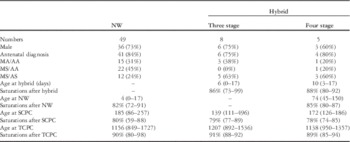
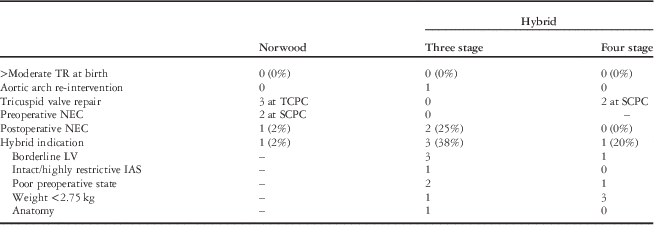
A total of 22 patients were identified. Among all, one patient was excluded because of prematurity, one patient was excluded because of significant ventricular septal defect, and seven patients underwent eventual biventricular repair and were therefore excluded. The final analysis included 13 patients – eight patients in the three-stage group and five patients in the four-stage group. A total of forty-nine primary Norwood patients were included for comparison. Baseline characteristics are shown in Table 1 and patient co-morbidities are shown in Table 2.
Patient population.

Number (%), median (range)
AA=Aortic atresia; AS=aortic stenosis; MA=mitral atresia; MS=mitral stenosis; NW=Norwood; SCPC=superior cavopulmonary connection; TCPC=total cavopulmonary connection
Baseline co-morbidities.

Number (%), median (range)
IAS=interatrial septum; LV=left ventricle; NEC=necrotising enterocolitis; SCPC=superior cavopulmonary connection; TCPC=total cavopulmonary connection; TR=Tricuspid regurgitation
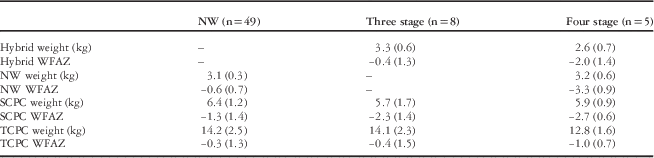
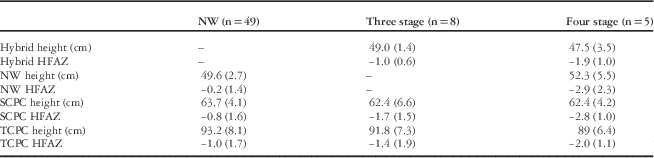
The most common reason for the hybrid procedure was low birth weight (n=4) and borderline left heart structures (n=4). The remainder underwent hybrid procedure for poor preoperative conditions (n=3), highly restrictive atrial septum (n=1), and right aortic arch with an aberrant subclavian (n=1). Tables 3 and 4 show the mean weight, weight z-scores, mean height, and mean height z-scores.
Weight and weight z-scores.

All data are means (SD)
NW=Norwood; SCPC=superior cavopulmonary connection; TCPC=total cavopulmonary connection; WFAZ=weight-for-age z-score
Height and height z-scores.

All data are means (SD)
HFAZ=height-for-age z-score; NW=Norwood; SCPC=superior cavopulmonary connection; TCPC=total cavopulmonary connection
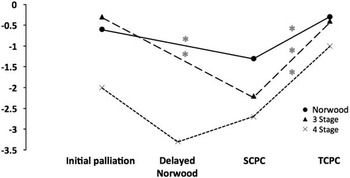
Weight (Table 3, Fig 3)
Graph demonstrating changes in weight-for-age z-score in the three-stage, four-stage, and primary Norwood groups. Significant changes are indicated with asterisks. SCPC=superior cavopulmonary connection; TCPC=total cavopulmonary connection.

Three-stage group
At hybrid procedure, patients in the three-stage group were of low–normal weight, with a weight-for-age z-score of −0.4 (SD 1.3) and mean weight of 3.3 kg (0.6 kg). The three-stage group tended to be heavier than the four-stage group [z-score −2.0 (1.4); mean weight 2.6 kg (0.7 kg)], but this did not reach statistical significance. Weight decreased significantly to the comprehensive second stage, by which time the mean z-score was −2.3 (1.4) (p<0.01). Weight subsequently increased significantly from the comprehensive second stage to the total cavopulmonary connection (z-score −0.4 (1.5); p<0.01). Weight returned to baseline (hybrid weight) by the total cavopulmonary connection: the difference in z-scores between hybrid and total cavopulmonary connection was non-significant (p=0.75).
Four-stage group
At hybrid procedure, the patients in the four-stage group were of lower weight [z-score −2.0 (1.4)] compared with healthy peers. This group then lost weight to the time of Norwood procedure [weight z-score −3.3 (0.9), p=0.06], which was the lowest z-score observed in weight in this group. Between the delayed Norwood procedure and the hemi-Fontan operation, there was a small non-significant increase in weight [hemi-Fontan z-score −2.7 (0.6), p=0.31]. After the hemi-Fontan operation, the four-stage group then grew significantly to the time of the total cavopulmonary connection [z-score −1.0 (0.7), p=0.01]. Weight gain at this stage also returned to baseline values: the difference in weight z-score between the hybrid stage and total cavopulmonary connection was non-significant (p=0.15).
Primary Norwood group
At the time of Norwood procedure, the primary Norwood group had a mean weight-for-age z-score of −0.6 (0.7), a figure comparable with the three-stage group. Weight significantly decreased from Norwood to hemi-Fontan [z-score −1.3 (1.4), p<0.001)], and subsequently increased significantly to time of total cavopulmonary circulation [z-score −0.3 (1.3), p<0.001)].
Height (Table 4)
Three-stage group
The patients in this group had a height-for-age z-score of −1.0 (0.6) at hybrid procedure and mean height of 49 cm (1.4). Height decreased to the comprehensive second stage [z-score −1.7 (1.5)] and then increased from comprehensive second stage to total cavopulmonary connection (z-score −1.4±1.9, p=non-significant).
Four-stage group
This group had a height-for-age z-score of −1.9 (1.0) at hybrid procedure. Height decreased to Norwood [z-score −2.9 (2.3), p=0.5] and then stabilised to hemi-Fontan [z-score −2.8 (1.0), p=0.96]. Height increased from hemi-Fontan to total cavopulmonary connection [z-score −2.0 (1.1), p=0.29].
Primary Norwood group
The Norwood group had a height-for-age z-score of −0.2 (1.4) at time of Norwood procedure. There was a significant height decrease to hemi-Fontan (z-score −0.8 (1.6), p=0.03), after which height increased to total cavopulmonary connection (z-score −1.0 (1.7) p=non-significant).
Comparison of somatic growth between the three-stage and four-stage groups
At each comparable stage – the hybrid procedure, the superior cavopulmonary connection, and total cavopulmonary connection – between the three-stage and four-stage groups, the differences in weight z-score, height z-score, and absolute values were non-significant.
Saturations
There were no significant differences in the oxygen saturation measurements when comparing the three-stage, four-stage, and primary Norwood groups at any comparable stage.
Three-stage group
The mean oxygen saturation decreased after the hybrid procedure to the superior cavopulmonary circulation, from a mean of 86% (range 72–99) to 79% (77–89). The values then increased by the time of discharge after the total cavopulmonary connection [mean 91 (88–92)%]. These changes were non-significant.
Four-stage group
The oxygen saturations decreased from the hybrid procedure [mean value 88% (range 80–92%)] to the delayed Norwood [85 (80–87)%] and then continued to decrease until after the superior cavopulmonary circulation [78 (74–85)%]. The oxygen saturations then increased at discharge from the total cavopulmonary connection [89 (85–94)%], which was significant (p<0.01). The change in oxygen saturations between the delayed Norwood and the total cavopulmonary circulation was also significant (p<0.01).
Primary Norwood group
In the primary Norwood group, there was a decrease in mean oxygen saturations from the Norwood procedure [82 (72–91)%] to the superior cavopulmonary connection [80 (59–88)%], followed by an increase to total cavopulmonary connection [90 (80–98)%]. The changes between stages were significant (p<0.05).
Discussion
In our study, mean z-scores in both weight and height were generally lower in the four-stage group than in the three-stage group at all comparable stages. This may be due to the increased metabolic demands of undergoing and recovering from four major cardiac operations. Growth may be influenced by the severity of cyanosis;Reference Day, Denton and Jackson 15 however, the mean oxygen saturations between the two hybrid groups were not significantly different.
Patients in all groups were of low-to-normal weight at the time of initial palliation. The weight trends seen in the three-stage group were comparable with that of this institution’s primary Norwood group – weight decreased until the second stage of palliation, followed by increase back to baseline levels. In the four-stage group, the weight decreased after the hybrid procedure to the delayed Norwood, then saw a non-significant increase until the hemi-Fontan, followed by a significant increase to total cavopulmonary circulation to beyond baseline z-scores. The decrease in weight after the initial palliation was greater in both hybrid groups as compared with the primary Norwood group, and was the most prominent in the four-stage hybrid group. This emphasises the need for closer monitoring and targeted nutritional interventions in the interstage period in hybrid patients, particularly the four-stage group.
The growth patterns seen in our study are comparable with previous studies. Miller-Tate et alReference Miller-Tate, Stewart and Allen 16 investigated the differences in weight in patients undergoing the hybrid procedure who had home interstage monitoring compared with those who did not, until the second operation. They observed significantly higher weight-for-age z-scores in their monitored groups by the second operation compared with the non-home monitored group. The mean weight-for-age z-score of those who had not been home monitored [−2.82 (1.28)] at the second stage was comparable with that of our hybrid patients [three stage: −2.3 (1.4); four stage −2.7 (0.6)].
Previous studies have shown a decrease in weight after the Norwood procedure,Reference Cohen, Bush and Ferry 17 – Reference Vogt, Manlhiot, Van Arsdell, Russell, Mital and McCrindle 19 thought to be due to continued cyanosis, volume overload, inefficient parallel circulations, and the inferior pumping capability of the morphologically right ventricle.Reference Ghanayem, Tweddell, Hoffman, Mussatto and Jaquiss 20 Catch-up growth seen after the hemi-Fontan procedure has also been previously reported.Reference Fukui, Mitsuno, Yamamura, Ryomoto, Hao and Miyamoto 21 The comprehensive second-stage and hemi-Fontan procedures result in a superior cavopulmonary anastomosis, which decreases ventricular volume load on the single ventricle, thereby promoting energy efficiency. Other physiological adaptations such as improved ventricular and atrioventricular valve function also improve energy efficiency. It is hoped that the hybrid procedure, which avoids cardiopulmonary bypass, results in better outcomes; however, as the present study illustrates, the weight trends in the hybrid groups are comparable with the primary Norwood group. In the hybrid group, significant increases in growth were not seen until superior cavopulmonary connection, similar to the Norwood group. This suggests that the main determinant in promoting weight gain remains the formation of the superior cavopulmonary connection. Whatever benefits the hybrid procedure might confer on somatic growth by avoiding bypass may be offset by the volume load the single right ventricle endures during the interstage period,Reference Miller-Tate, Stewart and Allen 16 as the resultant circulation of the hybrid procedure is still in-circuit rather than in-series. Early surgical intervention, and therefore early removal of volume overload and cyanosis, may lead to improved clinical outcomes and growth.
Growth pattern may be a reflection of adapting physiology and changes in energy efficiency in these children. Poor weight gain in infants with cyanotic CHD, particularly hypoplastic left heart syndrome, is well established,Reference Kelleher, Laussen, Teixeira-Pinto and Duggan 22 , Reference Leitch, Karn and Peppard 23 and has been linked to inadequate energy intake, excess energy requirements, and raised metabolic rate associated with cardiac failure, critical illness, surgical stress, cyanosis, genetic syndromes, and gastro-intestinal problems.Reference Hehir, Rudd and Slicker 24 However attributing substandard growth to a matter of simple energy mismatch remains debatable – a recent small study in children with CHD demonstrated that total energy expenditure did not differ between healthy age-matched infants and those with CHD who had undergone surgical intervention in the first 30 days of life.Reference Trabulsi, Irving and Papas 25
In the present study, we believe weight is a more accurate reflection of somatic growth as compared with height. First, there are practical difficulties in height measurement, particularly in the neonatal period. This in itself is important, given that height now forms part of the National Institute for Cardiovascular Outcomes Research data set. 26 Analysis of weight changes may be more clinically significant: a previous study has demonstrated that a weight-for-age z-score of <−2 at Fontan completion is associated with a higher rate of serious postoperative infections, which are associated with longer length of hospital admission.Reference Anderson, Kalkwarf, Kehl, Eghtesady and Marino 10 Furthermore, effects are generally seen in weight before length when caloric intake is inadequate to meet demands,Reference Daymont, Neal, Prosnitz and Cohen 27 which is relevant as nutritional therapy is a realistic target for intervention in improving growth trends in this cohort. Nutritional algorithms for infants with hypoplastic left heart syndrome have already been proposed.Reference Slicker, Hehir and Horsley 28 , Reference Jenkins 29
All the hypoplastic left heart syndrome patients in this study received specialist dietetic support while at the hospital, in order to optimise nutrition and maximise growth potential. Follow-up care in the community was arranged on discharge. The nutritional strategy used was patient-specific, but in general the calorific target for these infants is 100 calories/kg/day as an initial baseline. Caloric provision is increased as tolerated, until appropriate weight gain is achieved. Often, high-energy formula is required to meet nutritional requirements, particularly when patients are fluid restricted for extended periods. If the high-energy formulae do not produce adequate weight gain, or if oral volumes taken are insufficient, then nasogastric feeding is considered. An important factor to note was that in these patients the community dietetic support after discharge was variable depending on the services of the region.
Home surveillance programmes employed after the Norwood procedure that include daily recording of weight and intake have been associated with improved survivalReference Ghanayem, Hoffman and Mussatto 30 as well as normal growth outcomes.Reference Hehir, Rudd and Slicker 24 Our institution implemented a home monitoring programme in June, 2014, which post-dates the patients in the present study. Furthermore, one of the aims of the home monitoring programme is to address the variable post-discharge nutritional support and provide consistent dietetic advice to these patients.
The patients in our analysis were compared with data derived from World Health Organization growth standards. A recent growth study in children with CHDReference Daymont, Neal, Prosnitz and Cohen 27 reported that their analysis using World Health Organization-derived z-scores without comparison with a control population would have underestimated the differences in head circumference between children with CHD and healthy children; however, as our institution is a tertiary-care centre with an ethnically diverse patient population and national referrals, we felt it was appropriate to use World Health Organization-based data only, without a control group.
It is difficult to ascertain the aetiology of abnormal growth patterns in patients with hypoplastic left heart syndrome. Certainly, the condition itself conceivably influences development of organs during critical periods of development (in and ex utero). Somatic growth trajectories are impaired in fetuses with hypoplastic left heart syndrome, suggesting that growth abnormalities manifest in utero.Reference Cnota, Hangge and Wang 31 Impaired brain growth in fetuses with complex CHD including hypoplastic left heart syndrome has also been well established;Reference Limperopoulos, Tworetzky and McElhinney 32 , Reference Rhein von, Buchmann and Hagmann 33 however, different growth trajectories are seen after birth in this patient population, suggesting that postnatal haemodynamic factors play a role in influencing somatic growth. The physiological stress of several major cardiac operations and their complications in the first few years of life, as well as common use of medications such as diuretics, are likely to impact growth.Reference Aguilar, Raff, Tancredi and Griffin 34
Limitations
Several limitations should be taken into consideration. Owing to the frequency of this procedure, even in a high-volume hybrid procedure unit, the sample size is by definition small. Furthermore, the time periods between the operative stages differed in length among patients as time of each operation depended on physiological factors. Analysis of head circumference measurements may also provide valuable insights to growth patterns; however, at our institution, these data are not routinely collected after the neonatal period. The data presented are based on patients who had survived to total cavopulmonary connection, and therefore the analysis may be subject to survivor bias.
This study presents a small observational window; therefore, extrapolations about long-term growth cannot be made. A longer follow-up period is required in order to elucidate potential impact on adolescent growth and beyond. Previous studies that analysed staged reconstruction from 1990 to 1995 noted that the mean height z-score remained under 0 at both 4 and 8 years after the Fontan completion.Reference Fukui, Mitsuno, Yamamura, Ryomoto, Hao and Miyamoto 21
Conclusion
It is important to identify the stages at which growth appears to falter the most in this patient group. The four-stage group appears more vulnerable to poor growth and may benefit from targeted nutritional therapy. The timing of growth failure may provide insight into both the causes of poor growth and critical periods for possible intervention. Further analysis with biochemical markers associated with growth, including hormones and inflammatory markers such as insulin-like growth factor-1 and insulin-like growth factor binding protein-3Reference Avitabile, Leonard and Brodsky 35 , may provide further understanding about the factors affecting growth patterns in children with hypoplastic left heart syndrome.
Acknowledgements
None.
Financial Support
This study has received funding from the Department of Health through the National Institute for Health Research comprehensive Biomedical Research Centre award to Guy’s & St Thomas’ NHS Foundation Trust in partnership with King’s College London and King’s College Hospital NHS Foundation Trust.
Conflicts of Interests
None.
Ethical Standards
Ethical Standards approval was obtained from the appropriate bodies within Guy’s and St Thomas’ NHS Foundation Trust.