1. Introduction
While Indonesia–Iron or Steel Products Footnote 1 has neither the procedural gravitas of Argentina–Footwear (EC) Footnote 2 nor the global trade implications of US–Steel Safeguards,Footnote 3 it nevertheless has potentially significant implications for how the Appellate Body (AB) will handle future safeguard disputes. As measured either by scope or by trade value, the dispute itself is minor. The dispute involved Indonesia's mid-2014 decision to impose safeguard duties on galvalume, a type of galvanized flat-rolled steel product. Two major import suppliers of galvalume, Chinese TaipeiFootnote 4 and Viet Nam,Footnote 5 challenged the measure, primarily asserting that the investigative authority's process fell short of what was delineated in Argentina–Footwear (EC). The Panel and AB's narrowly crafted decisions hinged on a tariff schedule technicality. All said, one could reasonably conclude that this is a modest dispute with modest implications.
Yet, we think there might be more to this dispute than meets the eye. What makes the dispute potentially consequential is that the Panel and AB concluded that the dispute did not involve what the parties thought it did – a case of mistaken identity so to speak. Indonesia, Chinese Taipei, and Viet Nam all agreed that the measure imposed was a safeguard measure within the meaning of Safeguards Agreement Article 1. The parties thought the crux of the dispute was whether Indonesia's investigative authority had followed all of the necessary procedural steps before levying the safeguard tariff. Interestingly, that is not how the Panel interpreted the dispute. In a bold affirmation of the WTO Dispute Settlement Body's independence, the Panel decided that all three parties were wrong: the tariff in question was not a safeguard measure.Footnote 6 The Panel determined (and the AB affirmed) that this was a simple discretionary increase in Indonesia's applied tariff. The reasoning was that because Indonesia did not have a binding tariff obligation with respect to galvalume, Indonesia had neither suspended a GATT obligation nor withdrawn or modified a GATT concession. As a result, Chinese Taipei's and Viet Nam's challenges were essentially moot.
Interestingly, Indonesia excluded 120 developing countries from the safeguard measure because it thought it needed to impose the higher duty on a discriminatory basis in order to comply with the special and differential (S&D) requirements of Safeguards Agreement Article 9.1. However, in light of the finding that the duty was not a safeguard measure, the Panel concluded (and the AB affirmed) that such exclusions were not only unnecessary but in fact were inconsistent with the most favoured nation (MFN) provisions in GATT Article I. Thus, Indonesia's discriminatory implementation was deemed inconsistent with GATT Article I.
While this dispute appears to be a simple case of a discretionary tariff increase masquerading as a safeguard measure, we believe there is more here than meets the eye. Resorting to the Safeguard Agreement offered economic value beyond what was available in Indonesia's tariff schedule. This is because Viet Nam, by far the largest source of imported galvalume, had a free trade agreement with Indonesia. Thanks in part to its preferential tariff rate (0%), Vietnamese suppliers dominated the Indonesian galvalume import market. If Indonesia had simply raised its MFN rate, suppliers from Viet Nam would be unaffected. In fact, a higher MFN tariff would arguably have resulted in an even greater competitive advantage for Viet Nam. A safeguard measure, on the other hand, applied to all of Indonesia's trade partners (including those with trade agreements), a fact that makes Indonesia's recourse to safeguard protection particularly expedient.
Indonesia is hardly the first or only country to publicly justify its claim for protection under some WTO provision when in fact ample evidence suggests that simple protectionism is the real reason. As of the time of our writing of this paper (mid-2019), a slew of disputes involving questionable justifications for increased protection (most notably US–Steel and Aluminum Products Footnote 7) are on the WTO Dispute Settlement Body's (DSB's) docket. The assertive stance taken by the Panel and AB in this dispute gives us reason to believe that the DSB will not feel constrained by the various parties’ claimed justifications. This dispute, when combined with the recent Panel Report in Russia–Traffic in Transit (Ukraine),Footnote 8 suggests that WTO Panels and the AB will pro-actively and independently examine the WTO-consistency of trade restrictive measures, including their claimed legal basis.
2. Background
Indonesia is a member of the ASEAN Free Trade Area (AFTA) and related ASEAN free trade arrangements. Consequently, Indonesia has committed to moving to free trade with ASEAN members (Brunei, Cambodia, Laos, Malaysia, Myanmar, Philippines, Singapore, Thailand, and Viet Nam) and also with countries such as Australia, New Zealand, China, India, and Korea.
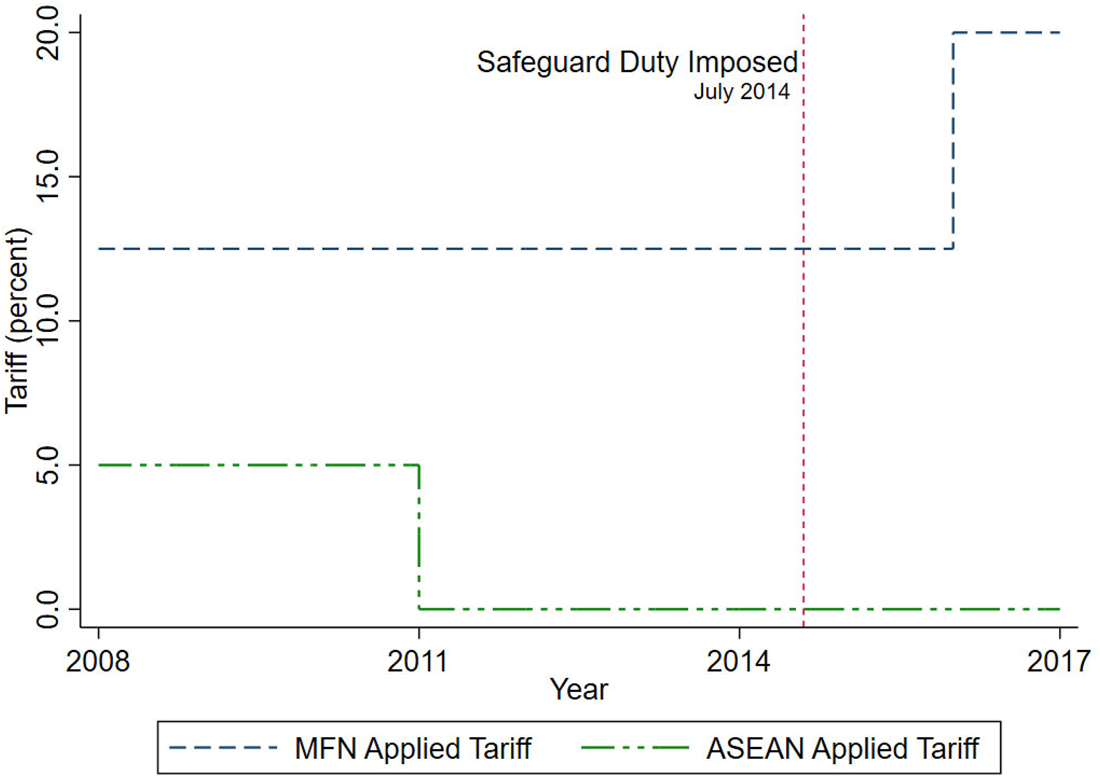
A MFN ad valorem tariff of 12.5% was applied on imports of galvanized flat rolled steel (with the trade name of galvalume) during the period preceding the safeguard investigation (Figure 1). Thanks to preferential trade agreements (PTAs) the tariff rate on galvalume was 0% for Viet Nam (since 2011) and 10% for Korea. The other two large suppliers, Chinese Taipei and China, both were subject to the MFN rate.
Indonesia MFN and ASEAN PTA applied tariffs (galvalume)

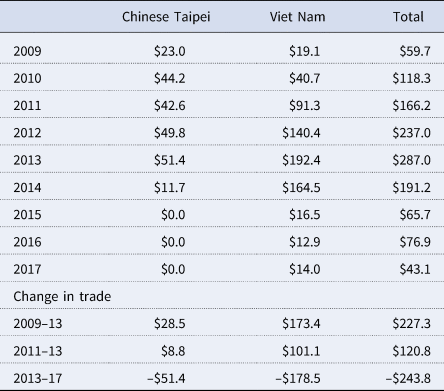
During the period preceding the safeguard investigation, Indonesian imports of galvalume increased sharply. As seen in Table 1, between 2009 and 2013 (the last year before the duties were levied) galvalume imports from all sources increased 380%, from $59.7 million to $287 million. Of the $227 million increase in imports, nearly 90% was due to Viet Nam ($173.4 million) and Chinese Taipei ($28.5 million). The fall in Viet Nam's preferential rate in 2011 further increased Viet Nam's dominant position: Viet Nam's trade value increased by more than $100 million and its market share grew by more than 30 percentage points over the subsequent three years. As seen, Viet Nam and Chinese Taipei were the dominant import suppliers. For perspective, Chinese Taipei, the number two supplier, was more than twice as large as the next largest supplier, Korea.
Indonesian galvalume imports (US$ millions)

In 2014, the Indonesian administering authority KPPI (Komite Pengamanan Perdagangan Indonesia) initiated and conducted a global safeguard investigation under its domestic safeguards legislation. This investigation led to the imposition of a specific duty for a period of three years, i.e., from 22 July 2014 to 21 July 2017. The schedule of duties is given in Table 2. For convenience, we have converted the specific duty in each year to an approximate ad valorem equivalent. As seen, we estimate the specific duty in the first year was equivalent to a 50% ad valorem tariff, declining to 43% in year two and then to 36% in year three.
Indonesia safeguard tariff on galvalumeFootnote 12

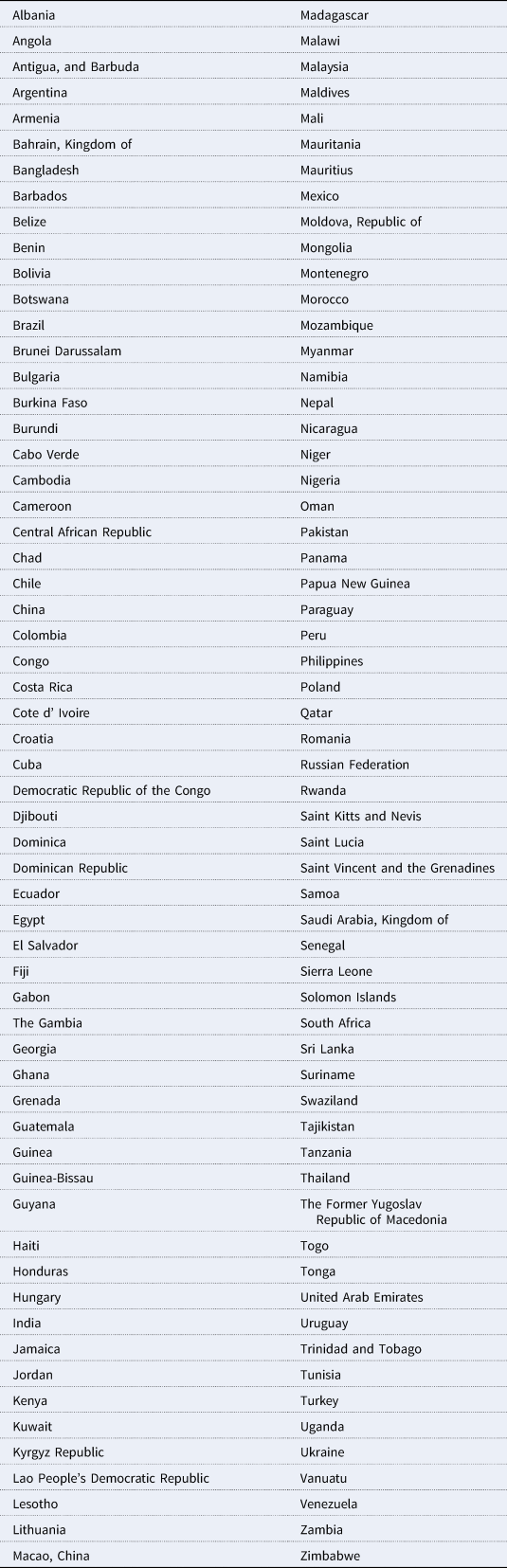
The specific duty was applied to imports of galvalume from all sources, with the exception of 120 allegedly developing countriesFootnote 9 that were listed in Indonesia's Article 9.1 Agreement on Safeguards (ASG) safeguard notification to the WTO Safeguards Committee.Footnote 10
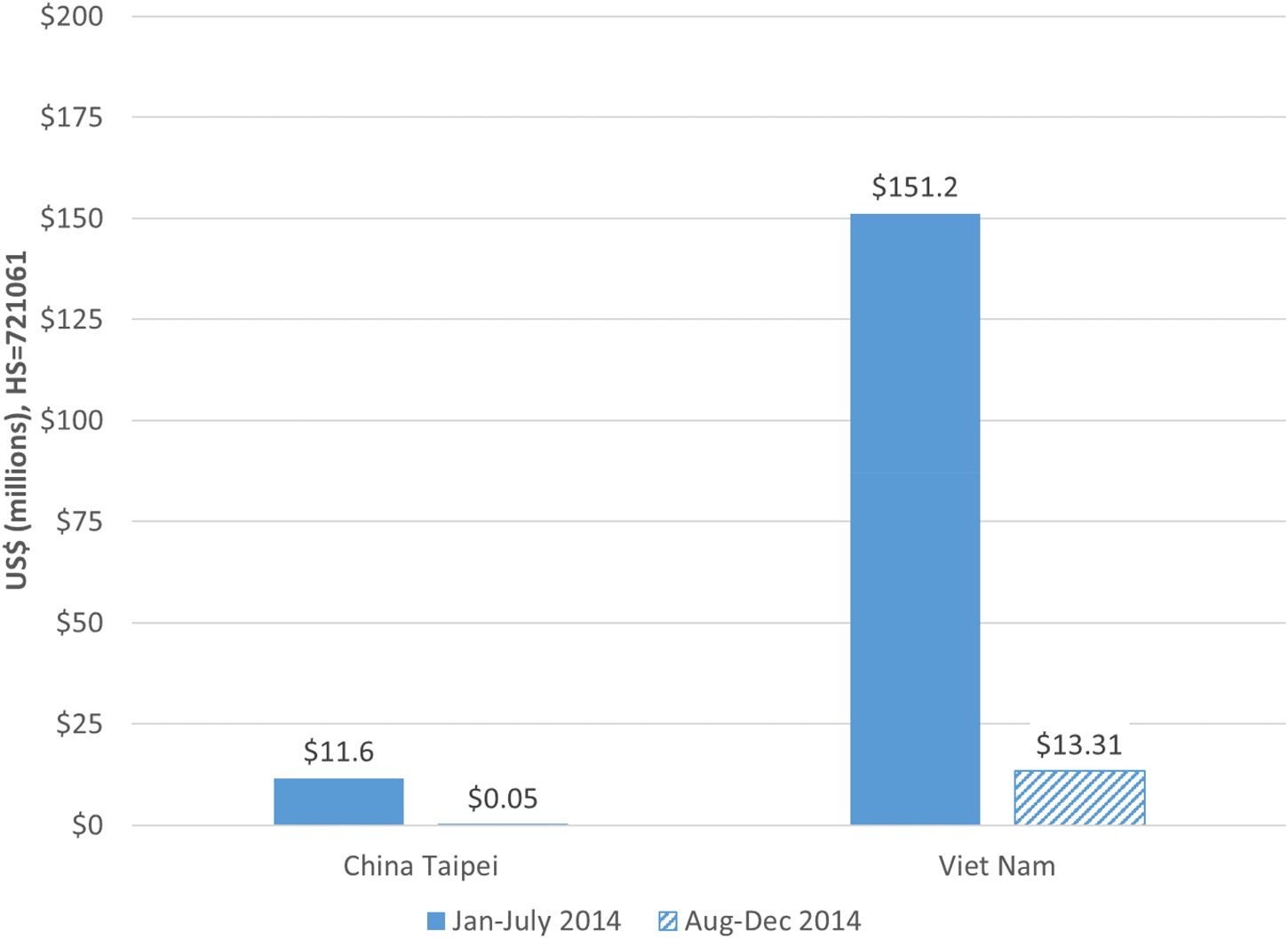
As seen in Table 1, the safeguard measure had its intended effect – trade plummeted. As compared to the year before, galvalume trade in 2017 was just 15% of its pre-safeguard level. Within the first year after the measure, overall imports of galvalume fell by nearly 80%. The impact on the two complaints was even larger. In the second half of 2014, imports from Chinese Taipei fell by more than 99% and those from Viet Nam fell by more than 90% (Figure 2). The two complainants accounted for the vast majority of the trade loss due to the specific tariff: $230 million of the $243 million in lost trade is attributable to Chinese Tapei and Viet Nam.
2014 Value of Indonesian galvalume imports, complainants (US$, millions)

3. Panel Findings
While the safeguard duty had entered into force on 22 July 2014, it took Chinese Taipei and Viet Nam until 20 August and 15 September 2015, respectively, to file their requests for establishment of a Panel. Consequently, the Panel Report was not circulated until after the initial three year safeguard period had expired.Footnote 11 The AB largely upheld the Panel's findings. On 15 August 2018, the WTO AB issued its report. On 22 March 2019, Indonesia withdrew the safeguard measure to comply with the AB findings.
Chinese Taipei and Viet Nam argued that the specific duty was a safeguard measure within the meaning of Article 1 ASG which Indonesia had adopted and applied in violation of various WTO provisions, notably Articles I:1, XIX:1(a) and XIX:2 of the GATT 1994 and Articles 2.1, 3.1, 4.1(b), 4.2(a), 4.2(b), 4.2(c), 12.2, and 12.3 of the ASG.
Thus, Chinese Taipei and Viet Nam considered that Indonesia in the course of its safeguard investigation had violated both procedural and substantive provisions.
In terms of substantive violations, in their view Indonesia had failed to demonstrate the existence of unforeseen developments, the effect of the [GATT] obligations, and the ‘logical connection’ between these two elements and the increase in imports that allegedly caused serious injury, Indonesia's increased imports’ determination was not based on an increase in imports that is ‘recent enough’, its threat of serious injury finding was inconsistent with the definition of threat of serious injury within the meaning of Article 4.1(b) ASG, it had not conducted a proper causation and non-attribution analysis, and it had not observed the ‘parallelism’ requirement.
In terms of procedural violations, Indonesia allegedly had failed to provide a reasoned and adequate explanation of how the facts supported its determination of threat of serious injury, including the evaluation of all relevant serious injury indicators, to provide all pertinent information in its notifications to the WTO Committee on Safeguards of the finding of threat of serious injury and the proposal to impose a safeguard measure, and to provide a reasonable opportunity to hold consultations prior to imposing the measure.However, if the Panel were to find that the specific duty was not a safeguard duty within the meaning of Article 1 of the ASG, Chinese Taipei and Viet Nam requested the Panel find that the measure violated Article I:1 of the GATT 1994 in that it discriminated between sources of imports of galvalume.Footnote 13 In a relatively short report of 40 pages, the Panel found that the specific duty did not constitute a safeguard measure within the meaning of Article 1 of the ASG and that the application of the duty on imports of galvalume originating in all but the 120 allegedly developing countries was inconsistent with Indonesia's MFN obligation under Article I:1 of the GATT 1994.Footnote 14 The Panel therefore did not find it necessary to address the many claims which assumed that the specific duty qualified as a safeguard measure. Given that the Panel did not address these claims, we will not do so either. However, it would seem that the investigation fell well short of what is required.
4. Appellate Body Findings
Although all three parties appealed the Panel finding that the Indonesian measure was not a safeguard measure,Footnote 15 the AB upheld the finding, although it had misgivings about part of the analysis, as we will see below.
As regards Indonesia's claim that the Panel exceeded its terms of reference within the meaning of Articles 6.2 and 7.1 of the DSU or failed to carry out an objective assessment of the matter under Article 11 of the DSU by finding that the measure did not constitute a safeguard measure, the AB found that under Article 11 DSU a panel is in fact obliged to examine whether the provisions of the WTO agreements invoked by a complaint as the basis for its claims are applicable and relevant to the case.Footnote 16 As Article 1 ASG applies to measures provided for in Article XIX of the GATT 1994, it was the Panel's duty to assess whether the specific duty constitutes a safeguard measure in order to determine whether Article XIX of the GATT 1994 and the invoked provisions of the ASG applied.Footnote 17
The AB subsequently found that the Panel did not err in its interpretation and application of Article 1 of the ASG and Article XIX of the GATT 1994, again ruling against all three appellants.
Article XIX:1(a) of the GATT 1994 provides that:
If, as a result of unforeseen developments and of the effects of the obligations incurred by a Member under this agreement, including tariff concessions, any product is being imported into the territory of that Member in such increased quantities and under such conditions as to cause or threaten to cause serious injury to domestic producers in that territory of like or directly competitive products, the Member shall be free, in respect of such product, and to the extent and for such time as may be necessary to prevent or remedy such injury, to suspend the obligation in whole or in part or to withdraw or modify the concession.
The AB considered that a ‘plain reading’ of this article indicates that a safeguard measure is a measure to suspend a GATT obligation or withdraw or modify a tariff concession. Therefore, the AB ‘failed to see’ how a measure could be characterized as a safeguard measure in the absence of such a suspension, withdrawal, or modification.Footnote 18 Furthermore, in the view of the AB, the suspension, withdrawal, or modification has to be designed to prevent or remedy serious injury.Footnote 19 These two elements must be present for a measure to constitute a safeguard measure and must be distinguished from the conditions that must be satisfied in order for a safeguard measure to be WTO-consistent.Footnote 20 In order to determine whether a measure contains these elements, a Panel must ‘assess the design, structure and expected operation of the measure as a whole’. Relevant factors for this assessment include the characterization of the measure under the domestic law of the Member, the domestic procedure that led to its adoption, and any relevant notifications to the WTO Safeguards Committee, but none of these is dispositive (as in fact this case showed).Footnote 21 On the other hand, the AB acknowledged that Article XIX:1(a) is open-ended as regards the type of GATT obligations that may be suspended. Obvious candidates are Article II:1 (tariff bindings) and XI:1 (quotas) of the GATT 1994, but there might be others as well.Footnote 22
The AB agreed with the three appellants (and several third parties) that the Panel had conflated the constituent features of a safeguard measure with its conditions for conformity with the ASG.Footnote 23
Next, the AB recalled that the Panel had found that the specific duty (1) did not suspend, modify, or withdraw Indonesia's Article II obligations as Indonesia had not bound its tariff for galvalume; (2) did not suspend Indonesia's obligations under Article XXIV GATT 1994 as the preferential treatment Indonesia had granted to its regional trade agreement partners concerned Indonesia's obligations under those agreements; and (3) did not suspend Indonesia's Article I:1 GATT 1994 MFN obligation because of Indonesia's exemption of the 120 countries ex Article 9.1 of the ASG.Footnote 24 As only the third issue had been appealed, the AB limited its analysis to this. The AB considered that ‘by its own terms’ the exemption could be seen as suspending Indonesia's Article I:1 MFN treatment obligation. However, such exemption was obviously not designed to prevent or remedy serious injury.Footnote 25
Before the AB, Indonesia argued that the purpose of the discriminatory application of the duty was to apply the duty only to major exporting countries which had contributed the most to the serious injury. However, the AB considered this an ex post justification.Footnote 26 Furthermore, Indonesia had confirmed during the Panel proceeding that the exemption was aimed at complying with Article 9.1 of the ASG (exclusion of developing countries with a de minimis import share). The AB considered that compliance with Article 9.1 concerned the WTO-consistent application of safeguard measures and was not relevant for the assessment whether the measure constituted a safeguard measure in the first place. And indeed, rather than preventing or remedying serious injury, the developing country exemption in fact allowed more galvalume imports than would have been the case otherwise.
The AB therefore upheld the Panel's conclusion that the specific duty did not constitute a safeguard measure within the meaning of Article 1 of the ASG and did not rule on the various alleged violations of Article XIX and the ASG.
This left the AB to assess the Panel finding that the application of the duty on imports of galvalume originating in all but the 120 allegedly developing countries was inconsistent with Indonesia's MFN obligation under Article I:1 of the GATT 1994. On appeal, Indonesia argued that the Panel had wrongly considered that Chinese Taipei and Viet Nam had made a claim that the duty ‘as a stand-alone’ measure violated Article I:1 and had therefore exceeded its terms of reference. The AB held that both complainants had identified the measure at issue as the specific duty on galvalume and that their panel requests had ‘clearly’ set out a claim under Article I:1 of the GATT 1994.Footnote 27 The AB therefore concluded that the Panel did not err in concluding that the complainants had properly made a claim under Article I:1 against the specific duty as a stand-alone measure.
5. Commentary
The AB (and Panel) Reports are noteworthy in that they confirm in the safeguards’ context that a Panel is not precluded from determining the applicability of a WTO agreement in cases where the issue has not been raised by the parties and that in fact a Panel's duty to conduct an objective assessment of the matter ex Article 11 DSU may require a Panel to depart from positions taken by the parties.Footnote 28 In the present case, the litigants all had proceeded on the assumption that the specific duty was in fact a safeguard measure, but nevertheless the Panel, later supported by the AB, held that it could depart from this characterization and did so by holding that the duty was not a safeguard measure because it did not suspend a GATT obligation or withdraw or modify a tariff concession. The facts that Indonesia had conducted an administrative investigation under its safeguards’ legislation, that the measure was characterized as a safeguard measure under Indonesian domestic law, and that it had made all relevant notifications to the WTO Safeguards Committee, all factors considered relevant (although not dispositive) by the AB, did not detract from this conclusion.
The AB ruling is welcome because it ends the confusion that had arisen as a result of a previous – unappealed – Panel Report involving a safeguard measure taken by the Dominican Republic (DR).Footnote 29 In that case, Costa Rica, Guatemala, Honduras, and El Salvador had challenged a safeguard measure imposed by the DR on polypropylene bags and tubular fabric. The facts of that case were relatively similar to the Indonesian case discussed here. The DR had also conducted a safeguard investigation and imposed a safeguard measure under its domestic law, had excluded (some)Footnote 30 developing countries with de minimis market shares and submitted the various notifications to the WTO Safeguards Committee. Furthermore the DR had imposed a safeguard measure in the form of a duty increase, albeit an ad valorem one of up to 38%, and although the DR had bound its tariff within the meaning of Article II GATT 1994, the binding was at 40% and therefore the total duty remained below the tariff binding. Finally, the dispute was brought by PTA partners of the DR, as was the case with Viet Nam in our dispute.Footnote 31
The difference with the Indonesian case was that before the Panel, the DR had taken the position that the measure in fact was not a safeguard measure because it remained below the level of the bound duty. In other words, the DR claimed that it had not suspended a GATT obligation or withdrawn or modified a tariff concession and therefore it was not bound by the disciplines of Article XIX GATT 1994 or the ASG.
The Panel ruled that the measure did qualify as a safeguard measure because it suspended the GATT 1994 Article I:1 MFN obligation by excluding Colombia, Indonesia, Mexico, and Panama from the scope of the measure.Footnote 32 The Panel further ruled that the measure also violated Article II:1(b) second sentence of the GATT 1994, having found that the measure fell within the category ‘other duties or charges’ within the meaning of that sentenceFootnote 33 and which had not been recorded in the DR's schedule of concessions.Footnote 34 It therefore considered that the measure was a safeguard measure subject to the disciplines of Article XIX GATT 1994 and the ASG.
The AB Report in the present case clearly sets out that the exclusion of developing countries ex Article 9.1 ASG does not result in the suspension of Article I:1 GATT 1994, confirming the findings of the Panel which had, in fact, openly rejected the findings of the DR Panel:
We recognize that our views in this respect depart from certain statements and findings of the panel in Dominican Republic–Safeguard Measures. In that dispute, the panel found that the discriminatory application of a safeguard measure in accordance with Article 9.1 of the Agreement on Safeguards resulted in the suspension of the importing Member's MFN obligations under Article I:1 of the GATT 1994 … We have carefully considered the panel's findings and, to the extent those findings would suggest a different outcome in this case, we respectfully disagree. In our view … the discriminatory application of a safeguard measure for the purpose of affording S&D pursuant to Article 9.1 does not result in a suspension of a Member's obligations under Article I:1, within the meaning of Article XIX:1(a) of the GATT 1994.Footnote 35 [Footnotes in original omitted]
In a footnote,Footnote 36 the Panel had noted that the facts in the DR case were different, among others because the measures in that case were found to suspend the obligations of the Dominican Republic under not only Article I:1 of the GATT 1994, but also Article II:1(b) of the GATT 1994.
The AB's clarification of the distinction between constituent elements of a safeguard measure (suspension of a GATT obligation or withdrawal or modification of a tariff concession designed to prevent or remedy serious injury) and Article XIX GATT 1994 conditions that must be satisfied for a safeguard measure to be WTO-consistent (such as the necessity requirements in this case) and the approach of both the Panel and the AB to first address the legal qualification of a measure seems correct from a legal perspective and makes sense from a process economy perspective.Footnote 37 Similarly, it seems correct that while the developing country exemption under article 9.1 ASG may amount to a suspension of the Article I:1 MFN obligation of the GATT 1994, it is not designed to prevent or remedy serious injury.Footnote 38
However, the AB findings also lays bare some painful shortcomings that result from a finding that imposition of an (unbound) duty is not a safeguard measure, even though it was treated as such by the importing country Member. Thus, as Chinese Taipei rightly pointed out,Footnote 39 if Indonesia were to have adopted a safeguard measure in the form of a – more trade-distorting – quota, it supposedly would have met the test as such a quota would then have suspended the Article XI GATT 1994 quota prohibition.
Furthermore, Indonesia is supposedly free to maintain or re-institute the specific duty as a simple increase of the unbound galvalume duty. This will benefit the major supplier Viet Nam as it would then return to its ASEAN free trade statusFootnote 40 but disadvantage Chinese Taipei and developing countries.Footnote 41
Assuming that Indonesia decided to follow the safeguard route because it wanted to hit the main galvalume exporter Viet Nam, one may wonder why it did not impose a safeguard measure under Article 23 of the AFTA.Footnote 42 The reasons for this seem threefold. First, and probably most importantly, imposition of an AFTA safeguard measure obliges the AFTA member doing so to offer compensation to its main AFTA suppliers or face retaliation. Second, any such measure would apply to all AFTA members equally but would not extend to non-AFTA members and, finally, it could result at most in imposition of the MFN duty (which might not have been sufficient to deter Vietnamese exports to Indonesia).
6. Concluding Comments
An obvious question that arises in this case is why Indonesia made life so difficult for itself by imposing a specific duty following a safeguard investigation while it simply could have increased the unbound duty to any level it considered appropriate. Was it ignorance,Footnote 43 a desire to grant interested parties due process rights through pre-established domestic safeguard procedures or something else?
Our review of trade statistics indicates an increase in the (unbound) MFN duty would probably have enabled Viet Nam to capture an even higher market share. The safeguard duty on the other hand applied erga omnes (with the exception of the 120 developing countries) in addition to any MFN/preferential tariffs and therefore also covered Viet Nam. Indeed, the import statistics show that following the imposition of the specific duty Viet Nam's exports dropped dramatically and Chinese Taipei exports basically disappeared while imports from other sources relatively increased (albeit at much lower levels than pre-safeguard measure). Thus, to the extent the objective of Indonesia was to limit imports from the main exporting countries, it succeeded by imposing the specific duty as a safeguard measure.
Indonesia's actions in this case highlight important political economy and trade negotiating complications associated with preferential trade arrangements. As emphasized by Bagwell and Staiger (Reference Bagwell and Staiger1999, Reference Bagwell and RW2002) trade agreements require all parties to evaluate the trade effects from changes to tariffs and rules. Negotiating agreements that balance the costs and benefits for each member is a precarious task. Countries like Viet Nam presumably offered concessions to Indonesia in order to obtain tariff concessions on products such as galvalume. When Indonesia uses the safeguard agreement to ‘undo’ the trade effects from such concessions, it creates pressure Viet Nam and other ASEAN members to act similarly. As it turns out, galvalume is not the only example of Indonesia using trade instruments to reverse previously negotiated concessions. According to Girsang (Reference Girsang2017), Indonesia is the ASEAN member with the most anti-dumping and safeguard actions. While not prohibited, these type of actions erode the value of the AFTA agreements to the other parties and should make it more difficult for the ASEAN group to negotiate additional agreements.
Finally, it seems to us that while the AB rightly distinguishes between the constituent elements of a safeguard measure and the conditions for its imposition, the unintended consequence of this ruling may be that WTO members wishing to impose safeguard measures in the future may decide to do so in the form of quotas rather than in the form of – less trade-restrictive – duties in order to avoid any exposure to findings that the safeguard measuredid not suspend a GATT obligation or withdraw or modify a tariff concession and therefore did not qualify as a safeguard measure in the first place.
List of countries excluded from the safeguard measure