



Introduction
Metabolic syndrome (MetS) is a clustering of metabolic abnormalities and is associated with the various complications(Reference Grundy, Cleeman and Daniels1). A recent study reported that Hispanic adults in the USA have higher MetS prevalence than other racial/ethnic groups, and the prevalence increased significantly in Hispanics from 2011 to 2016(Reference Hirode and Wong2). Previous findings also indicate that the prevalence of MetS varies by acculturation levels among Mexican Americans(Reference Vella, Ontiveros and Zubia3,Reference Espinosa de los Monteros, Gallo and Elder4) .
Diet plays a critical role in the development of MetS. Fruits are rich in antioxidants, and high fruits consumption has been shown to reduce the risk of MetS(Reference Lee, Lim and Kim5). As Hispanics acculturate to the US mainstream culture, they are more likely to adopt the standard American diet, which is generally low in fruits intake(Reference González, Tarraf and Haan6,Reference Lee-Kwan, Moore and Blanck7) . Therefore, we hypothesised that acculturation may increase the risk of MetS through its negative influence on fruits intake in the Hispanic population. To test this novel hypothesis, we analysed data from the National Health and Nutrition Examination Surveys (NHANES) study.
Materials and methods
Study population
Data from four NHANES continuous cycles between 2009 and 2016 were used in this study. The NHANES is a cross-sectional survey designed to monitor the health and nutritional status of a nationally representative sample of the US population, described previously in detail(Reference Johnson, Dohrmann and Burt8). Participants who were aged ≥20 years at the time of the survey; self-identified as Hispanic ethnicity, including Mexican Americans and those self-identified as other Hispanic ethnicity and had reliable 24-h dietary recall data were included in the study sample (n 5483). Participants with missing data on any component of MetS, or acculturation, and those who were taking prescriptions for hypertension or diabetes, as well as female respondents who were pregnant or lactating, were further excluded from the analysis. A total of 2078 participants were included in this analysis.
Assessment of MetS
Based on the modified US National Cholesterol Education Program Adult Treatment Panel III, participants were identified as having MetS if they met three or more of the following criteria(Reference Grundy, Cleeman and Daniels1): (1) high blood pressure defined as resting blood pressure of 130/85 mm Hg or higher; (2) hypertriglyceridemia defined as TAG of 1·7 mmol/l or higher; (3) low HDL cholesterol defined as direct HDL cholesterol less than 1·0 mmol/l or 1·3 mmol/l in men and women, respectively; (4) hyperglycaemia defined as fasting glucose of 5·6 mmol/l or higher and (5) central obesity defined as the waist circumference greater than 102 cm or greater than 82 cm in men and women, respectively.
Assessment of acculturation
By adopting the measurement strategy developed by previous studies(Reference O’Brien, Alos and Davey9), acculturation was assessed using country of birth, language spoken at home and duration of US residence. A 2-point scale was used to describe individuals’ responses to each of these questions. Participants born inside the 50 states or District of Columbia were considered as US-born (1 point); otherwise, they were considered as foreign-born (0 points). Participants who spoke ‘more Spanish than English’ or ‘only Spanish’ at home were defined as Spanish speakers (0 points); those who spoke ‘both equally,’ ‘more English than Spanish,’ or ‘only English’ were defined as English speakers (1 point). We categorised the duration of living in the USA into two groups using 20 years of staying as the cut-off point, living in the USA for ≥20 years (1 point) v. <20 years (0 points). In this study, we chose to use a summary score to measure the overall acculturation by summing the points of individual items, because these items are clustered in unique combinations that may result in an additive risk of MetS not captured by studying each of them separately(Reference O’Brien, Alos and Davey9). Therefore, a participant scored higher if s/he was more acculturated to the USA.
Assessment of dietary intakes
Data on the consumption of food groups were collected via two 24-h recalls and stored in the Food Patterns Equivalents Database developed by the Food Surveys Research Group, Agricultural Research Service of United States Department of Agriculture in NHANES(Reference Bowman, Clemens and Shimizu10). In the Food Patterns Equivalents Database, total fruits include all intact fruits (whole or cut) and citrus and non-citrus fruit juices are presented in cup equivalents(Reference Bowman, Clemens and Shimizu10). Due to the consideration of sample size and the consistency of intake information, only the in-person recall data were used in the present analysis.
Statistical analysis
Multi-variable adjusted logistic structural equation modelling with the bootstrapping method was applied to estimate OR (i.e. exponential of point estimates, e β ) and the corresponding 95 % bias-corrected bootstrap CI for the mediation effect of total fruits intake on the association between acculturation and MetS(Reference Kline11). Potential confounders included in the multi-variable modelling were age, gender (male, female), Hispanic origin (Mexican American, other Hispanics), poverty–income ratio (PIR) (<1·85, ≥1·85), smoking status (never, ever), alcohol drinking status (never, ever, defined as having at least 12 drinks of any type of alcoholic beverage in any 1 year) and daily total energy intake. The indirect (ORIE), direct (ORDE) and total (OR) effects were deemed significant if the corresponding 95 % CIs of ORs did not contain 1. All analyses were adjusted for sampling weights to incorporate the complex, multi-stage clustered probability survey sampling design of the NHANES. SAS version 9·4 (SAS Institute Inc) was used to conduct the descriptive analyses, and STATA Release 15·0 (Stata Corporation) was used to conduct the multiple mediation analyses. Two-tailed P-values were reported with the level of significance of 0·05.
Results
Of the Hispanic adults included in the study, 21·99 % were defined as having MetS, and approximately 67 % had acculturation score ≥ 1 (Table 1).
Participant characteristics in Hispanics aged ≥ 20 years, NHANES 2009–2016* (N 2078)
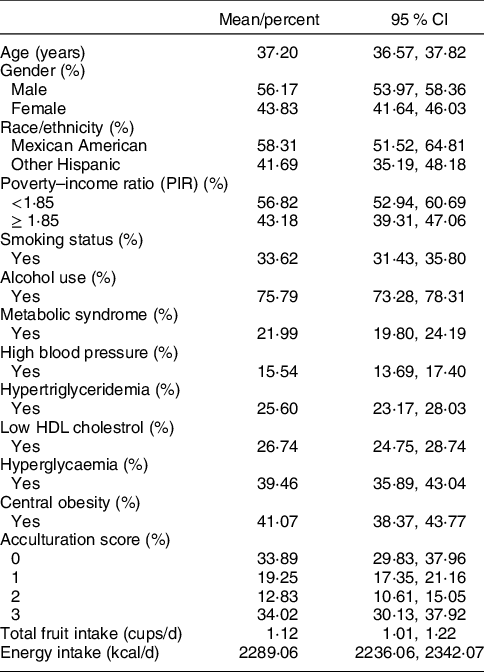
* Values are presented as weighted mean or weighted percent along with 95 % CI.
After adjustment for age, gender, Hispanic origin, PIR level, other known risk factors of MetS and total energy intake, Hispanic adults with a greater acculturation score had an increased odds of MetS (OR = 1·20, 95 % CI 1·04, 1·39). There were positive associations between acculturation and certain components of MetS, including high blood pressure (OR = 1·16, 95 % CI 1·02, 1·32) and central obesity (OR = 1·24, 95 % CI 1·07, 1·44) (Table 2).
Mediation analysis of fruits intake on the association between acculturation score and metabolic syndrome (MeS) and its components among Hispanics aged ≥ 20 years, NHANES 2009–2016*

* Adjusted for age, gender, Hispanic origin, PIR status, smoking status, alcohol use status and total energy intake.
† Total effects are presented as OR. Indirect and direct effects are presented as ORIE and ORDE, respectively.
‡ CI, CI for indirect, direct and total effects.
We further conducted mediation analysis on the association between acculturation, total fruits intake and MetS in Hispanic adults (Table 2). Total fruits intake had a partially mediating effect on the association between acculturation and MetS (ORIE = 1·02, 95 % CI 1·00, 1·03; ORDE = 1·18, 95 % CI 1·01, 1·37). Greater acculturation score was significantly associated with less total fruits intake (β = –0·15, P < 0·001); whereas, higher total fruits intake was reversely associated with the probability of having MetS (β = –0·11, P = 0·04). Additional mediation analyses of individual components of MetS showed that the association between acculturation and high blood pressure was fully mediated through total fruits intake (ORIE = 1·03, 95 % CI 1·01, 1·06; ORDE = 1·12, 95 % CI = 0·98, 1·28). High acculturation score was inversely associated with total fruits intake (β = –0·15, P < 0·001), and higher total fruits intake was significantly associated with less chance of having high blood pressure (β = –0·22, P < 0·001). Moreover, the association between acculturation and central obesity was partially mediated by total fruit intake (ORIE = 1·02, 95 % CI 1·00, 1·03; ORDE = 1·22, 95 % CI 1·05, 1·42).
Stratified analyses by gender, PIR level and Hispanic origin were performed. The positive association between acculturation score and odds of MetS was limited in those with PIR < 1·85 (OR = 1·22, 95 % CI 1·01, 1·46) and Mexican Americans (OR = 1·21, 95 % CI 1·00, 1·46) (data not shown). We further conducted mediation analyses by Hispanic origin, and found that the intake of total fruits had a fully mediating role on the association between acculturation and MetS (ORIE = 1·02, 95 % CI 1·00, 1·05; ORDE = 1·18, 95 % CI 0·97, 1·44) in Mexican Americans. Fig. 1 showed that in Mexican Americans, acculturation score was reversely associated with total fruits intake (β = –0·15, P = 0·003), and there was a marginal association between total fruits intake and reduced chance of having MetS (β = –0·13, P = 0·07). However, total fruits intake did not mediate the association of acculturation score with MetS by PIR status.
Mediating roles of fruits intake on the association between acculturation and metabolic syndrome (MeS) in Mexican Americans aged ≥ 20 years, NHANES 2009–2016.a
aValues are presented as coefficients (se).
*P-value < 0·05.

Furthermore, we found that acculturation score was positively associated with odds of having high blood pressure in overall Hispanic adults with PIR ≥ 1·85 (OR = 1·23, 95 % CI 1·01, 1·50) and odds of central obesity in males (OR = 1·28, 95 % CI 1·06, 1·54), those with PIR < 1·85 (OR = 1·23, 95 % CI 1·01, 1·51), as well as participants self-identified as other Hispanics (OR = 1·42, 95 % CI 1·13, 1·79). However, there was no mediating role of total fruits intake on the associations between acculturation and individual components of MetS in stratified analyses by Hispanic origin and PIR status, possibly due to smaller sample sizes for these stratified analyses (data not shown).
Discussion
Utilizing a population-based study of US adults(Reference Johnson, Dohrmann and Burt8), higher acculturation was associated with increased odds of MetS, high blood pressure and central obesity in Hispanic adults. These findings are consistent with previous evidence, indicating positive associations between greater acculturation and MetS(Reference Vella, Ontiveros and Zubia3,Reference Espinosa de los Monteros, Gallo and Elder4,Reference González, Tarraf and Haan6) , high blood pressure(Reference McIntire, Scalzo and Doran12) and central obesity(Reference Vella, Ontiveros and Zubia3). Through mediation analyses, we further found that total fruits intake partially mediated the associations of acculturation with MetS and central obesity, and fully mediated the association between acculturation and high blood pressure among Hispanic adults.
The traditional Hispanic or Mexican diet contains more fruits than the Western or standard American diet(Reference Spivey and Palmer13), and is associated with better health outcomes(Reference Santiago-Torres, Tinker and Allison14). Previous studies have reported that Hispanics consume more fruits than non-Hispanic blacks and non-Hispanic whites(Reference Di Noia, Monica and Cullen15). Therefore, as Hispanics become more acculturated to the US lifestyle, they are more likely to follow a Western or standard American diet, resulting in a reduction in total fruits intake(Reference Arandia, Nalty and Sharkey16).
Furthermore, we found that the mediator role of total fruits intake in the acculturation–MetS association primarily occurred among Mexican Americans. It may be due to the fact that Mexican Americans are more acculturated compared to other Hispanics. A previous study indicated that starting from the second-generation Mexican Americans in the USA, the influence of the Mexican diet is almost lost(Reference Batis, Hernandez-Barrera and Barquera17). Acculturated Mexican Americans tend to consume less traditional Mexican diet that is rich in fruits, which may contribute to the increased risk of developing MetS(Reference Lee, Lim and Kim5). Results in other immigrant populations have also suggested that adoption of local dietary habits may mediate the acculturation–MetS association(Reference Garduño-Diaz and Khokhar18). Our findings suggest that future health promotion strategies should encourage cultural sensitivity in efforts to increase total fruits intake; however, further studies particularly longitudinal studies are needed to replicate the findings.
One strength of our study is the use of data from the NHANES with a nationally representative sample of the US population and oversampled Hispanic subjects, which provided a sufficient sample of Hispanic adults. In addition, the bootstrapping technique was used in the mediation analysis to address the potential issues of the NHANES data such as lack of normality of variables and missing values to produce more accurate estimates. However, our study can be limited by the self-reported dietary recall data which may have both random and systematic errors with potential recall bias(Reference Roark and Niederhauser19). In addition, a one-time 24-h dietary recall may not capture long-term dietary exposures. Due to the nature of all cross-sectional studies, the temporal sequence for the associations is not clear. However, the positive associations between acculturation and risk of MetS, high blood pressure and central obesity are consistent with previous studies(Reference Vella, Ontiveros and Zubia3,Reference McIntire, Scalzo and Doran12) . Finally, due to limited acculturation information available in NHANES, we only used country of birth, length of stay in the USA and language spoken at home to measure the extent of acculturation. They may not capture all of the domains of cultural adoption that may influence health outcomes(Reference Marin, Sabogal and Marin20).
In conclusion, we found significant associations of higher acculturation with increased odds of MetS, high blood pressure and central obesity in Hispanic adults; total fruits intake mediated these associations, and the mediating role of total fruits intake was limited among Mexican Americans. Further studies, such as prospective studies, are warranted to confirm these findings.
Acknowledgements
Acknowledgements: We thank the investigators, the staff and the participants of NHANES for their valuable contribution. Financial support: The work was supported by the National Institute on Minority Health and Health Disparities of the National Institute of Health under Award U54MD006882. Conflict of interests: No potential conflicts of interests were disclosed. Authorship: Jiangliang Liu conducted the statistical analyses and wrote the manuscript; Meng-Hua Tao designed the study and supervised the study process, Kimberly G Fulda and Meng-Hua Tao contributed to statistical analysis, data interpretation and the critical review of the manuscript. All authors read and approved the final manuscript. Ethics of human subject participation: This study was conducted according to the guideline laid down in the Declaration of Helsinki and all procedures involving research study participants were approved by the Research Ethics Review Board at the National Center for Health Statistics (NCHS). All participants provided written informed consent.
Supplementary material
For supplementary material accompanying this paper visit https://doi.org/10.1017/S1368980021003530



