Introduction
The present work is the first comprehensive taxonomic study of the Late Oligocene LBF (nummulitids and lepidocyclinids) from shallow-marine strata of the Qom Formation (Central Iran) in the Tethyan Seaway (Reuter et al., Reference Reuter, Piller, Harzhauser, Mandic, Berning, Rögl, Kroh, Aubry, Wielandt-Schuster and Hamedani2007) based on a morphometric approach. In the north-eastern coast of the Tethyan Seaway, the Oligocene deposits of the Qom Formation are characterized by the dominance of shallow-marine carbonates (Reuter et al., Reference Reuter, Piller, Harzhauser, Mandic, Berning, Rögl, Kroh, Aubry, Wielandt-Schuster and Hamedani2007), often rich in LBF, which are the most important components of sediments in Cenozoic platforms (Pomar and Hallock, Reference Pomar and Hallock2007; Renema, Reference Renema and Renema2007; Boudagher-Fadel, Reference Boudagher-Fadel2018). Their high variety and abundance are very important in reconstruction of the paleoenvironment, detection of changes in environmental parameters (due to their sensitivity to changes in environmental conditions such as light, nutrition, sedimentation, and water energy; Hottinger, Reference Hottinger1997), and reconstruction of paleobiogeography (Hallock, Reference Hallock1987; Hallock et al., Reference Hallock, Silva and Boersma1991; Langer and Hottinger, Reference Langer and Hottinger2000; Hottinger, Reference Hottinger and Levi-Montalcini2001; Hohenegger, Reference Hohenegger2005, Reference Hohenegger2009; Hallock and Pomar, Reference Hallock and Pomar2008; Renema et al., Reference Renema, Bellwood, Braga, Bromfield, Hall, Johnson, Lunt, Meyer, McMonagle and Morley2008; Pomar et al., Reference Pomar, Baceta, Hallock, Mateu-Vicens and Basso2017; Förderer et al., Reference Förderer, Rödder and Langer2018).
The LBF are considered as important tools for biostratigraphy, classification, and evolution of species because of their rapid evolution, high abundance, widespread appearance, and sudden extinction of species or communities (Schaub, Reference Schaub1981; Hottinger, Reference Hottinger and Meulenkamp1983; Less, Reference Less1987; Drooger, Reference Drooger1993; Cahuzac and Poignant, Reference Cahuzac and Poignant1997; Serra-Kiel et al., Reference Serra-Kiel, Hottinger, Caus, Drobne, Ferrandez, Jauhri, Less, Pavlovec, Pignatti and Samso1998; etc.). Therefore an accurate description of their morphology and internal structures using morphometric methods is very important for identifying the taxonomic composition and to determine their age by correlation with other coeval deposits.
In biostratigraphic studies on the Oligo-Miocene of the Mediterranean, the Middle East, and the Indo-West Pacific basins, the defined biozonation framework is often based on LBF (e.g., Adams, Reference Adams1970, Reference Adams, Ikebe and Tsuchi1984; Drooger and Laagland, Reference Drooger and Laagland1986; Jones and Racey, Reference Jones, Racey and Simmons1994; Cahuzac and Poignant, Reference Cahuzac and Poignant1997; Boudagher-Fadel and Banner, Reference Boudagher-Fadel and Banner1999; Renema, Reference Renema and Renema2007; Boukhary et al., Reference Boukhary, Abdelghany, Hussein-Kamel, Bahr, Alsayigh and Abdelraouf2010; Özcan et al., Reference Özcan, Less, Báldi-Beke and Kollányi2010a; Yazdi-Moghadam, Reference Yazdi-Moghadam2011; Less et al., Reference Less, Frijia, Özcan, Saraswati, Parente and Kumar2018; Yazdi-Moghadam et al., Reference Yazdi-Moghadam, Sadeghi, Adabi and Tahmasbi2018a, Reference Yazdi-Moghadam, Sadeghi, Adabi and Tahmasbi2018b). The majority of the LBF biozones are based on subsequent morpho-species of evolutionary lineages subdivided from each other by morphometric limits (see Less, Reference Less1987; Pignatti, Reference Pignatti1998; Pignatti and Papazzoni, Reference Pignatti and Papazzoni2017). However, these lineages often evolved simultaneously in semi-isolated sub-basins that were connected with each other occasionally. Therefore, the speed of evolution within lineages could be slightly different in the different sub-basins. Because the species-limits within the lineages are arbitrarily chosen, they can easily be diachronic.
The biometrical approach applied to different groups of Cenozoic LBF consists of lepidocyclinids and miogypsinids (Drooger, Reference Drooger1993 and papers cited therein), orthophragminids (Less, Reference Less1987), and nummulitids (Laagland, Reference Laagland1990; Less and Öczan, Reference Less and Özcan2008; Less et al., Reference Less, Frijia, Özcan, Saraswati, Parente and Kumar2018). Our information about the biometry, taxonomy, and phylogenetic records of the Oligocene LBF in the Tethys is based on the data obtained from different locations from the circum-Mediterranean/European region and Western India (Drooger, Reference Drooger1993). To date, there have been no data from the Iranian part of the Tethys.
The present paper, therefore, pays special attention to the detailed taxonomic description of the LBF from the Late Oligocene deposits of the Tethyan seaway based on a precise morphometric approach. Also, this part of the Tethys is an important area for the comprehension of marine connections between the Indo-Pacific and Mediterranean provinces. Interestingly, according to some studies (e.g., Drooger, Reference Drooger1993; Rögl, Reference Rögl1997; Harzhauser et al., Reference Harzhauser, Piller and Steininger2002), the faunal composition of comparable horizons from the two provinces have significant differences and variable time extensions. Study of Late Oligocene LBF, which are extensively distributed in the Tethys ocean within the Middle East and the Western Indo-Pacific, allows biostratigraphical correlation of these deposits with other parts of the Tethys.
Geological setting
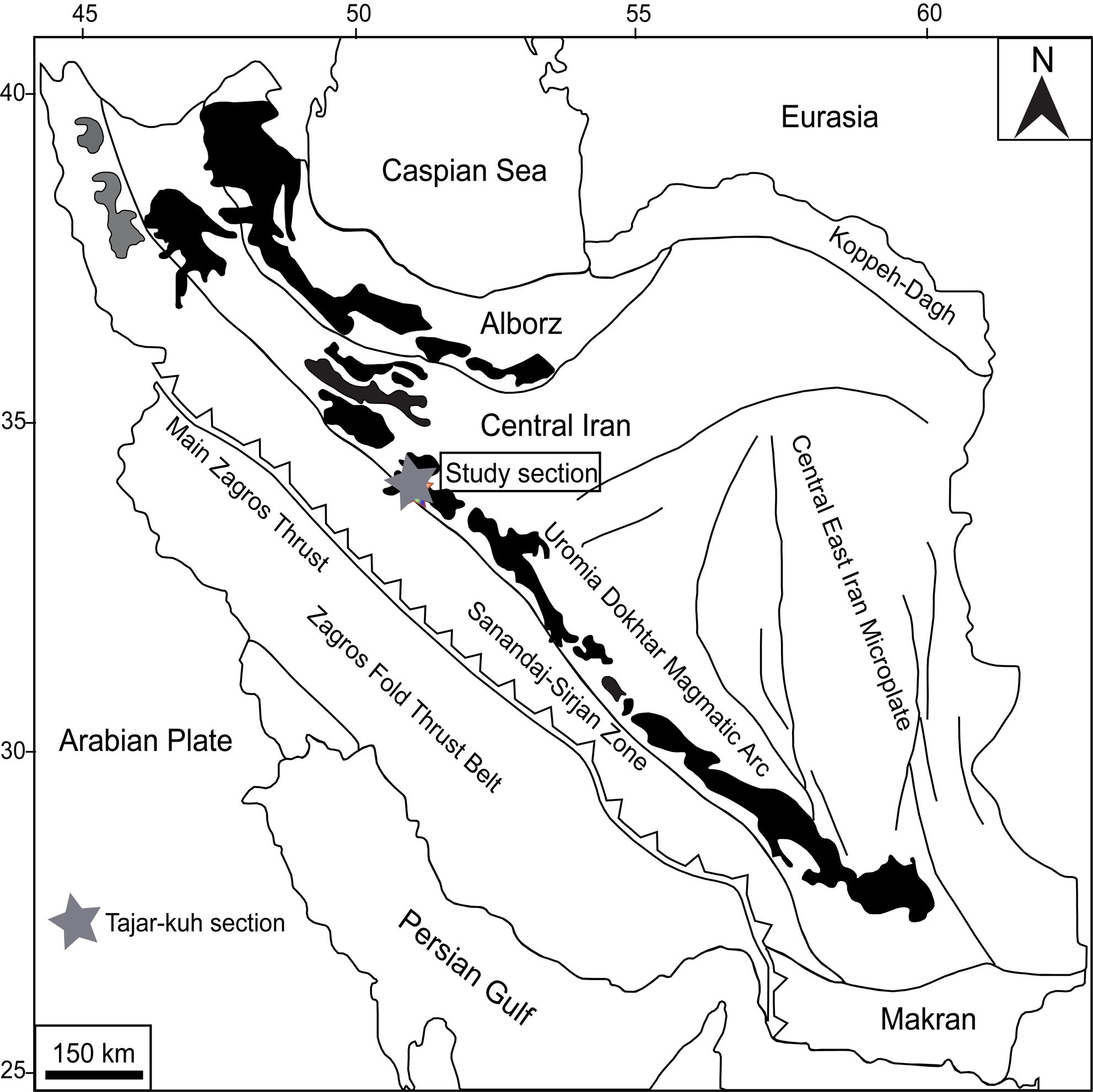
The Iranian plate, based on differences in sedimentary sequence, age of magmatism and metamorphism, nature, structural characters, and mechanism of major faults, is subdivided into different parts (Alavi, Reference Alavi2004, Reference Alavi2007; Walker and Jackson, Reference Walker and Jackson2004). On a division based on structural trends, Stöcklin and Nabavi (Reference Stöcklin and Nabavi1973) differentiated this plate into eight units, including Zagros fold, Zagros thrust belt, Uromia-Dokhtar Magmatic Arc, Sanandaj-Sirjan, Central Iran, Alborz, Koppeh-Dagh, and eastern Iran (Fig. 1).
Simplified geological map of Iran (modified after Agard et al., Reference Agard, Omrani, Jolivet, Whitechurch, Vrielynck, Spakman, Monié, Meyer and Wortel2011) showing the main tectonic subdivisions and approximate location of the studied section.

Oligocene–Miocene marine rocks of Central Iran are generally called the Qom Formation. During this time, tectonic and plutonic activities originated from subduction and final collision of the Arabian Plate with the Iranian Plate that began during the Mesozoic (Colman-Sadd, Reference Colman-Sadd1982) have been activated in Central Iran. The important outcome of this collision was closure of the Tethyan Seaway during the Miocene and the end of marine fauna migration between the eastern Mediterranean and the Western Indo-Pacific (Harzhauser et al., Reference Harzhauser, Piller and Steininger2002). The Qom Formation is mainly made up of limestone, marlstone evaporates, and siliciclastics, with different thicknesses in many places. At the type locality, the marine layers of the Qom Formation are mostly sandwiched between two non-marine formations: the Lower Red Formation at the bottom and the Upper Red Formation at the top (Furrer and Soder, Reference Furrer and Soder1955; Gansser, Reference Gansser1955).
The Qom Formation is synchronous in age with the Asmari Formation, a fractural oil reservoir in Southern Iran (Bozorgnia, Reference Bozorgnia1966; Sepehr and Cosgrove, Reference Sepehr and Cosgrove2004). Both of these formations have recorded evidence of the so-called Terminal Tethys Events because after the collision of the Arabian plate with Iranian plate, the connection between the Western and the Eastern Tethys was removed and the Qom Basin as a seaway was located in the northernTethys (Harzhauser et al., Reference Harzhauser, Piller and Steininger2002).
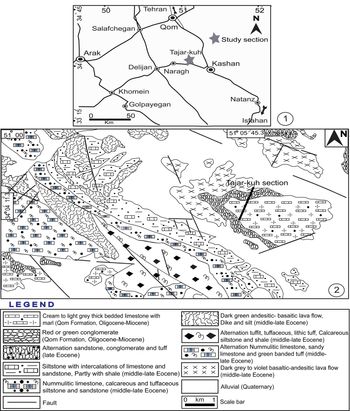
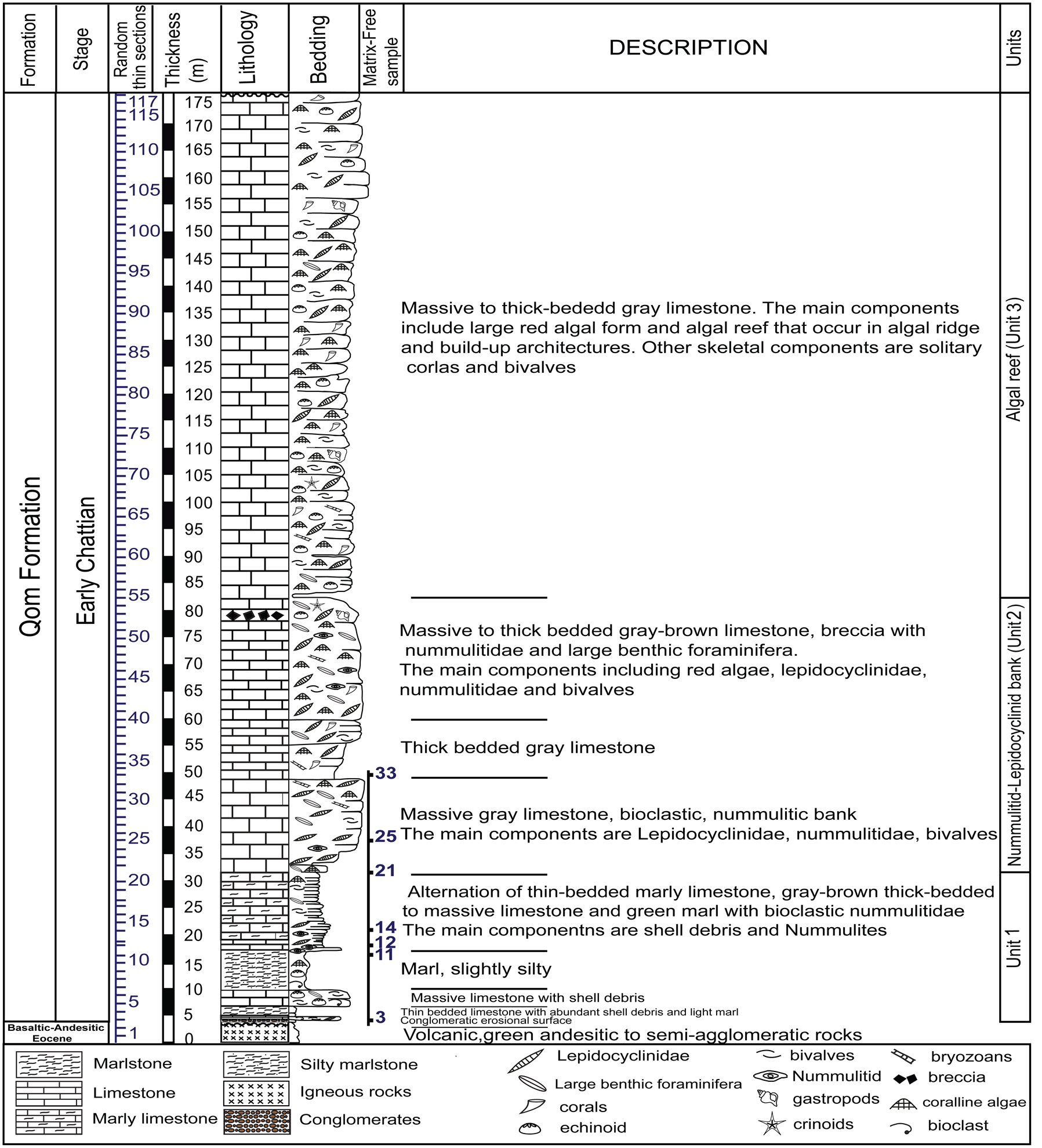
The Tajar-Kuh section studied in the present work is located ~26 km to the NW of Kashan city (Figs. 1, 2). The coordinates of the section are 34°04'0.1"N, 51°05'45.3"E for the base and 34°04'11.3"N, 51°05'34.6"E for the top (Fig. 2). The measured section is an incomplete sequence of late Oligocene (early Chattian) shallow marine deposits that record only the lower part of the Qom Fm. It is 175 m thick and mainly consists of limestone, marl, and marly limestone representative of the lower part of the Qom Formation (Fig. 3). It overlies unconformably the Eocene volcanic rocks with an erosional surface. The upper boundary is an erosional contact with the Upper Red Formation that usually overlies the formation (Bozorgnia, Reference Bozorgnia1966), although it does not appear here.
(1) Road map showing the position and locality of the Tajar-Kuh section. (2) Geological map of the studied area (simplified from the geological map of Aran, scale 1:100,000; Amini et al., Reference Amini, Emami and Sahami1996). Scale bars are (1) 50 km; (2) 1 km.

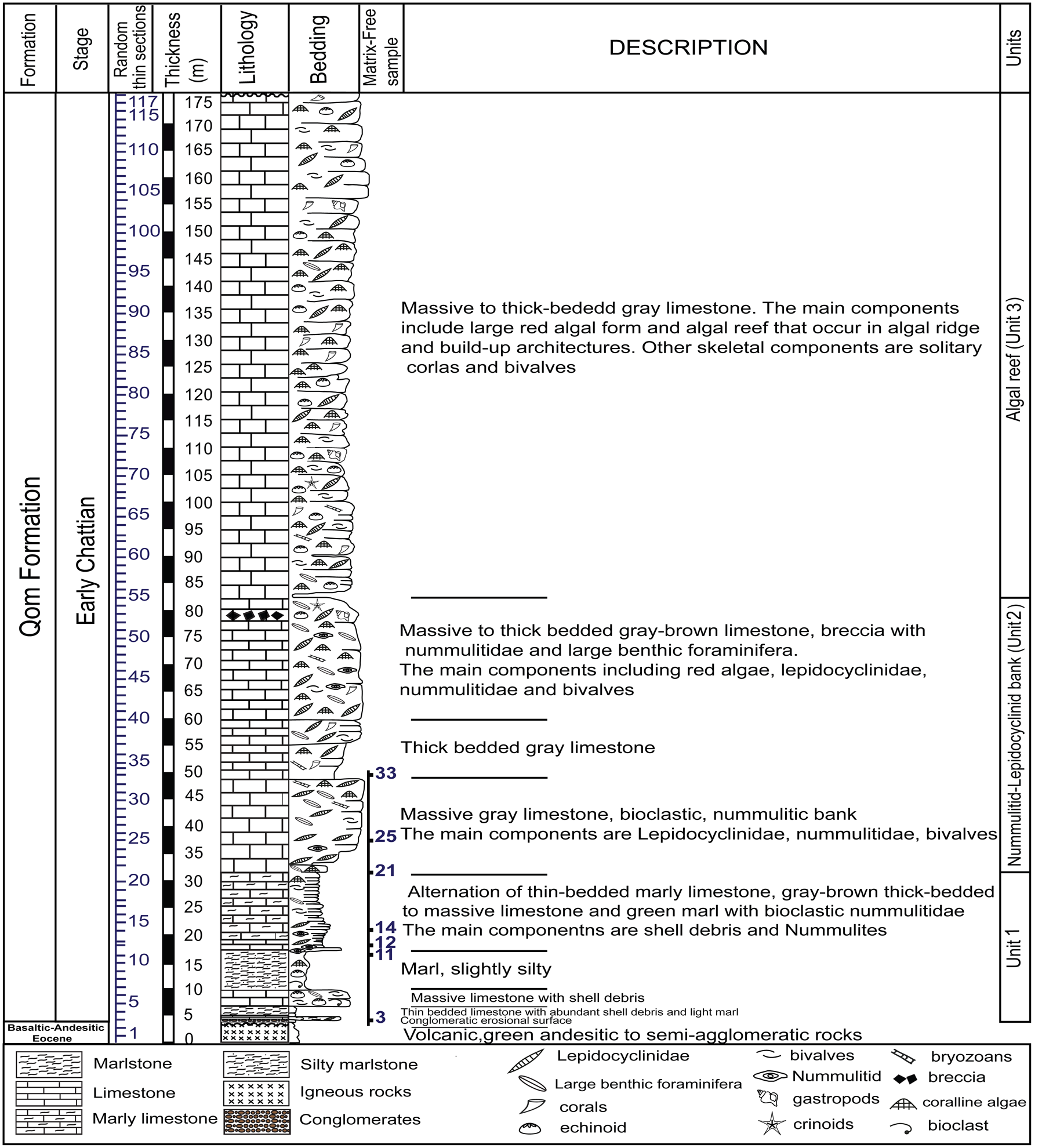
Lithostratigraphic log of the Tajar-Kuh section.
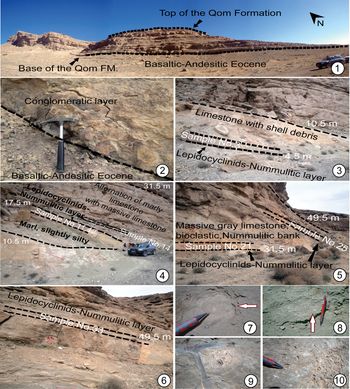
Outcrops of the Qom Formation at Tajar-Kuh. (1) General view of the Qom Formation overlying the basaltic-andesitic Eocene; (2) unconformity between the conglomerate basal layer and basaltic-andesitic Eocene; (3–6) a view of the layers containing matrix-free specimens, including samples 3, 11, 12, 14, 25, and 33; and (7–10) corallinacean red algae.
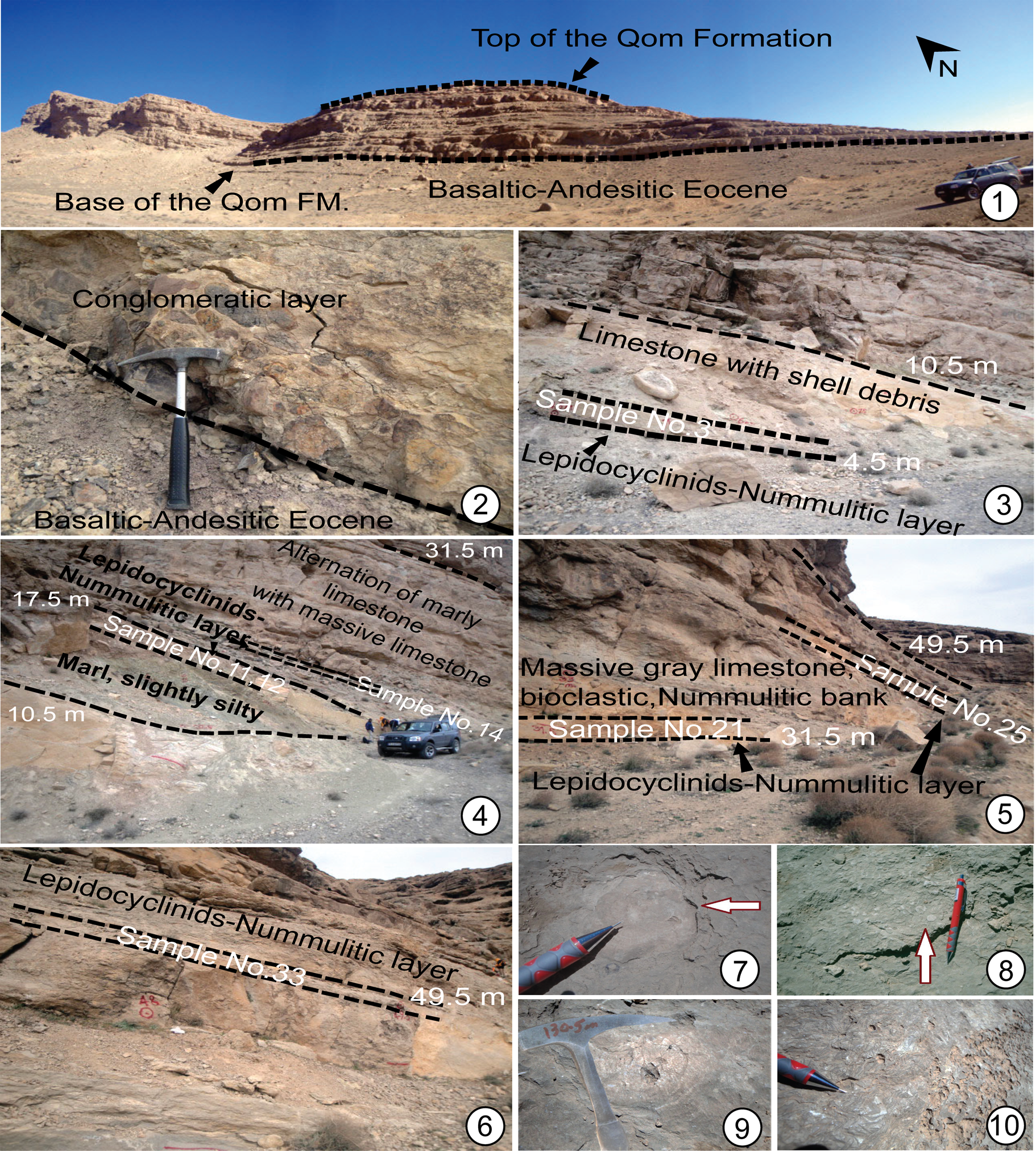
The measured section can be divided into three units (Fig. 3): Unit 1 begins with a conglomeratic erosional surface and forms the lower 32 m of the section. It is composed of white to green marl, massive to thin-bedded, gray-brown limestone and marly limestone. Unit 2 is 50 m thick (32–82 m) and consists of mainly gray-brown massive to thick-bedded limestones. Unit 3 is 93 m thick (82–175 m) and includes gray massive to thick-bedded limestone. All matrix-free specimens for this study were collected from units1 and 2. Specimens from Unit 3 could not be isolated.
Materials and methods
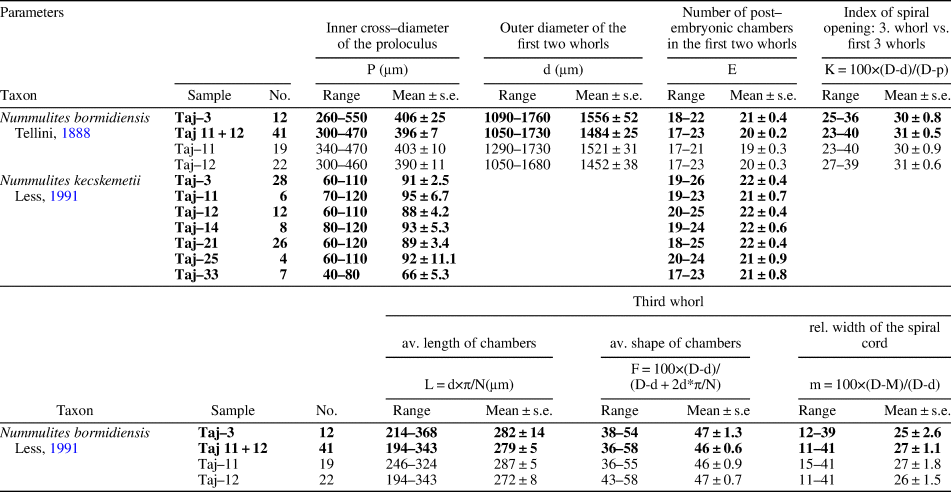
The morphometric analysis presented here is based on matrix-free specimens. A total of 117 samples with 1–2 m sampling interval were collected to cover the whole sequence under study (Fig. 3). Most samples came from cemented hard rocks; although we made thin sections, they were not perfect for biometrical analysis. Therefore, our morphometric data come from seven samples very rich in LBF and containing matrix-free specimens. Since morphometric analysis is elaborated for megalospheric (A) specimens, in this paper, we do not deal in detail with the much rarer microspheric (B) forms. We only mention their presence/absence in the systematic part. External features of the LBF were studied typologically, whereas their internal characteristics were mostly investigated morphometrically in the equatorial plane of matrix-free specimens, which was exposed either by splitting or by sectioning.
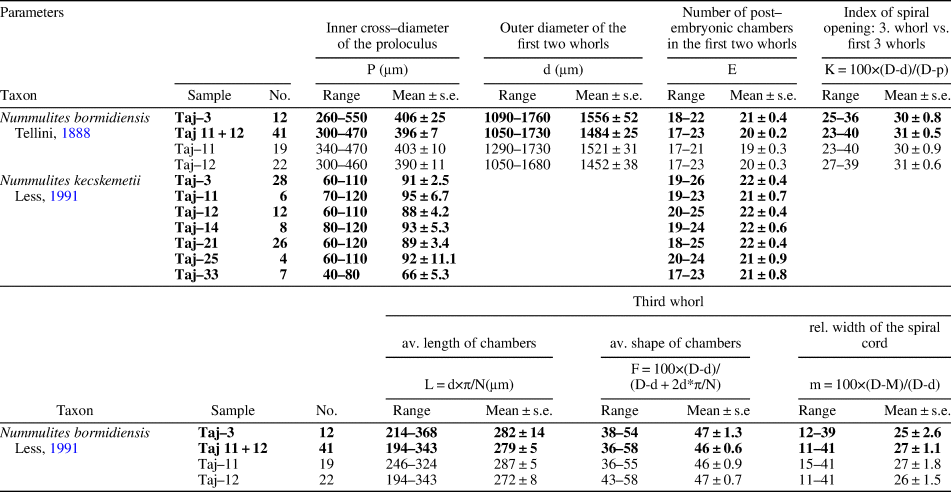
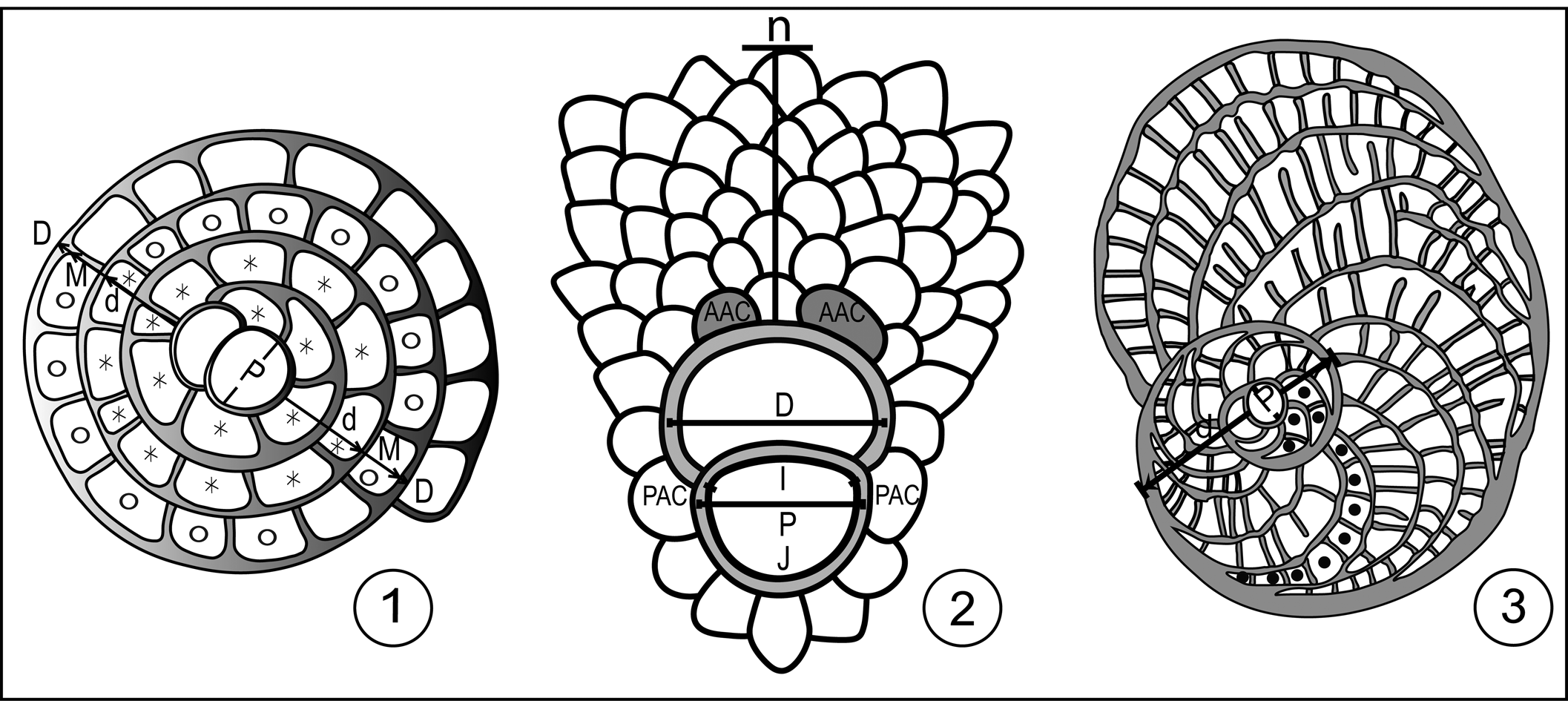
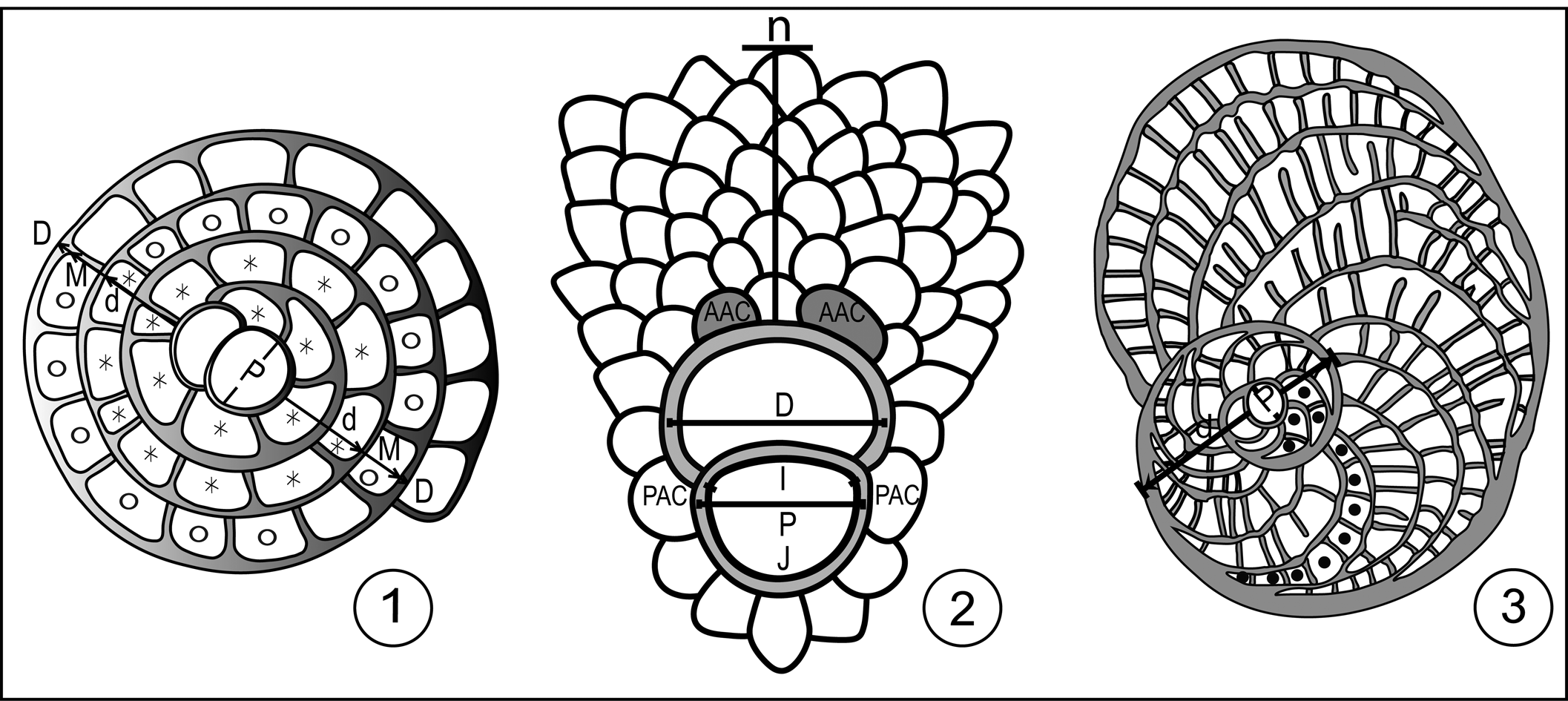
Surface properties and the internal morphology in the equatorial section are the two most important features for identifying species in the genus Nummulites. Biometrical analysis on reticulate Nummulites (N. bormidiensis) is based on a series of measurements and parameters introduced by Drooger et al. (Reference Drooger, Marks and Papp1971) and Less (Reference Less1999). We measured and counted seven parameters on 53 megalospheric specimens (described in the header of Table 1 and shown in Fig. 5.1). This system is widely used in the subsequent papers by Less and Özcan (Reference Less and Özcan2008), Less et al. (Reference Less, Özcan and Okay2011, Reference Less, Frijia, Özcan, Saraswati, Parente and Kumar2018), and Özcan et al. (Reference Özcan, Less, Báldi-Beke, Kollányi and Acar2009a, Reference Özcan, Less, Báldi-Beke and Kollányi2010a, Reference Özcan, Less, Okay, Báldi-Beke, Kollányi and Yilmaz2010b), therefore these results can easily be compared with each other. We did not use the system elaborated by Hohenegger (Reference Hohenegger2011) for recent nummulitids because the obtained data cannot be compared with ours and it is tested only on relatively small number of specimens. Two populations consisting Taj–11 and Taj–12 lie very close to each other (see the lithostratigraphic log of the section in Figure 3) and show similar results of morphometrical parameters; thus, they were treated jointly as a composite sample. Mean values were evaluated for all parameters based on the total number of specimens. These data are marked with bold letters in Table 1.
Statistical data of populations of Late Oligocene Nummulites from the Tajar-Kuh, Central Iran (№: number of specimens and s.e: standard error).
The methods of measurement and calculation parameters of the internal structure in equatorial plane for megalospheric larger foraminifera (most of the parameters are explained in the headers of Tables 1 and 3); P = proloculus. (1) Nummulites (D and M: outer and inner diameter of the third whorl; E (number of chambers in the first two whorls labeled by asterisk, E = 17); N (number of chambers in the third whorl labeled by circle, N = 15); (2) Nephrolepidina (PAC = Principal Auxiliary Chamberlets (parameter C); AAC = Adauxiliary Chamberlets = 2; I and J: inner perimeter of the protoconch embraced; and n: number of annuli within 1 mm from the deuteroconch along the axis of the embryon; (3) Spiroclypeus, d: outer diameter of one and a half whorls; X = number of undivided chambers; S4 + 5 = total number of chamberlets in chambers 4 and 5; S14 = total number of chamberlets in chamber 14; in this figure X = 1, S4 + 5 = 4, S14 = 8 (number of chamberlets indicated by solid dots).
For the identification of the radiate Nummulites kecskemetii, previously identified as Operculina complanata (Defrance, Reference Defrance1822), we measured two parameters on the equatorial section of 91 megalospheric specimens summarized in Table 1. The complete measurement system for Nummulites applied in the case of N. bormidiensis (see above) was not possible to perform here because specimens usually did not contain three complete whorls. Unfortunately, the equatorial sections do not allow clear identification of the generic affiliation of these specimens, although forward-directed multiple secondary apertures on the septa (diagnostic for Operculina and lacking in Nummulites) cannot be seen. However, the preservation of the Tajar-Kuh material is much poorer than that of from Hungary (Less, Reference Less1991; Less and Özcan, Reference Less and Özcan2008) and SW Aquitaine (Benedetti et al., Reference Benedetti, Less, Parente, Pignatti, Cahuzac, Torres-Silva and Buhl2018), where the presence/absence of these apertures is well visible in split equatorial sections. Nevertheless, we demonstrate on Figure 12.4 (the best preserved split equatorial section of Nummulites kecskemetii from sample Taj–33) that we could not identify any forward-directed multiple secondary apertures on the septa. Therefore, we rely mostly upon the vertical sections (Fig. 12.18–12.22) where the involute character of the shells and the well-developed alar prolongation, both characteristic for Nummulites rather than for Operculina, can be clearly seen. It is worth mentioning that the size of the proloculus of the Tajar-Kuh specimens fits also with Nummulites kecskemetii and not with Operculina complanata.
Nummulitids with secondary chamberlets are very rare and only one single specimen of Heterostegina assilinoides Blanckenhorn, Reference Blanckenhorn1890 has been recorded. Therefore, statistical analysis of morphometric data listed in the systematical description of this species was not performed.
In order to determine both lepidocyclinid genera (Nephrolepidina and Eulepidina), the terminologies offered by van der Vlerk (Reference van der Vlerk1959), Drooger and Socin (Reference Drooger and Socin1959), and updated by Özcan et al. (Reference Özcan, Less and Baydoğan2009b) were adapted. Accordingly, five parameters (Table 3; Fig. 5.2) were measured on 70 and 109 megalospheric forms, respectively, for Eulepidina and Nephrolepidina. The adauxiliary chambers (parameter C) were not measured for Eulepidina because, according to Adams (Reference Adams1987), they are not necessarily positioned in the equatorial plane, so they are often difficult to detect with certainly. Because samples Taj–11, Taj–12, and Taj–14 were taken close to each other, their lepidocyclinid contents were first evaluated one by one and then as a joint population. For the genus Nephrolepidina, the same procedure was applied for samples Taj–21 and Taj–25.
Reticulate Nummulites and species of Eulepidina and Nephrolepidina were identified according to the morphometric limits of species for populations detailed in the systematic part. Where the mean value for a given population varied between two neighboring species by less than one standard error (s.e.), we used an intermediate denomination. In these cases, we adopted Drooger's (Reference Drooger1993) proposal in using the notation ‘exemplum intercentrale’ (abbreviated as ex. interc.), followed by the names of the two subspecies on either side of the limit that the biometric parameters are closer to the first name.
In order to determine their taxonomy, we followed the protocol described in detail by Drooger (Reference Drooger1993). In this process, all specimens of a particular lineage coming from the same sample were treated as belonging to the same population, to which a single taxon name was given based on the diagnostic morphometric parameter(s). Morphometrical parameters are statistically summarized in Tables 1 and 3.
Canvas 11, Past 3, Adobe Illustrator CC 2015.3, and Adobe Photoshop CC 2015.5 software packages were utilized for measurements, statistical analysis, and drawing, respectively. The generic classification of foraminifera is in accordance with the studies of Loeblich and Tappan (Reference Loeblich and Tappan1987), Drooger (Reference Drooger1993), and Hottinger (Reference Hottinger2007).
Repository and institutional abbreviation
All specimens are deposited in the Akbari collection of the Tehran University, Tehran, Iran, under the acronym Taj.
Systematic paleontology
Class Globothalamea Pawlowski, Holzmann, and Tyszka, Reference Pawlowski, Holzmann and Tyszka2013
Order Rotaliida Delage and Hérouard, Reference Delage and Hérouard1896
Family Nummulitidae de Blainville, Reference de Blainville1827
Genus Nummulites Lamarck, Reference de Lamarck1801
Type species
Camerina laevigata Bruguière, Reference Bruguière1792, Paris Basin, France (Bruguière, Reference Bruguière1792, p. 395; Schaub, Reference Schaub1981, op. cit. pl. 60, figs. 40, 42–44).
Remarks
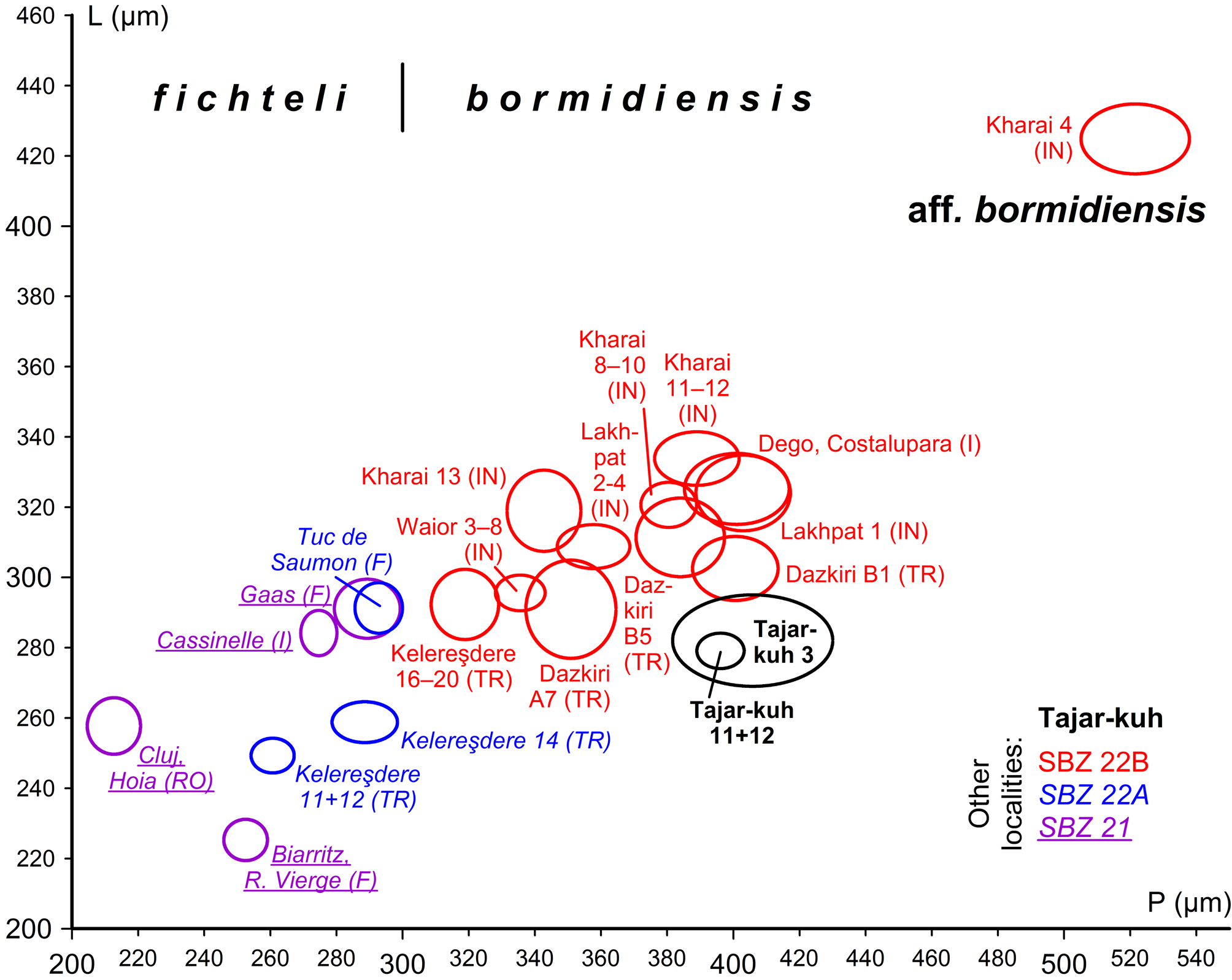
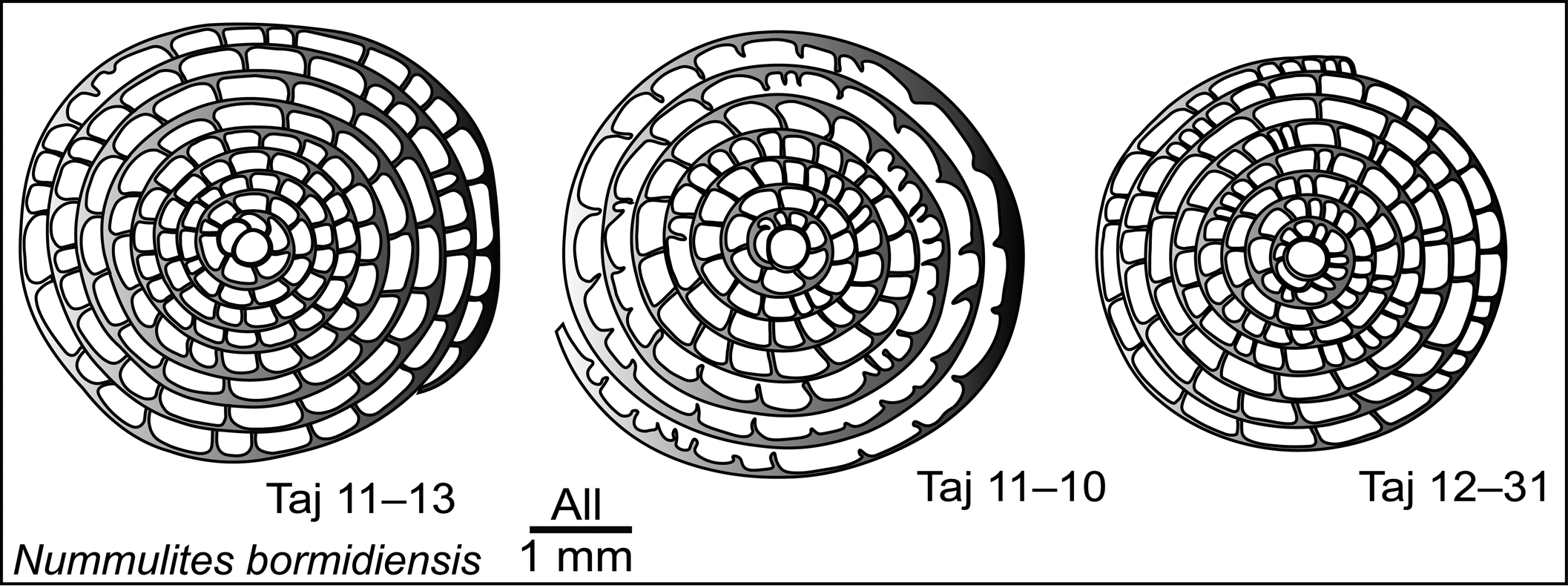
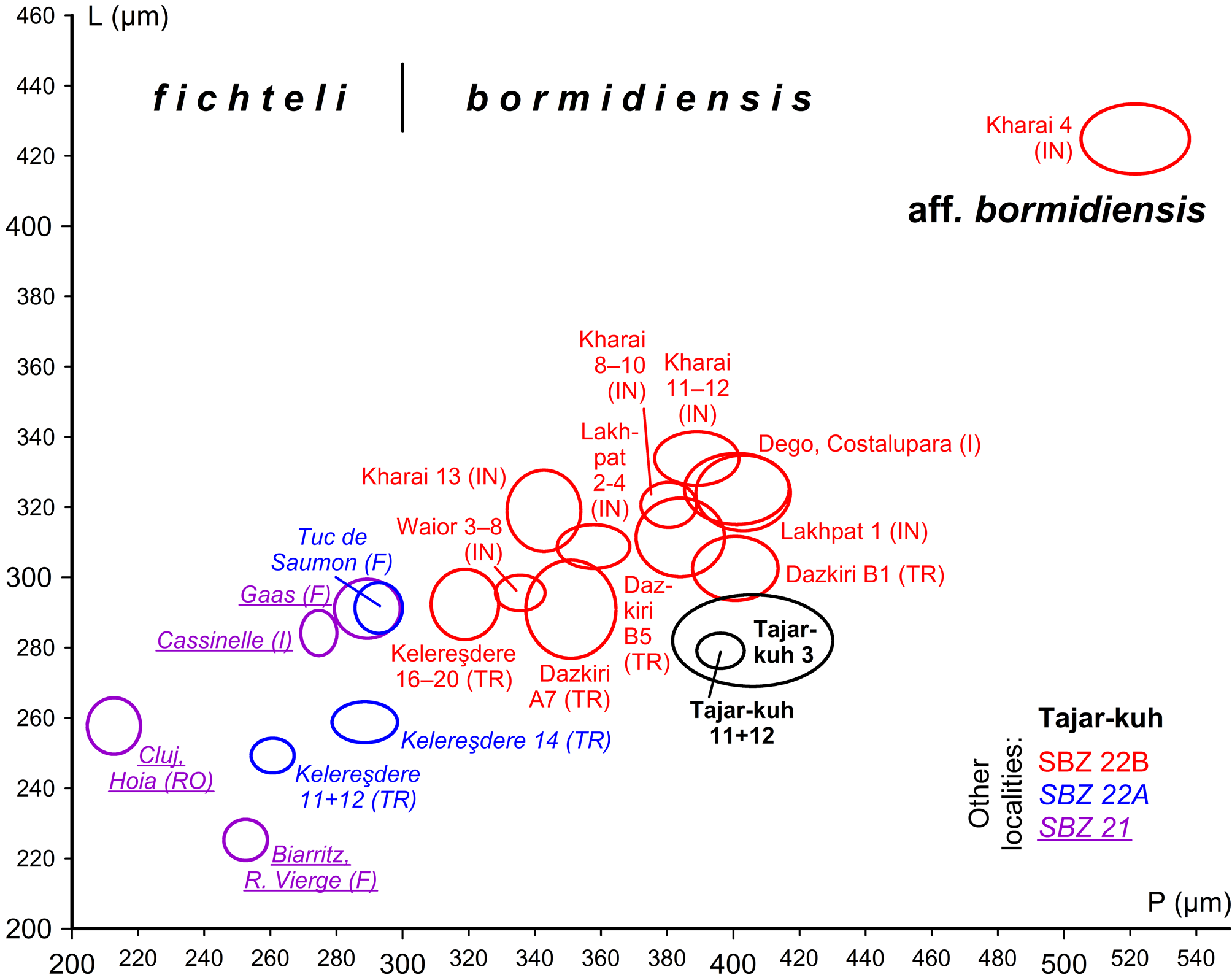
Two diagnostic features for the identification of Nummulites are surface characteristics and the internal morphology of the equatorial section. The measurements are based on Drooger et al. (Reference Drooger, Marks and Papp1971) and Less (Reference Less1999) on 53 and 91 megalospheric specimens of two different species of Nummulites, respectively (Table 1; Fig. 5.1). The identified species are Nummulites bormidiensis (reticulate forms) and N. kecskemetii (radiate forms). Figure 6 shows the distribution of the reticulate Nummulites populations on the P-L bivariate plot, which fit very well to the Nummulites bormidiensis field. Populations of Western Tethys Oligocene reticulate Nummulites investigated by Özcan et al. (Reference Özcan, Less, Báldi-Beke, Kollányi and Acar2009a, Reference Özcan, Less, Báldi-Beke and Kollányi2010a) and Less et al. (Reference Less, Frijia, Özcan, Saraswati, Parente and Kumar2018) are also shown on the figure for comparison. Statistical results of all measured parameters and their description are summarized in Table 1. Nummulites bormidiensis belongs to the Nummulites fabianii (Prever in Fabiani, Reference Fabiani1905) lineage (Less et al., Reference Less, Frijia, Özcan, Saraswati, Parente and Kumar2018), which has been revised and subdivided to different species (Table 2) by Özcan et al. (Reference Özcan, Less, Báldi-Beke, Kollányi and Acar2009a, Reference Özcan, Less, Báldi-Beke and Kollányi2010a, Reference Özcan, Less, Okay, Báldi-Beke, Kollányi and Yilmaz2010b) and Less et al. (Reference Less, Özcan and Okay2011, Reference Less, Frijia, Özcan, Saraswati, Parente and Kumar2018). The type species was described based on material from several European localities.
Bivariate P-L plot (proloculus diameter vs. chamber length in the third whorl) (mean values at the 68% confidence level) for Oligocene reticulate Nummulites populations from Tajar-Kuh (for statistical results see Table 1) and some other Tethyan localities (for numerical and source data, see Less et al., Reference Less, Frijia, Özcan, Saraswati, Parente and Kumar2018).
Subdivision of the Nummulites fabianii-lineage in the Bartonian to early Chattian time-span (Özcan et al., Reference Özcan, Less, Okay, Báldi-Beke, Kollányi and Yilmaz2010b modified by Less et. al, Reference Less, Frijia, Özcan, Saraswati, Parente and Kumar2018).

Nummulites bormidiensis Tellini, Reference Tellini1888
Figures 8, 9
- Reference Tellini1888
Nummulites intermedia var. bormiensis n. var. Tellini, p. 219, pl. 8, figs. 14a, 14b, 15, 17.
- Reference Roveda1970
Nummulites intermedia var. bormiensis; Roveda, p. 274, pl. 24, figs. 5, 6, 63, 64.
- Reference Schaub1981
Nummulites sublaevigatus; Schaub, p. 130, pl. 50, figs. 19–22; pl. 54, figs. 1–5.
- Reference Less, Frijia, Özcan, Saraswati, Parente and Kumar2018
Nummulites bormidiensis; Less et al., p. 197, figs. 9/8–27 (with synonymy).
Holotype
Dego, Costalupara, Oligocene of Ligurian Alps, NW Italy (Tellini, Reference Tellini1888, p. 219, pl. 8, figs. 14a, 14b, 15, 17).
Materials
Populations of megalospheric forms include samples Taj–3, Taj–11, and Taj–12 (Table 1). Microspheric forms were not detected.
Remarks
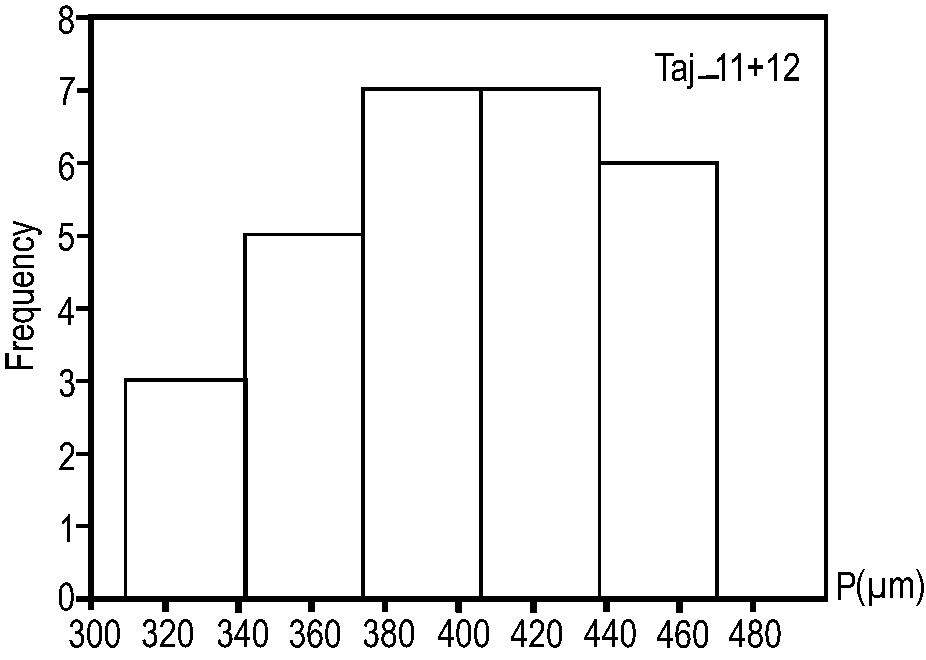
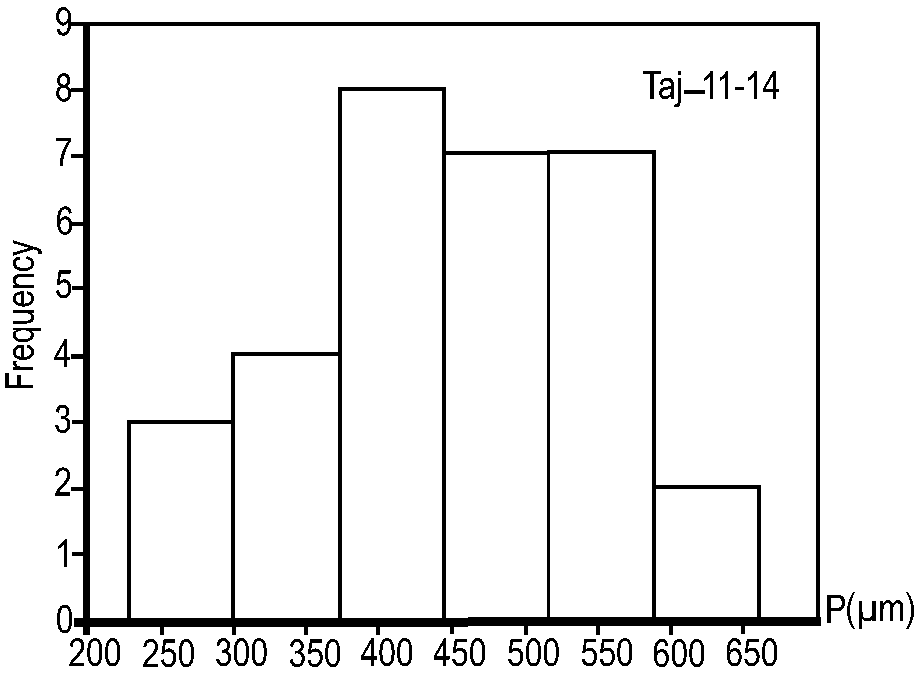
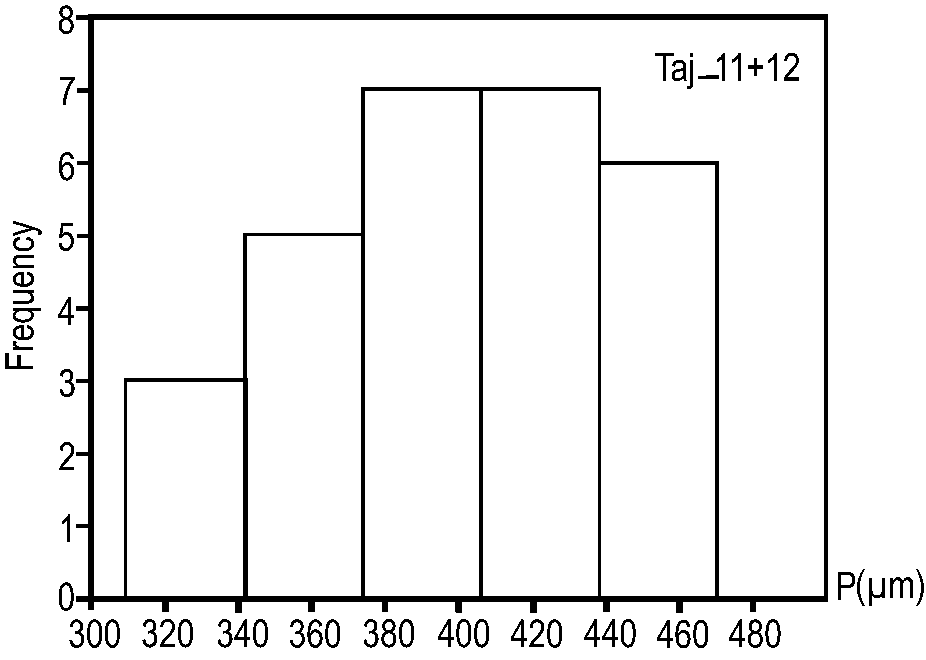
According to Özcan et al. (Reference Özcan, Less, Báldi-Beke, Kollányi and Acar2009a) reticulate Nummulites with the mean value of proloculus diameter >300 μm belong to N. bormidiensis, which is characteristic for the early Chattian SBZ 22B zone, in contrast to N. fichteli Michelotti, Reference Michelotti1841, with considerably smaller proloculus and occurring in the Rupelian SBZ 21 and 22A Zones (Fig. 6). Morphometric parameters of the Tajar-Kuh populations are very similar to each other, and fit very well with those of the N. bormidiensis populations from Italy, Turkey, and Kutch (India) (Fig. 6; Tables 1, 2). In addition, the histogram of the inner cross diameter of the proloculus (parameter P) from Taj–11 + 12 populations (Fig. 7) shows a distribution close to unimodal, which indicates the presence of a single species in these populations. We could not find any indications for reticulate Nummulites other than N. bormidiensis from the Tajar-Kuh section (see Fig. 6 and Table 1), in contrast with Kutch (W India) from where Less et al. (Reference Less, Frijia, Özcan, Saraswati, Parente and Kumar2018) reported a population (from sample Kharai 4) with extremely large proloculus and sometimes with unusual shape (Sengupta, Reference Sengupta2000; Sengupta et al., Reference Sengupta, Sarkar and Mukhopadhyay2011) under the name of N. aff. bormidiensis. In this study, both the presence and morphometric parameters of typical N. bormidiensis are being reported from Iran for the first time.
Histogram of the inner cross-diameter of proloculus (P) in the Nummulites bormidiensis population from samples Taj-11 + 12.
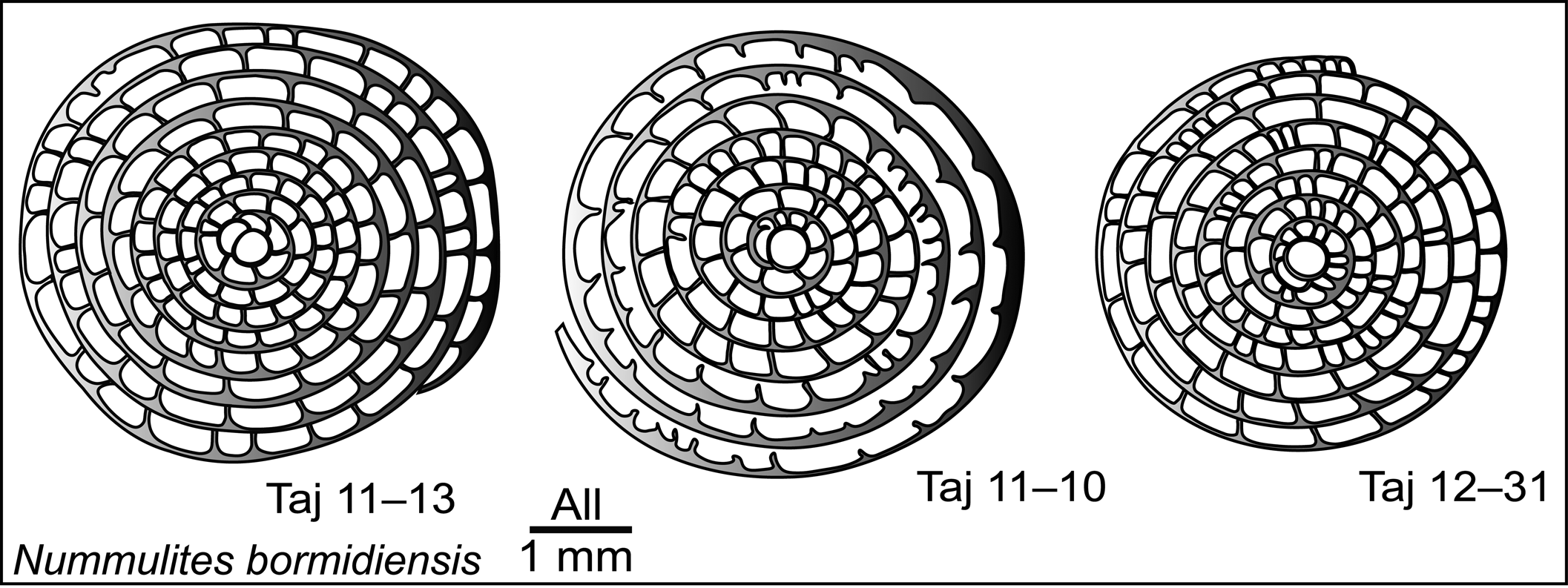
Drawing view of embryonic-nepionic alignment in Nummulites bormidiensis from two populations in the Tajar-Kuh section.
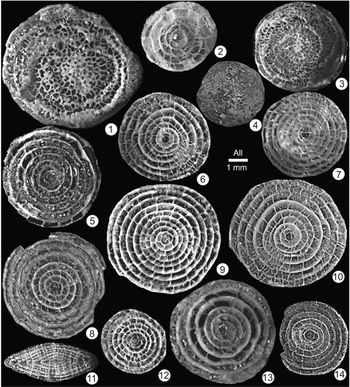
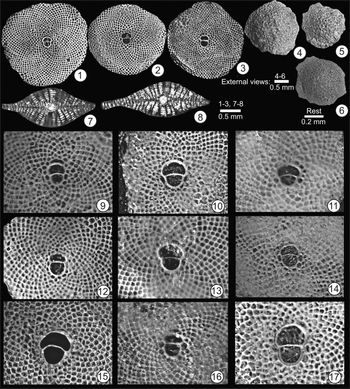
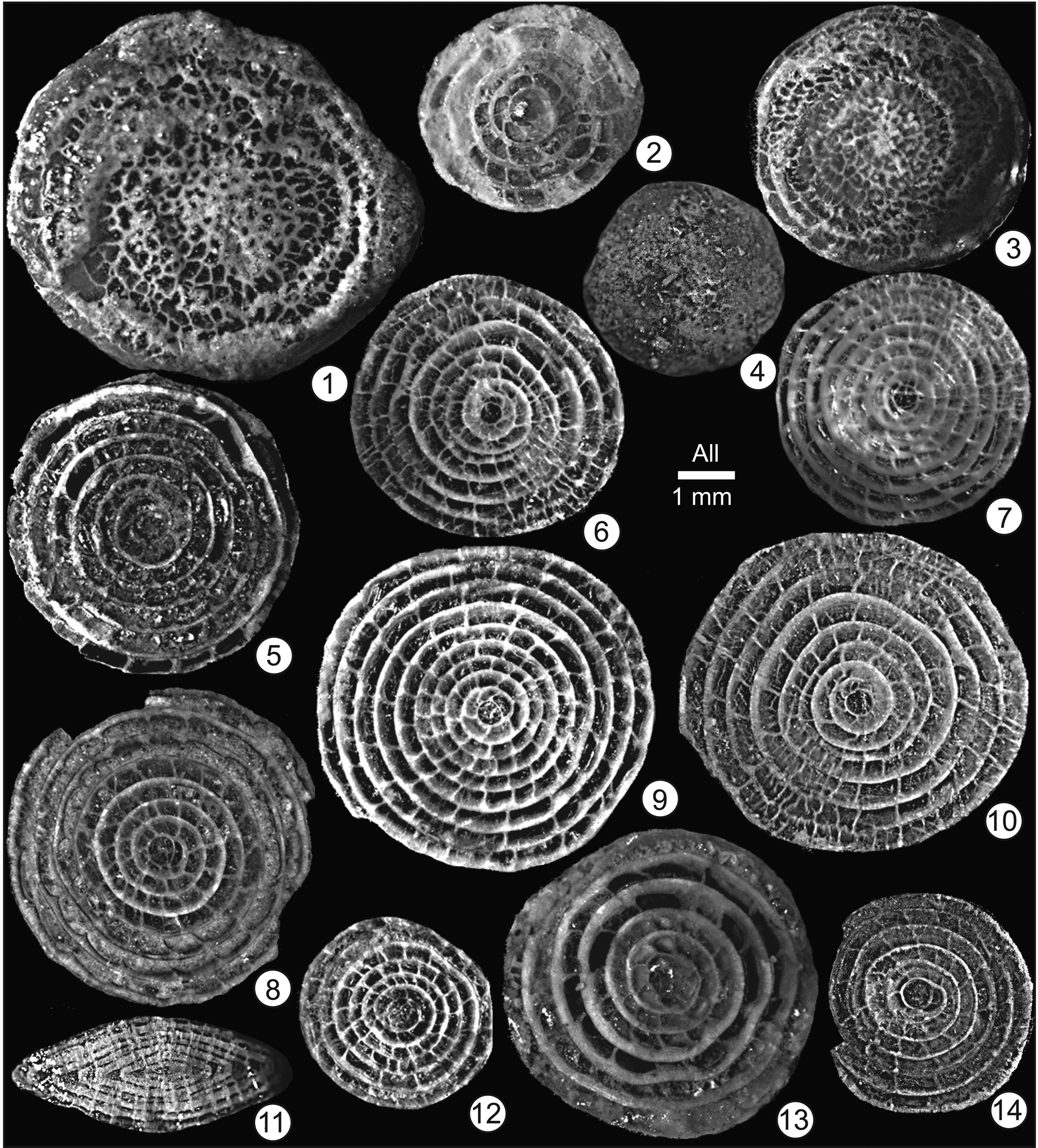
Nummulites bormidiensis Tellini, Reference Tellini1888, early Chattian from the Tajar-Kuh section: (1–5, 7, 11, 13) specimen Taj 12 (respectively 12–34, 12–36, 12–35, 12–33, 12–40, 12–31, 12–37, 12–39), (1, 3, 4) external view, (2, 5, 7, 13) equatorial view, (11) vertical view; (6, 8–10, 12) specimen Taj 11 (respectively 11–1, 11–10, 11–21, 11–8, 11–13), all equatorial view; (14) specimen Taj 3 (3–7), equatorial view.
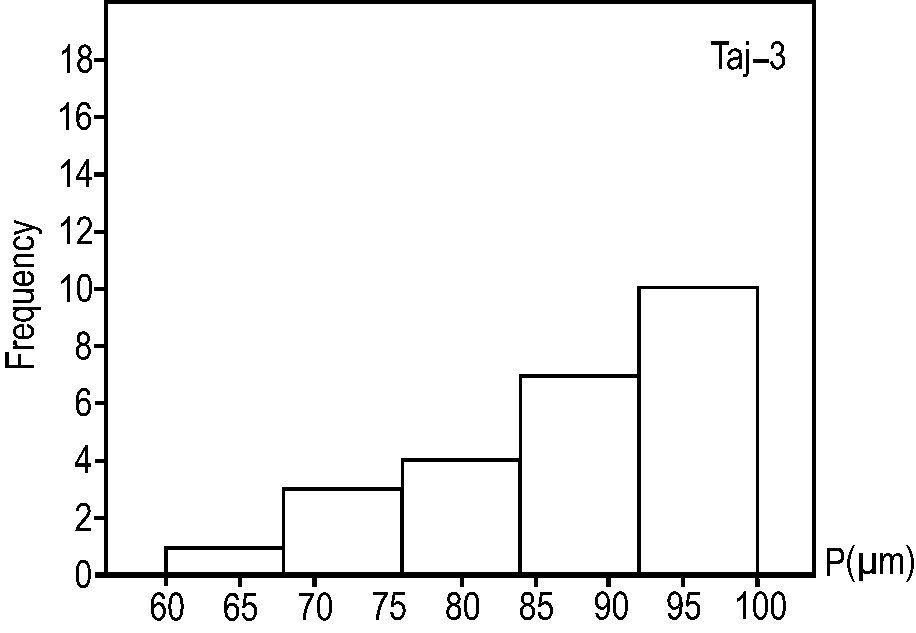
Histogram of the inner cross- diameter of the proloculus (P) in the Nummulites kecskemetii population from sample Taj-3.

Nummulites kecskemetii Less, Reference Less1991
Figures 11, 12
- Reference Less1991
Nummulites kecskemetii Less, p. 439, pl. 1, figs. 1–6; pl. 2, figs. 1–3.
- Reference Özcan, Less, Báldi-Beke, Kollányi and Acar2009a
Nummulites kecskemetii; Özcan et al., p. 755, fig. 17.6–17.10. (with synonymy)
- Reference Özcan, Less, Báldi-Beke and Kollányi2010a
Nummulites kecskemetii; Özcan et al., p. 479, pl. 4, figs. 23, 24.
- Reference Less, Frijia, Özcan, Saraswati, Parente and Kumar2018
Nummulites kecskemetii; Less et al., p. 199, figs. 10/1–5.
- Reference Parente and Less2019
Nummulites kecskemetii; Parente and Less, p. 248, figs. 6A, 6B.
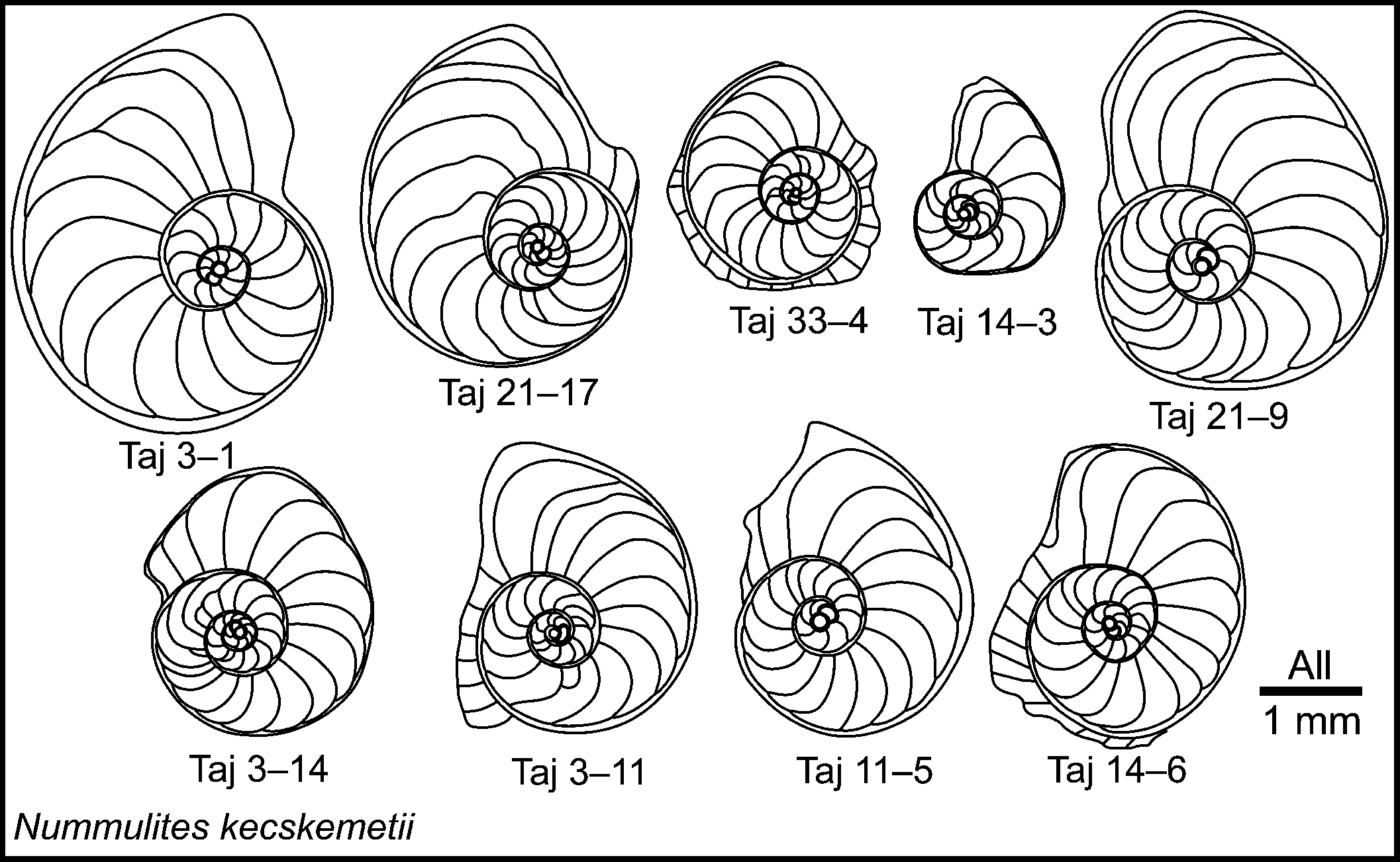
Drawing view of embryonic-nepionic alignment in Nummulites kecskemetii from five populations in the Tajar-Kuh section. scale bar = 1 mm.

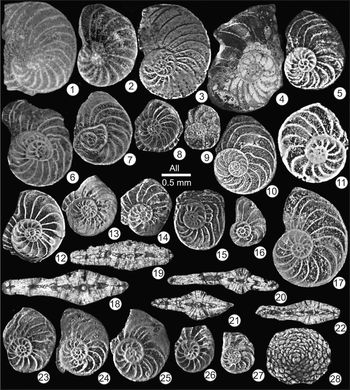
Nummulites kecskemetii Less, Reference Less1991, early Chattian from the basal Tajar-Kuh section: (1–3, 6, 7, 11, 17, 24, 25, 27) specimen Taj 3 (respectively 3–43, 3–42, 3–29, 3–25, 3–34, 3–2, 3–1, 3–11, 3–18, 3–39), (1, 2) external view, (3, 6, 7, 11, 17, 24, 25, 27) equatorial view; (5, 9, 10) specimen Taj 21 (respectively 21–9, 21–30, 21–17), all equatorial view; (4, 8) specimen Taj 33 (33–8, 33–4), equatorial view; (12, 16, 23, 26) specimen Taj 14 (respectively 14–6, 14–3, 14–10, 14–5), equatorial view; (13–15) specimen Taj 12 (respectively12–1, 12–2, 12–5), equatorial view; (18, 19) specimen Taj 12 (random thin section), vertical view; (20–22) specimen Taj 25 (random thin section), vertical view; (28) Planolinderina sp. from the Tajar-Kuh section, specimen Taj 33 (33–1), equatorial view.

Holotype
Csókás, Upper Oligocene of Bükk Mountains, NE Hungary, (Less, Reference Less1991, p. 439–441, pl. 1, figs.1–6; pl. 2, figs. 1–3).
Description
Nummulites kecskemetii is characterized by a very small proloculus with a mean value between 66–95 μm in Tajar-Kuh. It has curved septa, open and loose spire, narrow and high chambers, and the maximum number of whorls is usually 2–2.5 whorls. This species is the youngest representative of the Tethyan radiate Nummulites, known only from the Chattian (SBZ 22B and 23 zones). According to Less et al. (Reference Less, Frijia, Özcan, Saraswati, Parente and Kumar2018), the identification of Nummulites kecskemetii is not problematic and can easily be distinguished from co-occurring forms; also, it does not show evolutionary changes through the Chattian. Therefore, no morphometric study is necessary for this species. However, for the first time, two parameters on 91 megalospheric specimens were measured and presented from Iran (Table 1). These data also do not reflect any development of N. kecskemetii along the lower part of the Tajar-Kuh section.
Materials
This species is recorded from all morphometrically studied Tajar-Kuh samples (Table 1). Microspheric forms were not recorded.
Remarks
Nummulites kecskemetii is regarded as an immigrant from the Western Hemisphere (Less, Reference Less1991; Less et al., Reference Less, Frijia, Özcan, Saraswati, Parente and Kumar2018). It was reported from Kutch (West India) as Operculina complanata by Biswas (Reference Biswas1992) and Reuter et al. (Reference Reuter, Piller, Harzhauser and Kroh2013). However, these two genera can be easily separated based on the vertical section (see above), and by the mean inner diameter of the proloculus for O. complanata, which is 100–250 μm. Histogram of the inner cross-diameter of proloculus (parameter P) from Taj–3 population (Fig. 10) does not suggest the presence of two different taxa. Also, for many years (until Less, Reference Less1999 separated them from each other), this species was determined as Nummulites bouillei de la Harpe, Reference de la Harpe1879 (Butt, Reference Butt1966; Cahuzac and Poignant, Reference Cahuzac and Poignant1997). The difference between N. kecskemetii and N. bouillei is shown on Figure 19 in Özcan et al. (Reference Özcan, Less, Báldi-Beke, Kollányi and Acar2009a).
The occurrence of N. kecskemetii in Tajar-Kuh section is unique, because it occurs with N. bormidiensis, Heterostegina assilinoides, and Planolinderina sp., which indicates the early Chattian SBZ 22B Zone. On the other hand, it is accompanied with Eulepidina formosoides, which has so far been known from the late Rupelian SBZ 22A Zone. This contradiction is discussed in detail later where we describe Eulepidina formosoides. Here, we only predict that at least the lower six Tajar-Kuh samples belong most likely to the basal part of the Chattian, thus the presence of N. kecskemetii in these samples is very probably one of the oldest occurrences of this taxon in the Tethys.
Genus Heterostegina d'Orbigny, Reference d'Orbigny1826
Type species
Heterostegina depressa d'Orbigny, Reference d'Orbigny1826, St. Helena Island, South Atlantic Ocean (d'Orbigny, Reference d'Orbigny1826, p. 305, pl. 17, figs. 5–7).
Remarks
A detailed review of the representatives of this genus from the Tethyan Oligocene can be found in Less et al. (Reference Less, Frijia, Özcan, Saraswati, Parente and Kumar2018). Because only a single specimen of Heterostegina was found in our material, we could not perform any statistical analysis.
Heterostegina assilinoides Blanckenhorn, Reference Blanckenhorn1890 emend. Henson Reference Henson1937
Figure 20.12
- Reference Blanckenhorn1890
Heterostegina assilinoides Blanckenhorn, p. 342, pl. 17, fig. 5 (non figs. 4, 6).
- Reference Henson1937
Heterostegina assilinoides emend. Henson, p. 48, pl. 4, figs. 1–5, pl. 6, fig. 2, tables 1, 2.
- Reference Less, Frijia, Özcan, Saraswati, Parente and Kumar2018
Heterostegina assilinoides Less et al., p. 200–201, figs. 10.6–10.13 (with synonymy).
- Reference Parente and Less2019
Heterostegina assilinoides Parente and Less, p. 249, fig. 6E–6L.
Holotype
Stunden, east of Aintab, Turkish Syria (Blanckenhorn, Reference Blanckenhorn1890, p. 342, pl. 17, fig. 5).
Description
This involute species is recently described in detail in Less et al. (Reference Less, Frijia, Özcan, Saraswati, Parente and Kumar2018) and in Parente and Less (Reference Parente and Less2019). Based on the measurement and parameter system introduced by Drooger and Roelofsen (Reference Drooger and Roelofsen1982) and updated by Less and Özcan (Reference Less and Özcan2008) (Fig. 5.3), morphometric data of our one single specimen are as follows:
Size of the proloculus (P): 180 μm.
Number of post-embryonic pre-hetero-steginid (X): 1.
Total number of chamberlets in the fourth and fifth chambers (S4+5): 4.
Number of chamberlets in the fourteenth chamber (S14): 8.
Outer diameter of the first whorl (d): 1290 μm.
Index of spiral opening (K): 45.
All the measurements well fit within the variations of H. assilinoides reported by Less et al. (Reference Less, Frijia, Özcan, Saraswati, Parente and Kumar2018).
Materials
This taxon has only been recorded from sample Taj–3 (one megalospheric specimen).
Remarks
We found only one specimen of Heterostegina assilinoides.
Family Lepidocyclinidae Scheffen, Reference Scheffen1932
Genus Nephrolepidina H. Douvillé, Reference Douvillé1911
Type species
Nummulites marginata Michelotti, Reference Michelotti1841, Turbin, Italy (Michelotti, Reference Michelotti1841, p. 253–302, pl. 3, figs. 4a-b).
Remarks
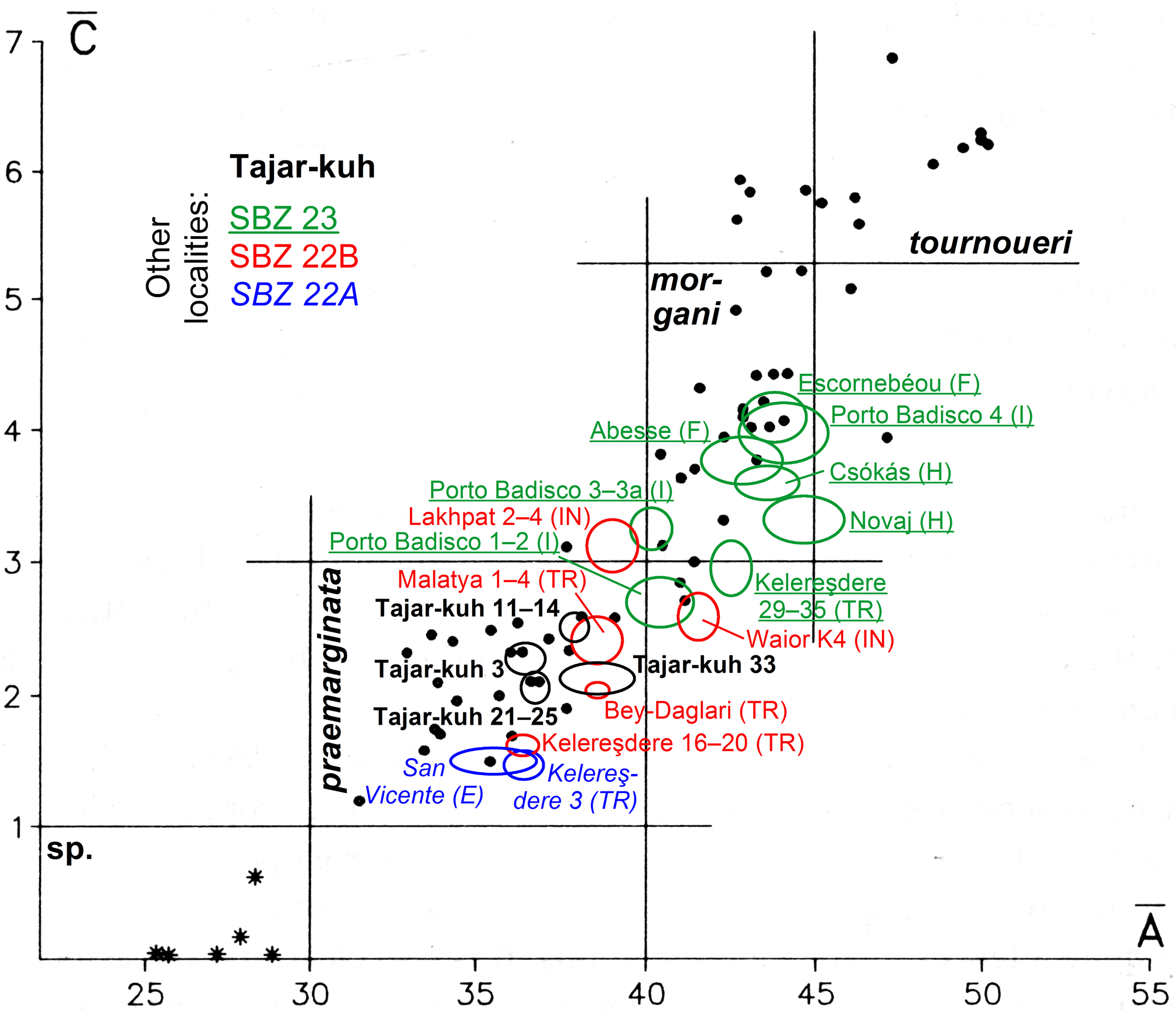
This genus has been widely reported from both the Mediterranean (e.g., Douvillé, Reference Douvillé1925; Lange, Reference Lange1968; de Mulder, Reference de Mulder1975; Less, Reference Less1991; Özcan et al., Reference Özcan, Less, Báldi-Beke, Kollányi and Acar2009a, Reference Özcan, Less, Báldi-Beke and Kollányi2010a) and Western Pacific (e.g., van der Vlerk, Reference van der Vlerk1928; Scheffen, Reference Scheffen1932; Caudri, Reference Caudri1939; van Vessem, Reference van Vessem1978) provinces. Based mainly on de Mulder's (Reference de Mulder1975) and van Vessem's (Reference van Vessem1978) data, Drooger (Reference Drooger1993) concluded that this genus shows a different path of evolution between the two provinces. Similarly to Kutch (Western India, Less et al., Reference Less, Frijia, Özcan, Saraswati, Parente and Kumar2018) we found that the Tajar-Kuh populations of Nephrolepidina rather belong to the Western Tethyan (Mediterranean) province. The main Nephrolepidina lineage from the Mediterranean was subdivided by de Mulder (Reference de Mulder1975) based on the parameters A and C into three species:
N. praemarginata 1 < Cmean ≤ 3 and 35 < Amean < 40
N. morgani 3 < Cmean ≤ 5.25 and 40 ≤ Amean < 45
N. tournoueri Cmean > 5.25 and Amean ≥ 45
The stratigraphic range of N. praemarginata is late Rupelian to early Chattian and defines the SBZ 22 Zone. However, N. morgani (Lemoine and Douvillé, Reference Lemoine and Douvillé1904) and N. tournoueri (Lemoine and Douvillé, Reference Lemoine and Douvillé1904) have a long-range overlap with each other. Nephrolepidina morgani is specific from the late Chattian to early Burdigalian, SBZ 23 to the basal part of SBZ 25, while N. tournoueri spans the latest Aquitanian to late Burdigalian, latest SBZ 24 to SBZ 25.The morphometrical data for Nephrolepidina populations from the Tajar-Kuh section correspond to N. praemarginata of the Western Tethyan lineage, according to the above categorization (Fig. 13; Table 3).
Amean-Cmean (mean of the degree of embracement of the protoconch by the deuteroconch vs. mean of the number of adauxiliary chambers) bivariate plot for Western and Central Tethyan nephrolepinid populations; the populations from Tajar-Kuh and some other localities are represented with ellipses, giving the mean values at the 68% confidence level (for numerical and source data see Parente and Less, Reference Parente and Less2019). The mean values for the nephrolepinid populations used by Drooger (Reference Drooger1993) to illustrate the N. praemarginata-tournoueri lineage are marked by dots, while the mean values for populations of Lepidocyclina sp. of Freudenthal (Reference Freudenthal1972) are marked by asterisks.

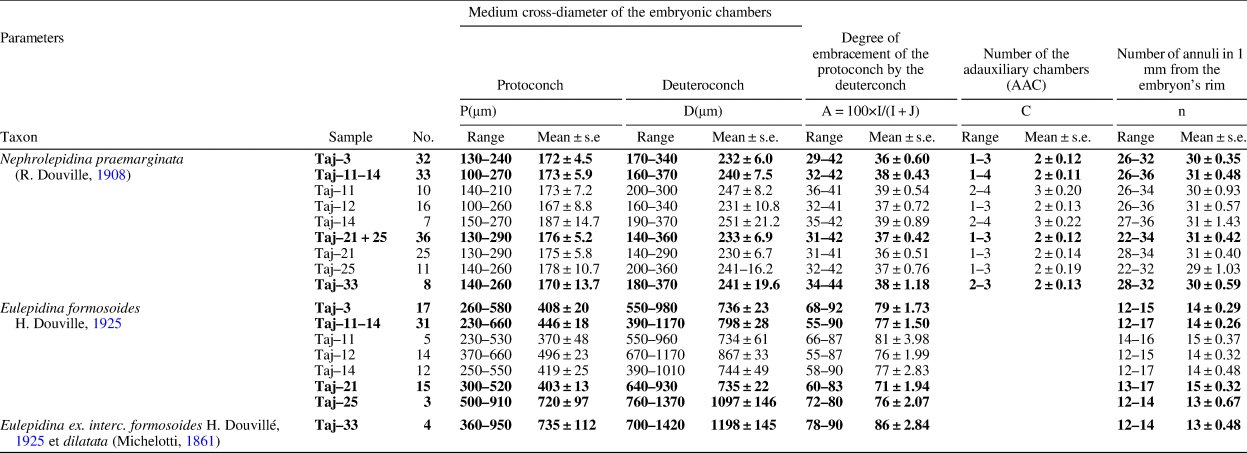
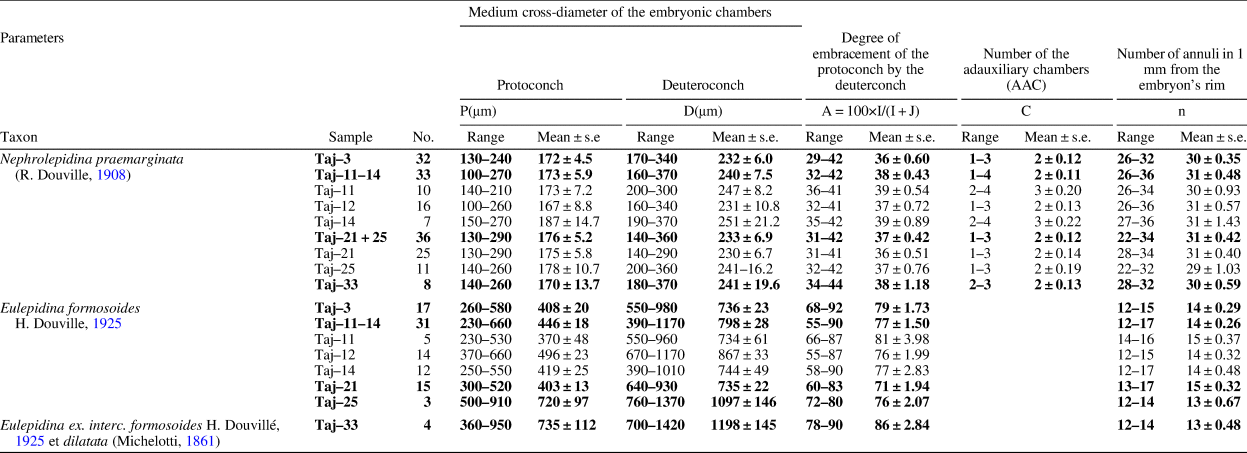
Statistical data of the Oligocene lepidocyclinid populations from the Tajar-Kuh section, Central Iran (№: number of specimens and s.e: standard error).
Nephrolepidina praemarginata (R. Douvillé, Reference Douvillé1908)
Figures 15, 16
- Reference Douvillé1908
Lepidocyclina praemarginata R. Douvillé, p. 91, figures 1, 2, 4a.
- Reference de Mulder1975
Lepidocyclina (Nephrolepidina) praemarginata; de Mulder, p. 62, pl. 3, figs. 6–8; pl. 4, figs. 8–11.
- Reference Özcan, Less, Báldi-Beke and Kollányi2010a
Nephrolepidina praemarginata; Özcan et al., p. 474, pl. 2, figs. 20–26. (with synonymy)
Holotype
Lower Oligocene of Dego, Piedmont, Italy (Douvillé, Reference Douvillé1908, p. 88–95, figs. 1, 2, 4a).
Diagnosis
Populations of the Nephrolepidina praemarginata-morgani-tournoueri lineage with 1 < Cmean < 3 and Amean < 40
Materials
109 equatorial sections of megalospheric specimens from seven samples (Taj–3, Taj–11, Taj–12, Taj–14, Taj–21, Taj–25, and Taj–33).
Remarks
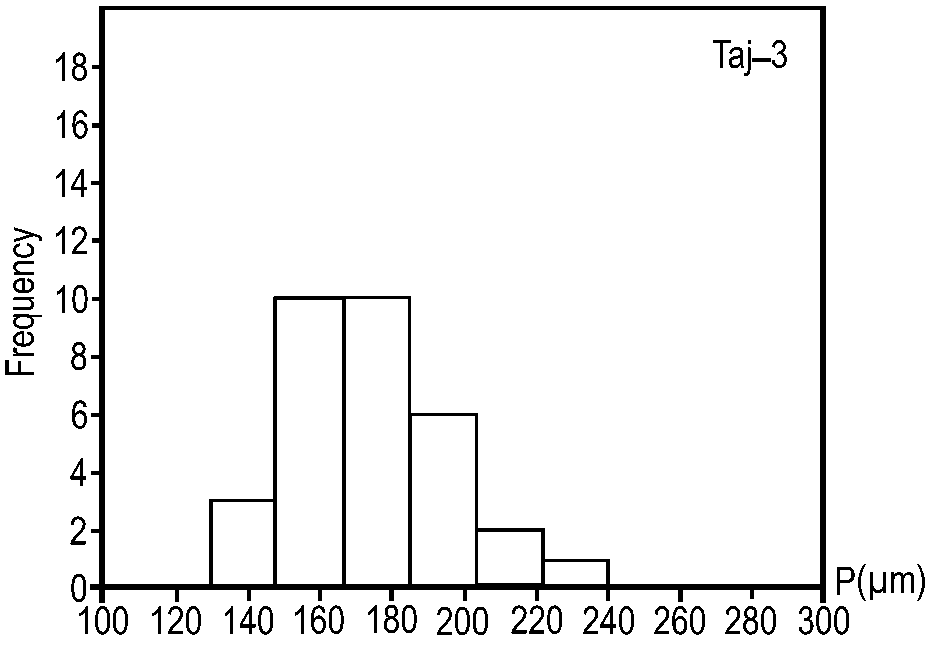
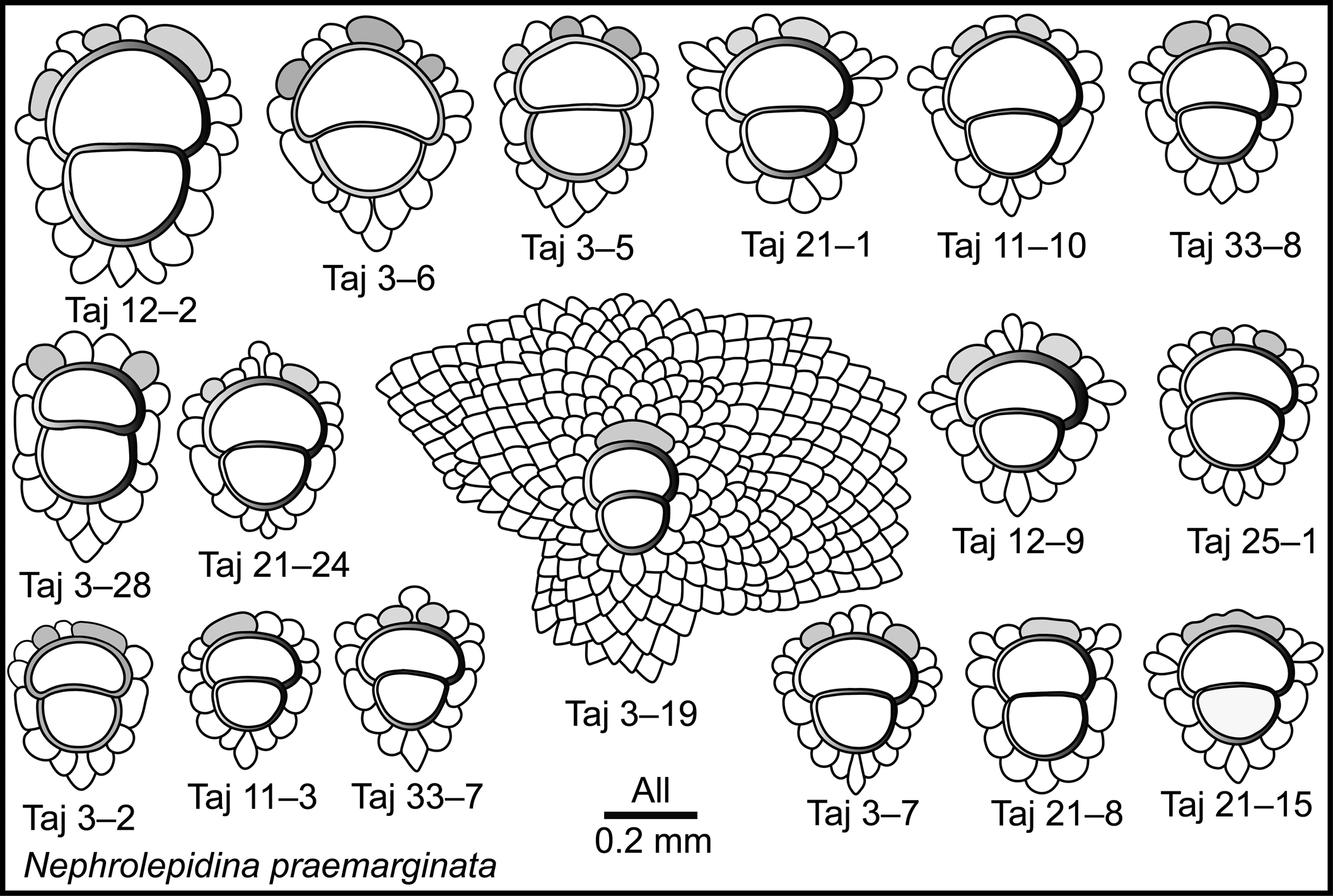
The presence of this taxon in Iran and its biometric data are reported for the first time here. This species was determined using the biometric results from seven Tajar-Kuh populations (Table 3). The histogram of the medium cross-diameter of the protoconch (parameter) P from Taj–3 population (Fig. 14) is clearly unimodal and confirms the presence of a single species. According to Cahuzac and Poignant (Reference Cahuzac and Poignant1997), the stratigraphic range of N. praemarginata is the SBZ 22A and 22B Zones, defining the late Rupelian to early Chattian time-span. However, based on the associated fauna (especially Nummulites bormidiensis, N. kecskemetii, Heterostegina assilinoides, and Planolinderina sp.), which are restricted to the Chattian SBZ 22B Zone, the Tajar-Kuh populations rather indicate this age. Moreover, the simultaneous presence of Eulepidina formosoides confirms that the lower six samples represent the lowest part of the SBZ 22B Zone.
Histogram of the medium cross-diameter of the protoconch (P) in the Nephrolepidina population from sample Taj–3.

Drawing view of the embryonic-nepionic alignment in Nephrolepidina praemarginata from several Nephrolepidina populations in the Tajar-Kuh section.

Nephrolepidina praemarginata (R. Douvillé, Reference Douvillé1908) from the Tajar-Kuh section. (1–3, 9, 10, 14) Specimen Taj 3 (respectively 3–2, 3–5, 3–28, 3–19, 3–24, 3–20), equatorial view; (4–6) specimen Taj 21 (respectively 21–27, 21–28, 21–29), external view; (7, 8) specimen Taj 30 (random thin section), vertical view; (11) specimen Taj 12 (12–9), equatorial view; (12, 13) specimen Taj 21 (21–5, 21–7), equatorial view; (15–17) specimen Taj 25 (25–2, 25–4, 25–5), equatorial view; (1–8). Scale bars as indicated on figure.

Genus Eulepidina H. Douvillé, Reference Douvillé1911
Type species
Orbitoides dilatata Michelotti, Reference Michelotti1861, Piedmont, north Italy (Michelotti, Reference Michelotti1861, p. 1–83, pl. 1, figs. 1–2).
Remarks
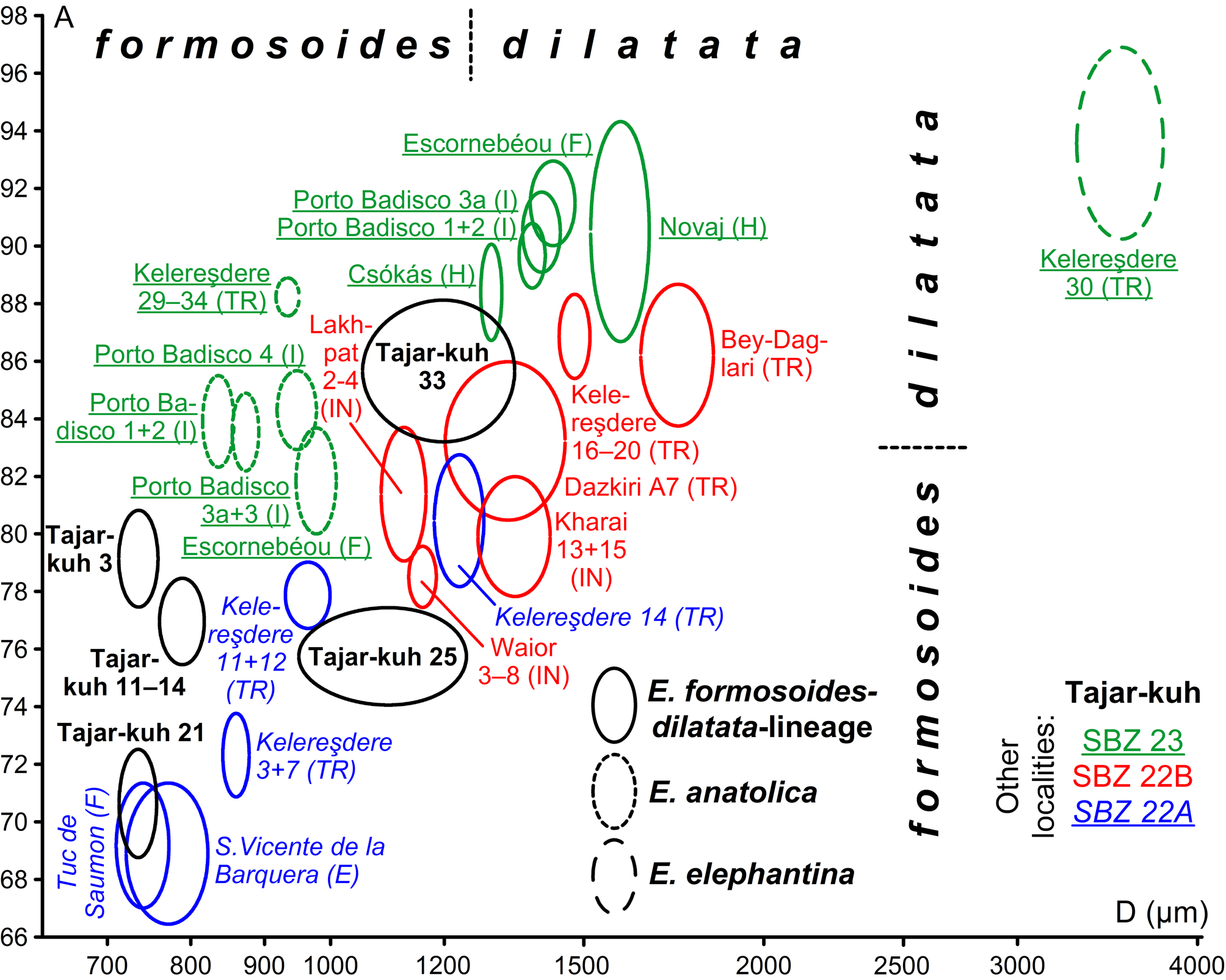
As discussed in detail in Less et al. (Reference Less, Frijia, Özcan, Saraswati, Parente and Kumar2018), the Oligocene representatives of this genus from Spain to Western India (Kutch) belong most likely to the Western Tethyan bioprovince, where Eulepidina is better documented than from the Western Pacific bioprovince. Three Oligocene lineages are distinguished, with two of them (Eulepidina anatolica and E. elephantina) known only from the uppermost Oligocene. The main E. formosoides-dilatata lineage (introduced by Drooger, Reference Drooger1993) spans the late Rupelian to the late Chattian (Parente and Less, Reference Parente and Less2019). Özcan et al. (Reference Özcan, Less, Báldi-Beke, Kollányi and Acar2009a, Reference Özcan, Less, Báldi-Beke and Kollányi2010a) proposed Amean = 83 and Dmean = 1250 μm to delimit the two successive species of the lineage from each other. However, based on the study of populations of Eulepidina from Kutch (India), Less et al. (Reference Less, Frijia, Özcan, Saraswati, Parente and Kumar2018) proposed that these morphometric limits should be later reconsidered, but no new values have been proposed yet.
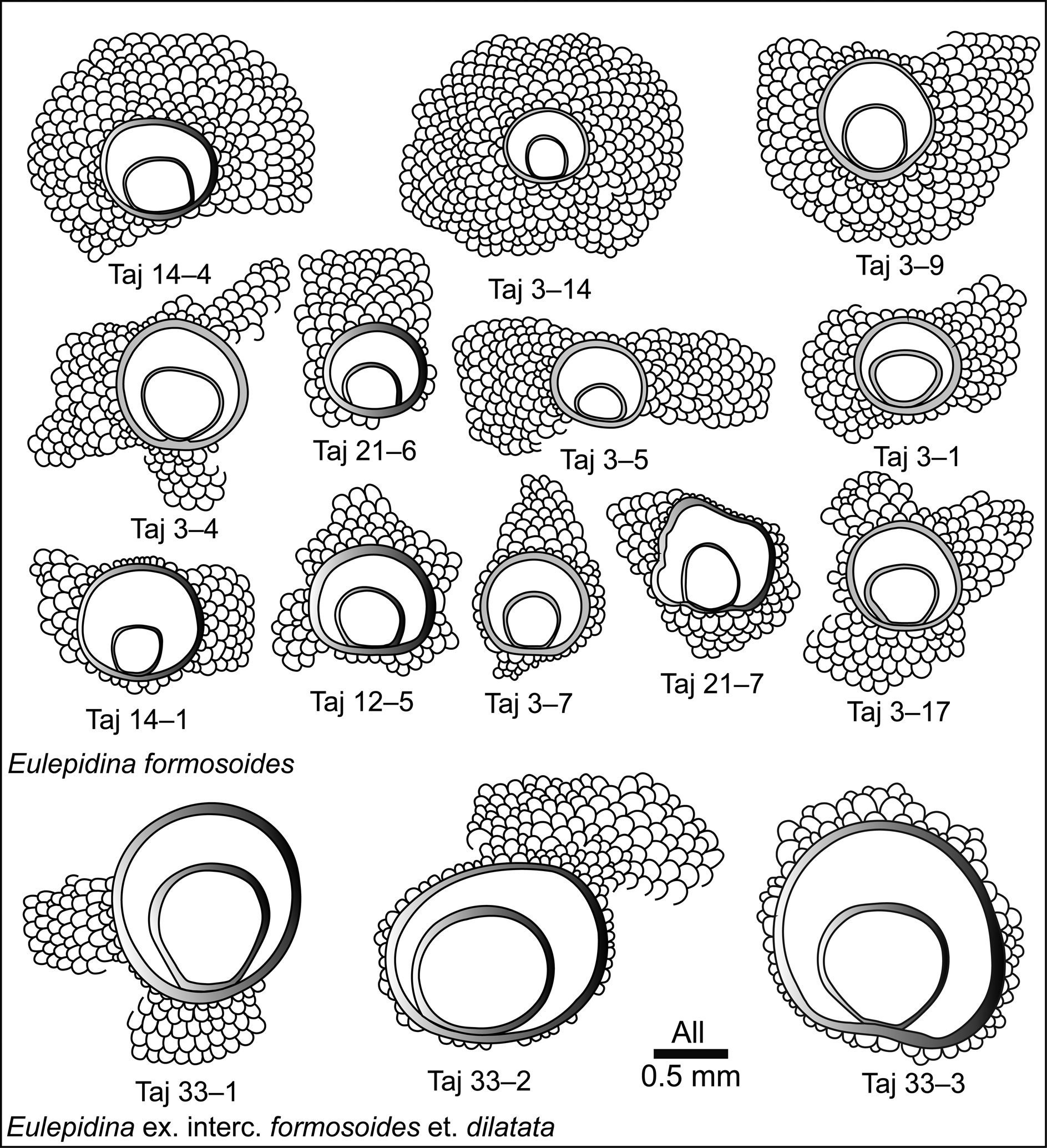
Based on the currently accepted boundaries, our morphometrical data of Eulepidina (Table 3; Fig. 17) from the lower six samples of the Tajar-Kuh section indicate (provided they belong to Western Tethyan lineage) E. formosoides, while the parameters of the uppermost population from sample Taj–33 already suggest transitional Eulepidina ex. interc. formosoides et dilatata.
Bivariate D-A plot (medium cross-diameter of the deuteroconch vs. degree of embracement of the protoconch by the deuteroconch; the scale for D is logarithmic) showing mean values at the 68% confidence level for Oligocene Eulepidina populations from Tajar-Kuh and some other Western and Central Tethyan localities (see Parente and Less, Reference Parente and Less2019, for numerical and source data).

Eulepidina formosoides Douvillé, Reference Douvillé1925
Figures 19, 20.1–20.11, 20.13–20.14
- Reference Douvillé1925
Lepidocyclina (Eulepidina) formosoides; Douvillé, p. 75, pl. 3, figs. 2–4.
- Reference Özcan, Less, Báldi-Beke and Kollányi2010a
Eulepidina formosoides; Özcan et al., p. 476, pl. 3, figs. 1–8. (with synonymy)
Holotype
Lower Oligocene of Santander, Spain (Douvillé, Reference Douvillé1925, p. 75, pl. 3, figs. 2–4).
Diagnosis
Populations of Eulepidina with Dmean < 1250 μm and Amean < 83.
Materials
Sixty-four equatorial sections of megalospheric specimens from all samples (Taj–3, Taj–11, Taj–12, Taj–14, Taj–21, and Taj–25).
Remarks
The presence of this taxon in Iran and its biometric data are reported for the first time here. This species is very abundant in the base of the Tajar-Kuh section. It was precisely determined by the results of the biometric study of six populations (Table 3). The histogram of the medium cross-diameter of the protoconch (parameter P) from Taj–11–14 populations (Fig. 18) is unimodal, indicating the presence of a single species. According to Cahuzac and Poignant (Reference Cahuzac and Poignant1997), the stratigraphic range of Eulepidina formosoides is late Rupelian and marks the SBZ 22A Zone. This range is based, however, on data exclusively from the Western Tethys (Spain, SW France, and Turkey). In the more eastern part of the Tethys, in Kutch (Western India), the transitional E. formosoides-dilatata have been reported already from the early Chattian SBZ 22B Zone in association with Nummulites bormidiensis and N. kecskemetii, and above the occurrences of Heterostegina assilinoides (Less et al., Reference Less, Frijia, Özcan, Saraswati, Parente and Kumar2018).
Histogram of the medium cross-diameter of the protoconch (P) in the Eulepidina population from sample Taj–11-14.

Drawing view of embryonic-nepionic alignment and variation in Eulepidina formosoides and Eulepidina ex. interc. formosoides et. dilatata from several Eulepidina populations in the Tajar-Kuh section.

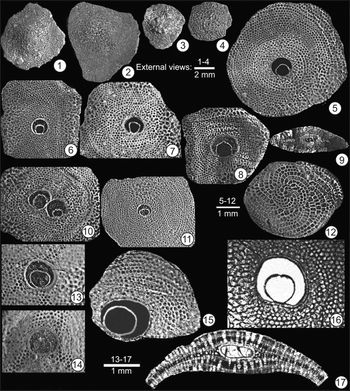
(1–11), (13, 14) Eulepidina formosoides Douvillé, Reference Douvillé1925, early Chattian from the Tajar-Kuh section: (1, 3, 4) specimen Taj 21 (respectively 21–23, 21–16, 21–15), external view; (5, 7) specimen Taj 14 (respectively 14–4, 14–3), equatorial view; (6, 9, 11) specimen Taj 3 (respectively 3–7, 3–18, 3–1), (6, 11) equatorial view, (9) vertical view; (8, 10, 13, 14) specimen Taj 12 (12–1, 12–2, 12–5, 12–8), equatorial view. (15–17) Eulepidina ex. interc. formosoides H. Douvillé, Reference Douvillé1925 et dilatata (Michelotti, Reference Michelotti1861) (15, 16) specimen Taj 33 (33–2, 33–4) equatorial view; (17) specimen Taj 33 (random thin section),vertical view; (2) specimen Taj 33 (33–4) external view; (12) Heterostegina assilinoides Blanckenhorn, Reference Blanckenhorn1890 specimen Taj 3 (3–1), equatorial section. (1–4). Scale bars as indicated on figure.

In the lower part of the Tajar-Kuh section, the situation is quite similar with Kutch, because here Eulepidina formosoides co-occurs with Nummulites bormidiensis, N. kecskemetii, and Heterostegina assilinoides, known from the early Chattian SBZ 22B Zone. Most probably, the representatives of the Eulepidina formosoides-dilatata lineage in the central part of the Tethys (Kutch and most of the recent Iranian territories) could be somewhat separated from those in the Western Tethys, and their evolution could be somewhat slower. Thus, the transition of E. formosoides to E. dilatata in the central Tethys happened most probably later than in the western part. Therefore, considering the associated LBF fauna, the occurrence of Eulepidina formosoides in Tajar-Kuh indicates most likely the basal part of the Chattian SBZ 22B Zone. It is worth mentioning that the population from sample Taj–25 is already somewhat more developed than those from the lower five samples (Taj–3 to Taj–21) and, following this trend, the uppermost population from sample Taj–33 is already transitional between E. formosoides and E. dilatata.
Eulepidina ex. interc. formosoides H. Douvillé, Reference Douvillé1925 et dilatata (Michelotti, Reference Michelotti1861)
Figure 20.15–20.17
- 2018
Eulepidina ex. interc. formosoides H. Douvillé, Reference Douvillé1925 et dilatata (Michelotti, Reference Michelotti1861) Less et al., p. 203, figures 14/1–6.
Materials
This taxon has only been recorded from sample Taj–33 (4 specimens).
Remarks
Based on Table 3 and Figure 17, the Eulepidina population from sample Taj–33 is intermediate between E. formosoides and E. dilatata, although somewhat closer to the former. According to Figure 17, populations with similar morphometric parameters can be found both in the late Rupelian SBZ 22A Zone from Kelereşdere (Eastern Turkey) and in the early Chattian SBZ 22B zone of Kutch (Western India). Based on the associated Nummulites kecskemetii and especially Planolinderina sp., the Tajar-Kuh occurrence of these forms is attributed to the early Chattian SBZ 22B Zone.
Discussion
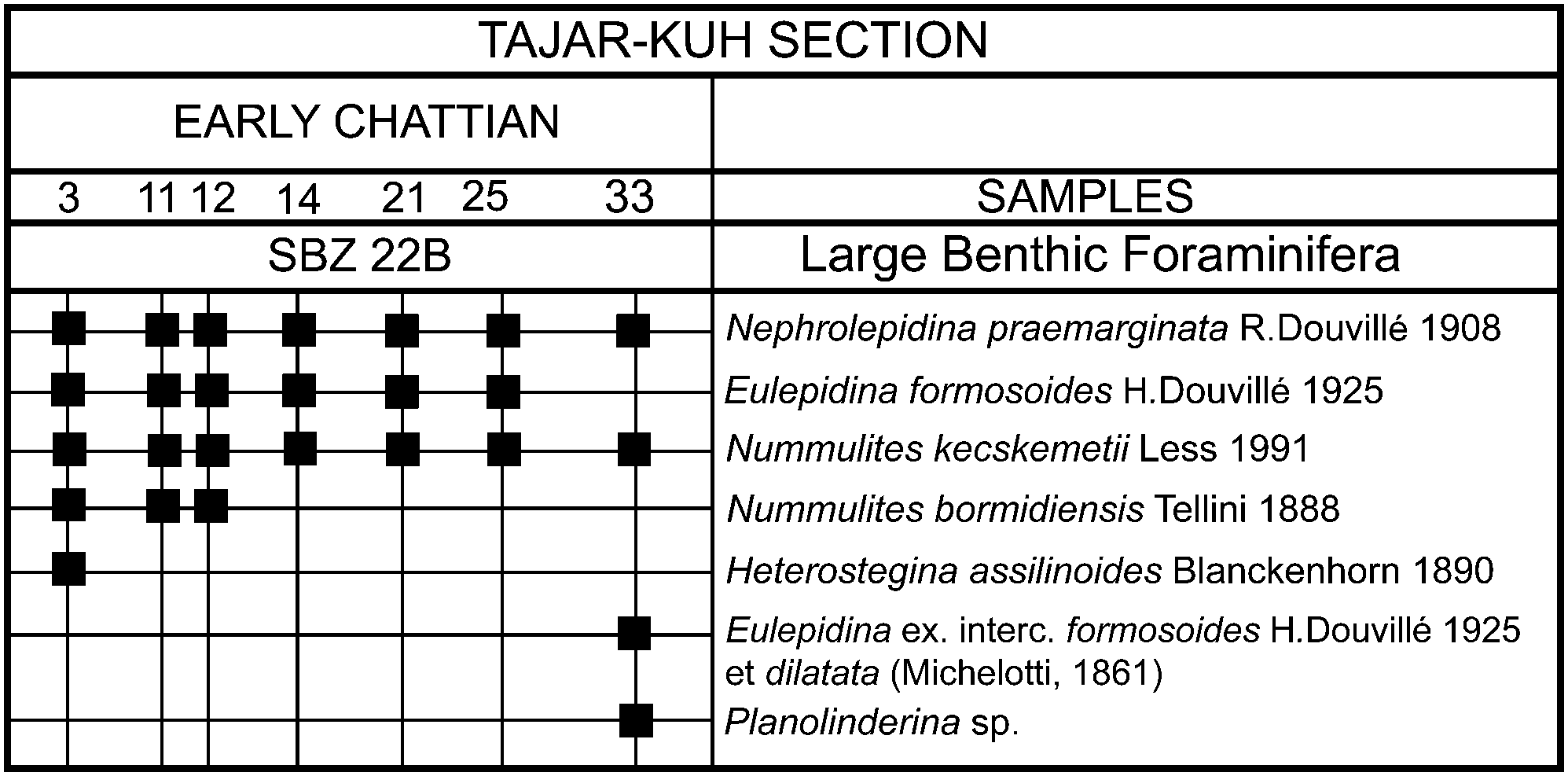
The main fossil components of the early Chattian of the Tajar-Kuh section are larger benthic foraminifera (LBF) consisting of lepidocyclinids and nummulitids that are present in different levels of the sequence. Nummulites bormidiensis was recorded in three samples (Taj–3, Taj–11, and Taj–12) (Fig. 21), which are organized into two populations for statistical analysis (Table 1).
Distribution of larger benthic Foraminifera in Tajar-Kuh section.

Nummulites kecskemetii was recovered from all the samples throughout the stratigraphic column. Rare nummulitids with secondary chamberlets, Heterostegina assilinoides, were recorded in sample Taj–3. Similar to that of Kutch, Western India (Less et al., Reference Less, Frijia, Özcan, Saraswati, Parente and Kumar2018), an important feature of the LBF fauna is the absence of Operculina complanata, which is widespread in the co-eval assemblages of the Western Tethys from Spain to Eastern Turkey (Less, Reference Less1991; Cahuzac and Poignant, Reference Cahuzac and Poignant1997; Özcan and Less, Reference Özcan and Less2009, Reference Özcan, Less, Báldi-Beke and Kollányi2010a; Ferràndez-Cañadell and Bover-Arnal, Reference Ferràndez-Cañadell and Bover-Arnal2017; Less et al., Reference Less, Frijia, Özcan, Saraswati, Parente and Kumar2018; Parente and Less, Reference Parente and Less2019).
Two Western Tethyan lepidocyclinids genera (Eulepidina and Nephrolepidina) were present in all samples. Eulepidina is represented by Eulepidina formosoides and the transitional E. formosoides-dilatata in the top-most sample Taj–33 (Table 3). Nephrolepidina is represented only by N. praemarginata, the less advanced species of the main Western Tethyan N. praemarginata-morgani-tournoueri lineage (Table 3).
The lowest assemblage in the base of the section in sample Taj–3 contains four taxa (Eulepidina formosoides, Nephrolepidina praemarginata, Nummulites bormidiensis, and N. kecskemetii) in reasonable quantity, allowing statistical evaluation of biometrical data, and one single specimen of Heterostegina assilinoides not sufficient for statistical analysis. Concerning the age, Nummulites bormidiensis (early Chattian) and Nummulites kecskemetii and Heterostegina assilinoides (early to late Chattian) indicate the SBZ 22B zone, while Western Tethyan occurrences of Eulepidina formosoides have been reported so far only from the late Rupelian SBZ 22A Zone. The co-occurrence of these forms suggests most likely the basal part of the SBZ 22B Zone, assuming that the Eulepidina formosoides-dilatata lineage developed in the central part of the Tethys (most of Iran and Kutch-Western India, from where E. ex. interc. formosoides-dilatata was reported from the SBZ 22B Zone by Less et al., Reference Less, Frijia, Özcan, Saraswati, Parente and Kumar2018) somewhat slower than in the Western Tethys. Therefore, it is concluded that the transition of E. formosoides to E. dilatata happened somewhat later in the west.
The composition of the LBF in the overlying levels (samples Taj–11 and Taj–12) is the same as the previous levels, but without Heterostegina assilinoides. So, it is inferred that the age of this part is also basal SBZ 22B. In the overlying strata (samples Taj–14, Taj–21, and Taj–25), Nummulites bormidiensis is missing from the assemblages; however, the age of these samples is still basal SBZ 22B.
The uppermost level (sample Taj–33) is characterized by the appearance of the phylogenetically more advanced Eulepidina ex. interc. formosoides et dilatata. The lowest appearance of Planolinderina sp. is also recorded from this level. This assemblage is already assigned to the main part of the SBZ 22B Zone, corresponding to the early Chattian.
Conclusions
Our study, based on the review of the literature on late Oligocene, LBF shows that the assemblages of the Qom Formation in Central Iran have a strong Mediterranean affinity because all taxa are found in the Western Tethys and are similar to the SBZ 22B assemblages of European (southern France, southern Spain, and Malta) and Turkish basins, although Operculina complanata is missing in Iran. Therefore, we used the SBZ zones of Cahuzac and Poignant (Reference Cahuzac and Poignant1997) for biozonation of these coeval sediments at the Tethyan seaway in the Middle East.
The LBF fauna in the Tajar-Kuh section was studied based on a morphometric method for the first time. Five taxa of nummulitids and lepidocyclinids were detected and reported from the Tajar-Kuh section. Two species of Nummulites are identified. Reticulate forms from the basal part of the section are identified as Nummulites bormidiensis. The other form (i.e., the radiate Nummulites kecskemetii), which had previously been assigned to Operculina complanata, is recorded from all studied samples.
Lepidocyclinids are the most abundant LBF occurring in all the samples. Morphometric results indicate two developmental stages of the Eulepidina formosoides-dilatata lineage: E. formosoides and E. ex. interc. formosoides et dilatata, the latter only present in the last matrix-free sample, 50 m above the base of the Oligocene. Nephrolepidina is represented by Nephrolepidina praemarginata, the less advanced taxon of the main Western Tethyan lineage (N. praemarginata-N. morgani-N. tournoueri), which is present throughout the studied samples. Based on the presence of Eulepidina formosoides (a characteristic species for the late Rupelian SBZ 22A Zone in the Western Tethys) together with Nummulites bormidiensis, N. kecskemetii, and Heterostegina assilinoides (whose range starts from the early Chattian SBZ 22B Zone), the lower six samples (Taj–3 to Taj–25) are distributed in the basal part of the early Chattian SBZ 22B Zone. The morphometrically studied uppermost sample (Taj–33) already contains the more advanced Eulepidina formosoides-dilatata in association with the first appearance of Planolinderina sp., and with Nummulites kecskemetii and Nephrolepidina praemarginata extending from the lower levels, which may belong to the main part of the early Chattian SBZ 22B Zone.
Acknowledgments
This research was supported by the University of Tehran. The work of G. Less was carried out at the University of Miskolc, within the framework of the Thematic Excellence Program funded by the Ministry of Innovation and Technology of Hungary (Grant Contract reg. nr.: NKFIH-846-8/2019). We thank M. Jalali (Tehran) for field assistance and the two anonymous reviewers for their constructive criticism that significantly improved quality of this paper.