From the early eighth to the thirteenth century, much of the territory known as the Spanish March was subjected to near perennial violence: Muslims besieged territories south of the Pyrenees, and north of this mountain range Christians forcefully persecuted those they considered heretics.Footnote 1 As these brutal events unfolded, devotion to the regions' early evangelisers and martyrs was renewed.Footnote 2 Many newly erected ecclesiastical foundations came to be dedicated to local saints. The times also saw a marked increase in devotion to regional saints, whose cults flourished particularly among the Cistercians and military orders in the twelfth century, and among mendicants in the thirteenth.Footnote 3
The relevance of regional saints amidst pervasive violence is not fortuitous. Manifesting the saints' intercession via the recitation of the Divine Office was part of an ecclesiastical community's arsenal in the role of religious as milites Christi, as Barbara Rosenwein has shown in her study of Cluny.Footnote 4 The place of liturgy on the battleground is discussed in studies by Carl Erdmann, Michael McCormick, Christoph Maier and and John Bliese.Footnote 5 It is in this multifaceted socio-religious context that historiae were written, sung and contemplated. In light of current scholarship, I discuss here how descriptions of violence, suffering and orthodoxy are articulated in chants for saints especially prominent in the territories of the Spanish March.Footnote 6 Examples from the hitherto unedited historiae of Paul of Narbonne, Eulalia of Barcelona and Saturninus of Toulouse will be analysed.
While sermons, orations, psalms and votive masses (such as ‘in tempore belli’) include instances of liturgy addressing the subject of warfare, these genres do not offer great insights into chant's role in the broader discourse. What was the function of plainchant in this context? Was it a passive, content-neutral medium used to recite texts as a matter of centuries' old liturgical convention?Footnote 7 Or was chant used to help formulate and communicate topics of particular relevance in the texts? Was a word-sensitive articulation of often-formulaic melodic patterns part of the compositional methods employed by liturgists in crafting their message?Footnote 8 These questions touching on the vast corpus of medieval historiae, which often grapple directly with issues of war, violence and suffering, have received scant scholarly attention.Footnote 9
The present article will examine how historiae engage with the interrelated topics of violence and orthodoxy, with the aim of understanding the discursive role played by the chants of the Divine Office. This perspective will be developed in a two-step process beginning with an examination of how liturgists reformulated the texts of vitae for use in antiphons and responsories. From this vantage point, further examination of how text and narrative are articulated, or staged, in the matrix of liturgical chant's musical conventions affords valuable analytical insights.Footnote 10 Elucidating how passages and their narrative elements were reformulated and rearticulated as historiae permits us to appreciate them as important sources of devotional and intellectual history.Footnote 11
Paul of Narbonne
The prevalence of St Paul of Narbonne (11 December), confessor, in the liturgies of Arago-Catalan dioceses is attested in the indexes of Iberian liturgical manuscripts compiled by José Janini.Footnote 12 A thirteenth-century antiphonary following the use of the cathedral of Vic (Barcelona, Biblioteca de Catalunya, Ms. 619, hereafter E-Bbc 619) contains the proper chants for Lauds sung in the region (fol. 75r).Footnote 13 They reflect a style predating that of historiae prevalent after the eleventh century, in which rhymed texts were set to clearly modal melodies.Footnote 14
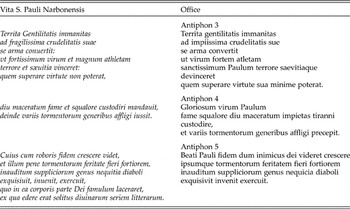
Examining how the antiphon texts adapt or reformulate the vita affords a useful starting point for exploring how liturgy participated in staging, and thus interpreting, the role of violence. Table 1 shows how the liturgy parses a passage from the vita into thematic groupings. As a whole, the Lauds antiphon texts are based on the introductory chapter of Paul's ‘vita A’, which describes the persecution he endured in Rome before heading off to evangelise southern Gaul.Footnote 15 Paul's invincibility is treated in the third antiphon, and the torments to which he was subjected in the fourth.Footnote 16
Comparison of Paul of Narbonne vita to chant texts

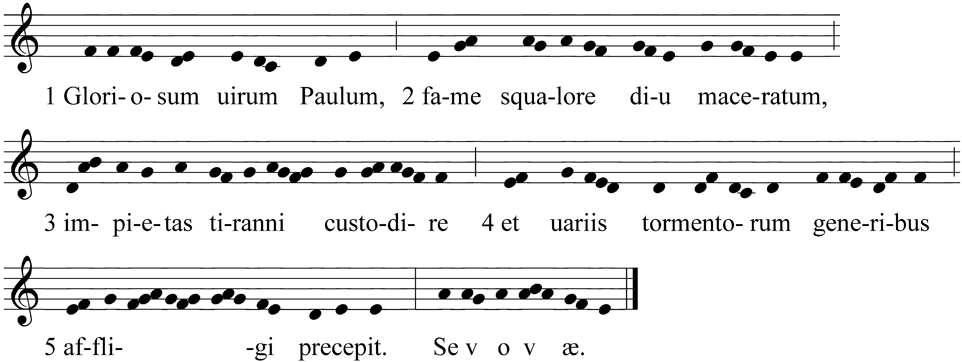
Starting the analysis with the fourth antiphon will prove instructive (Ex. 1). The text comprises two distinct clauses drawn from a long sentence in the vita. Each clause presents an independent, yet subsequent, moment in time. The instigator and recipient of the torture are left implicit. Comparing the antiphon text with that of the vita reveals how the liturgist restructured the narrative. The antiphon transmits a message juxtaposing Paul's moral superiority with his persecutor's evilness. This is affected first by textual interpolations which characterise Paul as ‘gloriosum’ and the tyrant as impious. The first of the two clauses from the vita was also reformulated by rearranging and deleting words. The inversion of the vita's original order of the effect of torture (‘maceratum’) and its causes (‘fame squalore’) creates a rhyme between ‘Paulum’ and ‘maceratum’ in the antiphon. The deletion of the verb ‘mandavit’ from the first clause of the vita text makes both aspects of Paul's trials become grammatically dependent on the final verb ‘precepit’ in the antiphon. This has the effect of recasting the temporal order of events in the vita by presenting them as the result of a single command. Additionally, the change of the final verb to ‘precepit’ introduces an aspect of premeditated intent, absent from the use of ‘iussit’ in the vita. Cumulatively these changes concentrate the intensity of the violent persecution and stage a polarised contrast between the saint and the tyrant.
St Paul of Narbonne (11 December), Lauds antiphon 4 (E-Bbc 619, fol. 75r).Footnote 17

The musical setting of the antiphon text supports the liturgist's reworking of the vita while offering an additional interpretative parameter on the text content. The antiphon is divisible into five phrases. The first two contrast the glory of Paul (phrase 1) with the severity of his suffering (phrase 2). There is an analogous contrast of register: the first phrase, which opens with a fourth-mode intonation formula, spans only a fourth and is situated in the lower segment of the ambitus, around and below the finalis E.Footnote 18 This contrasts with an exploration of the upper segment of the ambitus in phrase 2, where a full cadence reinforces the rhyme affected by the new position of ‘maceratum’.
The setting of the remaining antiphon text continues to underscore the contrasts. Phrase 3 introduces the largest leap in the antiphon melody, the fifth D–a on ‘impietas’, thereby singling out the tyrant responsible for Paul's suffering. This is further emphasised by the relative scarcity of this melodic gesture in the fourth mode.Footnote 19 In the phrases 3–5 the tyrant's orders are recounted. These three phrases avoid full internal cadences, underscoring the restructuring of temporal events in the antiphon resulting from the deletion of the verb ‘mandavit’. It is only at the end, on the word ‘precepit’, that a full cadence is reached again. Thus the single sentence created for the antiphon from two phrases of the vita is rearticulated musically in two portions: phrases 1–2 treat Paul; phrases 3–5 highlight the tyrant's maliciousness. The two portions of the antiphon are differentiated musically by the setting of text in contrasting registers, the placement of full and half-cadences, and the use of large leaps to signal shifts in narrative focus.
We have not yet considered the role of violence in the antiphon text. The slightly more melismatic setting of phrase 3 (in comparison to the neumatic setting of the previous two) might have suggested to listeners something of the contrast between the protagonists. The word receiving the most emphatic melismatic elaboration, however, is ‘affligi’ in the final phrase 5. This musical treatment offers a clue to understanding how violence is instrumentalised in the antiphon. Paul's suffering is positioned as the axis on which saintliness opposes the belligerent tyrant's wickedness.
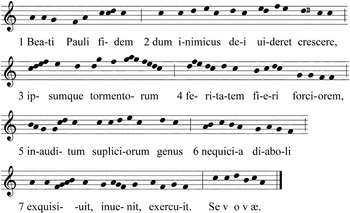
The fifth antiphon of Lauds presents a slightly different approach in its extensive quotation of the vita (see again Table 1; Ex. 2). The text used for antiphon 5 follows directly after that used in the third and fourth antiphons, and narrates how Paul's faith increases with the successively cruel torments. Once again, the antiphon reformulates the vita by contrasting Paul's blessedness with the tyrant's cruelty. This commences not with ‘cuius’, a pronoun referring to the tyrant, but with the saintly protagonist's presentation. Additionally, shifting the verb ‘crescere’ towards the end has the effect of beginning and ending the clause with aspects pertaining to Paul's faith: the antiphon text opens by refocusing the narrative towards the fortitude of the saint and away from the tyrant. The omission of the last portions of the sentence in the vita, which describe the mutilation of Paul's hands, underscores the aim of the antiphon text's creator. In leaving unstated how the tyrant's torture manifested itself, he positioned the strength of Paul's faith in direct opposition to the tyrant's unquenchable aggression.
St Paul of Narbonne (11 December), Lauds antiphon 5 (E-Bbc 619, fol. 75r).Footnote 20

The melodic formulae of the fifth-mode chant are articulated in this example again to project violence as the axis on which both tyrant and saint are defined.Footnote 21 The placement of cadences at the end of phrases 4 and 7 divides the antiphon in two. The first period (phrases 1–4) treats the growth of Paul's faith in reaction to violence; the second (phrases 5–7) sets the tyrant's malicious scheming. A noteworthy aspect of this division is how the music emphasises Paul's virtue over the tyrant's vileness, a reading not necessarily deduced from the vita. Through the contrasting interaction of cadence placement, melodic embellishment and register setting in the first and second periods, the chant stages the text in a relationship of musical inequality. The first period seems like a carefully constructed exercise in the creation of tension and dissipation through cadence. It moves towards the reciting tone, with the two subsequent phrases not moving below c. Tension and the musical expectation for closure are heightened by the setting of ‘ipsumque tormentorum’ in phrase 3. A shift towards a melismatic setting and the expanded range of a tenth draw attention to the role these two words play in the narrative, while simultaneously creating an expectation for modal repose. Having a modal and grammatical caesura coincide at ‘fieri fortiorem’ adds a degree of stability to the passage. The second period's musical setting has no comparable articulation through cadences, ambitus or melismatic emphasis, with the exception of ‘exquisivit’. The melody of the second period is overshadowed by the reappropriation of the tyrant's tortures for the sake of highlighting Paul's spiritual fortitude. Changing the pronoun from the vita's ‘illum’ to the antiphon's ‘ipsum’ underscores this narrative refocusing. Violence is prominently positioned in the chant, but its musical and narrative function is related to defining the saint's virtue.
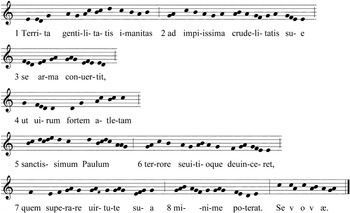
The third antiphon of Lauds affords yet another, complementary perspective (see again Table 1; Ex. 3). The corresponding passage in the vita describes pagans turning to violence in an effort to defeat Paul, the invincible warrior of virtue. This portion of text, which precedes the previous examples, comprises three phrases (the last of which is truncated and also figures in the fourth antiphon). As with the previous examples, the text of the third antiphon contrasts the saint's attributes with those of the pagans through direct quotation and textual interventions. The ambivalent ‘fragilissima’ of the pagans is intensified to become ‘impiissima’, and their aggression is rhetorically heightened by their wanting to conquer definitively (‘devinceret’) rather than merely conquer (‘vinceret’). While the adjectives describing the strength and greatness of the spiritual warrior are reduced to a shorter ‘virum fortem’, the antiphon text identifies Paul as a ‘sanctissimum’ whose virtue cannot be overcome under any circumstance (‘minime poterat’), showing that aggressive qualities normally associated with the pagans may be displayed by saints, albeit in a very different guise.
St Paul of Narbonne (11 December), Lauds antiphon 3 (E-Bbc 619, fol. 75r).Footnote 22

The musical setting of the third antiphon subtly shifts the original text's semantic structure to underscore Paul's superiority over the unbelievers. This is accomplished by means of a musical technique similar to that encountered in the fifth Lauds antiphon. The original (ternary) text is divided into two musical periods (phrases 1–3, 4–8), which are once again placed in an unequal musical relationship although here the second musical period overshadows the first. (In the fifth antiphon it is the reverse.) The first melodic period divides loosely into three modally and semantically dependent phrases (1–3). The opening words are set to a third-mode intonation figure, which briefly touches the reciting tone before arriving at a cadence on E in phrase 2.Footnote 23 The cadence on ‘sue’ interrupts the text's semantic construction – were the chant strictly following the text's grammar, a stronger cadence would be expected at ‘convertit’. As becomes evident, the third phrase (neither starting nor ending on the final) functions as a coda leading to an expanded reiteration of the melody of the first melodic period in phrases 4–8. This second iteration, more clearly organised by mode, expands the ambitus to reach the upper e, and it contains words set to more lengthy melismatic flourishes. Phrase 4, triggered by the conjunction ‘ut’, repeats the opening modal intonation figure and emphasises the arrival on c at ‘atletam’. Phrase 5 continues to inhabit the recitative space and sets ‘sanctissimum’ to the highest note of the chant; the words ‘Sanctissimum’ and ‘Paulum’ receive lengthy melismatic ornamentations. Repeating nearly the same music from phrase 2, phrase 6 cadences at the point of semantic closure with the verb ‘devinceret’. Offset grammatically by the pronoun ‘quem’, which signals the beginning of a new sentence in the vita, the remaining two phrases of the antiphon are set to what can be described as an expanded version of the coda-like phrase 3. Relegating this passage to a subordinate musical position, created by the restricted ambitus and movement around G, is not an inherent musical decision that the text completely supports. Yet the two-period organisation of the antiphon melody, with the second being the more prominent musically, has a discernible impact: the passage stressing the invincibleness of ‘sanctissimum Paulum’ receives the strongest emphasis.
Eulalia of Barcelona
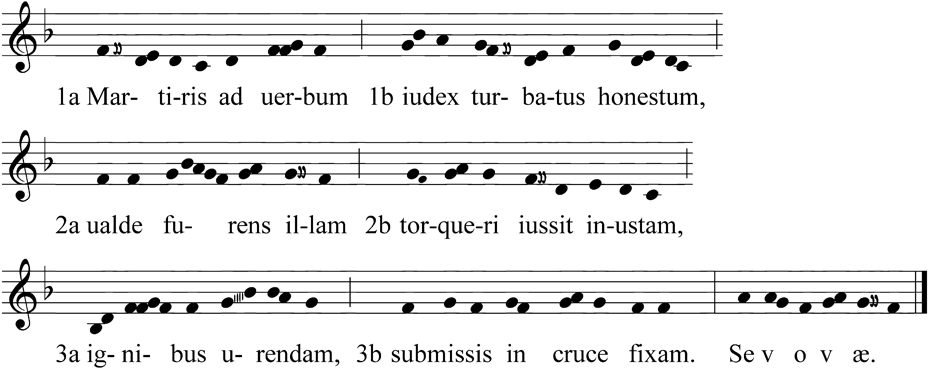
St Eulalia was martyred at the age of thirteen on 12 February 303, in Barcelona.Footnote 24 Her presence as the region's patron saint has been a constant in the devotional life of Arago-Catalonian territories from the late ninth century on.Footnote 25 The historia of St Eulalia in E-Bbc 619, attributed to Renall of Pauliac, a Languedocian canon of Barcelona and later Girona, was probably written in the second decade of the twelfth century (Ex 4).Footnote 26 Its text shows no clear dependence on the vita of Eulalia, also penned by Renall, or for that matter any other extant work on Eulalia.Footnote 27 Composed in the fashion of a versified office, the antiphons are in rhymed hexameters; in their musical settings, they display the expected clarity of mode typical of historiae. (The melodic formulae of Franco-Roman Chant are absent).Footnote 28
St Eulalia (12 February), Matins antiphon 6 (E-Bbc 619, fol. 88r. Transposed to c in the manuscript).Footnote 29

The sixth antiphon of Matins describes Eulalia's torture in ways comparable to the chants previously examined. The first hexameter describes the anger (‘turbatus’) of the governor, Dacian, here called ‘iudex’, in opposition to the martyr, Eulalia (‘Martyris … ad verbum … honestum’). Notable again is the conflict between the good martyr and violent pagan, which propels the narrative. The rage against Eulalia and the tortures she endured are described in the second hexameter. In the third hexameter, these torments culminate in Eulalia being affixed to the cross on which she would be burned.
While the Leonine hexameters impose on the sixth-mode melody a particular pattern of text articulation, there nonetheless continues to be a discernible staging of words in relation to one other. The choice of the downward intonation formula on ‘martyris’ in the first line contrasts with ‘iudex’, occupying the opposite register at the opening of phrase 1b.Footnote 30 The repetition of a similar melodic line in phrase 2b positions the two phrases in the lower register around the setting of ‘furens’ in phrase 2a. Instead of repeating the opening (descending) melisma as in phrase 1a, the participle ‘furens’ is set to the longest melisma in the antiphon and positioned in the top register, thereby disrupting musical expectations and emphasising the persecutor's aggression. The opening of phrase 3a stresses words describing the manner of torture (‘ignibus urendam’) by extending the chant's lower ambitus and traversing the octave interval in the space of nine notes. This articulation of text using contrasts of register and melismatic density affects a more direct differentiation of the words than seen in previous examples.
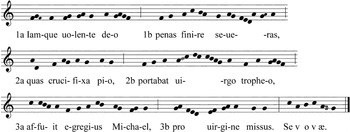
The eighth antiphon of Matins further illustrates how flexibly a melody can stage words in contrasting relation to each other, while still adhering to the confines of the versified genre (see Ex. 5). The form of the antiphon text parallels that of the previous example: three narrative clauses are again organised in Leonine hexameters. The eighth antiphon, however, contrasts Eulalia's severe torments with the condition of her pious crucifixion. Line one announces God's intervention in Eulalia's fate, line two the laudable circumstances of her martyrdom, which in line three merits being attended by the Archangel Michael.Footnote 31
St Eulalia (12 February), Matins antiphon 8 (E-Bbc 619, fol. 88v).Footnote 34

As in the preceding example, cadences do not support the text's semantic or grammatical structure, but rather underscore the rhyme and dynamism of the hexameter verse. Phrase 1a of this eighth-mode chant opens with melodic movement encompassing a minor third.Footnote 32 The range expands when Eulalia's torture is mentioned, where in phrase 1b a minor seventh is traversed between ‘finire’ and ‘severas’. The three syllables of ‘severas’ are set to eleven notes encompassed by a downward scale that leaps up a fifth to form a ‘z-shape’ figure characteristic of this repertoire.Footnote 33 Setting the first hexameter in this manner creates a point of contrast with the second. Phrase 2b positions the noun ‘virgo’, a facet corroborating Eulalia's steadfast faith, in the opposite register inhabited by ‘severas’ in phrase 1b. By means of an arching ten-note stepwise melisma, ‘virgo’ reaches the melody's high point.
The highlighting of words through melodic and register contrasts shows rather plainly the approach to staging the text. Eulalia's virtue embodied by her virginity is contrasted with the severity of her suffering. The musical setting could have emphasised the role of God and Michael in Eulalia's hagiography, but it does not, even though it holds equal narrative weight in the antiphon text. Instead, the opposition between suffering and orthodoxy are prominently highlighted through melismatic embellishment.
Saturninus of Toulouse
Discussing the liturgy of the bishop and militant martyr St Saturninus (29 November) offers a complementary perspective on how chants in historiae stage violence and suffering.Footnote 35 In many respects, the portrayal of St Saturninus in the Marseille manuscript (F-Pn lat. 1090, c.1190–1200) resembles that of St Paul of Narbonne:Footnote 36 both are represented as determined spiritual warriors in their missions to evangelise Gaul. Yet to Saturninus's prowess is added the ultimate sacrifice of martyrdom in which his mutilated body becomes an attribute of steadfast faith.Footnote 37
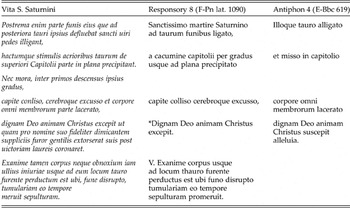
Besides F-Pn lat. 1090, the thirteenth-century antiphonary from Vic cathedral, E-Bbc 619, also contains a group of Matins and Lauds antiphons for St Saturninus not yet indexed in the CANTUS database.Footnote 38 The text of the fourth Lauds antiphon in E-Bbc 619 is very similar to that of the eighth Matins responsory in F-Pn lat. 1090, Marseille antiphoner.Footnote 39 Comparing them affords useful insights into how the same text was treated in different chant genres of a historia.
Both the E-Bbc 619 antiphon and the F-Pn lat. 1090 responsory stem from the same passage in the vita's fourth chapter, which describes Saturninus's martyrdom. According to the account, his body was tied to a bull whose descent down the steps of Toulouse's capitol hill caused his death. Also specified is the place where Saturninus was buried. Table 2 compares the texts of the vita, responsory and antiphon.
Comparison of Saturninus vita to chant texts

Note: *indicates division of the respond.
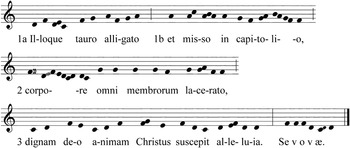
The music of the fourth Lauds antiphon sets the saint's passion in a more varied manner than the previously discussed chants (see Ex. 6). The changes made in transforming the passage from vita into antiphon introduce a tension between the three moments in the succession of events and the binary form suggested by the emendations. Phrase 1 of the antiphon relates Saturninus's preparation for torture, phrase 2 the deadly violence to which he was subjected, culminating in his ascent to heaven in phrase 3. The first phrase is divided between the act of tying the saint to the bull (phrase 1a) and his being cast down the steps (phrase 1b), which was set as antecedent/consequent. The opening mode-one intonation formula ends in phrase 1a on the reciting tone, thereby introducing an expectation of closure.Footnote 40 Phrase 1b extends the ambitus to a perfect octave (C–c) and introduces the first caesura with an open cadence on F. The melismatic setting of ‘capitolio’ accentuates the place from whence Saturninus was hurled down. Avoiding full modal closure at this point joins this phrase to the following one, which discloses details of the martyrdom. Phrase 3 commences with a lengthy descending melisma on ‘corpore’. The melismatic accents on ‘capitolio’ and ‘corpore’, in the upper and then lower registers, contrast the height of the capitol hill and the saint's dead body. At the words describing graphically the laceration of Saturninus's body in phrase 2, the melody shifts to extended syllabic setting and, at the end of the phrase, at ‘lacerato’, a full cadence is evaded. The absence of cadences in phrases 1 and 2 imbues the melody with a need for repose, achieved only with narrative closure at the antiphon's ending.
St Saturninus (29 November), Lauds antiphon 4 (E-Bbc 619, fols. 125r–125v).Footnote 41

This articulation of the melody's trajectory underscores the bipartite structure of the antiphon text: events surrounding Saturninus's death receive a processual, uncompleted musical setting. The narrative ends not with the saint's death, but with his elevation. Accordingly, his acceptance into heaven triggers the chant's only cadence. On a different musical level, the setting of the saint's victory over violence is differentiated through a gradual tapering of musical parameters involved in reciting the text. The antiphon progresses from the first phrase moving across a perfect octave, with text set neumatically and melismatically, to the second phrase traversing only a major sixth. This finds the melody, in the final phrase, moving only across a perfect fifth in near complete syllabic declamation, honing the antiphon's progression towards its narrative goal while instilling solemnity to the last phrase.
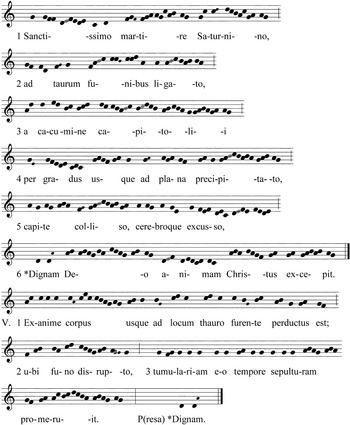
Discussing the eighth responsory from the Marseille manuscript after the Lauds antiphon introduces a more multifaceted text setting, although the process of adapting the vita to the responsory appears to reflect interpretative concerns similar to those of the antiphon (see again Table 2; Ex. 7).Footnote 42 The responsory does show a comparable reworking of the first half of the vita text, though with a more literal quotation in the latter portion. The narrative focus shifts from the persecutors and towards the saint: Saturninus is explicitly named most blessed martyr (‘Sanctissimo martyre’), with corresponding changes of verb conjugation and tense (‘illigant’ vs. ‘ligato’, ‘precipitant’ vs. ‘precipitato’). The description of the bull's movement from the top of the capitol hill to the bottom appears in the vita before mention of the steps and their role in the saint's death, but the responsory positions this detail as the intermediary between origin and destination, simplifying the text and leading to a direct description of the saint's death immediately before the repetendum. This small adjustment refocuses the succession of temporal events, underscoring the close causal relationship between Saturninus's martyrdom and sanctity. To these changes is added a poetic adaptation of the vita whereby the verbs at the end of each phrase form end-rhyme or assonance (‘ligato’, ‘precipitato’, ‘excusso’). Similar to the antiphon, this divides the vita text in two parts where the repetendum, quoting the vita verbatim, departs from the rhyme pattern (‘dignam … precepit’) and differentiates it as the narrative goal of the responsory. The verse forms the expected last section of the narrative. Its content consists of the selective quotation from the vita. Shifting the verb ‘promeruit’ towards the end of the line creates an end-rhyme, and thereby an association, with the repetendum's last word, ‘excepit’.
St Saturninus (29 November), Matins responsory 8 (F-Pn lat. 1090, fol. 238v).Footnote 43

Due to the musical conventions of the genre's longer length and florid melismatic setting, the staging of words in the responsory is more multifaceted than the previously discussed antiphons. Contributing to this is the normal four-part responsory form comprising an introductory phrase, a middle section often serving as a bridge to the repetendum, the repetendum itself, and then the verse, which gives way to an iteration of the repetendum. The interplay between this convention, the melody's articulation of mode and the placement of melodic formulae or embellishments all affect the reading of the text.
The placement of cadences reveals the first facet of the liturgist's parsing of the narrative. Phrase 1, in which the saint is introduced, employs standard melodic formulas moving through a ninth while confining the phrase to a musically closed period.Footnote 44 By means of the weak cadence at ‘ligato’, phrases 2 and 3 are placed in an antecedent/consequent relationship, with the chant's longest melisma moving to a full cadence on ‘capitolii’.Footnote 45 While this emphasis interrupts the end-rhyme, the shape of the melody unites the second, third and fourth phrases with the chant's highest note, e, occurring in phrase 3 on ‘cacumine’. The peak and long descent to the final on ‘capitolii’ continues a downward melodic path eliding into the beginning of phrase 4 at ‘per gradus’. This expands the ambitus to a tenth on words describing the dragging of Saturninus's body down the capitol hill. The contrast of setting ‘usque ad plana precipitato’ in phrase 4 with a melody revolving statically around the final suggests a musical analogy underscoring the events narrated.Footnote 46 In any case, the grouping of phrases 2–4 emphasises the separation between the virtuous saint (in the opening phrase) and his violent martyrdom. Phrase 5, which describes the fracturing of Saturninus's head, is set to a melodic passage that neither commences nor finishes on the final, the most musically unstable phrase of the chant. Positioned as the section leading to the repetendum, phrase 5 finishes on an open cadence.Footnote 47 The strongest instance of expectation for modal repose then leads to the expected melismatic elaborations in the repetendum. The melody of the verse-tone then sets the description of where Saturninus's body was interred.Footnote 48
The articulation of cadences in the responsory supports the textual interventions affected in the liturgical text. Compared to the vita, the responsory more clearly juxtaposes the perpetration of violence versus the reward of martyrdom. Melodic emphases on individual words, in turn, reveal the continued underscoring of violence: In comparison to ‘tauro’, ‘capite’, ‘cerebro’ or other words, ‘ligato’, ‘precipitato’, ‘colliso’, ‘excusso’ receive strong melodic emphasis in phrases 2–5. The contrast of this group of verbs with the repetendum's non-rhyming ‘excepit’ reintroduces the opposition between salvation and violence. A last notable aspect related to this is the prominence of the musical setting of ‘capitolii’. Given that this place represents the centre of the pagan government responsible for condemning Saturninus, its musical emphasis functions to further the polarisation of the responsory's narrative.
Conclusions
The last example from St Saturninus's historia provides a good basis for returning to observations made at the beginning of this article. The treatment of violence, suffering and the saints' spiritual orthodoxy in the sung liturgy starts with the texts. As the responsory and antiphons surveyed here demonstrate, the manner in which these topics are reformulated and musically staged commences with the interpretation of a saint's vita. In many instances, the tailoring of the plainchant text departs from the source passage with a new formulation. Reflecting theological viewpoints on violence and suffering, the texts analysed here position these aspects into a preordained narrative plan: the brutality martyrs suffered as a result of their steadfast faith is rewarded with the expectation of sainthood.
Different options were available to liturgists when crafting texts suitable for the sung liturgy along these lines. Starting with the selection of the source passage, usually chosen to fit into a historia's overarching exposition, a text was often quoted directly or paraphrased, and direct quotation and paraphrase were indeed combined to create new hybrids. Further characterising the new chant texts are interpolations creating or intensifying contrasts between saint and tyrant (or their violence), which may clarify aspects of the quoted vita text. The interpolations may be entirely new words or changes in the inflection of the original, leading to a reorientation of the narrative. Affecting a stronger focus on the narrative trajectory, words, phrases and sentences of the original were selectively omitted. As was the case with the first example from the Paul of Narbonne liturgy, this can affect a change in the original clause structure. Another technique employed was the writing of entirely new historiae texts. As demonstrated in the foregoing, the inclusion of Archangel Michael in the eighth antiphon of Eulalia's historia illustrates how the newly written liturgy may interpolate novel hagiographic elements into a saint's legend, thereby underscoring God's role in the salvation of martyrs. Additionally, the newly composed texts display a clear narrative structure that progresses, normally through a relationship of causality, towards communicating the saint's ultimate spiritual triumph at the end of the passage.
An aspect of increasing relevance in the High Middle Ages is the poetic adaptation of passion texts in the new historiae.Footnote 49 Saturninus's liturgy involves semi-regular rhyme, while Eulalia's historia is in Leonine hexameters. The cumulative effect of these changes is to hone, in the short space of an antiphon or responsory, the role violence and suffering play in a saint's liturgy.
After the preliminary step of creating the texts followed setting them to melody. As the foregoing demonstrates, music may complement passages describing violence and suffering. Needless to say, the examples discussed above in no way ‘represent’ any affect or word in particular; rather, they exemplify music's role in articulating the latent meanings of the liturgical texts. Two principal techniques stand out. The first affects musical morphology at the level of the setting of words. All the antiphons discussed above show how formulaic patterns were newly articulated to subtly differentiate the words set to them. Most often, differences between melismatic or syllabic settings accentuate contrasts in the text. The positioning of a word in the mode's ambitus affects another kind of differentiation. In Eulalia's eighth antiphon, as we have seen, the difference between her suffering and virtue are emphasised by the setting of words as contrasting melismatic figures occupying opposite modal registers. The movement of a phrase through an extended range of notes is another way of staging a text musically. The setting of the scene of Saturninus's martyrdom in the antiphon and responsory illustrates this type of musical articulation. In conjunction with the treatment of individual words and phrases is the second technique: the articulation of the text in the chant's modal trajectory. It is through all these levels of setting text that chant melodies provided readings of the messages communicated.
Worth noting is how the textual and musical procedures observed in antiphons are also present in responsories. In the expanded space of the responsorial genre, a melody is able to interact in a more complex manner in the articulation of text. The relationship with the message communicated, however, remains the same. The correlation between the grammar of the text and the chant's navigation of key tones at commas, colons or full stops indicates whether a chant melody supports the text's form or provides a counter-reading.Footnote 50 The positioning of half and full cadences may either rearrange narrative events into new groupings, or reinforce a text's sense of causality by placing the narrative in a musical relationship of antecedent/consequent phrases. The careful arrangement of full cadences in Paul of Narbonne's third Lauds antiphon illustrates how caesurae on ‘sue’, ‘devinceret’ and ‘poterat’ can underscore the semantic parsing of the original text, while advancing new interpretations. Often the relationship between arrival at the modal final correlates with a grammatical pause and/or the attainment of a narrative goal, such as the acceptance of the saint in heaven. Saturninus's eighth responsory reveals the complexity of these interactions. The setting of the graphic moment of his death in a position modally distant from the final creates a strong musical expectation for closure. The repeated melodic motion from the reciting tone to the final in the repetendum confirms the decisive arrival on the modal goal. Not coincidentally, the violent death of Saturninus is answered with conclusive reiteration at his acceptance into heaven.
While the foregoing is not an exhaustive overview, it does offer a glimpse into how violence, suffering and orthodoxy may be interpreted in the chants of historiae. In these subtle re-craftings, text and melody work together to more clearly articulate theological attitudes and interpretations of the saints' vitae.Footnote 51 The varied compositional methods examined here demonstrate that music was not a content-neutral medium. Rather, through the superimposition of musical relationships onto texts, music became a concurrent interpretative layer helping to stage, in a clear relationship, those facets which formed the understanding of a saint's ascent to heaven. Under this revised perspective, the historiae of Paul of Narbonne, Eulalia of Barcelona and Saturninus of Toulouse appear to have functioned as incisive and communally sung liturgical glosses on the role of violence and sainthood in the turbulent context of the Spanish March.