1. Introduction
Visual-inertial odometry (VIO) is the process of estimating the state (pose and velocity) of a robot by utilizing input from one or more cameras along with an inertial measurement unit (IMU) attached to it [Reference Deshmukh, Hasamnis, Kulkarni and Bhaiyya1]. Compared to purely visual odometry systems, most VIO systems [Reference Qin, Li and Shen2, Reference Von Stumberg and Cremers3] significantly enhance localization accuracy and robustness in complex environments. By integrating inertial data from IMU, VIO systems are better equipped to handle environmental uncertainties, resulting in more reliable and precise performance in real-world applications. This fusion of visual and inertial information effectively overcomes the limitations inherent in vision-only approaches. As a viable alternative to GPS [Reference Cao, Lu and Shen4] and LiDAR-based [Reference Da, Chen, Song and Lu5] odometry for precise state estimation, VIO finds extensive application in fields such as autonomous driving and robotic navigation [Reference Yekkehfallah, Yang, Cai, Li and Wang6, Reference Zhang, Zhang, Liu, Ma and Qin7].
There are two main types of VIO methods: feature-based methods and direct methods. Feature-based methods calculate the camera pose by aligning feature points and determining the transformation between poses. Most feature-based VIO systems primarily rely on point features for localization. However, in low-texture, structured environments such as corridors, stairwells, and factory workshops, extracting a sufficient number of point features often becomes challenging, directly affecting the system’s accuracy and robustness. In these scenarios, line features are often more abundant than point features and excel at capturing structural details. Their geometric richness encodes robust spatial relationships, offering stronger constraints that improve odometry accuracy and provide a more detailed representation of the environment [Reference Si, Yu, Chen and Yang8].
One of the most widely adopted methods for line segment extraction is the line segment detector (LSD) [Reference Von Gioi, Jakubowicz, Morel and Randall9], which efficiently detects a large number of line segments in images and performs particularly well in structured environments. Over the years, extensive research has focused on improving the performance of LSD and adapting it for visual odometry applications. Many methods [Reference Zuo, Xie, Liu and Huang10, Reference Zheng, Tsai, Zhang, Liu, Chu and Hu11] address the issue of excessively short line segments by filtering them out and leveraging the rich geometric information provided by longer segments.
However, excessively long line segments pose challenges for feature-based VIO systems. They span multiple local texture regions, increasing computational overhead and rendering descriptors more sensitive to local appearance variations and partial occlusions. Consequently, it is necessary to constrain segment lengths to a moderate range commensurate with the image scale to ensure computational efficiency and matching stability.
Moreover, although the truncation operation improves the stability of the resulting line features, significant differences in descriptors between sub-segments may still degrade matching performance. Structural information, such as parallelism and orthogonality between lines, serves as a higher-level geometric constraint. Prior studies have shown that incorporating structural priors can effectively enhance the accuracy and robustness of feature matching [Reference Wang, Zhu, Liu and Wang12]. In this work, we further exploit the latent structural information introduced by truncation: the resulting sub-segments naturally satisfy collinearity constraints. Collinearity not only requires consistent orientation but also enforces alignment along the same straight line, offering stronger geometric consistency than mere parallelism. To this end, we introduce collinearity as an auxiliary constraint by labeling collinear sub-segments.
This paper focuses on improving the processing efficiency and geometric stability of line features in point-line VIO systems. The effects of line segments with different lengths on feature processing and matching are analyzed. Based on this analysis, a length-filtered and collinearity-labeled line segment processing method is proposed. The main contributions of this work are summarized as follows:
-
• We propose a length-filtered line segment processing method. The method employs appropriate length thresholds to eliminate excessively short line segments and truncate overly long segments into sub-segments. Compared with methods that mainly eliminate short line segments, the proposed method further handles overly long segments and keeps segment lengths within a moderate range, thereby reducing redundant processing while retaining useful geometric information and improving line feature processing efficiency.
-
• We propose a collinearity-based matching method to exploit the inherent collinearity among sub-segments generated after long-segment truncation. By assigning collinearity labels to sub-segments originating from the same original line segment and introducing structural consistency constraints during matching, the method improves line feature matching robustness and provides more stable line observations for subsequent point-line VIO state estimation.
-
• Based on the above method, a point-line VIO system is proposed. The system is systematically evaluated on several public benchmark datasets and further validated in indoor real-world environments using a RealSense D435i. Experimental results demonstrate that the proposed method achieves high localization accuracy and maintains stable performance under various environmental conditions.
2. Related work
In feature-based VIO systems, the accuracy of state estimation is largely determined by the reliability of feature extraction and inter-frame association [Reference Azzam, Taha, Huang and Zweiri13, Reference Kazerouni, Fitzgerald, Dooly and Toal14]. Beyond widely used point features, line segments provide complementary structural information that is particularly valuable in man-made environments characterized by abundant straight edges and limited texture [Reference Zhang, Lee, Lim and Suh15]. This has motivated extensive research on line segment processing, including both detection and matching.
To achieve robust extraction of line segments under challenging visual conditions, a wide range of methods have been proposed. Classical methods such as LSD and EDLines [Reference Akinlar and Topal16] have been widely adopted in geometric vision tasks, while more recent detectors such as ELSED [Reference Suárez, Buenaposada and Baumela17] further improve efficiency and robustness. Most of these methods, however, primarily focus on geometric accuracy and completeness, whereas VIO applications additionally require line segments with appropriate length, continuity, temporal stability, and a reasonable balance between accuracy and efficiency.
For line segment description and matching, both handcrafted descriptors and robust matching strategies have been extensively studied. The line band descriptor (LBD), which encodes the intensity distribution around each segment into a compact binary representation, has become a standard choice for line-based matching in VIO systems. To further enhance robustness, several studies have proposed multi-scale descriptors to improve scale invariance [Reference Zhang and Koch18, Reference Xing, Wei and Zhang19], stricter geometric consistency checks under wide-baseline conditions [Reference Wang, Zhu, Liu and Wang12, Reference Verhagen, Timofte and Van Gool20], and additional structural constraints among intersecting and parallel line segments [Reference Wang, Wang, Wang, Zhu, He and Liu21]. These strategies demonstrate the effectiveness of integrating local appearance with geometric structure to reduce mismatches and improve tracking stability.
In point-line VIO systems, line features complement point features by providing additional geometric constraints that enhance the accuracy and robustness of pose estimation. PL-VIO [Reference He, Zhao, Guo, He and Yuan22], one of the earliest tightly coupled point-line VIO systems built upon VINS-MONO [Reference Qin, Li and Shen2], represents line segments detected by LSD as spatial lines and jointly optimizes them together with point and IMU states. Building on this foundation, PL-VINS [Reference Fu, Wang, Yu, Ali, Guo, He and Zhang23] refines the system by optimizing the front-end LSD implementation and adopting a Plücker-based line representation [Reference Zhang, Lee, Lim and Suh15] in the back-end, thereby achieving substantially higher computational efficiency.
To further exploit scene regularities, PLF-VINS [Reference Lee and Park24] introduces parallel-line constraints that enforce detected lines to remain parallel in the reconstructed map, significantly enhancing stability and consistency in man-made environments. SLC-VIO [Reference Wei, Tang, Yang and Huang25] extends this idea by explicitly modeling Manhattan-world [Reference Coughlan and Yuille26] structural lines and associated points within a stereo VIO system. By parameterizing structural lines with a compact representation and imposing point-to-line distance constraints, it improves pose accuracy while maintaining structural consistency in 3D maps.
Another line of research focuses on runtime efficiency and line-tracking robustness. PLI-VIO [Reference Zhang, Yang, Shang and Li27] employs EDLines for detection and a line-to-point tracking strategy based on the Lucas-Kanade optical flow [Reference Lucas and Kanade28], reducing the need for repeated line detection and improving tracking stability. EPLF-VINS [Reference Xu, Yin, Shi, Jiang and Huang29] further proposes a dedicated line optical-flow tracker with a lightweight measurement model, effectively eliminating repeated line detection and descriptor matching while maintaining competitive accuracy.
Collectively, these methods represent a class of point-line VIO approaches that enhance system performance through either stronger structural priors or more efficient and robust line-tracking modules. In contrast, the present work focuses on processing raw line detections through length-based filtering to generate features inherently more suitable for long-term tracking and capable of providing stable geometric constraints for VIO.
3. Methodology
3.1. VIO system overview
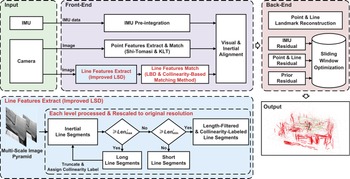
We propose a point-line VIO system, which integrates line features into the VINS-MONO and incorporates extensive system enhancements. Figure 1 illustrates the overall system, with the system composed of two primary threads: the front-end module and the back-end module. The front-end module is responsible for processing image and IMU data, while the back-end module implements state estimation.
System overview. The system consists of two primary threads: the front-end module and the back-end module. The components highlighted in red denote the key modules proposed in this work.
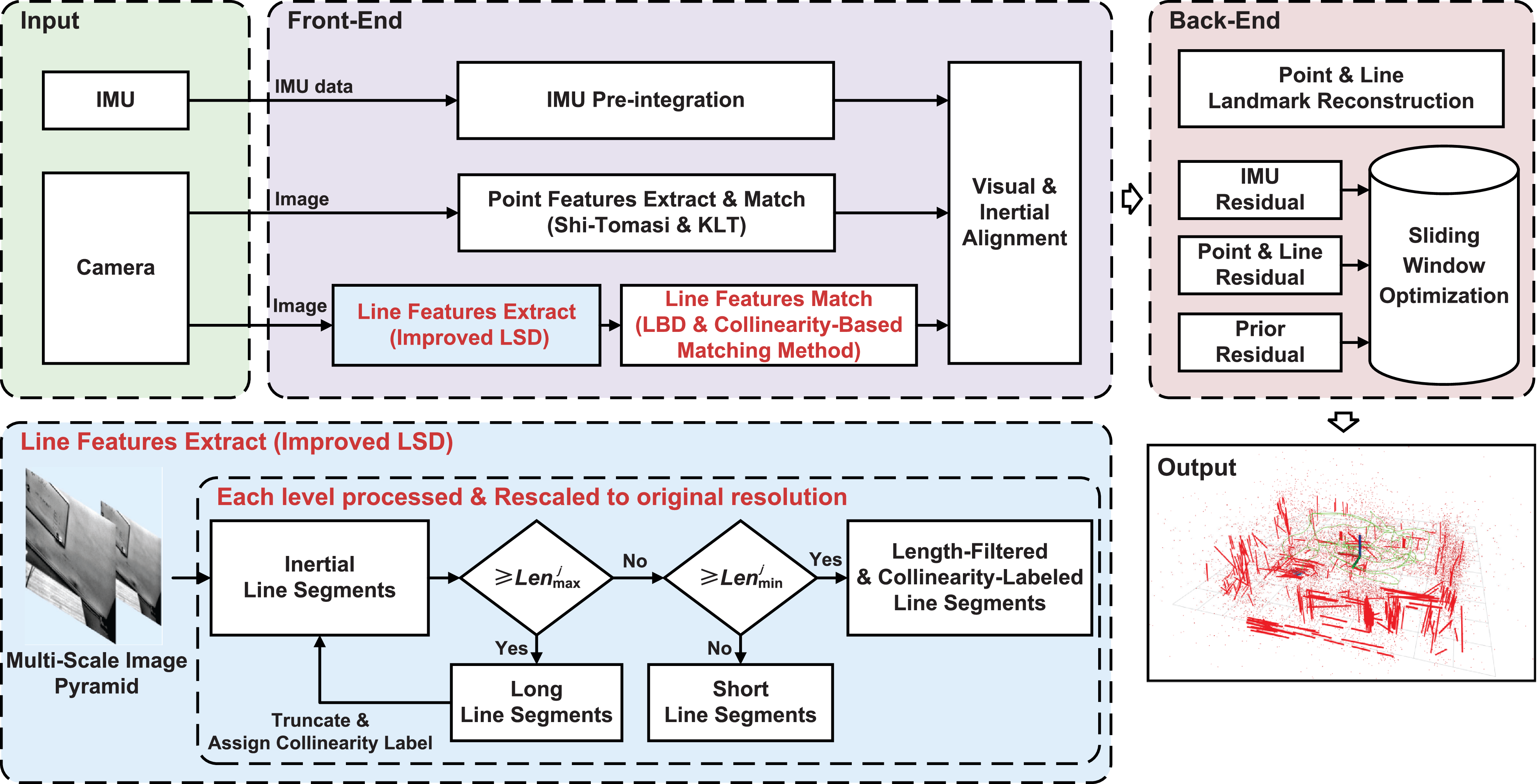
Figure 1. Long description
Panel A: The input section includes an IMU and a camera. The IMU data and images are processed in the front-end module. IMU data undergoes pre-integration, while images are used to extract and match point features using Shi-Tomasi and KLT methods. Line features are extracted using an improved LSD method and matched using LBD and collinearity-based matching methods. The visual and inertial data are aligned. Panel B: The back-end module includes point and line landmark reconstruction and sliding window optimization, which uses IMU residual, point and line residual, and prior residual. Panel C: The line features extraction process involves creating a multi-scale image pyramid, processing and rescaling each level to the original resolution, and filtering line segments based on length and collinearity. The output is a reconstructed 3D map.
The system first receives input data in the form of synchronized image frames and IMU data from a visual-inertial sensor suite.
In the front-end module, the system processes input images to extract and match both point and line features. For point features, the Shi–Tomasi algorithm [Reference Shi and Tomasi30] is employed to detect corner keypoints in keyframes, which are subsequently tracked across consecutive image frames using the KLT optical flow method [Reference Tomasi and Kanade31]. For line features, an improved LSD method is employed to extract length-filtered and collinearity-labeled line segments, which are subsequently matched using the LBD in conjunction with a collinearity-based matching method.
In parallel with visual feature processing, IMU data are continuously pre-integrated [Reference Forster, Carlone, Dellaert and Scaramuzza32] to provide high-frequency inertial constraints for motion estimation. Before being passed to the back-end module, keyframes are selected based on visual information, and the visual and inertial measurements are temporally aligned within the front-end. This process ensures consistent and synchronized inputs for the subsequent sliding-window optimization, thereby improving the stability of state estimation.
In the back-end module, matched point and line features are first reconstructed as initial 3D landmarks. Point landmarks are initialized through multi-view triangulation. For line landmarks, a dual-parameterization method is adopted. Specifically, spatial lines are reconstructed in Plücker coordinates and further associated with an orthogonal minimal representation [Reference Zhang, Lee, Lim and Suh15]. In this formulation, Plücker coordinates are used for geometric computation and reprojection error evaluation, while the orthogonal representation is employed during optimization to remove redundant degrees of freedom and improve numerical stability. This hybrid design enables an efficient and well-conditioned integration of line features into the back-end optimization.
Based on the reconstructed landmarks and IMU pre-integration, a tightly coupled sliding-window bundle adjustment problem is formulated [Reference Bustos, Chin, Eriksson and Reid33]. Within a fixed-size keyframe window, IMU poses, point inverse depths, and 3D line parameters are jointly optimized by minimizing the combined residuals of IMU measurements, point reprojection errors, and line reprojection errors under robust loss functions and prior constraints. To maintain real-time performance, outdated keyframes and their associated landmarks are marginalized from the optimization window, which effectively bounds the state dimension while preserving essential historical information [Reference Leutenegger, Furgale, Rabaud, Chli, Konolige and Siegwart34]. As a result, the back-end maintains both computational efficiency and stable state estimation in complex environments.
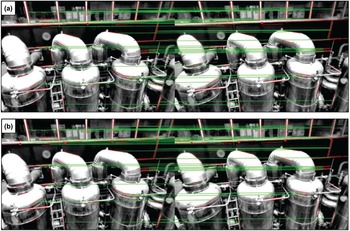
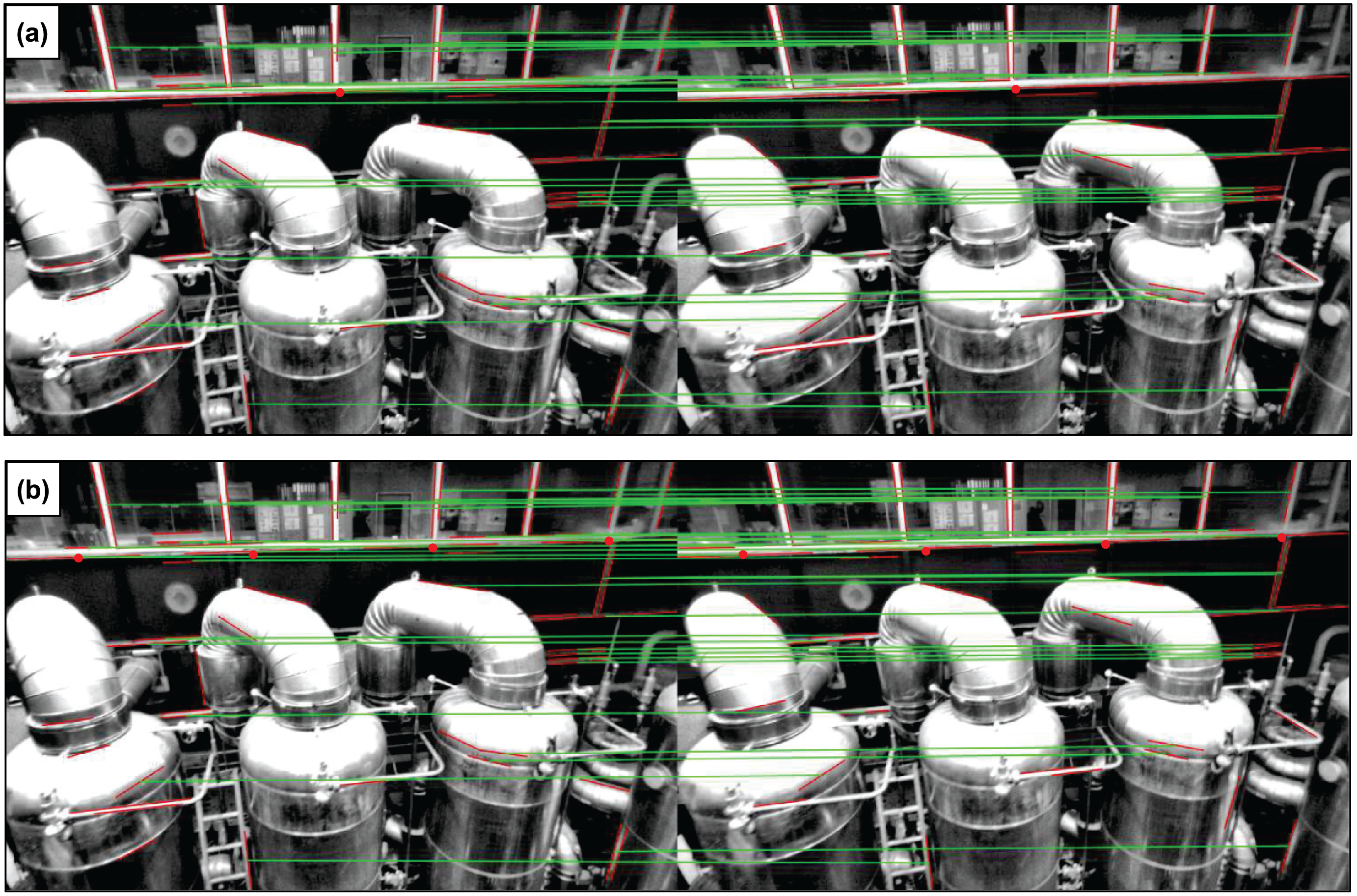
Line segment matching results for consecutive frames in the MH_05_difficult sequence of the EuRoC dataset. (a) Matching results with short-segment filtering only. (b) Matching results with additional long-segment truncation. Green lines denote matched segment pairs between two consecutive frames, while red dots indicate the midpoints of truncated sub-segment correspondences.
3.2. Line segments in VIO: Problem formulation and design principles
In typical point-line VIO systems, line features are extracted and matched in the front-end and then jointly optimized with point features and IMU measurements in the back-end [Reference Li, Cai, Zhao, Liu and Liu35, Reference Wu, Yu, Qu and Zhang36]. In front-end line feature processing, the combination of the LSD algorithm and the LBD descriptor is widely used. The LSD algorithm is a gradient-based detector that efficiently extracts line segments by fitting nearly collinear image gradients within local support regions. Paired with LSD, the LBD descriptor encodes gradient information around each segment into a binary vector, enabling fast and reliable inter-frame matching and data association.
However, since LSD relies on local gradient information, it often produces excessively short segments supported by only a few pixels in regions with fine texture. The geometric estimates of these segments are sensitive to noise and motion blur [Reference Liu, Liu, Yang and Zhang37]. Moreover, the corresponding LBD descriptors possess limited discriminative capability, which makes reliable tracking difficult while increasing the number of line landmarks to be maintained and the computational load of the back-end optimization.
On the other hand, in scenes containing long straight structures, LSD often merges large-scale line support regions into a single long line spanning the field of view. Geometrically, such segments can be observed across multiple frames, providing strong temporal constraints. However, when the entire long line segment participates as a single feature in LBD-based matching, its extensive coverage area and complex local textures result in high computational costs. By truncating such long line segments into several moderately sized sub-segments on the image plane, allowing them to participate independently in matching within local regions, more evenly distributed and relatively stable cross-frame matches can be obtained along the same physical edge. Compared to a single long line segment, these sub-segments provide the front-end with a more abundant and reasonably distributed set of observations, thereby supporting more stable and accurate VIO trajectory estimation.
Figure 2 compares line segment matching results between consecutive frames in the EuRoC MH_05_difficult sequence [Reference Burri, Nikolic, Gohl, Schneider, Rehder, Omari, Achtelik and Siegwart38]. Figure 2(a) shows the results obtained using short-segment filtering only, whereas Figure 2(b) additionally applies the proposed long-segment truncation method. Compared with filtering alone, the truncation-based method produces more evenly distributed correspondences along the same physical structures, resulting in more stable and consistent line observations.
However, relying solely on truncation strategies introduces new challenges. Sub-segments originating from the same 3D long line segment are treated as independent features at the front-end, making it easier for mismatches with adjacent segments to occur in complex scenarios. Numerous studies tend to merge collinear line segments and keep them as a single linear feature in order to achieve more stable consistency constraints [Reference Liu, Shi, Li, Qin, Zhang and Ren39–Reference Li and Qu41]. In practice, truncated sub-segments remain geometrically closely related, as they are collinear in the image plane and share similar directional and depth distributions. By leveraging this inherent collinearity, additional geometric information can be introduced to support potential correspondences, even when visual descriptors differ.
In summary, the original line segment processing method struggles to directly meet the stability and efficiency requirements of point-line VIO. Consequently, we propose the following design principles from two perspectives: (1) The length of each line segment should remain moderate. Excessively short segments supported by only a few pixels are removed, while overly long segments spanning a large field of view are divided into several medium-length sub-segments along the same physical edge. This ensures that each segment maintains reliable geometric support and yields a more uniform distribution of observations across the image. (2) Beyond local appearance LBD descriptors, lightweight geometric information is introduced to incorporate structural priors. Sub-segments originating from the same 3D long line segments are treated as correlated features for consistent association, thereby suppressing mismatches and improving the stability of inter-frame constraints.
Based on these principles, we propose a filtering strategy for LSD-extracted line segments, along with a collinearity-based matching method that incorporates collinearity priors. The proposed method is detailed in the following sections.
3.3. Line segment extraction
As discussed in Section 3.2, the original LSD algorithm tends to extract numerous short line segments that are sensitive to noise and a few overly long segments with wide coverage and complex textures, resulting in high computational costs. To address this, a line segment extraction pipeline is designed to maintain appropriate segment lengths by eliminating short segments and truncating overly long structural ones. The detailed methodology is presented below.
3.3.1. Line segment preprocessing
Initially, each input image frame is preprocessed for subsequent length-based filtering. A two-level Gaussian image pyramid [Reference Martorell, Buades and Lisani42] with a scaling factor of 2.0 is constructed to enable feature detection across multiple scales. By progressively smoothing and downsampling the image, this pyramid facilitates cross-scale line segment detector, enhancing coverage and robustness without incurring significant computational overhead.
Subsequently, the LSD algorithm is applied to each downsampled level of the image pyramid to extract line segments at multiple scales. For each level, length-based filtering is performed at its respective resolution. The filtered line segments are then uniformly scaled back to the original image resolution and aggregated to form the initial line segment set of the current image frame. The initial line segments from each level are denoted as:
 \begin{equation} L^j = \big\{l^{\,j}_1, l^{\,j}_2, l^{\,j}_3, \ldots , l^{\,j}_i\big\}, \quad i = 1, 2, \ldots , \quad j = 0, 1, \ldots \end{equation}
where
 $ L^j$
denotes the set of initial line segments extracted from the
 $j$
-th pyramid level of the current image frame, and
 $l^{\,j}_i$
represents an arbitrary segment within this set. Each line segment
 $l^{\,j}_i$
is represented by its two endpoints, as defined below:
 \begin{equation} l^{\,j}_i \rightarrow (A_i, B_i), \quad A_i(x_{A_i}, y_{A_i}), \quad B_i(x_{B_i}, y_{B_i}) \end{equation}
where
 $ A_i(x_{A_i}, y_{A_i})$
and
 $ B_i(x_{B_i}, y_{B_i})$
denote the start and end points of the line segment
 $ l^{\,j}_i$
in the two-dimensional image coordinate system. These endpoint coordinates define the position and orientation of the segment within the image plane.
Then, for each line segment
 $ l^{\,j}_i$
in
 $ L^j$
, we calculate the corresponding length
 $ Length(l^{\,j}_i)$
using the Euclidean distance formula:
 \begin{equation} Length\big(l^{\,j}_i\big)=\sqrt {(x_{B_i}-x_{A_i})^2+(y_{B_i}-y_{A_i})^2} \end{equation}
At each pyramid level, the diagonal length is computed from the corresponding image height and width. This diagonal serves as the basis for defining the minimum and maximum allowable line segment lengths, as formulated by the following equation:
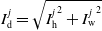 \begin{equation} I^j_{\mathrm{d}} = \sqrt {{I^j_{\mathrm{h}}}^2 + {I^j_{\mathrm{w}}}^2} \end{equation}
where
 $ I^j_{\mathrm{d}}$
denotes the image diagonal at the
 $ j$
-th pyramid level, and
 $ I^j_{\mathrm{h}}$
and
 $ I^j_{\mathrm{w}}$
are the image height and width, respectively. Since the diagonal is the largest span in the image in geometric terms, we use it as the basis for setting the maximum and minimum length thresholds for line segments, thereby determining the length constraints used in the line segment extraction process. The thresholds are defined as follows:
 \begin{equation} Len^{\,j}_{\mathrm{min}} = \alpha \times I^j_{\mathrm{d}}, \quad Len^{\,j}_{\mathrm{max}} = \beta \times I^j_{\mathrm{d}} \end{equation}
where
 $ Len^{\,j}_{\mathrm{min}}$
and
 $ Len^{\,j}_{\mathrm{max}}$
denote the minimum and maximum length thresholds for line segments at the
 $ j$
-th pyramid level, respectively. These thresholds are computed based on the diagonal length of the image at the corresponding resolution. The factors
 $ \alpha$
and
 $ \beta$
are the scaling coefficients applied to the image diagonal to determine
 $ Len^{\,j}_{\mathrm{min}}$
and
 $ Len^{\,j}_{\mathrm{max}}$
.
3.3.2. Truncation and collinearity labeling of overly long segments
After preprocessing the segments and obtaining the required conditions, we first follow the steps to evaluate each segment
 $ l^{\,j}_i$
to determine if it is overly long by comparing the segment length
 $ Length(l^{\,j}_i)$
to the maximum length threshold
 $ Len^{\,j}_{\mathrm{max}}$
:
 \begin{equation} \frac {Length\big(l^{\,j}_i\big)}{Len^{\,j}_{\mathrm{max}}}\geq 1 \end{equation}
For the line segments that satisfy Eq. (6), we recognize them as overly long segments
 $ Long^{\,j}_i$
and add them to the set of overly long segments
 $ Long^{\,j}$
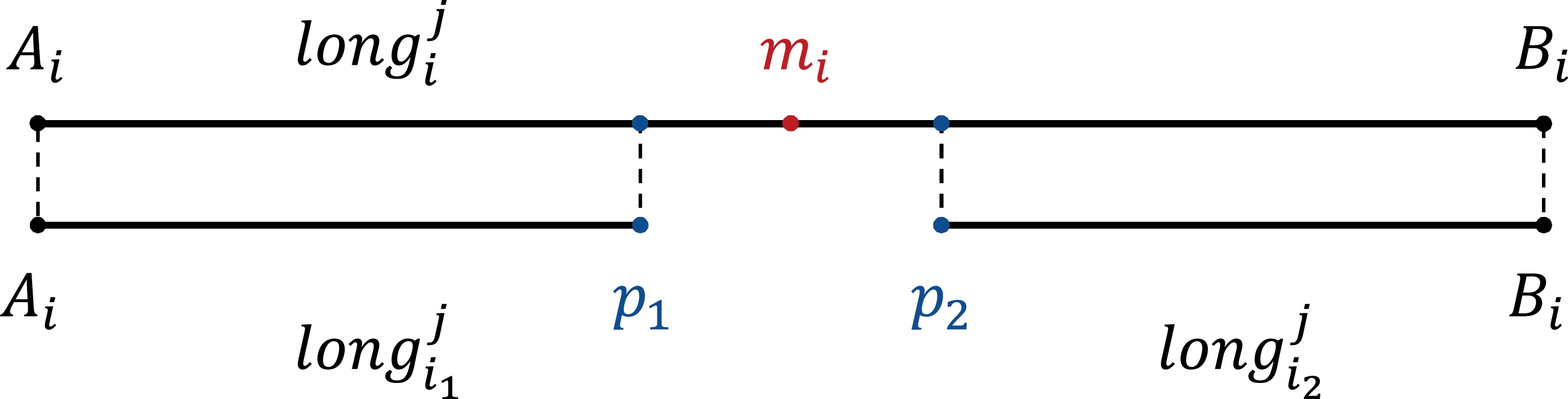
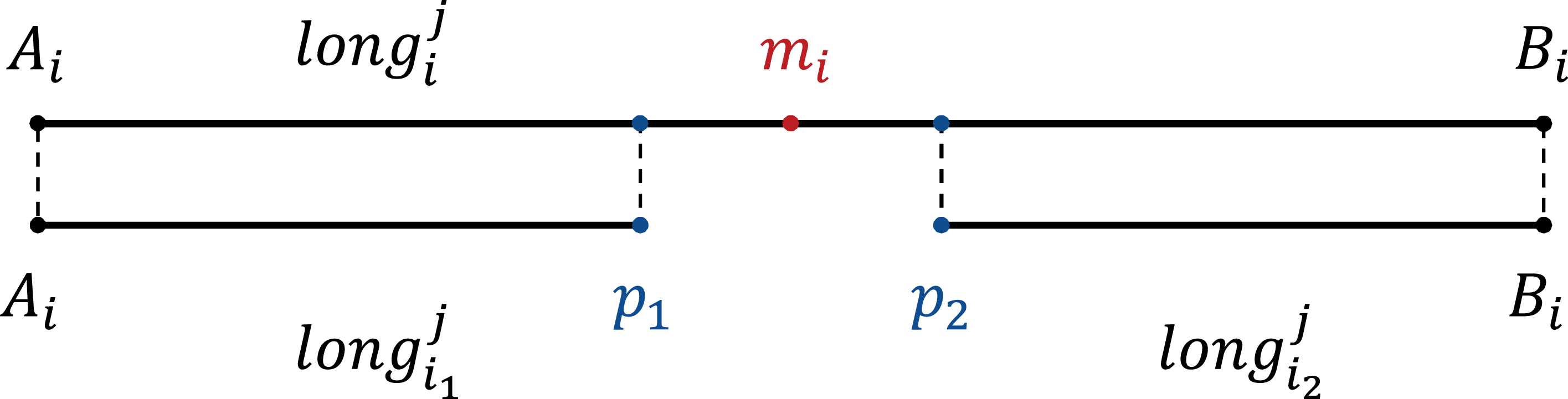
. Subsequently, the extracted line segments are further processed using the proposed truncation method. Overly long segments and their resulting sub-segments are assigned collinearity labels for subsequent feature matching. An illustration of the line segment truncation and collinearity labeling process is shown in Figure 3, with detailed steps as follows:
Line truncation and collinearity labeling process.
For any long segment
 $ Long^{\,j}_i$
in the set of long segments
 $ Long^{\,j}$
, we first calculate its midpoint
 $ m_i(x_m, y_m)$
based on the coordinates of its endpoints:
 \begin{equation} x_m=\frac {x_{A_i}+x_{B_i}}2,\quad y_m=\frac {y_{A_i}+y_{B_i}}2 \end{equation}
where the midpoint
 $ m_i$
serves as the reference point for subsequent truncation operations.
In order to ensure that after the truncation operation, the two line segments generated can maintain an appropriate distance between them to avoid overlapping or mismatching during feature matching, we introduce a truncation ratio coefficient
 $ r$
, which is calculated as:
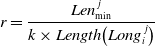 \begin{equation} r=\frac {Len^{\,j}_{\mathrm{min}}}{k \times Length\big(Long^{\,j}_i\big)} \end{equation}
where
 $ k$
is an adjustment coefficient used to control the truncation ratio. In preliminary experiments,
 $ k$
was empirically set to 2.0 and kept fixed throughout all experiments. With this setting, the distance between the two sub-segments after truncation is approximately equal to the minimum acceptable segment length, which helps avoid overlap and reduces the risk of mismatches during subsequent feature matching.
Based on the truncation ratio coefficient
 $ r$
and the midpoint
 $ m_i$
of the original long line segment, the coordinates of the truncation points
 $ p_1$
and
 $ p_2$
in the image coordinate system can be computed as follows:
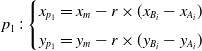 \begin{align} p_1\,: \begin{cases} x_{p_1}=x_m-r\times (x_{B_i}-x_{A_i}) \\[3pt] y_{p_1}=y_m-r\times (y_{B_i}-y_{A_i}) \end{cases} \\[-10pt] \nonumber \end{align}
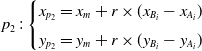 \begin{align} p_2\,: \begin{cases} x_{p_2}=x_m+r\times (x_{B_i}-x_{A_i}) \\[3pt] y_{p_2}=y_m+r\times (y_{B_i}-y_{A_i}) \end{cases} \\[10pt] \nonumber\end{align}
With Eqs. (9) and (10), we obtain the two truncation points
 $ p_1$
and
 $ p_2$
on the line segment, whose coordinates are
 $ (x_{p_1},y_{p_1})$
and
 $ (x_{p_2},y_{p_2})$
. Finally, using the start and end points of the original long line segment and these two truncation points, we can construct two new line segments that satisfy the length requirement, which can be represented by the end points as:
 \begin{align} Long^{\,j}_{i_1}=\{(x_{A_i},y_{A_i}),(x_{p_1},y_{p_1})\} \\[-10pt] \nonumber\end{align}
 \begin{align} Long^{\,j}_{i_2}=\{(x_{p_2},y_{p_2}),(x_{B_i},y_{B_i})\} \\[10pt] \nonumber \end{align}
Through the truncation process, each overly long line segment in the set
 $Long^{\,j}$
is divided into two shorter sub-segments whose lengths fall below the predefined maximum threshold
 $Len^{\,j}_{\mathrm{max}}$
. Each sub-segment covers only a local portion of the original edge, with spacing controlled to minimize overlap, which helps improve descriptor stability and reduces matching ambiguity. Structural collinearity labels are assigned to the original segment and its two sub-segments, denoted as
 $Long^{\,j}_i$
,
 $Long^{\,j}_{i_1}$
, and
 $Long^{\,j}_{i_2}$
, indicating that they belong to the same collinearity group. These labels serve as the basis for the subsequent collinearity-based matching method.
3.3.3. Filtering of short line segments
After overly long line segments have been truncated, each segment in the line segment set is further evaluated to determine whether it satisfies the minimum length requirement
 $ Len^{\,j}_{\mathrm{min}}$
. Specifically, a line segment is retained if the ratio between its length and the minimum threshold satisfies the following condition:
 \begin{equation} \frac {Length\big(l^{\,j}_i\big)}{Len^{\,j}_{\mathrm{min}}} \geq 1 \end{equation}
Line segments that meet the above condition are retained and rescaled back to the original image resolution. These are then output as length-filtered and collinearity-labeled segments for subsequent feature matching and computation. Conversely, segments that do not satisfy this criterion are discarded to ensure the geometric quality and usability of the final output.
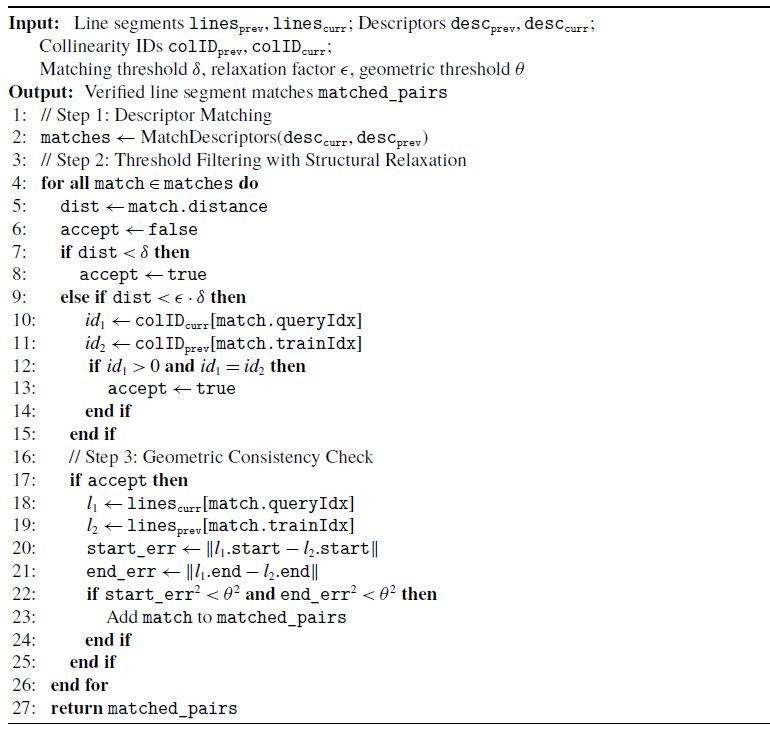
Line segment feature matching with structural guidance
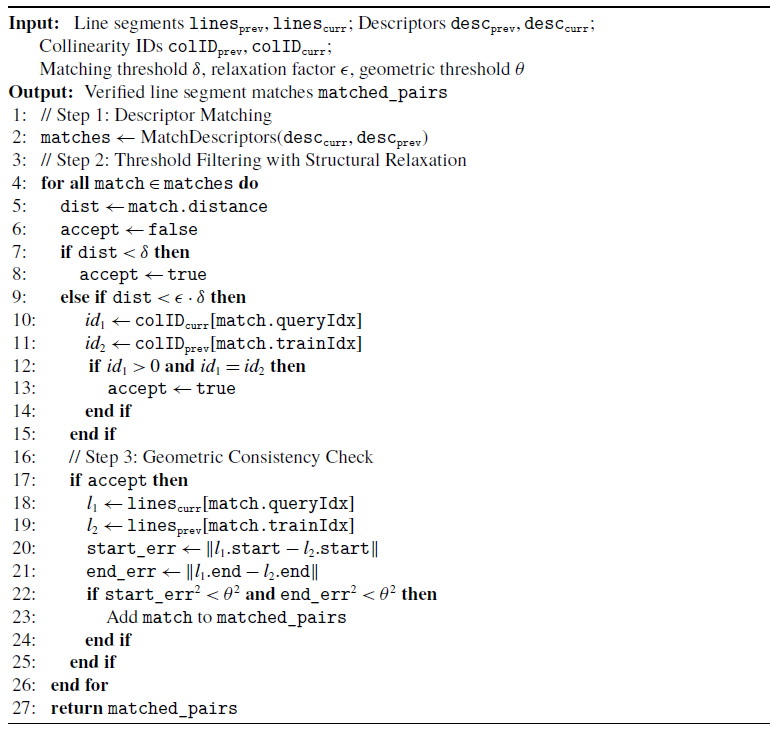
Algorithm 1 Long description
An algorithm for matching line segments with structural guidance. The process begins with descriptor matching. It then applies threshold filtering with structural relaxation. Finally, it performs a geometric consistency check. The algorithm takes line segments, descriptors, collinearity IDs, and thresholds as inputs and outputs verified line segment matches.
3.4. Line segment matching
After line segments are extracted and regularized, a remaining question is how to exploit their structural properties to improve inter-frame matching. As discussed in Section 3.2, while truncation enhances the geometric stability of line segments, it also causes homologous sub-segments at the front-end to be treated as independent features, thereby increasing the likelihood of erroneous matching in complex scenes. To address this issue, we incorporate the collinearity information introduced by truncation as a structural prior in the matching stage, leading to a collinearity-based matching method. The overall procedure is summarized in Algorithm 1, where the matching threshold is set to
 $\delta = 30$
, the relaxation factor to
 $\epsilon = 1.2$
, and the geometric consistency threshold to
 $\theta = 60$
. These values were empirically determined in preliminary tests and kept fixed throughout all experiments to ensure a consistent evaluation. Specifically,
 $\delta$
defines the basic descriptor-distance threshold,
 $\epsilon$
allows a limited relaxation for candidate matches with the same collinearity label, and
 $\theta$
rejects matches with large endpoint deviations.
In the matching stage, LBD descriptors are computed for the selected line segments, and initial matches are obtained using the BinaryDescriptorMatcher [Reference Norouzi, Punjani and Fleet43]. All matches are then filtered based on descriptor distance. For those slightly exceeding the threshold, we further check whether the matched line segments in the current and previous frames share the same collinearity ID. If so, the match is considered structurally consistent and accepted under a relaxed threshold. Subsequently, geometric consistency is verified by evaluating the spatial proximity of the matched endpoints.
Finally, matched line segments are assigned consistent tracking IDs for cross-frame association, while unmatched segments are retained as new candidates for subsequent tracking. These verified matches serve as input to the back-end pose estimation module. This structural guidance strategy can effectively utilize the collinearity of the truncated line segments.
4. Experiments
In this section, we present a comprehensive experimental evaluation of the proposed length-filtered and collinearity-labeled line segment processing method, as well as the performance of the proposed VIO system in structured and low-texture environments. Three sets of experiments are conducted to assess the effectiveness of the line segment processing method, compare the overall system performance against existing approaches, and validate the feasibility of real-world deployment. All experiments are carried out on a platform running Ubuntu 18.04 with an Intel Core i7-4700MQ CPU @ 2.40 GHz.
4.1. Comparative evaluation of line segment processing methods on public dataset
To evaluate the effectiveness of the proposed line segment extraction and collinearity-based matching methods, we conduct a threshold experiment and an ablation experiment.
4.1.1. Threshold experiment
The threshold experiment aims to evaluate and determine the optimal parameters for line segment length filtering, namely the short-length coefficient
 $\alpha$
and the long-length coefficient
 $\beta$
, which have been previously defined in Eq. (5). These coefficients are applied in the proposed short-segment elimination and long-segment truncation strategies. The parameter configuration identified from this experiment is employed in all subsequent evaluations throughout the paper. Moreover, the parameters used in the long-segment truncation and matching stages, namely
 $k$
,
 $\delta$
,
 $\epsilon$
, and
 $\theta$
, were kept fixed throughout all experiments.
The evaluation is conducted on the MH05_difficult sequence of the EuRoC MAV dataset [Reference Burri, Nikolic, Gohl, Schneider, Rehder, Omari, Achtelik and Siegwart38], which contains abundant line segments and presents significant challenges due to its rapid motion and strong illumination variations. We run the proposed VIO system, which incorporates line segment filtering and a collinearity-based matching method, under 25 different
 $ \alpha$
-
 $ \beta$
combinations.
The evaluation metrics selected are the average number of extracted line segments, average extraction time per frame, and matching performance. The reported number of line segments represents the average per-frame count of segments retained after computing the LBD descriptors, while the extraction time, also averaged over all frames, includes line detection, filtering, scale recovery, and descriptor calculation, providing a comprehensive measure of line segment processing effect and segment quality.
Matching performance is evaluated using Recall and Acceptance, which quantitatively measure the completeness of the exploited line segments and the acceptance rate of candidate matches, respectively. Recall indicates the percentage of potential matches that are successfully identified. Acceptance measures the proportion of candidate correspondences that are finally accepted by the matching pipeline. Higher recall and acceptance rates indicate that more structural segments are converted into reliable inter-frame constraints, which is more beneficial for trajectory estimation. These metrics are formulated as:
 \begin{align} \mathrm{Recall}=\frac {\text{FinalMatches}}{\text{PossibleMatches}}\times 100\% \\[-8pt] \nonumber \end{align}
 \begin{align} \mathrm{Acceptance}=\frac {\text{FinalMatches}}{\text{TotalMatches}}\times 100\% \\[10pt] \nonumber \end{align}
where PossibleMatches denotes the total number of line segments in the current frame with valid LBD descriptors, representing the maximum number of potential matches. TotalMatches denotes the total number of candidate correspondences produced by the initial matching stage in Algorithm 1, which uses the BinaryDescriptorMatcher method based purely on raw descriptor similarity. FinalMatches refers to the number of correspondences retained after completing the full verification pipeline outlined in Algorithm 1, which includes descriptor-distance thresholding, collinearity-guided relaxation, and geometric consistency checks based on line orientations and the proximity of segment endpoints. Eqs. (14) and (15) provide a consistent and comparable basis for evaluating matching completeness across different sequences. For better interpretability, we also report the average recall and acceptance values to summarize overall matching stability.
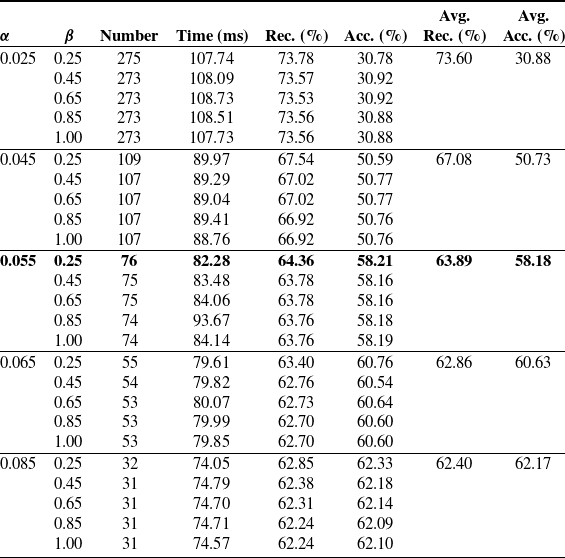
The detailed results of the thresholding experiment, which evaluates the influence of different line segment length filtering thresholds, are presented in Table I to illustrate their impact on matching performance and processing efficiency.
Threshold evaluation on MH_05_difficult sequence (EuRoC MAV Dataset).
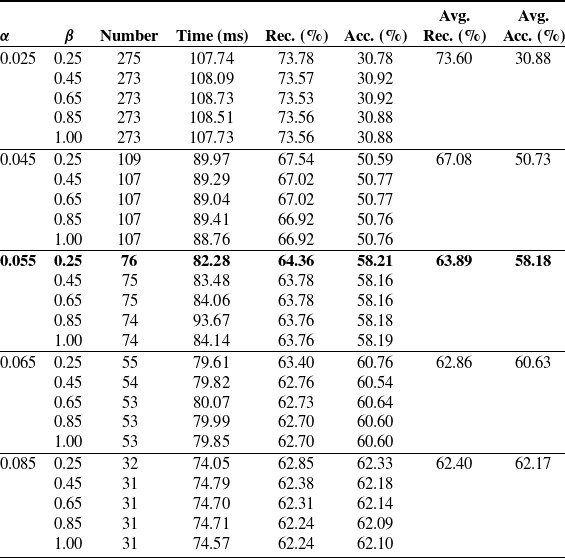
Table I. Long description
The table presents the results of a thresholding experiment, focusing on the impact of different line segment length filtering thresholds on matching performance and processing efficiency. It has 5 rows and 9 columns. The columns are labeled as follows: alpha, beta, Number, Time (ms), Rec. (%), Acc. (%), Avg. Rec. (%), and Avg. Acc. (%). The table is divided into four groups based on different alpha values: 0.025, 0.045, 0.055, and 0.065. Each group contains multiple rows with varying beta values and corresponding data. For example, in the first group with alpha value 0.025, the beta values range from 0.25 to 1.00, and the corresponding data includes the number of instances, time in milliseconds, recognition percentage, accuracy percentage, and average recognition and accuracy percentages. Similar patterns are observed in the other groups with different alpha values. The table provides a detailed comparison of how different thresholds affect the performance and efficiency of the matching process.
As shown in Table I, increasing
 $\alpha$
leads to a gradual reduction in the average number of extracted line segments per frame and the corresponding processing time. At the same time, the recall of line matching decreases, while the acceptance consistently improves. This trend occurs because smaller values of
 $\alpha$
retain more short segments, resulting in higher quantity but also introducing noise, which degrades matching accuracy. Conversely, larger
 $\alpha$
values apply stricter filtering, improving acceptance but reducing the number of segments available for matching, thereby lowering recall. At
 $\alpha =0.055$
, a desirable trade-off is achieved, balancing segment quantity, processing efficiency, and matching performance.
Further analysis of
 $\beta$
reveals that when
 $\alpha =0.055$
, the configuration
 $\beta =0.25$
delivers the best performance: it yields the lowest processing time (82.28 ms) while maintaining comparable matching performance (64.36% recall and 58.21% acceptance). These results confirm that constraining segment lengths within a moderate and scale-normalized range, as described in Section 3.2, effectively reduces redundant processing while preserving geometric richness, leading to a balanced trade-off between matching robustness and computational efficiency.
4.1.2. Ablation experiment
The ablation study is conducted to assess the contribution of each module within the proposed line segment processing strategy. Four comparative configurations are considered: (1) LSD, the original LSD algorithm; (2) Short-Filtered LSD, which applies short-segment elimination to LSD; (3) Length-Filtered LSD, which incorporates both short-segment elimination and long-segment truncation; and (4) Length-Filtered and Collinearity-Labeled LSD, the proposed method, which further combines length filtering with collinearity labeling. For all configurations involving length filtering, the minimum and maximum line segment lengths are determined according to Eq. (5), with the coefficients
 $\alpha$
and
 $\beta$
set to the optimal values selected from the threshold experiment results summarized in Table I.
For feature matching, the LSD, Short-Filtered LSD, and Length-Filtered LSD configurations adopt the baseline strategy outlined in Algorithm 1, which involves descriptor matching, distance-based filtering, and geometric consistency checks on segment orientations and endpoints, without the use of collinearity-guided relaxation. In contrast, the proposed method employs the complete matching pipeline. All configurations are evaluated within the proposed VIO system.
The evaluation metrics are consistent with those used in the threshold experiment, including the average number of extracted line segments per frame, the average extraction time per frame, and the recall and acceptance of feature matching. The line segment matching procedure used to compute recall and acceptance for each method follows the description provided in the preceding paragraph. In addition, to provide a more comprehensive assessment of the impact on overall VIO accuracy, we introduce the root mean square error (RMSE) of the absolute trajectory error (ATE) as an additional metric. The results of the ablation experiment are presented in Table II. Moreover, to provide intuitive evidence of the improvement, we visualize the extracted line segments for different methods in Figure 4.
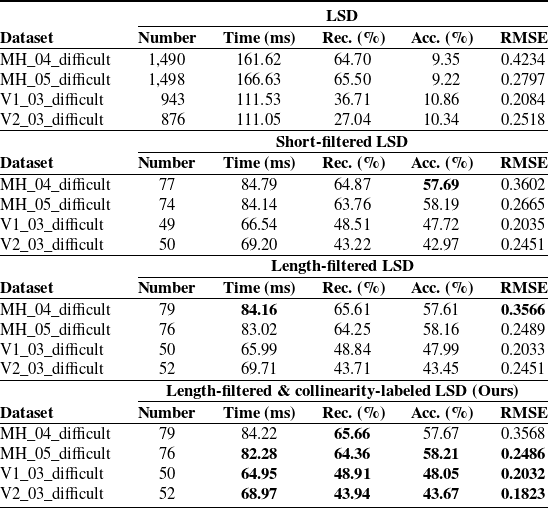
As shown in Table II, the proposed method achieves the best overall performance across all comparison configurations. When employing the original LSD configuration, the average RMSE of ATE across the four sequences is approximately 0.291 m. Applying the proposed method reduces this to 0.248 m, while also improving processing time, recall, and acceptance. Particularly on the V2_03_difficult sequence, the RMSE of ATE decreased from 0.2518 m to 0.1823 m, representing an improvement of approximately 27%.
Ablation experiment on the EuRoC MAV dataset.
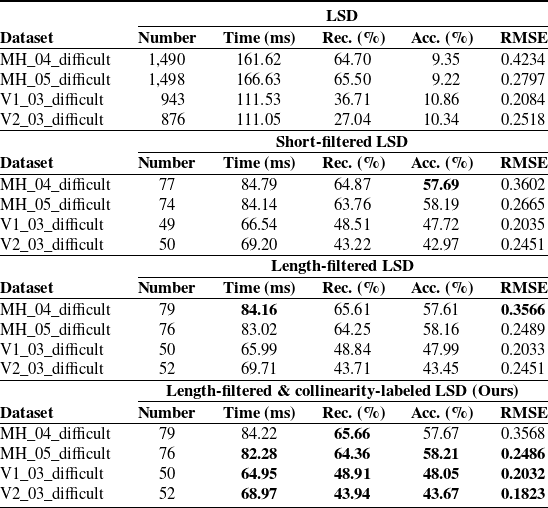
Table II. Long description
The table presents a comparison of performance metrics for different line segment detector methods on the EuRoC MAV dataset. It includes four main sections: LSD, Short-filtered LSD, Length-filtered LSD, and Length-filtered & collinearity-labeled LSD. Each section lists datasets with corresponding metrics: Number, Time (ms), Rec. (%), Acc. (%), and RMSE. The datasets include MH_04_difficult, MH_05_difficult, V1_03_difficult, and V2_03_difficult. For example, in the LSD section, MH_04_difficult has 1,490 line segments, 161.62 ms time, 64.70 percent recall, 9.35 percent accuracy, and 0.4234 RMSE. The table provides a detailed comparison of the performance of different methods across various metrics.
Most existing line-feature VIO systems only eliminate excessively short segments, a strategy corresponding to the Short-filtered LSD configuration in our ablation experiments. Compared to raw LSD outputs, merely removing short segments reduces the average number of segments by over an order of magnitude, yielding improvements in matching accuracy and trajectory estimation accuracy.
Building upon short-segment elimination, we further introduce truncation for excessively long segments in the Length-filtered LSD configuration. Although long segments are relatively rare in practice and have limited impact on the total number of features, truncation effectively reduces the physical span of long structural edges, resulting in slight improvements in accuracy and runtime. A consistent downward trend in line segment processing time is observed from LSD to short-filtered and then to length-filtered configurations. This is because the timing includes not only line extraction but also length-based filtering, scale recovery, and descriptor computation. By removing redundant short lines and shortening overly long ones, the amount of data to be processed is reduced, which lowers the computational cost of descriptor extraction and contributes to better overall estimation accuracy.
When structural priors are further incorporated through collinearity labeling, additional improvements are observed in recall, acceptance, and trajectory estimation accuracy. This demonstrates that constraining segment lengths within a reasonable range and incorporating collinearity priors produce complementary effects, enhancing the stability and reliability of line feature matching – particularly in weakly textured scenes.
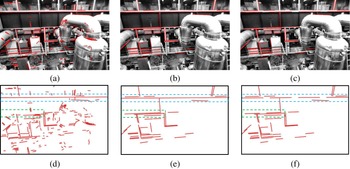
Figure 4 presents qualitative comparison results on the MH_05_difficult sequence, where two overly long segments are highlighted with blue and green dashed boxes, respectively. In Figures 4(a) and (d), the original LSD outputs contain numerous excessively short and fragmented segments densely distributed within textured regions, primarily introducing noise and increasing computational overhead. Following the elimination of excessively short segments, the segment distributions in Figures 4(b) and (e) exhibit markedly improved organization. Nevertheless, certain structural boundaries (such as the regions within dashed boxes) remain represented by excessively long segments. Upon applying the proposed length filtering and collinearity labeling method, as shown in Figures 4(c) and (f), these overly long segments are effectively truncated into multiple medium-length sub-segments, whilst redundant fragments are simultaneously eliminated. The resulting segments are not only more consistently detected across frames, but also exhibit stronger geometric consistency through collinearity, forming a compact and information-rich representation.
Comparison of line segment detector results for different methods on the MH_05_difficult sequence. (a)–(c): Extracted line segments overlaid on the original images. (d)–(f): Extracted line segments mapped onto a white background for clearer visualization. From left to right: (a), (d) LSD; (b), (e) Short-filtered LSD; (c), (f) Proposed method.
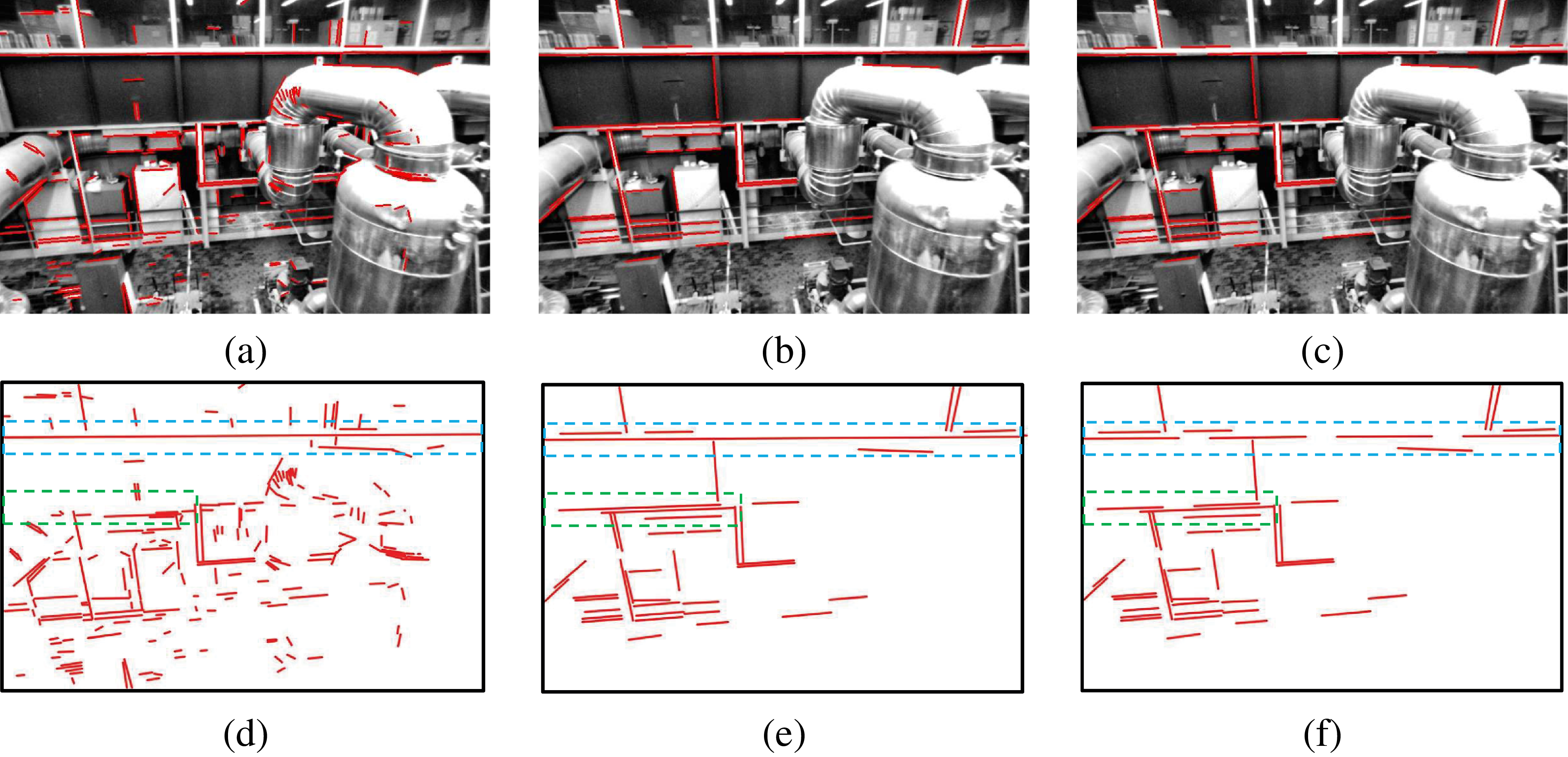
Figure 4. Long description
Panel A: Extracted line segments overlaid on the original image using LSD method. Panel B: Extracted line segments overlaid on the original image using Short-filtered LSD method. Panel C: Extracted line segments overlaid on the original image using the proposed method. Panel D: Extracted line segments mapped onto a white background using LSD method. Panel E: Extracted line segments mapped onto a white background using Short-filtered LSD method. Panel F: Extracted line segments mapped onto a white background using the proposed method.
This improvement aligns with the quantitative results presented in Table II. On the V2_03_difficult sequence, our method achieves the best overall performance across key metrics, with 52 retained segments and 68.97 ms processing time per frame, while reaching 43.94% recall and 43.67% acceptance, and yielding the lowest trajectory error (0.1823 m).
These observations confirm that eliminating excessively short segments, truncating overly long structural segments, and exploiting collinearity among the resulting sub-segments jointly contribute to more robust line matching and improved VIO accuracy. This aligns with the two design principles summarized in Section 3.2.
4.2. Comparative evaluation of VIO methods on public datasets
To evaluate the performance of the proposed VIO system and the effectiveness of the line segment processing method, we conduct experiments on public datasets encompassing both structured indoor and unstructured outdoor scenarios.
Structured indoor experiments are primarily conducted on the EuRoC MAV dataset, with the corridor sequences from the TUM-VI dataset [Reference Schubert, Goll, Demmel, Usenko, Stückler and Cremers44] included as complementary validation, while unstructured outdoor experiments are performed on the BotanicGarden dataset [Reference Liu, Fu, Qin, Xu, Xu, Chen, Goossens, Sun, Yu, Liu, Chen, Tao and Zhao45].
All methods are evaluated under identical parameter settings, and the proposed method is benchmarked against three representative VIO baselines: VINS-MONO [Reference Qin, Li and Shen2], PL-VIO [Reference He, Zhao, Guo, He and Yuan22], and PL-VINS [Reference Fu, Wang, Yu, Ali, Guo, He and Zhang23]. In all experiments, loop-closure modules are disabled for every method so that the comparison reflects pure VIO performance without being affected by different mapping or pose-graph optimization strategies. For the TUM-VI sequences, which are captured using a wide field-of-view fisheye stereo camera, all methods are evaluated under a unified fisheye camera configuration. The calibrated fisheye projection model is applied consistently across methods to process the raw images.
We use the RMSE and MAX of ATE to evaluate localization accuracy. RMSE measures the average deviation between estimated and groundtruth trajectories, whereas MAX reflects the worst-case error. Average RMSE and MAX values across sequences are also reported for comparison.
4.2.1. Structured indoor scenes: EuRoC MAV and TUM-VI datasets
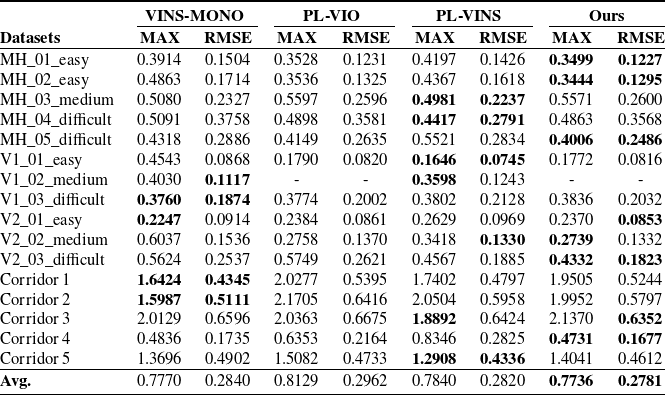
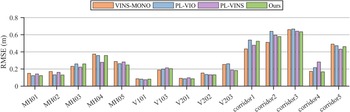
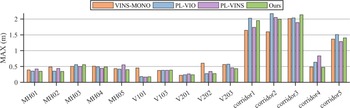
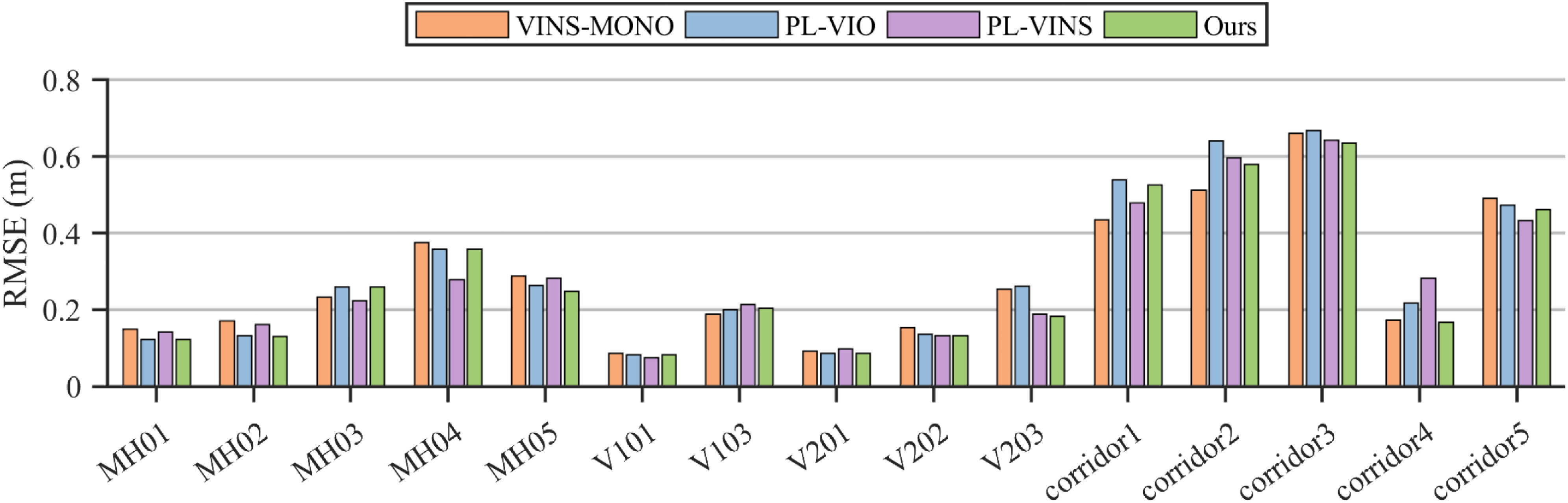
All methods are evaluated in structured indoor environments, using the machine-hall and room sequences from the EuRoC MAV dataset, along with the corridor sequences of TUM-VI as representative scenarios. These environments are characterized by dominant linear structures and repetitive man-made geometry, but contain relatively limited texture, particularly in corridor scenes where long straight-line motion and strong directional layout emphasize geometric consistency over texture-based cues. The quantitative results are summarized in Table III, with corresponding bar chart visualizations provided in Figures 5 and 6. Note that the V1_02_medium sequence is excluded from both the average (Avg.) values reported in the last row and the corresponding bar chart visualizations, due to incomplete results across all methods.
Experiment on structured indoor datasets (EuRoC MAV & TUM-VI).
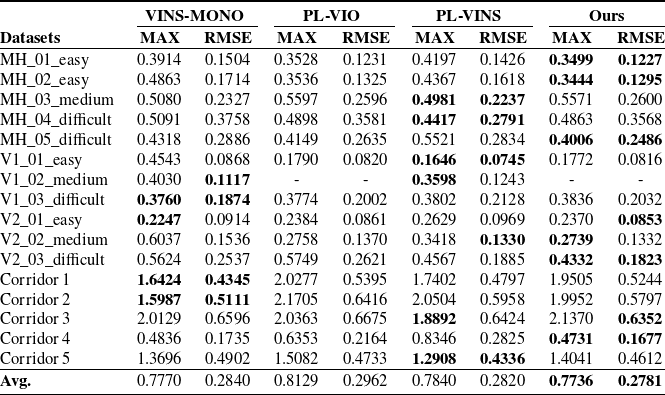
Table III. Long description
A table comparing performance metrics across different datasets and methods. The table has 15 rows and 13 columns. The columns are labeled as follows: Datasets, VINS-MONO MAX, VINS-MONO RMSE, PL-VIO MAX, PL-VIO RMSE, PL-VINS MAX, PL-VINS RMSE, Ours MAX, Ours RMSE. The rows are labeled with different datasets: MH_01_easy, MH_02_easy, MH_03_medium, MH_04_difficult, MH_05_difficult, V1_01_easy, V1_02_medium, V1_03_difficult, V2_01_easy, V2_02_medium, V2_03_difficult, Corridor 1, Corridor 2, Corridor 3, Corridor 4, Corridor 5, Avg. Each cell contains numerical values representing the performance metrics for each method on the respective dataset.
According to the results, the proposed method attains the lowest average MAX and RMSE of ATE over all structured indoor sequences, slightly outperforming the point-only VINS-MONO and the point-line baselines PL-VIO and PL-VINS. The relative improvement is modest (about 2–3% in RMSE on average), but it indicates that the proposed length-filtered and collinearity-labeled line segments provide a consistently beneficial complement to standard point and line measurements in these environments.
RMSE of ATE across structured indoor datasets (EuRoC MAV & TUM-VI).
MAX of ATE across structured indoor datasets (EuRoC MAV & TUM-VI).
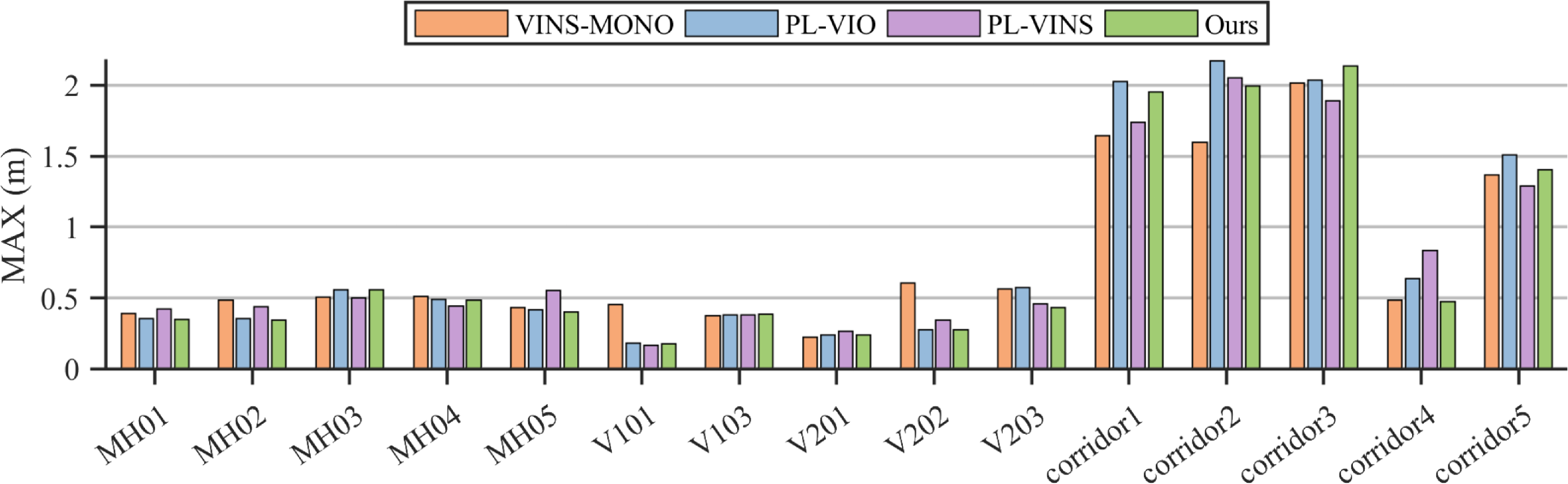
On the EuRoC MAV dataset, performance gains are most evident in sequences with strong structural cues. In the machine-hall sequences, which feature numerous pillars, beams, and pipelines, the proposed method achieves lower MAX and RMSE values in most sequences, with the most notable improvement observed on MH_05_difficult. Here, RMSE decreases from 0.2886 m (VINS-MONO) and 0.2635/0.2834 m (PL-VIO/PL-VINS) to 0.2486 m with our method, corresponding to a 14% reduction over VINS-MONO and 6% over PL-VIO. These improvements are attributed to the elimination of excessively short segments and truncation of overly long ones, which helps avoid lines crossing depth discontinuities. Collinearity labeling further stabilizes the matching of truncated segments, ensuring that the added line constraints remain geometrically valid and temporally consistent.
For the V1_02_medium sequence, fast motion and severe image blur result in sparse and noisy line extraction. Under these conditions, our estimator fails to converge, whereas VINS-MONO and PL-VINS remain stable, with RMSE values of 0.1117 m and 0.1243 m, respectively. These results indicate that our method is less effective in room-like environments where sufficient texture exists but reliable line features are limited. In such cases, point-based or conventional point-and-line methods may offer greater robustness. By contrast, for room sequences that contain both adequate texture and a moderate number of structural edges, such as V2_03_difficult, our method demonstrates noticeable improvements in ATE compared with both VINS-MONO and PL-VINS.
The TUM-VI corridor sequences demonstrate a similar trend under more complex geometric conditions. In the Corridor 4 sequence, which involves turning and lateral motion, and where hallway structures such as doors and openings introduce line segments with varying orientations and depths, our method achieves the lowest RMSE among all evaluated approaches. Specifically, the RMSE reaches 0.1677 m, compared to 0.1735 m for VINS-MONO, 0.2164 m for PL-VIO, and 0.2825 m for PL-VINS, representing an improvement of approximately 3% over VINS-MONO and more than 20% to 40% over the two line-based baselines. It is worth noting that the TUM-VI dataset is recorded using a fisheye camera. Although all methods are evaluated under fisheye settings, the point-based VINS-MONO demonstrates strong performance by effectively handling residual distortion, which partly accounts for its accuracy on these sequences. Despite this, the proposed method with length-filtered and collinearity-labeled line features introduces additional structural constraints, resulting in the best accuracy on Corridor 4 sequence.
Overall, the results indicate that the proposed system achieves more consistent accuracy improvements across structured indoor sequences. For the point-only baseline VINS-MONO, tracking becomes less reliable in low-texture and highly structured scenes where repeatable point features are insufficient, leading to weaker geometric constraints and increased drift. By incorporating line features, dominant structural edges provide complementary and more stable constraints, which helps reduce trajectory errors. Compared with PL-VIO and PL-VINS, which mainly remove excessively short segments, our method further regularizes line observations to improve matching stability and efficiency. Although the advantage may diminish in a few sequences with rapid motion and severe blur, the proposed method performs better on more structured sequences and achieves the best overall average results, indicating that our line-segment processing strategy provides more reliable structural constraints and improves the robustness and accuracy of point-line VIO.
4.2.2. Unstructured outdoor scenes: BotanicGarden dataset
To further evaluate the robustness and generalization capability of our method in natural, unstructured outdoor environments where reliable line segments are relatively sparse, we conduct additional experiments on the BotanicGarden dataset. The dataset mainly contains trees, shrubs, grassland and other vegetation-dominated areas, while only a few man-made structures such as buildings and bridges are visible. These characteristics make BotanicGarden a representative and challenging benchmark for evaluating our line-enhanced VIO in scenarios with sparse and irregular structural lines.
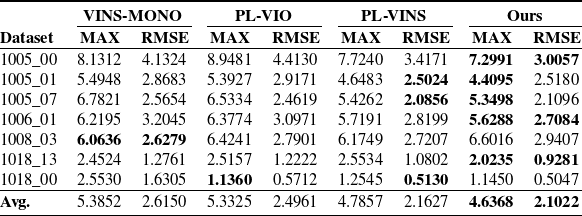
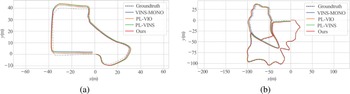
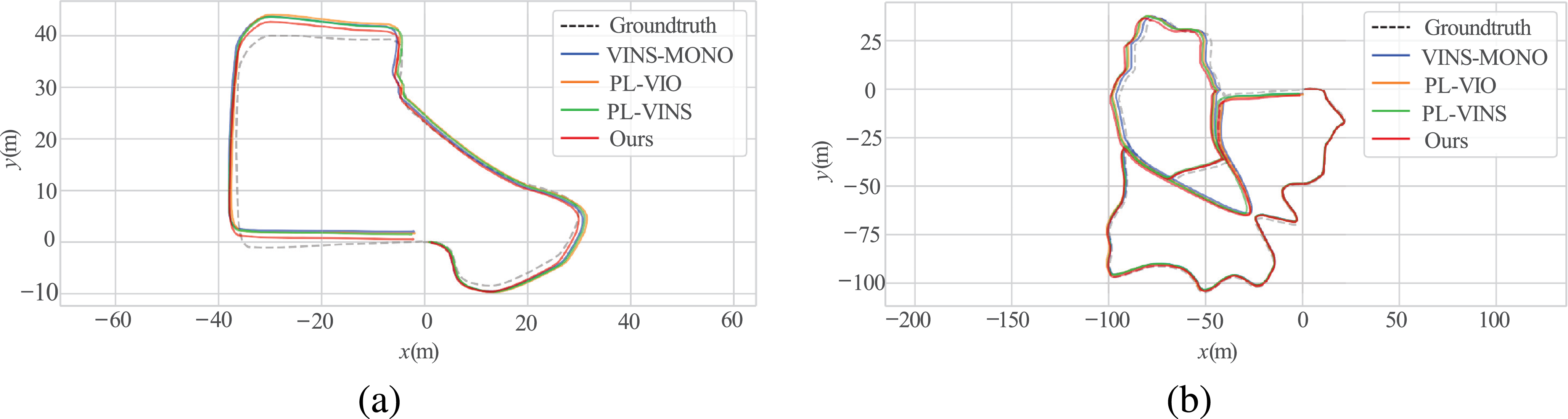
The experimental results are summarized in Table IV. On average, our method achieves the lowest MAX and RMSE of ATE among all four methods (MAX 4.6368 m and RMSE 2.1022 m). This indicates that, even in largely unstructured outdoor scenes, the proposed line processing can still bring a modest overall benefit. To gain more insight, we visualize the best and worst trajectory estimates of our system on sequences 1018_13 and 1008_03, respectively, in Figure 7.
Experiment on unstructured outdoor dataset (BotanicGarden dataset).
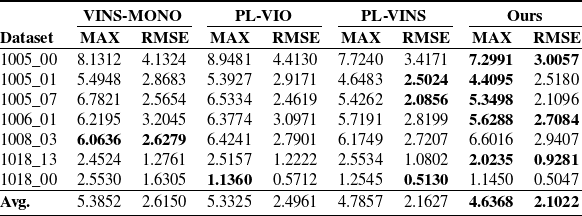
Table IV. Long description
The table compares the performance of four different methods (VINS-MONO, PL-VIO, PL-VINS, and Ours) on an unstructured outdoor dataset. It includes data from seven different sequences (1005_00, 1005_04, 1005_07, 1006_01, 1008_03, 1018_13, and 1018_08) and provides the maximum (MAX) and root mean square error (RMSE) values for each method. The table has 8 rows and 9 columns. The columns are labeled with the method names and the rows are labeled with the dataset sequences. The values in the table represent the performance metrics for each method on the respective dataset sequences. The average performance across all sequences is also provided at the bottom of the table.
On the 1018_13 sequence (Figure 7(a)), which includes a medium-length loop passing through vegetation-dominated areas with some buildings and bridges, all methods generally follow the groundtruth path. However, our trajectory (red line) aligns more closely with the groundtruth. This visual consistency corresponds well with the quantitative results in Table IV, where our method achieves the lowest RMSE of 0.9281 m, compared to 1.2761 m for VINS-MONO and 1.0802 m for PL-VINS, reflecting reductions of approximately 27% and 14%, respectively. In this scenario, a moderate number of stable line segments can be extracted from tree trunks, bridge railings, and building edges, and our length-filtered, collinearity-labeled strategy provides effective geometric constraints that help mitigate drift.
In contrast, the 1008_03 sequence (Figure 7(b)) involves large-scale motion through highly unstructured, vegetation-dominated areas, where reliable structural lines are extremely sparse. In this challenging setting, the estimated trajectories show noticeable deviations from the groundtruth trajectory, and our method exhibits slightly larger drift than VINS-MONO and PL-VINS, particularly along the longest straight sections. This is consistent with the results in Table IV, where our RMSE reaches 2.9407 m, approximately 12% higher than VINS-MONO (2.6279 m) and 8% higher than PL-VINS (2.7207 m). In such environments, the scarcity and noise of line features limit the effectiveness of our method, whereas point-based approaches demonstrate better robustness.
These results indicate that the proposed system can provide benefits in unstructured outdoor sequences when a sufficient number of stable structural line segments are available. However, the effectiveness of the proposed method depends on the availability and temporal stability of such line features. In highly unstructured vegetation-dominated scenes, reliable long structural segments are scarce, and the extracted line segments are often fragmented or noisy. As a result, long-segment truncation and collinearity-based matching provide limited additional geometric constraints, and the performance gain may diminish or even reverse relative to point-based methods.
Trajectory comparison on the BotanicGarden dataset: (a) 1018_13 sequence, (b) 1008_03 sequence.
4.3. Experimental evaluation in a real-world scene with RealSense D435i
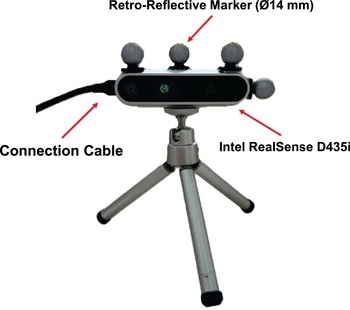
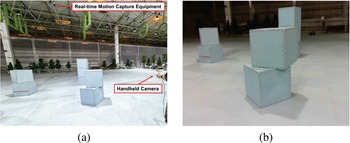
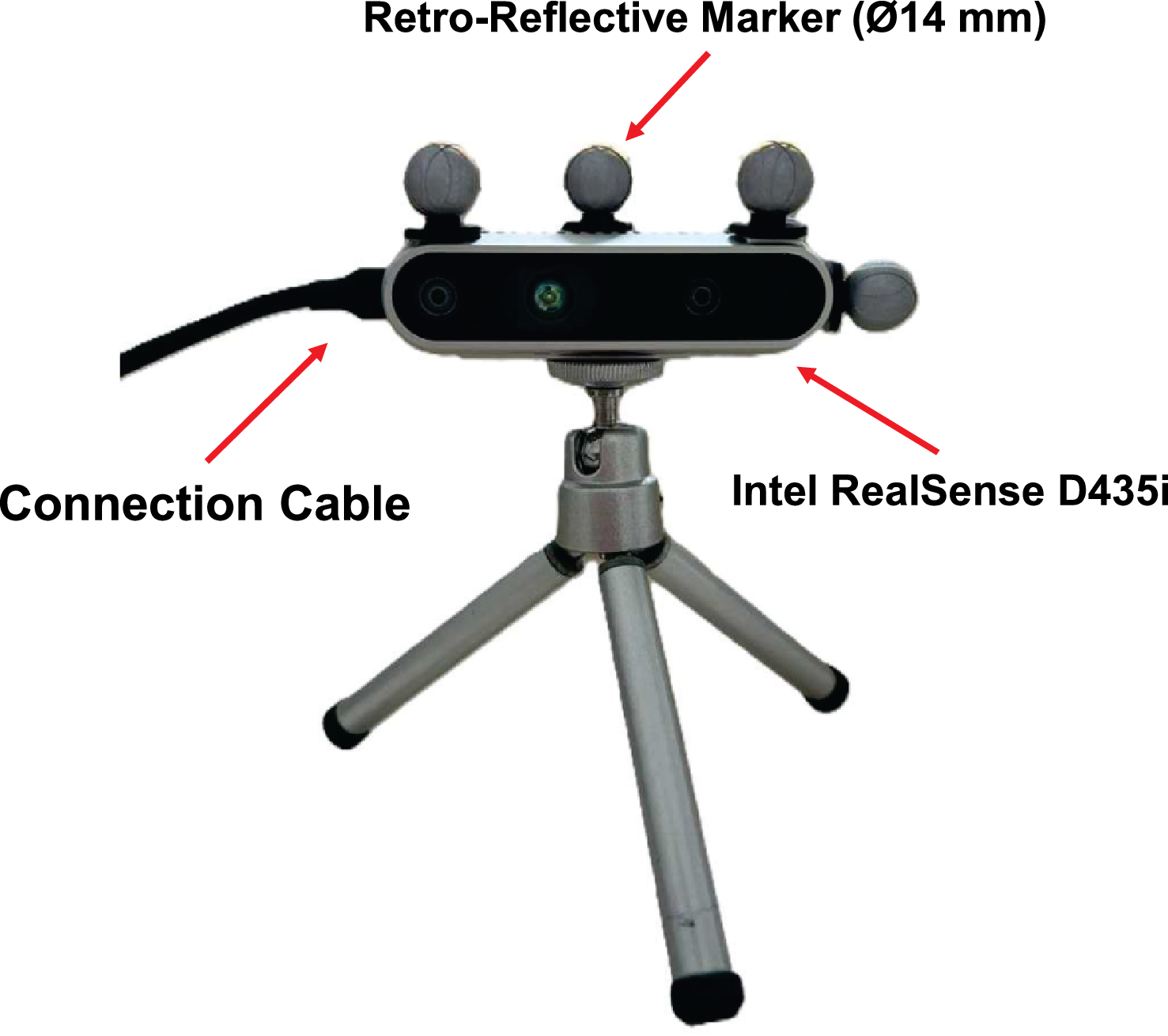
To further verify the robustness of the proposed method in low-texture scenes, we conducted a handheld camera experiment in a real indoor scene. The experiment uses Intel RealSense D435i as the main sensor, which can simultaneously collect high-resolution RGB images and IMU data. The experimental setup and scene examples are shown in Figures 8 and 9.
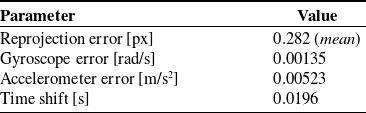
To ensure high-precision sensor extrinsic calibration, we employed the Kalibr toolbox [Reference Rehder, Nikolic, Schneider, Hinzmann and Siegwart46] and imu_utils [Reference Woodman47] to perform both individual and joint calibration of the camera and IMU. The final calibration achieved a root mean square reprojection error of 0.282 pixels, ensuring the accuracy of multi-sensor data fusion, as summarized in Table V.
Camera-IMU calibration results using Kalibr and imu_utils.
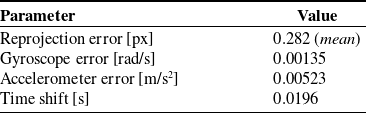
Table V. Long description
A table summarizing camera-IMU calibration results. The table has two columns: Parameter and Value. It contains four rows with the following data: Row 1: Parameter, Reprojection error [px]; Value, 0.282 (mean). Row 2: Parameter, Gyroscope error [rad/s]; Value, 0.00135. Row 3: Parameter, Accelerometer error [m/s^2]; Value, 0.00523. Row 4: Parameter, Time shift [s]; Value, 0.0196.
Intel RealSense D435i equipped with retro-reflective markers for motion capture.
Real-world validation with RealSense D435i: (a) Experimental scene, (b) Camera view.
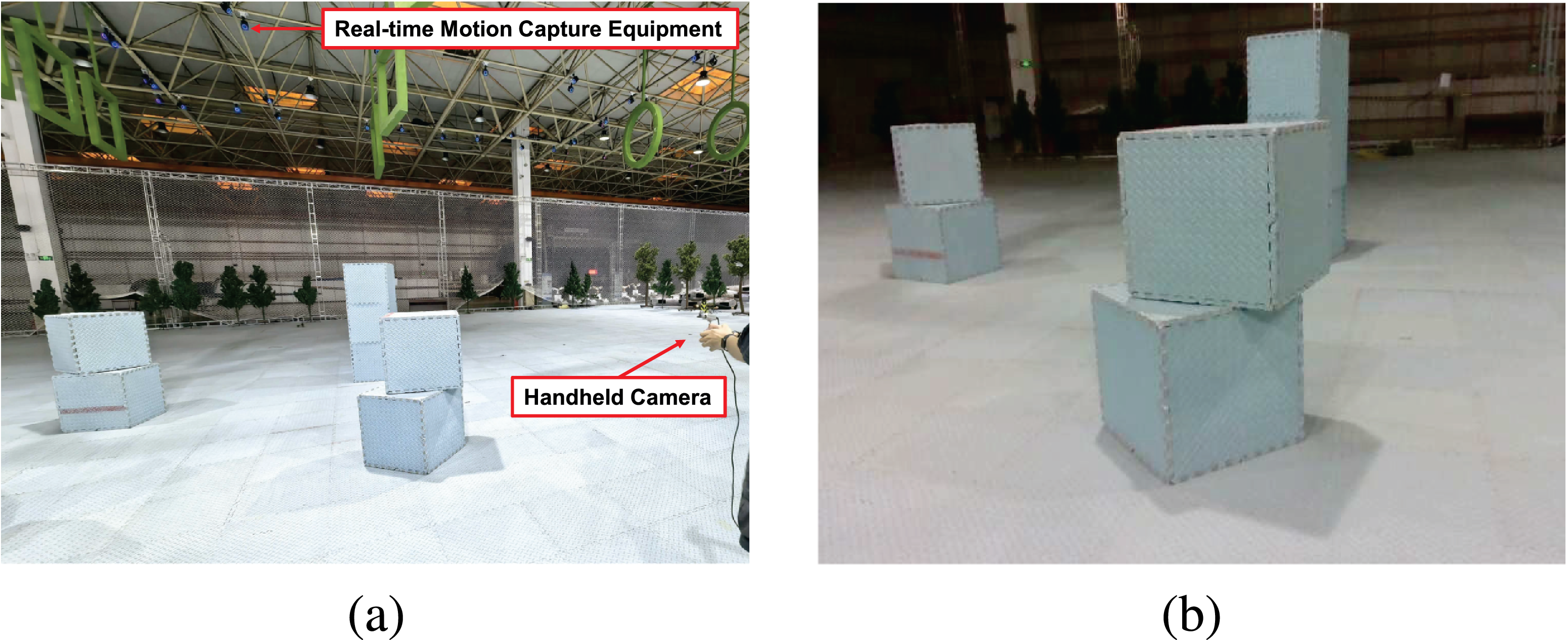
The experiment was conducted in an indoor motion capture hall, with a testing area of approximately 7 m
 $\times$
6 m. Several box-shaped obstacles were placed at the center of the area. Reflective markers were attached to the handheld camera to provide full six-degree-of-freedom pose information, while the groundtruth trajectory was recorded by a high-precision overhead motion capture system FZmotion.
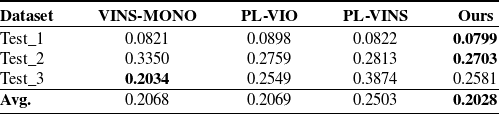
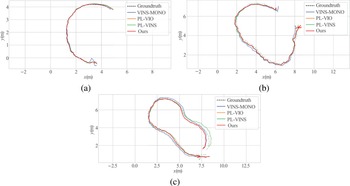
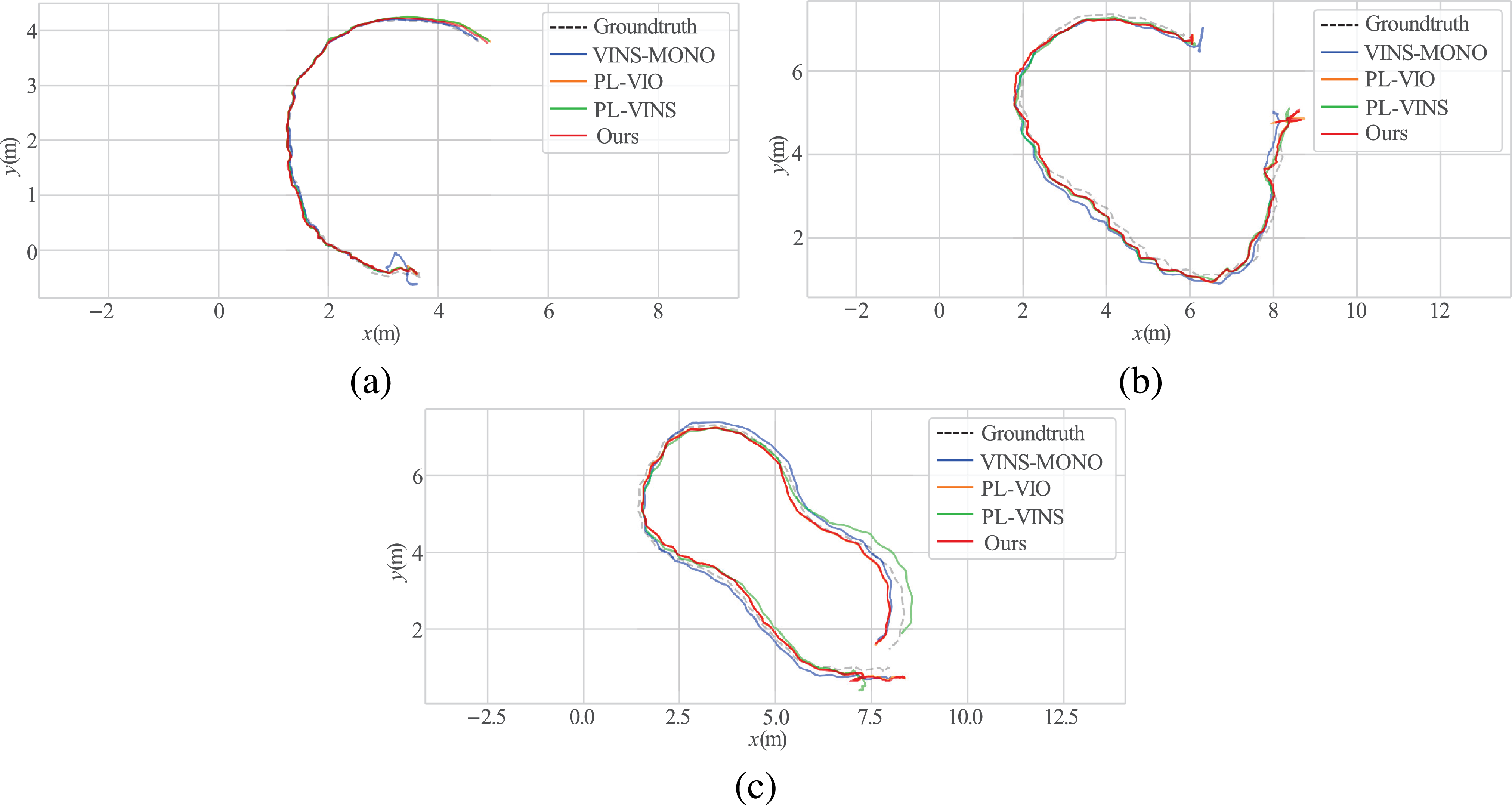
Three real-world datasets were collected, and all sequences were evaluated under identical parameter settings using four methods: VINS-MONO, PL-VIO, PL-VINS, and the proposed point-line VIO system. Considering sensor noise and dynamic variations in real environments, RMSE of ATE is used as the primary metric to evaluate overall localization accuracy. In addition, we report the average RMSE over all three sequences to summarize the overall performance of each method.
As summarized in Table VI, the proposed method achieves the lowest RMSE on Test_1 (0.0799 m) and Test_2 (0.2703 m), and also yields the best average RMSE (0.2028 m) across all three datasets. Although our method is not the best on Test_3, it remains comparable to the baselines. Overall, these results indicate that the proposed system provides consistently accurate localization in real-world, low-texture environments, which is further supported by the trajectories in Figure 10.
RMSE of ATE for real-world experiment.
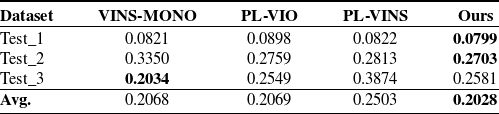
Table VI. Long description
The table presents a comparison of RMSE of ATE for real-world experiments across different methods and test datasets. It consists of 4 rows and 5 columns. The columns are labeled as Dataset, VINS-MONO, PL-VIO, PL-VINS, and Ours. The rows are labeled as Test_1, Test_2, Test_3, and Avg. The values in the table are as follows: Row 1: Test_1, 0.0821, 0.0898, 0.0822, 0.0799. Row 2: Test_2, 0.3350, 0.2759, 0.2813, 0.2703. Row 3: Test_3, 0.2034, 0.2549, 0.3874, 0.2581. Row 4: Avg., 0.2068, 0.2069, 0.2503, 0.2028. The table shows the RMSE values for different methods across three test datasets and their average values.
Trajectory comparison on three real-world sequences. (a) Test_1 sequence, (b) Test_2 sequence, (c) Test_3 sequence.
5. Conclusion
In this paper, we propose an improved line segment processing method based on the LSD algorithm. The method combines short line segment elimination with long line segment truncation to keep the extracted segments within a reasonable length range, thereby improving matching robustness while preserving geometric information. To address the potential matching inconsistency introduced by truncation, we further propose a collinearity-based matching method that exploits the natural collinear structure among truncated sub-segments to enhance inter-frame matching stability. Compared with existing methods that mainly filter out overly short segments, our method explicitly handles overly long segments and validates the effectiveness of this method through extensive experiments.
Based on the proposed line segment processing method, we design and implement a point-line VIO system and evaluate it on public benchmarks and real-world data. The experimental results show that the proposed system achieves superior or comparable localization performance to existing point-line VIO systems, demonstrating its practicality and robustness, especially in structured and low-texture environments.
However, the proposed method still has limitations in scenes with few reliable structural line segments. In most experimental sequences, only a small proportion of segments exceed the maximum length threshold. Therefore, long-segment truncation is applied to only a limited number of key structural edges, and its benefit may vary across different scenarios. In highly unstructured environments, the extracted line segments are often sparse and unstable, making it difficult for the front-end to obtain reliable geometric constraints consistently. In addition, this work mainly focuses on front-end line segment processing and matching, while the collinearity information introduced by truncation is not explicitly incorporated into the back-end optimization. Future work will investigate adaptive multi-segment truncation and cross-frame consistency maintenance and incorporate collinearity constraints into sliding-window optimization to further improve localization accuracy and robustness.
Acknowledgements
ChatGPT was used solely to refine the language and grammar of the manuscript. All AI-assisted content was carefully reviewed by the authors, who take full responsibility for the final content.
Author contributions
Chunhe Hu and Qi Wang developed the core methodology, designed the experiments, and performed the primary data analysis. Ruifang Dong refined the proposed method and contributed to the optimization and technical improvements. Jiangjian Xie supervised the overall research process and guided the literature review and theoretical framing. All authors discussed the results and contributed to the final manuscript.
Financial support
This work was supported by the National Natural Science Foundation of China (grant number 62203059).
Competing interests
The authors declare no competing interests exist.
Ethical approval
None.