

Introduction
Anxiety is a common neuropsychiatric manifestation in PD. The prevalence of anxiety varies between 12% and 57%, depending on the methodology used to assess anxiety and the study sample characteristics (Dissanayaka et al., Reference Dissanayaka, White, O'sullivan, Marsh, Pachana and Byrne2014). Despite the high occurrence of anxiety in PD, it is underdiagnosed and undertreated (Dissanayaka et al., Reference Dissanayaka2015). An improved understanding of the clinical presentation of anxiety specifically in patients with PD is vital so that such non-motor symptoms are detected in a timely manner for patients to receive effective treatment (Weintraub and Burn, Reference Weintraub and Burn2011; Dissanayaka et al., Reference Dissanayaka, White, O'sullivan, Marsh, Pachana and Byrne2014). While assessment of depression in PD has been a focus of clinical research for the past decade, assessment of anxiety in PD has only received attention very recently, despite the high prevalence of anxiety in PD (Dissanayaka et al., Reference Dissanayaka2010). A review by Leentjens et al. (Reference Leentjens2008) suggested that there is insufficient evidence of validity studies to provide recommendations for an appropriate anxiety rating scale that can be used in PD. Addressing this matter, a number of recent studies have extensively examined the validity of anxiety rating scales used in the general population for use in PD, and a new scale for PD has been emerged. The present review therefore, will provide an update on the validity of anxiety rating scales in PD, will review validated scales that have not been captured in the previous review (e.g. the GAI), and will summarize and critique the usefulness of the new anxiety rating scale designed for PD (PD Anxiety Scale (PAS)).
Methods
The literature search employed in the current study included terms such as Parkinson* disease, psychiatric, depress*, anxiety, assessment, scales, and valid* in PsycInfo, PubMed, and Web of Science databases. Validation of anxiety instruments in PD and related review articles published in all years up until June 2014 were included. Studies written in languages other than English were excluded.
Results
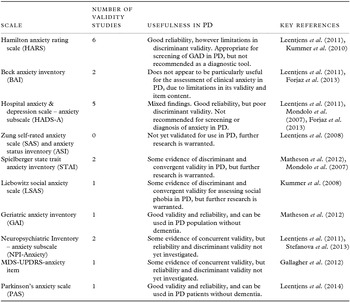
The results of the search revealed nine anxiety rating scales that have been used in PD. The present review provides a description of each scale, its general use, and validity in PD. A summary of all scales reviewed is presented in Table 1.
Summary of all of the anxiety scales that were reviewed and their usefulness in PD

Frequently used general anxiety rating scales
Hamilton anxiety rating scale (HAM-A)
The HAM-A is a 14-item clinician-rated scale used to assess and quantify severity of anxiety symptoms (Hamilton, Reference Hamilton1959). While these items assess a broad range of cognitive, behavioral, and somatic symptoms that are typical of all anxiety disorders detailed in the Diagnostic and Statistical Manual Edition IV criteria (DSM-IV) (American Psychiatric Association, 1994), the scale is most often used to assess the severity of Generalized Anxiety Disorder (GAD). Clinicians are required to rate severity of these symptoms, which are scored on a 5-point scale ranging from 0 = absent to 4 = severe.
The psychometric properties of the HAM-A, including its validity as a screen for GAD in PD, were investigated by Kummer et al. (Reference Kummer, Cardoso and Teixeira2010). The cut-off score for the screening of 91 cognitively intact patients who were diagnosed with GAD from those who did not have an anxiety disorder was found to be 10/11, with a moderate area under the ROC curve (AUC) of 0.77. The internal consistency of the HAM-A in this PD sample was high (Cronbach's α = 0.89). A limitation of Kummer et al. (Reference Kummer, Cardoso and Teixeira2010), however, is that the mean age of the sample was 57.2 years while the mean age of PD onset was 48.4 years, suggesting this sample was not representative of the older age and PD onset in typical PD samples. Leentjens et al. (Reference Leentjens, Dujardin, Marsh, Richard, Starkstein and Martinez-Martin2011) evaluated the discriminant validity of the HAM-A in a sample of 342 PD patients without dementia. An optimal cut-off score of 12/13 on the HAM-A was found to best distinguish patients with a diagnosed anxiety disorder according to the DSM-IV criteria from those with no anxiety disorder, however the AUC was moderate (0.78). The HAM-A displayed good internal consistency (Cronbach's α = 0.86) and inter-rater reliability (r = 0.87). The use of PD patients without dementia is a limitation, given the results may not be generalizable to patients with dementia.
Forjaz et al. (Reference Forjaz2013) analyzed the measurement properties of the items of the HAM-A for use in PD using Rasch analysis. The Rasch model is used to investigate how responses are a function of the difference between the person's ability and the item parameter. With regards to anxiety scales, the person's ability is the experienced anxiety level while the item parameter represents the level of anxiety assessed by that item. Forjaz et al. (Reference Forjaz2013) concluded that the original HAM-A did not display adequate measurement properties to measure anxiety in PD. The results of Mondolo et al. (Reference Mondolo, Jahanshahi, Grana, Biasutti, Cacciatori and Di Benedetto2007) indicated that the HAM-A displayed good concurrent validity against the Spielberger State Trait Anxiety (STAI) and the Hospital Anxiety and Depression Scale, anxiety subscale (HADS-A). However, this study used only 46 PD patients without dementia. Finally, Stefanova et al. (Reference Stefanova, Ziropadja, Petrovic, Stojkovic and Kostic2013) recently assessed the psychometric properties of the HAM-A in a large PD sample (N = 360). The HAM-A displayed high internal consistency (Cronbach's α = 0.91) and satisfactory inter-item correlation (mean r = 0.51). It correlated with NPI anxiety subscale (ρ = 0.75), however when adjusted for NPI depression subscale, a lowered correlation between NPI anxiety and HAM-A was observed (ρ = 0.13). The factorial structure analyses suggested 55% variance for depression and anxiety items, and only 10% variance for somatic items. Overall, the HAM-A appears to have good reliability, but limitations in discriminating anxiety independent of depression suggests HAM-A as a suitable screen for anxiety, but not a diagnostic tool for use in PD. While it may be appropriate for screening for GAD symptoms, it is not recommended as a diagnostic tool given it was not designed specifically for GAD.
Beck anxiety inventory (BAI)
The BAI is a 21-item self-report questionnaire designed to measure the severity of affective, somatic, and cognitive symptoms associated with anxiety in a psychiatric population (Beck et al., Reference Beck, Epstein, Brown and Steer1988). Patients are required to indicate the severity or frequency of a particular anxiety symptom on a 4-point Likert scale, with scores ranging from 0 to 3. The scale has been shown to discriminate patients with anxiety disorders from non-anxious patients (Beck et al., Reference Beck, Epstein, Brown and Steer1988). BAI was developed to have limited symptoms with depression. Therefore, it displays good content validity and criterion validity for assessing the symptoms of panic disorder, but limited validity for assessing the symptoms of other anxiety disorders, including GAD (Leyfer et al., Reference Leyfer, Ruberg and Woodruff-Borden2006; Leentjens et al., Reference Leentjens2008).
Leentjens et al. (Reference Leentjens, Dujardin, Marsh, Richard, Starkstein and Martinez-Martin2011) validated the BAI for use in PD in their large (N = 342), cross-sectional, international study. The results indicated that the optimal cut-off score for discrimination between an anxiety disorder of any type and no anxiety disorder was 12/13, however the discriminant validity was moderate as indicated by the AUC of 0.77. Internal consistency of the BAI was satisfactory (Cronbach's α = 0.88), as was the test–retest reliability (r = 0.77). Forjaz et al. (Reference Forjaz2013) investigated the BAI using Rasch analysis and found that the scale included items which were highly related such that the answer to one item could determine the answer to another item. It was concluded that the BAI contained redundant items and did not appear to be satisfactory for measuring anxiety in PD. Another limitation with use of the BAI in PD is the over-sampling of items relating to physical manifestations of anxiety (e.g. panic symptoms). Many PD patients might score highly on these items due to the overlap of anxiety symptoms as measured by this scale with PD motor symptoms (Leentjens et al., Reference Leentjens2008). Overall, the BAI does not appear to be particularly useful for the assessment of clinical anxiety in PD, due to limitations in its validity and item content with this population.
Hospital anxiety and depression scale – anxiety subscale (HADS-A)
The HADS is a 14-item self-report questionnaire used to briefly assess anxiety and depression symptoms (Zigmond and Snaith, Reference Zigmond and Snaith1983). It is comprised of anxiety and depression subscales each consisting of 7 items. The items of the HADS-A subscale aim to assess symptoms of panic disorder and GAD. For each item, the respondent indicates the extent to which they agree with the statement on a 4-point scale, ranging from 0 to 3, from the absence of a symptom to maximal symptomatology (Mondolo et al., Reference Mondolo, Jahanshahi, Grana, Biasutti, Cacciatori and Di Benedetto2007). The HADS has been found to display adequate internal consistency, test–retest reliability, and concurrent validity with DSM-IV criteria for anxiety disorders (Herrmann, Reference Herrmann1997; Bjelland et al., Reference Bjelland, Dahl, Haug and Neckelmann2002). It has performed well in the assessment of symptom severity and detection of anxiety disorders, and is considered a useful screening tool in the general population (Zigmond and Snaith, Reference Zigmond and Snaith1983). A Movement Disorder Society (MDS) task force has suggested, however, that the HADS-A subscale displays only moderate face validity due to the items poorly reflecting established anxiety symptoms or diagnostic criteria (Leentjens et al., Reference Leentjens2008).
There have been a number of studies which have investigated the validity and other psychometric properties of the HADS-A in PD. The HADS-A was found to have an optimal cut-off score of 6/7 when discriminating between a DSM-IV diagnosed anxiety disorder and no anxiety disorder, however discriminant validity was poor with a low AUC of 0.63 (Leentjens et al., Reference Leentjens, Dujardin, Marsh, Richard, Starkstein and Martinez-Martin2011). The internal consistency of the HADS-A was satisfactory (Cronbach's α = 0.82), as was the test–retest reliability (r = 0.80). Mondolo et al. (Reference Mondolo, Jahanshahi, Grana, Biasutti, Cacciatori and Di Benedetto2007) found moderate correlations between the HADS-A and other anxiety rating scales (STAI and HAM-A) in their small sample of 46 PD patients, indicating good convergent validity.
Rodriguez-Blazquez et al. (Reference Rodriguez-Blazquez, Frades-Payo, Forjaz, De Pedro-Cuesta and Martinez-Martin2009) investigated the psychometric properties of the HADS-A in a sample of 387 PD patients without cognitive decline. They concluded the HADS-A was a reliable (Cronbach's α = 0.81), valid, and potentially responsive scale for use in PD. Marinus et al. (Reference Marinus, Leentjens, Visser, Stiggelbout and Van Hilten2002) evaluated the HADS in 205 PD patients, and reported that the internal consistency of the HADS-A subscale was satisfactory (Cronbach's α = 0.86) and displayed good test–retest reliability (r = 0.86). Neither Marinus et al. (Reference Marinus, Leentjens, Visser, Stiggelbout and Van Hilten2002) nor Rodriguez-Blazquez et al. (Reference Rodriguez-Blazquez, Frades-Payo, Forjaz, De Pedro-Cuesta and Martinez-Martin2009) included a “gold standard” diagnostic measure in their studies, therefore discrimination properties of the scale were not able to be assessed. Measurement properties of the HADS-A were also analyzed using Rasch analysis in Forjaz et al. (Reference Forjaz2013). Consistent with the findings of the HAM-A and BAI, it was concluded that the HADS-A was not satisfactory to measure anxiety in PD. In summary, there appear to be mixed findings regarding the validity of the HADS-A for use in PD. While there is evidence of sufficient reliability and the suggestion of appropriate item content for PD, it appears to have poor discriminant validity and thus is not recommended to screen or diagnose anxiety symptoms in PD.
Zung self-rated anxiety scale (SAS) and anxiety status inventory (ASI)
The SAS is a self-rated version and the ASI an observer-rated version of the same 20-item anxiety scale (Zung, Reference Zung1971; Leentjens et al., Reference Leentjens2008). Items on both measures are scored on a 4-point scale in which the frequency, intensity, and duration of symptoms are considered to provide an indication of severity. Symptoms of GAD and panic disorder are the focus of these scales. In non-PD patients, the ASI and SAS have each displayed satisfactory measures of reliability (Jegede, Reference Jegede1977; Cohen et al., Reference Cohen, Magai, Yaffee and Walcott-Brown2006; Olatunji et al., Reference Olatunji, Deacon, Abramowitz and Tolin2006). These scales were discussed as part of the anxiety rating scale in PD task force conducted by Leentjens et al. (Reference Leentjens2008), due to their use in epidemiological studies of anxiety in PD (Pal et al., Reference Pal, Thennarasu, Fleming, Schulzer, Brown and Calne2004; Richard, Reference Richard2005). The SAS and ASI have not yet been validated in the PD population, thus they are not recommended for use in PD until further research is conducted.
Spielberger state trait anxiety inventory (STAI)
The STAI is a self-report questionnaire comprised of two separate 20-item scales designed to measure feelings of apprehension, tension, nervousness, and worry (Spielberger et al., Reference Spielberger, Gorsuch, Lushene and Vagg1983; Mondolo et al., Reference Mondolo, Jahanshahi, Grana, Biasutti, Cacciatori and Di Benedetto2007). One scale measures State anxiety (STAI-S), on which the respondent completes items based on how they feel “right now,” while the other scale measures Trait anxiety (STAI-T), with the respondent completing items based on how they “generally feel.” All items are scored on a 4-point Likert scale, where response options range from 1 = not at all to 4 = very much so on the STAI-S, and 1 = almost never to 4 = almost always on the STAI-T. Symptoms of some anxiety disorders are not represented in STAI, and the STAI-S is less useful for assessing panic disorder if the patient is not experiencing a current panic attack (Leentjens et al., Reference Leentjens2008). In a non-PD sample, both the STAI-T and STAI-S displayed good internal consistency, however only the STAI-T had satisfactory test–retest reliability (Spielberger et al., Reference Spielberger, Gorsuch, Lushene and Vagg1983; Kabacoff et al., Reference Kabacoff, Segal, Hersen and Van Hasselt1997). Both scales were also found to have low discriminant validity against a gold standard diagnostic interview.
Mondolo et al. (Reference Mondolo, Jahanshahi, Grana, Biasutti, Cacciatori and Di Benedetto2007) investigated the psychometric properties of the STAI in 46 PD patients without dementia. Results indicated that both the STAI-S and STAI-T were moderately correlated with the HADS-A and HAM-A, providing evidence of sound convergent validity with the other scales. The STAI was also used in Matheson et al. (Reference Matheson2012) as a comparison when evaluating the psychometric properties of the GAI in PD patients without comorbid dementia. In this study, the STAI appeared to have moderate discriminant validity against a DSM-IV diagnosis of anxiety disorders, with an AUC of 0.84. The STAI and other commonly used anxiety rating scales, such as the BAI and HADS-A, have also been criticized with respect to their use in older adult populations more generally (Byrne et al., Reference Byrne, Pachana, Goncalves, Arnold, King and Khoo2010). The 4-point response options of these scales may cause difficulties for adults with sensory and cognitive impairments. This raises concern with respect to the use of these scales in PD patients who are, on average, diagnosed at age 60 (Slaughter et al., Reference Slaughter, Slaughter, Nichols, Holmes and Martens2001). There is currently insufficient research regarding the reliability and validity of the STAI in PD. Further investigation of the validity of the STAI subscales for use in PD is required.
Infrequently used general anxiety rating scales
Liebowitz social anxiety scale (LSAS)
The LSAS is a 24-item clinician-rated scale designed for the assessment of social phobia (Heimberg et al., Reference Heimberg1999). It is divided into two subscales, which consist of 11 items that assess situations of social interaction and 13 items to assess situations of performance. Items are scored on a 4-point Likert-type scale, ranging from 0 to 3. Evaluation of the psychometric properties of the LSAS in the non-PD population indicates that the scale has high internal consistency, good convergent validity, and is sensitive to the effects of pharmacological treatments for social phobia (Heimberg et al., Reference Heimberg1999).
To date, there is only one study that has assessed the validity of the LSAS in a sample of 90 PD patients without dementia. Kummer et al. (Reference Kummer, Cardoso and Teixeira2008) interviewed patients using the DSM-IV criteria for a diagnosis of social phobia and administered the LSAS and HAM-A. An optimal cut-off score of 41/42 on the LSAS was found to provide the ideal balance between sensitivity and specificity for a diagnosis of social phobia in PD, with an AUC of 0.77. Scores on the LSAS were also significantly correlated with scores on the HAM-A (ρ = 0.55). A limitation of this study, however, was that the sample consisted of a younger PD patient group. Overall, the LSAS appears acceptable as an assessment tool for social phobia disorder in PD; however, more research regarding the use of this scale in PD, particularly using a sample across all ages, is warranted.
Anxiety rating scales developed for use in older adults
Geriatric anxiety inventory (GAI)
The GAI is a 20-item self-report measure which primarily assesses dimensional anxiety (Pachana et al., Reference Pachana, Byrne, Siddle, Koloski, Harley and Arnold2007). The scale was not intended as a tool for the diagnosis of specific anxiety disorders, but rather to provide an indication of the severity of anxiety symptoms experienced in people who are potentially symptomatic for anxiety disorders. Designed for use in older adults, it includes a dichotomous “agree/disagree” response set for ease of administration. The scale also limits the number of items assessing somatic symptoms of anxiety which may overlap with PD symptoms, suggesting it might be appropriate for use in PD (Matheson et al., Reference Matheson2012). In non-PD populations, the GAI displayed high internal consistency, excellent test–retest reliability, and moderate concurrent validity against other anxiety scales (Pachana et al., Reference Pachana, Byrne, Siddle, Koloski, Harley and Arnold2007).
One study by Matheson et al. (Reference Matheson2012) has investigated the psychometric properties of the GAI for use in 58 PD patients without dementia. The optimal cut-off score for distinguishing PD patients with and without anxiety disorders according to the DSM-IV criteria was 6/7. There was a high AUC (0.91) indicating excellent discrimination between the diagnostic groups. The results also revealed moderate concurrent validity against the STAI (ρ = 0.69), and excellent internal consistency (KR20 = 0.95), and test–retest reliability (ρ = 0.99). There are some limitations associated with this validation study, however, which include the sample size of only 58 patients and that other psychometric properties were not assessed (such as factor analysis and Rasch analysis). Overall, the GAI appears to be an appropriate scale for use with PD patients without dementia, but further investigation of psychometric properties is required.
Anxiety rating scales developed for use in dementia
Neuropsychiatric inventory – anxiety subscale (NPI-Anxiety)
The NPI is used to evaluate common neuropsychiatric disturbances (e.g. depression, anxiety, and apathy) that occur in dementia and contains a number of subscales including anxiety. There are two forms of the NPI, an informant-rated version and a clinician-rated version (Cummings et al., Reference Cummings, Mega, Gray, Rosenberg-Thompson, Carusi and Gornbein1994; de Medeiros et al., Reference De Medeiros2010). The clinician-rated NPI scale involves a structured interview with an informant who is familiar with the patient's behavior. The anxiety subscale of the NPI (NPI-Anxiety) focuses on behavioral manifestations of emotional and somatic symptoms of anxiety. If the informant answers “yes” to any of the three screening questions regarding the presence of anxiety symptoms, they will be asked additional questions (including frequency and severity of the symptoms) in an attempt to further understand the presenting anxiety.
There is evidence that the NPI-Anxiety subscale is a reliable measure of anxiety in a non-PD population (Cummings et al., Reference Cummings, Mega, Gray, Rosenberg-Thompson, Carusi and Gornbein1994). The discriminant validity of the NPI-Anxiety in PD has not been investigated, however there is evidence of concurrent validity. Leentjens et al. (Reference Leentjens, Dujardin, Marsh, Richard, Starkstein and Martinez-Martin2011) examined the correlation between the NPI-Anxiety subscale and other measures of anxiety in 342 PD patients. The NPI-Anxiety subscale was moderately correlated with the BAI (ρ = 0.39) and the HAM-A (ρ = 0.56) and had a poor correlation with the HADS-A (ρ = 0.19). Similarly, an examination of the relationship between the NPI-Anxiety subscale and the HAM-A was included in a study by Stefanova et al. (Reference Stefanova, Ziropadja, Petrovic, Stojkovic and Kostic2013) and the results indicated a high correlation between the anxiety scales (ρ = 0.75). Further validity studies are required to investigate the usefulness of NPI-Anxiety subscale in PD.
Screening item only for assessment of anxiety
Movement disorders society unified Parkinson's disease rating scale (MDS-UPDRS)-anxiety item
The MDS-UPDRS is the most widely used outcome measure in clinical trials of PD and includes assessment of motor symptoms and non-motor symptoms (Goetz et al., Reference Goetz2008). Part 1 of the MDS-UPDRS includes a screening question for assessing anxious mood and is completed by the assessor. The severity is assessed on a 5-point scale ranging from 0 = normal to 4 = severe.
Gallagher et al. (Reference Gallagher, Goetz, Stebbins, Lees and Schrag2012) investigated the validity of the MDS-UPDRS non-motor symptoms scale in 94 PD patients, including patients with cognitive impairment. The single anxious mood item in the scale was validated against the HADS-A subscale, and results indicated that there was a modest but significant correlation (ρ = 0.53). Further research regarding the reliability and validity of the MDS-UPDRS-Anxiety item in PD is required to determine the usefulness of the individual item as an indicator of clinical anxiety in patients.
New anxiety scale for PD
Parkinson's anxiety scale (PAS)
The PAS is a newly developed scale for the assessment of anxiety in PD (Leentjens et al., Reference Leentjens, Dujardin, Pontone, Starkstein, Weintraub and Martinez-Martin2014). It is a 12-item self-rated or observer-rated instrument. The items are structured to reflect three subscales of persistent anxiety, episodic anxiety, and avoidance behavior. Each item is scored on a 5-point Likert scale ranging from 0 = not or never to 4 = severe or almost always. The validation study of the PAS suggested good acceptability, and excellent test–retest (ICC = 0.89 ± 0.51), and inter-rater reliability (ICC = 0.92 ± 0.46). The Chronbach's α (patient-rated = 0.87 and observer rated = 0.89) was higher than the HAM-A (0.79) and was similar to the BAI (0.87). The scale demonstrated high convergent validity against the HAM-A and BAI. The discriminant validity against a DSM-IV diagnosis of anxiety disorders (GAD, panic disorder, agoraphobia, and social phobia) was high and this was suggested by demonstrating a large AUC (observer-rated = 0.86, self-rated = 0.85). The optimal cut-off value that discriminated between patients with and without a DSM-IV anxiety disorder was 13/14 for both observer-rated and self-rated scales (that is those who score 14 or higher can be classified as having a anxiety disorder according to the DSM-IV criteria and 13 or lower can be classified as free of anxiety disorder). Cut-off values were also examined for the subscales. The divergent validity for depression assessed by Hamilton depression rating scale (HAM-D) was high and moderately correlated with the persistent anxiety subscale (observer-rated PAS ρ = 0.60 and self-rated PAS ρ = 0.58), suggesting GAD and depression overlap. All instruments were administered without blinding, however, and this was a limitation of the validation study. The observer-rated version of the PAS can potentially be useful to assess anxiety in PD patients with dementia. Validity of this scale in PD patients with dementia warrants future research.
Conclusions
The novel PAS demonstrates psychometric superiority over more general anxiety rating scales, such as the HAM-A and the BAI, and is promising for use in PD (Leentjens et al., Reference Leentjens, Dujardin, Pontone, Starkstein, Weintraub and Martinez-Martin2014). An optimal cut-off score of 13/14 is suggested to discriminate between patients with and without DSM-IV anxiety disorders. The self-rated GAI also appear to be a promising assessment tool for measuring anxiety in PD. With the focus of items on cognitive symptoms of anxiety and a simple design for easy use in older adults, the GAI has exhibited good validity and reliability in PD. It also has good test–retest reliability, suggesting it is useful for repeated administration in clinical practice or research. The optimal cut-off score for distinguishing PD patients with and without DSM-IV anxiety disorders was 6/7 (Matheson et al., Reference Matheson2012). However, further research on the GAI is required to assess other properties of the scale. Both the PAS and the GAI were examined in PD patients without dementia, and their usefulness for detecting anxiety in PD patients with dementia should be examined in future studies.
Some evidence exists for the validity and reliability of the self-rated BAI, HADS-A, and HAM-A in PD, although the validity of the scales to discriminate between anxious and non-anxious patients was generally poor. Forjaz et al. (Reference Forjaz2013) confirmed that these scales are not satisfactory to measure anxiety in PD. The clinician-rated LSAS appears to be acceptable as a tool for assessing social phobia in PD, however there is insufficient research regarding the psychometric properties of the scale. There was either very limited or no evidence of the validity and reliability of the NPI-Anxiety subscale, STAI, MDS-UPDRS-Anxiety item, and SAS tools for use in PD.
The relationship between anxiety symptoms and PD motor symptoms is complex (Dissanayaka et al., Reference Dissanayaka, White, O'sullivan, Marsh, Pachana and Byrne2014). The somatic symptoms experienced in both disorders is one problem, however, the onset of anxiety symptoms in PD is unclear and presents another key issue. There has been the suggestion that anxiety symptoms might present when patients are in the “off” state from their medication, and that there might exist a subsyndromal form of anxiety specific to PD (Dissanayaka et al., Reference Dissanayaka2010; Reference Dissanayaka, White, O'sullivan, Marsh, Pachana and Byrne2014; Leentjens et al., Reference Leentjens, Dujardin, Marsh, Martinez-Martin, Richard and Starkstein2012). None of the existing anxiety scales have examined the usefulness during PD motor fluctuations (at “off” states). Further research is required to explore the phenotype of anxiety in PD, and consequently develop an anxiety scale tailored for use in PD.
Conflict of interest
None.
Description of authors’ roles
All authors contributed to the conception and design of the manuscript. N. Dissanayaka and E. Torbey prepared the draft. N. Pachana provided critical revision.
Acknowledgments
We thank Lions Medical Research Foundation for supporting Dr Dissanayaka's fellowship.