The human rights field has grown dramatically in just over a decade. In political science, the creation of APSA's Human Rights Section in 2001 was a significant indicator of the field's rising prominence. The proliferation of human rights journals, book series, institutes and centers, as well as graduate and undergraduate programs are other important gauges of rising visibility. In this article, I assess the extent to which human rights issues have entered the mainstream of political science scholarship. More specifically, I examine the growth and nature of journal articles devoted to human rights. I also consider the implications for future political science research and graduate training.
The rise of human rights as a coherent field of inquiry coincides with the growing prominence of the issue in international relations and law. Indeed, recent decades arguably constitute a shift in “world time,” marked by the global diffusion of human rights norms and discourse (Risse and Sikkink Reference Risse, Sikkink, Risse, Ropp and Sikkink1999, 19–22; Finnemore and Sikkink Reference Finnemore and Sikkink1998). Insofar as scholarship reflects real-world concerns, these developments should be apparent in publishing trends. At a minimum, we should expect the percentage of human rights articles to have risen in recent decades as scholars respond to a changing world.
Understanding these publishing trends is increasingly important at a time when human rights issues are informing a wide array of research. For the discipline as a whole, the stakes are higher than they may seem: if human rights concerns are interdependent with a range of political processes—from democracy and conflict resolution to judicial accountability and terrorism—then political scientists should factor them into their research. For graduate students and human rights researchers, awareness of long-term and substantive trends in the discipline can help identify prominent gaps and define research agendas.
I find that human rights research has entered the mainstream of political science, but it has done so only at the margins. After discussing selection criteria and coding issues, I describe the trends in more detail and speculate about the potential reasons for this marginal integration. I conclude with key lessons gleaned from the preliminary survey, including changes that human rights researchers and the discipline as a whole can make to integrate human rights issues more productively into political science.
SELECTION CRITERIA AND CODING
This analysis focuses on publications by the top-ranked journals in political science. Examining only the top-ranked outlets has the advantage of documenting trends within a highly visible set of publications, but it can miss broader trends and omit influential publications. Subsequent analyses could therefore adjust these criteria to survey a wider array of journals. The data collected here reflect the entire life of a journal, through August 2008.Footnote 1
In selecting political science journals, I focused on the top 15 political science journals, as ranked by Garand (Reference Garand2005) (see also Garand and Giles Reference Garand and Giles2003). Since I was interested in political science journals exclusively, I did not include the American Sociological Review, American Economic Review, and American Journal of Sociology, which appear in Garand's ranking. This adjustment led to the inclusion of three additional journals, ranked 16th to 18th, respectively: Public Opinion Quarterly, Journal of Conflict Resolution, and International Security.
Journal articles, totaling 233, were selected as follows. Titles and abstracts were scanned for certain keywords, including “rights” or specific violations (e.g., “genocide,” “torture”). The focus was on articles framed explicitly in terms of human rights, where framing is understood to be the self-conscious packaging of a topic in terms of a particular body of research. Articles were also coded according to the subfield to which they corresponded most closely. Subfield coding certainly can be problematic, as the boundary between sub-disciplinary divisions is not always clear. Still, assigning each article to a single subfield can help describe the field's overall evolution.
A potentially serious objection is that this analysis defines human rights too narrowly. For example, studies on race or poverty also could be categorized as human rights topics. Conversely, some of the research included, on civil rights in the United States for instance, does not address a human rights audience per se or tap into the human rights literature. While perhaps true, the objective here was to identify works marketed or framed explicitly as rights topics. On balance, then, this coding scheme captures overall trends in political science publications.
QUANTITATIVE SHIFT
The number of human rights articles published in the leading journals has increased exponentially in recent decades. This growth has been remarkable both in absolute and relative terms, with the number of relevant articles rising dramatically. The increase signals, to some extent, that human rights issues have entered the mainstream of political science.
Indeed, the number of articles has exploded since the 1970s. Whereas just over 30 articles were published in the leading political science journals before 1980, this number has risen sharply in recent decades (Table 1). Since 1990, the leading political science journals have published over twice the number of human rights articles they had in all previous years combined. More remarkable still, in the first decade of the new millennium, the number of human rights articles published in the top 15 political science journals increased 73% over that published in the 1990s.
Number of Human Rights Articles in Major Political Science Journals, by Decade

a Total number of human rights articles is in parentheses.
b Data collected are through August 2008.
Source: Compiled by author.
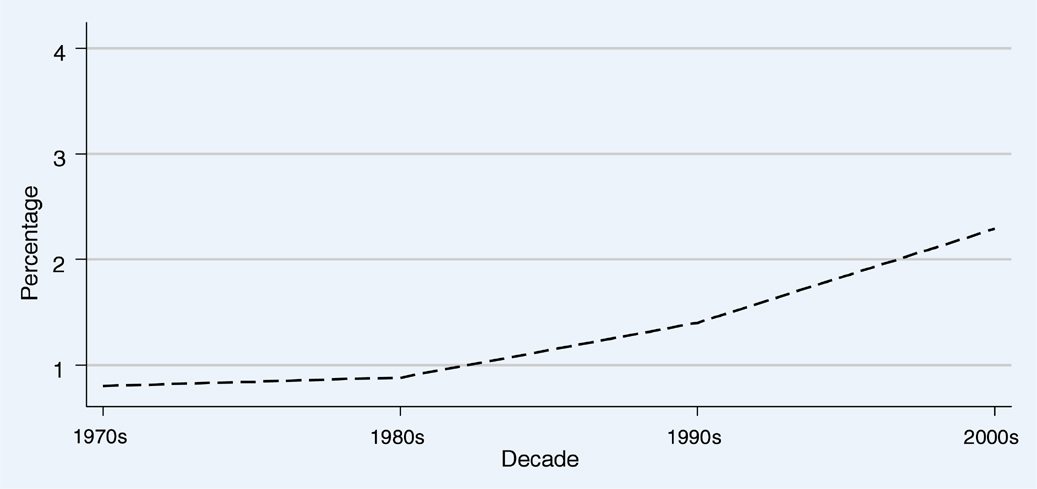
In relative terms, taking into account the overall growth of political science journal publications, the number of published human rights articles has also risen notably. The percentage of human rights articles—relative to all articles published by a given journal—has mounted steadily each decade since the 1980s, with the largest jump occurring since 2000. (See Figure 1.) More precisely, 85% more human rights articles were published in the top-ranked political science journals in the 2000s than in the 1990s. The preliminary evidence therefore suggests that human rights issues have become increasingly integrated into the discipline.
Percentage of Human Rights Articles in Leading Political Science Journals, by Decade

What explains this phenomenal rise? Two related factors may underlie the trend: internationalization and professionalization. As human rights issues have become more global in scope, scholarship has followed in its wake, reflecting changes in the international landscape and in institutions like the U.S. Congress and the foreign policy establishment. The internationalization of human rights, while rooted in the post-World War II institutional architecture of an evolving human rights system, has been most apparent since the 1970s, when transnational human rights movements emerged in response to authoritarian abuses worldwide. Activists were energized by the entry into force of seminal treaties (including two major international covenants) and the introduction of human rights concerns into the foreign policies of various countries. For scholars with an American focus, human rights issues progressively were institutionalized in congressional and foreign policy mandates throughout the 1970s, developments that are likely to have shaped academic interest. The end of the Cold War and an ongoing wave of democratization further diffused and embedded human rights globally, and the 1990s brought the formation of post-hoc war crimes tribunals, the design of an international criminal court, and the advent of universal jurisdiction for heads of state. Post-September 11, the controversial policies surrounding a global war on terror mobilized human rights networks and shaped national security debates.Footnote 2
The sharp rise in human rights journal publications also may mirror professional trends, namely a growth in human rights expertise, along with a time lag between the training of a critical mass of graduate students and the appearance of their publications. As real-world events sparked unprecedented interest in human rights research, a growing number of political scientists specialized in the topic. A search for dissertations listing “human rights” and “political science” as keywords reveals that 15 such projects were written in the 1970s, 138 in the 1980s, 390 in the 1990s, and 459 since 2000.Footnote 3 The exponential rise in human rights dissertations thus parallels broader publishing trends. These trends, in turn, reflect young scholars' attempts to understand the rising prominence of human rights issues.
A CAVEAT: MARGINAL INTEGRATION
If human rights have entered the mainstream of political science, they have done so only at the margins. Human rights topics continue to constitute a relatively small percentage of overall publications. Even among the top journals, mainstreaming has not been uniform, as human rights issues remain highly concentrated in a few publications. While human rights research clearly has increased in visibility, this trend should not be exaggerated.
Human rights articles constitute a very small percentage of the total publishing effort in political science, as Table 2 shows. Since 1990, for example, the number of human rights articles appearing in the 15 leading journals has represented no more than 2% of overall political science articles. And since 2000, only two of the top-ranked 15 journals published more than 10 human rights articles; the other 13 journals published an average of .08 human rights articles throughout the decade.
Percentage of Human Rights Articles in Major Political Science Journals, by Decade

a A journal's average percentage of human rights articles for the full period is in parentheses.
b Data collected are through August 2008.
Source: Compiled by author.
To place this marginalization in further context, it is useful to compare human rights with a parallel issue like democracy. Democracy is in many ways similar to human rights: a broad subject that spans the subfields of political science and has strong policy relevance, especially after the end of the Cold War. Furthermore, democracy and human rights are themselves substantively connected, as numerous studies have established empirically (e.g., Davenport and Armstrong Reference Davenport and Armstrong2004; Bueno de Mesquita, Cherif, Downs, and Smith Reference Bueno de Mesquita, Cherif, Downs and Smith2005). Given these similarities, one might expect somewhat comparable levels of integration into the mainstream of the discipline. Publications on democracy, however, dwarf those on human rights. Since 2000, 13% of the articles featured in the top 15 journals have focused on democracy, compared to 2.6% for human rights.Footnote 4 Despite key similarities, democracy and human rights are integrated to widely varying degrees in the discipline's journals.
FRAGMENTED SPECIALIZATION
The marginal integration of human rights into political science may reflect the field's fragmented specialization, or a tendency to conduct largely compartmentalized research. This pattern in turn reflects the field's interdisciplinary and pragmatic origins, rooted in law and advocacy. While such fragmentation is not unique to human rights, the interdisciplinary nature of human rights studies may magnify this tendency. Consequently, human rights research is often driven by the particulars of a case, rather than the discipline-specific debates showcased in mainstream political science publications.
More specifically, fragmented specialization manifests itself in a body of research often divided by issue area, geographic focus, and methodological approach. Human rights issues cover a wide spectrum of subjects, spanning civil, political, economic, and social rights. Specific topics can range from law and gender to religion and health. Even in general-readership political science journals, the distribution of human rights articles varies substantially across subfields, as Table 3 illustrates, although most work still engages International Relations and Comparative Politics. While the rich empirical diversity of human rights issues means the topic is represented across all subfields, this thematic range reinforces heavy compartmentalization.
Number of Human Rights Articles since 1990, by Political Science Journal and Subfielda

a Data are through August 2008.
b Total number of human rights articles in parentheses.
PT = Political Theory; AP = American Politics; IR = International Relations; CP = Comparative Politics
Source: Compiled by author.
Furthermore, human rights scholarship is often region-specific. Many researchers have responded to the large variability in human rights conditions by focusing on a particular geographic region. The same balkanization that sometimes characterizes area studies can apply doubly to human rights, already fragmented heavily by issue area. And despite the value of regional expertise, such specialization often produces non-generalizable arguments of limited interest to top-tier political science publications. A comparable argument can be made about the study of civil rights in the United States, which rarely has been framed explicitly in terms of broader human rights scholarship despite the obvious substantive links. Americanists might contend that such links are unnecessary, but demarcations on the basis of geography alone are not always theoretically justifiable in a globalizing world.
Methodological divisions, however, may be most important in understanding why human rights remains relatively marginalized. Like other fields, human rights is largely divided methodologically into quantitative and qualitative camps that only recently and sporadically have addressed one another (see Landman Reference Landman2005; Reference Landman2006; Cardenas Reference Cardenas2007; Hafner-Burton and Ron Reference Hafner-Burton and Ron2009). This is most evident in the top-ranked journals, which continue to favor quantitative methods. Since 2000, the vast majority of human rights articles published in the leading political science journals have employed quantitative methodology. And the two journals that have seen the largest increase in the number of human rights publications since the last decade—International Studies Quarterly and Journal of Conflict Resolution—have featured empirically oriented articles. The evidence strongly suggests that, at least in the top-tier journals, most human rights articles employ quantitative methods.
Fragmentation of issues, regions, and methodology in human rights research is to be expected in a field of such enormous breadth. Accordingly, human rights publishing trends reflect this fragmented and specialized state of affairs, just as political science itself shows conflicting signs of fragmentation and integration (Garand Reference Garand2005; Grant Reference Grant2005). Mainstream political science publications, however, have not always been receptive to the interdisciplinary, region-specific, and qualitative methods informing much human rights scholarship. Human rights researchers, for their part, often have retreated behind specialization without taking full advantage of broader disciplinary insights. An even more vigorous two-way exchange between human rights and political science scholarship is now needed.
IRRECONCILABLE DIFFERENCES?
Is the marginalization of human rights within political science inevitable? It is true that the field has been heavily descriptive, as scholars have mapped the empirical boundaries of a new and rapidly evolving set of concerns. The field also evokes a plethora of ethical issues and has close connections to the world of advocacy. But the same can be said about mainstream subjects like democratization, development, and war. Human rights issues do not lend themselves a priori to description, bias, and speculation more than to the explanations and testing that are the hallmark of social science research. Nor does anything inherently distance human rights from the theoretical and methodological rigor promoted by the top publishers in political science. The fact that the field has been relatively marginalized is not indicative of its logical compatibility with political science or of future research possibilities. Human rights issues—deeply implicated in state-society relations—are essentially political in nature; there is room for further integrating human rights into political science.
One challenge, however, is that the topic's relative marginalization may be undermining professional interest in human rights. Even if up-and-coming political scientists interpret publishing trends differently—with some viewing the marginal integration of human rights as a potentially productive research gap—many may see the paucity of human rights research in the discipline's leading publications as signaling reduced professional opportunities. Accordingly, the relatively low number of major human rights publications may have a self-replicating effect, discouraging the professional training of specialists inclined to publish in the major outlets. Indeed, the number of new political scientists specializing in human rights remains relatively low; since 2000, the number of political science dissertations focusing on human rights—despite rising dramatically in absolute terms—represents only about 3% of the discipline's total.Footnote 5 While publishing trends do not determine subfield specialization, they may influence how attractive emerging scholars find a topic.
Breaking this cycle requires changes in both the discipline and among human rights students. From the perspective of the discipline, the study of human rights should be more actively encouraged. While human rights topics now are part of political science curricula, most of these courses target M.A.-level students for careers in advocacy and policy. Those training Ph.D. students should therefore signal—through coursework, syllabi, and mentoring—that human rights is a productive field of research. On the publishing front, editors should remain open to human rights submissions. Even if editors are not responsible for the number or quality of submissions, editorial choices still can be significant. Editors and their boards have some freedom in establishing research criteria and priorities, and they essentially serve as gatekeepers of mainstream scholarship. Take the example of International Studies Quarterly, a top-flight journal that has published among the most human rights articles and has seen the greatest relative increase in human rights articles (Tables 1 and 3); its editor-in-chief since 2004 was also a leading human rights researcher. While this single case is of limited usefulness in explaining general publishing trends, it suggests the potential significance of editorial preferences in setting disciplinary directions.
The choices and training of prospective authors are no less important. Through a self-selecting mechanism, some human rights authors may not bother submitting their work to the leading venues. They may view, in a highly competitive publishing market, the likelihood of a human rights piece being accepted as especially low. Current publishing trends may therefore reinforce authors' submission choices. Prospective authors also have an increasing number of alternative outlets, from leading interdisciplinary journals like Human Rights Quarterly to those by the country's top law schools. Substantively, human rights authors must therefore continue to engage the theories and methods of political science, while not abandoning interdisciplinary insights. Such cross-fertilization can only help human rights researchers better understand the complex outcomes they study. Political scientists, in turn, will benefit from knowing more about a quintessentially political topic of rising consequence in world affairs.
CONCLUSIONS: HARNESSING RESEARCH DIVERSITY
Human rights research has entered the mainstream of political science, as evidenced by a substantial growth in the number of articles in the discipline's top-ranked publications. This is a significant development, especially for a field largely uncharted two decades ago and increasingly prominent in contemporary politics. Yet despite the dramatic growth in human rights scholarship, this research remains relatively marginal among major political science publications. The reasons for this marginal integration are complex, reflecting the discipline's priorities and ongoing fragmentation among human rights studies.
This preliminary survey is only suggestive, since numerical trends are limited indicators of how and why human rights have entered the discipline's mainstream. Such trends simply showcase the standing of human rights within a subset of publications. And while I have focused on top-ranked publications, such rankings can be contested; indeed, dozens of well-regarded, influential journals exist below those conventionally considered in the top tier. My assessment of the causes underlying publishing trends, moreover, is necessarily speculative. And this analysis does not imply that fragmented specialization is universally significant among human rights studies. Despite ongoing fragmentation, for example, close analysis of human rights scholarship in political science reveals that some corners of the field are now acquiring a critical mass of research, showing signs of Lakatosian “cumulative knowledge.”
This analysis does suggest specific actions that may improve the place of human rights within political science. First, in terms of professional training, graduate students should be encouraged to specialize empirically in human rights, while tapping theoretically and methodologically into the discipline's mainstream and importing cross-disciplinary insights. Second, political scientists need to challenge any misconceptions that human rights topics inherently preclude the rigor of more mainstream scholarship, while supporting greater pluralism of approaches and topics within the discipline. Third, editorial choices may reflect particular preferences and agendas, but human rights researchers must take some responsibility for the marginal integration of their field; they must address mainstream audiences explicitly and persist in submitting their work to the top-tier journals. Fourth, human rights students should situate their work so as to mitigate the field's tendency toward fragmentation, tempering specialization with vigorous cross-fertilization—within and outside the discipline.
The study of human rights and political science can be combined synergistically. The heterogeneity of the human rights field, its attachments to the world of policy and advocacy, and its implicit humanism do not undermine the extent to which political science disciplinary tools can be used productively to study it. As a political (and contested) idea operating within and across borders, the subject is intellectually compatible with political science analysis. Publishing trends from recent decades confirm this, just as they show there is room for improvement. Graduate students should view the field as an opportunity to engage in creative and rigorous research, beyond traditional disciplinary boundaries, while established political scientists should support broad-gauged and discipline-informed scholarship on new human rights issues. ■